B2B content marketing playbook for 2026. Strategy, content types, buyer journey mapping, AI search, distribution, and the 6 ROI metrics that matter.
B2B content marketing earns demand from buying committees that research long before they contact sales. It covers audience research, topic selection, format mix, distribution, and measurement tied to pipeline rather than pageviews. This guide walks through each stage with examples and a workable operating cadence.
Most B2B content marketing fails for one reason. Teams produce content that satisfies a calendar, not a buyer. They publish blog posts that target the wrong stage of intent, push gated PDFs that no one downloads, and report on traffic numbers that never convert into pipeline. The CFO sees the bill. The CMO sees the slide deck. Nobody sees the revenue.
B2B content marketing in 2026 looks nothing like it did 3 years ago. AI search engines now answer 80% of B2B research questions before a buyer ever visits a website, according to Gartner buyer research. LinkedIn organic reach has shifted to founders, not brand pages. ChatGPT and Perplexity are citing your competitors in answers your prospects read. And buying committees of 6 to 10 stakeholders now expect every decision to be backed by content evidence.
This guide is a complete blueprint for B2B content marketing that actually drives pipeline. We publish 3,500+ blog posts across 70+ industries. Our average SEO score is 92%. The framework below is the same one we use to scale content for B2B clients with sales cycles ranging from 60 days to 18 months.
Here is what you will learn:
- What B2B content marketing actually means in 2026 (beyond the textbook definition)
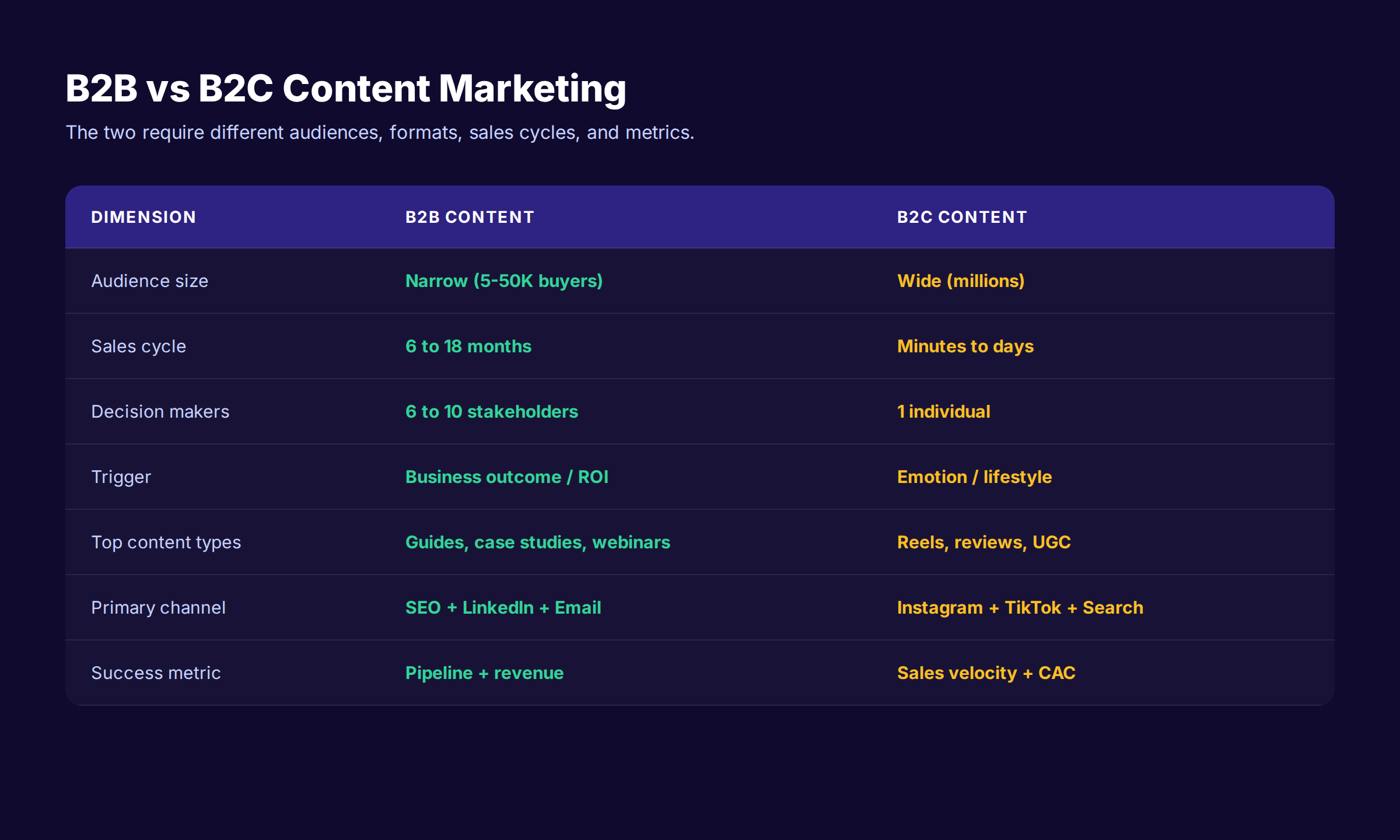
- How B2B content differs from B2C in 7 measurable ways
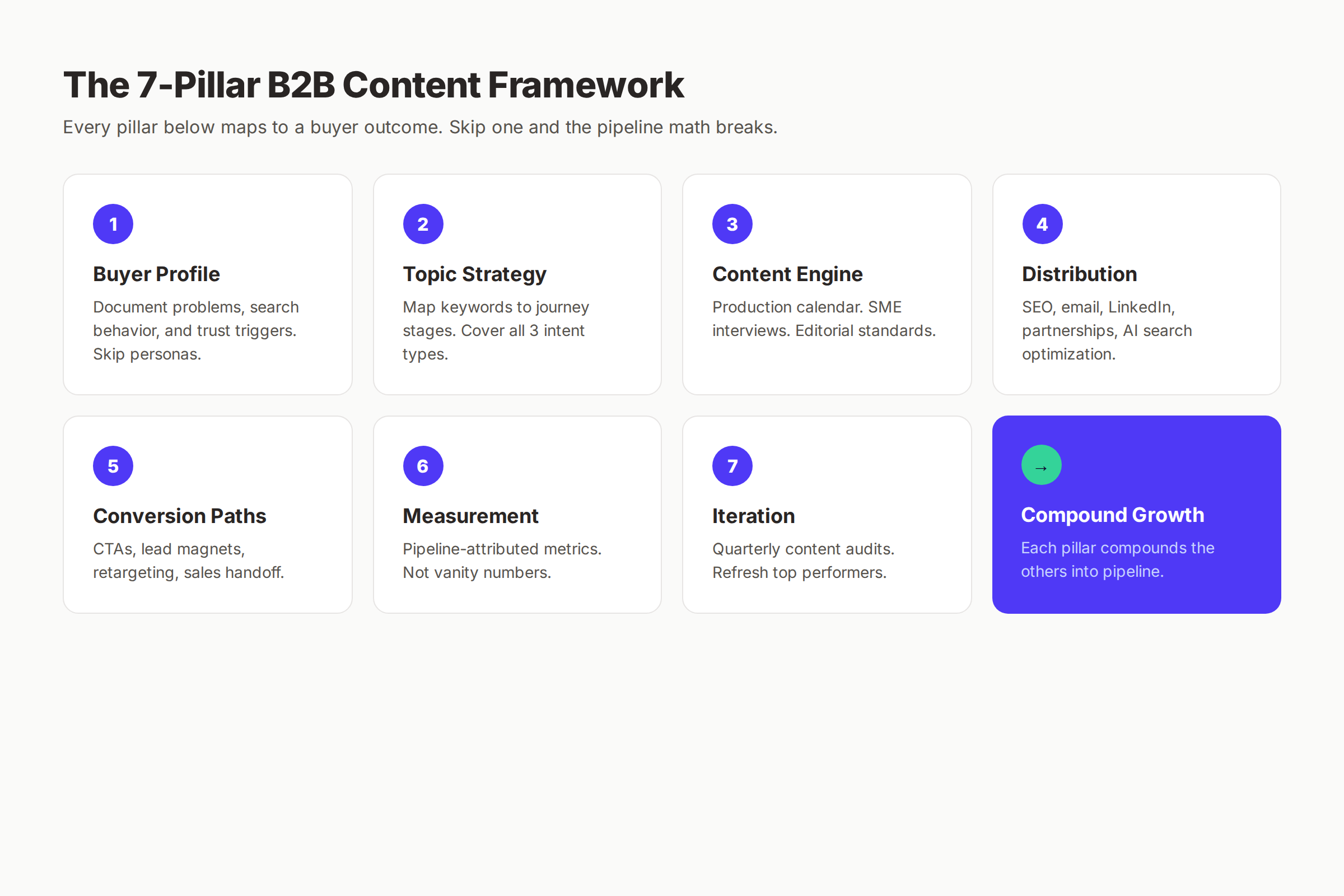
- The 7-pillar framework that compounds traffic into pipeline
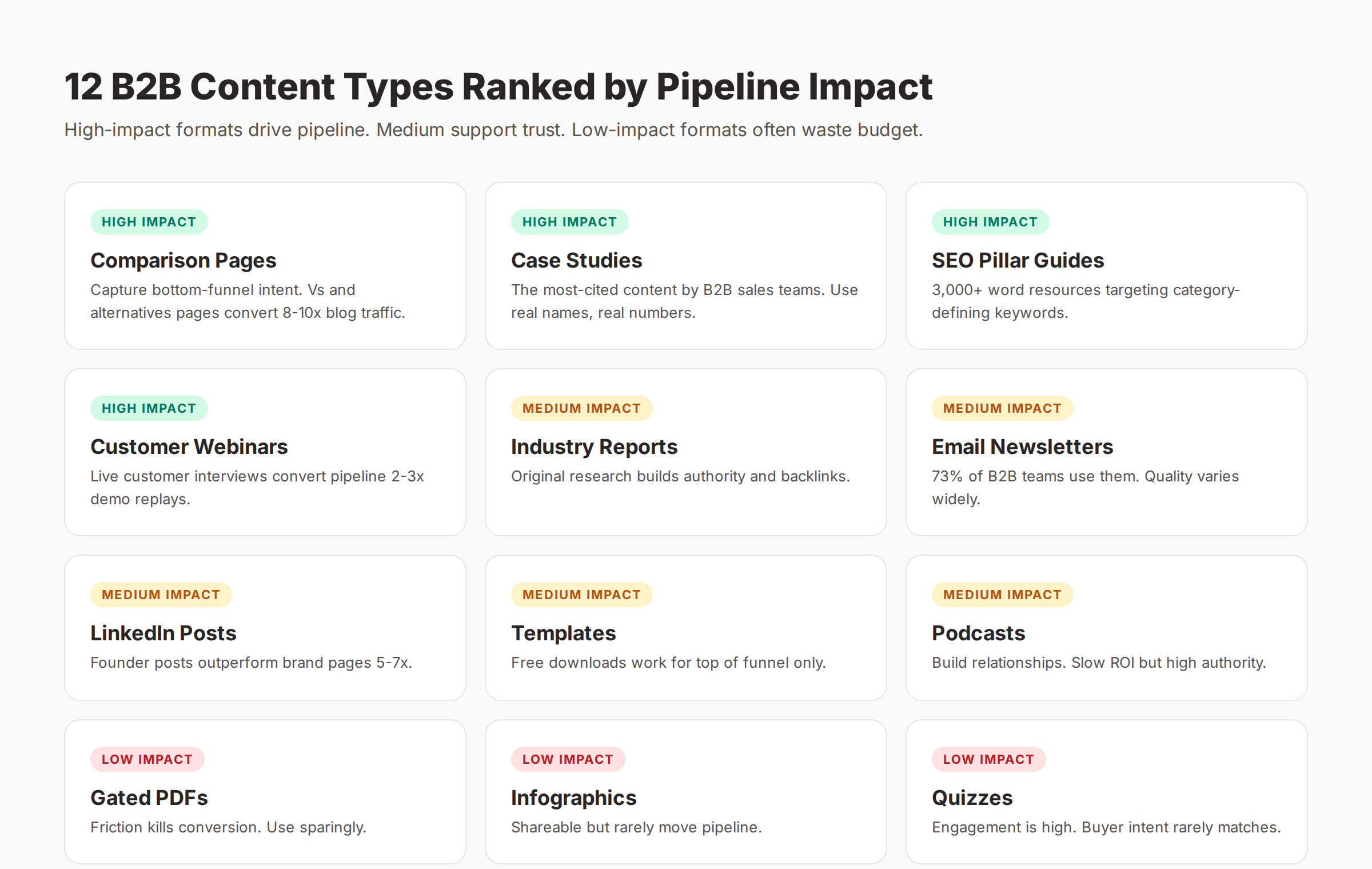
- The 12 content types ranked by pipeline impact
- How to map every asset to a B2B buyer journey stage
- The distribution channels B2B buyers actually use
- How to win in AI search and Google AI Overviews
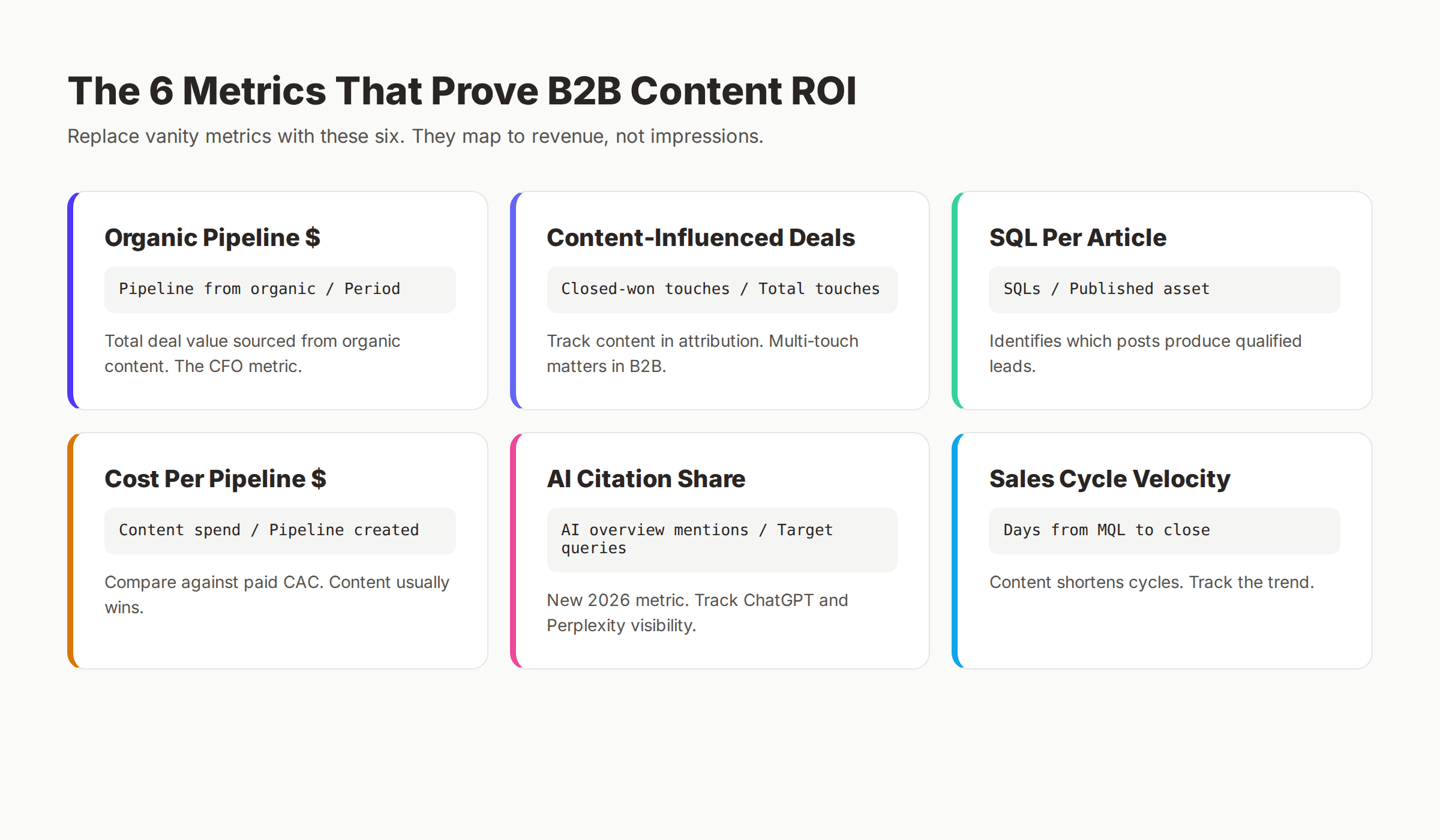
- The 6 ROI metrics that prove content works to the CFO
- The 8 mistakes that quietly kill B2B content programs
What B2B Content Marketing Is in 2026
B2B content marketing is the practice of producing and distributing content that educates business buyers, builds trust across long sales cycles, and turns search and social attention into pipeline.
That definition has 3 important shifts in 2026.
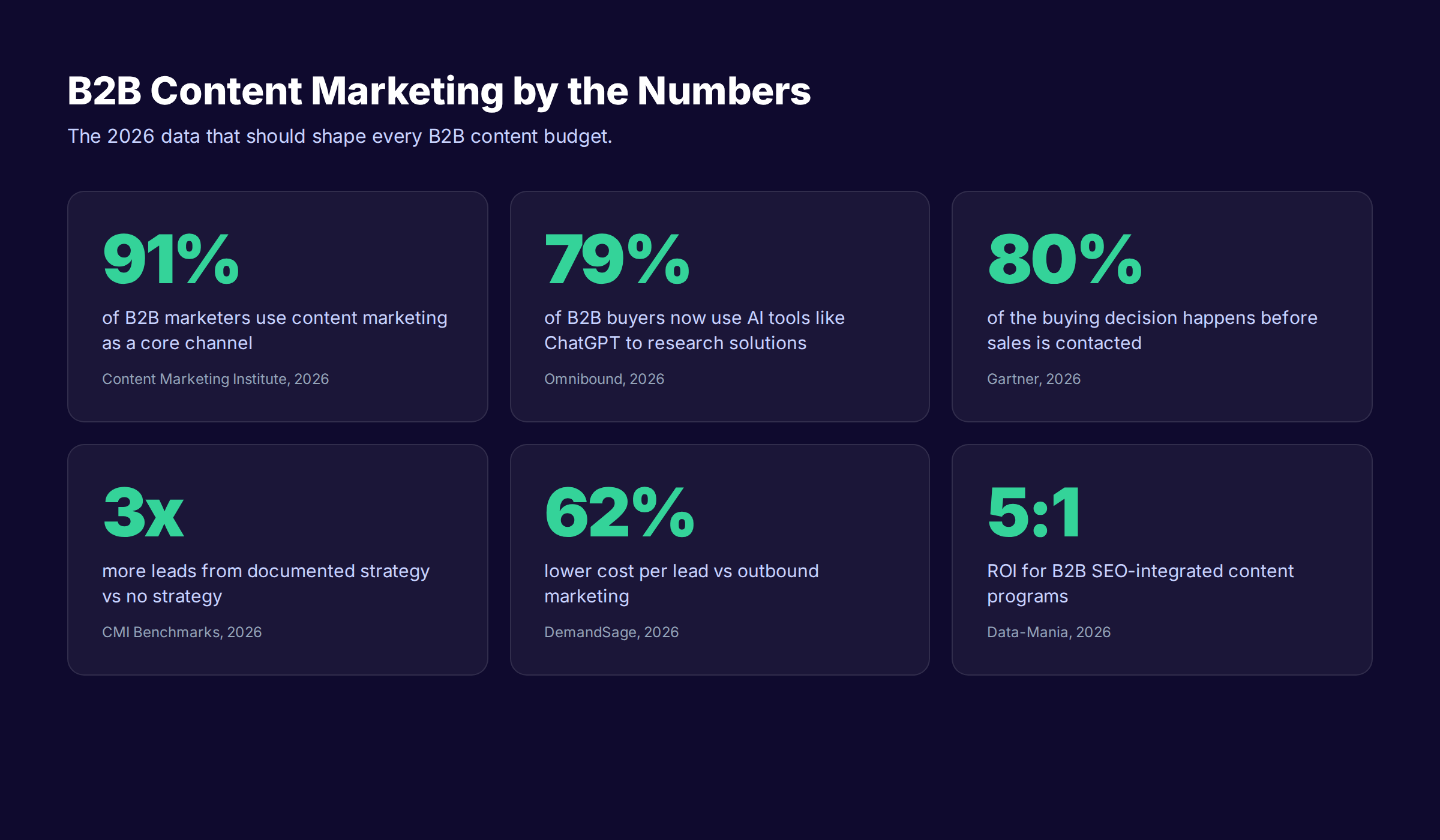
Shift one: Buyers research without humans. 80% of B2B purchase decisions are made before a buyer ever talks to a sales rep, according to Gartner. The content you publish is now your sales motion for the first 60% of the funnel.
Shift two: AI is the new search interface. 79% of global B2B buyers now use AI tools like ChatGPT, Perplexity, and Google AI Overviews to research solutions, according to Omnibound research. If your content is not cited in those answers, you are invisible to a growing share of the market.
Shift three: Pipeline replaces traffic. Marketing teams that track revenue impact, not page views, are 3.1x more likely to receive budget increases, according to the Content Marketing Institute 2026 B2B research. The metrics that matter changed. So did the content that drives them.
The version of B2B content marketing that worked in 2022 was a blog and a gated PDF. The version that works in 2026 is an editorial engine that produces SEO-optimized, AI-citable, sales-aligned content across every buyer stage.
Why B2B Content Marketing Matters More in 2026
The data is unambiguous. B2B content marketing generates 3x more leads per dollar than outbound, and costs 62% less, according to DemandSage. Email marketing returns $36 to $42 for every $1 spent, the highest ROI of any channel. SEO-integrated content programs return 5:1 on average, with top performers hitting 10:1, according to Data-Mania benchmarks.
The flip side is also true. 94% of published content earns zero backlinks. 96.55% of indexed pages get zero organic traffic from Google. The gap between content that pays back and content that wastes budget is enormous. The framework below closes that gap.
B2B vs B2C Content Marketing: The 7 Differences That Matter
B2B and B2C content marketing share the same underlying mechanic. You publish content, attract an audience, and convert that audience into customers. Everything else is different.
1. Audience Size and Targeting
B2C audiences are wide. A consumer brand selling fitness apparel targets millions of potential buyers. B2B audiences are narrow. A SaaS company selling expense management software targets maybe 50,000 finance leaders globally.
Narrow audiences require precision. Generic content fails. Every piece of B2B content has to speak to a specific buyer role at a specific stage of awareness.
2. Sales Cycle Length
B2C buyers convert in minutes to days. They see a TikTok, search the brand, buy the product. B2B buyers take 6 to 18 months on average. They research, evaluate, build a business case, get budget approval, work through procurement, and then sign.
That timeline means B2B content has to nurture across months. One blog post does not close a deal. A library of content, mapped to every concern a buying committee raises, closes deals.
3. Decision Makers
B2C decisions involve 1 buyer, sometimes 2. B2B decisions involve a buying committee of 6 to 10 stakeholders, each with veto power, according to Gartner. CFOs need ROI data. CTOs need security and integration details. End users need ease-of-use proof. Procurement needs vendor stability evidence.
B2B content has to serve all of them. A single white paper aimed at the CMO cannot win the deal if the CTO blocks it.
4. Emotional vs Rational Triggers
B2C content sells aspiration, identity, and emotion. B2B content sells ROI, efficiency, and risk reduction. That does not mean B2B content is dry. The best B2B content uses story and tension. But the underlying purchase trigger is always a business outcome.
5. Content Format Mix
B2C content lives on Reels, TikTok, reviews, and user-generated content. B2B content lives on long-form guides, case studies, webinars, and thought leadership. The formats are not interchangeable. A 90-second TikTok will not close a $250K SaaS deal. A 4,000-word comparison guide will.
6. Primary Distribution Channels
B2C content distributes through paid social and influencer marketing. B2B content distributes through SEO, email, LinkedIn, and partnerships. We covered the distribution playbook in detail in our content distribution strategy guide.
7. Success Metrics
B2C success is sales velocity, CAC, and brand affinity. B2B success is pipeline created, content-influenced revenue, and sales cycle compression. Same word, very different math.
B2B content compounds. B2C content spikes. A great B2B blog post earns traffic, citations, and pipeline for years. We help you build that asset library at $99/month.
The 7-Pillar B2B Content Framework
Every successful B2B content program we have built rests on the same 7 pillars. Remove any one and the math breaks. Here is what each pillar does and how to execute it.
Pillar 1: Buyer Profile Definition
Stop building personas. Build buyer profiles. The difference matters.
A persona documents demographics. A buyer profile documents the specific information a buying committee needs to make a decision. Skip the "Marketing Mary, age 35, drinks oat milk lattes" template. Document this instead:
| Profile Element | What to Document |
|---|---|
| Primary problem | The specific business outcome at stake |
| Search behavior | Exact phrases they type into Google and ChatGPT |
| Knowledge level | Beginner, intermediate, or expert in the category |
| Trust triggers | Data, named experts, case studies, peer reviews |
| Veto risks | What would kill the deal in their organization |
| Buying stage | Problem aware, solution aware, vendor aware, decision |
Without that document, every content brief is a guess. With it, every brief becomes a targeted asset.
Pillar 2: Topic Strategy Built on Search Data
Most B2B content fails because the topic was wrong. The team picked a subject that felt interesting, not one buyers actually search for. A real topic strategy works backward from search demand.
Use a tool like Ahrefs, Semrush, or our keyword research output to identify:
- ✓ Top-of-funnel keywords with monthly volume > 500 and difficulty < 30
- ✓ Comparison keywords for every competitor in your category
- ✓ Alternatives keywords for category leaders
- ✓ "How to" keywords aligned with your product capabilities
- ✓ Statistics keywords for link bait and citation potential
- ✓ Industry-specific long-tail variations
For step-by-step keyword selection logic, see our content marketing strategy guide.
Pillar 3: Content Engine
Production is where most B2B content programs collapse. Strategy is easy. Shipping 8 to 30 quality assets a month is hard. The engine needs:
- A documented editorial standard (every post hits the same bar)
- A topic backlog with at least 60 days of runway
- SME interview process for technical accuracy
- Editing checks for brand voice and SEO
- Asset templates for case studies, comparisons, and pillar guides
- A publishing rhythm that does not slip
We documented our approach in how to scale blog content with AI and our internal workflow in content operating system.
Pillar 4: Distribution
Publishing is half the job. Distribution is the other half. The mix that works for B2B in 2026:
- SEO for compounding evergreen traffic
- Email for nurture and reactivation
- LinkedIn for founder-led and employee-led reach
- AI search optimization to get cited in ChatGPT and AI Overviews
- Partnerships for category expansion
- Sales enablement so reps actually use the content
Pillar 5: Conversion Paths
Traffic is meaningless if it does not convert. Every B2B asset needs a path to action. The conversion options:
- A free tool or calculator (highest intent)
- A demo or trial signup (qualified intent)
- A newsletter signup (top-of-funnel capture)
- A specific case study or template (mid-funnel nurture)
- A consultation booking (sales-ready)
Pick the right path for the stage of the asset. A problem-aware blog post should not push a demo. A decision-stage comparison page absolutely should.
Pillar 6: Measurement
If you cannot measure it, the CFO will cut it. We cover the 6 B2B content metrics that matter in detail later in this guide. Start there.
Pillar 7: Iteration
Content is not a one-time publish. The top 20% of posts deserve quarterly refreshes. The bottom 30% should be consolidated, redirected, or pruned. Run a content audit every 90 days using our content gap analysis and content audit template frameworks.
The 12 B2B Content Types Ranked by Pipeline Impact
Not all content types are equal. Some drive pipeline. Some build authority. Some waste budget. Here is how we rank the 12 most common B2B content formats by their pipeline impact.
High-Impact Formats
1. Comparison Pages ("X vs Y") These capture the highest intent traffic in B2B search. A buyer typing "Salesforce vs HubSpot" is in active evaluation mode. Conversion rates on comparison pages are typically 8 to 10x your average blog post. Build one for every competitor in your category.
2. Alternatives Pages ("Best Alternatives to X") Similar high-intent traffic. Buyers searching for alternatives are usually unhappy with an incumbent and actively shopping. These pages can hit 5x conversion rates of generic blog traffic.
3. SEO Pillar Guides (3,000+ Words) The workhorse of B2B content. A definitive pillar guide for a category-defining keyword can drive 5 to 10 figures of pipeline per year. The post you are reading is one example.
4. Case Studies The most-cited content type by B2B sales teams. Real customer names, real numbers, real outcomes. Sales reps drop case studies into deals at every stage. Aim for at least 1 new case study per month.
5. Customer Webinars A live customer interview converts pipeline at 2 to 3x the rate of a recorded demo. The trust transfer from peer to prospect is enormous. Run one per quarter at minimum.
Medium-Impact Formats
6. Industry Reports Original research generates backlinks, citations, and authority. The ROI is slow but durable. The Content Marketing Institute B2B Benchmarks report has been cited millions of times since launch.
7. Email Newsletters 73% of B2B teams send them. Quality varies wildly. A great newsletter compounds reader trust over years. A bad newsletter is delete bait. Decide which you are building.
8. LinkedIn Posts (Founder-Led) Founder posts outperform brand page posts 5 to 7x in reach. Build a personal content engine for the CEO, CMO, or category-defining executive. We covered this in LinkedIn content strategy.
9. Templates and Frameworks Free downloadable templates work as top-of-funnel lead magnets. Conversion to qualified opportunity is low, but volume is high.
10. Podcasts Slow ROI. High authority. Best for category creation and executive thought leadership, not direct lead capture.
Low-Impact Formats
11. Gated PDFs The classic gated white paper used to work in 2015. In 2026, friction kills conversion. Most B2B buyers will not exchange an email for content they suspect is generic. Ungate by default.
12. Quizzes and Interactive Tools (Generic) Engagement is high. Buyer intent rarely matches. Useful for brand awareness, not pipeline.
3,500+ blogs. 70+ industries. Average SEO score: 92%. We build the high-impact assets above on autopilot for $99/month.
Mapping B2B Content to the Buyer Journey
Every B2B buyer moves through 4 stages on the path from problem to purchase. Each stage needs different content. Most B2B teams over-invest in one stage and starve the others.

Stage 1: Problem Aware (~40% of Search Volume)
The buyer knows they have a pain. They do not yet know there is a solution category. They search informational queries.
Example queries:
- "Why is my SEO traffic dropping"
- "How to track marketing ROI"
- "Why are deals stalling in late stage"
Content to produce:
- Educational blog posts
- Diagnostic checklists
- Industry trend reports
- Podcast episodes
- LinkedIn thought pieces
Goal: capture the email, start the relationship, plant the seed.
Stage 2: Solution Aware (~25% of Search Volume)
The buyer knows there is a solution category. They are researching how it works. They search informational and educational queries.
Example queries:
- "What is account-based marketing"
- "How content marketing works for SaaS"
- "Benefits of marketing automation"
Content to produce:
- Long-form guides (like this one)
- Framework explainers
- Webinars and masterclasses
- Buyer's guides
- ROI calculators
Goal: become the trusted teacher. Buyers who learn from you tend to buy from you.
Stage 3: Vendor Aware (~20% of Search Volume)
The buyer knows what category they want. They are now evaluating vendors. They search commercial queries.
Example queries:
- "Best B2B content marketing agencies"
- "HubSpot vs Marketo"
- "Alternatives to Salesforce"
Content to produce:
- Comparison pages
- Alternatives pages
- Best-of category lists
- Analyst report mentions
- Demo videos and product tours
Goal: get on the shortlist.
Stage 4: Decision (~15% of Search Volume)
The buyer is ready to act. They are validating their choice. They search branded and high-intent queries.
Example queries:
- "theStacc pricing"
- "theStacc case studies"
- "theStacc implementation timeline"
Content to produce:
- Case studies with specific outcomes
- Customer testimonials and video reviews
- ROI calculators with personalized outputs
- Implementation guides
- Security and compliance pages
- Pricing transparency content
Goal: close the deal.
Most B2B teams publish 80% of content at stage 1 and starve stages 3 and 4. That is why their content drives traffic but not revenue. For a deeper map, see our content marketing funnel guide.
B2B Content Distribution Channels That Actually Work in 2026
Publishing is not distribution. Hitting "publish" on a blog post and hoping Google ranks it is not a distribution strategy. The B2B distribution channels that actually move pipeline in 2026:
Search (SEO)
SEO is the highest-return B2B distribution channel. A pillar guide that ranks for a 1,000-search-per-month keyword can drive 200+ qualified visitors a month for years. SEO content also compounds. Old posts keep producing traffic long after publication, unlike paid ads that stop the moment budget pauses.
Priority actions:
- ✓ Target a mix of informational, commercial, and transactional keywords
- ✓ Build topical clusters around your category
- ✓ Optimize for featured snippets and AI Overviews
- ✓ Refresh top performers every 6 months
We covered the SEO playbook in SEO content writing and SEO for SaaS companies.
LinkedIn is the only social network with reliable B2B reach in 2026. The catch is that brand pages get almost no organic reach. Founder profiles and employee profiles do.
Distribution rules:
- Post from individual profiles, not the company page
- Encourage employee advocacy with content templates
- Repurpose long-form blog posts into LinkedIn carousels and text posts
- Engage in target buyer comment threads daily
Email Newsletters
Email returns the highest ROI of any B2B channel at $36 to $42 per $1 spent. A newsletter with 5,000 engaged subscribers can generate more pipeline than 5 paid campaigns.
The bar is high. Buyers unsubscribe from generic broadcasts in seconds. Write the newsletter you would actually want to read.
For tactical ideas, see our email newsletter ideas guide.
AI Search and AI Overviews
This channel did not exist 2 years ago. It is now critical. 79% of B2B buyers use AI tools to research solutions. If ChatGPT does not mention you, you do not exist for that buyer.
We cover the full playbook in the next section.
Sales Enablement
Distribution is not just external. Sales reps need access to the right content at the right deal stage. A great case study only matters if a rep can find it and send it within 30 seconds of a prospect raising a relevant question.
Build a content library inside your CRM. Tag every asset by stage, persona, and use case. Train sales on what to send when.
Partnerships and Guest Distribution
Distribute through audiences you do not own. Guest posts, podcast appearances, joint webinars, and industry community sponsorships all build authority faster than organic alone.
Optimizing B2B Content for AI Search
AI search is the most important new channel in B2B content marketing. ChatGPT, Perplexity, Google AI Overviews, and Claude now mediate a growing share of buyer research. The optimization rules differ from traditional SEO.
Why AI Search Matters for B2B
79% of B2B buyers use AI tools in their research, according to Omnibound. AI search visitors convert at 4 to 5x the rate of traditional organic, according to recent benchmarks. The traffic is smaller in volume but enormously higher in quality.
Buyers who use AI search are doing structured evaluation. They ask comparative questions like "What is the best content marketing software for a 100-person SaaS team." The AI cites 3 to 5 sources in its answer. If you are not one of them, you lose the consideration window entirely.
What AI Models Actually Cite
We analyzed AI citation patterns across major B2B queries. AI models consistently favor:
- Content with clear definitions in the opening 100 words
- Sources with named experts and direct quotes
- Pages that answer the exact question in a single paragraph
- Statistics with explicit sources and dates
- Lists, tables, and structured formats
- Recent content (last 18 months)
- Original research and proprietary data
How to Optimize for AI Citation
| Tactic | Why It Works |
|---|---|
| Open every section with a direct definition | AI models pull the first definition they find |
| Use Q&A formatted blocks | Maps directly to user questions |
| Cite primary sources with hyperlinks | Authority transfer |
| Include statistics with year and source | Trust signal for fact-checking models |
| Add original frameworks with named steps | Distinctive, citable content |
| Update old content every 6 months | Recency boost |
For the full optimization framework, see our guides on how to optimize for Google AI Overviews, get cited in AI search, and track AI search visibility.
The 6 ROI Metrics That Prove B2B Content Marketing Works
If you cannot prove ROI, the CFO will cut the budget. Most content programs report on the wrong metrics. Pageviews, bounce rate, and social shares do not translate to revenue. Replace those with the 6 metrics below.
B2B Content Marketing Statistics That Matter
Metric 1: Organic Pipeline Dollars
The CFO metric. Total dollar value of pipeline sourced from organic content in a given period. This single number ends most "is content working" debates.
Formula: Total pipeline value from organic sessions / Reporting period
Track in your CRM with UTM parameters and original-source attribution.
Metric 2: Content-Influenced Deals
Multi-touch attribution matters in B2B. A deal that closes after 14 touches almost certainly involved content the rep cannot remember sharing. Track every content interaction as an "influence touch" and report the percentage of closed-won deals that included at least one content touch.
Formula: Deals with content touches / Total closed-won deals
A healthy B2B program shows 70%+ content influence on closed-won.
Metric 3: SQLs Per Published Asset
Some posts produce SQLs. Most do not. Track which posts actually drive qualified leads so you can double down on the format and topic.
Formula: SQLs attributed to a post / Total SQLs across all content
Top 5% of posts typically produce 50% of SQLs. Find them. Make more like them.
Metric 4: Cost Per Pipeline Dollar
Compare against paid CAC. Content almost always wins on this metric.
Formula: Total content program spend / Total pipeline created
A well-run program returns $5 to $10 of pipeline per $1 spent.
Metric 5: AI Citation Share
New for 2026. Track how often your brand appears in AI-generated answers across your target queries. Tools like Profound, Otterly, and HubSpot AI Search Grader now measure this.
Formula: AI answer mentions / Total tracked queries
A baseline target is 20% citation share across your top 100 commercial queries.
Metric 6: Sales Cycle Velocity
Content shortens sales cycles. A buyer who arrives already educated by your content closes faster. Track the average days from MQL to closed-won and watch the trend over quarters.
Formula: Days from MQL to closed-won / Number of deals
Expect a 15 to 30% cycle compression after 12 months of strong content investment.
For deeper measurement guidance, see how to measure content marketing ROI and content marketing metrics.
8 B2B Content Marketing Mistakes That Quietly Kill Programs
Most B2B content programs fail in predictable ways. Here are the 8 mistakes we see most often and the fixes that work.
Mistake 1: Writing for Algorithms Instead of Buyers
Some teams chase keywords with no buyer intent behind them. They rank for terms that do not convert. Fix: every keyword target must trace back to a specific buyer profile and stage.
Mistake 2: Over-Investing in Top-of-Funnel Content
Most B2B blogs are 80% problem-aware content and 20% everything else. The mid and bottom of funnel starve. Fix: rebalance to 40% problem-aware, 30% solution-aware, 20% vendor-aware, 10% decision-stage.
Mistake 3: Gating Everything
Gating made sense when email lists were rare. In 2026, buyers expect free content. Gating reduces reach by 80% on average and adds friction to the trust-building process. Fix: ungate everything except true research reports.
Mistake 4: No Sales Alignment
Content sits on the blog. Sales never uses it. The asset library never makes it into deals. Fix: build a tagged content library inside your CRM and train sales on what to send when.
Mistake 5: One Author for Everything
Every post sounds identical. There is no signal of expertise. Fix: route content through subject matter experts. Quote real people. Build named authors with credibility.
Mistake 6: Publishing and Forgetting
Posts go live and never get updated. Rankings decay. Citations dry up. Fix: schedule quarterly refreshes for top performers and prune the bottom 30%.
Mistake 7: Measuring the Wrong Things
Pageviews and time on page dominate the dashboard. Pipeline does not. Fix: replace vanity metrics with the 6 listed above.
Mistake 8: Outsourcing to Generalist Agencies
Generic content from generic agencies produces generic results. The B2B content that wins is opinionated, deeply researched, and aligned to a specific category. Fix: work with operators who actually understand your market.
We covered the in-house vs outsource decision in in-house vs outsource content team.
Real B2B Content Marketing Examples
The frameworks above work. Here are 4 quick examples of B2B brands executing them well.
Example 1: HubSpot — Topical Authority at Scale
HubSpot has built the largest B2B content library in marketing. The strategy: dominate a category by publishing the definitive resource on every adjacent topic. Their inbound certification, blog, and tool library form a moat that costs competitors millions to replicate.
Lesson: depth beats breadth. Own a category by being the definitive resource.
Example 2: Stripe — Documentation as Content
Stripe treats documentation as a marketing asset. Their developer docs are so well-written that developers share them in Slack channels. That distribution turns docs into a top-of-funnel demand generator.
Lesson: the best B2B content is sometimes the product itself, well-explained.
Example 3: Ahrefs — Education as Acquisition
Ahrefs built a $100M+ ARR business almost entirely on content. Their YouTube channel, blog, and Ahrefs Academy teach SEO at a level most agencies cannot match. The result: when an SEO professional needs a tool, Ahrefs is the default choice.
Lesson: teach what you sell. Trust transfers to purchase.
Example 4: Gong — Original Research as Authority
Gong publishes original research from anonymized customer conversation data. Their "Sales Stat of the Week" series has been cited thousands of times across sales blogs. The research positions Gong as the authority on sales effectiveness.
Lesson: proprietary data is the most defensible B2B content asset.
For more examples, see content marketing examples.
You do not need an in-house content team to publish at this level. We are your SEO team. $99/month. 30 articles. Zero meetings.
How to Start a B2B Content Marketing Program in 90 Days
A 90-day startup plan that produces measurable results:
Days 1 to 30: Foundation
- ✓ Document 2 to 3 buyer profiles
- ✓ Audit existing content and tag by stage
- ✓ Build a 30-keyword target list across all 4 stages
- ✓ Set up tracking for pipeline, content touches, and AI citations
- ✓ Define publishing rhythm and accountability
Days 31 to 60: Production
- ✓ Publish 8 to 12 new SEO-optimized posts
- ✓ Refresh 3 top-performing legacy posts
- ✓ Launch 1 case study or original research piece
- ✓ Begin distributing on LinkedIn and email
- ✓ Set up AI search monitoring
Days 61 to 90: Optimization
- ✓ Review which posts drove SQLs
- ✓ Double down on winning formats
- ✓ Add internal links across the content library
- ✓ Brief 1 piece of original research for Q2
- ✓ Report pipeline impact to leadership
Programs that follow this rhythm typically show measurable pipeline contribution by month 6 and break even on cost by month 9.
For a deeper checklist, see start a blog for organic traffic.
What practitioners are saying on X
AI search advice ages quickly. Here is high-signal public discussion from SEO and growth operators — context for your roadmap, not a substitute for primary data.
- @varunram (Jul 2026): Critique of GEO slopfarm products that combine SEO clickbait with unresearched content marketing — quality and research still separate winners from farms. See the post on X.
- @jakezward (Feb 2026): 2026 SEO predictions emphasize AI Overview share-of-SERP, schema for LLM token efficiency, brand mentions in AI answers as a KPI, proprietary data as a moat, and content refresh beating net-new AI slop. See the post on X.
- @HlynurStefDev (Jul 2026): Public case: niche site traffic jumped from ~18 to 4,162 Google visits/month after focused technical/on-page SEO work (GSC screenshots claimed) — reminds that fundamentals still move numbers. See the post on X.
Grok, AI Overviews, and multi-engine visibility
Content topics like “b2b content marketing” get AI citations when process steps, quality bars, and examples are concrete. Operator consensus on X is clear: research-backed pages beat unedited bulk generation — reflect that honestly.
- Google AI Overviews: Use passage-ready answers, tables, and FAQ schema where relevant.
- ChatGPT / Perplexity: Cite named sources next to key claims.
- Grok: Maintain accurate entity facts on-site and in high-signal X posts.
Publish content built for Google and AI citations. theStacc’s Content SEO module ships SEO-scored articles structured for rankings and generative engines — including clearer entity pages models like Grok can quote.
Frequently Asked Questions
B2B content marketing is the practice of producing and distributing content that educates business buyers, builds trust across long sales cycles, and converts search and social attention into pipeline. It differs from B2C in audience size, sales cycle length, decision-maker count, and primary distribution channels.
B2B audiences are narrower, sales cycles are longer (6 to 18 months), decisions involve 6 to 10 stakeholders, and the dominant content formats are long-form guides, case studies, and webinars rather than short-form social video. B2B content distributes primarily through SEO, email, and LinkedIn rather than Instagram and TikTok.
A complete B2B content marketing strategy includes buyer profiles, a topic strategy backed by search data, a production calendar, distribution playbooks for SEO and LinkedIn and email, AI search optimization, conversion paths, and a measurement framework that tracks pipeline impact rather than vanity metrics.
Most successful B2B programs spend between 25% and 40% of total marketing budget on content. Smaller companies can spend $1,000 to $5,000 per month for 4 to 12 articles. Mid-market companies typically spend $10,000 to $30,000 per month. Enterprise programs often exceed $100,000 monthly. theStacc handles full content production starting at $99 per month for 30 articles.
Most B2B content programs show first measurable pipeline contribution at month 4 to 6. The compounding effect of SEO traffic typically becomes obvious at month 9 to 12. Programs that stop before month 6 almost always quit before the curve.
HubSpot (topical authority), Stripe (documentation as marketing), Ahrefs (education as acquisition), and Gong (original research) are widely studied for their content marketing approaches. Each built a category-defining content moat.
Track 6 metrics: organic pipeline dollars, content-influenced deal percentage, SQLs per published asset, cost per pipeline dollar, AI citation share, and sales cycle velocity. Together these metrics translate content effort into the revenue language the CFO uses.
Yes. 79% of B2B buyers now use AI tools like ChatGPT and Perplexity to research solutions. AI search visitors convert at 4 to 5x traditional organic rates. Brands that are not cited in AI answers lose visibility in a growing share of the buyer research process.
The Bottom Line
B2B content marketing in 2026 is no longer optional, and it is no longer the same playbook from 2022. Buyers research with AI. Buying committees grow larger. Sales cycles stay long. Trust is built across 30 to 60 content touches before a single sales call.
The teams that win in 2026 do 4 things consistently. They publish opinionated content tied to specific buyer profiles. They distribute across SEO, email, LinkedIn, and AI search. They measure pipeline, not pageviews. And they iterate every 90 days.
You can build that engine in-house. Or you can let us run it for you. Either way, the work is the same. The only question is who does it.
Your SEO team. $99/month. 30 SEO-optimized articles, published, indexed, and ranking on your domain. No meetings. No briefs.
Related Tools & Resources
Free SEO Tools:
Best Lists:
Sources & references
- [1] Princeton / Georgia Tech et al. — GEO research (arXiv:2311.09735)
- [2] @varunram on X — Critique of GEO slopfarm products that combine SEO clickbait with unresearched content marketing — quality and research
- [3] @jakezward on X — 2026 SEO predictions emphasize AI Overview share-of-SERP, schema for LLM token efficiency, brand mentions in AI answers
- [4] @HlynurStefDev on X — Public case: niche site traffic jumped from ~18 to 4,162 Google visits/month after focused technical/on-page SEO work (G
- [5] Referenced source — www.gartner.com

Researched, written, and published articles that compound organic traffic.
Weekly local SEO teardowns
One practical email a week. Map Pack, GBP, AI Overviews — no fluff. Unsubscribe anytime.