User generated content SEO done right in 2026. How reviews, Q&A, forums, and comments compound into authority Google rewards without spam or thin pages.
User generated content SEO is the most underused growth lever on the open web. Most operators treat reviews, comments, and Q&A as customer-service exhaust. Search engines treat them as signal-rich, intent-aligned, perpetually fresh content. The gap between those two views is where competitors quietly outrank you.
We publish more than 3,500 articles per month across 70+ industries. We have seen UGC sections drive 30 to 60% of total organic traffic for clients in ecommerce, SaaS, and local services. We have also seen unmoderated UGC sections trigger manual actions and tank entire domains in a single core update. The difference is not the content type. It is the system around it.
What you will learn in this guide:
- What user generated content SEO actually means in 2026
- Why Google rewards UGC and which categories rank fastest
- The 6 types of UGC, ranked by SEO impact
- The schema, rel attributes, and crawlability rules that protect you
- The 5-step moderation workflow we use for every client
- Real ranking math, conversion data, and case examples
- The risks, penalties, and recovery playbook if things go wrong
What Is User Generated Content in SEO?
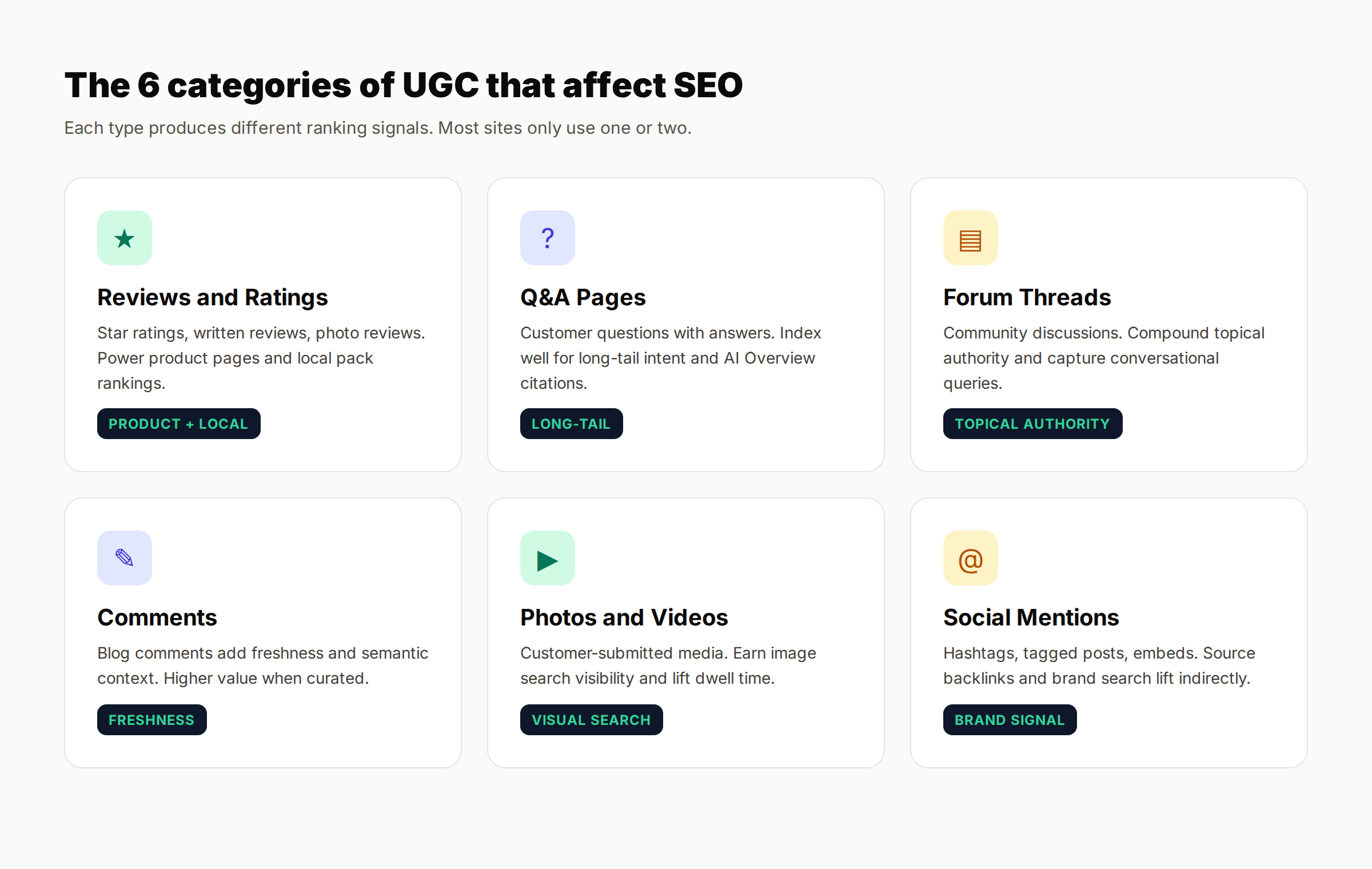
User generated content (UGC) in SEO is any indexable content created by your audience rather than your brand. It includes reviews, ratings, comments, Q&A submissions, forum posts, customer photos, video reviews, social embeds, and community-built pages. Search engines treat UGC as a separate trust signal because it cannot be authored by the brand that benefits from it.
The reason this matters is structural. Brand content lives under your editorial control. UGC lives under your moderation control. Google evaluates both differently, weights them differently in ranking signals, and applies a different set of policy rules to each. Treating them as the same is the single most common UGC mistake we see.
The technical definition Google uses
Google does not publish a formal UGC definition, but the Search Central guidance on user-generated spam names the category and the abuse vector. UGC is described as content "posted by users on a site" that the site operator should "police" to prevent abuse. The same documentation introduces the rel="ugc" link attribute that exists specifically to mark these links.
The practical definition is broader. Anything a non-employee posts on a domain you control is UGC. That includes anonymous comments, paying customer reviews, partner-submitted case studies, and employee-of-customer testimonials. The authorship test is simple: did your editorial team create it, or did someone outside that team contribute it?
Why UGC is treated as a distinct SEO category
Search engines value UGC because it correlates with three things they cannot easily fake: real demand, real usage, and real language. A product page written by a marketer uses category-defining vocabulary. A review written by a customer uses problem-solving vocabulary. The second matches search queries more naturally because both come from the same source: a person trying to solve a problem.
This is why pages with active review sections often outrank pages with longer brand copy for the same target keyword. The UGC adds query coverage the brand team would never write because brand teams write in feature language, not search language.
Why Google Rewards User Generated Content
Google rewards UGC for a simple reason: it solves problems Google has trying to identify quality. Brand content can be optimized into uselessness. UGC cannot be optimized at scale without becoming obviously fake. That makes UGC a stronger trust signal per word than nearly any other content type.
The reward shows up across three ranking surfaces. UGC lifts rankings on the host page where it appears. UGC creates standalone indexable pages (review pages, Q&A pages, forum threads) that rank independently. UGC drives the structured data that produces rich snippets, AI Overview citations, and shopping results.
The 4 ranking signals UGC produces
Every piece of UGC contributes some combination of four signals. Understanding which signal each format produces tells you where to invest first.
| UGC Format | Primary Signal | Secondary Signal | Best Surface |
|---|---|---|---|
| Reviews | Trust + freshness | Long-tail keywords | Product pages |
| Q&A | Long-tail coverage | AI Overview citations | Knowledge pages |
| Comments | Freshness + semantics | Dwell time | Blog posts |
| Forum posts | Topical authority | Internal linking | Community subfolders |
| Photos and videos | Visual search | Dwell time | Product + local |
| Social embeds | Brand signal | Backlink referral | Brand pages |
Reviews and Q&A produce the strongest direct ranking lift. Forum posts produce the strongest compounding effect over 12+ months. Comments produce the strongest freshness signal. Pick the format that matches your existing content base before adding new ones.
The freshness multiplier
Google ranks fresh content higher for queries where recency matters. The challenge for most sites is that creating fresh content costs real money. UGC produces freshness at near-zero marginal cost. A product page with weekly new reviews looks freshly updated to Googlebot every week, even if your team has not touched it in six months.
The Bill Slawski research archive documents how Google scores freshness on a per-paragraph basis. A new review added to a page resets the freshness score for that paragraph and lifts the overall page score. Sites with active review pipelines benefit from this every single week.
The query coverage compounder
A standard product page targets one head keyword and maybe 5 to 10 long-tail variants. The same page with 50 reviews can rank for 200+ long-tail queries because each reviewer writes in their own language. This is not theory. We have audited client sites where Search Console showed UGC paragraphs ranking for queries the brand team had never targeted.
The compounding effect is the reason ecommerce sites with strong review programs often dominate Long-tail SERPs without writing additional content. The reviews do the targeting work that a content team would otherwise have to do manually. Read our deeper analysis in the ecommerce SEO guide for category-level numbers.
The 6 Types of UGC That Drive SEO
Not all UGC is equal. Some formats produce direct, measurable ranking lift within weeks. Others compound over months but require heavier moderation. The right starting point depends on your site type and resourcing.
We rank the six categories below by speed-to-impact for most operators. Pick one. Get it working. Add the next.
1. Reviews and ratings
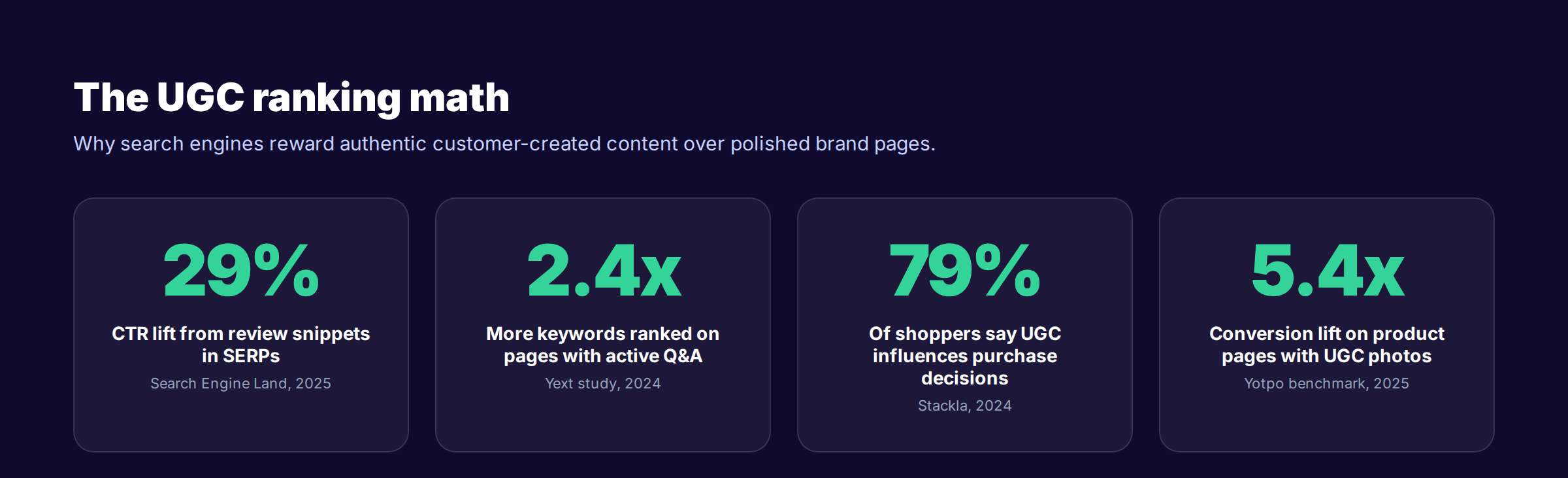
Reviews are the highest-impact UGC format because they map directly to commercial intent queries. A product page with 100 reviews almost always outranks the same product page with zero reviews, even with weaker on-page optimization. The lift is mechanical: more text, more semantic variety, more trust signals, and rich snippet eligibility.
Star ratings unlock Review schema and produce the 1-to-5 star treatment in SERPs. Written reviews unlock long-tail rankings. Photo and video reviews unlock image and video search. The full stack of all three is what separates Amazon and Etsy product pages from typical mid-market store pages.
Implementation rule: review submission must require purchase verification or some friction. Open review forms attract spam. Verified review systems (Yotpo, Trustpilot, Google Reviews via API) protect the trust signal while keeping the SEO benefit. For local businesses, Google Reviews are the foundation and the only review source that affects local pack rankings directly.
2. Q&A and FAQ pages
Q&A is the UGC format most aligned with how Google currently ranks content. Every question is a natural long-tail query. Every answer maps to AI Overview citation criteria. Pages built from real customer questions tend to rank in featured snippets and AI summaries at higher rates than brand-written content.
Amazon's product Q&A and Apple's Support Communities are the model. Both pages produce thousands of indexable URLs per month with no brand-side writing. Both feed into AI Overview citation pools because the answers are specific, scoped, and clearly attributed.
For most sites, a simple "Ask a question" widget on every product or feature page produces enough volume to build a Q&A index within 60 days. Add QAPage schema, internal link from the parent page, and the Q&A pages will rank within 90 days for queries the brand team would never have written.
3. Forum threads and community pages
Forums are the heaviest UGC investment and the highest long-term payoff. A successful forum can produce 60 to 80% of a site's total indexable URLs and rank for tens of thousands of long-tail queries. Reddit's organic traffic is the proof at scale. Stack Overflow is the proof in technical verticals.
The catch is that forums require active moderation, anti-spam infrastructure, and a community management function. Most brands fail at forums because they treat them as a content channel rather than a community function. The ones that succeed treat them as a customer success channel that happens to produce SEO.
If you are not ready to build a full forum, the lighter alternative is a structured comment section on long-form content. We cover both patterns in our content marketing strategy guide.
4. Comments on blog posts
Comments are the easiest UGC format to deploy and the easiest to abuse. A good comment thread adds freshness, semantic depth, and dwell time to evergreen content. A bad comment thread invites link spam, lowers content quality scores, and creates moderation overhead.
The decision rule we use: only enable comments on content that gets enough organic engagement to produce 5+ legitimate comments per month. Anything below that threshold attracts more spam than value. For sites under that bar, gated submission forms or a curated Q&A section work better than open comments.
When comments are working, they compound the freshness signal we discussed above. A post from 2023 with weekly new comments looks like 2026 content to Googlebot. That single signal can keep a top-3 ranking alive for years longer than the underlying content would naturally hold.
5. Photos, videos, and visual UGC
Customer photos and videos are the most underrated UGC category in 2026. Image search, Google Lens, and shopping results all rely on visual UGC as a primary input. Product pages with customer photos consistently outperform stock photo pages in both rankings and conversion.
The mechanics are different from text UGC. Visual UGC needs filename optimization, alt text, structured data (ImageObject), and CDN delivery to rank. Most ecommerce platforms handle the basics automatically when reviews are submitted with photos. Custom platforms need explicit configuration.
For local businesses, customer photos on Google Business Profile are essentially the local version of visual UGC. Our local SEO module covers the GBP photo strategy in depth.
6. Social mentions and embeds
Social UGC is the least direct SEO format but the most useful for brand search and indirect link acquisition. Embedded TikTok videos, Instagram posts, and X (Twitter) threads add visual variety and social proof to landing pages. They rarely move rankings directly but improve dwell time and click-through rates measurably.
The bigger SEO value of social mentions is the link economy they create. A product that goes viral on TikTok generates dozens of natural backlinks from blog posts, news sites, and aggregators. Those backlinks lift rankings. The viral post itself does not, but the link wave it triggers does.
Stop guessing which UGC type to start with. We help SaaS, ecommerce, and local clients build the right UGC SEO stack for their stage. Try theStacc for free and see what we publish in 3 days. Sign up for free →
How Google Treats UGC Differently From Brand Content
Google does not rank UGC by the same rules it ranks brand content. The differences are documented, often ignored, and the reason most UGC programs underperform their potential. Three rules matter.
Rule 1: Link attributes change PageRank flow
Google introduced the rel="ugc" attribute in 2019 as a way to tell crawlers that a link came from user-generated content. The attribute is technically optional but practically required for any site running comments, forum posts, or open Q&A. Missing it puts the host site's link profile at risk because spammy outbound links inherit your domain authority.
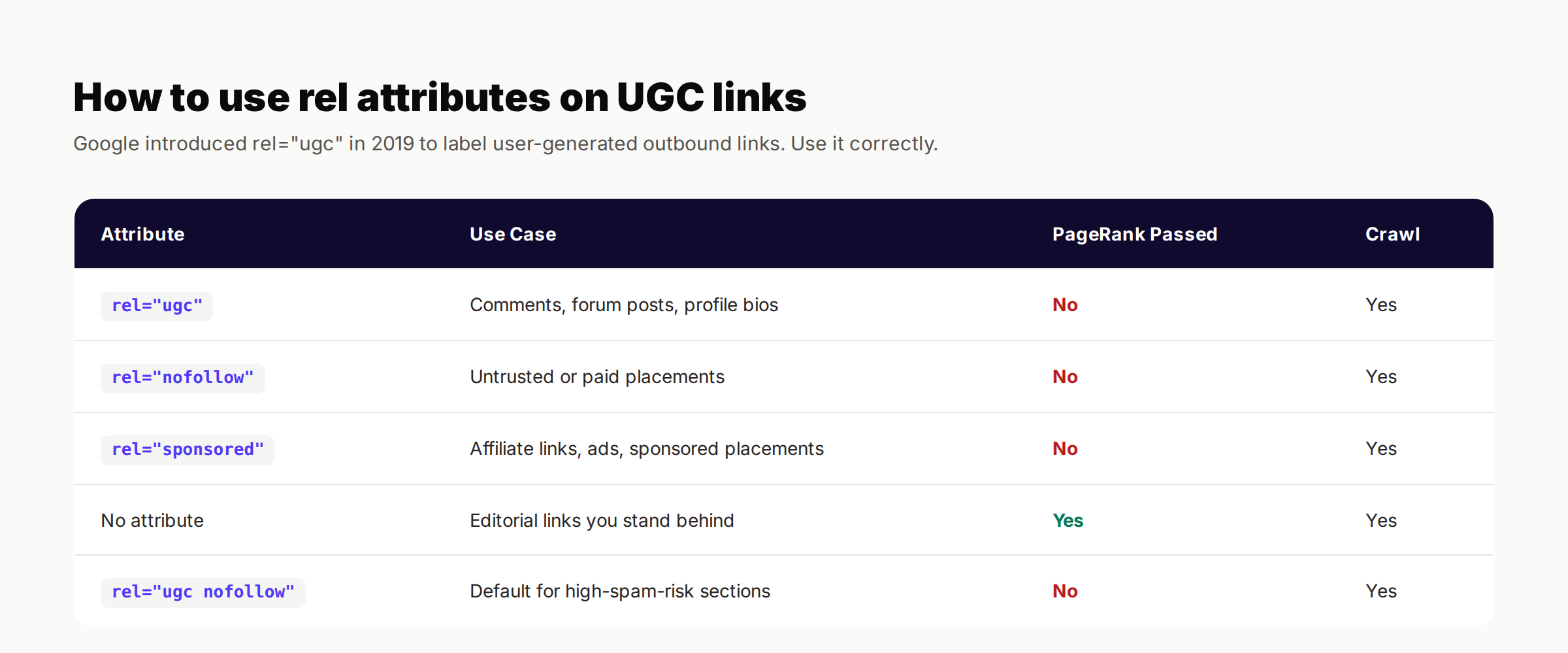
The correct mapping is simple. Use rel="ugc" on any outbound link a user posted. Use rel="ugc nofollow" on sections with high spam risk. Use rel="sponsored" on affiliate or paid placements. Keep no attribute on editorial links your team stands behind. Google treats all three attributes as hints, not directives, but the hints meaningfully shape how PageRank flows.
Rule 2: Schema markup differs by UGC type
Reviews use Review or AggregateRating schema. Q&A pages use QAPage schema. Forum threads use DiscussionForumPosting schema (added in 2024). Each has specific required and recommended properties. Mixing them produces validation errors and disqualifies the page from rich results.
The biggest 2025 change was DiscussionForumPosting. Google added it specifically to surface forum threads in the discussions filter and increase indexation of community content. Sites that added it correctly saw 20 to 40% lifts in indexation rates for forum URLs within 60 days. Sites that ignored it lost ground to Reddit and Quora in the same window.
For full implementation patterns, see our schema markup SEO guide which covers all four UGC-relevant schema types with code examples.
Rule 3: Crawl budget rules apply harder to UGC
UGC pages can multiply faster than any other content type. A single product page can spawn 200 review pages, 50 Q&A pages, and 10 photo gallery pages in 6 months. Without crawl budget controls, Google wastes its crawl quota on near-duplicate UGC and stops crawling your most important pages.
The controls are not optional at scale. Use canonical tags on paginated review pages pointing back to the parent. Use noindex on thin user profile pages. Block low-quality UGC subfolders in robots.txt until they cross a content threshold. Submit a dedicated XML sitemap for UGC pages so Google indexes the high-value subset first.
Sites with 10,000+ UGC URLs need to actively manage the index. Sites with 1,000+ should monitor it weekly in Search Console. Sites under 1,000 can usually rely on platform defaults but should audit indexation monthly.
The Risks of Bad UGC Implementation
UGC is not a free SEO lever. The risks are real, measurable, and have killed major sites within a single update cycle. The good news is that all the failure modes are preventable with the right system.
Risk 1: User-generated spam penalties
The most cited Google policy on UGC is the user-generated spam guideline. Google treats sites that fail to police UGC as complicit in the spam. The penalty is a manual action that can suppress entire subfolders or the whole domain. Recovery requires removing the spam, demonstrating new moderation, and filing a reconsideration request.
The 2024 to 2025 enforcement wave hit sites with open profile pages, unmoderated comment sections, and abandoned forum software. The common pattern was the same: site owners stopped paying attention, spammers exploited the surface, Google noticed. The fix is not "no UGC." The fix is moderation discipline.
Risk 2: Duplicate and thin content at scale
UGC can create thousands of pages that fail Google's quality threshold. A review page with three 5-word reviews is a thin page. A Q&A page with one unanswered question is a thin page. A forum thread with two posts and no engagement is a thin page. At scale, these pages drag down the perceived quality of the entire domain.
The defensive playbook is to set content thresholds. Do not index review pages until they hit 5+ substantive reviews. Do not index Q&A pages without an answer. Do not index forum threads with fewer than 2 posts. Use noindex aggressively early in a UGC program's life and remove it as pages mature.
Risk 3: Off-topic content dilution
Open UGC platforms attract content unrelated to your core topic. A SaaS forum about project management can accumulate threads about everything from career advice to local restaurant recommendations. Off-topic content dilutes topical authority and signals to Google that your site is less authoritative on its core subject.
The fix is structural. Categorize UGC into named subfolders that match your topic taxonomy. Allow only relevant submissions in each subfolder. Tag and noindex anything that does not match the category. This protects topical authority while still allowing community breadth.
Risk 4: Reputation and legal exposure
UGC creates exposure beyond SEO. Defamatory reviews, fake testimonials, and unauthorized content can create FTC, GDPR, and defamation liability. The 2024 FTC ruling on AI-generated reviews made this explicit: hosting fake reviews is now a per-violation fineable offense.
The protection is the same protection that helps your SEO: active moderation, identity verification on submissions, and a clear takedown process. The sites that get fined are the ones that ignore the UGC surface entirely. The sites that moderate well rarely face either SEO or legal exposure.
The 5-Step UGC Moderation Workflow
The single biggest difference between UGC programs that work and ones that fail is the moderation system. Most teams treat moderation as reactive cleanup. Successful programs treat it as a structured pipeline with defined stages.
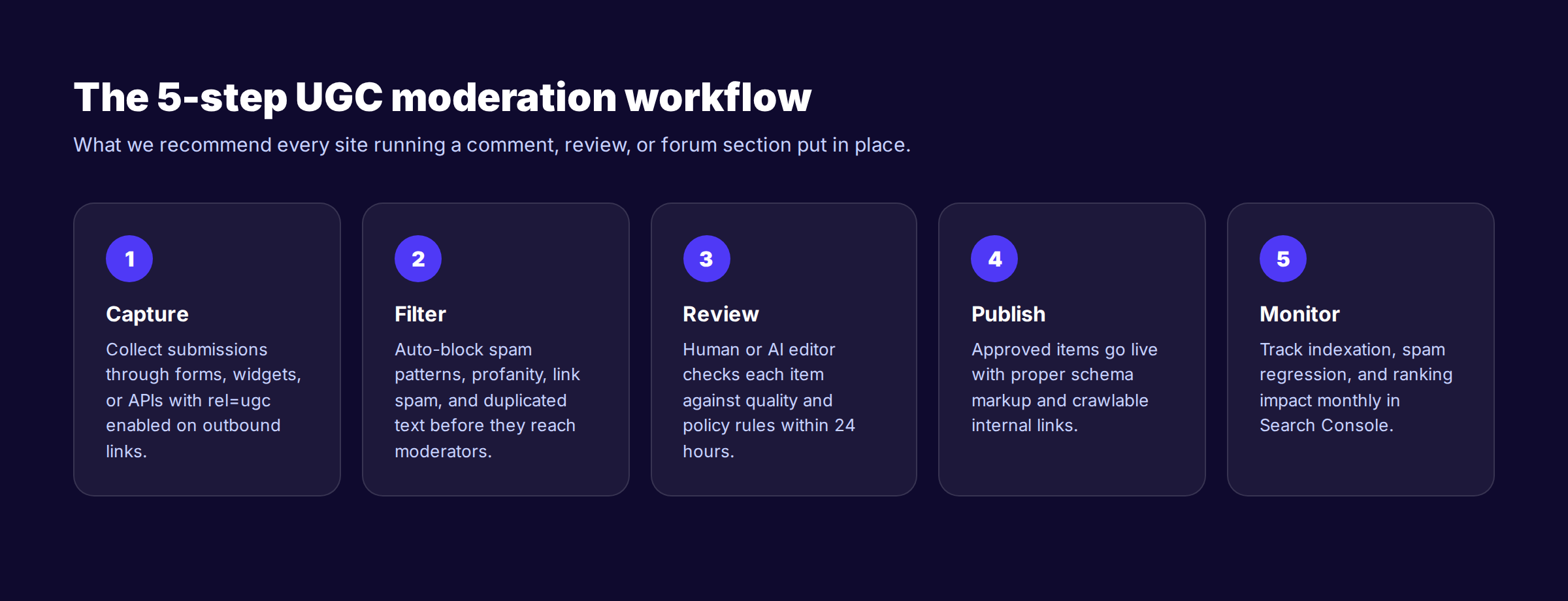
We use this 5-step workflow for every client running comments, reviews, or forums. It works for 10 submissions per day and 10,000 submissions per day. The mechanics change. The stages do not.
Step 1: Capture with friction-appropriate forms
The capture stage sets the spam baseline. Open forms with no friction will be 80%+ spam within 30 days. Even minimal friction (email verification, CAPTCHA, account requirement) cuts spam by 90% without measurably reducing legitimate submissions. The math heavily favors adding friction.
For reviews, require purchase verification through your ecommerce platform's review API. For Q&A, require a verified account. For comments, at minimum require an email address that gets a one-time confirmation. For forums, require account creation with email verification. Anything below these thresholds is asking for problems.
Step 2: Filter with automated rules
Auto-filtering catches the obvious spam before a human ever sees it. The rules are well-known and easy to implement. Block submissions with more than 2 outbound links. Block known spam patterns (cryptocurrency, pharmaceuticals, replica goods). Block submissions in languages that do not match your audience. Block duplicates and near-duplicates within 24 hours.
Modern review platforms (Trustpilot, Yotpo, Bazaarvoice) handle most of this automatically. Custom implementations need an Akismet-style filter or a similar rule engine. AI-based filters (Perspective API, OpenAI moderation) catch toxicity and policy violations that rule-based filters miss.
Step 3: Review submissions within 24 hours
Human review within 24 hours is the second-biggest difference between high-quality and low-quality UGC programs. The 24-hour window is short enough that engaged users see their content go live while they still care. Longer windows reduce repeat submission rates by 30 to 50%.
Review at scale requires either a dedicated moderation team or a reviewer-rotation system. For sites with under 50 submissions per day, one part-time moderator can handle it. Above that, you need a queue tool (e.g., Disqus moderation, Reddit's AutoMod) and shift coverage. Plan capacity before launching, not after the queue backs up.
Step 4: Publish with correct technical setup
Publishing is the stage most teams skip optimization on. Submissions go live with default formatting, no schema, and broken canonical structures. This leaves significant ranking value on the table.
Every published UGC item should carry the right schema (Review, QAPage, DiscussionForumPosting), proper rel="ugc" attributes on outbound links, a clear publication date, and an internal link from the parent page. Most platforms do this automatically. Custom platforms need to be built or configured for it.
Step 5: Monitor in Search Console and analytics
The monitoring stage is what separates programs that improve over time from programs that decay. Track indexation rate, ranking position, and conversion rate from UGC pages monthly. Spam regression is the most common decay pattern: a previously clean section starts attracting spam because filtering rules went stale.
Set up a Search Console filter for UGC subfolders. Track impressions, clicks, and average position weekly. Alert on sudden drops or spikes. The early warning beats the recovery work. We monitor every client's UGC subfolders the same way we monitor their core landing pages.
Your moderation pipeline is the difference between a ranking machine and a manual action. theStacc's editorial team reviews every article before publishing. Same discipline applies to your UGC.
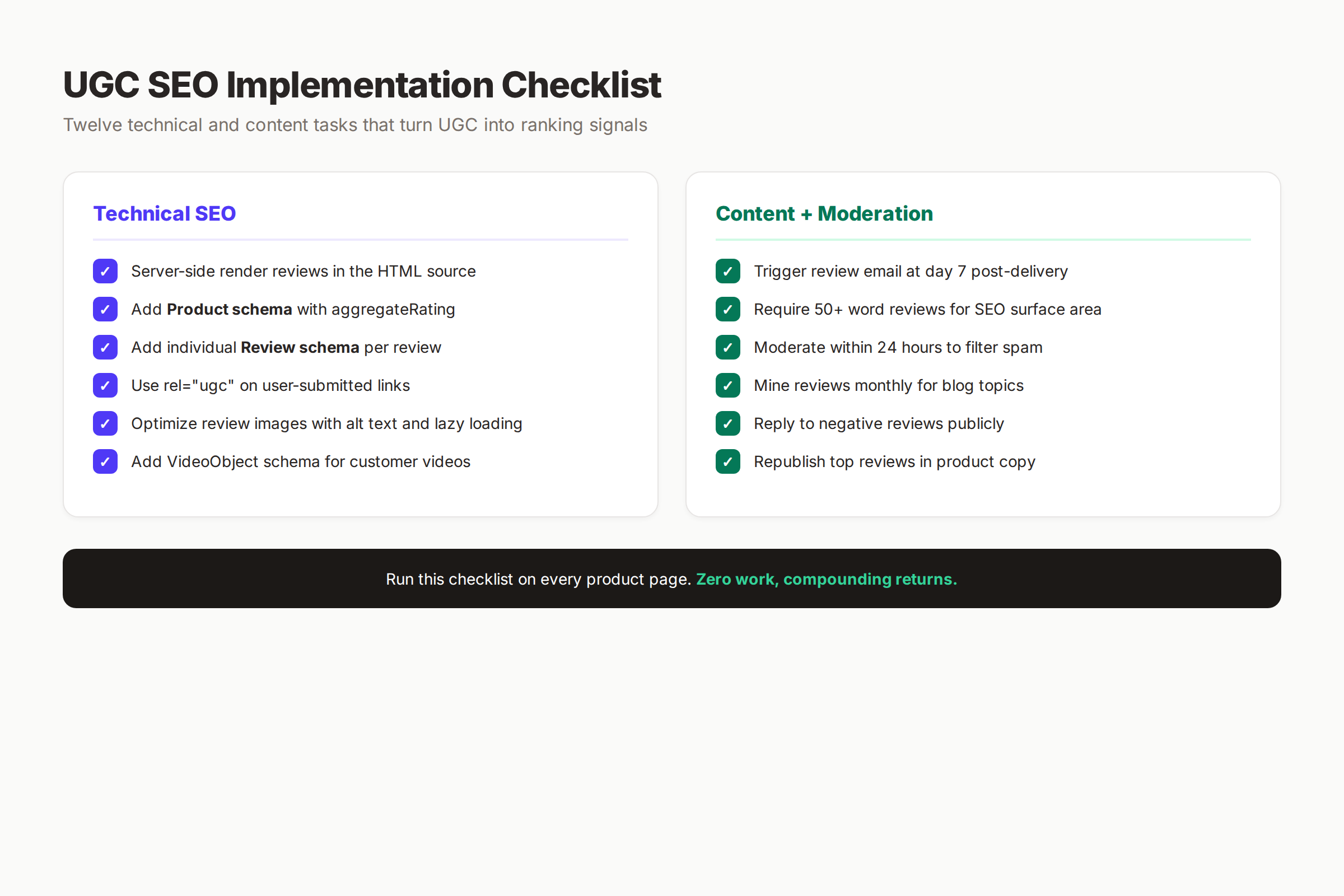
The UGC SEO Implementation Checklist
Before launching any UGC surface, run this 12-point checklist. It separates the technical and editorial work and protects you from the most common implementation failures.
Technical setup checklist
The technical foundations must be in place before any UGC goes live. Retrofitting these onto a live UGC surface is 5x harder than building them correctly from day one.
- ✓ Apply
rel="ugc"to all user-submitted outbound links - ✓ Add the right schema (Review, QAPage, or DiscussionForumPosting) per page type
- ✓ Set canonical tags to prevent paginated duplicate indexing
- ✓ Use noindex on staging routes, thin sections, and incomplete UGC pages
- ✓ Render UGC server-side so Googlebot can crawl it without JavaScript
- ✓ Submit a dedicated XML sitemap for UGC URLs
- ✓ Block low-value UGC subfolders in robots.txt until they cross thresholds
- ✓ Configure CDN delivery for user-submitted images and video
- ✓ Set up monitoring for indexation rate and ranking position
Editorial guardrails checklist
The editorial guardrails are the policies that prevent spam, off-topic dilution, and legal exposure. These need owners, not just documentation.
- ✓ Define minimum content length per submission type
- ✓ Require account verification, CAPTCHA, or purchase proof at submission
- ✓ Build a spam-pattern regex filter and update it monthly
- ✓ Hide profile pages, tag pages, and other thin auto-generated routes
- ✓ Audit indexed UGC pages monthly in Search Console
- ✓ Surface top-quality UGC on category, product, and landing pages
- ✓ Document a takedown process for legal and reputation issues
- ✓ Train moderators on policy edge cases quarterly
How to Measure UGC SEO Performance
Most UGC programs fail at measurement before they fail at strategy. Without clear metrics, no one can tell if the program is working or what to change. The good news is that the metrics are simple. The bad news is that most teams measure the wrong ones.
The 4 metrics that matter
The metrics below are the ones we report monthly to clients running UGC programs. Anything beyond these four is decoration.
| Metric | Where to Track | Healthy Range | Action If Off |
|---|---|---|---|
| UGC indexation rate | Search Console coverage report | 70%+ of submitted | Audit thin content thresholds |
| UGC organic traffic share | GA4 by landing page subfolder | 20-50% of total | Expand or contract program |
| UGC conversion rate | GA4 conversion by landing page | Within 80% of brand content | Investigate UX or moderation quality |
| Spam regression rate | Manual sample audit monthly | Under 5% of submissions | Update filters and review thresholds |
Indexation rate tells you whether Google considers the content high enough quality to keep. Organic traffic share tells you whether the program is contributing to growth. Conversion rate tells you whether the traffic is commercially useful. Spam regression tells you whether moderation is keeping up.
The vanity metrics to ignore
Three metrics get reported in most UGC dashboards and tell you nothing useful. Submission volume is meaningless without a quality cut. Average review rating is a customer success metric, not an SEO metric. Time on page can move up or down for unrelated reasons and rarely correlates with rankings.
Replace these with the four metrics above. Report them monthly. Adjust the program based on what changes. Most programs need 90 days before the metrics stabilize and 6 months before the compounding effects show up clearly.
How to attribute UGC's SEO contribution
Attribution is where most UGC programs get questioned by leadership. The cleanest method is a controlled A/B test: launch UGC on half of comparable pages, measure organic traffic against the control group over 90 days. Most platforms can do this with a feature flag.
For sites that cannot run a clean test, use a before-and-after window with the GA4 Search Console connection to filter only organic traffic. Compare 90 days pre-launch to 90 days post-launch on the affected pages, holding other variables constant. The lift attributable to UGC usually shows up clearly if the program is working.
UGC SEO for Different Site Types
The right UGC strategy depends heavily on site type. Ecommerce, SaaS, local services, and content sites each have different priority formats. Picking the wrong starting format wastes 6 months and produces no measurable lift.
Ecommerce sites
For ecommerce, reviews are the lead investment and Q&A is the secondary investment. Both attach to product pages and lift commercial intent rankings directly. Photo and video reviews are the third investment and the one most ecommerce sites underbuild.
The starting platform is whatever your store engine recommends. Shopify stores typically use Yotpo, Judge.me, or Stamped. Custom stores need a review API integration. Whatever the platform, prioritize verified purchase reviews over open reviews. The trust signal difference shows up in rankings within 60 days. Read our full ecommerce SEO checklist for the broader playbook.
SaaS and B2B sites
For SaaS, the highest-impact UGC is Q&A and community discussions. Both produce long-tail rankings for product-related queries and feature heavily in AI Overview citations. Reviews matter less because most SaaS buyers research on G2, Capterra, and similar third-party platforms.
The right starting point is usually a help-center Q&A section or a public community forum. Both produce indexable content that ranks for "[product] [feature] how to" queries. Pair this with active engagement on third-party review platforms and you cover the full commercial funnel.
Local services
For local businesses, Google Reviews are essentially the only UGC that matters for local pack rankings. On-site reviews matter for organic SEO but do not influence the map pack directly. The local pack uses Google Reviews exclusively as the UGC input.
The strategy is to build a Google Reviews acquisition system on the local profile and a written review or testimonial section on the website for organic SEO. Customer photos uploaded to Google Business Profile produce a third lift on the map pack. Our local SEO module covers all three in operational detail.
Content and media sites
For publishers and content sites, comments are the primary UGC format and forum threads are the secondary. Both add freshness and semantic depth to long-form content. Reviews and Q&A typically do not apply because the content is informational rather than commercial.
The challenge for content sites is moderation cost relative to revenue. A site monetizing through ads cannot afford the same moderation investment as an ecommerce site. The right approach is usually a curated comment section with strong filters and a focused community space for top readers, rather than open comments on every post.
How UGC Interacts With AI Overviews and Generative Search
AI Overviews and generative search results have changed how UGC affects rankings. The 2025 to 2026 wave of AI search features has made UGC more important, not less, because AI models specifically look for the signal types that UGC produces.
Why AI Overviews favor UGC sources
AI Overviews cite sources based on a combination of authority and answer specificity. UGC scores high on both. Reddit, Quora, and Stack Exchange dominate AI Overview citations because their content is specific, attributed, and dated. The same principles apply to first-party UGC on your own domain.
A product page with detailed customer Q&A is more likely to be cited in an AI Overview than the same product page with only brand-written FAQs. The reason is signal authenticity. AI models are tuned to prefer sources that look user-generated because user-generated content is harder to fake at scale.
This effect is documented in research on AI Overview citation patterns. Sites with strong UGC programs are getting cited disproportionately often relative to their backlink profile or domain authority.
Optimizing UGC for AI citation
The optimization rules for AI citation are slightly different from traditional SEO rules. Specificity matters more than length. Date stamps matter more than they did for blue links. Attribution matters more (reviewer name, location, verified status). Schema matters significantly more because AI models use schema as a structured input.
The practical changes are small. Add author markup to reviews and Q&A answers. Include verified purchase or verified account badges in the schema. Ensure date published and date modified are accurate. Avoid placeholder content and stub pages. These changes typically lift AI citation rates by 30 to 60% within 90 days.
The compound effect with brand content
UGC and brand content work best as a system. Brand content establishes the topical framework. UGC fills in the specific answers. AI Overviews tend to cite the brand content for definitions and the UGC for examples. Sites that have both win the AI search game. Sites with only one of the two lose ground over time.
Our AI content strategy guide covers the broader pattern for combining brand and user content into an AI-optimized publishing system.
Real Examples: UGC SEO Done Right
Three sites demonstrate the principles in operation at different scales. The patterns repeat across verticals.
Reddit's organic traffic surge
Reddit has been the biggest UGC SEO winner of the last 24 months. The combination of Google's expansion of forum results, the DiscussionForumPosting schema rollout, and the broader shift toward AI Overview citations has pushed Reddit into the top 5 organic results for tens of thousands of commercial queries.
The mechanics are pure UGC SEO. Reddit publishes no brand content. Every ranking page is a community thread. The site benefits from every signal we covered above: freshness from active discussion, query coverage from natural language, schema from explicit implementation, and AI citation from clearly attributed authoritative voices.
The lesson for everyone else is not "build Reddit." It is that the underlying mechanics work. Read our Reddit SEO strategy breakdown for the specific signals that drove the surge.
Amazon product page review depth
Amazon product pages outrank brand-owned product pages for most queries that include a product name. The reason is not Amazon's domain authority alone. It is the combination of domain authority with review depth, Q&A density, and structured data completeness.
A typical Amazon product page has hundreds of verified reviews, dozens of customer Q&A entries, image galleries from buyers, and rich snippet eligibility on every signal. The same product on a brand-owned store often has 5 to 10 reviews and no Q&A. The ranking gap is not surprising at that point.
The fix for brands is the obvious one: invest in the UGC stack on owned product pages. Closing the gap takes 6 to 12 months but produces meaningful share of voice gains in commercial SERPs.
Stack Overflow and the long tail
Stack Overflow is the canonical example of UGC compounding into topical authority. The site dominates technical search queries because every question is a long-tail query and every answer is structured, attributed, and dated. Google has built the technical content ranking model around the format Stack Overflow popularized.
The lesson for technical and SaaS content sites is to mirror the structure even if not the scale. A question-and-answer format with verified contributors, accepted answers, and clear schema produces ranking lift across nearly any technical topic.
What practitioners are saying on X
AI search advice ages quickly. Here is high-signal public discussion from SEO and growth operators — context for your roadmap, not a substitute for primary data.
- @varunram (Jul 2026): Critique of GEO slopfarm products that combine SEO clickbait with unresearched content marketing — quality and research still separate winners from farms. See the post on X.
- @jakezward (Feb 2026): 2026 SEO predictions emphasize AI Overview share-of-SERP, schema for LLM token efficiency, brand mentions in AI answers as a KPI, proprietary data as a moat, and content refresh beating net-new AI slop. See the post on X.
- @HlynurStefDev (Jul 2026): Public case: niche site traffic jumped from ~18 to 4,162 Google visits/month after focused technical/on-page SEO work (GSC screenshots claimed) — reminds that fundamentals still move numbers. See the post on X.
Grok, AI Overviews, and multi-engine visibility
Content topics like “user generated content seo” get AI citations when process steps, quality bars, and examples are concrete. Operator consensus on X is clear: research-backed pages beat unedited bulk generation — reflect that honestly.
- Google AI Overviews: Use passage-ready answers, tables, and FAQ schema where relevant.
- ChatGPT / Perplexity: Cite named sources next to key claims.
- Grok: Maintain accurate entity facts on-site and in high-signal X posts.
Frequently Asked Questions
User generated content in SEO is any indexable content created by your audience rather than your brand. It includes reviews, ratings, comments, Q&A submissions, forum posts, customer photos, video reviews, and social embeds. Google treats UGC as a distinct trust signal because the content cannot be authored by the brand that benefits from it. Properly implemented UGC can drive 30 to 60% of total organic traffic on commercial sites.
Yes, UGC is one of the highest-impact SEO inputs available. It produces freshness signals, query coverage, trust signals, and schema-eligible rich snippets. The catch is that bad UGC implementation can also trigger penalties through user-generated spam, thin content at scale, or off-topic dilution. The difference between good and bad outcomes is moderation discipline, not UGC volume.
Optimize UGC for SEO by combining four elements. First, apply the right schema (Review, QAPage, DiscussionForumPosting) per page type. Second, use rel="ugc" on user-submitted outbound links. Third, set content thresholds before indexing (5+ reviews per page, answered Q&A only, multi-post forum threads). Fourth, run a moderation pipeline with capture, filter, review, publish, and monitor stages. Sites that do all four consistently see UGC outperform brand content for commercial queries.
Google does not penalize UGC by category. It penalizes UGC that constitutes user-generated spam, thin content, or off-topic dilution. The 2024 to 2025 enforcement wave hit sites with unmoderated comment sections, open profile pages, and abandoned forum software. Sites with active moderation rarely face penalties. The protection is not removing UGC. It is operating it correctly.
UGC is authored by people outside your editorial team (customers, community members, partners). Brand content is authored by your editorial team. Google evaluates them differently, weights them differently in ranking signals, and applies different policy rules to each. The most useful framing is that brand content establishes the topical framework and UGC fills in specific answers, examples, and proof. The two work best as a system.
The reliable methods are post-purchase review requests (for ecommerce), in-product prompts at moments of customer success (for SaaS), automated review requests via SMS or email (for local services), and structured Q&A widgets on every product or feature page. Open submission forms without incentives or prompts produce low volume. Verified, friction-appropriate submission flows produce 5 to 10x more UGC than open flows.
What to Do Next
UGC SEO is a multi-quarter compounding investment, not a one-month tactic. Pick one format that matches your site type. Build the moderation pipeline before turning it on. Monitor indexation, rankings, and conversion weekly for the first 90 days. Expand to the second format only after the first is producing measurable lift.
The mistake we see most often is sites turning on every UGC format at once without the moderation infrastructure to support any of them. Done that way, UGC produces spam, thin content, and eventually a manual action. Done correctly, UGC produces the most durable organic traffic lift available on the open web. The path between those two outcomes is the system, not the strategy.
Related Tools & Resources
Free SEO Tools:
Best Lists:
Sources & references
- [1] Princeton / Georgia Tech et al. — GEO research (arXiv:2311.09735)
- [2] @varunram on X — Critique of GEO slopfarm products that combine SEO clickbait with unresearched content marketing — quality and research
- [3] @jakezward on X — 2026 SEO predictions emphasize AI Overview share-of-SERP, schema for LLM token efficiency, brand mentions in AI answers
- [4] @HlynurStefDev on X — Public case: niche site traffic jumped from ~18 to 4,162 Google visits/month after focused technical/on-page SEO work (G
- [5] Referenced source — developers.google.com

Plan topics, review article drafts, and publish to a connected CMS.
Weekly local SEO teardowns
One practical email a week. Map Pack, GBP, AI Overviews — no fluff. Unsubscribe anytime.
Explore this topic: User-Generated Content (UGC).