A 40-point ecommerce SEO checklist covering product pages, category architecture, faceted navigation, schema, and technical checks before launch.
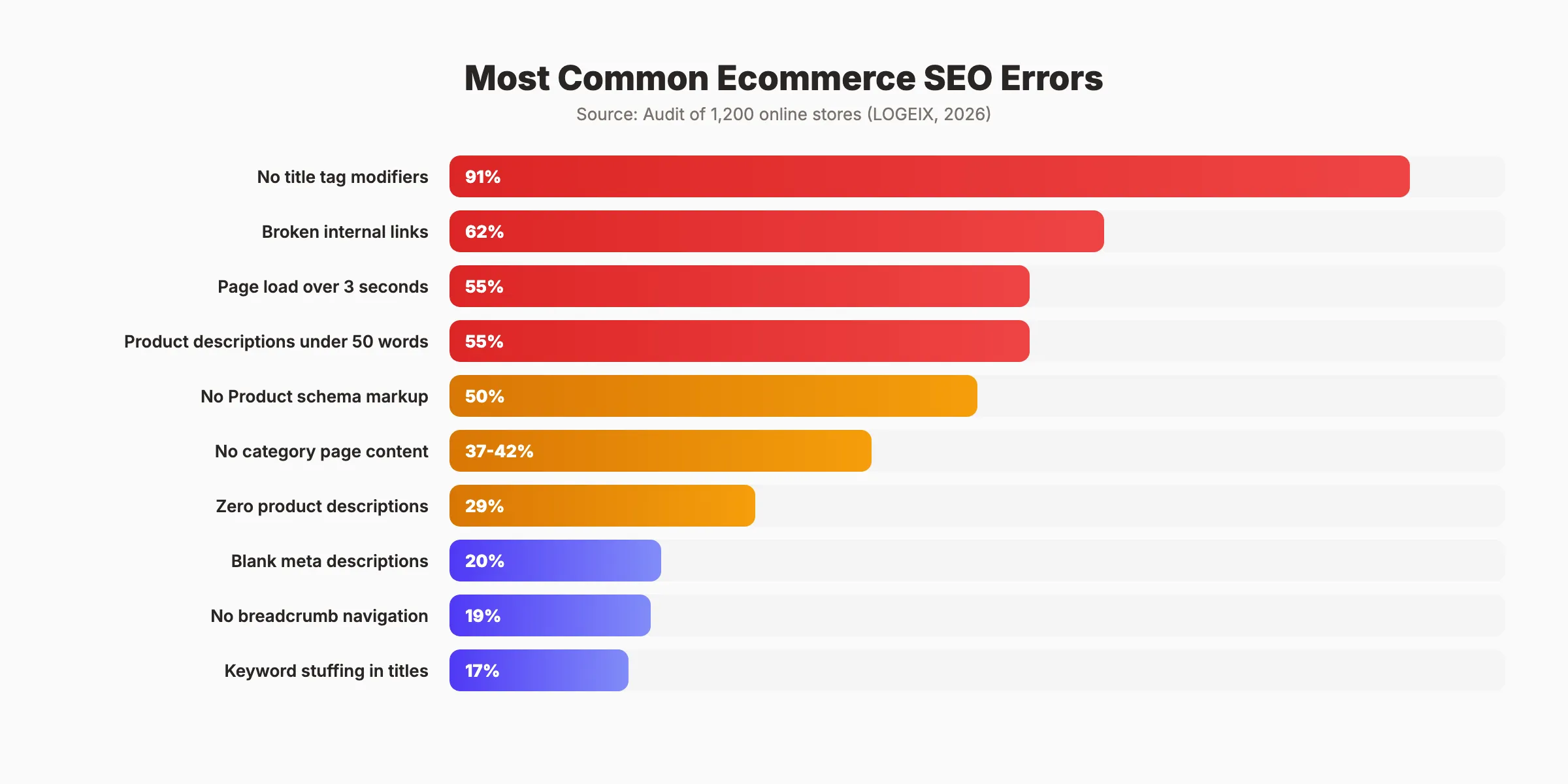
43% of all ecommerce traffic comes from organic search. Yet 50% of online stores lack Product schema markup. 55% have page load times over 3 seconds. And 29% have zero product descriptions at all. These numbers come from an audit of 1,200 ecommerce stores (LOGEIX).
Most ecommerce sites lose organic revenue not because SEO is hard. They lose it because they skip the basics. Missing meta descriptions. Thin product pages. Broken internal links. No structured data. Each gap costs rankings and sales.
This ecommerce SEO checklist covers every optimization that matters. Product pages, category pages, technical infrastructure, schema markup, content strategy, and AI search readiness. Every item is prioritized by impact so you know where to start.
We have published 3,500+ blog posts across 70+ industries, including ecommerce brands on Shopify, WooCommerce, BigCommerce, and custom platforms. The stores that follow a systematic SEO checklist outperform those that optimize ad hoc by 2 to 4 times in organic traffic within 12 months.
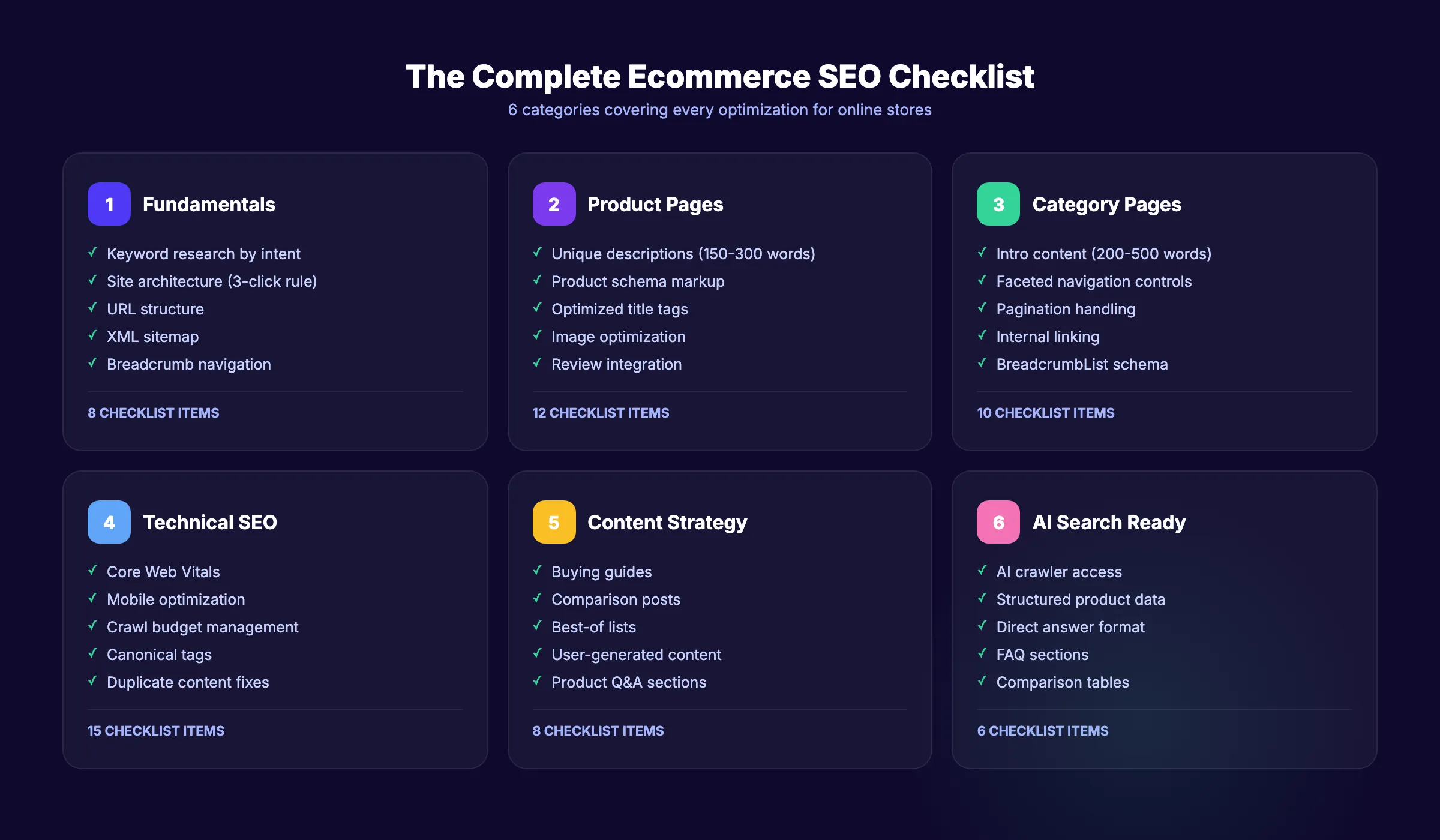
Here is what this checklist covers:
- Keyword research and site architecture for ecommerce
- Product page optimization (descriptions, images, schema)
- Category page SEO that drives commercial traffic
- Technical SEO fixes that prevent ranking losses
- Content strategy to build topical authority
- AI search optimization for ecommerce in 2026
- Common ecommerce SEO mistakes with data on how often they occur
Ecommerce SEO Fundamentals
Before optimizing individual pages, get the foundation right. These fundamentals affect every page on your store.
Keyword Research for Ecommerce
Ecommerce keyword research differs from blog keyword research. You target commercial and transactional intent, not informational.
Priority keyword types:
| Keyword Type | Example | Intent | Page Type |
|---|---|---|---|
| Product keywords | "Nike Air Max 90 white" | Transactional | Product page |
| Category keywords | "running shoes for women" | Commercial | Category page |
| Comparison keywords | "Nike vs Adidas running shoes" | Commercial | Blog/comparison page |
| Long-tail product | "waterproof hiking boots under $100" | Transactional | Category or product page |
| Informational | "how to choose running shoes" | Informational | Blog post |
Long-tail keywords convert at 2.5 times the rate of broad keywords. Target them on product and category pages with specific modifiers like size, color, price range, and use case.
Use our keyword research guide adapted to ecommerce: find seed keywords from your product catalog, expand with competitor keyword analysis, and map each keyword to a specific page type.
Site Architecture
A clean site architecture helps Google crawl and understand your store. Follow the 3-click rule: every product should be reachable within 3 clicks from the homepage.
Recommended hierarchy:
Homepage → Category → Subcategory → Product- ✓ Flat URL structure:
store.com/category/product-name - ✓ Breadcrumb navigation on every page
- ✓ Logical category grouping (by product type, not by brand alone)
- ✓ Internal linking from categories to top products
- ✓ HTML sitemap for large catalogs (1,000+ products)
- ✓ XML sitemap segmented by page type (products, categories, blog)
Product Page SEO Checklist
Product pages are your revenue pages. Every optimization here directly affects sales.
Product Descriptions
The average ecommerce product description is 69 words. That is not enough to rank. Aim for 150 to 300 words minimum on every product page.
- ✓ Unique product description (never copy manufacturer descriptions)
- ✓ Primary keyword in the first sentence
- ✓ Benefits and use cases, not specs alone
- ✓ Natural inclusion of long-tail variations (color, size, material)
- ✓ Bullet points for scannable features
- ✓ Clear pricing and availability information
29% of stores have zero product descriptions. Even a 100-word unique description puts you ahead of nearly a third of competitors.
Product Images
- ✓ High-resolution images (minimum 1000x1000 pixels)
- ✓ Descriptive file names:
nike-air-max-90-white-mens.jpgnotIMG_4523.jpg - ✓ Alt text on every image with product name and key attribute
- ✓ Multiple angles (3 to 5 images per product minimum)
- ✓ WebP or AVIF format for faster loading
- ✓ Lazy loading on images below the fold (keep hero image eager-loaded)
Read our image SEO guide for the full optimization process.
Product Title Tags and Meta Descriptions
- ✓ Title tag format: [Product Name] - [Key Attribute] | [Brand]
- ✓ Title under 60 characters
- ✓ Primary keyword near the beginning
- ✓ Include modifiers: "Buy," "Free Shipping," price, year
- ✓ Unique meta description per product (145-155 characters)
- ✓ Meta description includes price, availability, and a benefit
91% of ecommerce stores do not use title tag modifiers like "Buy Online" or "Free Shipping." Adding these modifiers captures long-tail searches that competitors miss.
Product Schema Markup
50% of ecommerce stores lack Product schema. Adding it earns rich results that increase click-through rates by 20 to 40%.
- ✓ Product schema with
name,image,description,sku - ✓
offerswithprice,priceCurrency,availability - ✓
aggregateRatingif you have reviews (stars in SERPs) - ✓
brandwith brand name - ✓
reviewwith individual review data - ✓ Test with Google's Rich Results Test
Use our schema markup generator to create Product JSON-LD. Read the full schema markup guide for implementation.
Google provides specific documentation for ecommerce structured data covering Product snippets and Merchant Listings.
Stop writing. Start ranking. theStacc publishes SEO-optimized articles per month for $99. Build the content layer that drives organic traffic to your product pages.
Category Page SEO Checklist
Category pages target the highest-value commercial keywords. "Running shoes for women" has more search volume and purchase intent than any individual product page. Yet 37 to 42% of ecommerce stores have zero content on their category pages.
Category Page Content
- ✓ 200 to 500 words of unique introductory content above the product grid
- ✓ Primary keyword in H1 and first 100 words
- ✓ Buying guide elements (what to look for, size guide links, popular features)
- ✓ Internal links to related categories and subcategories
- ✓ Link to relevant blog content (buying guides, comparison posts)
A category page with a helpful 300-word introduction outranks a bare product grid 8 times out of 10. Google sees the grid-only page as thin content.
Category Page Structure
- ✓ Clean URL:
/category-name/not/index.php?cat=47 - ✓ H1 matches the target category keyword
- ✓ Breadcrumbs with BreadcrumbList schema
- ✓ Pagination with
rel="prev"andrel="next"(or load-more button) - ✓ Faceted navigation uses
noindexor canonical tags to prevent crawl bloat - ✓ Sort and filter options do not create indexable URL variants
- ✓ Product count visible ("Showing 48 of 312 products")
Faceted Navigation
Faceted navigation (filtering by color, size, price, brand) creates thousands of URL combinations. Without controls, Google wastes crawl budget indexing every filter combination.
- ✓ Use
robots.txtornoindexfor filter URLs - ✓ Apply canonical tags pointing filter pages to the main category
- ✓ Block faceted URLs in robots.txt if they have no unique value
- ✓ Allow only the most commercially valuable filter combinations to index (e.g., "/running-shoes/womens/" but not "/running-shoes/?color=blue&size=8")
Technical SEO Checklist
Technical issues silently kill ecommerce rankings. 62% of ecommerce sites have broken links. 55% load slower than 3 seconds.
Page Speed and Core Web Vitals
Every second of load delay costs 7% in conversions (Charle Agency). The average ecommerce store loads in 3.97 seconds. That is nearly a full second above Google's "Good" threshold.
- ✓ LCP under 2.5 seconds (optimize hero images, use CDN)
- ✓ INP under 200 milliseconds (reduce JavaScript, defer non-critical scripts)
- ✓ CLS under 0.1 (set image dimensions, avoid dynamic content shifts)
- ✓ Compress images to WebP/AVIF format
- ✓ Enable browser caching and GZIP/Brotli compression
- ✓ Use a CDN for global page delivery
Follow our Core Web Vitals guide for step-by-step fixes.
Crawlability and Indexing
- ✓ Submit XML sitemap in Google Search Console
- ✓ No critical pages blocked in robots.txt
- ✓ Canonical tags on all product pages (especially variants)
- ✓ 301 redirects for out-of-stock or discontinued products (do not 404)
- ✓ Fix broken links across the site (check monthly)
- ✓ No orphan pages (every product linked from at least 1 category)
- ✓ Crawl budget managed: block low-value URLs (search results pages, internal filters)
Mobile Optimization
68% of ecommerce traffic comes from mobile. Google uses mobile-first indexing. Your mobile experience is your SEO experience.
- ✓ Responsive design across all page types
- ✓ Touch-friendly buttons and navigation (minimum 48x48px tap targets)
- ✓ No horizontal scrolling on any screen size
- ✓ Mobile checkout flow tested and functional
- ✓ No intrusive pop-ups blocking product content
Duplicate Content
Ecommerce sites generate duplicate content through product variants, session IDs, and parameter URLs.
- ✓ Canonical tags on all product variant pages (color, size variations)
- ✓ Self-referencing canonicals on all main pages
- ✓ No session IDs or tracking parameters in indexed URLs
- ✓ Unique product descriptions (do not use manufacturer copy)
- ✓ Consolidate thin pages with similar content
Content Strategy for Ecommerce SEO
Product and category pages target transactional keywords. Blog content targets informational keywords that feed your sales funnel.
Blog Content That Drives Ecommerce Traffic
- ✓ Buying guides: "How to Choose [Product Category]"
- ✓ Comparison posts: "[Product A] vs [Product B]"
- ✓ Best-of lists: "Best [Product Category] for [Use Case]"
- ✓ How-to content: "How to Use [Product] for [Outcome]"
- ✓ Seasonal content: "[Product Category] for [Season/Event]"
Companies publishing 16 to 20 blog posts per month generate 3 times more leads. For ecommerce, every blog post should include internal links to relevant product and category pages.
Use a content marketing strategy that maps blog topics to product categories. Build topical authority around your core product areas. Create a topical map connecting informational content to commercial pages.
User-Generated Content
Product reviews are free, unique content that builds trust and adds keyword-rich text to product pages.
- ✓ Enable product reviews on all product pages
- ✓ Send post-purchase review request emails
- ✓ Display reviews with Review schema markup
- ✓ Respond to reviews (positive and negative)
- ✓ Feature Q&A sections on product pages
Your SEO team. $99 per month. SEO-scored articles, published automatically. Build the blog content that drives organic traffic to your store.
Off-Page SEO for Ecommerce
Ecommerce link building requires different tactics than B2B or service businesses. Product-focused content earns different types of links.
Link Building Tactics for Ecommerce
- ✓ Create linkable content assets (data studies, industry reports, free tools)
- ✓ Pitch products to review bloggers and industry publications
- ✓ Build resource page links in your product niche
- ✓ Pursue digital PR for product launches and company news
- ✓ Recover unlinked brand mentions
- ✓ Submit products to "best of" lists and gift guides
Read our link building for ecommerce guide for the full strategy with outreach templates.
Brand Signals
- ✓ Consistent brand information across all platforms
- ✓ Active social media profiles linked from your site
- ✓ Press and media coverage of your brand
- ✓ Industry awards and certifications displayed on-site
AI Search Optimization for Ecommerce
AI search is growing in ecommerce. ChatGPT traffic to ecommerce sites converts 31% higher than non-branded organic traffic (Search Engine Land). Stores that optimize for AI citation earn a new traffic channel.
AI-Ready Ecommerce Checklist
- ✓ Allow AI crawlers in robots.txt (GPTBot, ClaudeBot, PerplexityBot)
- ✓ Product data structured with complete schema (name, price, availability, reviews)
- ✓ Direct answers to common product questions in the first 100 words of each page
- ✓ FAQ sections on product and category pages
- ✓ Comparison tables that AI can extract and cite
- ✓ Updated content with recent dates (AI prefers fresh sources)
Google AI Overviews reduced organic CTR by 61% for some queries. But pages cited in AI Overviews see a 35% boost in organic clicks. The goal is to be the cited source. Read our generative engine optimization guide for the full framework.
Ecommerce SEO Mistakes to Avoid
These mistakes come from the LOGEIX audit of 1,200 online stores. Each one has data showing how common it is.
| Mistake | How Common | Fix |
|---|---|---|
| No Product schema markup | 50% of stores | Add Product JSON-LD to all product pages |
| Product descriptions under 50 words | 55% of stores | Write 150-300 word unique descriptions |
| Page load over 3 seconds | 55% of stores | Compress images, use CDN, optimize scripts |
| No title tag modifiers | 91% of stores | Add "Buy," "Free Shipping," price to titles |
| Blank meta descriptions | 20% of stores | Write unique meta per page |
| No category page content | 37-42% of stores | Add 200-500 words of intro content |
| No breadcrumb navigation | 19% of stores | Add BreadcrumbList with schema |
| Broken internal links | 62% of stores | Audit and fix monthly |
| Zero product descriptions | 29% of stores | Write unique copy for every product |
| Keyword stuffing in titles | 17% of stores | Use natural, readable title tags |
Every percentage in that table represents lost revenue. Run an SEO audit to find which of these issues exist on your site. Then fix them in order of impact.
How to Prioritize Fixes
Start with the items that are both common and high-impact:
Fix first (week 1): Add Product schema to all product pages. This is a one-time technical task that immediately qualifies you for rich results. 50% of stores lack it. You gain an advantage the moment it is live.
Fix second (weeks 2 to 4): Write unique product descriptions for your top 50 revenue-generating products. 150 to 300 words each. Prioritize by revenue, not alphabetical order.
Fix third (month 2): Address page speed. Compress images, enable lazy loading, and implement a CDN. Every second you shave off load time recovers 7% of lost conversions.
Fix fourth (month 2 to 3): Add introductory content to your top 20 category pages. 200 to 500 words of buying guidance that includes your target keyword naturally.
Ongoing: Fix broken links monthly. Update product descriptions quarterly. Publish 4 to 8 blog posts per month to build topical authority around your product categories. Use a content calendar to maintain publishing consistency.
Ecommerce SEO ROI Benchmarks
Ecommerce SEO delivers measurable returns. Here is the data from First Page Sage's 2026 report:
| Time Horizon | Average ROI |
|---|---|
| 12 months | 2.6x |
| 24 months | 3.8x |
| 36+ months | 5.2x |
Specialty retail achieves the highest ROI at 4.2x. Companies with $1M to $10M in revenue see 3.3x ROI. The organic search conversion rate for ecommerce averages 2.8%.
The compounding effect matters. Year 1 builds the foundation. Year 2 and beyond are where SEO investment generates outsized returns as indexed pages, backlinks, and domain authority accumulate.
3,500+ blogs published. Every article is SEO-scored before publish. See what theStacc can do for your ecommerce site. Consistent content builds the organic traffic that converts.
What practitioners are saying on X
AI search advice ages quickly. Here is high-signal public discussion from SEO and growth operators — context for your roadmap, not a substitute for primary data.
- @hridoyreh (Mar 2026): Widely shared SEO skill tree: foundations, research, technical, on-page, content, links, AI SEO/GEO, analytics, UX, brand, programmatic — useful map for stats and how-to posts. See the post on X.
- @jakezward (Feb 2026): 2026 SEO predictions emphasize AI Overview share-of-SERP, schema for LLM token efficiency, brand mentions in AI answers as a KPI, proprietary data as a moat, and content refresh beating net-new AI slop. See the post on X.
Grok, AI Overviews, and multi-engine visibility
For “ecommerce seo checklist”, multi-engine visibility still starts with clear definitions, sourced numbers, and extractable section answers. Grok additionally factors live X discussion — keep public claims consistent with this page.
- Google AI Overviews: Use passage-ready answers, tables, and FAQ schema where relevant.
- ChatGPT / Perplexity: Cite named sources next to key claims.
- Grok: Maintain accurate entity facts on-site and in high-signal X posts.
Publish content built for Google and AI citations. theStacc’s Content SEO module ships SEO-scored articles structured for rankings and generative engines — including clearer entity pages models like Grok can quote.
FAQ
An ecommerce SEO checklist is a structured list of optimizations for online stores covering product pages, category pages, technical infrastructure, schema markup, content strategy, and off-page authority. It ensures no critical optimization is missed. This checklist is organized by priority so you can start with the highest-impact items.
Initial improvements from technical fixes and on-page optimization appear within 30 to 60 days. Content-driven traffic growth takes 3 to 6 months. Full ROI from ecommerce SEO compounds over 12 to 36 months. First Page Sage data shows 2.6x ROI at 12 months and 5.2x at 36+ months.
Product schema markup and unique product descriptions have the highest immediate impact because they are missing on 50% and 29% of stores respectively. Fixing these two items alone can increase organic visibility and click-through rates. For long-term growth, category page content and blog publishing drive the most sustained traffic gains.
Shopify handles hosting, SSL, and mobile responsiveness automatically. The main Shopify-specific SEO considerations are: managing auto-generated URL structures, handling collection page pagination, editing robots.txt through the Shopify admin, and managing duplicate content from product variants. The core principles in this checklist apply to all platforms.
Write unique product descriptions of 150 to 300 words minimum. Add Product schema markup with price, availability, and reviews. Optimize title tags with the product name and a modifier like "Buy" or "Free Shipping." Compress images, add descriptive alt text, and include multiple product photos. Add a reviews section for user-generated content.
Yes. Ecommerce blogs target informational keywords that product and category pages cannot rank for. Blog posts like "how to choose running shoes" drive traffic that feeds into product page visits through internal links. Stores with active blogs generate 68% more leads than those without one.
Ecommerce SEO is systematic. Follow this checklist from top to bottom, starting with the technical foundation and working through product pages, category pages, content, and off-page authority. The stores winning in organic search are the ones that treat SEO as a continuous process rather than a one-time project. Start with the items most stores get wrong. The data shows exactly where those gaps are.
Related Tools & Resources
Free SEO Tools:
Best Lists:
Sources & references
- [1] Princeton / Georgia Tech et al. — GEO research (arXiv:2311.09735)
- [2] @hridoyreh on X — Widely shared SEO skill tree: foundations, research, technical, on-page, content, links, AI SEO/GEO, analytics, UX, bran
- [3] @jakezward on X — 2026 SEO predictions emphasize AI Overview share-of-SERP, schema for LLM token efficiency, brand mentions in AI answers
- [4] Referenced source — logeix.com

Plan topics, review article drafts, and publish to a connected CMS.
Weekly local SEO teardowns
One practical email a week. Map Pack, GBP, AI Overviews. No fluff. Unsubscribe anytime.