55 voice search statistics for 2026 with sources. Covers usage rates, smart speakers, voice commerce, local search, accuracy, and SEO impact data.
Last updated: May 2026
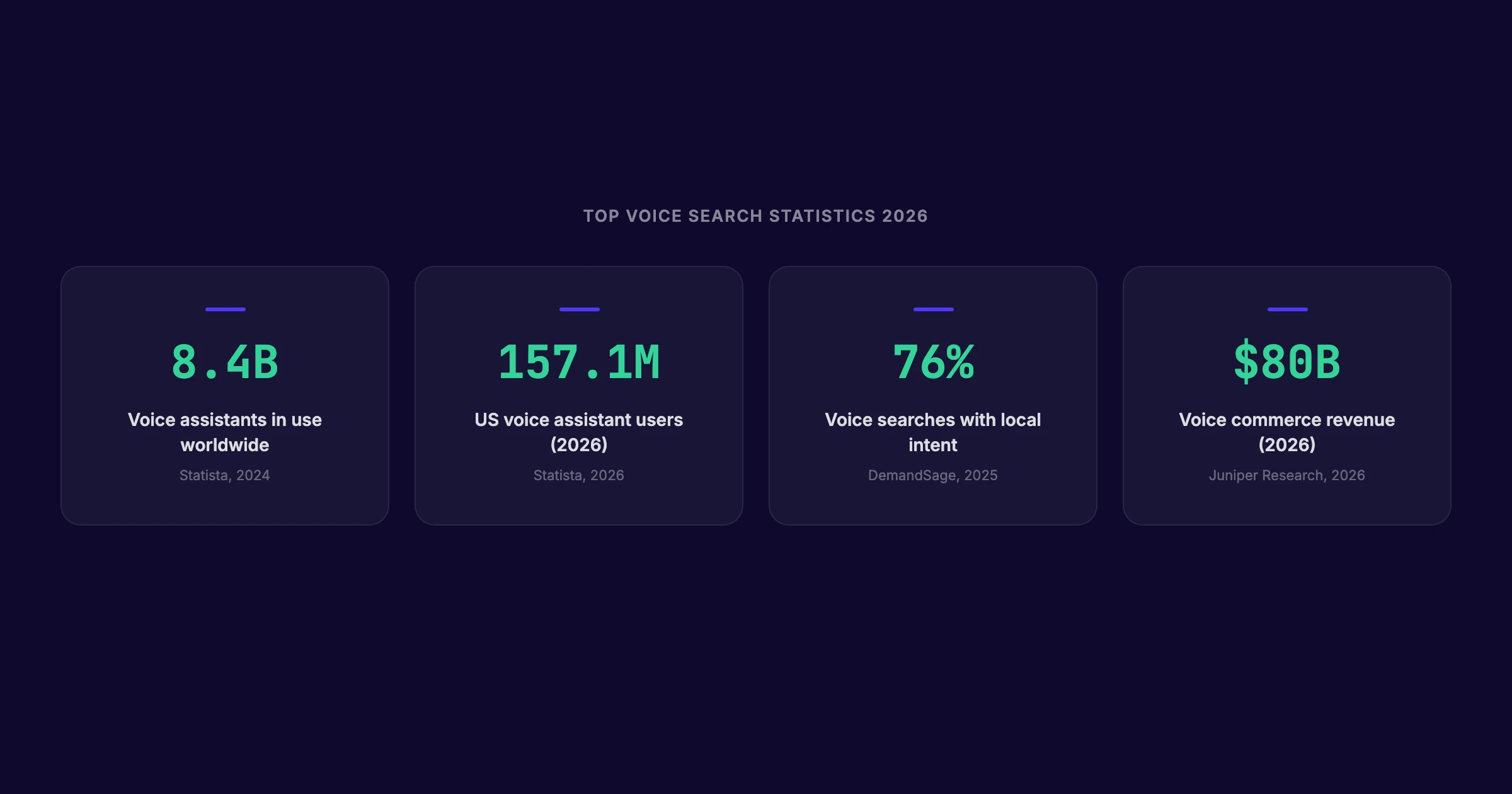
Voice search is no longer a future trend waiting for its moment. There are 8.4 billion voice assistants in use worldwide, more than the entire human population. United States voice assistant users will reach 157.1 million by the end of 2026. Voice commerce is on track to clear 80 billion dollars in transactions this year. These are not projections cobbled together from old research. These are current figures from Statista, Edison Research, eMarketer, and the major analyst firms tracking this category right now.
The 55 voice search statistics below cover every angle marketers, search professionals, and business owners need to understand the state of voice in 2026. Every stat includes a source link. theStacc publishes 3,500+ articles across 70+ industries and tracks voice search SEO and AI search visibility signals daily. These numbers shape how the writing team optimizes pages for both traditional Google ranking and the growing share of queries that travel through voice channels first.
Here is what you will find:
- Top 8 most important voice search numbers in a single summary table
- Global voice assistant adoption rates by region and device class
- United States voice assistant user counts and platform market share
- Smart speaker ownership data, household penetration, and major device launches
- Voice search accuracy figures by assistant (Google, Siri, Alexa)
- Local voice search behavior, "near me" query rates, and same-day visit data
- Voice commerce revenue, conversion lift figures, and growth forecasts
- Demographic breakdowns by age, device class, and country
- SEO and content implications for ranking in voice answers
Top Voice Search Statistics at a Glance
The table below pulls the eight numbers that matter most for any marketing, search, or product decision tied to voice in 2026. Every figure carries a named source. The full citation list appears in the methodology section at the bottom of the page.
| Statistic | Number | Source | Year |
|---|---|---|---|
| Voice assistants in use worldwide | 8.4 billion | Statista | 2024 |
| United States voice assistant users (projected) | 157.1 million | Statista | 2026 |
| Daily voice searches (consumers using voice daily) | 32% | Digitalsilk | 2025 |
| Voice searches that include a "near me" component | 76% | DemandSage | 2025 |
| Smart speaker ownership in the United States (12+ population) | 35% | Edison Research | 2025 |
| Voice search query accuracy rate (cross-assistant average) | 93.7% | Statista | 2024 |
| Voice commerce revenue (forecast) | 80 billion dollars | Juniper Research | 2026 |
| Brands reporting conversion lift from voice optimization | 66% | Algolia | 2024 |
Global Voice Search Usage Statistics
Voice search adoption has reached a stable plateau globally. The story for 2026 is no longer about new users discovering voice. It is about depth of usage among the 1.7 billion people already using voice assistants every week.
- Approximately 20.5% of people globally use voice search, up slightly from 20.3% in early 2024. (DataReportal)
- 8.4 billion voice assistants are now active worldwide, surpassing the global population for the first time. (Statista)
- The 2020 installed base of voice assistants stood at 4.2 billion, meaning the figure has effectively doubled in five years. (Statista)
- 27.6% of online adults aged 16 to 64 worldwide use voice assistants every week. (DataReportal)
- Voice search usage peaked at 22.5% in Q2 2022 and has stabilized between 20% and 21% since. (DataReportal)
- Over 1 billion voice searches occur monthly across the major voice platforms. (Yaguara)
- Voice queries now make up roughly 27% of all mobile search activity in 2026. (DemandSage)
- 32% of consumers carry out daily searches with voice instead of typing them manually. (SEOProfy)
- The global voice assistant installed base now processes over 10 billion queries per day across smartphones, smart speakers, vehicles, and wearables. (Statista)
- 31% of men versus 28% of women globally use voice assistants on a weekly basis. (We Are Social)
- Weekly voice usage peaks at 32% or higher among people aged 25 to 44 and drops to 17% to 19% for users aged 65 and over. (We Are Social)
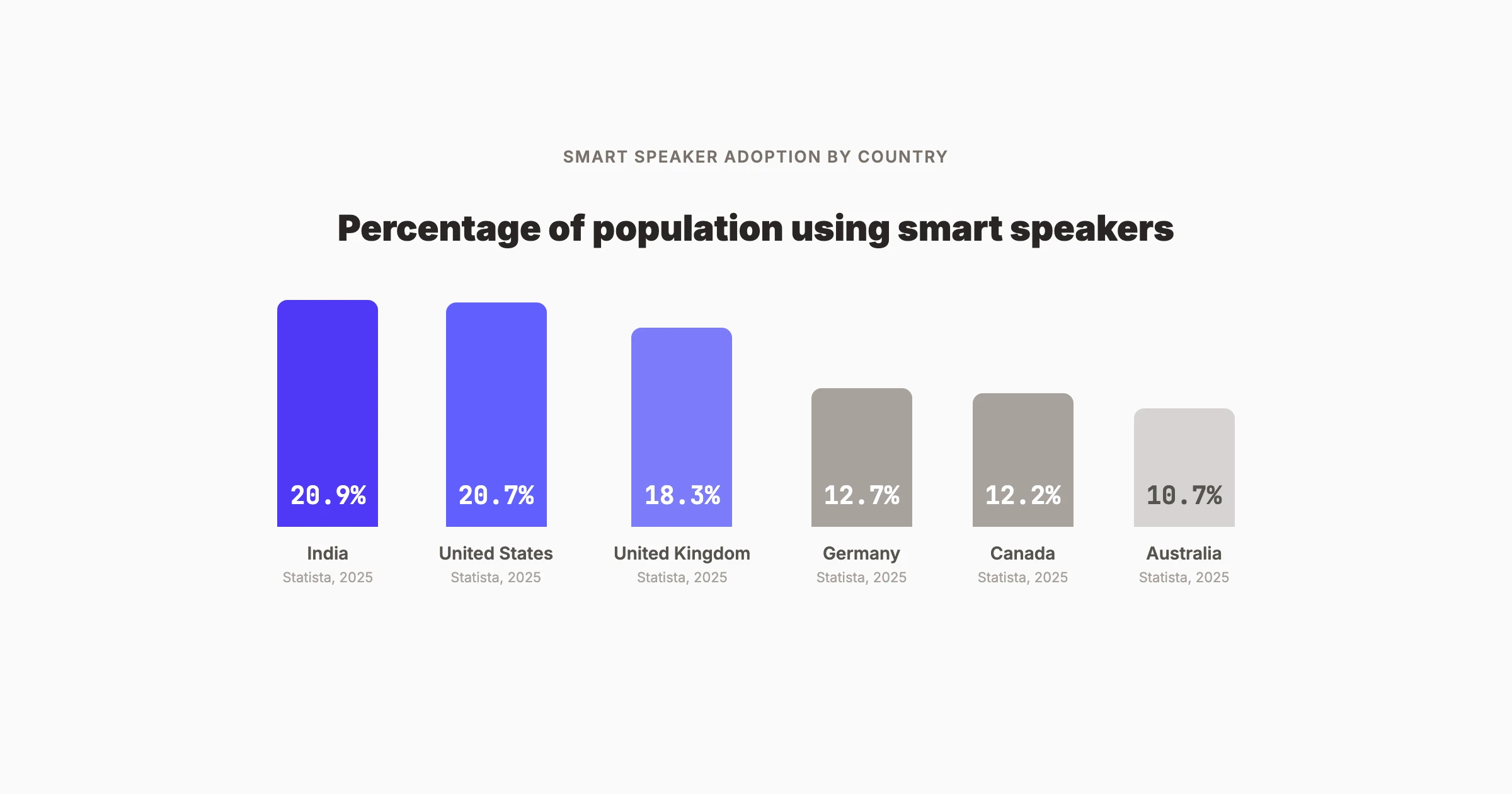
- India leads global smart speaker adoption at 20.9% of the population, narrowly ahead of the United States at 20.7%. (Statista)
Stop guessing which queries to write for. theStacc publishes 30 voice-ready articles per month for 99 dollars. Each piece is optimized for conversational long-tail queries, featured snippet capture, and AI Overview citation. Start for 1 dollar →
United States Voice Assistant Users
The United States remains the largest single voice market in dollar terms. User counts have grown every year for the past decade, and the platform mix has consolidated around three providers.
- The number of voice search users in the United States is projected to reach 157.1 million by end of 2026. (Statista)
- The United States voice assistant user base hit 153.5 million in 2025, a 2.5% year-over-year increase. (Statista)
- 149.8 million United States voice users were recorded in 2024. (Statista)
- Google Assistant leads the United States market with 91.9 million users, followed by Siri at 86.5 million and Alexa at 77.2 million. (eMarketer)
- 50% of United States consumers report using voice search every day. (Synup)
- Among adults aged 25 to 34, the daily United States voice search rate climbs to 58%. (Synup)
- 58.6% of United States consumers have tried voice search at least once. (Keywords Everywhere)
- 41% of United States adults use voice search on a daily basis. (Blogging Wizard)
Smart Speaker Adoption Statistics
Smart speakers represent the most visible voice hardware category, but the broader voice ecosystem now extends far beyond dedicated devices. The data shows where dedicated speakers stand and where the channel is moving.
- Smart speaker ownership in the United States sits at 35% of Americans aged 12 and older, an estimated 101 million people. (Edison Research)
- The global smart speaker market is projected to reach 23.32 billion dollars in 2026. (IMARC Group)
- Smart speaker market revenue is forecast to surge to 52.44 billion dollars by 2030 at a 22.5% compound annual growth rate. (IMARC Group)
- 52% of smart speaker users report using their devices every single day. (Edison Research)
- 52% of smart speakers sit in the family room, 25% in bedrooms, and 22% in kitchens. (Edison Research)
- Smart speaker penetration in the United Kingdom reached 18.3% in 2025. (Statista)
- Germany shows 12.7% smart speaker adoption, while Canada records 12.2% household penetration. (Statista)
- United States smart speaker brand share splits Amazon Echo at 65%, Google Home at 24%, and Apple HomePod at 18% (some households own multiple brands). (Radio Advertising Bureau)
- Amazon Alexa+, the generative AI assistant built on Amazon Nova and Anthropic models, became generally available to all United States customers in February 2026 — free for Prime members and 19.99 dollars per month for standalone access. (Amazon Press Release)
- Alexa+ users interact 2 to 3 times more frequently than original Alexa users, with smart home interactions up over 50% in early data. (Amazon Press Release)
Voice Search Accuracy Statistics
Voice assistant accuracy has improved dramatically over the past five years. The current generation of large language models drives a meaningful step change in answer quality, though gaps between assistants remain.
- Across all major voice assistants, queries are answered correctly 93.7% of the time on average. (DemandSage)
- Google Assistant understands 100% of voice queries and answers them correctly 92.9% of the time. (DemandSage)
- Siri understands 99.8% of queries and provides a correct answer 83.1% of the time. (DemandSage)
- Alexa understands 99.9% of queries but answers correctly only 79.8% of the time, the lowest of the three. (DemandSage)
- The average Word Error Rate (WER) for modern voice systems sits at 3.5% for clean speech, climbing to 12% in noisy environments and 15% for strong regional accents. (VoiceToNotes Research)
- On-device voice processing grew from 12% to 38% of queries between 2022 and 2025 as Apple, Google, and Amazon shifted to local AI models. (DemandSage)
- 47% of voice users say on-device processing would directly increase their trust in voice assistants. (DemandSage)
Local Voice Search Statistics
Local intent dominates voice search behavior. People speak to find places, products, and services around them — and the data on conversion is stronger here than for any other voice use case.
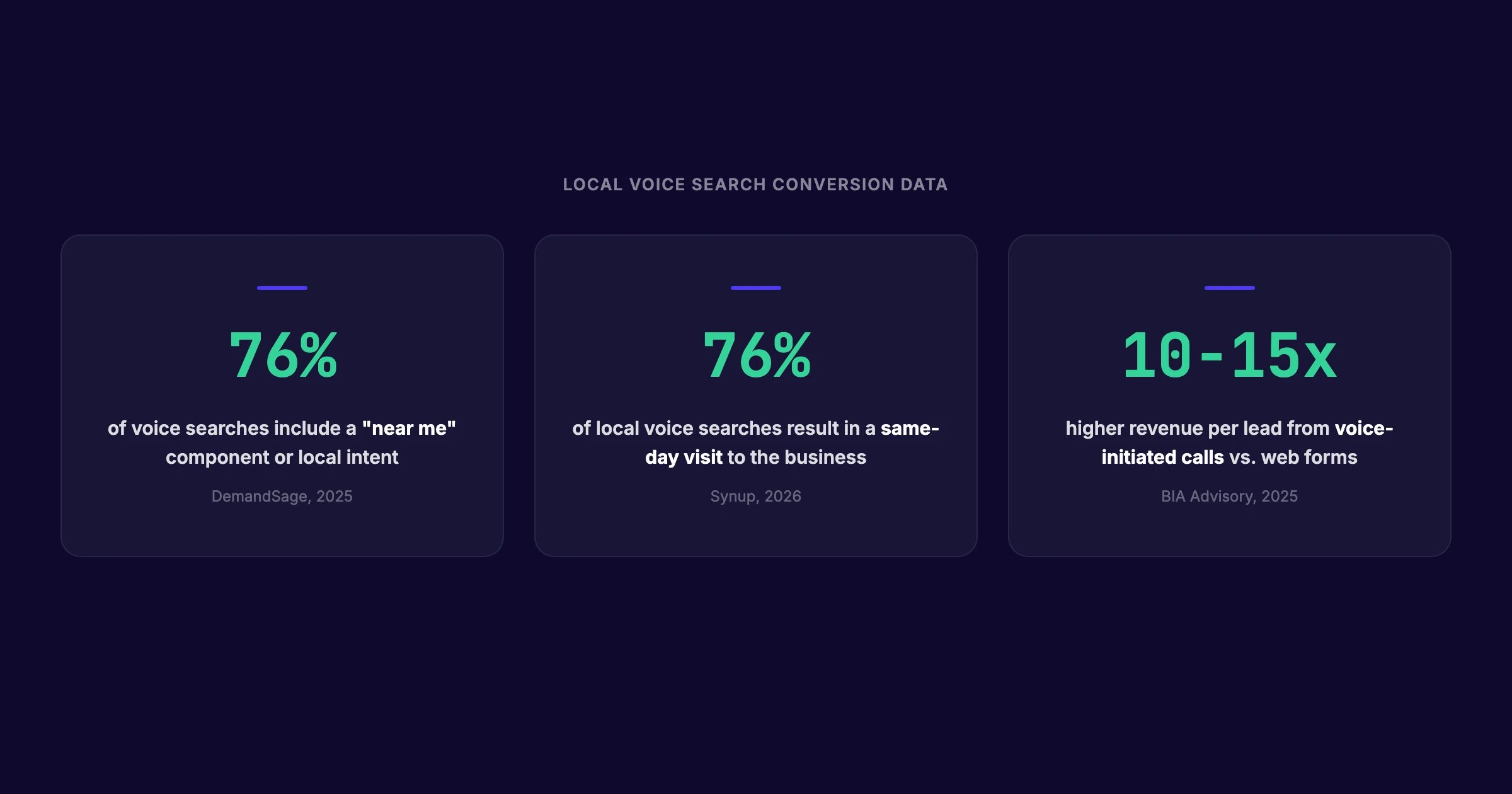
- 76% of voice searches include a "near me" component or local intent signal. (DemandSage)
- 58% of consumers use voice search to find local business information. (Synup)
- 76% of voice searches for local businesses result in a same-day visit. (Synup)
- 28% of consumers call a business directly after finding it through a voice search. (Synup)
- 51% of voice users search for restaurants, cafes, and food establishments via voice. (BrightLocal)
- Voice-initiated phone call revenue runs 10 to 15 times higher per lead than equivalent web form leads. (BIA Advisory Services)
- Only 4% of United States businesses are currently optimized for voice search, leaving a major gap for early movers. (Search Engine Land)
- The car voice assistant market is expected to reach 3.65 billion dollars by end of 2026 at a 13.3% compound annual growth rate. (Markets and Markets)
Local voice queries demand local-ready pages. theStacc generates local SEO content optimized for "near me" voice queries, with proper schema markup, conversational FAQ blocks, and the exact phrasing voice assistants extract. See live examples →
Voice Commerce Statistics
Voice commerce moved from experimental to material in 2026. Improved natural language understanding, voice payment authentication, and the broader smart speaker installed base have combined to create a viable shopping channel.
- Voice commerce revenue is projected to hit 80 billion dollars in 2026, with broader voice-initiated transactions expected to reach 164 billion dollars by 2028. (Juniper Research)
- The voice commerce market grew from 42.75 billion dollars in 2023 to a projected 186.28 billion dollars by 2030 at a 24.6% compound annual growth rate. (Grand View Research)
- 38.8 million Americans (13.6% of the population) use smart speakers for shopping tasks. (eMarketer)
- 54% of United States retail searches now occur through voice channels, compared with roughly 40% in the United Kingdom and Germany. (DemandSage)
- 91% of brands invest heavily in voice search optimization, with 66% reporting measurable conversion lifts from voice-optimized content. (Algolia)
- 58% of companies that have invested in voice optimization say it has exceeded their expectations, and the same group reports voice-driven service cost reductions of roughly 20%. (Algolia)
Voice Search SEO Statistics
Voice changes how pages need to be written. Conversational phrasing, structured data, and fast page speed all carry more weight in voice answer selection than in standard organic results.
- 40.7% of voice search answers are extracted directly from featured snippets. (Backlinko)
- 80% of voice search answers come from pages ranking in the top 3 organic positions for the underlying query. (Keywords Everywhere)
- Pages that rank in voice search results load roughly 52% faster than the standard organic average. (Backlinko)
- The average word count of a voice-search-ranking page sits at 2,312 words, with conversational sections and question-format headings dominating the structure. (Backlinko)
Key Takeaways
The numbers above paint a clear picture for 2026. Voice has matured into a stable channel where the growth is no longer about acquiring new users — it is about deepening usage and capturing the commercial value that flows through voice queries.
- Voice is everywhere: 8.4 billion voice assistants in use, more than one device per person on the planet
- United States dominates monetization: 157.1 million users and 80 billion dollars in voice commerce
- Local is king: 76% of voice queries carry local intent and 76% of local voice queries convert to a same-day visit
- Smart speakers plateaued: 35% United States ownership has been stable for 4 years, but Alexa+ is reigniting interaction frequency
- Accuracy crossed the trust threshold: Cross-assistant average answer accuracy hit 93.7%, removing the historical adoption barrier
- Featured snippets win voice: 40.7% of voice answers pull directly from snippets, and 80% come from the top 3 organic results
- Voice optimization is still a gap: Only 4% of United States businesses are voice-ready, leaving a wide-open lane
How to Optimize for Voice Search in 2026
The data above translates into a short list of practical moves. Pages built for voice share specific structural traits. Three actions matter more than any other.
Match the question format directly in H2 headings. Voice queries average 60 to 80 characters and almost always carry a question word ("how", "what", "where"). Pages that mirror the verbatim question in H2 headings capture voice answers at a much higher rate. The featured snippets guide walks through this in detail.
Open every section with a 40 to 60 word standalone answer. Voice assistants extract self-contained passages, not paragraphs that reference other sections. A clear answer block at the top of each H2 dramatically raises voice citation likelihood.
Add structured data to every page. Schema markup (FAQPage, HowTo, LocalBusiness, Speakable) gives voice assistants a clean signal about what each passage answers. The schema markup SEO guide covers exactly which types matter for voice.
The data is settled. Voice carries commercial intent. Local voice queries convert at rates that beat almost any other channel. The remaining question is whether your content is structured to win the citation when the voice query happens.
Methodology
Sources used in this report:
- Statista — voice assistant installed base, United States user counts, smart speaker market data
- Edison Research — Infinite Dial 2025 study on smart speaker ownership and behavior
- eMarketer — United States voice assistant user forecast by platform
- DataReportal — Digital 2025 Global Overview Report (global voice usage rates)
- DemandSage — compiled voice search statistics 2026 update
- BrightLocal — local consumer search behavior surveys
- Backlinko — voice search SEO factor analysis
- Synup — industry-specific voice search data
- Juniper Research — voice commerce market sizing and forecasts
- Grand View Research — voice commerce market growth analysis
- Algolia — brand voice search investment and conversion data
- Edison Research Infinite Dial 2025 — smart speaker household data
- We Are Social — global digital usage demographics
Last updated: May 2026
Update frequency: theStacc updates this page quarterly. The next scheduled refresh is August 2026. Any statistics that change between updates carry an inline date stamp.
Verification: Every statistic in this report includes a source link. theStacc removes any figure that cannot be traced back to a named primary source or peer-reviewed secondary source.
Beat the 96% of businesses ignoring voice. theStacc writes 30 voice-optimized SEO articles per month for 99 dollars. Every piece includes the question-format H2 structure, standalone answer blocks, and schema markup voice assistants extract. Start for 1 dollar →
What practitioners are saying on X
AI search advice ages quickly. Here is high-signal public discussion from SEO and growth operators — context for your roadmap, not a substitute for primary data.
- @hridoyreh (Mar 2026): Widely shared SEO skill tree: foundations, research, technical, on-page, content, links, AI SEO/GEO, analytics, UX, brand, programmatic — useful map for stats and how-to posts. See the post on X.
- @jakezward (Feb 2026): 2026 SEO predictions emphasize AI Overview share-of-SERP, schema for LLM token efficiency, brand mentions in AI answers as a KPI, proprietary data as a moat, and content refresh beating net-new AI slop. See the post on X.
- @alexgroberman (Jul 2026): Case narrative: organic value plus multi-engine citations (ChatGPT, Perplexity, Grok) from knowledge-hub pages, category authority links, commercial intent content, and tight internal linking — not thin product copy. See the post on X.
Grok, AI Overviews, and multi-engine visibility
Analytics and SEO setup pages should keep entity names and steps extractable for AI Overviews, ChatGPT, Perplexity, and Grok.
- Google AI Overviews: Use passage-ready answers, tables, and FAQ schema where relevant.
- ChatGPT / Perplexity: Cite named sources next to key claims.
- Grok: Maintain accurate entity facts on-site and in high-signal X posts.
Publish content built for Google and AI citations. theStacc Content SEO ships SEO-scored articles structured for rankings and generative engines.
Frequently Asked Questions
The single most important figure is that 76% of voice searches carry local intent and 76% of those local voice queries result in a same-day business visit. No other digital channel converts curiosity into physical foot traffic at that rate. For any business with a physical location, the local voice statistic determines whether voice optimization belongs in the priority list. The 8.4 billion installed base of voice assistants matters because it makes that 76% local intent number applicable at meaningful scale.
Approximately 20.5% of people globally use voice search, with 27.6% of online adults aged 16 to 64 using voice assistants weekly. In the United States, 157.1 million people are projected to use voice assistants by end of 2026, and 50% of United States consumers report using voice search daily. The total installed base of voice assistants worldwide stands at 8.4 billion, more than one device per person globally.
Google Assistant is the most accurate, answering 92.9% of voice queries correctly with 100% query comprehension. Siri sits second at 83.1% answer accuracy with 99.8% comprehension. Alexa trails at 79.8% answer accuracy despite understanding 99.9% of queries. The average across all assistants reached 93.7% in the most recent Statista benchmark. The gap between comprehension and correct answers is where assistants differ most.
76% of voice searches include a "near me" component or other local intent signal. Restaurants and food establishments are the single largest local voice search category at 51% of local voice queries. Voice-initiated phone call revenue runs 10 to 15 times higher per lead than equivalent web form submissions, which explains why local businesses are seeing voice referrals convert at unusually high rates compared with their traditional digital channels.
Voice commerce revenue is projected to reach 80 billion dollars in 2026, with the broader category expected to hit 164 billion dollars in voice-initiated transactions by 2028. The market grew from 42.75 billion dollars in 2023 to a projected 186.28 billion dollars by 2030, representing a 24.6% compound annual growth rate. 54% of United States retail searches now occur through voice channels, ahead of the United Kingdom and Germany at roughly 40%.
Voice search rewards three specific signals. First, 40.7% of voice answers come from featured snippets, so capturing snippet positions is the highest-use voice SEO action. Second, 80% of voice answers come from pages ranking in the top 3 organic positions for the underlying query — voice does not change the underlying ranking math. Third, voice-ranking pages load roughly 52% faster than the standard organic average and average 2,312 words, with conversational long-tail phrasing and question-format headings. The voice search SEO guide covers the specific optimization patterns.
theStacc refreshes this page quarterly. The most recent update was May 2026 and the next scheduled refresh is August 2026. Any statistic that changes between scheduled updates carries an inline date stamp. Source links are checked at every refresh and dead links are replaced with current primary sources. The methodology section above lists every source used in the current edition.
Every figure is sourced from a named primary source or established secondary source. Primary sources include Statista, Edison Research, eMarketer, DataReportal, Juniper Research, Grand View Research, and the major search platform research publications. Secondary sources include DemandSage, Backlinko, BrightLocal, Algolia, and Synup, all of which compile their numbers from named primary studies. theStacc removes any statistic that cannot be traced to an identifiable source.
Related Statistics
- Google AI Overviews in 2026: 48% of Searches Have Them (40+ Stats)
- Google Search Statistics 2026: 16.4 Billion Searches/Day (50+ Stats)
- Google Reviews Statistics 2026: 97% Read Them Before Buying (47 Stats)
- Mobile Search Statistics 2026: 63.8% of Traffic Is Mobile (45 Stats)
- Voice Search Statistics 2026: 50%+ of Searches Are Voice (50+ Stats)
Sources & references

Researched, written, and published articles that compound organic traffic.
Weekly local SEO teardowns
One practical email a week. Map Pack, GBP, AI Overviews — no fluff. Unsubscribe anytime.
Explore this topic: Voice Search.