50+ voice search statistics for 2026: smart speaker adoption, local voice search behavior, voice commerce growth, and how voice queries change SEO strategy.
1 billion+ voice searches happen every month. 20.5% of the global population uses voice search, and 76% of voice queries have local intent. Voice search is not a future trend. It is a current channel that affects how your business gets found.
Voice search statistics matter for any business investing in SEO or local search. The data shapes how you optimize content, structure your website, and target keywords.
We compiled 50+ voice search statistics from sources including Google, BrightLocal, Statista, and DemandSage. Every stat includes its source and year.
Last updated: March 2026
Voice Search Usage and Adoption
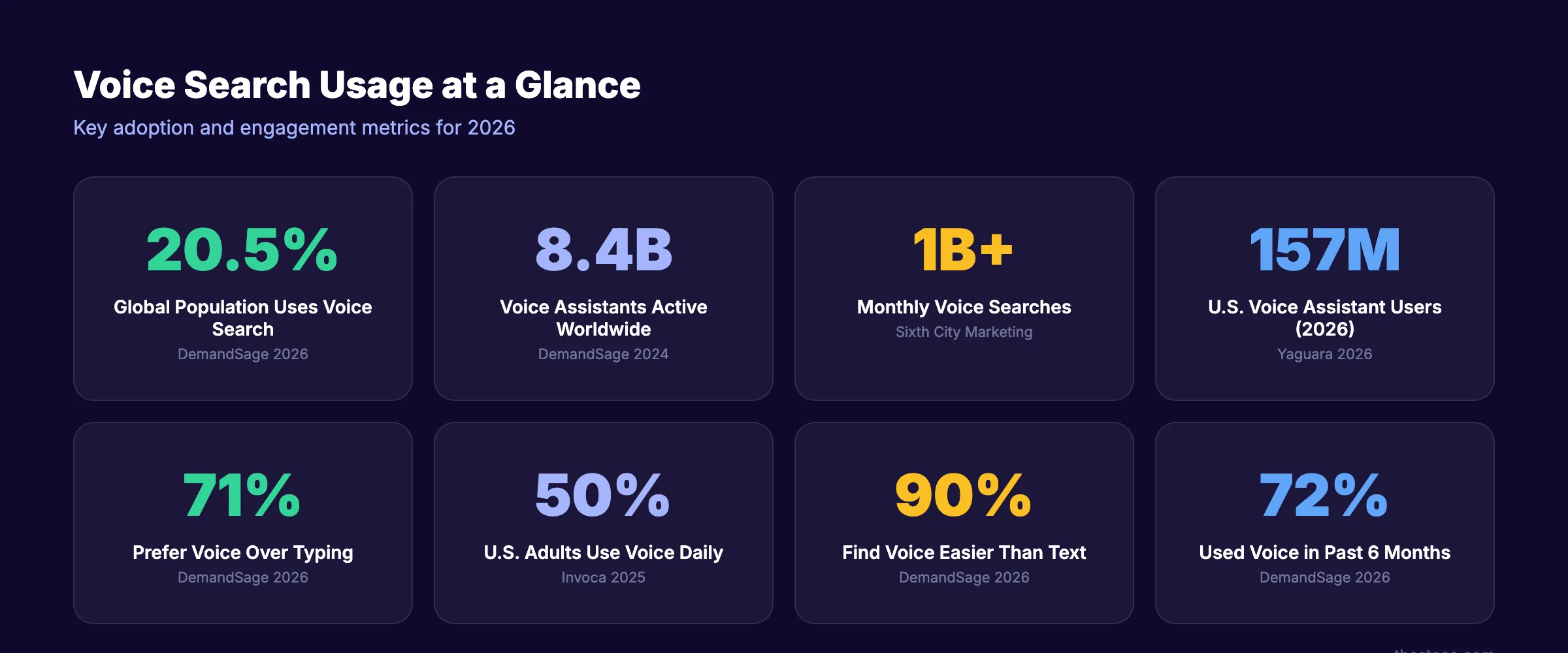
1. 20.5% of people globally use voice search. (Source: DemandSage, 2026)
2. 8.4 billion voice assistants are in use worldwide. (Source: DemandSage, 2024)
3. 157.1 million Americans will use voice assistants by 2026. (Source: Yaguara, 2026)
4. 1 billion+ voice searches happen every month. (Source: Sixth City Marketing, 2026)
5. 50% of the U.S. population uses voice search daily. (Source: Invoca, 2025)
6. 71% of consumers prefer voice search over typing. (Source: DemandSage, 2026)
7. 90% of people find voice search easier than typing a query. (Source: DemandSage, 2026)
8. 72% of people have used voice assistance in the past 6 months. (Source: DemandSage, 2026)
9. 30% of global internet users aged 16-64 use a voice assistant weekly. (Source: Sixth City Marketing, 2026)
Voice adoption is not growing as fast as predicted in 2020. Usage peaked at 22.5% in Q2 2022 and has stabilized around 20.5%. The growth story now is about depth of usage, not new user acquisition.
Voice Search and Local SEO
This is the category that matters most for local businesses. Voice search skews heavily toward local intent.
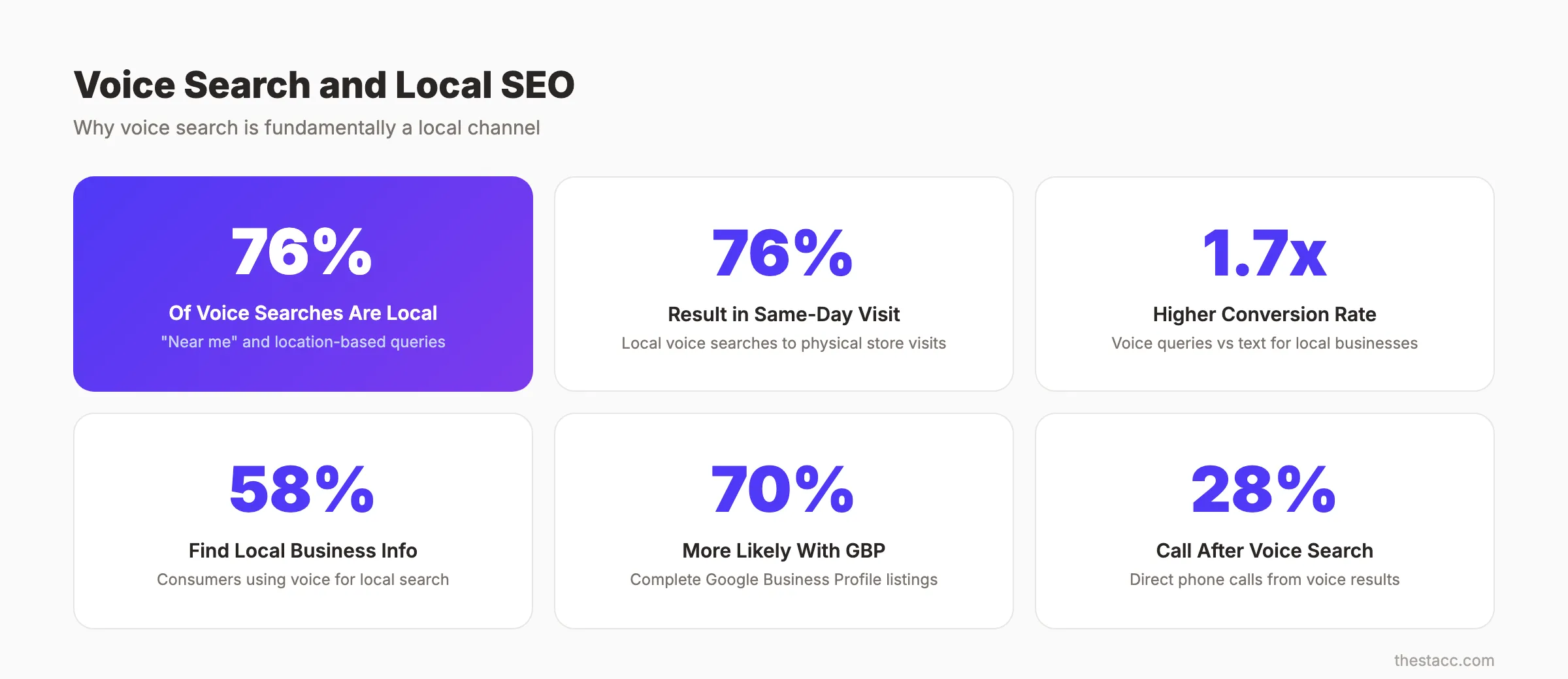
10. 76% of voice searches are "near me" or local queries. (Source: DemandSage, 2026)
11. 58% of consumers use voice search to find local business information. (Source: Synup, 2025)
12. 76% of smart speaker users conduct local searches weekly. (Source: Sixth City Marketing, citing BrightLocal)
13. 46% of voice search users look up local businesses daily. (Source: Koanthic, 2026)
14. 76% of voice searches for local businesses result in a same-day visit. (Source: Koanthic, 2026)
15. 28% of consumers call a business after finding it through voice search. (Source: Sixth City Marketing, citing BrightLocal)
16. Voice queries convert at 1.7x higher rates than text searches for local businesses. (Source: Koanthic, 2026)
17. Businesses optimized for voice search report 19% lower customer acquisition costs. (Source: Koanthic, 2026)
18. Businesses with complete Google Business Profile listings are 70% more likely to attract voice queries. (Source: Synup, 2025)
19. 51% of voice search users research restaurants via voice. (Source: Sixth City Marketing, citing BrightLocal)
For local businesses, these numbers reinforce the importance of a fully optimized Google Business Profile and strong local SEO rankings.
Your SEO team. $99 per month. 30 optimized articles, published automatically. Blog SEO, Local SEO, and Social on autopilot.
Smart Speaker Statistics
20. 103 million Americans have a smart speaker in their home. (Source: Sixth City Marketing, 2025)
21. 75% of U.S. households are expected to own a smart speaker by the end of 2025. (Source: Sixth City Marketing, citing Statista)
22. The global smart speaker market is worth $15.10 billion (2025). (Source: Fortune Business Insights, 2025)
23. Smart speaker market projected to reach $34.08 billion by 2034 (9.4% CAGR). (Source: Fortune Business Insights, 2025)
24. 52% of smart speaker owners use their device daily. (Source: DemandSage, 2026)
25. 65% of smart speaker owners say they cannot imagine going back to life without one. (Source: Sixth City Marketing, citing GeoMarketing)
26. North America holds 40.2% of the global smart speaker market. (Source: Fortune Business Insights, 2025)
27. 52% place smart speakers in living rooms. 25% in bedrooms. 22% in kitchens. (Source: Sixth City Marketing, citing Google)
Voice Assistant Market Share
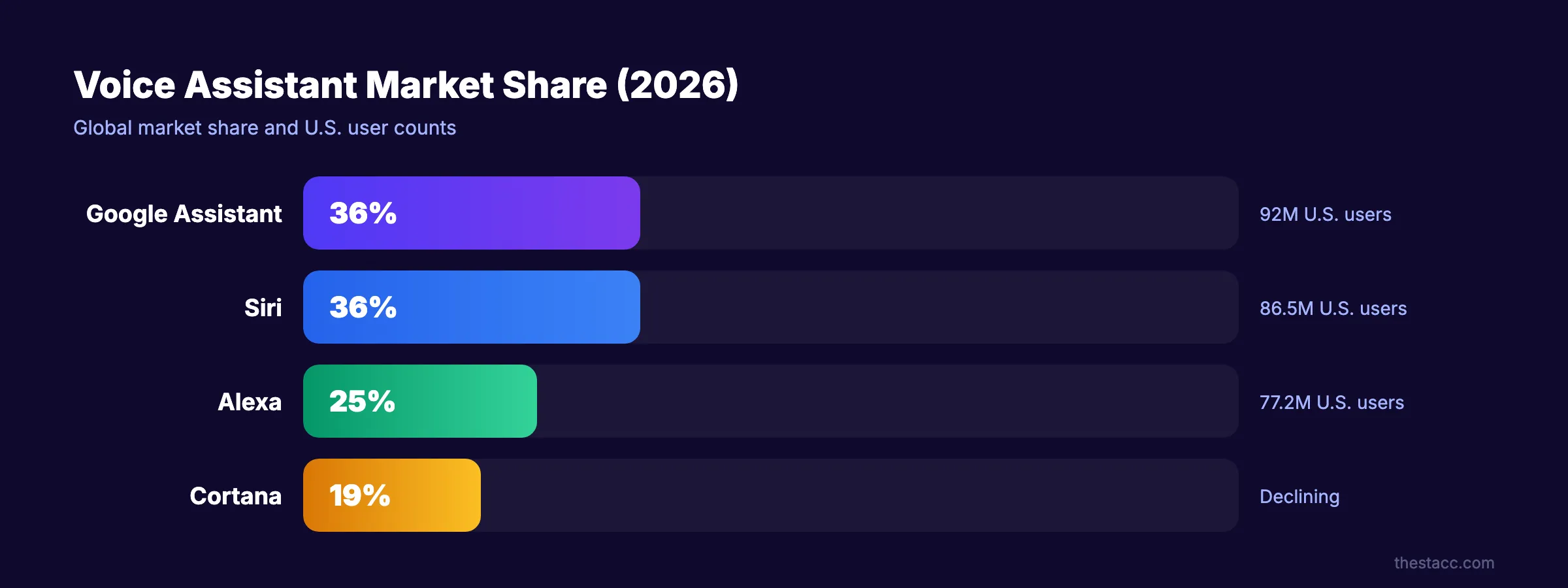
28. Google Assistant and Siri each hold 36% market share. Alexa holds 25%. (Source: DemandSage, 2026)
29. 92 million projected Google Assistant users in the U.S. (2025). (Source: DemandSage, 2025)
30. 86.5 million Siri users in the U.S. (2025). (Source: DemandSage, 2025)
31. 77.2 million Alexa users in the U.S. (2025). (Source: DemandSage, 2025)
32. 500 million people worldwide use Google Assistant monthly. (Source: Yaguara, 2025)
33. Google Assistant supports 119 languages. (Source: Sixth City Marketing, 2025)
34. 45.1% of smartphone voice assistant users use Siri. (Source: DemandSage, 2026)
Voice Search SEO Impact
These statistics directly affect how you approach content optimization and keyword research.
35. 40.7% of voice search answers come from Featured Snippets. (Source: Sixth City Marketing, 2025)
36. The average voice search result is 29 words long. (Source: DemandSage, 2026)
37. Voice search result pages load in 4.6 seconds (52% faster than the average page). (Source: DemandSage, 2026)
38. 80% of Google Assistant answers come from the top 3 organic results. (Source: DemandSage, 2026)
39. The average page length for voice search ranking pages is 2,312 words. (Source: DemandSage, 2026)
40. 70% of voice search result pages use HTTPS. (Source: DemandSage, 2026)
41. Only 1.71% of voice search results have exact keyword matches in the title tag. (Source: DemandSage, 2026)
42. Voice queries are 20-35% longer than text searches. (Source: Koanthic, 2026)
43. Only 13% of marketers actively optimize for voice search. (Source: Improvado, 2025)
44. 22.8% of SEO professionals cite voice search as the most important emerging SEO factor. (Source: DemandSage, 2026)
The gap between stat 43 and stat 44 is striking. SEO professionals recognize voice search matters, but most marketers do nothing about it. That gap is an opportunity for businesses that optimize now.
For practical steps, see our guides on getting featured snippets and optimizing for People Also Ask boxes.
Stop writing. Start ranking. theStacc publishes 30 SEO articles per month for $99. Each one optimized for search, including voice.
Voice Commerce Statistics
45. The global voice shopping market is projected at $62 billion (2025). (Source: Capital One Shopping, 2025)
46. Voice commerce market projected to reach $186.28 billion by 2030 (24.6% CAGR). (Source: Grand View Research, 2025)
47. 49.6% of U.S. consumers use voice search for shopping (154.3 million Americans). (Source: Capital One Shopping, 2025)
48. 51% of online shoppers research products and services via voice. (Source: Sixth City Marketing, citing Narvar)
49. 43% of smart speaker owners use voice for online shopping. (Source: Sixth City Marketing, citing Narvar)
50. 34% have purchased takeout or food delivery via voice assistants. (Source: Yaguara, 2025)
51. 40% of consumers have made a purchase after hearing a voice ad. (Source: DemandSage, 2026)
52. 80% of voice shoppers are satisfied with the experience. (Source: Sixth City Marketing, 2025)
Voice Search Demographics
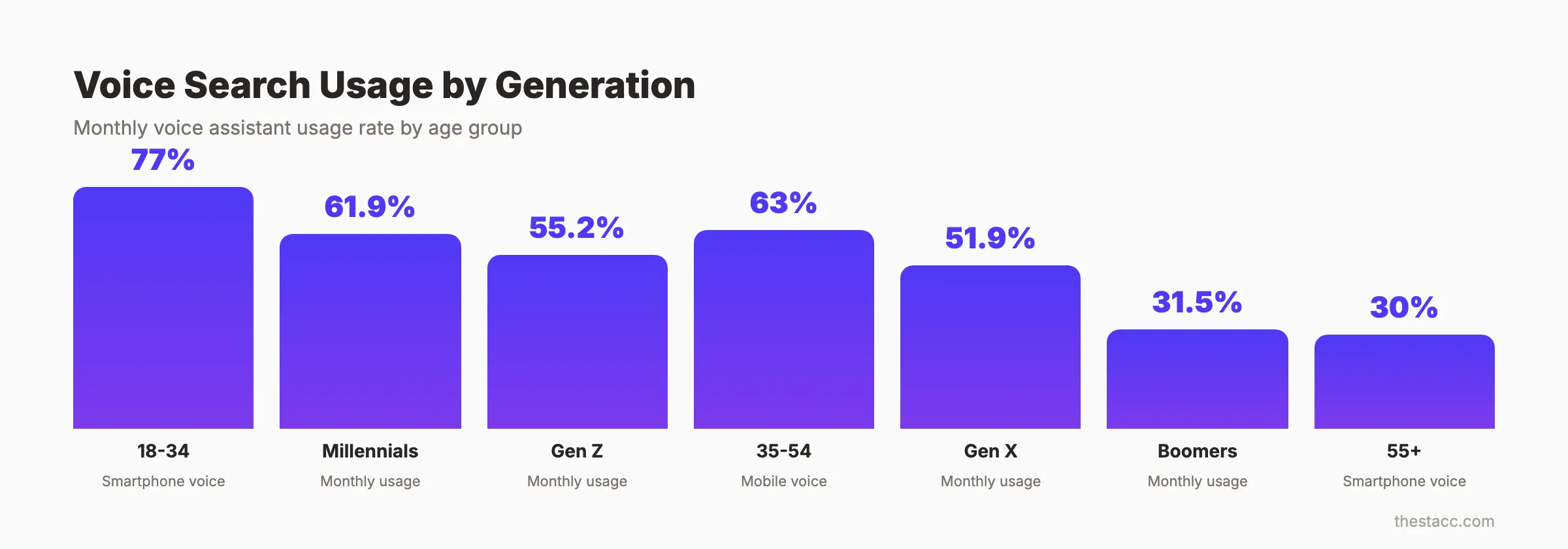
53. 77% of adults aged 18-34 use voice search on smartphones. (Source: DemandSage, 2026)
54. 63% of adults aged 35-54 use voice search on mobile devices. (Source: DemandSage, 2026)
55. 30% of adults aged 55+ use voice search on smartphones. (Source: DemandSage, 2026)
56. 55% of American teens use voice search daily. (Source: Blogging Wizard, 2025)
57. Millennials lead monthly usage at 61.9%. Gen Z: 55.2%. Gen X: 51.9%. Boomers: 31.5%. (Source: Invoca, 2025)
58. 61% of adults aged 25-64 plan to increase their voice assistant usage. (Source: Sixth City Marketing, citing PwC)
Voice Search Accuracy
59. Voice search assistants have a 93.7% overall accuracy rate. (Source: DemandSage, 2026)
60. Google Assistant: 100% query understanding, 92.9% correct answers. (Source: DemandSage, 2026)
61. Siri: 99.8% query understanding, 83.1% correct answers. (Source: DemandSage, 2026)
62. Alexa: 99.9% query understanding, 79.8% correct answers. (Source: DemandSage, 2026)
63. Only 22% alignment of voice search results across different devices. (Source: DemandSage, 2026) Stat 63 is an underappreciated detail. The same voice query returns different results on Google Assistant, Siri, and Alexa. Optimizing for one assistant does not guarantee visibility across all 3.
Voice Search and Mobile
64. Smartphones account for 56% of all voice search device usage. (Source: ElectroIQ, 2025)
65. 56% use voice search on smartphones to find business information. (Source: DemandSage, 2026)
66. 31% of consumers use voice search in vehicles. (Source: DemandSage, 2026)
67. Smart speakers account for 35% of voice search usage. TVs account for 34%. (Source: ElectroIQ, 2025)
Mobile dominance explains why voice search skews toward local intent. People search by voice on their phones while driving, walking, or multitasking. The query pattern is naturally local: "where is the nearest," "open now," "directions to."
This is why mobile optimization and a strong local SEO presence are prerequisites for voice search visibility.
Voice Search Predictions and Forecasts
68. Speech recognition market projected to reach $47 billion by 2030. (Source: DemandSage, 2025)
69. Global voice recognition market projected to reach $83 billion by 2032 (20% CAGR). (Source: ElectroIQ, 2025)
70. 20 billion digital voice assistant units expected worldwide by 2029. (Source: Capital One Shopping, 2025)
71. Voice shopping projected to drive 30% of e-commerce revenue by 2030. (Source: Ringly.io, 2026)
72. 80% of businesses plan to integrate voice technology into customer service by 2026. (Source: Ringly.io, 2026)
73. 91% of brands are investing in voice search. (Source: ElectroIQ, 2025)
3,500+ blogs published. Every article is SEO-scored before publish. See what theStacc can do for your site. Blog and Local SEO on autopilot.
Key Takeaways
- 76% of voice searches have local intent. Voice search is fundamentally a local SEO channel.
- 76% of local voice searches result in a same-day visit. The conversion path is short.
- 40.7% of voice answers come from Featured Snippets. Winning position zero matters more than ever.
- Only 13% of marketers optimize for voice search. The competition gap is wide open.
- Voice queries are 20-35% longer than text. Long-tail, conversational keywords dominate.
- 80% of voice answers come from top 3 organic results. You do not need a separate voice SEO strategy. You need to rank.
- Smart speaker market growing at 9.4% CAGR to $34 billion by 2034. The device base keeps expanding.
Methodology
Sources: DemandSage, Sixth City Marketing, Yaguara, Invoca, Capital One Shopping, Fortune Business Insights, Grand View Research, Koanthic, Synup, ElectroIQ, Blogging Wizard, Improvado, Ringly.io, BrightLocal, Google, PwC, Statista, Narvar.
Last updated: March 2026
We update this page quarterly to keep all statistics current. If a stat has changed since original publication, we note the updated date.
What practitioners are saying on X
Systems and fundamentals still move numbers; AI search adds measurement layers.
- @jakezward (Feb 2026): 2026 SEO predictions emphasize AI Overview share-of-SERP, schema for LLM token efficiency, brand mentions in AI answers as a KPI, proprietary data as a moat, and content refresh beating net-new AI slop. See the post on X.
- @hridoyreh (Mar 2026): Widely shared SEO skill tree: foundations, research, technical, on-page, content, links, AI SEO/GEO, analytics, UX, brand, programmatic — useful map for stats and how-to posts. See the post on X.
- @HlynurStefDev (Jul 2026): Public case: niche site traffic jumped from ~18 to 4,162 Google visits/month after focused technical/on-page SEO work (GSC screenshots claimed) — reminds that fundamentals still move numbers. See the post on X.
Grok, AI Overviews, and multi-engine visibility
Voice search stats are often outdated. Label survey years clearly and separate assistant usage from Google voice-of-search click behavior so Grok and other models do not merge incompatible datasets.
- Year stamps: Never show a percentage without a collection year.
- Assistants vs Search: Split smart-speaker stats from mobile voice queries.
- Grok: Conversational AI answers now overlap voice — clarify what you are measuring.
Publish content built for Google and AI citations. theStacc’s Content SEO module ships SEO-scored articles structured for rankings and generative engines — including clearer entity pages models like Grok can quote.
FAQ
76% of voice searches have local intent, and 76% of those result in a same-day visit. For any business with a physical location, voice search is a direct path to foot traffic. Optimizing your Google Business Profile is the single highest-impact action.
157.1 million Americans use voice assistants. Globally, 20.5% of the population uses voice search. Over 1 billion voice searches happen every month worldwide.
Yes. 40.7% of voice search answers come from Featured Snippets, and 80% come from the top 3 organic results. Voice search rewards fast-loading pages (4.6 second average load time), HTTPS security, and conversational long-tail content.
Google Assistant and Siri are tied at 36% market share each. Alexa holds 25%. On smartphones specifically, Siri leads with 45.1% usage among voice assistant users due to its default position on iPhones.
Yes. The voice commerce market is projected to grow from $62 billion in 2025 to $186 billion by 2030. Nearly half of U.S. consumers (49.6%) already use voice search for shopping-related queries.
Target conversational, long-tail keywords. Win Featured Snippets with concise 29-word answers. Ensure fast page load speeds. Use HTTPS. Maintain a complete Google Business Profile for local queries. Write content that answers specific questions directly.
Voice search is not replacing traditional search. It is adding a new layer on top of it. The businesses that rank well in traditional search already have a head start in voice. The gap is in optimization specifics: page speed, Featured Snippet targeting, conversational keywords, and local presence. These are the same fundamentals that drive all SEO performance. Voice search just raises the stakes for getting them right.
Related Statistics
- Google AI Overviews in 2026: 48% of Searches Have Them (40+ Stats)
- Google Search Statistics 2026: 16.4 Billion Searches/Day (50+ Stats)
- Google Reviews Statistics 2026: 97% Read Them Before Buying (47 Stats)
- Mobile Search Statistics 2026: 63.8% of Traffic Is Mobile (45 Stats)
- Voice Search Statistics 2026: 55 Facts and Figures
Sources & references
- [1] Princeton / Georgia Tech et al. — GEO research (arXiv:2311.09735)
- [2] @hridoyreh on X — Widely shared SEO skill tree: foundations, research, technical, on-page, content, links, AI SEO/GEO, analytics, UX, bran
- [3] @jakezward on X — 2026 SEO predictions emphasize AI Overview share-of-SERP, schema for LLM token efficiency, brand mentions in AI answers
- [4] Referenced source — www.demandsage.com

Plan topics, review article drafts, and publish to a connected CMS.
Weekly local SEO teardowns
One practical email a week. Map Pack, GBP, AI Overviews. No fluff. Unsubscribe anytime.
Explore this topic: Voice Search.