A venue-specific operating guide for aligning local search, organic pages, operational truth, tours, and completed-event evidence.
Wedding venue SEO works when the website and the Google Business Profile describe what the venue can truthfully deliver: real capacity, real available dates, a package someone can understand, and a tour request that gets answered. This guide covers profile setup, keyword strategy, real-wedding blogging, images, reviews, on-page work, and measurement.
Wedding venue SEO starts with a harder question than “Which keyword should we rank for?”: what can this venue truthfully sell, show, schedule, and follow through on? Search can help prospective clients discover a real space and event fit. It cannot create open dates, fix an unclear package, staff a tour, or make an event experience good.
This guide is for venue owners, general managers, sales and marketing leads, and multi-space operators who need a practical local-search system. It treats Google Maps and organic search as separate discovery surfaces, then connects them to enquiries, tours, booked events, and completed events without pretending they are the same measure.
For the commercial service proposition, see theStacc for wedding venues. This guide stays with the operating decisions that make a venue’s search presence accurate and measurable.
Google’s local-results guidance says relevance, distance, and prominence primarily shape local results, and that no one can request or pay for a better local ranking. That makes accurate venue facts and useful evidence more durable starting points than a generic ranking formula.
Here is what you will build:
- Why organic search beats directory listings for wedding vendor leads
- How to optimize your Google Business Profile for wedding searches
- The keyword strategy that captures couples at every stage of planning
- How to blog real weddings in a way that actually ranks
- Why image optimization matters more for wedding vendors than any other industry
- How reviews directly impact your local search visibility
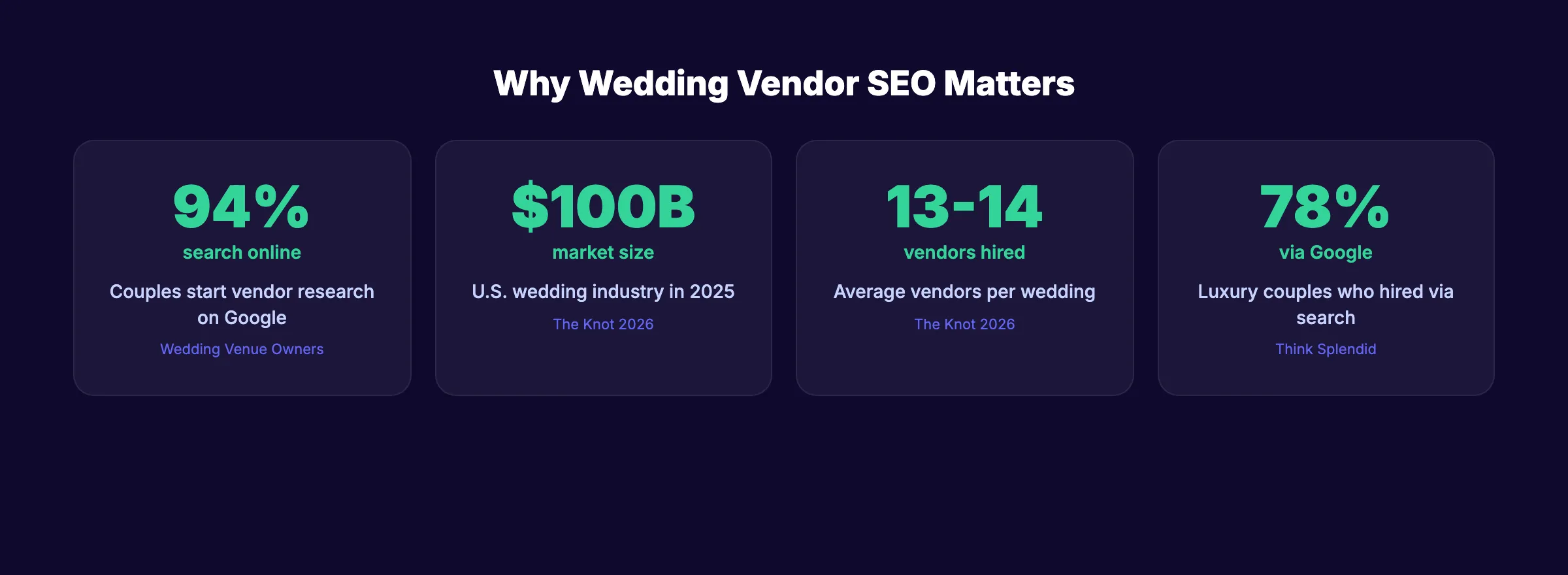
Why Wedding Vendors Need SEO Over Directory Listings
Most wedding vendors pay $300 to $500 per month for The Knot or WeddingWire listings. Those directories rank well on Google. But the leads they send are often price-shopping couples comparing 10 vendors at once.
Organic search delivers a different type of lead. When a couple searches "best wedding photographer in Austin" and finds your website first, they are already interested in you specifically. They have seen your work, read your about page, and formed an impression before they even send an inquiry. Organic leads close at higher rates and at higher price points.
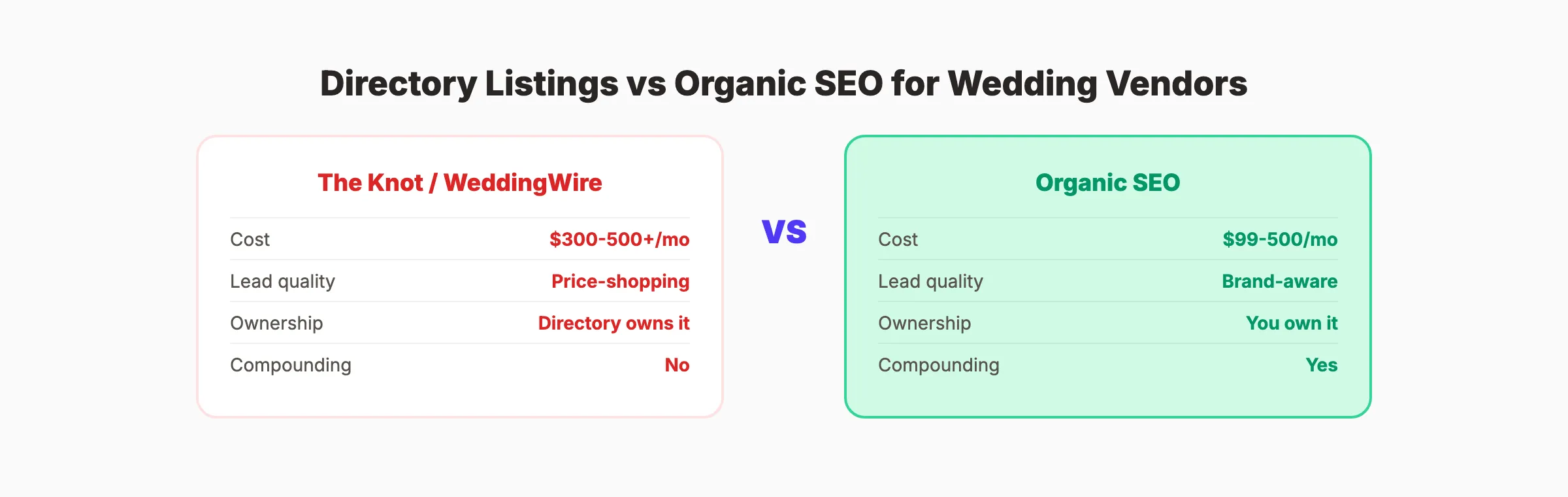
The Math: Directories vs Organic SEO
| Factor | Directory Listings | Organic SEO |
|---|---|---|
| Monthly cost | $300-$500+/mo per directory | $99-$500/mo for content + local SEO |
| Lead quality | Price-shopping, comparing many vendors | Intent-driven, already interested in your brand |
| Ownership | Directory owns the audience | You own your website and rankings |
| Compounding | Stops when you stop paying | Content and authority build over time |
| Control | Limited profile customization | Full control over messaging and experience |
SEO is the #1 inquiry source for wedding photographers, according to a poll of 330+ photographers. The vendors who invest in their own website SEO reduce directory dependency while building an asset they own.
For a full breakdown of SEO costs, see our pricing guide.
Your SEO team. $99 per month. 30 optimized articles published automatically. Built for local service businesses like wedding vendors.
Google Business Profile for Wedding Vendors
Your Google Business Profile is the most important single asset for wedding vendor SEO. It determines whether you appear in the map pack when couples search for vendors in your area.
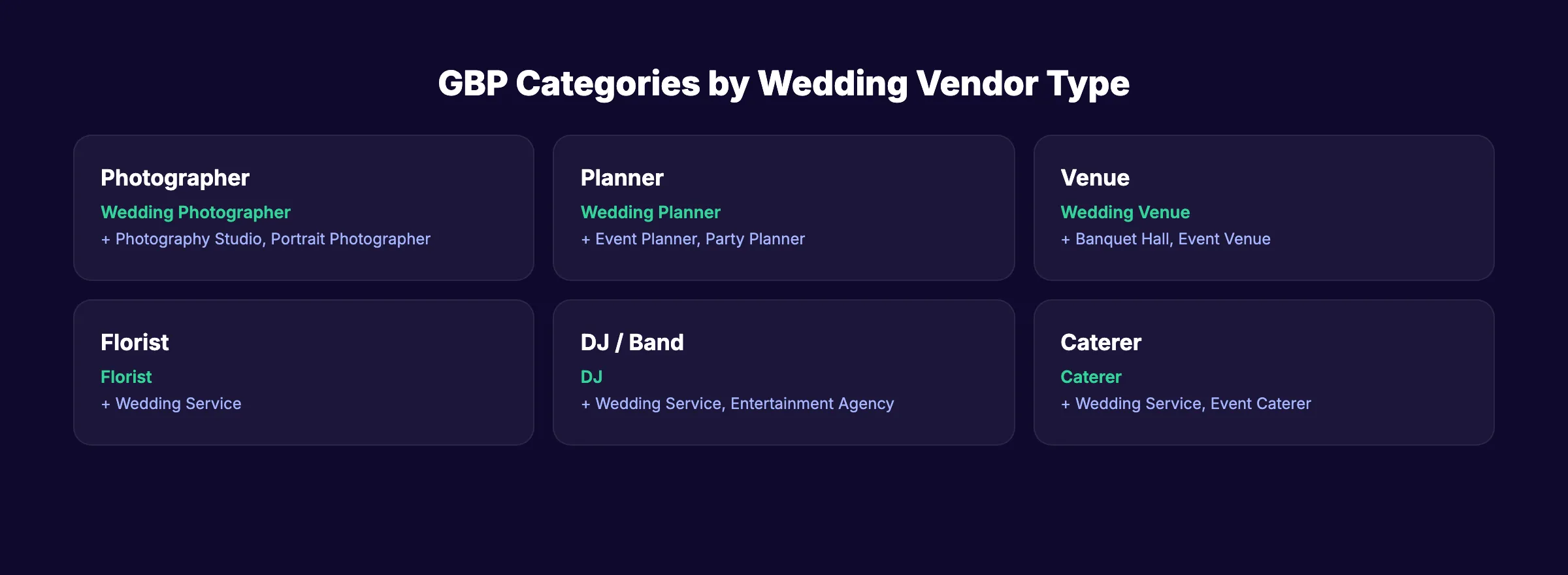
Choose the Right Categories
Your primary GBP category tells Google what type of wedding vendor you are. Use the most specific option available.
| Vendor Type | Primary Category | Secondary Categories |
|---|---|---|
| Photographer | Wedding Photographer | Photography Studio, Portrait Photographer |
| Planner | Wedding Planner | Event Planner, Party Planner |
| Venue | Wedding Venue | Banquet Hall, Event Venue, Conference Center |
| Florist | Florist | Wedding Service |
| DJ | DJ | Wedding Service, Entertainment Agency |
| Caterer | Caterer | Wedding Service, Event Caterer |
Complete Every Field
Listings with complete information get 7x more clicks than incomplete ones. Fill in services, business description (750 characters), hours, attributes, and your service area. Add 15 or more photos and upload new images monthly.
Post Regularly
Post 2 to 3 times per week. Share recent wedding highlights, seasonal availability, and behind-the-scenes content. GBP posts signal freshness to Google. Active listings rank higher than dormant ones.
Keyword Strategy for Wedding Vendors
Most wedding vendors target the wrong keywords. They optimize for "wedding photographer" (a national term they will never rank for) instead of "wedding photographer Austin TX" (a local term they can own).
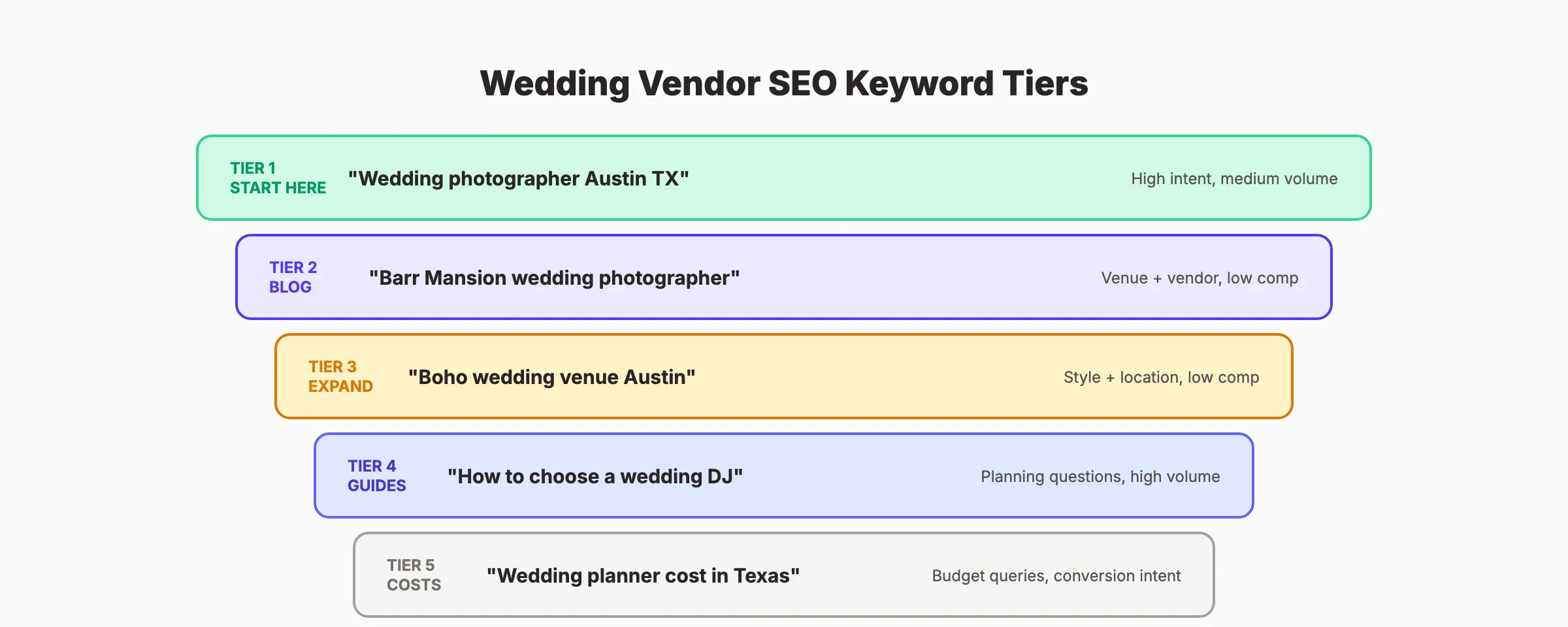
The Wedding Vendor Keyword Framework
| Keyword Tier | Pattern | Example | Volume | Competition |
|---|---|---|---|---|
| Tier 1: Local + vendor type | "[vendor] [city]" | "wedding planner Denver" | 200-2,000/mo | Medium |
| Tier 2: Venue + vendor | "[venue name] wedding" | "Barr Mansion wedding photographer" | 50-500/mo | Very low |
| Tier 3: Style + location | "[style] wedding [city]" | "boho wedding venue Austin" | 100-500/mo | Low |
| Tier 4: Planning questions | "how to [wedding task]" | "how to choose a wedding photographer" | 1,000-10,000/mo | Low |
| Tier 5: Cost queries | "how much does [service] cost" | "how much does a wedding DJ cost" | 500-5,000/mo | Low |
Where to Start
Target Tier 1 keywords first. Create a dedicated landing page for each major city you serve. "Wedding Photographer in Austin, TX" needs its own page with unique content, local references, and testimonials from clients in that area.
Then build Tier 2 content by blogging real weddings with venue names in the title. A post titled "Romantic Wedding at The Driskill Hotel | Austin Wedding Photographer" targets both the venue name and the location keyword simultaneously.
For keyword research methods, see our guide on keyword research for blog posts.
Blogging Real Weddings for SEO
Most wedding vendors blog about real weddings. But most of those blog posts rank for nothing. The reason: they optimize for the couple's names instead of keywords couples actually search.
The Right Way to Blog a Wedding
| Title format: "[Descriptor] Wedding at [Venue Name] | [City] [Vendor Type]" |
|---|---|
| Example: "Garden Wedding at Barr Mansion | Austin Wedding Photographer" |
What to include in every wedding blog post:
- ✓ Venue name in the title, H1, and first 100 words
- ✓ City and state in the title and body text
- ✓ Your vendor type in the title
- ✓ 20 to 40 optimized images (compressed, descriptive filenames, alt text)
- ✓ Vendor credits with links (builds relationships and earns reciprocal links)
- ✓ 300 to 500 words of text describing the day, the venue, and the details
- ✓ Internal links to your service pages and other wedding blog posts
Why Venue-Name Keywords Work
1 in 3 luxury couples research venues before they are even engaged. When they search "[venue name] wedding photos" or "[venue name] reviews," your blog post appears. You capture leads before they start actively searching for your vendor type.
Couples searching venue names are in research mode. They want to see what weddings at that venue look like. If your photography, floral design, or planning is showcased alongside the venue name, you are the first vendor they associate with that location.
Content Beyond Real Weddings
Real wedding blogs are the foundation. But add these content types to capture more search traffic:
- Planning guides , "How to Choose a Wedding Photographer in [City]" targets couples in the research phase
- Cost breakdowns , "How Much Does a Wedding Planner Cost in [State]?" captures budget-conscious couples
- Venue roundups , "10 Best Outdoor Wedding Venues in [City]" ranks for high-volume venue searches and positions you as a local expert
- Seasonal tips , "What to Wear to a Fall Wedding in [Region]" captures peripheral traffic that builds domain authority
- Vendor comparison content , "Wedding DJ vs Live Band: Pros and Cons" captures couples comparing options
Each post should link to your service pages and other blog posts. Build a web of internal links that keeps visitors on your site and signals topical authority to Google. For planning your content pipeline, see our content calendar guide.
3,500+ blogs published. Every article is SEO-scored before publish. Every article passes a 40-point quality audit before it goes live.
Image Optimization for Wedding Vendor Sites
Wedding vendor websites are image-heavy by nature. A photographer's portfolio page may contain 50 to 100 images. A venue's gallery shows dozens of event spaces. Without proper image optimization, those pages load slowly, tank your Core Web Vitals, and hurt your rankings.
The Image SEO Checklist
- ✓ Rename files descriptively. "lake-como-wedding-photography.jpg" ranks in Google Images. "IMG_4872.jpg" does not.
- ✓ Write alt text with keywords. "Bride and groom first dance at Barr Mansion, Austin wedding photographer" beats "photo1."
- ✓ Compress every image. Target under 200KB per image. Use WebP format. Tools: ShortPixel, TinyPNG, or Squoosh.
- ✓ Use responsive images. Serve smaller sizes on mobile devices.
- ✓ Lazy load below-the-fold images. Only load images as the user scrolls down. Improves initial page speed.
- ✓ Add structured data. ImageObject schema helps Google understand and index your images.
For a deeper guide, see our post on blog image optimization.
Why Image SEO Matters for Wedding Vendors
69% of couples choose restaurants based on food photos in emails. The same visual-first behavior applies to wedding vendors. Couples browse Google Images and Pinterest for inspiration. If your images appear in Google Image search results with proper alt text and filenames, they drive traffic to your site without any additional content creation.
Reviews and Reputation for Wedding Vendors
73% of couples rely on reviews when choosing vendors. 97% of consumers read reviews for local businesses. And 68% require a minimum 4-star rating. For wedding vendors, reviews are not just a trust signal. They are a booking requirement.
Review Impact on Wedding Vendor SEO
Review signals account for approximately 20% of local pack rankings. The volume, velocity, rating, and recency of your reviews directly determine whether you appear in the map 3-pack for "[vendor type] near me" searches.
Building a Wedding Vendor Review System
Wedding vendors have a unique advantage: the emotional peak after a wedding is the highest point of client satisfaction. Use it.
- Day of or day after: Send a thank-you text with a direct link to your Google review form
- Gallery delivery (1-2 weeks post-wedding): Follow up with an email requesting a review alongside the gallery link
- Social media prompt: When the couple shares photos and tags you, reply with gratitude and a gentle review request
The best review requests are personal. "We loved being part of your day at [Venue]. If you have a moment, a Google review would mean the world to us" outperforms a generic automated message.
For the complete review playbook, see our guide on getting more Google reviews.
Rank everywhere. Do nothing. Blog SEO, Local SEO, and Social on autopilot. theStacc starts at $99 per month with a free trial.
On-Page SEO for Wedding Vendor Websites
Most wedding vendor websites prioritize design over SEO. Beautiful portfolios with zero text, no title tags, and no header structure. Google cannot rank what it cannot read.
The Wedding Vendor On-Page Checklist
- ✓ Title tags include your vendor type and primary city (under 60 characters)
- ✓ Meta descriptions include your specialty and location (145-155 characters)
- ✓ H1 tag on every page matches the topic
- ✓ Service pages exist for each offering (wedding photography, elopements, engagement sessions)
- ✓ Location pages exist for each city you serve with unique content
- ✓ Schema markup with LocalBusiness type and relevant properties
- ✓ Mobile-friendly design (couples search on phones. 55%+ of searches happen on mobile)
- ✓ Page speed under 3 seconds (compress images, enable caching, use a CDN)
- ✓ NAP on every page (Name, Address, Phone in footer)
For a full on-page SEO checklist, see our detailed guide.
Seasonal Content Strategy
Weddings are seasonal. Engagement season peaks from November through February. Wedding season runs March through October. Your content calendar should match.
| Month | Content Focus |
|---|---|
| Nov-Feb | "Newly engaged" guides, venue selection tips, vendor checklists |
| Mar-May | Spring wedding inspiration, outdoor venue features, seasonal floral guides |
| Jun-Aug | Real wedding blogs from current season, behind-the-scenes content |
| Sep-Oct | Fall wedding content, year-end booking pushes, styled shoots |
Publishing 4 or more blog posts per month builds topical authority that compounds over time. A wedding photographer with 50 venue-specific blog posts ranks for dozens of long-tail keywords that no amount of directory spending can replicate.
Measuring Wedding Vendor SEO Results
Track these metrics monthly to know whether your SEO investment is working.
| Metric | Tool | What It Shows |
|---|---|---|
| Organic traffic | Google Analytics | Whether search visitors reach your site |
| Inquiry source | Contact form tracking | How many leads come from organic search |
| Keyword rankings | Google Search Console | Whether you rank for target wedding terms |
| GBP views and actions | GBP Insights | Map visibility, calls, and direction requests |
| Review count and rating | GBP dashboard | Whether your review system is producing results |
Realistic Timeline
| Timeframe | What to Expect |
|---|---|
| Month 1 | GBP optimization, site audit, first blog posts published |
| Months 2-3 | Google indexes new content. Impressions appear for long-tail keywords |
| Months 4-6 | Local keywords start ranking. Inquiry volume increases for upcoming wedding season |
| Months 7-12 | Authority compounds. Venue-name posts rank. Organic inquiries become a consistent channel |
SEO aligns well with the wedding booking cycle. Couples research 12 to 18 months before their wedding date. Content published today generates inquiries for next year's wedding season.
AI Search: The Emerging Channel
36% of engaged couples used AI tools for wedding planning in 2025, nearly double the previous year. 45% of consumers now use AI chatbots for local business recommendations. When a couple asks ChatGPT "best wedding photographer in Austin," the AI pulls from websites with strong content, reviews, and structured data.
Optimize for AI search by structuring content with clear headings and direct answers. Add FAQ schema to service pages. Build the kind of authoritative, well-cited content that AI systems prefer to reference. For a deeper look at this shift, see our guide on optimizing for AI Overviews.
Use our free SEO audit tool to check your current performance across all these factors.
What practitioners are saying on X
Local SEO advice ages quickly. Here is high-signal public discussion from operators who still win Map Pack visibility — context for your roadmap, not a substitute for primary data.
- @noelcetaSEO (Sep 2025): Local SEO playbook still centers complete GBP, NAP consistency, quality citations, local keywords, location content, review velocity, and local links. See the post on X.
- @irentdumpsters (Jan 2026): Most businesses have a GBP; few fully optimize every ranking-relevant section for Map Pack visibility. See the post on X.
- @EldarCohenSEO (Jul 2026): 2026 WhiteSpark-oriented reminder: primary Google Business category is a top Map Pack ranking factor — wrong primary category can erase visibility for money queries. See the post on X.
Grok, AI Overviews, and multi-engine visibility
For “wedding vendor seo”, multi-engine visibility still starts with clear definitions, sourced numbers, and extractable section answers. Grok additionally factors live X discussion — keep public claims consistent with this page.
- Google AI Overviews: Use passage-ready answers, tables, and FAQ schema where relevant.
- ChatGPT / Perplexity: Cite named sources next to key claims.
- Grok: Maintain accurate entity facts on-site and in high-signal X posts.
What wedding venue SEO can and cannot do
Wedding venue SEO makes accurate venue information easier to discover through Google Maps and organic results. It can help a searcher reach a relevant profile or page, but it cannot manufacture date inventory, venue fit, sales capacity, licences, or a good event experience. Treat discovery as an earlier stage, not proof of a booking or completed event.
For a venue, the useful unit of work is not “more visibility” in the abstract. It is a documented connection between a real offer and a searcher’s question: a ceremony-and-reception space, a reception-only room, a corporate event option, an accessible entrance, or a tour path that the operator can substantiate. The page or profile should make the next action clear without overstating availability or suitability.
Use a stage dictionary before reporting performance. Each stage needs a written business rule, a timestamp, a source system, an owner, exclusions, and a way to join it to the next stage. A call click is not a connected enquiry. A tour is not a signed agreement. A booked event may later cancel, and a completed event is later still.
| Stage | Business rule and timestamp | System and owner | Exclusions and next join |
|---|---|---|---|
| Impression | Google records an appearance for a declared query/page cohort at the report timestamp. | Search Console; search or analytics owner. | Disclose anonymized queries; join only to clicks in the same declared cohort. |
| Click | A Google organic click for that cohort. | Search Console; search or analytics owner. | Do not call it an enquiry; join to on-site events only where instrumentation permits. |
| Call click or form | A tracked click-to-call action or submitted form at its recorded time. | Website or call system; marketing owner. | Exclude form starts and test submissions; join to a connected record. |
| Connected and qualified enquiry | A contact reaches the venue and meets its documented event, date, capacity, geography, value-band, and restriction rule. | Call system plus CRM; venue sales owner. | Exclude spam, vendors, employment, duplicates, and unsupported dates or events; join to tour or contract record. |
| Tour, booked event, completed event | Use the venue’s written tour, signed-agreement, booking-commitment, and completion definitions with their own timestamps. | CRM, contract, and event systems; sales manager and operations owner. | Report holds, unsigned proposals, cancellations, and future events separately; never backfill a missing join. |
Search Console can report queries, pages, clicks, impressions, click-through rate, and average position within its documented limits. It does not know whether an enquiry was qualified or an event was completed. Make that boundary visible in every venue report.
Map the venue operation before choosing pages or keywords
Before choosing wedding venue keywords, build a factual inventory of what the venue actually offers and who owns each fact. The inventory prevents a page, profile, gallery, or sales form from promising a space, event type, amenity, date, or restriction that is stale, inferred, or awaiting review.
Start with physical spaces rather than marketing labels. List each real space and its usable event scope: ceremony, reception, corporate event, private dinner, or another event type the venue actually offers. Capture setting or style only as an operator-approved description. Use capacity ranges and layouts only where the venue has approved them; a range can be more truthful than a single headline number.
| Inventory field | Record | Evidence and control |
|---|---|---|
| Space and event scope | Actual room, outdoor area, or campus space; event types actually offered. | Operations-approved source; named owner and last-reviewed date. |
| Fit and access | Setting, layout or capacity band, amenities, and accessibility facts. | Current venue material or inspection record; mark unknowns rather than infer them. |
| Commercial context | Date or season availability context, booking-window evidence, and venue-defined package or value band. | Dated availability or sales record; do not publish a portable lead-time or price benchmark. |
| Restrictions | Venue-approved catering, vendor, alcohol, noise, insurance, or other restrictions. | Mark “operator verified” or “review required”; route legal or compliance decisions to qualified local reviewers. |
| Tour path | Tour options, form fields, response owner, and the next CRM stage. | Test submission or documented workflow; record the accountable sales owner. |
A multi-space venue often has different search jobs hiding under one brand. Someone looking for a reception room may need a different answer from someone exploring a ceremony setting or a company off-site. That does not automatically mean three pages. It means the operator must understand the distinctions before assigning pages, images, and calls to action.
Keep the inventory in a dated working record. If a field changes, update the profile, the owner page, related gallery captions, and the tour form where applicable. If a fact cannot be approved, hold it. Search content is not a place to resolve venue, alcohol, food-service, accessibility, occupancy, insurance, or zoning decisions.
Separate Maps visibility from organic page visibility
Maps visibility and organic page visibility share venue facts but rely on different assets and diagnostics. A Business Profile update cannot substitute for a useful page about a real space or event fit, while an organic page cannot create proximity or profile eligibility. Diagnose the surface first, then assign a correction and owner.
For Maps, begin with profile eligibility and real-world representation. Google’s Business Profile guidance covers accurate names, addresses or service areas, categories, and one-profile expectations. For organic discovery, begin with whether Google can crawl a useful page with descriptive, people-first content and crawlable links. The two surfaces should agree on the core truth without being copied mechanically.
| Surface | Eligible asset | Shared truth | Unique diagnostic and owner |
|---|---|---|---|
| Maps and local results | A properly represented, eligible Google Business Profile for the real venue. | Name, actual location, contact route, visitor-facing hours where applicable, and real venue evidence. | Profile status and edits; GBP owner. Review relevance, distance, and prominence as Google describes them, not a private ranking formula. |
| Organic results | Crawlable pages that answer a distinct venue question with reviewed text, images, and links. | The same approved space, event, access, restriction, and contact facts. | Index coverage, page/query data, titles, internal links, and page usefulness; search or technical owner. |
| Tour conversion path | Page and form or call route that matches the promised next step. | Event scope, requested date context, and contact details. | Test the handoff and CRM join; sales and marketing owners. |
If a query has a local pack, a venue may need both surfaces working without treating them as interchangeable. If a page earns impressions but a related profile is inaccurate, fix the profile truth. If a profile is sound but a space-specific question has no useful page, decide whether that question has enough distinct proof to earn one. For generic ranking mechanics, use the separate guide to ranking higher on Google; this page stays focused on venue diagnosis.
Publish content built for Google and AI citations. theStacc’s Content SEO module ships SEO-scored articles structured for rankings and generative engines — including clearer entity pages models like Grok can quote.
Keep the GBP and site consistent with real venue operations
A wedding venue’s Business Profile and website should tell the same, operator-verified story about the real place. Keep the name, actual location, contact route, chosen category from live options, event scope, visitor information, images, and tour destination current; do not turn post frequency, review volume, or categories into a ranking formula.
Google says complete and accurate profile information helps it match a business to relevant local searches, but it also says there is no way to request or pay for better local ranking. That is a reason to review factual accuracy, not to stuff a venue name with keywords or create extra profiles for the same business. Representation guidelines require a real-world name and an accurate address or service area.
Run a profile-to-site comparison whenever an operational change occurs. Check the published name, actual location, phone, website or tour URL, hours or appointment information where appropriate, offered event types, and images. The profile’s category should be selected from live options and represent the core business; do not assume a category from a generic list. Google’s guidelines specifically cover categories, addresses, and venue representation.
Images deserve the same review. Use real venue photos that a visitor can understand in context: identify the space, the event or layout shown if approved, and the relevant accessibility or amenity detail where it is visible and verified. Keep rights and permission records for photography and do not publish couple or customer details without permission. The venue-specific decision is the proof and context; for generic image mechanics, see the image optimization guide.
Reviews are evidence in a decision path, not a script for manipulating local results. Google permits asking genuine customers for reviews, prohibits incentives conditioned on sentiment, and advises businesses to protect personal information in replies. A venue should use its own approved follow-up process, then route review operations to the review management guide rather than inventing a response-time rule.
Create a canonical map for spaces, event types, settings, and locations
A canonical page map assigns each real venue question to one owner instead of creating a page for every keyword variation. Give a space, event type, setting, amenity, or geography its own page only when it serves a distinct reader job and has reviewable venue proof. Otherwise improve, merge, hold, or exclude the existing owner.
Use a compact decision tree before creating a URL. First ask whether an approved page already answers the query. If it does, add the missing evidence there. If the searcher has a distinct task and the venue has enough approved facts, images, and a clear next step, create a dedicated page. If the question is small but useful, add an FAQ answer. If the material overlaps or repeats, merge it. If evidence is incomplete, hold it. If the venue does not offer it, exclude it.
| Question pattern | Decision | Minimum proof before publishing |
|---|---|---|
| “Can this real room host this approved event type?” | Update a shared owner or create a distinct space/event page when the reader job differs. | Space scope, operator-approved layout or capacity qualifier, relevant images, restriction context, and next step. |
| “Does the venue have this amenity or access feature?” | Add evidence to the page that owns the space or answer in an FAQ. | Current, operator-verified fact and review date. |
| “Wedding venue in [city]” for a place outside that city | Hold or exclude rather than make a swapped-location page. | Do not fabricate local relevance or use doorway-like variants. |
| Overlapping space, style, and event pages | Merge where a single page serves the same reader job. | Redirect or canonical handling should be owned by the technical reviewer. |
Keyword research still matters, but it should not drive a venue into a page factory. The detailed space × event × location × intent workflow belongs in the venue keyword-research spoke when it is published. Until then, keep this pillar at the decision level and use the Google Business Profile optimization guide for generic profile mechanics.
Build pages and galleries from venue evidence
Venue pages and galleries should document a real space or event fit clearly enough for a prospective client to decide on a next step. Each owner page needs approved scope, context-rich images, capacity or layout qualifiers where available, restrictions and availability caveats, an accessible contact path, useful internal links, and a named last-review owner.
Start a page with the question it owns. A space page may explain which approved events it can host, show the actual setting, and identify a tour or enquiry path. An event page may link back to relevant spaces and state what the venue can verify. Avoid generic superlatives, fake real-event narratives, and phrases that imply availability on a particular date unless the venue has a controlled, current source for that information.
Google’s guidance on helpful content favors material made for an intended audience with useful purpose and original value. Its image guidance supports high-quality images in relevant context with descriptive alt text and metadata where appropriate. That means gallery captions can clarify what the image shows without cramming in location phrases. It also means an image-only gallery is usually a poor owner for an operational question.
- Scope: identify the actual space or approved event type, not a keyword-created offer.
- Proof: use approved photography, image rights records, contextual alt text, and a last-reviewed owner.
- Qualifiers: state approved capacity bands, layouts, amenities, access facts, restrictions, and availability caveats without inferring compliance.
- Next step: link to the appropriate tour or enquiry route and make its requested information match the page promise.
- Connections: link related spaces, event pages, and genuine FAQs so a user and crawler can reach the next useful answer.
Structured data can help Google understand visible, accurate business information when supported properties are used. It does not replace the page’s content, resolve an unverified fact, or turn a gallery into a complete venue description. Assign markup changes to the technical owner after the visible source of truth is approved.
Diagnose venue SEO failure states instead of listing generic mistakes
Venue SEO problems are easier to fix when they are described as failure states with evidence, owners, and retest dates. A traffic drop, low enquiry count, or poor ranking position does not prove a single cause. Check the affected surface and stage, record plausible causes, then make the smallest correction that the evidence supports.
| Failure state | Surface or stage | Evidence and plausible causes | Owner, correction, retest |
|---|---|---|---|
| Wrong surface is being changed | Maps or organic | Query result type, profile status, and page/query data; a page change may not address a profile issue. | Search/GBP owner; assign the correct asset; retest on a dated review. |
| False or stale operational facts | Profile, page, gallery, form | Inventory conflicts with published copy, image context, or tour fields. | Operations approver; correct all owners of the fact; record review date. |
| Conflicting or thin page ownership | Organic | One page answers incompatible event intents, or variants repeat the same text. | Content and technical owners; add evidence, merge, hold, or exclude; check indexing later. |
| Inaccessible gallery or duplicate titles | Organic and user path | Images lack useful context, important content is absent from text, or title records overlap. | Content/technical owners; improve the actual owner page; retest crawl and page rendering. |
| Tour-path mismatch or missed call ownership | Enquiry stage | Form asks for different information than the page promises, or call records have no sales owner. | Sales and marketing owners; test a route and document the CRM join. |
| Unjoined downstream stages | Measurement | Clicks, forms, and booked events cannot be connected under a declared rule. | Analytics and sales owners; report the earlier observable stage and mark downstream evidence unavailable. |
Maintain a failure-state log with symptom, affected surface or stage, evidence, plausible causes, diagnostic owner, correction, retest date, and what cannot be concluded. This protects the venue from replacing a factual problem with a content-volume project or reading one short reporting window as a business result.
Bring the evidence chain before you buy more activity. A focused strategy call can help separate profile, page, tracking, and operating-process work.
Decide whether SEO is worth testing from venue economics
Wedding venue SEO is worth testing when the venue can define the commercial and operating conditions that make a search programme accountable. Use the venue’s own capacity, priority event mix, value bands, direct spend, competitive context, sales capacity, and completed-event evidence. Do not borrow a generic ROI, payback period, booking rate, or ticket-size benchmark.
A useful decision has four possible outcomes. Go means facts, proof, tracking, and sales capacity are ready for a scoped test. Limited test means a high-priority space or event question has evidence, but the venue will bound spend, duration, and review criteria. Repair-first means inventory, technical readiness, or tour-path truth is missing. Stop or hold means the venue cannot serve the demand, cannot define success, or cannot observe the downstream stage.
| Worth-testing input | Venue-owned evidence | Decision implication |
|---|---|---|
| Date capacity and priority event fit | Approved availability context and event mix, with exclusions. | Do not promote an event or date pattern the venue cannot serve. |
| Package or value band and contribution definition | Venue-defined bands and finance-approved treatment of direct cost. | Keep commercial evaluation venue-specific; do not use a portable ROI claim. |
| Search demand and local competition | Declared query evidence and local result review, with date and geography. | Use as prioritization evidence, not a forecast of traffic, enquiries, or bookings. |
| Tour and sales capacity | Named response owner, form/call route, and written qualification rule. | Repair the handoff before judging search from unconnected contacts. |
| Proof, technical, and tracking readiness | Reviewed pages and images, crawl checks, and stage joins. | Choose go, limited test, repair-first, or stop/hold with a review date. |
If the venue needs help with a distinct system, keep the capability claim narrow. The Content SEO module covers keyword research, long-form drafting, on-page scoring, queueing, and CMS publishing. The Local SEO module covers GBP posts, review replies, citations, rank tracking, and approval rules. The venue still owns factual approval, operating fit, and commercial definitions.
Choose what to DIY, delegate, hire, or automate
Venue SEO works best when ownership is assigned task by task, not when “SEO” is handed to one vague owner. Keep operational truth, restrictions, image rights, and sales qualification with the people who know them. Delegate specialist production or technical work only with access, an approver, evidence of completion, and a clear escalation trigger.
| Task | Venue knowledge and risk | Suggested owner and proof | Escalation trigger |
|---|---|---|---|
| Space, event, access, restriction, and availability facts | High venue knowledge; policy or compliance sensitivity. | Operations owner approves dated inventory evidence. | Fact is uncertain, disputed, or requires qualified local review. |
| Content briefs, pages, and internal links | Requires venue proof plus editorial skill. | Marketing owns brief; operations approves facts; CMS record confirms publication. | New page lacks a distinct reader job or enough proof. |
| Images and rights | High rights, privacy, and accuracy risk. | Asset owner maintains permission and context records. | Image, couple detail, or accessibility claim lacks approval. |
| GBP and review replies | Platform-policy and representation risk. | Named profile owner works from approved facts and review policy. | Profile eligibility, name, address, category, or review issue needs policy review. |
| Technical and analytics changes | Requires system access and QA. | Technical/analytics owner keeps deployment and test evidence. | Crawl, indexing, event, or CRM join is broken. |
| Sales follow-up and CRM stages | High operating impact. | Sales owner defines qualification, tour, booking, and completion rules. | Contact cannot be connected to the next stage. |
DIY can be sensible when the venue has reliable facts, a capable internal owner, controlled CMS access, and enough time to review evidence. Delegation can work when the venue retains approval. Hiring is a fit when specialist work or governance needs exceed internal capacity. None of those choices removes the need for the venue to own its factual record and sales definitions.
Measure progress by stages and cohorts, not a universal timeline
Measure venue SEO with dated cohorts that move from discovery to completed events, not with a promised month range. Review indexation and query discovery first, then impressions, clicks, call clicks or forms, connected and qualified enquiries, tours if tracked, booked events, and completed events. Segment by space, event type, date, or season only where data quality permits.
Set formulas only when their numerator, denominator, evidence window, source system, owner, and exclusions are present beside the result. The following definitions are operating templates, not benchmarks.
| Measure | Formula and evidence window | System, owner, exclusions |
|---|---|---|
| Organic click-through rate | Google organic clicks ÷ Google organic impressions for the same declared query/page/device/country cohort; compare one declared 28-day window with the immediately preceding comparable 28-day window and state season/date caveats. | Search Console export; search/analytics owner. Exclude branded queries for non-brand analysis and non-US traffic for US scope; disclose missing or anonymized queries. |
| Qualified-enquiry rate | Unique connected enquiries meeting the written event, date, capacity, geography, value-band, and restriction rule ÷ all unique connected enquiries under the same rule and cohort; use one declared 28-day enquiry cohort plus stated qualification lag. | Call system plus form/CRM; venue sales owner. Exclude call clicks without connection, form starts, spam, vendors, employment, duplicates, unsupported events/dates, and tests. |
| Booked-event rate | Unique qualified enquiries with a signed agreement and venue-defined booking commitment ÷ all qualified enquiries created in the same cohort; use a declared 90-day or venue-approved window plus documented decision lag. | CRM/contract system; sales manager with finance/operations sign-off. Exclude holds, tours, proposals, unsigned agreements, and cancelled leads; report cancellations separately. |
| Cost per completed attributable event | Direct approved search-program spend for the declared cohort ÷ unique attributable booked events from that cohort that reached the completed-event state; include enough lag for every event date to pass. | Invoice/time-cost ledger plus analytics, CRM, contract, and event systems; finance owner with marketing and operations sign-off. Exclude uncosted owner labour, unattributable or cancelled events, open/future bookings, non-search spend, and refunds unless the rule states treatment. |
Never divide impressions by enquiries or revenue and label the result causal. When a venue cannot join an observable search action to a downstream outcome, report the earlier stage and mark downstream evidence unavailable. That is more useful than a synthetic ROI calculation because it shows exactly which operating connection still needs work.
Run a bounded 30-day repair and measurement cycle
A 30-day venue SEO cycle is an operating rhythm for repairing truth, page ownership, proof, and measurement. It is not a promise of ranking movement, tours, bookings, or completed events in 30 days. Finish each week with documented evidence, dependencies, exclusions, and a named decision about what to keep, change, or stop.
| Week | Action and owner | Evidence, dependency, and review decision |
|---|---|---|
| 1 — inventory and truth | Operations and sales confirm spaces, event scope, facts, restrictions, dates/availability context, and tour rules. | Dated inventory with owner and approval status. Hold any field that needs review. |
| 2 — surfaces and canonicals | Marketing, GBP, and technical owners compare profile and site truth, then assign page owners, merges, holds, or exclusions. | Surface map, page decision log, and crawl/indexing checks. Do not create swapped-city pages. |
| 3 — proof and instrumentation | Content and asset owners add reviewed text, image context, rights records, internal links, and matching tour-form fields; analytics and sales test joins. | Published-page review, test records, and CRM-stage definitions. Escalate broken handoffs. |
| 4 — evidence review | Search, analytics, sales, and operations review the declared cohort and assign the next action. | Change log, observable stages, limitations, and keep/change/stop decision with next review date. |
Use the cycle to make smaller, defensible decisions: correct a stale fact, merge a thin page, give a space page better evidence, repair a form handoff, or wait for a missing operational approval. The result is a venue search system that stays tied to real spaces and real records instead of a generic publication schedule.
Start with the venue’s real operating evidence. A focused strategy call can help turn that evidence into an accountable local-search repair plan.
FAQ
These answers keep the distinction between search discovery and venue outcomes explicit. Apply each answer to the venue’s documented spaces, event scope, availability context, sales workflow, and evidence records rather than using it as a universal ranking, timing, or return-on-investment rule.
What is wedding venue SEO?
Wedding venue SEO is the work of making accurate venue information discoverable in Google Maps and organic search. It connects real spaces, event types, location, availability context, images, and next steps to searches that a venue can genuinely serve; it does not create inventory, sales capacity, or a successful event.
How can a wedding venue improve visibility on Google?
Start by verifying that the Google Business Profile and website describe the same real venue: its name, location, contact details, event scope, visitor-facing information, and images. Then repair the page or profile that owns the searcher’s question, keep evidence current, and review Search Console and enquiry records by defined stage.
Should a venue focus on Google Maps or its website first?
Start with the surface that is failing. A profile cannot replace a useful page about a real space or event fit, and a page cannot create proximity or Business Profile eligibility. Check profile truth and eligibility for Maps discovery, then check crawlable pages, titles, links, and evidence for organic discovery.
What SEO mistakes do wedding venue websites make?
Common venue SEO failure states include stale operational facts, one page trying to answer conflicting event intents, thin location variants, inaccessible image-only galleries, duplicate titles, blocked indexing, and tour forms that do not match the page promise. Diagnose each with evidence before changing it; a symptom alone does not prove the cause.
How long does wedding venue SEO take?
There is no universal wedding venue SEO timeline. Discovery, indexing, search impressions, clicks, connected enquiries, tours, bookings, and completed events occur on different clocks. Review changes in dated cohorts, account for the venue’s own seasonality and booking-decision lag, and do not treat an early search signal as a completed-event result.
Is wedding venue SEO worth paying for?
SEO is worth testing only when the venue can state its available date capacity, priority event fit, value bands, competitive context, sales and tour capacity, proof readiness, technical readiness, and stage-tracking rules. If those inputs are missing, repair the operating evidence first or run a limited, explicitly bounded test rather than claiming a universal return.
Can a wedding venue do SEO without an agency?
Yes, a venue can keep factual ownership in-house and delegate specialist work selectively. Operations should approve venue facts, images, restrictions, and availability context; marketing can own content and profile updates; technical staff can own site changes; and sales can own enquiry-stage definitions. Record access, approver, proof, and escalation trigger for every task.
Should every city, space, amenity, or event type have its own page?
No. Give a page its own owner only when it serves a distinct reader job and has real, reviewable proof. Otherwise add evidence to a shared page, answer the question in an FAQ, merge overlapping pages, hold the idea pending proof, or exclude it. Swapped-city pages and near-duplicate variants are not a venue content strategy.
Sources & references
- [1] Google Business Profile Help — local ranking factors
- [2] Google Business Profile Help — representation guidelines
- [3] Google Business Profile Help — review policy
- [4] Google Search Console Help — Performance report
- [5] Google Search Central — SEO Starter Guide
- [6] Google Search Central — people-first content
- [7] Google Search Central — Image SEO best practices
- [8] Google Search Central — LocalBusiness structured data
- [9] Google Analytics Help — recommended lead events

Manage Google Business Profile posts, review replies, and local rank tracking.
Weekly local SEO teardowns
One practical email a week. Map Pack, GBP, AI Overviews — no fluff. Unsubscribe anytime.