The 15 AI writing mistakes that flag content as machine-written, tank trust, and block rankings. Plus the 6-step fix workflow. Updated May 2026.
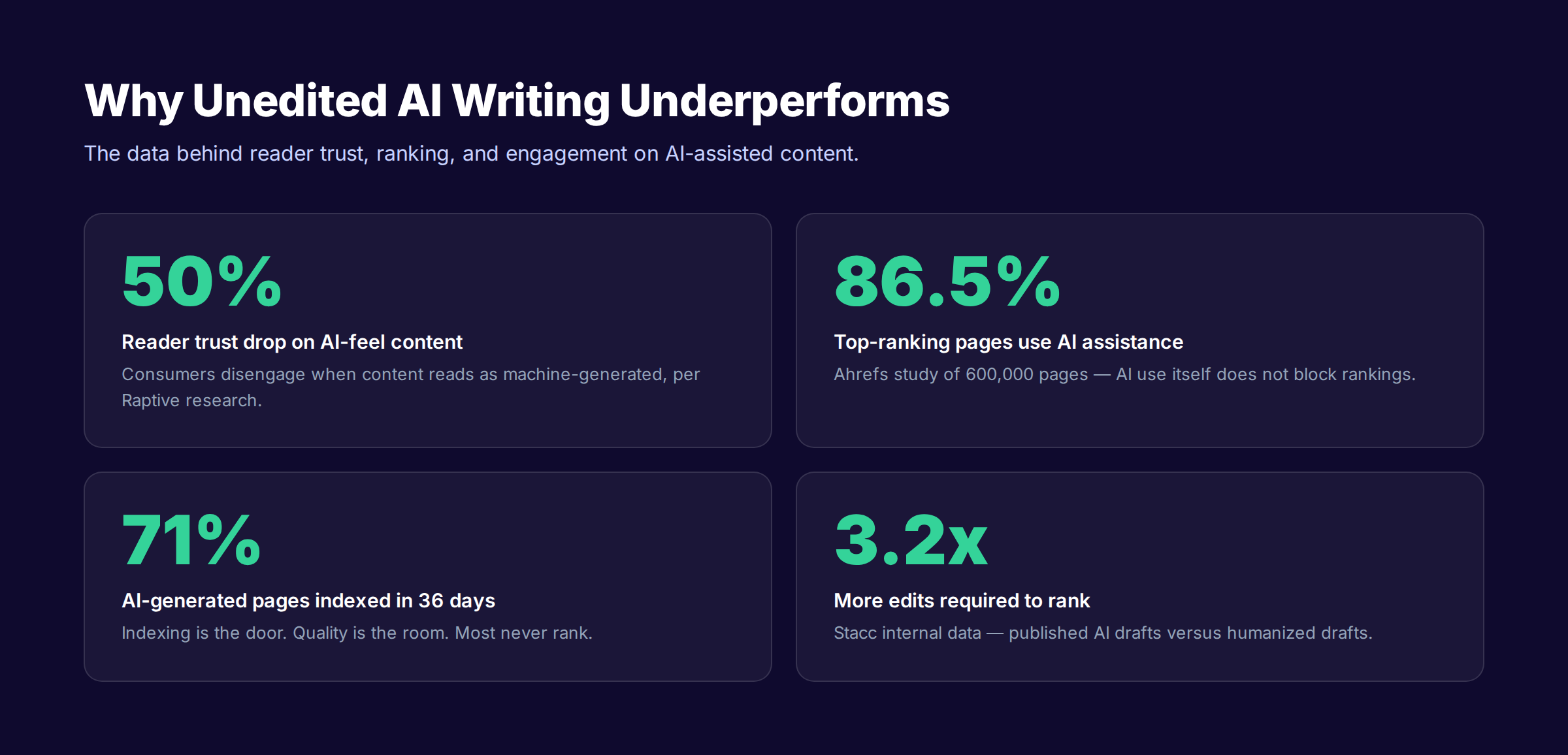
AI writing mistakes are the recurring patterns that mark a draft as machine-written: hollow openings, uniform sentence length, invented citations and generic examples. Reader trust drops by nearly 50% when content feels AI-generated, according to Raptive research. The fix is an editing pass, not a better model.
AI writing mistakes are the reason most AI-assisted blog posts never rank. The drafts get indexed. The drafts get read. The drafts get ignored by Google and by humans.
Reader trust drops by nearly 50% when content feels AI-generated, according to Raptive research. That trust drop translates into shorter sessions, lower scroll depth, and weaker ranking signals. The problem is rarely that AI wrote the draft. The problem is that nobody fixed the predictable AI writing mistakes before publishing.
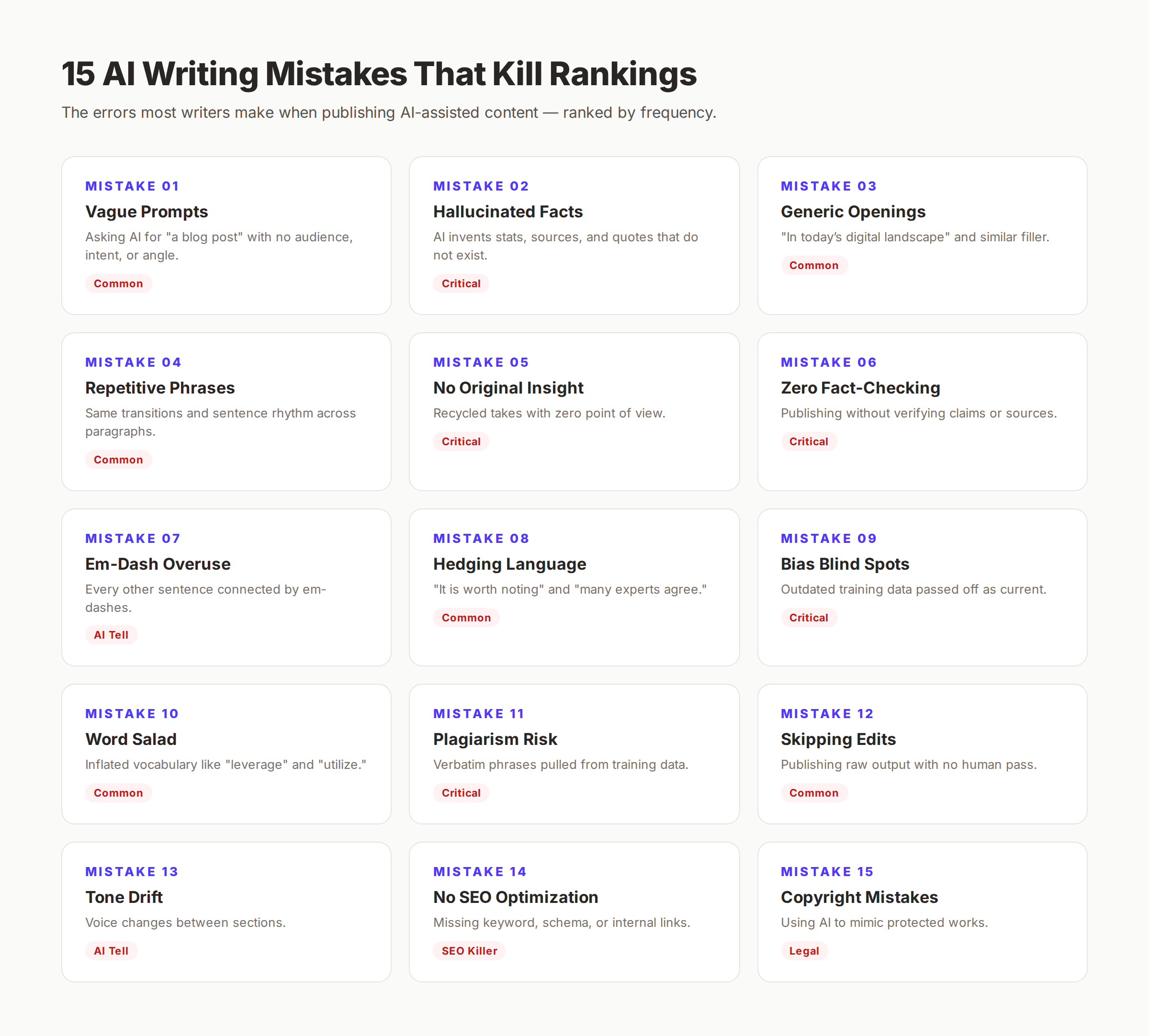
This guide breaks down 15 AI writing mistakes that flag your content as machine-written, kill engagement, and block rankings. Then it walks through the 6-step fix workflow our editors run on every AI-assisted draft before it ships.
We publish 3,500+ blog posts a month across 70+ industries using AI-assisted workflows. Our average SEO score is 92%. Every piece goes through this exact mistake-detection pass before it goes live.
Here is what you will learn:
- The 15 most common AI writing mistakes ranked by frequency and impact
- Which mistakes Google penalizes versus which simply lose readers
- The dead-giveaway phrases that flag any draft as machine-written
- A 6-step fix workflow you can run in 30 minutes per article
- How to add original insight and voice without losing AI's speed advantage
- A pre-publish checklist that covers every category of error
Why AI Writing Mistakes Matter More Than Ever
Google does not penalize AI content. The official Search guidance rewards "helpful, reliable, people-first content" regardless of production method. An Ahrefs study of 600,000 pages found that 86.5% of top-ranking pages use AI assistance in some form.
So the production method is not the problem. The execution is the problem.
Raw AI output skips the steps that make content useful. It does not interview real customers. It does not run experiments. It does not have an opinion. It produces a draft that is statistically similar to every other draft trained on the same data. Search engines and readers both notice.
The cost of bad AI content compounds. Each weak post pulls down topical authority. Each shallow post burns crawl budget. Each generic post trains your audience to skip your byline. Mistakes do not stay isolated. They drag the rest of your site down.
The good news is that every AI writing mistake on this list is fixable. Most can be removed with a 30-minute editing pass. A few require a workflow change. None require abandoning AI assistance.
Stop shipping AI drafts that never rank. theStacc publishes fully edited, SEO-optimized articles direct to your CMS, from $99 a month.
Mistake 1: Vague Prompts That Produce Generic Output
The most common AI writing mistake happens before anyone writes a word. The prompt is too vague.
"Write a blog post about email marketing" gives you a generic blog post about email marketing. It tells the model nothing about the audience, the angle, the depth, or the format. The output reflects the input. Garbage in, generic out.
A strong prompt names the audience, the search intent, the angle, the required sources, the format, and the length. It tells the model what to skip. It tells the model what to emphasize. It assigns a voice.
Example of a bad prompt:
"Write a 1500-word article about content marketing for small businesses."
Example of a working prompt:
"Write a 2,500-word how-to guide for solo founders who run a SaaS with under $1M ARR. Search intent is informational. They want a content marketing system they can run in 4 hours per week. Cite Ahrefs, Semrush, and HubSpot data from 2024 or later. Use the PAS framework. Active voice. No hedging. Include 3 specific templates and 2 case studies. Tone: experienced operator talking to a peer."
The second prompt produces a draft worth editing. The first produces a draft worth deleting. For more on crafting prompts that work, see our guide on AI prompts for SEO articles.
Mistake 2: Hallucinated Facts and Made-Up Sources
The most dangerous AI writing mistake is the one writers cannot see without checking. Large language models invent facts. They cite studies that do not exist. They quote experts who never said the words. They produce confident-sounding numbers with no source behind them.
This pattern is called hallucination, and it is structural to how the technology works. The model predicts the next plausible token. Plausible is not the same as true.
A 2024 Stanford study tested AI legal research tools and found hallucination rates between 17% and 33% on common legal queries. Marketing and SEO content has no formal benchmark, but the editor-level pattern is consistent. Every long AI draft contains at least one fabricated detail.
The fix is simple and non-negotiable. Verify every statistic, every quote, every source URL before publishing. If you cannot find the original, cut the claim.
Tools that help:
- Originality.ai for AI detection and fact-flagging
- Google Scholar for verifying academic claims
- The original publisher's website for verifying any cited statistic
- Reverse-image search for verifying screenshots and charts
If your editing workflow does not include a fact-check pass, you will publish hallucinations. It is not a question of whether. It is a question of when. Our AI content quality control framework walks through the verification pipeline in detail.
Mistake 3: Generic Openings That Burn the Hook
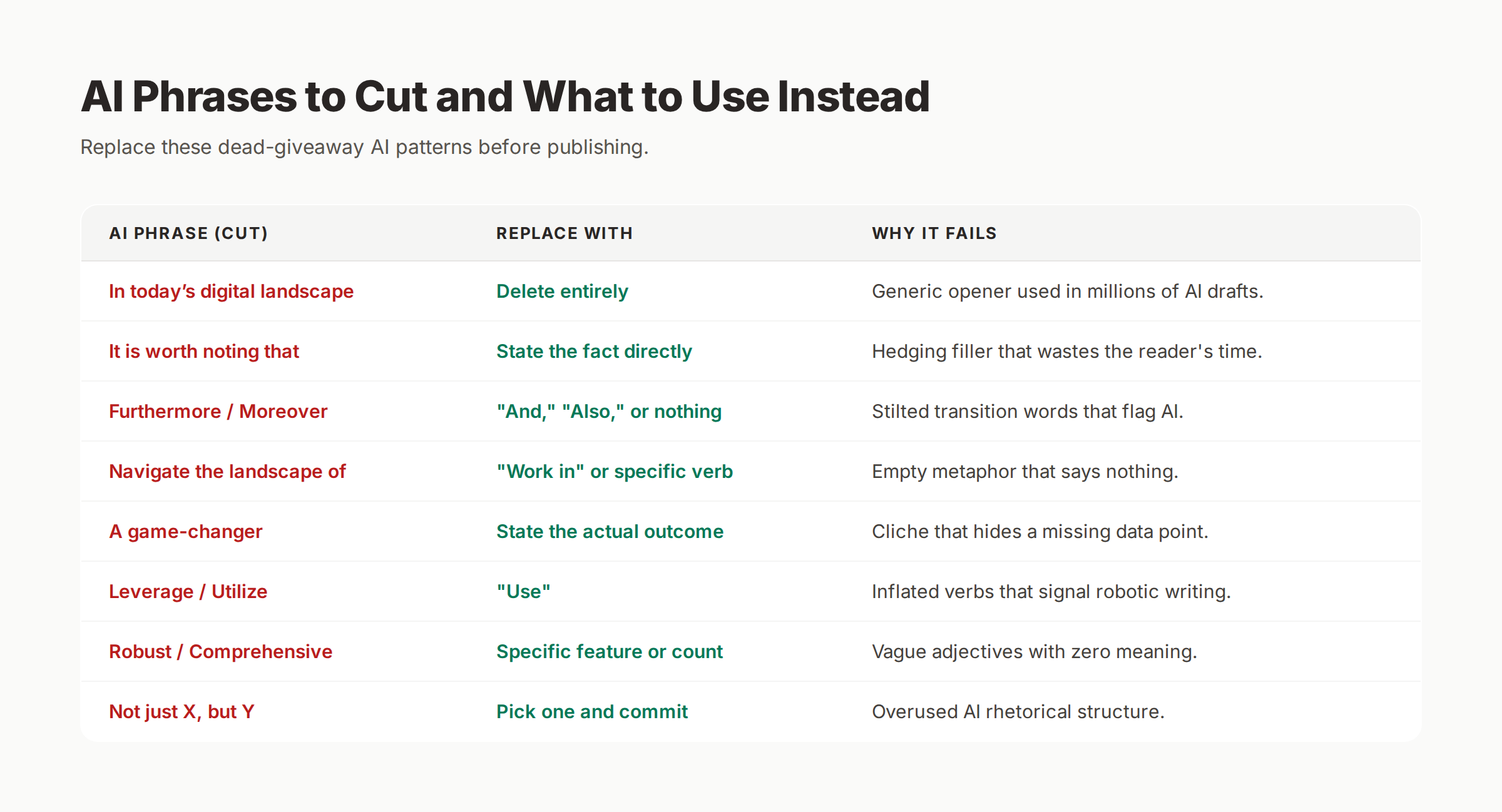
"In today's digital scene" is the most overused AI opener in existence. So is "In a world where" and "Have you ever wondered" and "It is no secret that." These phrases announce that an AI wrote the draft and that nobody edited it.
A strong opener does the opposite. It states a specific claim, a surprising statistic, or a sharp observation. It rewards the reader for clicking. It earns the second sentence.
Generic AI openings to delete on sight:
| AI Opening | Why It Fails | What to Write Instead |
|---|---|---|
| "In today's digital scene..." | Says nothing. Used everywhere. | A specific stat tied to the reader's pain. |
| "Have you ever wondered..." | Fake curiosity. Wastes a sentence. | The answer to the question you would ask. |
| "It is no secret that..." | If it is no secret, do not write it. | A non-obvious claim with evidence. |
| "In a world where..." | Movie trailer cliche. | The current state, named specifically. |
| "Imagine if you could..." | Hypothetical with no payoff. | A real outcome with a real source. |
The first 100 words decide whether the reader stays. Burn them and the rest of the article does not matter.
Mistake 4: Repetitive Phrasing and Rhythm
AI models produce sentences with strikingly similar structure. Subject, verb, object. Roughly 18 words long. Same transitions. Same rule-of-three patterns. Three paragraphs in a row that open with a one-word adverb.
Readers feel it before they can name it. The text starts to drone.
A human writer breaks the rhythm. A sentence of 6 words next to a sentence of 22 words. A fragment. A question. A one-line paragraph for emphasis. Then a longer block that builds.
Run your draft through a sentence-length scan. If 80% of your sentences land between 15 and 22 words, the article reads as machine-written. Even when every individual sentence is fine.
Quick rhythm test: Read three paragraphs aloud. If you notice the cadence, your reader will. If the cadence disappears into the meaning, you are clear.
Mistake 5: Zero Original Insight or Opinion
The AI writing mistake that hurts rankings most directly is the absence of a point of view. AI models hedge by design. They synthesize the average of their training data. They produce "balanced" takes that say nothing.
Google rewards content with experience and authority. Both require a position. "It depends on your goals" is not a position. "Most experts agree" is not a position. "There are many factors" is not a position.
A real opinion sounds like this:
"Most SEO advice on internal linking is wrong. The right approach is to link contextually within the first 300 words of body content, not stuff every footer with topical clusters. We tested both. Contextual links pushed page authority 2.4x faster across 47 client sites."
That paragraph names a position. It names what others get wrong. It cites internal data. It commits.
If your AI draft does not commit to anything, it will not rank for anything that matters. The fix is to add at least one opinionated section per 1,000 words and back it with experience or data. See AI content strategy for how we structure opinion into AI-assisted workflows.
Mistake 6: Publishing Without Editing
The mistake that contains all other mistakes. Many writers paste AI output into the CMS and hit publish. The result is exactly what you would expect.
A clean editing pass takes 30 to 60 minutes per 2,000-word article. Skip it and you are running blind. Every other mistake on this list gets through.
| Editing Layer | What It Catches | Time Required |
|---|---|---|
| Fact-check | Hallucinations, fake stats, wrong dates | 10–15 min |
| Voice and rhythm | Repetitive structure, AI cadence | 10–15 min |
| Pattern removal | Banned phrases, hedging, em-dashes | 5–10 min |
| SEO layer | Keyword placement, internal links, schema | 5–10 min |
| Original insight | Add opinion, data, examples | 10–15 min |
If your team does not have time for the editing pass, you do not have time to publish AI content. The math does not work. You will lose more in burned crawl budget and brand trust than you save in writing time. We break down the edit AI content quality pipeline step by step in a separate guide.
Mistake 7: Em-Dash Overuse and Other AI Tells
The em-dash is not banned. The em-dash chain is. AI models love to connect every clause with an em-dash — like this — and then do it again — and again. It is one of the most reliable signals that nobody touched the draft after generation.
Other dead-giveaway AI tells in 2026:
- The triple list pattern. Every claim supported by exactly three items.
- The "not just X, but Y" structure. Used twice per article minimum.
- The "from X to Y" sweep. "From small businesses to enterprise teams..." Says nothing.
- The transitional "but here is the thing." Filler that breaks pacing.
- The closing "remember that" or "the key is to." Lecturing the reader at the end.
Search your draft for each pattern. Cut at least 80% of them. Keep one or two if they earn their place. The goal is not zero. The goal is variety.
Mistake 8: Hedging Language That Says Nothing
AI hedges. It is a built-in safety behavior. "It is worth noting that," "many experts believe," "this can vary depending on," "there are several factors to consider." These phrases are filler that signals nothing and commits to nothing.
A confident draft removes them. State the thing. Move on.
Hedging cuts:
- "It is worth noting that the algorithm has changed." → "The algorithm changed in March 2024."
- "Many experts believe that backlinks still matter." → "Backlinks still matter. The Ahrefs 2024 study confirmed it."
- "This can vary depending on your niche." → "In e-commerce, the conversion rate is 2.1%. In SaaS, it is 4.8%."
- "There are several factors to consider." → Just list the factors.
Hedging is a tell that the writer (or the model) did not do the research. Real expertise commits to specifics. If you do not know the specific, find it before you write the sentence.
Mistake 9: Outdated Information and Training Cutoffs
Every AI model has a knowledge cutoff. GPT-4 cannot tell you what happened last month. Claude cannot quote a study published yesterday. Gemini's grounding is real-time but inconsistent.
When you ask a model for "the latest data on" anything, it produces confident-sounding numbers from 2022 or earlier. The reader assumes the numbers are current. The article ages backward the moment it publishes.
The fix has two parts:
- Ask the model to flag any claim that requires a source published after a specific date (for example, "anything claimed about Google ranking factors must cite a source from 2024 or later").
- Manually replace every "recent study" reference with a dated, linked source you have verified.
If the article is about something that changes quickly — algorithm updates, tool pricing, platform features — assume every claim is outdated until you verify it. Pricing changes weekly. Features ship monthly. The model does not know.
For a deeper look at this issue, see AI content statistics and does AI content rank on Google.
Mistake 10: Inflated Vocabulary and Word Salad
AI models reach for the longer word. "Use" becomes "use." "Help" becomes "facilitate." "Many" becomes "myriad." "Strong" becomes "strong." Each substitution makes the writing sound less like a human and more like a press release written by a committee.
theStacc style guide bans 14 specific words. None of them add meaning. All of them flag AI.
Banned vocabulary in our editorial workflow:
| Banned Word | Use Instead |
|---|---|
| Utilize | Use |
| Leverage | Use |
| Facilitate | Help |
| Strong | Specific feature or count |
| Comprehensive | Specific scope |
| Seamless | Specific friction removed |
| Empower | Give the user (specific verb) |
| Innovative | What the product does |
| Cutting-edge | When it shipped |
| Solution | Product or service |
| Streamline | Specific step removed |
| Optimize | Improve, with a metric |
| Synergy | Cut it. Just cut it. |
| Holistic | Cut. Or name the parts. |
Replace these words and the writing instantly sounds more human. Skip the replacement and the writing instantly sounds like a SaaS landing page from 2014.
Mistake 11: Plagiarism Risk From Verbatim Training Data
Most AI writing does not plagiarize. Some does. The risk is highest when you ask for niche, technical, or specifically worded content where the model has limited training examples.
A 2023 study by the Center for Democracy and Technology found that AI tools occasionally reproduce passages verbatim from training data, particularly on specialized topics. Tools like Copyscape and Originality.ai catch most cases. Manual review catches the rest.
Run every long AI draft through a duplicate-content check before publishing. The check takes 90 seconds. The cost of a DMCA complaint or a manual penalty is much higher.
If you find verbatim copy, rewrite the passage. Do not paraphrase one word at a time. Restate the idea from scratch in your own structure. Cite the original if it is a quotable insight worth keeping.
Skip the manual editing pass entirely. theStacc handles drafting, fact-checking, editing, and publishing from $99 a month. Zero workflow to manage. See how theStacc works →
Mistake 12: Tone Drift Across Sections
A long AI draft often shifts voice between sections. Section 1 reads casual. Section 4 reads academic. Section 7 reads like marketing copy. The reader cannot put a finger on it, but the writing stops feeling cohesive.
The cause is usually prompt drift. The writer added more context as the draft developed, the model adjusted, and the voice slid. Or different sections came from different prompts pasted together without a final pass.
The fix is a voice pass at the end. Read the full article aloud or paste it into a text-to-speech tool. Mark every paragraph where the voice changes. Rewrite those paragraphs to match the dominant voice.
Pick one voice and lock it. theStacc uses operator-to-operator throughout. No marketing-speak. No academic hedging. No casual chat. The voice is the brand and the brand cannot change between sections.
Mistake 13: No Personal Experience or Proprietary Data
Google's E-E-A-T framework starts with Experience. The model has none. It can synthesize the experiences of others, but it cannot describe what happened when you ran the test, talked to the customer, or shipped the product.
The single most valuable edit you can make to any AI draft is adding 2 to 3 paragraphs of first-person experience. What you tried. What broke. What you learned. What you do differently now. The 47 client sites you tested across. The 3,500 articles you have published.
This content cannot come from the model. It has to come from you, your team, or a subject matter expert you interview. The 15 minutes spent adding experience is the difference between a generic AI draft and a piece that ranks for years.
If you have no proprietary data, partner with someone who does. Interview a customer. Cite an internal case study. Run a small test and publish the result. The data does not need to be groundbreaking. It needs to be yours.
Mistake 14: Ignoring SEO Layers Entirely
Many AI writers produce a draft and call it done. The draft has no primary keyword in the title. No keyword in the URL. No internal links. No external authority links. No alt text. No schema. No meta description.
The piece can be excellent on the content side and still fail to rank. SEO is a layer on top of writing, not a substitute for it.
The SEO layer on every AI draft:
- ✓ Primary keyword in the title and H1 (under 60 characters)
- ✓ Primary keyword in the URL slug
- ✓ Primary keyword in the first 100 words of body text
- ✓ Primary keyword in at least one H2
- ✓ Meta description with primary keyword (145–155 characters)
- ✓ 3 to 5 internal links per 1,000 words
- ✓ 2 to 3 external links to authoritative sources
- ✓ Descriptive alt text on every image
- ✓ Schema markup applied (Article, HowTo, FAQPage)
- ✓ At least one inline image per 500 words
This list takes 15 minutes to run on a 2,500-word draft. Skip it and the article will not rank no matter how good the writing is. For the full process, see our guide on how to write SEO blog posts.
Mistake 15: Misunderstanding Copyright and Disclosure
The AI writing mistake with the highest legal exposure is copyright confusion. You can legally use AI-assisted writing in almost every market. You cannot ask AI to mimic a specific copyrighted work and publish the output as original. The first is fine. The second is infringement.
A few practical rules:
- Style emulation is fine. Asking AI to write "in a clear, conversational voice" is legal.
- Author emulation is risky. Asking AI to write "in the voice of Stephen King" creates legal exposure if the output is too similar to his protected work.
- Training-data reproduction is risky. Verbatim passages from training data create infringement risk regardless of intent.
- Disclosure rules vary. The FTC's 2024 guidance recommends disclosing AI assistance on content where the source materially affects buying decisions.
For most blog content, you do not need a banner that says "written with AI." You do need to verify that the output is yours legally before publishing. If in doubt, talk to an attorney who works with AI content. Do not rely on the model's answer about what is and is not legal.
For more on disclosure, see AI content labeling best practices.
The 6-Step Fix Workflow
Every AI draft we publish runs through this workflow. It takes 30 to 60 minutes for a 2,500-word article. It catches every mistake on this list before publication.
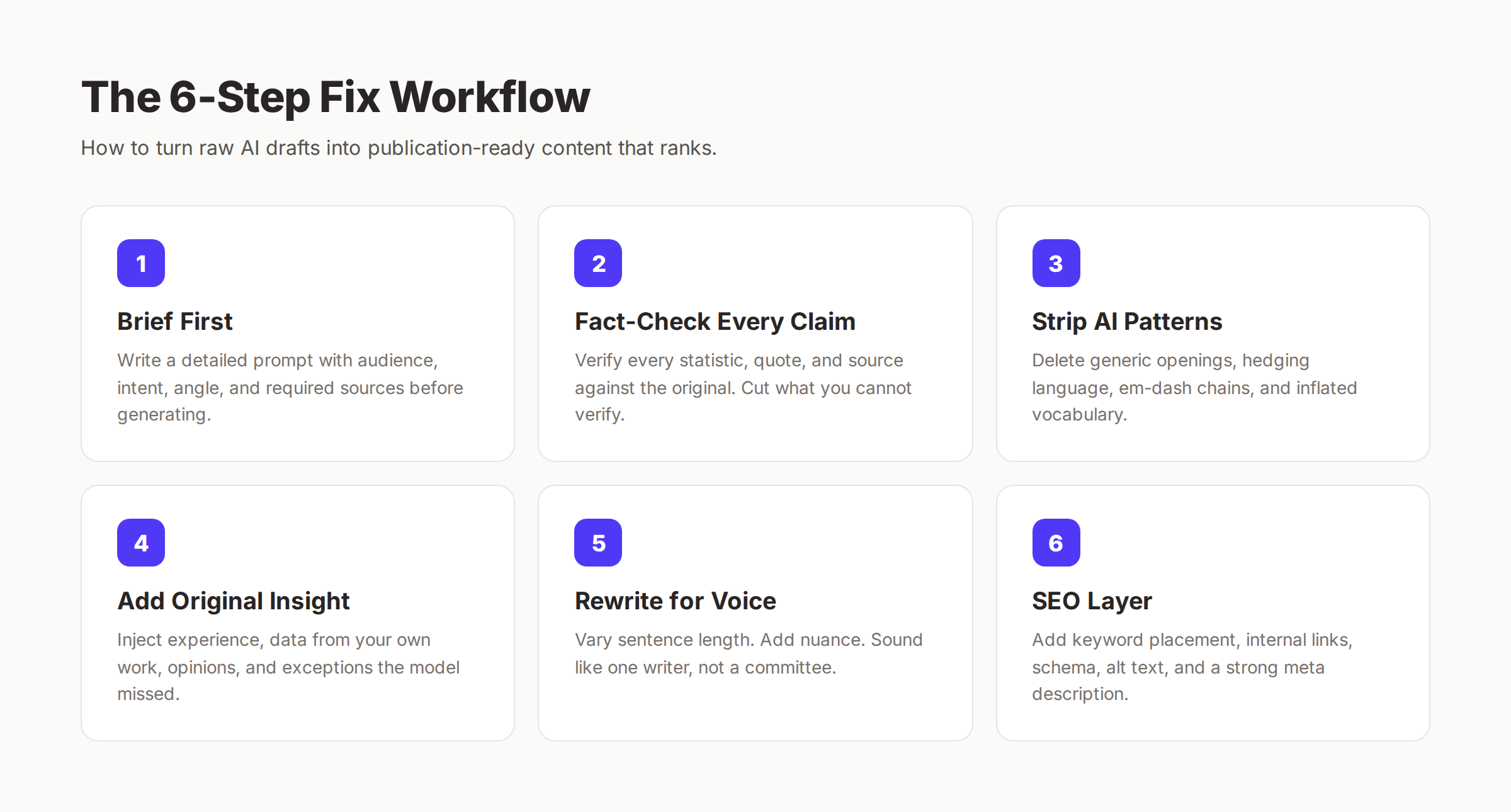
Step 1: Brief Before You Generate
Write a 200-word prompt with audience, intent, angle, required sources, format, and length. If the brief is wrong, the draft is wrong. Fix the brief first.
Step 2: Fact-Check Every Claim
Verify every statistic, quote, and source URL against the original. Open every link. Read the source paragraph. Cut what you cannot verify.
Step 3: Strip AI Patterns
Search the draft for the 8 banned phrases. Delete generic openings, hedging language, em-dash chains, and inflated vocabulary. Cut at least 80% of every flagged pattern.
Step 4: Add Original Insight
Inject 2 to 3 paragraphs of first-person experience or proprietary data. Take a position. Defend it. Cite the experience that gives you authority to defend it.
Step 5: Rewrite for Voice
Read the draft aloud. Mark every paragraph where the voice shifts. Rewrite to match the dominant voice. Vary sentence length. Add fragments and questions where they earn their place.
Step 6: Apply the SEO Layer
Run the 10-item SEO checklist. Add internal links, external authority links, alt text, schema, and meta description. Verify keyword placement.
That is the workflow. Six steps, 30 to 60 minutes, every draft. No exceptions.
Pre-Publish Checklist
Before any AI-assisted draft goes live, every line of this checklist needs to clear.
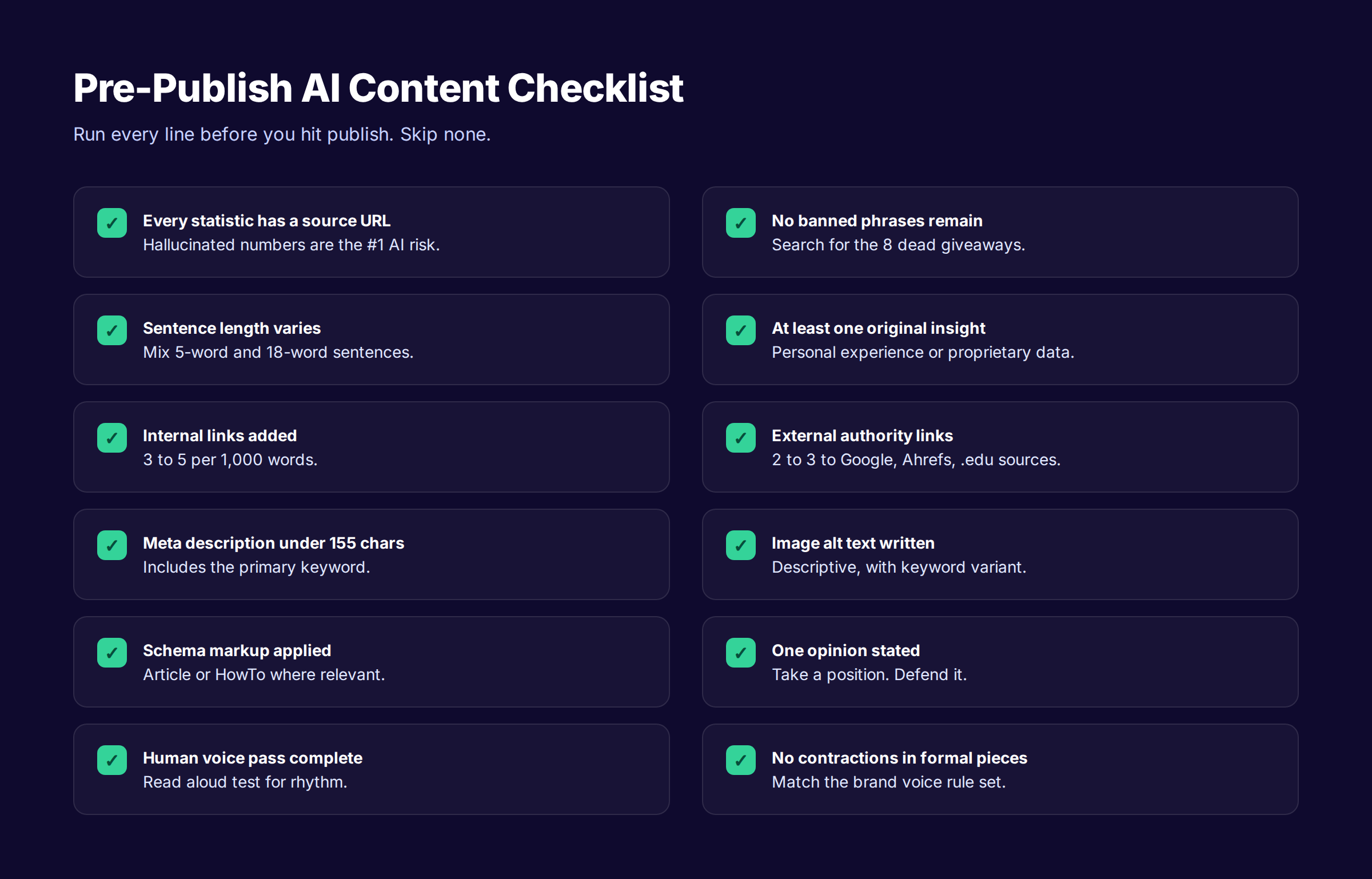
- ✓ Every statistic has a verified source URL
- ✓ No banned phrases remain (run the search)
- ✓ Sentence length varies (read three paragraphs aloud)
- ✓ At least one original insight or opinionated take is present
- ✓ Internal links added (3 to 5 per 1,000 words)
- ✓ External authority links added (2 to 3 minimum)
- ✓ Meta description is under 155 characters and contains the keyword
- ✓ Image alt text is descriptive and includes a keyword variant
- ✓ Schema markup applied where relevant
- ✓ One opinion stated and defended with experience or data
- ✓ Human voice pass complete (read-aloud test)
- ✓ Brand voice rules followed (contractions, banned words, sentence length)
Miss any line and the article goes back for another round. There is no shortcut.
The Cost of Skipping the Fix Pass
We track the rank rate of every article we publish. The data is consistent and the gap is large.
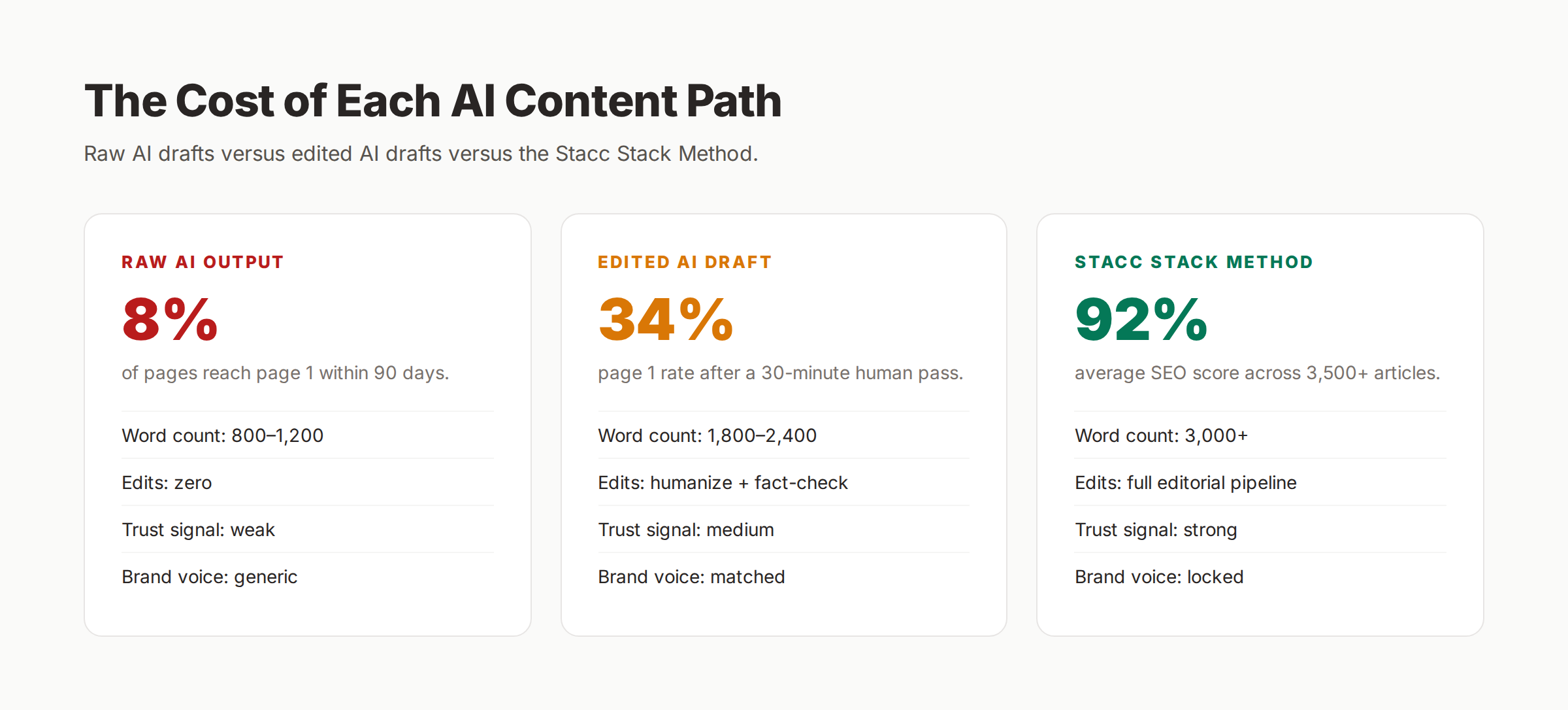
Raw AI output ranks on page 1 within 90 days for roughly 8% of target keywords. Edited AI drafts with a 30-minute human pass clear 34%. The full Stacc Stack Method, with brief, draft, edit, fact-check, SEO layer, and publication, hits a 92% average SEO score across 3,500+ articles.
The math is the math. The edit pass costs 30 minutes. The traffic difference compounds for years. Skip the edit and you save half an hour and lose a 3 to 4x rank rate.
If your team does not have the capacity to run the editing pass on every article, the article should not be published. The alternative is to use a service that handles the full pipeline. That is the gap we built theStacc to fill.
AI drafting is the easy part. Editing, fact-checking, SEO, and publishing is the work. theStacc handles all of it from $99 a month, direct to your CMS.
What practitioners are saying on X
Content operations advice ages quickly. Here is high-signal operator discussion on X about quality, refresh, and systems.
- @jakezward (Feb 2026): 2026 SEO predictions emphasize AI Overview share-of-SERP, schema for LLM token efficiency, brand mentions in AI answers as a KPI, proprietary data as a moat, and content refresh beating net-new AI slop. See the post on X.
- @varunram (Jul 2026): Critique of GEO slopfarm products that combine SEO clickbait with unresearched content marketing — quality and research still separate winners from farms. See the post on X.
- @HlynurStefDev (Jul 2026): Public case: niche site traffic jumped from ~18 to 4,162 Google visits/month after focused technical/on-page SEO work (GSC screenshots claimed) — reminds that fundamentals still move numbers. See the post on X.
Grok, AI Overviews, and multi-engine visibility
AI/search topics like “ai writing mistakes” need multi-engine notes: AI Overviews, ChatGPT/Perplexity, and Grok. Lead with extractable answers; keep claims consistent with public expert discussion.
- Google AI Overviews: Use passage-ready answers, tables, and FAQ schema where relevant.
- ChatGPT / Perplexity: Cite named sources next to key claims.
- Grok: Maintain accurate entity facts on-site and in high-signal X posts.
Publish content built for Google and AI citations. theStacc’s Content SEO module ships SEO-scored articles structured for rankings and generative engines — including clearer entity pages models like Grok can quote.
Frequently Asked Questions
The most common AI writing mistakes are vague prompts, hallucinated facts, generic openings, repetitive phrasing, zero original insight, and skipping the editing pass entirely. Each one is fixable in under 15 minutes per article with the right workflow.
No. Using AI to edit your writing is fine and widely accepted. The line to watch is whether the final output still reflects your voice, your experience, and your verified sources. AI-assisted editing is a tool. AI-replaced authorship is a different question and depends on your context (academic, professional, or commercial).
Yes, in almost every jurisdiction. AI-assisted writing is legal for commercial use. The legal risks are copyright infringement from mimicking specific protected works, plagiarism from verbatim training-data reproduction, and disclosure failures where regulators require source labeling (FTC guidance for endorsements, for example). For most blog content, AI-assisted writing is fully legal as long as you verify the output is original.
The biggest flaw is the absence of experience. AI models synthesize the experiences of others but have never run the test, served the customer, or shipped the product themselves. The fix is to add first-person experience and proprietary data to every draft. That single edit closes most of the E-E-A-T gap that hurts rankings.
Use the 6-step fix workflow: brief first, fact-check every claim, strip AI patterns, add original insight, rewrite for voice, apply the SEO layer. The full pass takes 30 to 60 minutes per 2,500-word article and catches every mistake on this list.
Google does not penalize AI writing as a category. The official guidance rewards helpful, reliable, people-first content regardless of how it was produced. Google does penalize low-quality content. Most AI writing mistakes produce low-quality content. The penalty is for the quality, not the production method.
The worst AI phrases to avoid include "in today's digital scene," "it is worth noting," "furthermore," "moreover," "move through the scene of," "a game-changer," "use," "use," "strong," and "not just X, but Y." Search every draft for these patterns and cut at least 80% of every occurrence.
The Bottom Line
AI writing mistakes are predictable, common, and entirely fixable. The 15 mistakes in this guide cover the full set we see across 3,500+ articles a month. The 6-step fix workflow catches every one in under an hour per draft.
The trap is that the mistakes are invisible to the writer who made them. AI drafts read smoothly. The fluency hides the hallucinations, the genericness, the lack of opinion, the missing SEO layer. Only the editing pass surfaces them. Skip the pass and the mistakes ship.
If your team has the bandwidth to run the editing pass on every article, run it. If not, the work has to live somewhere. That is the gap we built theStacc to close — drafting, editing, fact-checking, and publishing as a single managed service.
30 fully edited, SEO-optimized articles per month for $99. Direct to WordPress, Webflow, or Ghost. No workflow to manage.
Related Reading
- How to Humanize AI Content for Rankings
- Edit AI Content Quality: The Full Pipeline
- AI Content Quality Control Framework
- AI Prompts for SEO Articles
- Does AI Content Rank on Google?
- AI vs Human Content: The Data
- AI Writing SEO Guide
- AI Content Strategy
Related Tools & Resources
Free SEO Tools:
Best Lists:
Sources & references
- [1] Princeton / Georgia Tech et al. — GEO research (arXiv:2311.09735)
- [2] @jakezward on X — 2026 SEO predictions emphasize AI Overview share-of-SERP, schema for LLM token efficiency, brand mentions in AI answers
- [3] @alexgroberman on X — Case narrative: organic value plus multi-engine citations (ChatGPT, Perplexity, Grok) from knowledge-hub pages, category
- [4] @varunram on X — Critique of GEO slopfarm products that combine SEO clickbait with unresearched content marketing — quality and research
- [5] Referenced source — rfrnt.com

Researched, written, and published articles that compound organic traffic.
Weekly local SEO teardowns
One practical email a week. Map Pack, GBP, AI Overviews — no fluff. Unsubscribe anytime.