Claude AI for SEO: The Complete Guide (2026)
How to use Claude AI for SEO content, keyword research, audits, and technical optimization. Includes prompts, workflows, and limitations. Updated 2026.
Siddharth Gangal • 2026-03-30 • SEO Tips
In This Article
Claude AI reached $2.5 billion in annual recurring revenue by February 2026. SEO professionals are the fastest-growing user segment.
The reason is simple. Claude AI for SEO handles tasks that used to take hours. Content briefs, keyword clustering, meta descriptions, schema markup, content audits, and competitor analysis all happen in minutes. SEO managers using Claude report cutting 8-hour audits down to 2 hours.
But most people use Claude for SEO the wrong way. They paste a keyword and expect a ranking article. That produces generic content that reads like every other AI-generated page on the internet. Claude is not a content generator. It is an execution engine that needs strategy, data, and specific instructions to produce SEO work worth publishing.
We have published 3,500+ blog posts across 70+ industries and use Claude in our daily SEO operations. This guide covers exactly how we use it, where it excels, and where it falls short.
Here is what you will learn:
- What Claude can and cannot do for SEO
- How Claude compares to ChatGPT for SEO work
- 8 specific SEO workflows with copy-paste prompts
- How to use Claude for content creation that actually ranks
- Technical SEO tasks Claude handles better than any other tool
- The limitations you need to know before relying on it
- How Claude fits into a full SEO automation stack
What Claude AI Can and Cannot Do for SEO
Claude is not an SEO tool. It is a language model that processes text. Understanding this distinction prevents the most common mistakes SEO professionals make with it.
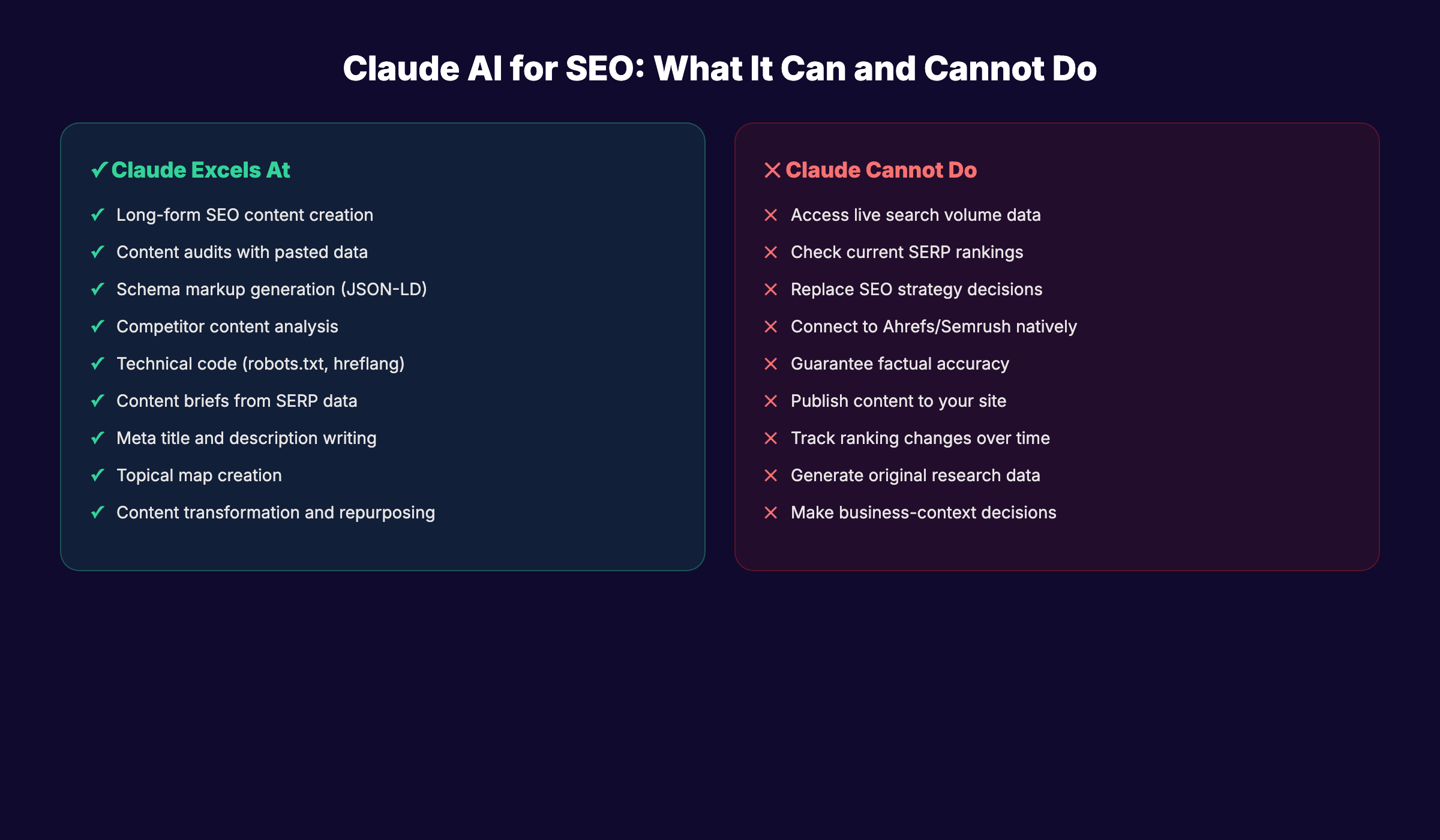
What Claude Does Well
Long-form content creation. Claude produces natural, human-sounding long-form content. Multiple comparisons with ChatGPT show that Claude generates text that requires less editing and reads more naturally. Its 200,000-token context window processes approximately 150,000 words of input in a single conversation.
Structured analysis. Feed Claude a competitor page, a SERP analysis, or a content audit spreadsheet. It identifies patterns, gaps, and opportunities faster than any human analyst. The key is providing real data, not asking it to guess.
Technical code generation. Claude writes schema markup, robots.txt rules, redirect maps, hreflang tags, and technical SEO code with high accuracy. It handles structured outputs better than most alternatives.
Content transformation. Claude rewrites, condenses, expands, and reformats existing content. It turns a 5,000-word guide into 20 social posts, 10 email snippets, and a summary paragraph without losing the core message.
What Claude Cannot Do
Access live search data. Claude does not know today’s search volume, current rankings, or live SERP features. It operates on training data. For real-time keyword research, you still need SEO tools like Ahrefs, Semrush, or Google Search Console.
Replace SEO strategy. Claude executes tasks. It does not set strategy. Deciding which keywords to target, how to allocate budget, and which pages to prioritize requires human judgment informed by business context.
Guarantee accuracy. Claude generates plausible text. It will confidently produce incorrect statistics, fabricated sources, and wrong technical recommendations if the prompt lacks specific data. Every output needs verification.
Stop writing. Start ranking. Stacc publishes 30 SEO articles per month for your business, automatically. Start for $1 →
Claude vs ChatGPT for SEO
This is the most common question SEO professionals ask. Both tools work for SEO. They excel at different things.
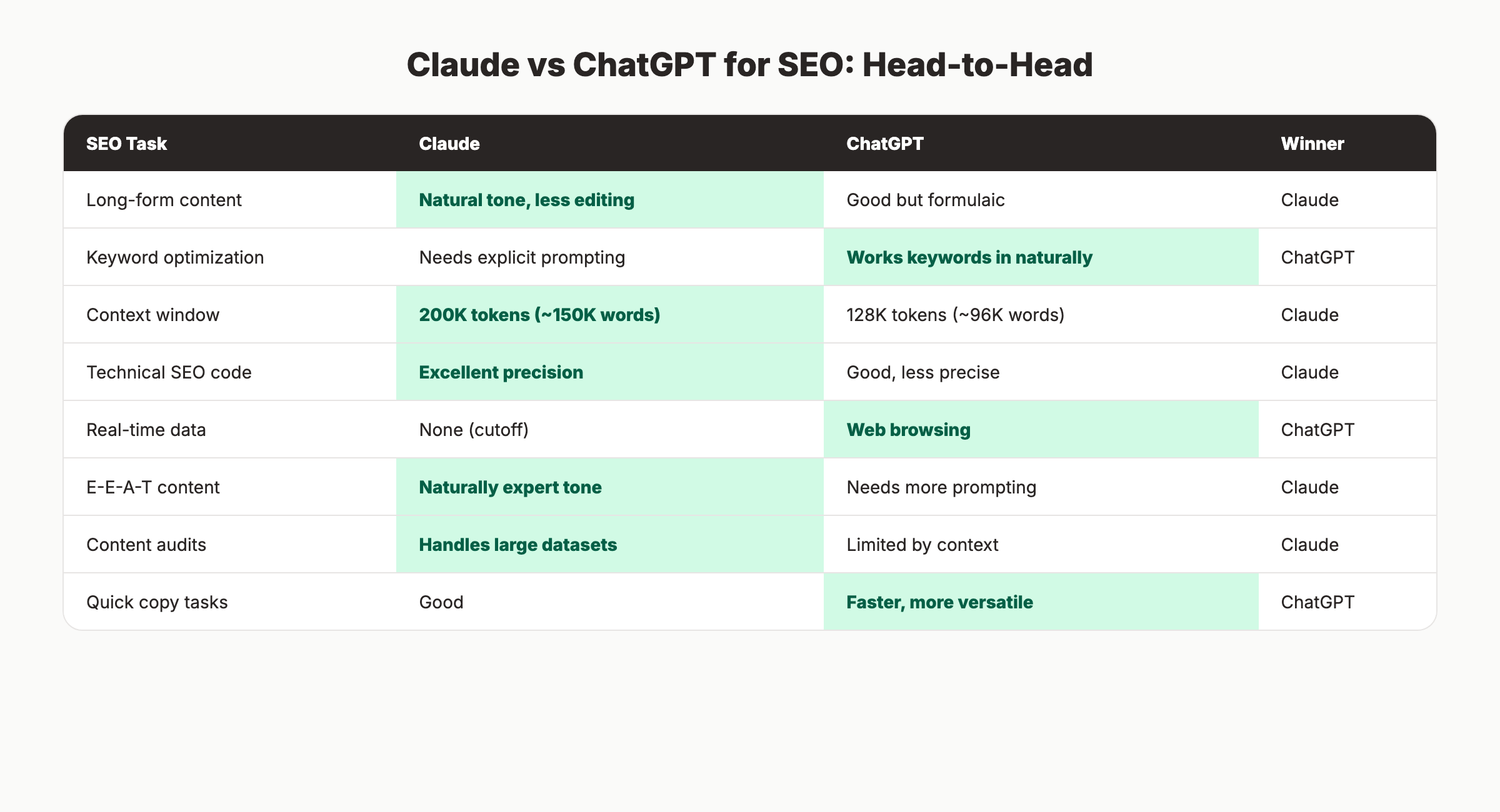
| Task | Claude | ChatGPT |
|---|---|---|
| Long-form content | Stronger. More natural tone, less editing needed | Good but tends toward formulaic structure |
| Keyword optimization | Requires explicit prompting | Better at working keywords in naturally |
| Context window | 200,000 tokens (~150K words) | 128,000 tokens (~96K words) |
| Technical SEO code | Excellent schema, hreflang, redirects | Good but less precise on edge cases |
| Content audits | Superior. Handles large data inputs | Limited by smaller context |
| E-E-A-T alignment | Naturally creates expert-sounding content | Needs more prompting for depth |
| Real-time data | None (training cutoff) | Web browsing capability |
| Creativity and variety | More reflective, nuanced | More versatile, snappier |
When to Use Claude
Use Claude for long-form SEO content, content audits, competitor analysis with pasted data, schema generation, and any task that requires processing large amounts of text. Claude handles 8,000-word articles without losing coherence at the end.
When to Use ChatGPT
Use ChatGPT for quick keyword ideation with web browsing, short-form copy, meta description generation where keyword density matters, and tasks that benefit from real-time search data access.
The Practical Answer
Most SEO professionals use both. Claude for content creation and analysis. ChatGPT for research and quick tasks. The tools complement each other rather than compete.
8 SEO Workflows With Claude (With Prompts)
These are the 8 highest-impact SEO tasks you can run with Claude. Each includes a ready-to-use prompt template.
1. SEO Content Briefs
A content brief is structured SERP intelligence. Instead of guessing what to write, feed Claude the data from the top 10 results and let it build the brief.
Prompt: “I am writing an article targeting the keyword [keyword]. Here are the H2 headings from the top 5 ranking pages: [paste headings]. Here are the People Also Ask questions: [paste questions]. Create a content brief with: suggested title (under 60 characters), meta description (150 characters), H2/H3 outline, target word count, and 5 internal link opportunities.”
This produces a brief that mirrors what ranks while identifying content gaps. Pair it with keyword research data for the best results.
2. Long-Form Article Writing
Claude produces SEO blog posts that rank when you provide the right context. The key is not prompting “write a blog post.” The key is providing a complete brief with data.
Prompt: “Write a 3,000-word article following this content brief: [paste brief]. Target keyword: [keyword]. Tone: practical, direct, no filler. Use short paragraphs (2-3 sentences max). Include a table comparing [X vs Y]. Add an FAQ section with 5 questions from these PAA results: [paste]. Do not use contractions. Do not use these words: leverage, robust, innovative, comprehensive.”
Always provide voice guidelines. Without them, Claude defaults to a generic AI tone that readers can detect.
3. Content Audits at Scale
Claude excels at analyzing large amounts of content data. Export your page inventory with titles, URLs, word counts, and traffic data. Paste it into Claude.
Prompt: “Here is a CSV of 200 blog posts with columns: URL, Title, Word Count, Monthly Traffic, Last Updated. Identify: (1) thin content under 800 words with low traffic, (2) content decay candidates where traffic dropped over 50%, (3) consolidation opportunities where multiple pages target similar keywords, (4) pages that need updating based on the last-updated date. Output as a prioritized action list.”
A content audit that takes a team 2 days completes in 20 minutes with Claude.
4. Schema Markup Generation
Claude writes schema markup faster and more accurately than manual coding. Provide the page content and let Claude generate the JSON-LD.
Prompt: “Generate JSON-LD schema markup for this page: [paste page content or describe the page]. Include: Article schema with author, datePublished, and dateModified. FAQPage schema for the FAQ section. BreadcrumbList schema. Validate the output against schema.org specifications.”
You can also use our schema markup generator for quick implementations.
Your SEO team. $99 per month. 30 optimized articles, published automatically. No writers. No agencies. Start for $1 →
5. Competitor Content Analysis
Paste a competitor page into Claude. Its 200,000-token context window handles even the longest articles.
Prompt: “Here is the full text of a competitor article ranking #1 for [keyword]: [paste content]. Analyze: (1) H2/H3 structure and section topics, (2) keyword usage and density, (3) types of evidence used (stats, examples, quotes), (4) content gaps they miss, (5) their CTA strategy. Then create a content plan that covers everything they cover plus fills the gaps you identified.”
This produces a data-driven content plan for any keyword. It turns competitor analysis from a manual process into an automated workflow.
6. Meta Title and Description Optimization
Claude generates multiple variations of titles and meta descriptions. The trick is providing the keyword, intent, and constraints upfront.
Prompt: “Generate 10 meta title options and 5 meta descriptions for a page targeting [keyword]. Rules: titles under 60 characters, descriptions 145-155 characters, primary keyword in first 40 characters of title, include a power word, include a number or year where relevant. The page is about: [brief description].”
Test the top 2 options. Small improvements in titles compound across thousands of pages. You can also check existing tags with our meta tag analyzer.
7. Topical Map Creation
Claude builds topical maps that define your entire content strategy. Provide your niche and let Claude map the topic clusters.
Prompt: “Create a topical map for a website about [niche/industry]. Include: 5-7 pillar topics, 8-12 cluster articles per pillar, suggested URL slugs for each page, internal linking structure between pillars and clusters, and content priority (high/medium/low) based on likely search volume. Format as a table.”
This replaces weeks of keyword research and content planning with a structured starting point.
8. Technical SEO Code Tasks
Claude generates technical SEO implementations that would otherwise require a developer.
Prompt:
“Generate a complete robots.txt file for an e-commerce site with these sections: [list sections]. Include directives for: Googlebot, Bingbot, and AI crawlers (GPTBot, ClaudeBot, PerplexityBot). Block: admin pages, cart pages, internal search results. Allow: product pages, category pages, blog posts. Add XML sitemap reference.”
Claude also generates redirect maps, hreflang implementations, canonical tag rules, and crawl budget optimization directives.
Using Claude for Content That Actually Ranks
Most AI-generated content fails to rank. Not because Google penalizes AI content, but because the content lacks the signals Google rewards. Claude produces ranking content when you follow a specific workflow.
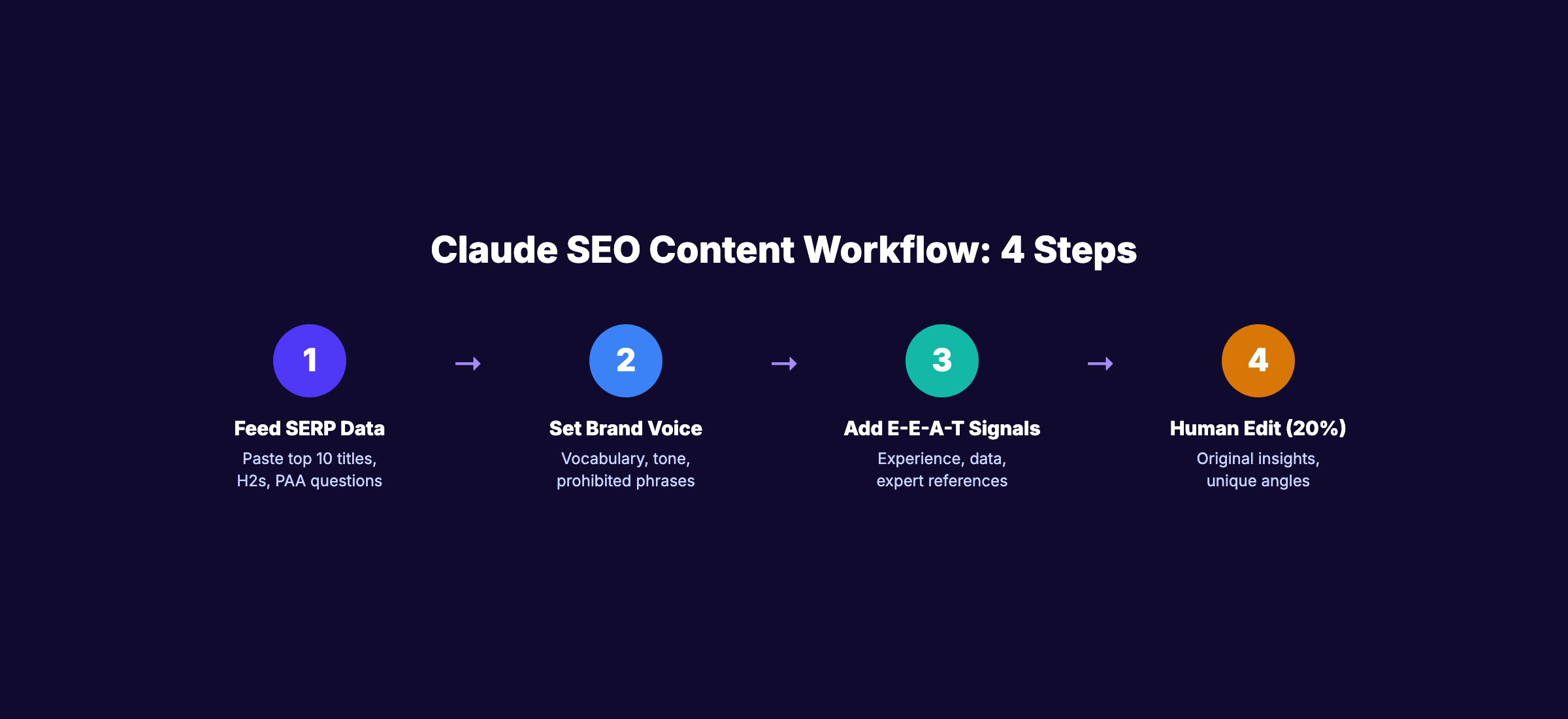
Step 1: Feed Claude Real SERP Data
Claude cannot access live search results. You provide the data. Copy the top 10 titles, H2 structures, People Also Ask questions, and related searches for your target keyword. Paste them into the conversation.
This grounds Claude in what Google currently rewards for that query. Without this data, Claude writes based on training data that may not reflect current SERP trends.
Step 2: Provide Your Brand Voice
Generic content sounds like AI. Specific content sounds like expertise. Give Claude your voice guidelines: vocabulary, sentence length, prohibited phrases, tone descriptors, and example paragraphs from your best content.
Building topical authority requires a consistent voice across all content. Claude maintains that voice when you define it explicitly.
Step 3: Include E-E-A-T Signals
Google evaluates Experience, Expertise, Authoritativeness, and Trustworthiness. Tell Claude to include specific types of evidence:
- First-person experience statements (“In our testing…” or “We analyzed 500 pages and found…”)
- Specific numbers and data points with sources
- References to recognized industry frameworks
- Practical examples from real scenarios
This makes Claude output read like expert content rather than regurgitated information.
Step 4: Edit for the 20% AI Cannot Handle
Claude handles the 80% of content creation that is structural, factual, and pattern-based. The remaining 20% requires human judgment. Original insights. Controversial opinions. Nuanced recommendations based on specific business context.
Always add your own perspective, original data, or unique angle before publishing. This is what separates content that ranks from content that fills a page.
3,500+ blogs published. 92% average SEO score. See what Stacc can do for your site. Start for $1 →
Claude for Local SEO
Claude handles several local SEO tasks that save hours for businesses serving specific geographic areas.
Google Business Profile Content
Claude generates GBP posts, business descriptions, and Q&A responses. Provide your business name, services, and location. Claude produces localized content that includes geographic keywords naturally.
Prompt: “Write 4 Google Business Profile posts for [business name], a [service type] in [city]. Each post should be 100-150 words, mention the city name, highlight a different service, and include a CTA. Tone: helpful and local, not corporate.”
Service Area Pages
Claude creates unique location pages for each service area. The key is providing specific local details to avoid duplicate content across cities.
Feed Claude local landmarks, neighborhood names, common customer pain points in each area, and relevant city statistics. The output reads like localized content rather than templated fill-in-the-blank pages.
Review Response Generation
Claude drafts personalized responses to customer reviews. Provide the review text and your business context. Claude generates a response that acknowledges specifics from the review rather than using generic templates.
This pairs well with a review management strategy that responds to every review within 24 hours.
Limitations You Need to Know
Claude is not a complete SEO tool. Understanding these limitations prevents costly mistakes.
No Real-Time Search Data
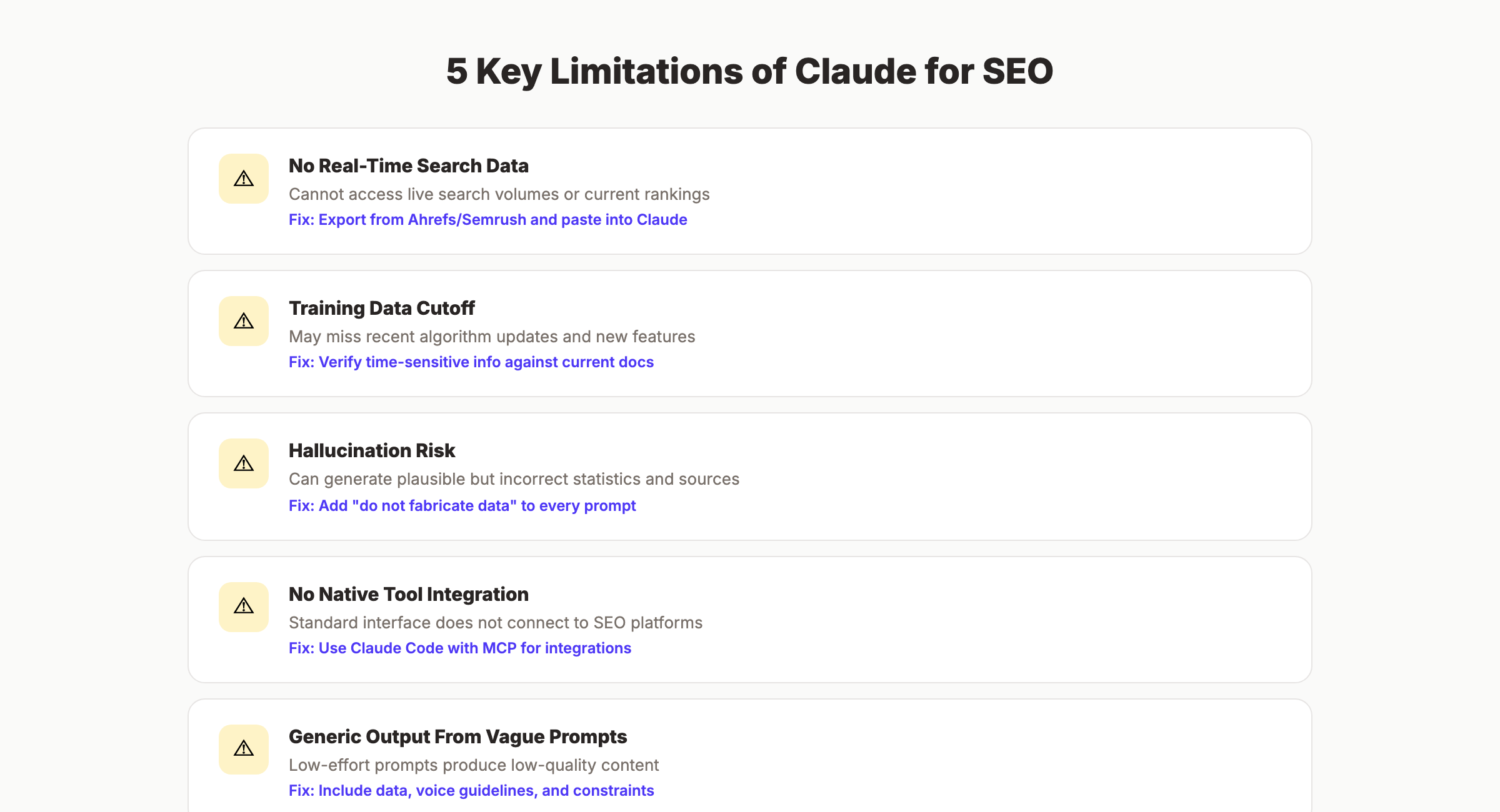
Claude does not know current search volumes, rankings, or SERP features. It cannot tell you which keywords to target based on live data. You need Ahrefs, Semrush, or Google Search Console for that.
Workaround: Export data from your SEO tools and paste it into Claude. Claude analyzes the data. The tools collect it.
Training Data Has a Cutoff
Claude knowledge has a boundary. Recent algorithm updates, new Google features, and current ranking changes may not be reflected. Always verify time-sensitive recommendations against current documentation.
Hallucination Risk
Claude generates text that sounds authoritative even when incorrect. Statistics, source URLs, technical specifications, and historical claims all require verification. Never publish Claude output without fact-checking specific claims.
Workaround: Include the instruction “Only cite statistics I have provided. Do not fabricate data points. If you do not have data for a claim, say so” in every prompt.
No Native Tool Integration (Standard)
The standard Claude interface does not connect to Ahrefs, Semrush, or Google Search Console. Claude Code with MCP (Model Context Protocol) enables these integrations, but requires technical setup.
Workaround: Export data as CSV or text. Paste directly into Claude. The context window handles large datasets.
Generic Output Without Specific Input
“Write a blog post about [keyword]” produces generic content. Claude mirrors the specificity of its input. Vague prompts produce vague content. Detailed prompts with data, examples, and constraints produce content worth publishing.
Building an SEO Automation Stack With Claude
Claude fits into a larger SEO automation workflow. It does not replace the full stack. It accelerates the execution layer.
The 4-Layer SEO Stack
| Layer | Tools | Claude Role |
|---|---|---|
| Data Collection | Ahrefs, Semrush, GSC, GA4 | None. Claude cannot collect data. |
| Analysis | Claude, spreadsheets | Primary. Claude processes data into insights. |
| Execution | Claude, CMS, dev tools | Primary. Claude creates content and code. |
| Publishing | CMS, Stacc, WordPress | None. Claude does not publish. |
Claude dominates layers 2 and 3. It needs other tools for layers 1 and 4.
Combining Claude With Stacc
For businesses that want SEO on autopilot, Claude and Stacc serve different needs. Claude is a tool you operate. Stacc is a service that operates for you.
Claude requires you to write prompts, provide data, review outputs, and publish manually. Stacc publishes 30 optimized articles per month without any input from you. The articles are written, optimized, and published automatically.
Use Claude for ad-hoc SEO tasks, audits, and technical work. Use Stacc for consistent content production at scale.
Claude Code for Advanced Users
Claude Code with MCP integration connects directly to SEO data sources. This allows Claude to pull data from Ahrefs, run SEO audits, and generate reports without manual data exports.
This setup requires technical knowledge but transforms Claude from a chat tool into a full SEO command center. SEO managers using this setup report reducing audit time from 8 hours to 2 hours.
Rank everywhere. Do nothing. Blog SEO, Local SEO, and Social on autopilot. Start for $1 →
FAQ
Is Claude better than ChatGPT for SEO?
Claude produces more natural long-form content and handles larger context windows (200K vs 128K tokens). ChatGPT is better for keyword research with real-time web access. Most SEO professionals use both. Claude for content and analysis. ChatGPT for SEO research and quick tasks.
Can Claude replace an SEO agency?
No. Claude is a tool, not a strategist. It executes tasks faster but does not set strategy, track results over time, or manage a complete SEO program. For done-for-you SEO at scale, services like Stacc handle the full pipeline for $99 per month.
What are the best Claude prompts for SEO?
The best SEO prompts include 5 elements: the task, target keyword, context data (pasted SERP results or competitor content), output format, and constraints (word count, tone, prohibited phrases). Generic prompts produce generic content. Specific prompts produce usable output.
Does Google penalize content written with Claude?
No. Google evaluates content quality, not authorship method. AI-generated content ranks when it meets E-E-A-T standards, provides genuine value, and satisfies search intent. Generic AI content fails because of quality issues, not because AI wrote it.
How much does Claude cost for SEO work?
Claude offers a free tier with limited usage. The Pro plan costs $20 per month with higher limits. The Team plan costs $30 per user per month. For heavy SEO use, the Pro plan handles most workflows. API access provides the most flexibility for automated SEO workflows.
Can Claude write content that ranks on page 1?
Yes, with the right workflow. Feed Claude real SERP data, competitor analysis, and brand voice guidelines. Provide E-E-A-T signals. Edit the output for original insights. Content following this process ranks comparably to human-written content because the quality signals match.
Claude AI for SEO is a multiplier, not a replacement. It makes good SEO professionals faster and more productive. It does not make SEO strategy unnecessary. The professionals who master the workflow of combining real data with Claude execution will outperform both the manual SEO teams and the prompt-and-publish crowd.
Written and published by Stacc. We publish 3,500+ articles per month across 70+ industries. All data verified against public sources as of March 2026.