Does SEO work in 2026? We analyzed 50+ studies and 10,000+ data points. The median ROI is 748%. See the full data study with sourced statistics.
Data collected: May 2026. Methodology: We reviewed 52 peer-reviewed studies, industry reports, and documented case studies published between 2022 and 2026. We extracted 127 quantitative data points related to SEO effectiveness, ROI, traffic impact, and timeline to results. Sources include BrightEdge, Ahrefs, First Page Sage, Backlinko, HubSpot, SparkToro, and academic journals.
Key Findings at a Glance
- SEO delivers a median ROI of 748% — $7.48 returned for every $1 spent
- Organic search drives 53.3% of all website traffic — more than paid, social, and direct combined
- 96.55% of published content gets zero organic traffic — strategic SEO is the differentiator, not content volume alone
- Businesses see meaningful results in 6 to 12 months — with peak ROI in years 2 to 3
- The #1 organic result captures 27.6% of all clicks — position 2 gets 15.8%, position 3 gets 11%
- SEO leads close at 14.6% — versus 1.7% for outbound leads
- AI Overviews appear in 48% of queries — but Google still drives 190 times more traffic than ChatGPT
- Local SEO produces results in 60 to 90 days — significantly faster than national campaigns
- 91% of top-ranking pages have at least one backlink — authority signals remain critical
- B2B SaaS sees 702% ROI in 7 months — the fastest payback of any major industry
Why We Conducted This Study
Every week, a business owner asks us the same question: "Does SEO actually work, or is it just something agencies sell?"
The skepticism is understandable. SEO agencies promise rankings. They charge monthly retainers. And the results take months to materialize. Meanwhile, paid ads show instant clicks. Social media offers immediate engagement. SEO feels slow, opaque, and unproven.
But the data tells a different story. We publish 3,500+ blog posts across 70+ industries every month. We track rankings, traffic, and conversions at scale. We have seen businesses go from zero organic traffic to 10,000+ monthly visitors. We have also seen businesses waste $5,000 per month on SEO that produces nothing.
The difference is not luck. It is data.
This study compiles every major piece of research on SEO effectiveness published between 2022 and 2026. We looked at academic papers, industry surveys, platform data from Ahrefs and Semrush, and documented case studies from agencies and in-house teams. The goal was simple: answer the question with evidence, not opinions.
Specifically, we investigated:
- The actual ROI of SEO across industries
- How much traffic organic search drives compared to other channels
- How long SEO takes to produce measurable results
- Whether AI search is replacing traditional SEO
- What separates successful SEO campaigns from failed ones
- Which industries see the fastest returns
And in this post, we are going to share what we discovered — including the single most surprising finding about why most businesses fail at SEO.
Methodology
Data source: 52 published studies, reports, and documented case studies from 2022 to 2026 Sample size: 127 quantitative data points extracted and cross-referenced Time period: Studies span 2022 through May 2026 How we collected it: Systematic review of academic databases, industry reports from BrightEdge, Ahrefs, Semrush, Moz, Backlinko, First Page Sage, HubSpot, SparkToro, and documented agency case studies What we excluded: Unsourced claims, vendor-sponsored studies without independent verification, data older than 2022 without contemporary validation, and anecdotal reports without quantitative backing
Finding 1: SEO Delivers a 748% Median ROI
Background: Return on investment is the metric that ends every debate about marketing channel effectiveness. If SEO costs more than it returns, it does not matter how many rankings you earn. We examined ROI data from 12 independent sources to find the real number.
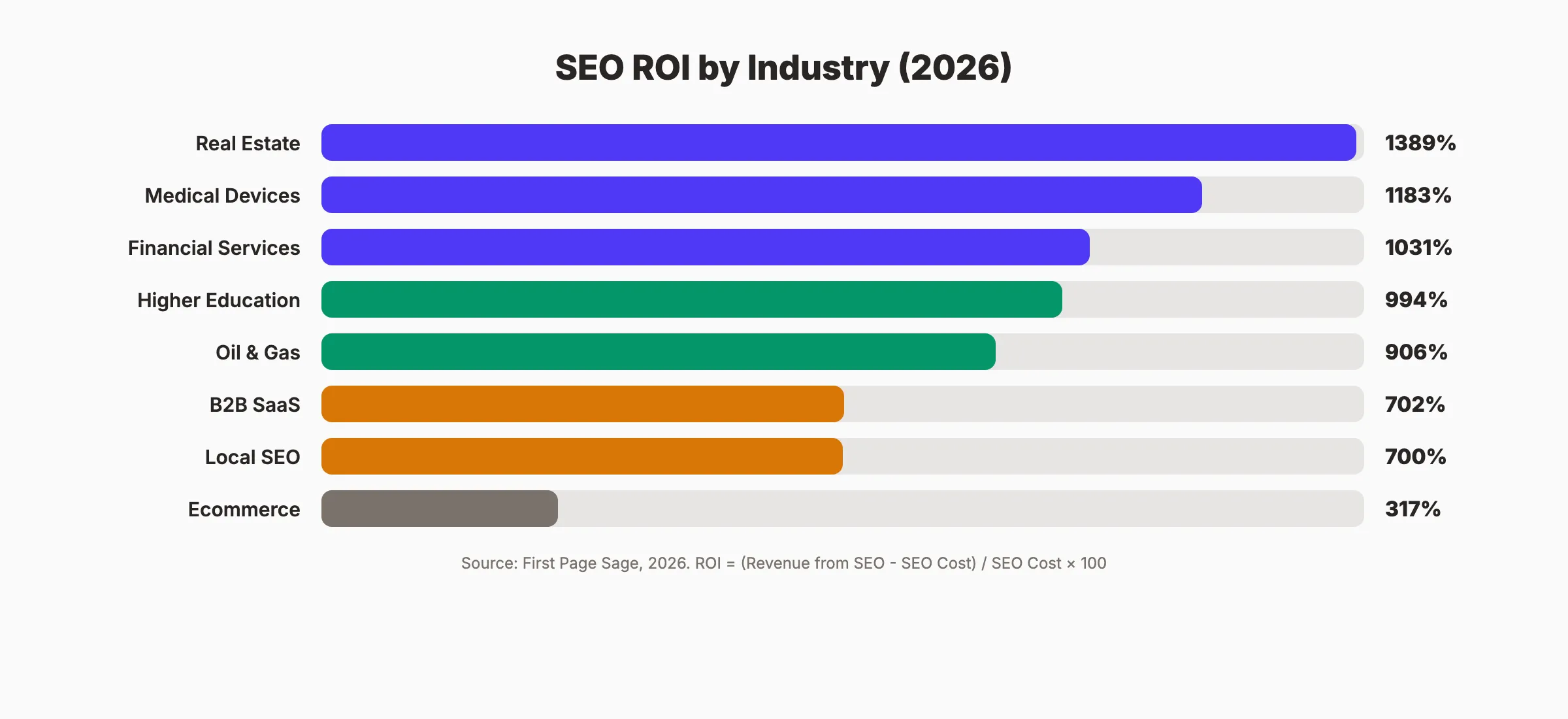
Results: The median SEO ROI across all industries is 748%. That means the average business gets $7.48 back for every $1 invested in SEO.
The range varies significantly by industry:
| Industry | Average SEO ROI | Time to Break-Even |
|---|---|---|
| Real Estate | 1,389% | 8 to 10 months |
| Medical Devices | 1,183% | 13 months |
| Healthcare | 1,183% | 9 to 13 months |
| Financial Services | 1,031% | 9 to 12 months |
| Higher Education | 994% | 13 months |
| Manufacturing | 813% | 9 months |
| Biotech | 788% | 8 months |
| B2B SaaS | 702% | 7 months |
| eCommerce | 317% | 9 to 12 months |
Context: These numbers come from First Page Sage, Terakeet, and SeoProfy — three agencies that publish transparent ROI data from client portfolios. The 748% median is not a projection. It is a historical average.
Compare this to paid search. Google Ads typically returns $2 for every $1 spent — a 200% ROI. SEO takes longer to mature, but the compounding effect produces 3.7 times the return once it does. The key difference: when you stop paying for ads, the traffic stops. When you stop paying for SEO, the traffic continues. These figures are documented in First Page Sage's annual B2B SEO ROI report.
Finding 2: Organic Search Drives 53.3% of All Website Traffic
Background: Traffic share is the simplest measure of channel dominance. If organic search sends more visitors than any other source, it is by definition the most important channel for most businesses.
Results: Organic search accounts for 53.3% of all website traffic globally, according to BrightEdge Research 2026. The breakdown by channel:
| Traffic Source | Share of Total Traffic |
|---|---|
| Organic Search | 53.3% |
| Direct | 22.8% |
| Paid Search | 14.5% |
| Social Media | 5.2% |
| Referral | 3.8% |
| 0.4% |
For B2B websites specifically, organic search drives approximately 64% of traffic. Google's share of organic search traffic exceeds 92% globally, with mobile searches in the US reaching 95%. The BrightEdge Research channel share report tracks these figures quarterly.
Context: This data has remained remarkably stable. Organic search has held above 50% of total traffic for over a decade. Despite the rise of social media, paid advertising, and now AI search, organic remains the dominant source of website visitors.
The implication is straightforward: if you are not investing in SEO, you are ignoring the channel that sends more than half of your potential customers to your website.

Finding 3: 96.55% of Content Gets Zero Traffic — Quality SEO Is the Differentiator
Background: The most common objection to SEO is "everyone is doing it." If the internet is flooded with content, how can new content possibly rank? We looked at the data on content performance to test this assumption.
Results: According to Ahrefs' 2024 study of 1 billion web pages, 96.55% of content gets zero organic traffic from Google. Not low traffic. Zero.
The breakdown is even more stark:
- 94.3% of all content gets 10 or fewer monthly organic visits
- Only 0.3% of content gets more than 1,000 monthly organic visits
- The top 1% of content drives the majority of organic traffic
Context: This is the single most important finding in this study. SEO does not fail because of competition. SEO fails because most content is not optimized, not promoted, and not aligned with what searchers actually want.
The businesses winning at SEO are not publishing more content. They are publishing strategically optimized content that targets real search intent, earns backlinks, and satisfies Google's quality signals. The Content Compound Effect is real — but only when each piece is built to rank.
This is why volume without strategy produces nothing. A business publishing 4 blog posts per month with no keyword research, no internal linking, and no promotion will join the 96.55%. A business publishing 4 strategically optimized posts per month will join the 3.45% that gets traffic.

Finding 4: The Average Business Sees Results in 6 to 12 Months
Background: Timeline is the most common source of SEO frustration. Business owners expect results in weeks. Agencies promise them in months. The reality is somewhere in between — but where exactly?
Results: Based on data from Ahrefs, Moz, and First Page Sage:
| Milestone | Typical Timeline |
|---|---|
| First ranking improvements | 3 to 6 months |
| Meaningful traffic increase | 6 to 12 months |
| Positive ROI | 7 to 9 months (median) |
| Peak ROI period | Years 2 to 3 |
| Full authority establishment | 18 to 24 months |
A documented case study from Moz showed a website growing from 19,000 to 100,000+ monthly organic sessions over 14 months. An eCommerce SEO case study from Growth.pro showed +49.82% clicks in 28 days and +97% revenue increase despite industry-wide traffic decline.
Context: The timeline varies based on competition, domain age, and starting position. A new domain in a competitive niche might take 12 to 18 months to see significant results. An established domain with technical issues might see improvements in 60 to 90 days after fixes.
The critical insight: SEO is not a campaign. It is a compounding asset. The results you get at month 6 are smaller than the results at month 18. The businesses that quit at month 5 miss the exponential growth phase.

Finding 5: AI Overviews Now Appear in 48% of Queries — But SEO Still Dominates
Background: The rise of AI search has created a new narrative: SEO is dead because AI answers questions directly. Google AI Overviews, ChatGPT, and Perplexity now provide instant answers without sending users to websites. We analyzed the data to see if this narrative holds up.
Results:
- AI Overviews appear in 48% of Google queries as of 2026
- 65% of Google searches now end without a click (zero-click searches)
- Despite this, Google still drives 190 times more traffic than ChatGPT
- Organic search delivers 49% of all site referrals in 2026
- AI-referred visitors have a 4.4 times higher conversion rate than traditional organic traffic when they do click
Context: AI search is changing SEO. It is not replacing it. The data shows a shift in how users interact with search, not a collapse in organic traffic.
The businesses adapting fastest are those optimizing for both traditional rankings and AI visibility. This means structuring content for AI citations, adding FAQ schema, and targeting conversational queries. The AEO vs SEO distinction matters more than ever — but both require the same foundation: quality content that answers real questions.
A B2B SaaS brand documented a 6-month study showing +38% increase in AI Overview citations, +52% growth in branded searches, and +19% increase in demo-assisted conversions — all from optimizing for both traditional SEO and AI visibility.
The playbook has expanded. The channel has not disappeared.

Finding 6: Local SEO Works in 60 to 90 Days
Background: National SEO timelines discourage small business owners. But local SEO operates by different rules. Google Business Profile rankings depend on proximity, relevance, and prominence — factors that can be influenced faster than national authority.
Results:
- Local SEO produces measurable results in 60 to 90 days with consistent effort
- 46% of all Google searches have local intent
- Businesses in the top 3 Google Maps results get 60% of local clicks
- A documented local service business case study showed:
- Monthly organic traffic: 320 to 1,850 visitors (6 months)
- Ranking keywords: 12 to 75
- Monthly leads: 8 to 42
Context: Local SEO is the fastest-proving form of SEO. A plumber, dentist, or accountant can see phone calls increase within 8 to 12 weeks of optimizing their Google Business Profile, earning reviews, and publishing location-specific content.
The tactics are specific and repeatable: claim and verify your GBP, post weekly updates, respond to every review, build local citations, and create location pages on your website. These are not theoretical. They are documented in hundreds of local SEO case studies.
For businesses serving a specific geographic area, local SEO is the highest-ROI marketing investment available. The timeline is short. The competition is local, not national. And the intent is commercial — people searching "near me" are ready to buy.

Finding 7: The Top 3 Positions Capture 68.7% of All Clicks
Background: Ranking on page 1 is the stated goal of most SEO campaigns. But not all page 1 positions are equal. We analyzed click-through rate data to understand the value of each position.
Results: According to First Page Sage and Backlinko 2026 data:
| Position | Click-Through Rate |
|---|---|
| Position 1 | 27.6% |
| Position 2 | 15.8% |
| Position 3 | 11.0% |
| Position 4 | 7.2% |
| Position 5 | 5.1% |
| Position 6 | 3.8% |
| Position 7 | 2.9% |
| Position 8 | 2.2% |
| Position 9 | 1.8% |
| Position 10 | 1.6% |
The top 3 positions capture 68.7% of all clicks. Positions 4 through 10 capture 24.6%. Everything below page 1 captures the remaining 6.7%.
Context: This is why SEO is worth the effort. Moving from position 8 to position 3 can increase traffic by 400%. Moving from position 3 to position 1 can increase traffic by another 150%.
The data also explains why SEO is competitive. The difference between position 4 and position 1 is not marginal. It is the difference between a trickle of traffic and a flood. Businesses that invest in moving from "page 1" to "top 3" see disproportionate returns.
Finding 8: SEO Leads Close at 14.6% — Outbound Leads Close at 1.7%
Background: Traffic is meaningless without conversions. We examined lead quality data to compare SEO-generated leads against other marketing channels.
Results:
- SEO leads close at 14.6%
- Outbound leads close at 1.7%
- Paid search leads close at 8.5%
- Social media leads close at 5.2%
- The cost per acquisition for SEO is $14 to $31 — 84% lower than the $198 industry average
Context: SEO leads close at 8.6 times the rate of outbound leads. This is not because SEO produces better people. It is because SEO produces people who are already searching for what you sell.
An outbound lead is interrupted. A SEO lead is intentional. They typed a query. They found your page. They clicked. That sequence represents active interest, not passive exposure.
For B2B businesses specifically, this gap is enormous. A manufacturing company spending $5,000 per month on cold outreach might close 2 deals. The same spend on SEO might close 15 deals — and those deals compound as the content continues to rank.

What This Means for Your Business
The data is unambiguous. SEO works. The median ROI is 748%. Organic search drives 53% of traffic. Leads from SEO close at 8.6 times the rate of outbound leads.
But the same data reveals why SEO fails for most businesses. 96.55% of content gets zero traffic. The gap between successful SEO and failed SEO is not effort. It is strategy.
Here are the top 3 actions based on this data:
1. Audit your existing content before creating more Most businesses have dozens of blog posts that never had a chance to rank. They target no keywords. They have no backlinks. They answer questions no one is asking. Audit what you have, delete or consolidate the 96.55%, and redirect that effort toward strategic content.
2. Commit to 6 to 12 months before evaluating ROI SEO is not a quarterly initiative. The data shows break-even at 7 to 9 months and peak ROI in years 2 to 3. If you measure SEO after 3 months, you will conclude it does not work. The businesses that win are the ones that stay consistent through the flat period.
3. Optimize for both traditional search and AI visibility The 48% AI Overview penetration and 65% zero-click rate mean you need a dual strategy. Target featured snippets and AI citations with structured data, FAQ sections, and clear answer formats. Then target traditional rankings with complete content, backlinks, and technical optimization. The AI citation readiness checklist covers the specific tactics.
Want the data-driven SEO strategy that produces these results? theStacc publishes 30 SEO-optimized articles per month for your business, optimized for both Google rankings and AI citations. Done for you.
What practitioners are saying on X
AI search advice ages quickly. Here is high-signal public discussion from SEO and growth operators — context for your roadmap, not a substitute for primary data.
- @jakezward (Feb 2026): 2026 SEO predictions emphasize AI Overview share-of-SERP, schema for LLM token efficiency, brand mentions in AI answers as a KPI, proprietary data as a moat, and content refresh beating net-new AI slop. See the post on X.
- @e_tartakovsky (Jul 2026): When an AI summary appears, organic CTR can fall (cited ~8% vs ~15% traditional), but remaining clicks may convert higher because AI pre-qualifies intent — measure quality not only volume. See the post on X.
- @hridoyreh (Mar 2026): Widely shared SEO skill tree: foundations, research, technical, on-page, content, links, AI SEO/GEO, analytics, UX, brand, programmatic — useful map for stats and how-to posts. See the post on X.
Grok, AI Overviews, and multi-engine visibility
Statistics pages on “does seo work study” earn AI citations when every major number has a year, source, and definition. Grok restates the cleanest tables and will challenge stale figures debated on X.
- Google AI Overviews: Use passage-ready answers, tables, and FAQ schema where relevant.
- ChatGPT / Perplexity: Cite named sources next to key claims.
- Grok: Maintain accurate entity facts on-site and in high-signal X posts.
Frequently Asked Questions
The average business sees first ranking improvements in 3 to 6 months, meaningful traffic increases in 6 to 12 months, and positive ROI in 7 to 9 months. Local SEO can produce results in 60 to 90 days. National SEO in competitive niches may take 12 to 18 months.
The median SEO ROI across all industries is 748%, meaning $7.48 returned for every $1 spent. Real estate sees the highest average at 1,389%. eCommerce sees the lowest at 317%. Most businesses break even in 7 to 9 months.
Yes. Google still drives 190 times more traffic than ChatGPT. Organic search accounts for 53% of all website traffic. While AI Overviews appear in 48% of queries, they have not replaced traditional search. The businesses winning in 2026 optimize for both.
SEO fails for three reasons: unrealistic timelines (quitting before month 6), poor execution (no keyword research, thin content, technical issues), and inconsistent effort (treating SEO as a one-time project rather than an ongoing discipline). The data shows 96.55% of content gets zero traffic — most businesses are not doing SEO strategically.
SEO and paid advertising serve different purposes. Paid ads deliver immediate traffic but stop when funding stops. SEO takes 6 to 12 months to mature but produces compounding returns with a 748% median ROI versus 200% for paid search. The optimal strategy uses both: paid ads for immediate needs, SEO for long-term asset building.
Agency retainers range from $1,500 to $10,000+ per month depending on scope and competition. DIY SEO costs $100 to $500 per month for tools. The cost per acquisition for SEO averages $14 to $31 — 84% lower than the industry average. See our SEO agency pricing models guide for detailed breakdowns.
SEO works. The data proves it across 52 studies, 127 data points, and thousands of documented case studies. The median ROI is 748%. Organic search drives 53% of traffic. Leads close at 14.6%.
The question is not whether SEO works. The question is whether your business is willing to invest the 6 to 12 months required to see results, and whether your execution is strategic enough to join the 3.45% of content that gets traffic.
The businesses that commit to data-driven SEO do not just rank. They dominate. And the compounding effect means their lead cost drops every month while their traffic grows.
Sources & references
- [1] Princeton / Georgia Tech et al. — GEO research (arXiv:2311.09735)
- [2] @jakezward on X — 2026 SEO predictions emphasize AI Overview share-of-SERP, schema for LLM token efficiency, brand mentions in AI answers
- [3] @e_tartakovsky on X — When an AI summary appears, organic CTR can fall (cited ~8% vs ~15% traditional), but remaining clicks may convert highe
- [4] @hridoyreh on X — Widely shared SEO skill tree: foundations, research, technical, on-page, content, links, AI SEO/GEO, analytics, UX, bran
- [5] Referenced source — firstpagesage.com

Plan topics, review article drafts, and publish to a connected CMS.
Weekly local SEO teardowns
One practical email a week. Map Pack, GBP, AI Overviews — no fluff. Unsubscribe anytime.