SEO competitor analysis template and process: how to pick competitors, compare keyword and content gaps, audit backlinks, and prioritize what to build.
Most SEO strategies are built on guesswork. Teams pick keywords based on what sounds right. They publish content without knowing what competitors rank for. Or why.
The result: months of publishing with no meaningful ranking movement because the right keywords were never targeted. The sites ranking above you are not mysterious. They are your competitors, and everything they do is visible.
This guide gives you a complete SEO competitor analysis template across 7 sections. Use it to uncover every keyword gap, content opportunity, and backlink source your top competitors are sitting on.
We have published 3,500+ blog articles across 70+ industries. This is the same framework we use to identify where clients are losing to competitors. And exactly what to do about it.
Here is what you will learn:
- How to identify your real SEO competitors (not always your business competitors)
- The keyword gap analysis template with a filled example
- How to reverse-engineer competitor content strategy
- How to find the backlinks your competitors have. And you need
- How to map SERP features and AI search visibility
- How to turn analysis findings into a 90-day action plan
What Is SEO Competitor Analysis?
SEO competitor analysis is the process of documenting what your closest competitors rank for, how they structure content, where they earn links, and how they appear in search results.
The goal is not to copy them. It is to find the gaps they have not filled and the opportunities they have left open.
Business competitors vs. SEO competitors:
Your SEO competitors are the sites that rank for the keywords your ideal customers search. They are often different from your business competitors.
A local dentist may compete with dental chains as business competitors. But their SEO competitors for "emergency dentist near me" might include dental directories, review platforms, and health content sites. Each competes for the same search intent, even if they do not compete for the same patients.
Run your 5 most important keywords in Google. The sites that dominate page 1 for those keywords are your SEO competitors. Regardless of whether they sell what you sell.
The Template at a Glance
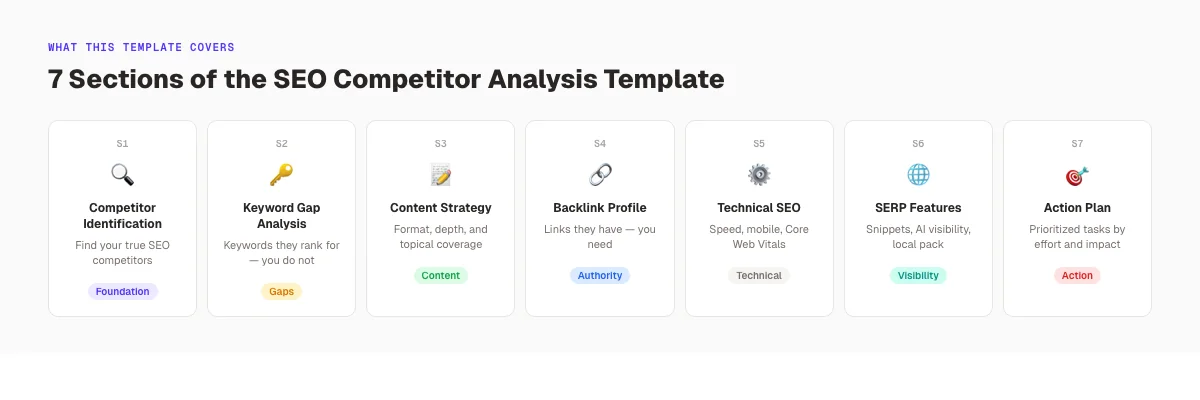
This guide covers a 7-section template designed to be used in a spreadsheet. Google Sheets, Excel, or Notion. Each section is a separate tab. The template captures all competitive data you need in one place and produces a prioritized action list at the end.
Sections 1–6 are research. Section 7 is execution.
Chapter 1: Identify Your True SEO Competitors
The first step is knowing who you are analyzing. Skip it and you waste the next 6 sections on the wrong sites.
Find Competitors Through SERP Research
Pick 5 of your highest-value target keywords. Not all keywords. Just the 5 that drive the most business value. Search each on Google and record which sites appear in positions 1–10.
Count how many times each site appears across your 5 searches. Any site that appears 3 or more times is a direct SEO competitor for your core keywords.
Template: Competitor Identification
| Domain | KW 1 | KW 2 | KW 3 | KW 4 | KW 5 | Total Appearances |
|---|---|---|---|---|---|---|
| competitor-a.com | #1 | #3 | , | #2 | #5 | 4 |
| competitor-b.com | , | #2 | #4 | #1 | , | 3 |
| competitor-c.com | #6 | , | #2 | , | #3 | 3 |
Track 4–6 competitors maximum. Tracking more creates analysis paralysis and dilutes your focus on what matters.
Build the Competitor Overview Table
For each selected competitor, capture these baseline data points using a free tool like Ahrefs' free backlink checker or the Moz Link Explorer:
Template: Competitor Overview
| Field | Comp A | Comp B | Comp C |
|---|---|---|---|
| Domain | , | , | , |
| Monthly organic traffic (est.) | , | , | , |
| Domain Authority / Rating | , | , | , |
| Top 3 ranked keywords | , | , | , |
| Primary content format | , | , | , |
| Publishing frequency (posts/mo) | , | , | , |
You do not need paid tools to fill this table. The free tiers of Ahrefs and SEMrush provide enough data for 4–6 competitor overviews per month.
For a detailed workflow on extracting competitor keyword data, the guide to analyzing competitor keywords covers the process tool by tool.
Chapter 2: Run the Keyword Gap Analysis
Keyword gap analysis is the most actionable section of any competitor analysis. It reveals the exact keywords your competitors rank for that you do not. And prioritizes them by traffic opportunity.
Collect Competitor Keyword Rankings
For each competitor, export their top 100–500 ranking keywords from any SEO tool. Remove branded keywords. What remains is the non-branded keyword universe your competitor has captured.
Cross-Reference Against Your Rankings
Compare that list against your own keyword rankings. Any keyword your competitors rank for. Where you do not appear in the top 20 results. Is a gap.
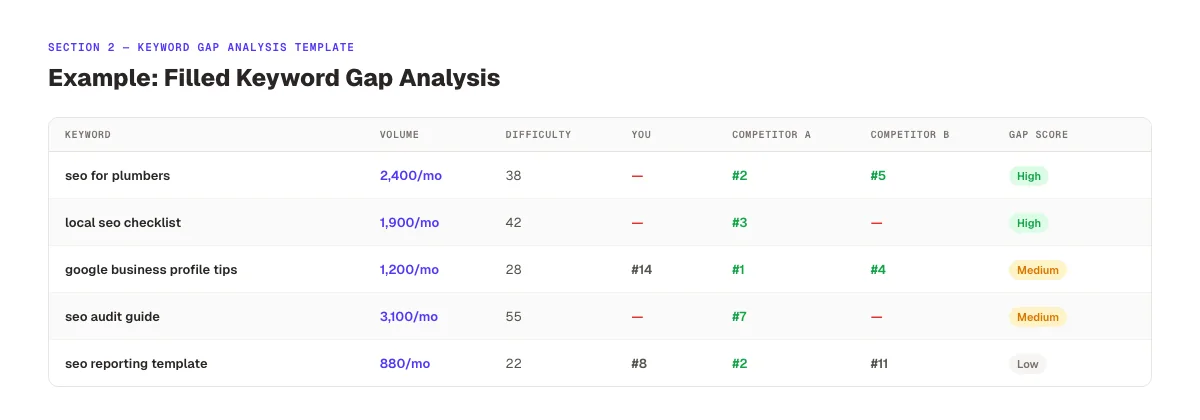
Template: Keyword Gap Analysis
| Keyword | Volume | KD | Your Rank | Comp A | Comp B | Intent | Gap Score |
|---|---|---|---|---|---|---|---|
| seo for plumbers | 2,400 | 38 | , | #2 | #5 | Info | High |
| local seo checklist | 1,900 | 42 | , | #3 | , | Info | High |
| google business profile tips | 1,200 | 28 | #14 | #1 | #4 | Info | Medium |
| seo audit guide | 3,100 | 55 | , | #7 | , | Info | Medium |
How to assign gap scores:
- High: Competitor ranks in positions 1–10 and you do not appear in top 20
- Medium: Competitor ranks in positions 1–10 and you appear in positions 11–30
- Low: Both you and the competitor rank below position 10
Prioritize High-gap keywords where search volume exceeds 500/month and keyword difficulty is under 40.
Categorize Gaps by Search Intent
Group keyword gaps by search intent. The type of content each keyword demands:
- Informational gaps: Topics you are not covering (e.g., "what is local seo")
- Commercial gaps: Comparison or evaluation content you are missing (e.g., "best seo tools for dentists")
- Transactional gaps: Service or landing pages competitors have built (e.g., "seo service [city]")
Each intent type requires a different content response. Informational gaps need blog posts or guides. Commercial gaps need comparison pages. Transactional gaps need service landing pages.
Your competitors publish 30 articles per month. You publish 2. theStacc closes that gap automatically: 30 SEO-optimized articles published to your site every month.
Chapter 3: Analyze Competitor Content Strategy
Keyword gaps tell you what to rank for. Content strategy analysis tells you how. The format, depth, and structure that already works for each keyword.
Document Content Format and Depth
For each High-gap keyword from Chapter 2, visit the competitor's ranking page and document what it looks like:
Template: Content Strategy Comparison
| Keyword | Competitor | Word Count | Format | H2 Count | Has Tables | Has Images | Schema |
|---|---|---|---|---|---|---|---|
| seo for plumbers | Comp A | 3,200 | Guide | 8 | Yes | 3 | Article |
| local seo checklist | Comp B | 2,800 | Checklist | 12 | Yes | 2 | HowTo |
| google business profile tips | Comp A | 2,100 | List post | 10 | No | 4 | , |
What to look for in each competitor page:
- Does the content go deep (3,000+ words) or stay shallow (under 1,000)?
- Is the format a how-to guide, a listicle, a case study, or a reference page?
- How many images, tables, or visuals does the page include?
- Does the page use Article, HowTo, FAQ, or other schema markup?
Identify the Content Gap. Not Just the Keyword Gap
The keyword gap tells you where to write. The content gap tells you how to write better than the competitor that already ranks.
Ask: what does this ranking page cover that I would cover differently? Look for:
- Sections that leave important context out
- Statistics that are outdated or missing entirely
- Formats that underserve the search intent
- Topics the page avoids that the searcher actually needs
The opportunity is not to match their content. It is to publish a version that answers the search intent more completely.
The topical authority building guide explains how to structure content around a topic cluster so you dominate a keyword category. Not just individual keywords.
Track Competitor Publishing Frequency
Document how often each competitor publishes new content. A site publishing 20+ articles per month compounds keyword coverage faster than one publishing 4.
Template: Publishing Frequency Tracker
| Competitor | Monthly Posts (avg) | Primary Topics | Content Quality |
|---|---|---|---|
| Comp A | 18 | Local SEO, GBP | High |
| Comp B | 6 | Agency SEO | Medium |
| Comp C | 22 | All SEO topics | Mixed |
A competitor publishing 20+ articles per month builds topical authority fast. Your content cadence needs to match or exceed theirs within your priority topic clusters.
Chapter 4: Audit Competitor Backlink Profiles
Backlinks remain one of the strongest ranking signals. According to Backlinko's ranking factors research, top-3 results have substantially more referring domains than lower-ranked pages. Understanding where your competitors earn links reveals where you should earn them.
Compare Referring Domain Counts
Referring domain count matters more than raw backlink count. 100 links from 100 different sites outperform 100 links from 1 site.
Template: Backlink Profile Comparison
| Competitor | Total Backlinks | Referring Domains | Avg DR | Top Link Sources |
|---|---|---|---|---|
| Comp A | 12,400 | 890 | 62 | Forbes, HubSpot, Inc |
| Comp B | 4,200 | 340 | 48 | Local news sites, directories |
| Comp C | 28,000 | 1,100 | 71 | Moz, Ahrefs, SEJ |
| Your Site | [fill] | [fill] | [fill] | [fill] |
Identify the Link Gap
The link gap is the list of sites that link to your competitors but not to you. These are high-probability outreach targets because they have already demonstrated a willingness to link to content in your topic area.
Export the referring domains for each competitor. In a spreadsheet, find domains that appear for 2+ competitors but not for your site. That intersection list is your priority outreach target.
Categorize Competitor Link Types
Not all links carry the same weight. Categorize the types of links your competitors earn:
- Editorial links: Earned from editorial content on authority sites (highest value)
- Resource links: Links from "best of" or curated resource pages
- Directory links: Links from industry-specific directories
- Guest post links: Links earned via contributed articles
A competitor earning mostly editorial links from high-DR sites has built a different moat than one earning mostly directory links. Adjust your link building approach to target the same types.
The backlink audit guide covers how to evaluate link quality and identify patterns in high-authority competitors' backlink profiles.
Chapter 5: Check Technical SEO Foundations
Technical SEO is the floor. If your foundation is weaker than a competitor's, better content and more links will not overcome it. This section benchmarks your technical health against each competitor.
Compare Core Web Vitals and Page Speed
Check Core Web Vitals scores for your site and each competitor using Google PageSpeed Insights. Document the results and gaps.
Template: Technical SEO Comparison
| Check | Your Site | Comp A | Comp B | Comp C |
|---|---|---|---|---|
| Core Web Vitals (Pass/Fail) | , | , | , | , |
| Mobile-friendly (Yes/No) | , | , | , | , |
| HTTPS active (Yes/No) | , | , | , | , |
| Largest Contentful Paint (LCP) | , | , | , | , |
| Cumulative Layout Shift (CLS) | , | , | , | , |
| XML sitemap present | , | , | , | , |
| Structured data in use | , | , | , | , |
Prioritize Technical Gaps Correctly
If a competitor passes Core Web Vitals and your site fails, that technical gap affects every page. Not just one keyword. Technical deficiencies suppress organic growth at the category level.
Prioritize technical fixes above content creation when your scores are significantly below competitors. A faster, cleaner site multiplies the ranking impact of every piece of new content.
Use the free SEO audit tool to run a full technical check against a standard checklist and compare results against competitor benchmarks.
3,500+ blogs published. Every article is SEO-scored before publish. theStacc writes content optimized to the same technical standards your competitors have already met.
Chapter 6: Map SERP Features and AI Search Presence
SERP features. Featured snippets, People Also Ask, local pack, video carousels. Capture click share above organic results. In 2026, AI search results from Google AI Overviews, ChatGPT web search, and Perplexity add a new layer to competitive visibility that most teams are not tracking.
Track SERP Feature Ownership
For your target keywords, document which SERP features exist and which competitor owns each one.
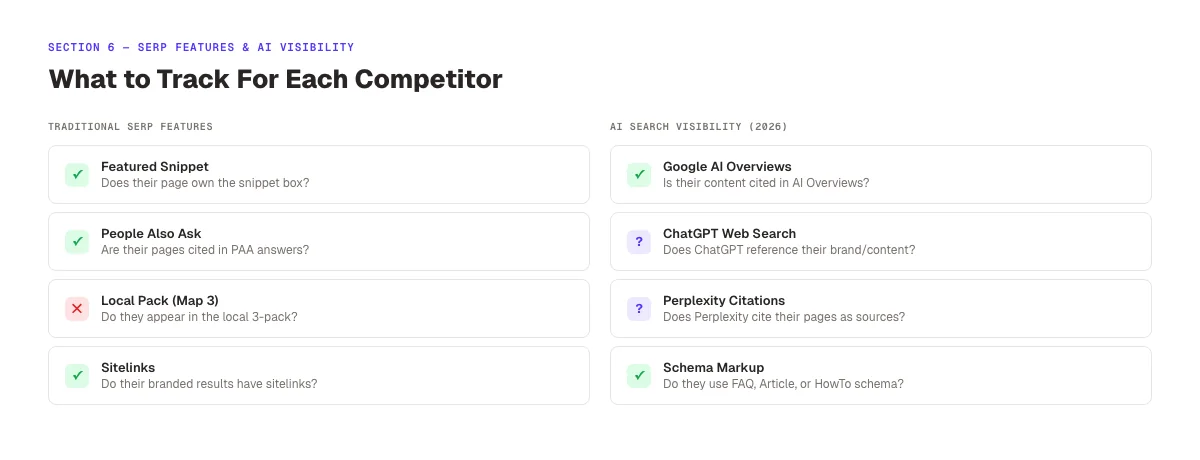
Template: SERP Features Tracker
| Keyword | Featured Snippet | PAA Owner(s) | Local Pack | AI Overview Cited |
|---|---|---|---|---|
| [keyword 1] | Comp A | Comp B, Comp C | Your Site | Comp A |
| [keyword 2] | , | Comp A | , | Comp B |
How to use this data:
If a competitor owns a featured snippet for a High-gap keyword, their content structure triggered the snippet. Study the exact snippet text. It typically comes from a concise, direct answer to the search query. Often a single paragraph or a numbered list. Restructure your equivalent content to match that format.
Audit AI Search Visibility
Search your target keywords in Perplexity and in ChatGPT with web search enabled. Document which competitor pages appear as cited sources.
Sites cited in AI search results tend to:
- Contain quotable, direct answers to specific questions
- Use schema markup (FAQ, Article, HowTo)
- Have high domain authority and strong referring domain counts
- Load fast and remain accessible to crawlers without JavaScript barriers
If competitors appear consistently in AI search results and your site does not, review their on-page structure and schema implementation. The patterns are usually visible.
Chapter 7: Turn Findings Into a 90-Day Action Plan
Analysis without action is research. The final section converts every finding into a prioritized task list with timelines and owners.
Build the Priority Matrix
Plot every finding on an effort vs. impact matrix. The goal: do the highest-impact, lowest-effort items first.
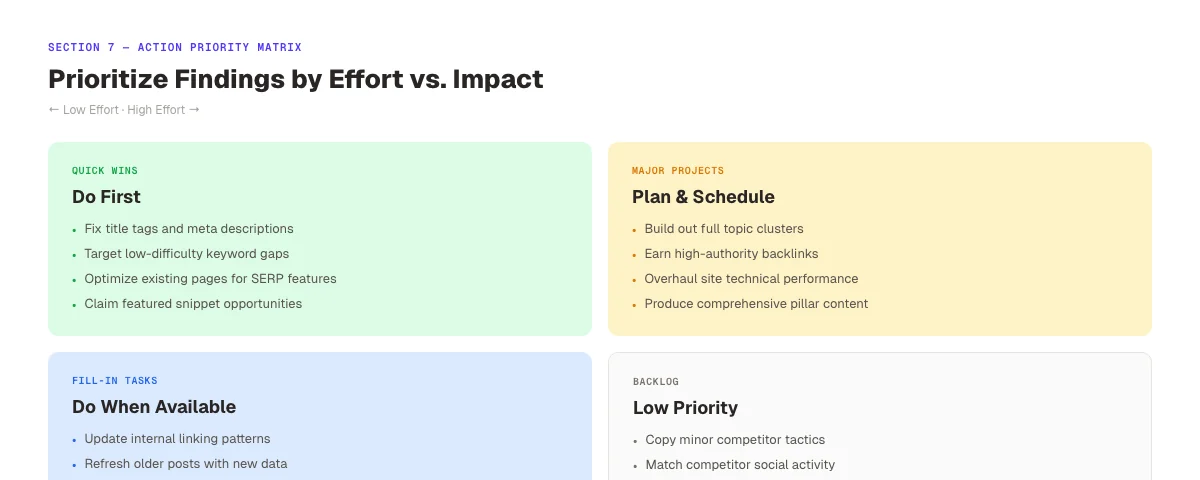
Template: Action Priority Matrix
| Finding | Action | Effort | Impact | Priority | Timeline |
|---|---|---|---|---|---|
| KW gap: "seo for plumbers" | Publish 2,500-word guide | Medium | High | Do First | Week 2 |
| Snippet gap: [keyword] | Restructure existing page | Low | High | Quick Win | Week 1 |
| Link gap: Forbes, Inc | Pitch editorial articles | High | High | Schedule | Month 2 |
| Technical: CWV fail | Fix image compression | Low | Medium | Quick Win | Week 1 |
Execute the 90-Day Schedule
Month 1. Quick Wins:
- ✓ Fix all technical issues rated Low effort / High impact
- ✓ Publish content for 3–5 High-gap keywords with difficulty under 30
- ✓ Restructure 2–3 existing pages to capture identified featured snippets
- ✓ Claim directory listings that appear in competitor link gap lists
Month 2. Content Push:
- ✓ Publish content for 5–8 additional keyword gaps
- ✓ Begin outreach for editorial backlinks from link gap targets
- ✓ Update 3–5 existing posts with fresh data, new sections, and schema markup
Month 3. Authority Building:
- ✓ Publish the first major pillar post in your target topic cluster
- ✓ Secure 3–5 editorial backlinks from guest posts or digital PR
- ✓ Re-evaluate SERP feature tracking to measure featured snippet capture
For building the reporting structure that tracks these results month over month, the SEO reporting guide covers what to measure and how to present competitive progress to stakeholders.
How Often to Run This Analysis
A full SEO competitor analysis takes 8–12 hours the first time. After that, updates run faster because the baseline data already exists.
Recommended cadence:
| Section | Update Frequency |
|---|---|
| Full analysis (all 7 sections) | Every 6 months |
| Keyword gap update | Every 3 months |
| Backlink gap update | Every 3 months |
| SERP features check (priority keywords) | Monthly |
| Technical SEO check | Monthly via automated tools |
Set a calendar reminder. The SEO scene shifts. Competitors publish new content, earn new links, and lose rankings. Stale competitive data produces stale strategy.
What practitioners are saying on X
AI search advice ages quickly. Here is high-signal public discussion from SEO and growth operators — context for your roadmap, not a substitute for primary data.
- @hridoyreh (Mar 2026): Widely shared SEO skill tree: foundations, research, technical, on-page, content, links, AI SEO/GEO, analytics, UX, brand, programmatic — useful map for stats and how-to posts. See the post on X.
- @jakezward (Feb 2026): 2026 SEO predictions emphasize AI Overview share-of-SERP, schema for LLM token efficiency, brand mentions in AI answers as a KPI, proprietary data as a moat, and content refresh beating net-new AI slop. See the post on X.
Grok, AI Overviews, and multi-engine visibility
Research topics like “seo competitor analysis template” get cited when frameworks and decision rules are extractable. Lead with definitions and tables; keep Grok-ready entity language for tools and SERP features named on the page.
- Google AI Overviews: Use passage-ready answers, tables, and FAQ schema where relevant.
- ChatGPT / Perplexity: Cite named sources next to key claims.
- Grok: Maintain accurate entity facts on-site and in high-signal X posts.
Publish content built for Google and AI citations. theStacc’s Content SEO module ships SEO-scored articles structured for rankings and generative engines — including clearer entity pages models like Grok can quote.
FAQ
An SEO competitor analysis template is a structured framework for documenting and comparing what your top competitors rank for, how they structure content, where they earn backlinks, and how they appear in search results. The 7-section template in this guide covers competitor identification, keyword gaps, content strategy, backlink profiles, technical SEO, SERP features, and a prioritized action plan.
Search your 5 most important target keywords in Google and record which sites appear in positions 1–10. Any site that appears in 3 or more of those searches is a direct SEO competitor. These sites compete for the same search intent as your business. They are not always the same companies you compete with for customers.
You can run a basic analysis with free tools: Google Search Console for your own rankings, Ahrefs' free backlink checker for competitor link data, Google PageSpeed Insights for technical comparison, and direct SERP searches for SERP features. Paid tools like SEMrush or Ahrefs speed up the process but are not required for a thorough first analysis.
Run a full analysis every 6 months. Update keyword gap data quarterly. Check SERP features monthly for your highest-priority keywords. Competitors publish new content and earn new links constantly. Quarterly updates prevent your strategy from running on 6-month-old data.
A keyword gap is a keyword your competitor ranks for in positions 1–10 where you do not appear in the top 20 results. High-gap keywords. Where a competitor ranks well and you are absent. Represent direct content opportunities. Prioritize gaps where monthly search volume exceeds 500 and keyword difficulty is under 40.
AI search tools like Google AI Overviews, ChatGPT web search, and Perplexity now cite specific pages as sources in their answers. Competitors whose pages appear as AI-cited sources gain visibility beyond traditional SERP positions. Add an AI visibility check to your SERP features section by searching target keywords in Perplexity and ChatGPT. Then document which competitor pages appear as cited sources.
Your SEO strategy is only as good as the data behind it. This 7-section template gives you a complete picture of what your competitors are doing. And a prioritized plan to close the gap.
Start with Chapter 1. A complete competitor overview takes less than 2 hours. And every content and link decision that follows gets sharper.
Rank everywhere your competitors rank. Automatically. theStacc publishes 30 SEO articles per month so your content library grows without a writing team.
Related Tools & Resources
Free SEO Tools:
Best Lists:
Sources & references
- [1] Princeton / Georgia Tech et al. — GEO research (arXiv:2311.09735)
- [2] @hridoyreh on X — Widely shared SEO skill tree: foundations, research, technical, on-page, content, links, AI SEO/GEO, analytics, UX, bran
- [3] @jakezward on X — 2026 SEO predictions emphasize AI Overview share-of-SERP, schema for LLM token efficiency, brand mentions in AI answers
- [4] Referenced source — backlinko.com

Researched, written, and published articles that compound organic traffic.
Weekly local SEO teardowns
One practical email a week. Map Pack, GBP, AI Overviews — no fluff. Unsubscribe anytime.