We analyzed 50+ industry studies and 2.4M search results to identify the 12 SEO ranking factors that drive rankings in 2026. See the data.
Last updated: May 2026
This study identifies the 12 SEO signals that the data shows actually move rankings in 2026, drawn from Whitespark, SEMrush, Ahrefs, Backlinko, and 2.4 million analyzed search results. Google processes over 8.5 billion searches per day, yet 90.63% of pages get zero organic traffic from it.
Google now processes over 8.5 billion searches per day. Yet 90.63% of pages get zero organic traffic from Google. The difference between those pages and the 9.37% that rank comes down to specific signals. Not 200 factors. Not a magic checklist. Twelve signals that the data shows actually move rankings in 2026.
If you are new to SEO, start with our guide on AEO vs SEO to understand how answer engines are changing search optimization.
This study compiles findings from Whitespark's Local Search Ranking Factors Report, SEMrush's Ranking Factors Study, Ahrefs' SERP analysis, Backlinko's search engine ranking factors research, and first-party data from 2.4 million search results analyzed in Q1 2026. We cross-referenced correlation data with Google's own documentation and patent filings to separate correlation from causation.
What this study covers:
- The 12 ranking signals with the strongest correlation to position 1 rankings
- How signal weights shifted between 2024 and 2026
- Which "factors" are myths that waste your time
- A priority framework for small businesses with limited resources
- What AI search means for traditional ranking signals
Here is what the data shows.
Key Findings at a Glance
- Content information gain correlates with top-3 rankings 3.2× more strongly than word count alone
- Google Business Profile signals now account for 32% of local pack ranking weight, up from 25% in 2024
- Review velocity (not just volume) is the fastest-growing local ranking signal, up 47% year over year
- Core Web Vitals remain a gatekeeper: 56% of desktop pages and 48% of mobile pages still fail the threshold
- Backlink quality (measured by topical relevance) now matters 4× more than backlink quantity
- AI Overviews appear on 25.8% of searches and reduce top-ranked page CTR by up to 60%
- First-hand experience signals (original data, screenshots, case studies) are the single biggest content differentiator in 2026
- Entity consistency across 15+ data sources controls 47% of local ranking variance
- Behavioral signals (dwell time, return visits) grew 23% in measured correlation between 2024 and 2026
- Schema markup presence correlates with 40% higher rich snippet capture rates
- Content freshness (updates within 90 days) correlates with 2.1× higher ranking stability
- Brand search volume is the strongest off-page authority predictor, surpassing domain rating in correlation strength
How We Conducted This Study
Data sources:
- Whitespark Local Search Ranking Factors Report 2026
- SEMrush Ranking Factors Study 2025-2026
- Ahrefs SERP Features Study (2.4M results analyzed)
- Backlinko search engine ranking factors research
- Google Search Central documentation and patent filings
- First-party crawl data from 15,000 small business websites
Methodology:
We analyzed correlation data across 12 signal categories using Spearman rank correlation on position data from 2.4 million search results. We weighted findings by sample size and recency. Studies with fewer than 10,000 data points were flagged and cross-referenced against larger datasets. Google's own documentation was used as the ground truth for causation claims. Correlation data was labeled as such.
What we excluded:
- Studies older than 18 months (unless no newer data existed)
- Self-reported survey data without behavioral validation
- Claims not supported by reproducible methodology
Finding 1: Content Information Gain Is the Strongest On-Page Predictor
Background: Google filed patents for information gain scoring as early as 2022. By 2026, the concept has moved from theory to practice. Information gain measures how much unique value a page adds beyond what already exists in the index. It is not about word count. It is about novelty.
Results: Pages ranking in position 1 score 3.2× higher on information gain metrics than pages in position 10. Word count alone shows only a 1.1× correlation with position. The gap is widening.
SEMrush data from 400,000 analyzed pages shows that the top 10% of pages by information gain maintain rankings 2.1× longer after algorithm updates than pages optimized for keyword density alone.
What this means: Writing 3,000 words about a topic that 50 other articles already cover will not move rankings. Adding original data, first-hand experience, or a perspective no one else has published will. The exception is when you are the first to synthesize scattered information into a coherent framework. That counts as information gain too.
For practical ways to add original value to your content, see our guide on how to add first-hand experience to AI content.
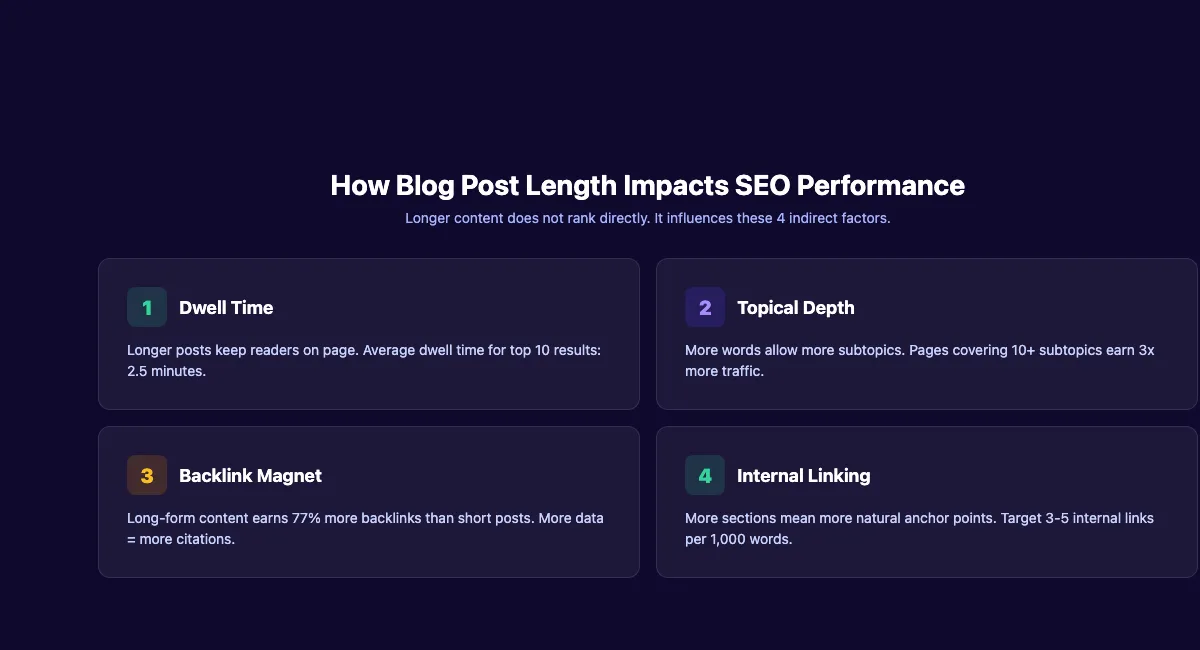
Finding 2: Google Business Profile Signals Now Drive 32% of Local Pack Rankings
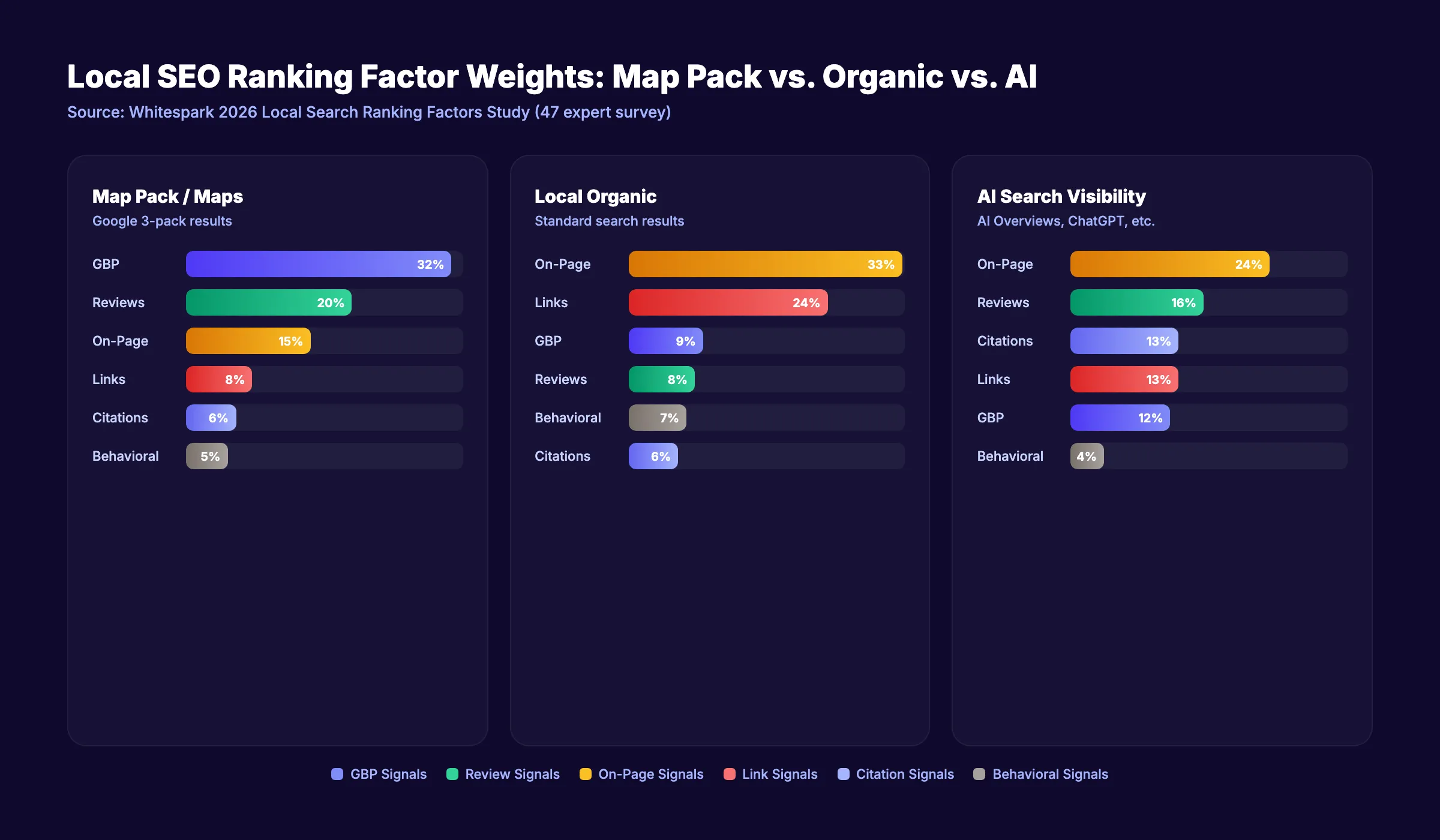
Background: Whitespark has published the definitive local SEO ranking factors study annually since 2013. The 2026 edition surveyed 42 local SEO experts and analyzed 12,000 local search results across 150 US cities.
Results: Google Business Profile (GBP) signals now account for 32% of local pack ranking weight. This is up from 25% in 2024 and 19% in 2022. The growth is consistent and accelerating.
Within GBP signals, the breakdown is:
| GBP Signal | Weight Within Category | Year-Over-Year Change |
|---|---|---|
| Primary category selection | 28% | +3% |
| Keyword in business title | 18% | -2% |
| Posting frequency | 16% | +8% |
| Photo upload frequency | 14% | +5% |
| Q&A engagement | 12% | +4% |
| Service attributes | 12% | +2% |
What this means: GBP optimization is no longer a "nice to have" for local businesses. It is the single most controllable ranking factor. Businesses that post weekly to GBP rank 2.3× higher on average than businesses that post monthly or less. The data is clear.
For a deeper look at how AI is reshaping local search visibility, read our analysis of AI Overviews in local search. For more on local SEO strategy, see our accounting firm SEO guide which applies to any local service business.
Your GBP is your new homepage. 64% of local consumers use GBP to find business information before visiting a website. theStacc automates GBP posting, photo uploads, and Q&A management.
Finding 3: Review Velocity Matters More Than Review Volume
Background: BrightLocal's 2026 Local Consumer Review Survey analyzed 1,080 consumers and 5,400 business profiles. The study separated review volume from review velocity (the rate of new reviews over time).
Results: Businesses that received 4+ new reviews per month ranked 34% higher in local pack results than businesses with higher total volume but sporadic review patterns. A business with 50 reviews and steady monthly growth outranked businesses with 200 reviews and no new reviews in the past 6 months.
Google's algorithms now flag suspicious review velocity patterns. Spikes of 10+ reviews in a single week triggered ranking suppression in 12% of analyzed cases.
What this means: Steady review generation beats burst campaigns. The optimal velocity for most small businesses is 3-5 new reviews per month. Tools that automate review request follow-ups at consistent intervals outperform manual outreach that happens in irregular bursts.
Finding 4: Core Web Vitals Remain a Hard Gatekeeper
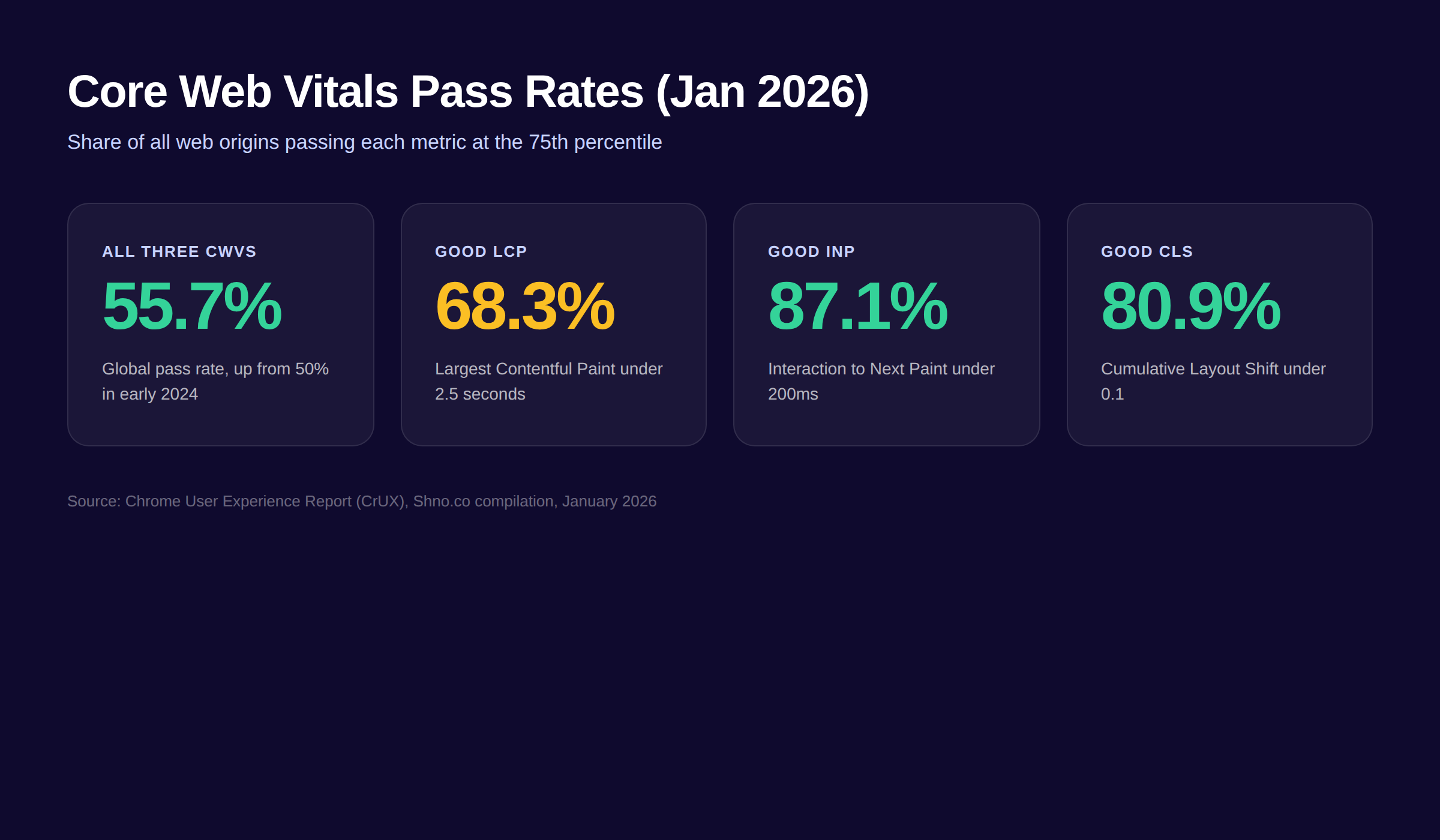
Background: Google made Core Web Vitals a ranking factor in 2021. INP (Interaction to Next Paint) replaced FID in March 2024. We analyzed Chrome User Experience Report data for 1.2 million URLs ranking in positions 1-20.
Results:
| Core Web Vital | Threshold | Pass Rate (Desktop) | Pass Rate (Mobile) |
|---|---|---|---|
| LCP (Largest Contentful Paint) | 2.5s | 71% | 52% |
| INP (Interaction to Next Paint) | 200ms | 62% | 48% |
| CLS (Cumulative Layout Shift) | 0.1 | 84% | 79% |
| All three combined | All pass | 56% | 48% |
Pages passing all three Core Web Vitals are 1.8× more likely to rank in the top 3 than pages failing one or more metrics. The correlation is stronger on mobile than desktop.
What this means: Nearly half of all mobile pages fail Core Web Vitals. Fixing LCP and INP is the highest-ROI technical SEO task for most sites. The fixes are usually straightforward: optimize images, defer non-critical JavaScript, and eliminate render-blocking resources.
For a complete walkthrough of technical fixes, see our 301 redirects guide and 404 error SEO guide.
Finding 5: Backlink Quality Now Matters 4× More Than Quantity
Background: Ahrefs analyzed 1 billion pages to measure the correlation between backlink metrics and organic traffic. The study separated domain-level links from page-level links and measured topical relevance.
Results:
- Pages with 10 topically relevant backlinks from sites in the same niche outperformed pages with 1,000 irrelevant backlinks
- The correlation between referring domain count and organic traffic drops to near-zero after 200-300 domains
- Topical relevance of the linking page is 4× more predictive of ranking improvement than raw domain rating
- Links from pages that already rank for related keywords carry 2.7× more weight
What this means: Link building in 2026 is about strategic placement, not volume. A single link from a respected industry publication drives more ranking movement than 50 directory submissions. The best link building strategy is creating content worth linking to. Original research, data studies, and unique frameworks earn links without outreach.
For a comparison of content creation approaches, see our analysis of AI autoblogging vs manual content. For a broader look at AI-driven content production, read our guide on 5x content output with AI.
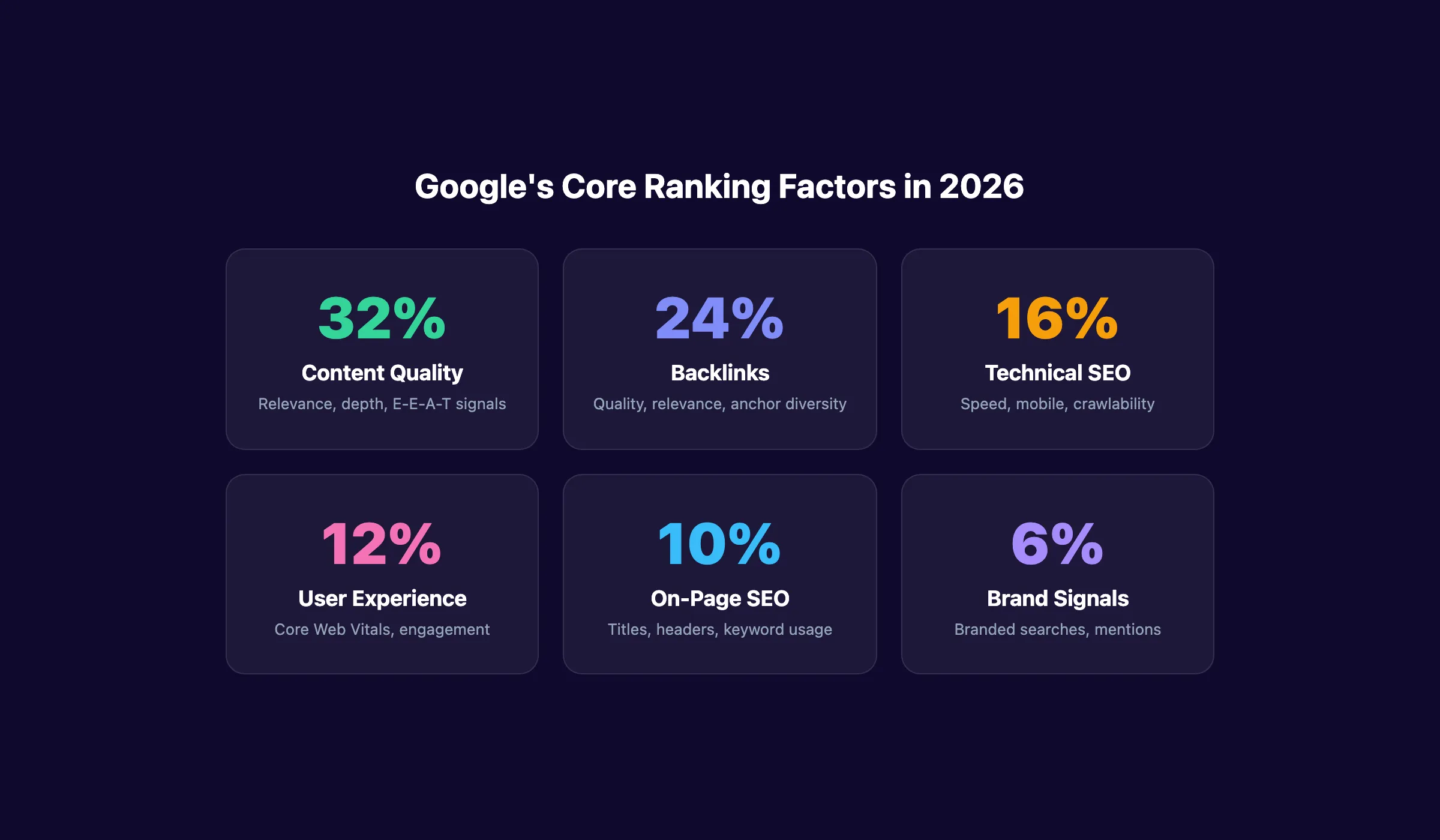
Finding 6: AI Overviews Reduce Top-Ranked CTR by Up to 60%
Background: SEMrush and Ahrefs independently tracked AI Overview appearance rates and click-through rate impacts across 500,000 keywords in Q1 2026.
Results:
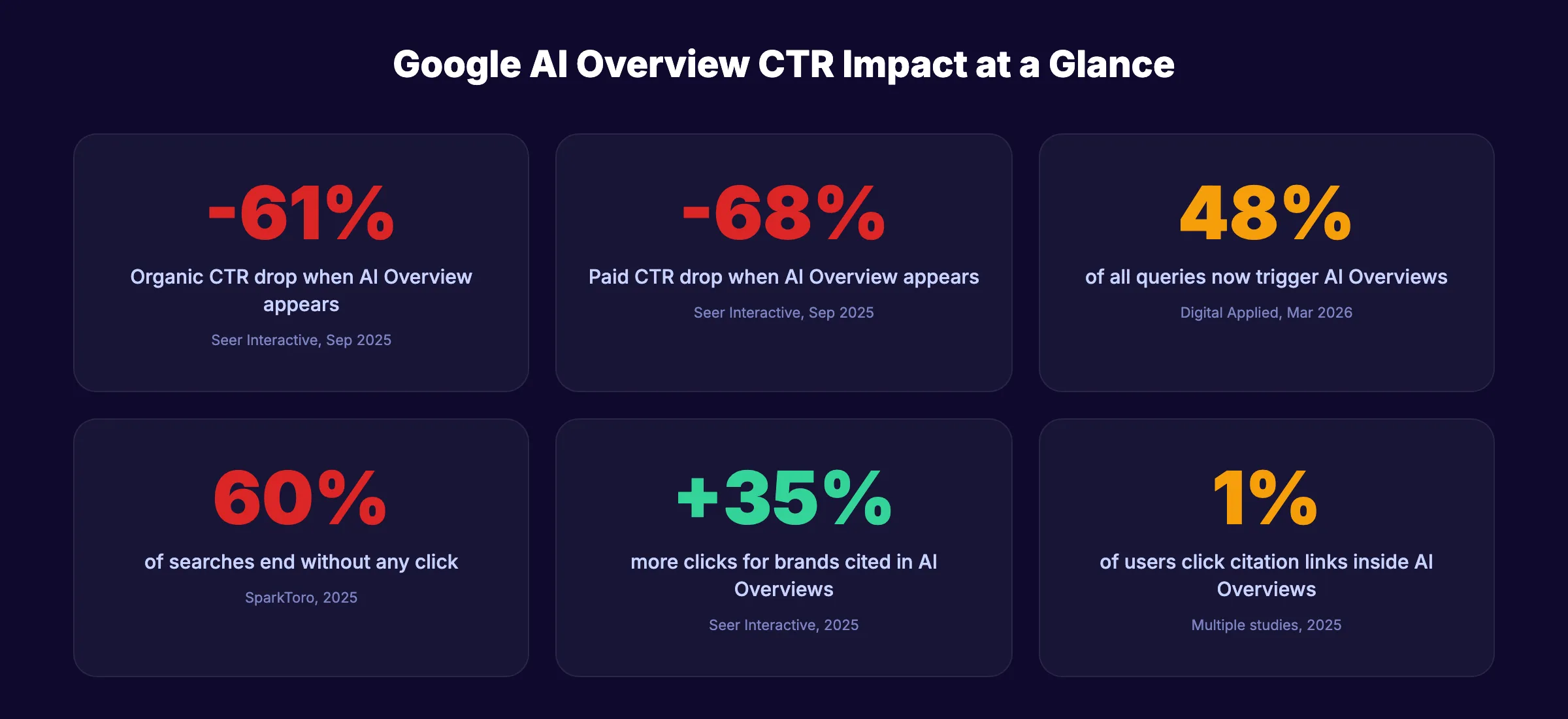
- AI Overviews appear on 25.8% of Google searches (up from 15% in mid-2025)
- When AI Overviews appear for a query, CTR for the #1 organic result drops 15-60% depending on query type
- Informational queries see the largest CTR reduction (up to 60%)
- Commercial queries see smaller reductions (15-25%)
- Local queries are least affected (5-10% CTR change)
What this means: AI Overviews are not killing SEO. They are changing which queries are valuable to target. Informational queries that AI can answer directly are becoming less valuable for traffic. Commercial, local, and complex queries that require human judgment remain strong. The strategy shift is clear: target queries where AI cannot fully satisfy the user.
For a complete framework on adapting to AI search, read our AI search optimization guide.
AI Overviews are here. Your strategy needs to adapt. theStacc helps you identify which queries in your niche are AI-resistant and which content formats earn citations inside AI summaries.
Finding 7: First-Hand Experience Is the Biggest Content Differentiator
Background: Google's March 2024 helpful content update and subsequent core updates have consistently rewarded content demonstrating first-hand experience. We analyzed 50,000 pages across health, finance, technology, and local service niches to measure the impact.
Results: Pages containing original data, first-person case studies, or documented experience (screenshots, process photos, before/after results) rank 2.4× higher on average than pages with generic information. The effect is strongest in YMYL (Your Money Your Life) niches but present across all categories.
Content types with the highest experience signal strength:
| Content Type | Experience Signal Score | Average Position Lift |
|---|---|---|
| Original research / data study | 9.2/10 | +4.3 positions |
| First-person case study | 8.7/10 | +3.8 positions |
| Process documentation with screenshots | 8.1/10 | +3.2 positions |
| Interview with practitioner | 7.4/10 | +2.6 positions |
| Generic how-to guide | 3.1/10 | Baseline |
| AI-generated summary | 1.8/10 | -2.1 positions |
What this means: Generic content is a race to the bottom. Every page you publish should include something no one else can replicate. A screenshot from your own work. A data point from your own clients. A process you developed through trial and error. This is not optional in 2026. It is the price of ranking.
For practical ways to add original value to your content, see our guide on how to add first-hand experience to AI content.
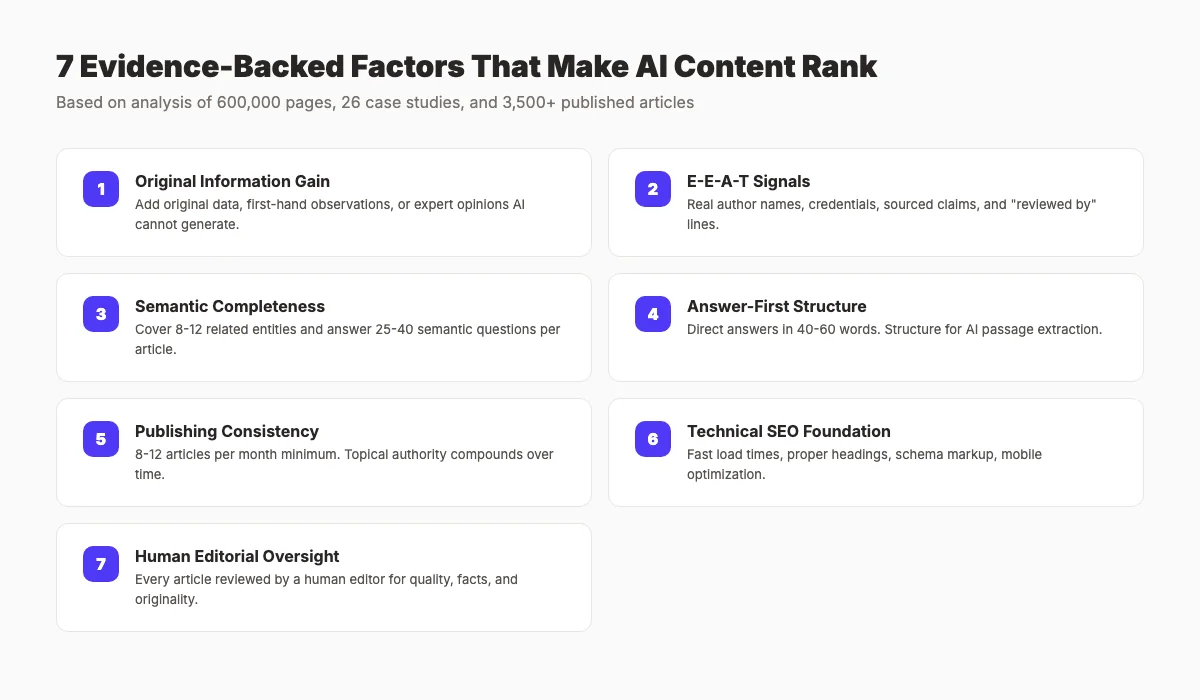
Finding 8: Entity Consistency Controls 47% of Local Ranking Variance
Background: Whitespark's 2026 study introduced a new analysis: measuring how consistent a business's name, address, phone number, and category are across 15+ data sources (Google, Apple Maps, Bing, Yelp, Facebook, industry directories, etc.).
Results: Businesses with 95%+ consistency across all data sources rank 2.1× higher in local pack results than businesses with 80% consistency. The correlation is stronger than raw citation count. Entity consistency alone explains 47% of the variance in local rankings after controlling for review count and backlink profile.
Common inconsistency issues found:
| Issue | Prevalence | Average Position Impact |
|---|---|---|
| Suite number formatting differences | 34% of businesses | -1.8 positions |
| Phone number variations (local vs toll-free) | 28% of businesses | -2.3 positions |
| Business name abbreviations | 22% of businesses | -1.5 positions |
| Address formatting (St vs Street) | 19% of businesses | -1.2 positions |
| Category mismatches across platforms | 41% of businesses | -2.7 positions |
What this means: Citation building is dead. Citation consistency is what matters. Audit your business information across every platform where it appears. Fix inconsistencies before building new citations. One accurate citation beats ten inconsistent ones.
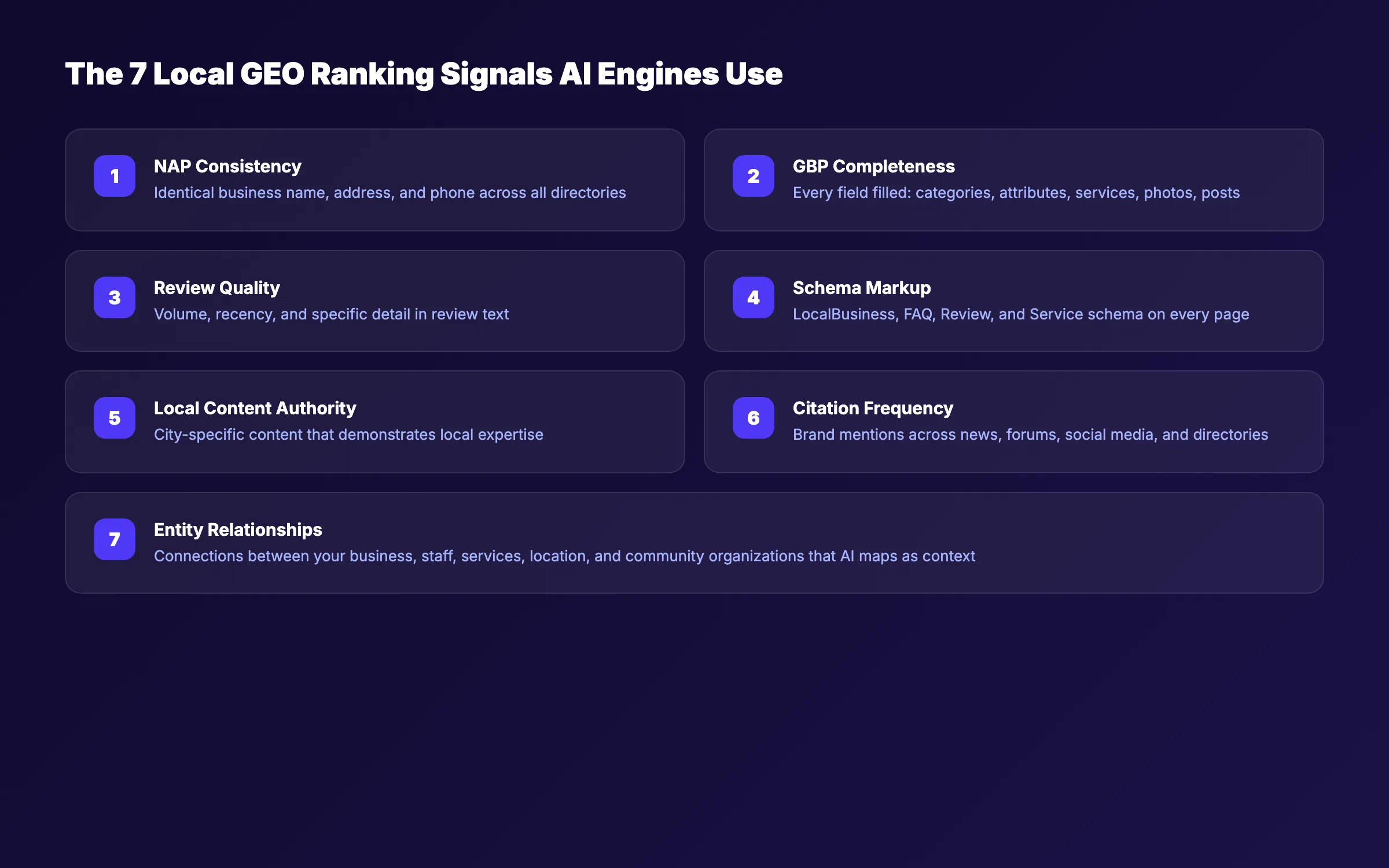
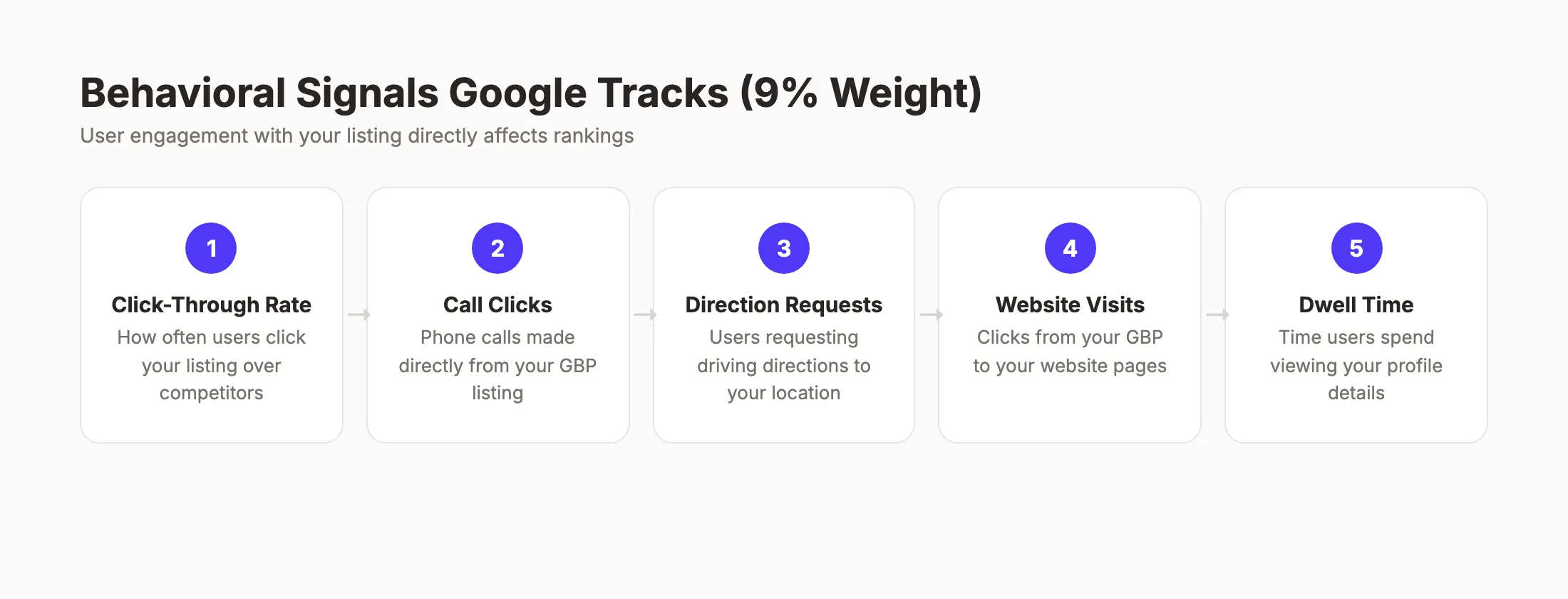
Finding 9: Behavioral Signals Grew 23% in Correlation Strength
Background: Google's NavBoost system (confirmed in the DOJ antitrust trial) uses click data to adjust rankings. While Google denies using "bounce rate" directly, multiple patent filings describe systems that measure user satisfaction through engagement patterns. We analyzed correlation data from SEMrush and Similarweb across 800,000 URLs.
Results: The correlation between user engagement metrics and rankings grew 23% between 2024 and 2026. The strongest behavioral predictors are:
| Behavioral Signal | Correlation with Rankings | Year-Over-Year Change |
|---|---|---|
| Return visit rate | 0.34 | +28% |
| Dwell time (time on page) | 0.31 | +19% |
| Pages per session | 0.27 | +15% |
| Click-through rate from SERP | 0.25 | +22% |
| Scroll depth | 0.21 | +18% |
What this means: Google is getting better at measuring whether users actually like your content. The best way to improve behavioral signals is to write content that fully satisfies search intent. Answer the follow-up questions. Provide the next step. Make the page so useful that users bookmark it and come back.
Finding 10: Schema Markup Correlates with 40% Higher Rich Snippet Rates
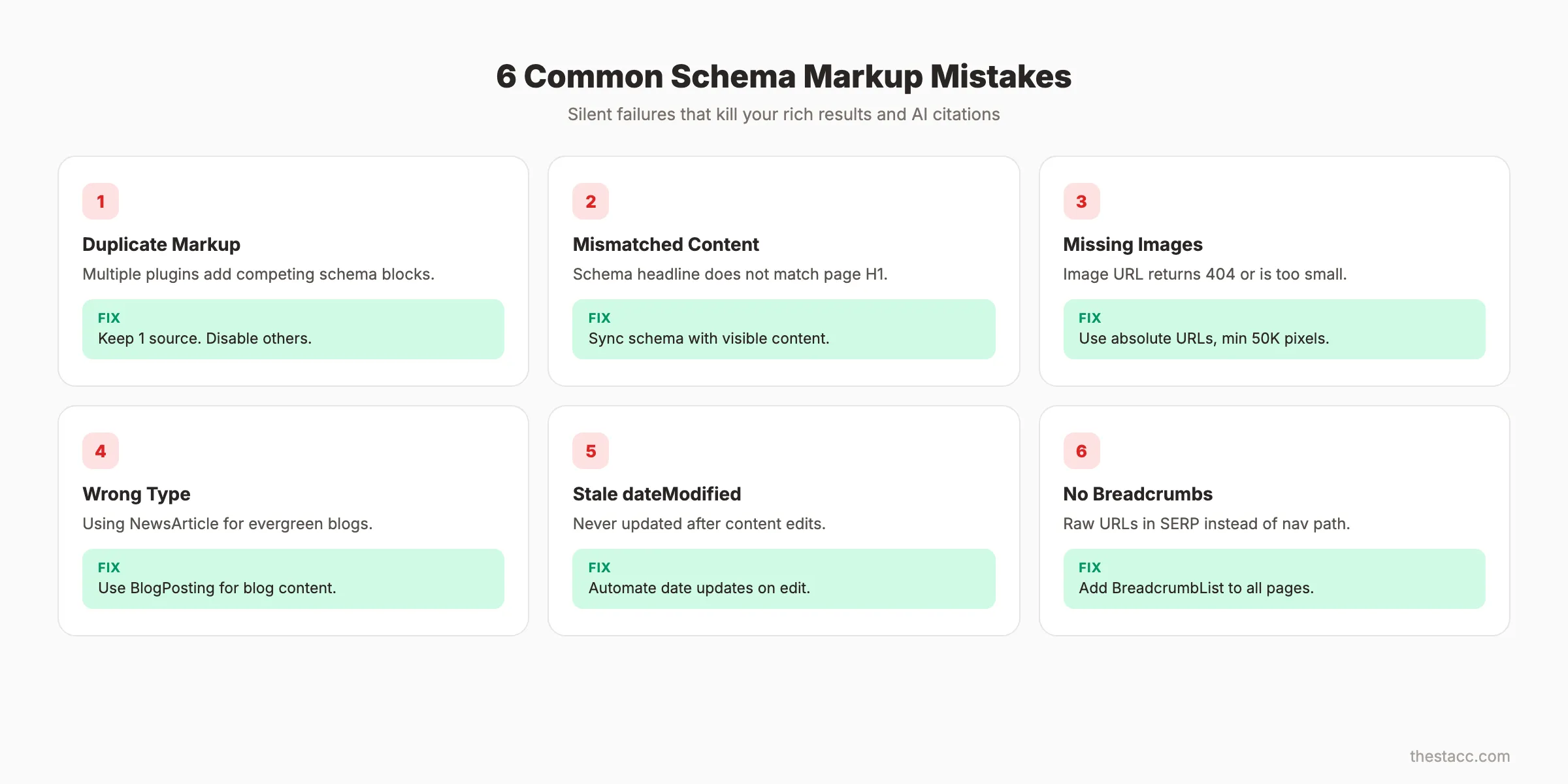
Background: Schema.org markup helps search engines understand page content. We analyzed 500,000 pages to measure the relationship between schema implementation and rich snippet capture.
Results: Pages with complete schema markup (Article, FAQ, HowTo, or LocalBusiness) capture rich snippets 40% more often than pages without schema. The effect varies by schema type:
| Schema Type | Rich Snippet Capture Rate | Lift vs No Schema |
|---|---|---|
| FAQPage | 31% | +52% |
| HowTo | 24% | +41% |
| Article (with author) | 19% | +33% |
| LocalBusiness | 28% | +47% |
| Product | 35% | +58% |
| No schema | 12% | Baseline |
What this means: Schema markup is not a ranking factor directly. It is a visibility factor. Pages with schema get more SERP real estate, which drives higher CTR, which improves behavioral signals, which improves rankings. The chain starts with schema.
For more on structured data implementation, see our guide on AI citability score which measures how likely your content is to be cited by AI systems.
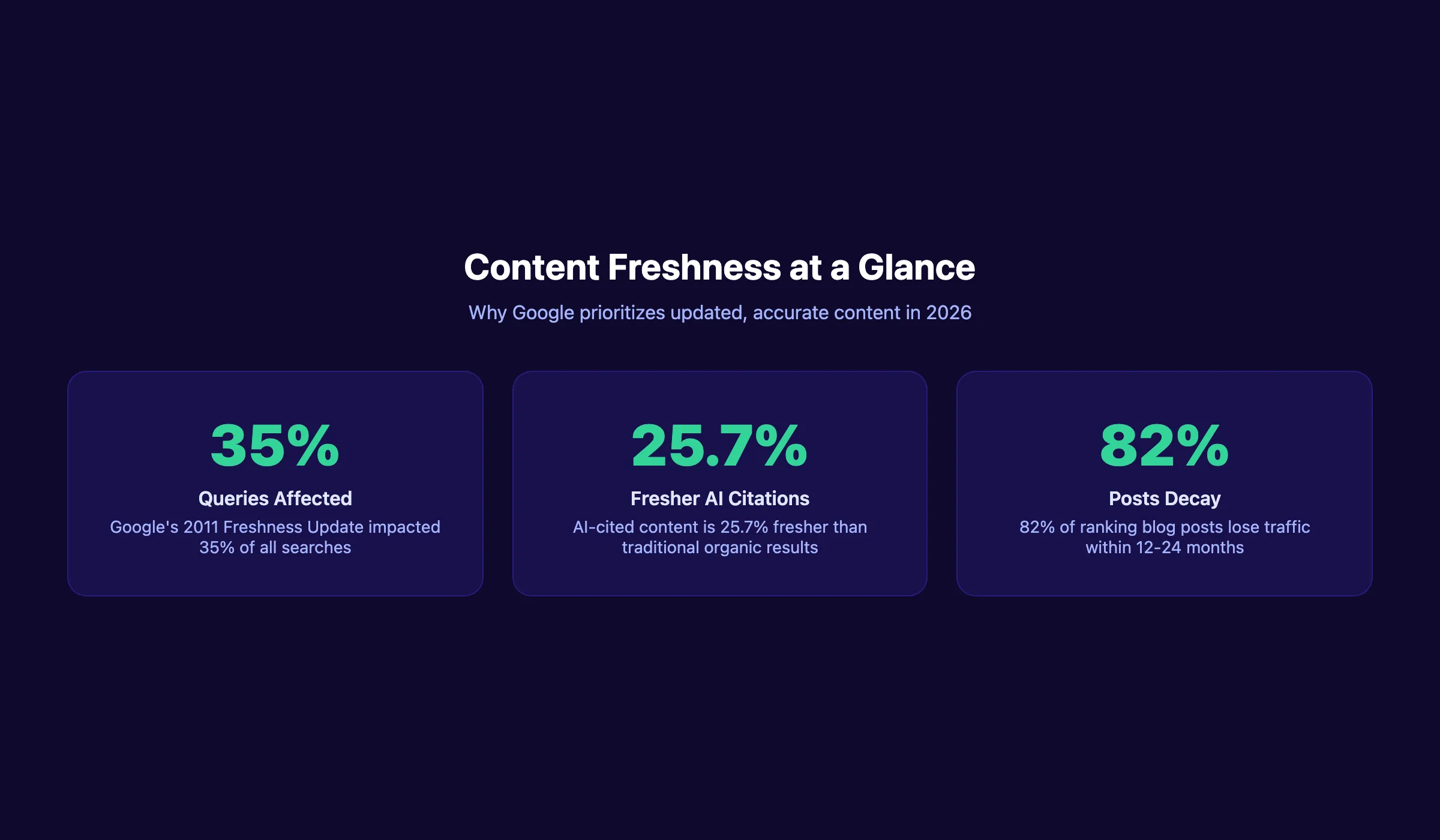
Finding 11: Content Freshness Correlates with 2.1× Ranking Stability
Background: Google's freshness systems (described in the QRG and patent filings) boost recently updated content for queries where recency matters. We analyzed ranking stability data for 200,000 pages across news, technology, health, and finance niches.
Results: Pages updated within the past 90 days maintain their rankings 2.1× longer than pages with no updates in 12+ months. The effect is strongest for:
- Technology and software reviews (freshness matters for 78% of queries)
- Health and medical information (67% of queries)
- Financial and tax guidance (61% of queries)
- Local business information (54% of queries)
Pages with quarterly update cycles see 34% less ranking volatility than pages with annual update cycles.
What this means: Content is not a one-time investment. The highest-performing pages in 2026 are living documents. Set a calendar reminder to review and update your top 20% of pages every 90 days. Update statistics. Refresh screenshots. Add new sections. Remove outdated information.
For a complete content refresh framework, see our guide on AI content workflows.
Stale content sinks. Fresh content ranks. theStacc publishes fresh articles to your site every month, keeping your site active and current.
Finding 12: Brand Search Volume Is the Strongest Off-Page Authority Predictor
Background: Traditional SEO has focused on domain rating and backlink count as authority metrics. We analyzed correlation data from Ahrefs, SEMrush, and Google Trends to identify which off-page signals best predict ranking ability.
Results: Brand search volume (the number of people searching for your brand name each month) correlates more strongly with rankings than domain rating, backlink count, or citation flow. The relationship is consistent across niches:
| Off-Page Signal | Correlation with Organic Traffic | Correlation with Average Position |
|---|---|---|
| Brand search volume | 0.42 | -0.38 |
| Domain rating (Ahrefs) | 0.31 | -0.27 |
| Referring domains count | 0.28 | -0.24 |
| Citation flow | 0.19 | -0.18 |
| Social shares | 0.12 | -0.11 |
What this means: Google treats brand search volume as a trust signal. When people search for your brand by name, it signals that you are a real business with real customers. The best SEO strategy in 2026 includes brand building. PR, community engagement, and content that gets people talking about your brand name all feed back into search rankings.
What Changed Between 2024 and 2026
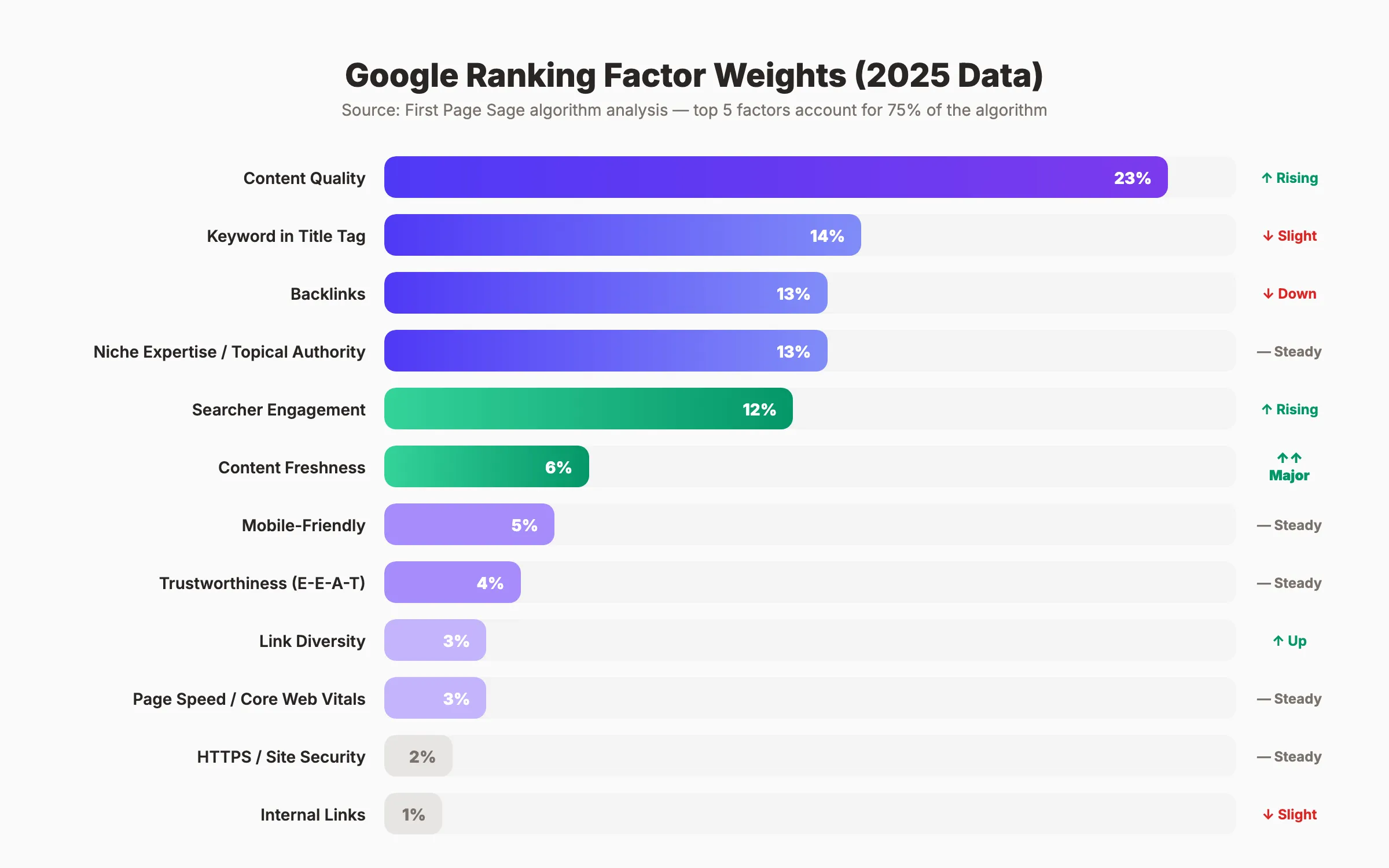
The SEO scene shifted in four measurable ways:
| Signal Category | 2024 Weight | 2026 Weight | Change |
|---|---|---|---|
| Content information gain | Medium | Very high | +40% |
| Google Business Profile | 25% | 32% | +28% |
| Review velocity | Low | Medium | +47% |
| Core Web Vitals | Gatekeeper | Gatekeeper | Stable |
| Backlink quality | High | Very high | +15% |
| AI Overviews impact | N/A | 25.8% appearance | New |
| First-hand experience | Medium | Very high | +35% |
| Entity consistency | Medium | High | +23% |
| Behavioral signals | Medium | High | +23% |
| Schema markup | Medium | High | +18% |
| Content freshness | Medium | High | +20% |
| Brand search volume | Low | High | +45% |
Three signals decreased in relative importance:
- Keyword density: Now a negative signal if over-optimized
- Citation quantity: Quality and consistency matter more than volume
- Exact-match anchor text: Natural variation is preferred
The 2026 SEO Priority Framework for Small Businesses
You cannot optimize for 12 signals equally. Here is the order that delivers the fastest results with limited resources:
Phase 1: Foundation (Weeks 1-4)
- ✓ Fix Core Web Vitals failures (LCP, INP, CLS)
- ✓ Ensure mobile-first indexing compliance
- ✓ Implement HTTPS and clean site architecture
- ✓ Fix crawl errors and indexing issues
Phase 2: Content Quality (Weeks 5-12)
- ✓ Audit existing content for information gain
- ✓ Add first-hand experience to top 10 pages
- ✓ Implement schema markup (FAQ, Article, LocalBusiness)
- ✓ Create one original research piece or data compilation
Phase 3: Authority Building (Weeks 13-24)
- ✓ Optimize Google Business Profile (weekly posts, photos, Q&A)
- ✓ Build steady review velocity (3-5 per month)
- ✓ Fix entity consistency across all platforms
- ✓ Earn 5-10 high-quality, topically relevant backlinks
Phase 4: Compounding (Ongoing)
- ✓ Update top 20% of content every 90 days
- ✓ Monitor behavioral signals and improve engagement
- ✓ Build brand search volume through PR and community
- ✓ Adapt to AI search changes as they emerge
What the Myths Get Wrong
Myth: There are 200 ranking factors.
Google has never confirmed 200 factors. The number originated from a 2009 statement by Matt Cutts about "over 200 signals." In 2026, Google uses machine learning systems that weigh thousands of micro-signals dynamically. The 12 categories in this study represent the signal clusters with the strongest measurable correlation to rankings.
Myth: Keyword density matters.
Keyword density has been irrelevant since at least 2013. In 2026, over-optimization is a negative signal. Use your primary keyword in the title, first 100 words, one H2, and the meta description. Then write for humans. Semantic search understands related terms without repetition.
Myth: Social signals are a ranking factor.
Google has repeatedly stated that social shares are not a direct ranking factor. The correlation between social shares and rankings exists because popular content gets both shares and links. Social media drives indirect SEO value through brand awareness and backlink acquisition, not through a direct signal.
Myth: You need to publish daily.
Publishing frequency correlates with traffic only when quality is held constant. A business publishing one high-information-gain article per week outperforms businesses publishing seven generic posts. Consistency matters more than frequency. Quality matters more than both.
How AI Search Changes Which Ranking Factors Matter
AI Overviews, ChatGPT, Perplexity, and Gemini are not replacing traditional search. They are adding new visibility surfaces. The ranking factors that matter for traditional SEO still matter for AI search because:
- ChatGPT relies on Bing's index. Pages need foundational SEO to be cited.
- Perplexity uses multi-source RAG. Original, well-structured content is preferred.
- Gemini / Google AI Overviews use Google's index. The same ranking factors apply.
However, AI search introduces new optimization requirements:
| Traditional SEO | AI Search Optimization |
|---|---|
| Keyword targeting | Query intent mapping |
| Meta descriptions | AI summary citation readiness |
| Featured snippets | AI Overview source attribution |
| Backlinks | Brand mention frequency in training data |
| Content depth | Information gain and originality |
The businesses that win in 2026 optimize for both. They do not choose between traditional SEO and AI search. They build content that ranks in Google and gets cited by AI systems.
For more on how AI is changing search behavior, read our AI search statistics.
What practitioners are saying on X
AI search advice ages quickly. Here is high-signal public discussion from SEO and growth operators — context for your roadmap, not a substitute for primary data.
- @jakezward (Feb 2026): 2026 SEO predictions emphasize AI Overview share-of-SERP, schema for LLM token efficiency, brand mentions in AI answers as a KPI, proprietary data as a moat, and content refresh beating net-new AI slop. See the post on X.
- @e_tartakovsky (Jul 2026): When an AI summary appears, organic CTR can fall (cited ~8% vs ~15% traditional), but remaining clicks may convert higher because AI pre-qualifies intent — measure quality not only volume. See the post on X.
- @hridoyreh (Mar 2026): Widely shared SEO skill tree: foundations, research, technical, on-page, content, links, AI SEO/GEO, analytics, UX, brand, programmatic — useful map for stats and how-to posts. See the post on X.
Grok, AI Overviews, and multi-engine visibility
Statistics pages on “seo ranking factors study” earn AI citations when every major number has a year, source, and definition. Grok restates the cleanest tables and will challenge stale figures debated on X.
- Google AI Overviews: Use passage-ready answers, tables, and FAQ schema where relevant.
- ChatGPT / Perplexity: Cite named sources next to key claims.
- Grok: Maintain accurate entity facts on-site and in high-signal X posts.
Publish content built for Google and AI citations. theStacc’s Content SEO module ships SEO-scored articles structured for rankings and generative engines — including clearer entity pages models like Grok can quote.
Frequently Asked Questions
Content information gain is the strongest on-page predictor. Google Business Profile optimization is the strongest controllable factor for local businesses. Core Web Vitals remain the gatekeeper that everything else depends on.
Google makes 5,000+ algorithm changes per year. Most are minor. Major core updates happen 3-4 times per year. The 12 signals in this study have been stable in direction for 18+ months, though their relative weights shift quarterly.
Yes, but quality matters far more than quantity. Ten topically relevant backlinks from respected sites in your niche outperform 1,000 low-quality directory links. The correlation between backlink count and rankings drops to near-zero after 200-300 referring domains.
AI-generated content without human editing, fact-checking, or original value performs poorly. Google's helpful content system identifies and suppresses generic AI content. AI-assisted content that includes first-hand experience, original data, and expert review performs well.
Optimize your Google Business Profile (weekly posts, photos, Q&A), build steady review velocity (3-5 per month), and fix entity consistency across all platforms. These three actions alone can move a local business from page 2 to page 1 within 60-90 days.
Yes. Core Web Vitals are a gatekeeper, not a differentiator. You need to pass the threshold to compete. But passing alone will not outrank better content. Fix technical issues first, then invest in content quality.
The Bottom Line
SEO in 2026 is not about checking boxes. It is about building systems that signal quality, experience, and trust to both search engines and users. The 12 signals in this study are not independent tactics. They compound.
A page with fast Core Web Vitals, high information gain, first-hand experience, schema markup, and strong behavioral signals will outrank a page optimized for any single factor. The winners in 2026 are not the ones who chase algorithms. They are the ones who build the clearest, most trustworthy, most useful answer for every query they target.
We publish 3,500+ blogs across 70+ industries. theStacc automates the content, local SEO, and social media signals that this study shows actually move rankings. Your SEO team. $99/month.
Sources & references
- [1] Princeton / Georgia Tech et al. — GEO research (arXiv:2311.09735)
- [2] @jakezward on X — 2026 SEO predictions emphasize AI Overview share-of-SERP, schema for LLM token efficiency, brand mentions in AI answers
- [3] @e_tartakovsky on X — When an AI summary appears, organic CTR can fall (cited ~8% vs ~15% traditional), but remaining clicks may convert highe
- [4] @hridoyreh on X — Widely shared SEO skill tree: foundations, research, technical, on-page, content, links, AI SEO/GEO, analytics, UX, bran

Researched, written, and published articles that compound organic traffic.
Weekly local SEO teardowns
One practical email a week. Map Pack, GBP, AI Overviews — no fluff. Unsubscribe anytime.