SERP Features: The Complete Guide (2026)
Every SERP feature type explained with optimization tactics. Covers featured snippets, AI overviews, local packs, and CTR impact. Updated March 2026.
Siddharth Gangal • 2026-03-30 • SEO Tips
In This Article
Google search results look nothing like they did 5 years ago. Standard blue links now share the page with featured snippets, AI overviews, local packs, video carousels, and more than a dozen other SERP features. That shift costs you clicks if you ignore it.
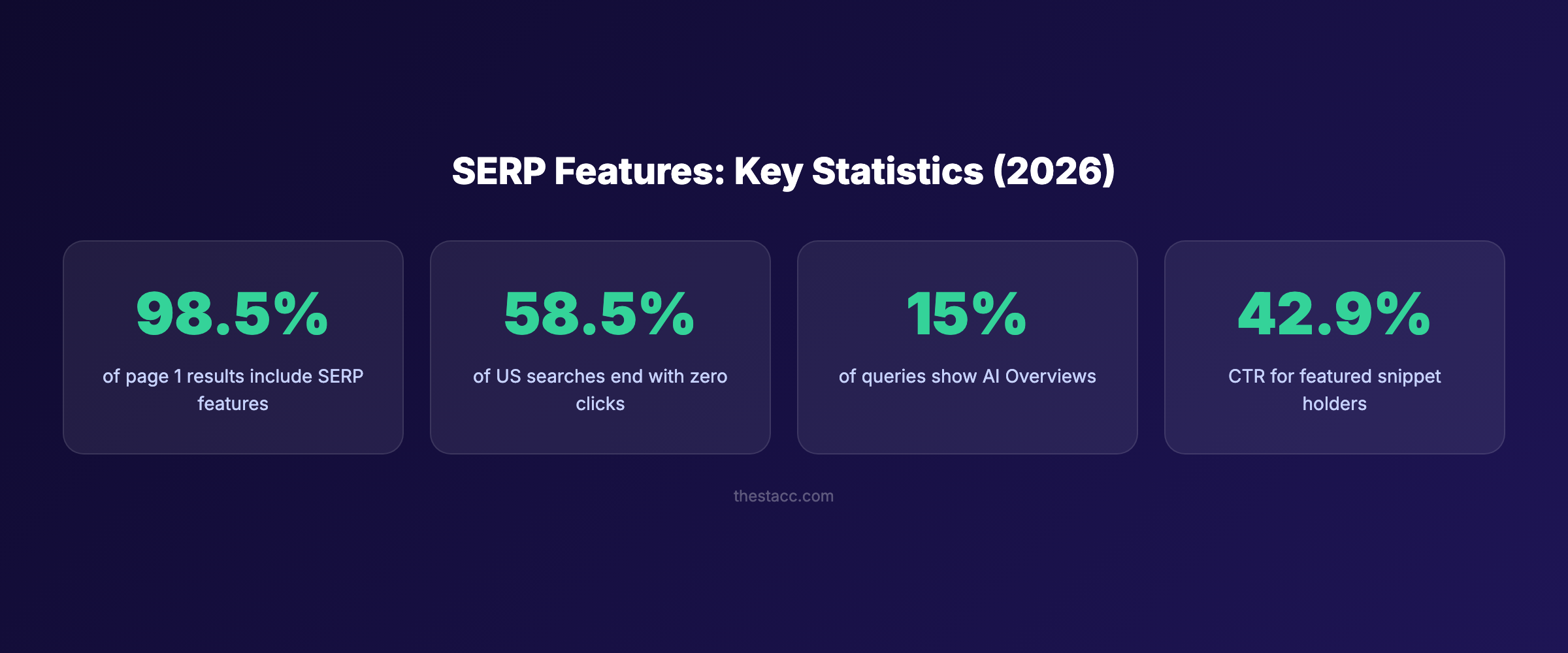
98.5% of page 1 results now include at least one SERP feature, according to Semrush Sensor data. The brands that win visibility in 2026 are the ones that optimize for these features on purpose. The rest fight over a shrinking share of standard organic clicks.
We publish 3,500+ blog posts across 70+ industries. Every article we write targets specific SERP features from the start. This guide covers everything we know about identifying, optimizing for, and tracking SERP features.
Here is what you will learn:
- What SERP features are and why they dominate Google results
- The complete list of 14 major SERP feature types
- How each feature type impacts organic click-through rates
- The exact process to identify which features appear for your keywords
- How to optimize your content for every major SERP feature
- The connection between SERP features and zero-click searches
- Which tools track SERP feature performance
- The right SERP feature strategy for your specific business type
Chapter 1: What Are SERP Features?
SERP features are any search result element that goes beyond a standard organic blue link. They include rich snippets, knowledge panels, local map packs, image carousels, AI-generated summaries, and many other visual or interactive elements.
Google introduced SERP features to answer queries faster. A user searching “weather in Austin” does not need to click 10 links. Google answers directly in the SERP. The same logic now applies to definitions, product comparisons, local businesses, and complex questions.
Why SERP Features Changed SEO
Traditional SEO focused on one goal: rank higher in blue links. SERP features broke that model. A page ranking in position 1 can now sit below a featured snippet, an AI overview, a People Also Ask box, and a local pack.
That stack of features pushes the first organic result down by 400+ pixels on many queries. Position 1 without any SERP feature visibility means fewer clicks than position 3 used to get.
The Scale of SERP Feature Adoption
Less than 1.5% of Google page 1 results appear without any SERP features. That number has dropped every year since 2019. Google keeps adding new features and expanding existing ones.
The most common SERP features by frequency are People Also Ask (appearing in 65% of queries), rich snippets (58%), and sitelinks (38%). AI overviews now appear in roughly 15% of US queries and are expanding fast.
Chapter 2: The Complete List of SERP Feature Types
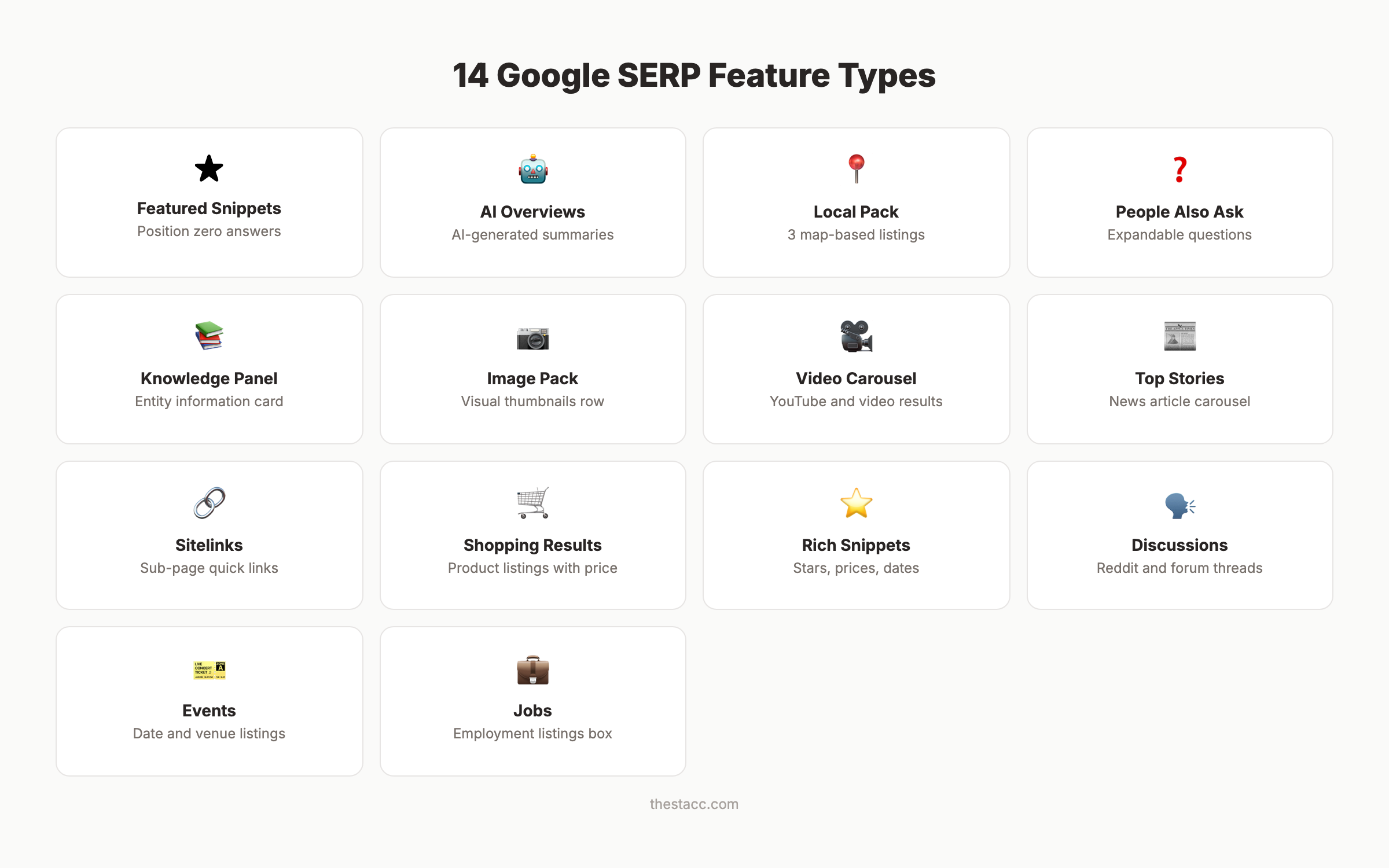
Google displays more than 30 distinct SERP feature types. Here are the 14 most common ones that impact SEO strategy and organic visibility.
Featured Snippets
Featured snippets display a direct answer to a query at the top of the SERP. They pull content from a ranking page and present it in paragraph, list, or table format. The snippet holder gets roughly 42.9% of clicks for that query.
Three format types exist. Paragraph snippets answer “what is” questions in 40-60 words. List snippets display steps or ranked items. Table snippets show comparison data in rows and columns. Your content format must match the snippet type Google prefers for each query.
Read the full breakdown in our featured snippets optimization guide.
AI Overviews
AI overviews are Google’s AI-generated summaries that appear at the top of search results. They synthesize information from multiple sources into a single answer block. Unlike featured snippets, they do not credit a single page.
AI overviews currently appear for about 15% of US queries. That number is growing. They reduce organic CTR by up to 58% for results below them, according to Ahrefs research.
Learn how to get cited in our AI overview optimization guide.
Local Pack
The local pack shows 3 business listings with a map for queries with local intent. It appears for searches like “plumber near me” or “best dentist in Chicago.” Each listing shows the business name, rating, address, and hours.
Local packs generate high click-through rates because they serve users with strong purchase intent. Ranking in the local pack requires a well-optimized Google Business Profile, positive reviews, and local relevance signals.
For a full breakdown, see our local SEO guide.
People Also Ask
People Also Ask (PAA) boxes display expandable related questions. Clicking a question reveals a snippet-style answer with a link to the source page. PAA boxes appear in roughly 65% of all Google queries.
Each click opens more questions. That means PAA creates an infinite opportunity for visibility. You do not need to rank on page 1 to appear in a PAA box. Pages ranking on page 2 or 3 can earn PAA placement.
We cover this in detail: how to optimize for People Also Ask.
Knowledge Panels
Knowledge panels appear on the right side of desktop SERPs for entity-based queries. They display structured data about businesses, people, places, and organizations. Google pulls this data from Wikipedia, Wikidata, Google Business Profile, and other authoritative sources.
You cannot directly create a knowledge panel. You earn one by building entity authority through consistent NAP data, structured markup, and authoritative mentions across the web.
Image Pack
Image packs display a row of thumbnails within organic results. They appear for visual queries like “kitchen remodel ideas” or “types of succulents.” Clicking an image leads to Google Images, then to the source page.
Image packs create a traffic opportunity that most sites ignore. Proper image SEO including descriptive file names, alt text, and image sitemaps increases your chances of appearing in image packs.
Video Carousel
Video carousels display a horizontal scroll of video results, primarily from YouTube. They appear for “how to” queries, tutorials, reviews, and entertainment searches. Google now indexes video content more aggressively than ever.
Videos with proper timestamps, titles, and VideoObject schema markup earn carousel placement more often.
Top Stories
Top Stories is a carousel of recent news articles. It appears for breaking news, trending topics, and time-sensitive queries. Only sites recognized in Google News or that publish timely content with NewsArticle schema appear here.
Sitelinks
Sitelinks are sub-page links that appear below a main organic result. They show for branded queries and authoritative domains. Google generates sitelinks automatically based on your site structure.
Clear internal linking, descriptive page titles, and logical site architecture increase the likelihood of sitelinks appearing for your brand.
Shopping Results
Shopping results display product listings with images, prices, and store names. They appear for commercial and transactional product queries. Both paid (Google Shopping ads) and free product listings can appear.
Product schema markup and Google Merchant Center integration are required for free shopping results.
Rich Snippets
Rich snippets add visual enhancements to standard organic listings. Examples include star ratings, review counts, prices, availability status, and recipe details. They do not change your ranking position but increase CTR by making your listing stand out.
Schema markup powers rich snippets. Review schema, product schema, recipe schema, and FAQ schema are the most common types.
Discussions and Forums
Google now shows Reddit threads, Quora answers, and forum discussions directly in SERPs. This “Discussions and Forums” feature appears for experience-based queries where users seek personal opinions.
This SERP feature rewards authentic user-generated content. Brands that actively participate in relevant communities gain visibility here.
Events
Event listings show date, time, venue, and ticket links for concerts, conferences, and local happenings. Event schema markup triggers this feature.
Jobs
The jobs SERP feature displays employment listings from sites like LinkedIn, Indeed, and Glassdoor. JobPosting schema is required.
Your content should target SERP features from day one. We build SERP feature optimization into every article we publish. Start for $1 →
Chapter 3: How SERP Features Impact Organic CTR
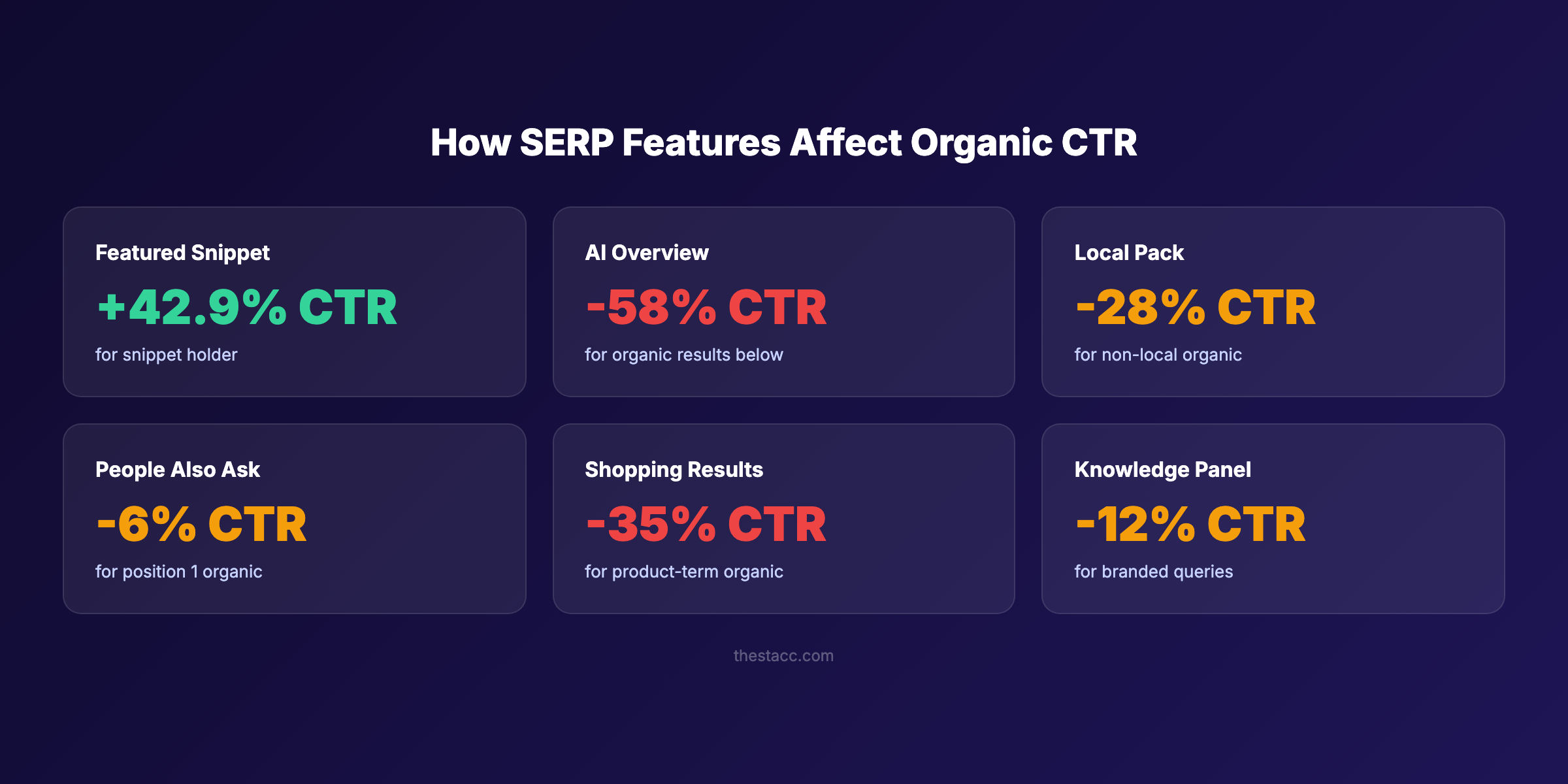
SERP features do not just change how results look. They redirect where clicks go. Understanding the CTR impact of each feature type determines which keywords are worth targeting and which need a different approach.
The Position 1 CTR Decline
Position 1 organic CTR has dropped 32% year-over-year. The primary cause is SERP feature expansion. When a query triggers an AI overview, a featured snippet, a PAA box, and a local pack, the first organic blue link sits far below the fold.
Without SERP features, position 1 earns a 35-40% CTR. With an AI overview present, that drops to 15-20%. The data comes from First Page Sage and multiple CTR studies.
Features That Generate Clicks
Not every SERP feature reduces organic traffic. Some features actively drive clicks.
| SERP Feature | CTR Impact | Click Behavior |
|---|---|---|
| Featured Snippet | +42.9% for holder | Users click to read more |
| Local Pack | High CTR for listed businesses | Strong local purchase intent |
| Rich Snippets (stars) | +20-30% vs. plain results | Visual appeal drives clicks |
| Top Stories | High for breaking news | Time-sensitive demand |
| People Also Ask | Moderate click-through | Curiosity-driven exploration |
Features That Reduce Clicks
Other SERP features satisfy the query without a click. These are the zero-click generators.
| SERP Feature | CTR Impact | Why |
|---|---|---|
| AI Overviews | -58% for organic below | Full answer in SERP |
| Knowledge Panels | -12% for branded queries | Entity info displayed directly |
| Calculators/Converters | Near-zero clicks | Answer is the feature itself |
| Direct Answer Boxes | Minimal clicks | Simple factual response |
| Weather/Time Widgets | No click needed | Instant utility |
The strategic move is clear. Target keywords where click-generating features dominate. For zero-click keywords, optimize for brand visibility and authority instead.
Chapter 4: How to Identify SERP Features for Your Keywords
Knowing which SERP features appear for your target keywords is the first step toward winning them. Here is the 4-step process.
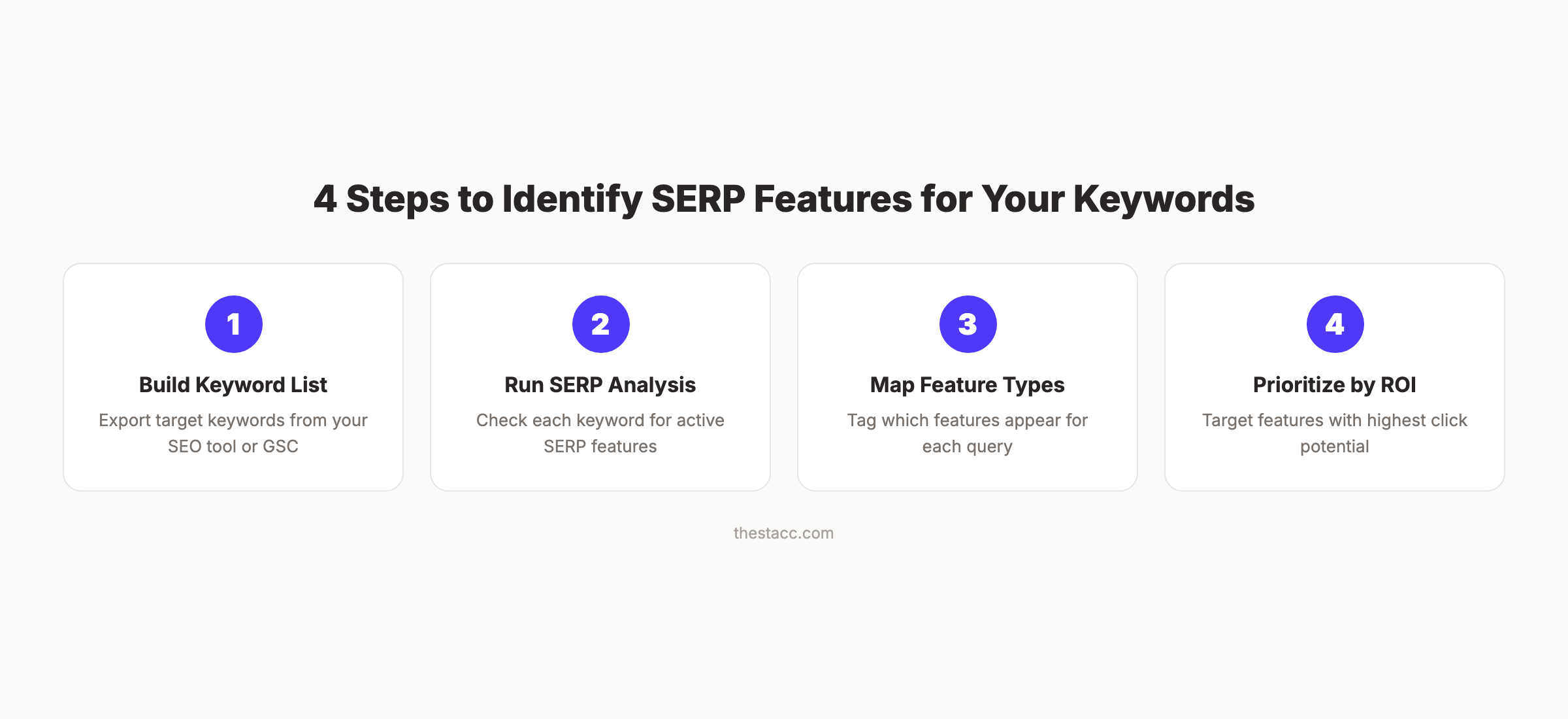
Step 1: Build Your Keyword List
Start with your existing keyword research. Export your target keywords from Google Search Console, Semrush, Ahrefs, or any rank tracking tool. Group them by topic cluster.
You need a minimum of 50-100 keywords to spot meaningful patterns in SERP feature distribution.
Step 2: Run Manual SERP Checks
Search each keyword in an incognito browser window. Note which SERP features appear, their position on the page, and which domains occupy them. This gives you a ground-truth view of the SERP layout.
For efficiency, focus on your top 20 priority keywords manually. Use tools for the rest.
Step 3: Use SERP Feature Detection Tools
Tools like Semrush Position Tracking, Ahrefs SERP Checker, and SE Ranking automatically detect and tag SERP features for your tracked keywords. They show which features appear, whether you own any, and which competitors hold them.
Google Search Console shows “search appearance” data including rich results, FAQ results, and video results that your site earns.
Step 4: Map Features to Content Opportunities
Create a spreadsheet with columns for keyword, search volume, current rank, SERP features present, and feature ownership status. This map reveals gaps where you rank well but do not own any SERP features.
Those gaps are your highest-ROI optimization targets. A page ranking in position 3 that also earns a featured snippet outperforms a page ranking in position 1 without one.
Stacc handles keyword research and SERP analysis for you. 30 articles per month, each optimized for the right SERP features. Start for $1 →
Chapter 5: How to Optimize for Every Major SERP Feature
Each SERP feature has its own optimization playbook. Here is what works for the 6 features with the highest ROI.
Optimizing for Featured Snippets
Featured snippets require specific content formatting. Google pulls snippet content from pages that already rank on page 1 for the target query.
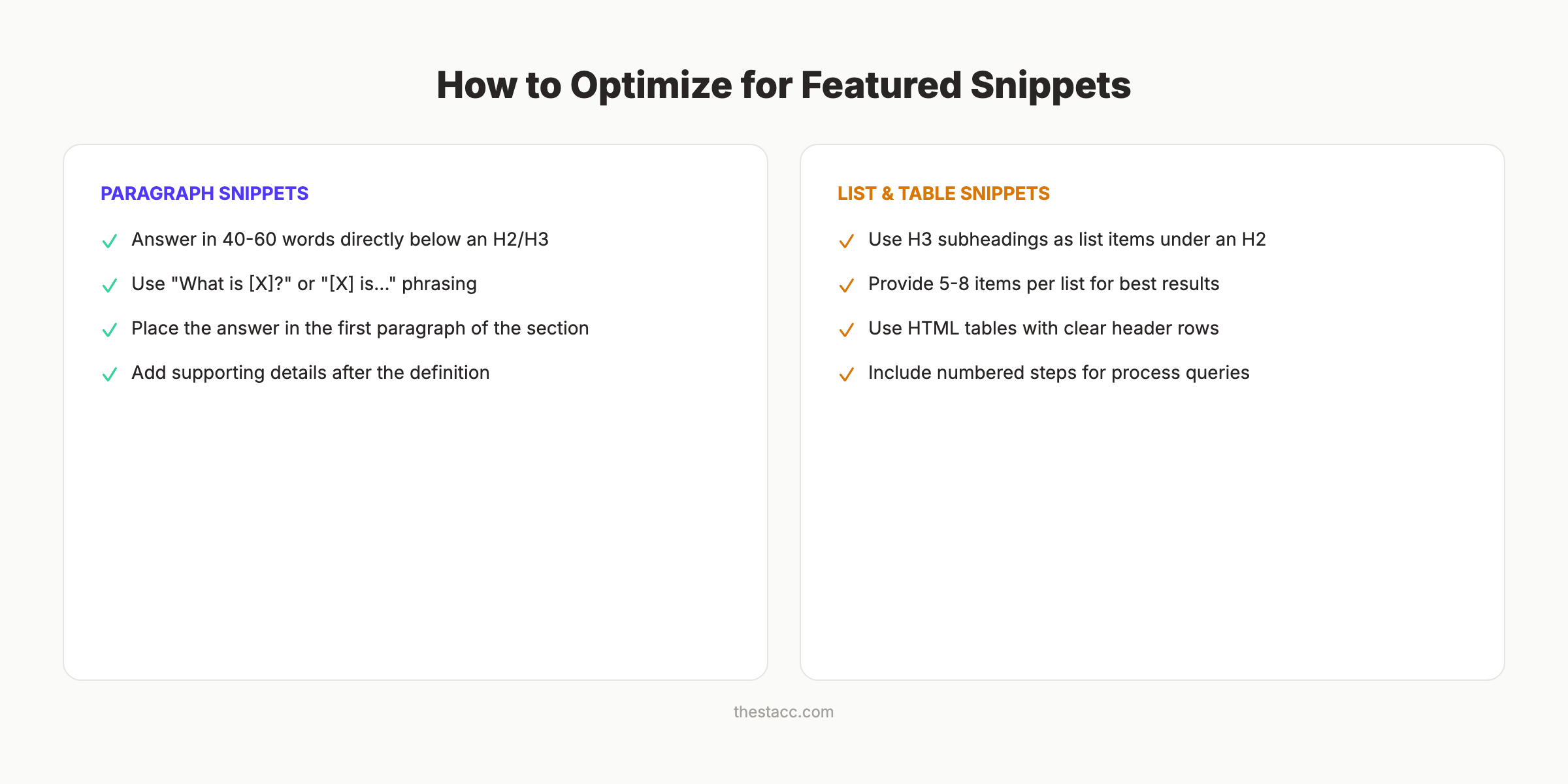
The optimization checklist:
- Target question-based keywords (“what is,” “how to,” “why does”)
- Answer the question in 40-60 words directly below a matching H2 or H3
- Use ordered lists for step-by-step processes
- Use tables for comparison or data queries
- Already rank in the top 10 for the target keyword
Our featured snippet guide covers all 7 optimization steps.
Optimizing for AI Overviews
AI overviews pull from multiple sources. Getting cited requires a different approach than traditional ranking.
Key tactics:
- Provide clear, structured answers with supporting evidence
- Build strong E-E-A-T signals across your site
- Use schema markup to help Google understand your content
- Write content that synthesizes multiple viewpoints on a topic
- Focus on search intent alignment above keyword density
Full strategy: how to optimize for AI overviews.
Optimizing for Local Pack
Local pack ranking depends on 3 factor categories: relevance, distance, and prominence.
Core requirements:
- Claim and fully optimize your Google Business Profile
- Build consistent citations across directories
- Earn and respond to Google reviews (see our review management guide)
- Publish local content targeting “[service] + [city]” keywords
- Add LocalBusiness schema to your website
See all local SEO ranking factors for details.
Optimizing for People Also Ask
PAA boxes pull answers from pages that clearly address specific questions. You do not need to rank on page 1.
Key tactics:
- Research PAA questions using Semrush or AlsoAsked.com
- Create dedicated FAQ sections with clear question-and-answer formatting
- Answer each question in 50-80 words within the first paragraph
- Target long-tail question keywords throughout your content
Full guide: optimize for People Also Ask.
Optimizing for Rich Snippets
Rich snippets require structured data markup. Google will not display stars, prices, or review counts without proper schema.
Most impactful schema types for rich snippets:
| Schema Type | Rich Snippet Result | Best For |
|---|---|---|
| Review / AggregateRating | Star ratings | Products, services, software |
| Product | Price, availability | E-commerce pages |
| Recipe | Cooking time, calories | Food blogs |
| FAQ | Expandable Q&A | Guides, service pages |
| HowTo | Step-by-step with images | Tutorial content |
| Event | Date, time, venue | Event pages |
Use our free schema markup generator to create the right structured data.
Optimizing for Video Carousels
Video carousels favor YouTube content. But you can also earn placement with on-page video content.
Optimization steps:
- Host videos on YouTube and embed them on your site
- Add VideoObject schema to pages with embedded video
- Include timestamps and chapters in YouTube descriptions
- Write keyword-rich video titles and descriptions
- Create video content for “how to” and tutorial queries
Chapter 6: SERP Features and Zero-Click Searches
58.5% of US Google searches now end without a click. SERP features are the primary driver. Understanding this trend changes how you set SEO goals.
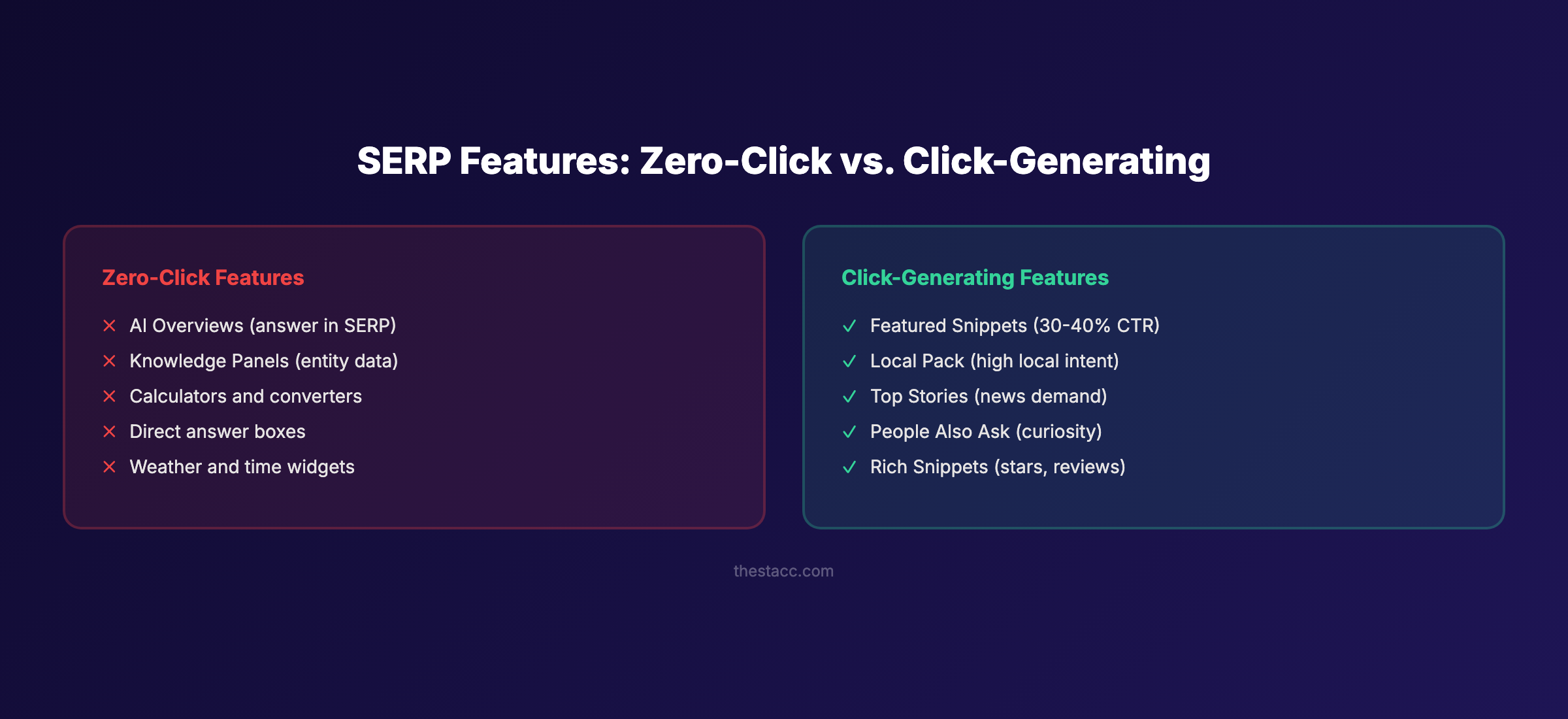
Why Zero-Click Searches Are Growing
Google answers more queries directly inside the SERP. AI overviews, knowledge panels, calculators, and direct answer boxes all satisfy user intent without a click. Mobile accelerates this trend. Mobile users are 66% more likely to experience zero-click results.
Read the full analysis: zero-click search and its impact on SEO.
How to Adapt Your Strategy
Zero-click does not mean zero value. Brand impressions in SERP features still build awareness and authority. Here is how to adapt:
For zero-click keywords:
- Optimize for brand visibility within the SERP feature itself
- Earn featured snippet placement to display your brand name
- Use schema markup so your brand appears in knowledge panels
- Accept that some queries will not drive clicks
For click-generating keywords:
- Double down on featured snippet optimization
- Target queries where PAA and rich snippets dominate (not AI overviews)
- Write compelling meta descriptions that earn clicks from standard results
- Prioritize commercial and transactional search intent queries
The balance matters. A content strategy that only chases clicks misses the 58.5% of queries where visibility without a click still builds trust. A strategy that ignores clicks leaves revenue on the table.
We optimize every article for the SERP features that drive real traffic. 30 posts per month. No guesswork. Start for $1 →
Chapter 7: Tools for Tracking SERP Features
You cannot optimize what you do not measure. These 6 tools track SERP feature presence, ownership, and changes over time.
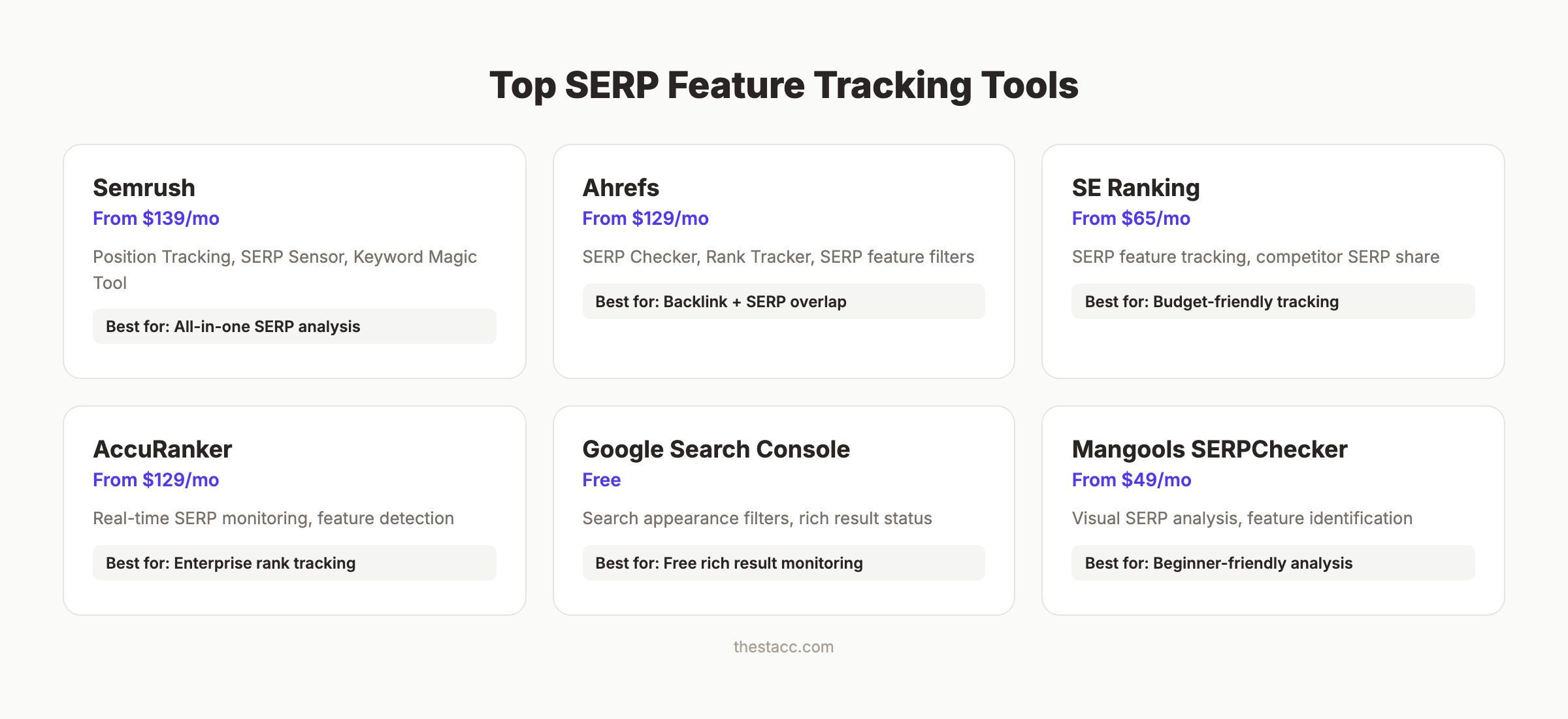
Semrush Position Tracking
Semrush tracks which SERP features appear for your keywords and whether you own them. The SERP Features filter lets you isolate keywords where you have (or lack) featured snippets, PAA, local packs, and more. Semrush Sensor also tracks SERP volatility across industries.
Starting price: $139 per month.
Ahrefs Rank Tracker
Ahrefs detects SERP features at the keyword level and shows historical changes. The SERP overview tool provides a visual snapshot of every feature on the page. SERP feature filters let you find opportunities where competitors hold features you do not.
Starting price: $129 per month.
Google Search Console
Google Search Console is free and shows which rich results your site earns. The Search Appearance filter breaks down clicks and impressions by result type: FAQ, HowTo, Video, Review, and more.
The limitation: GSC only shows your own data. It does not reveal competitor SERP feature ownership.
SE Ranking
SE Ranking provides SERP feature tracking at a lower price point. It detects feature types per keyword and shows your SERP feature share versus competitors.
Starting price: $65 per month.
AccuRanker
AccuRanker offers real-time SERP monitoring with granular feature detection. It is popular among agencies managing hundreds of keywords. Real-time updates (not daily) give faster visibility into SERP changes.
Starting price: $129 per month.
Mangools SERPChecker
Mangools SERPChecker provides visual SERP analysis with feature identification built in. It is the most beginner-friendly option. The visual layout makes it easy to spot features and estimate their impact.
Starting price: $49 per month.
Chapter 8: SERP Feature Strategy by Business Type
Not every SERP feature matters equally to every business. Your strategy should match your business model, audience, and query types.
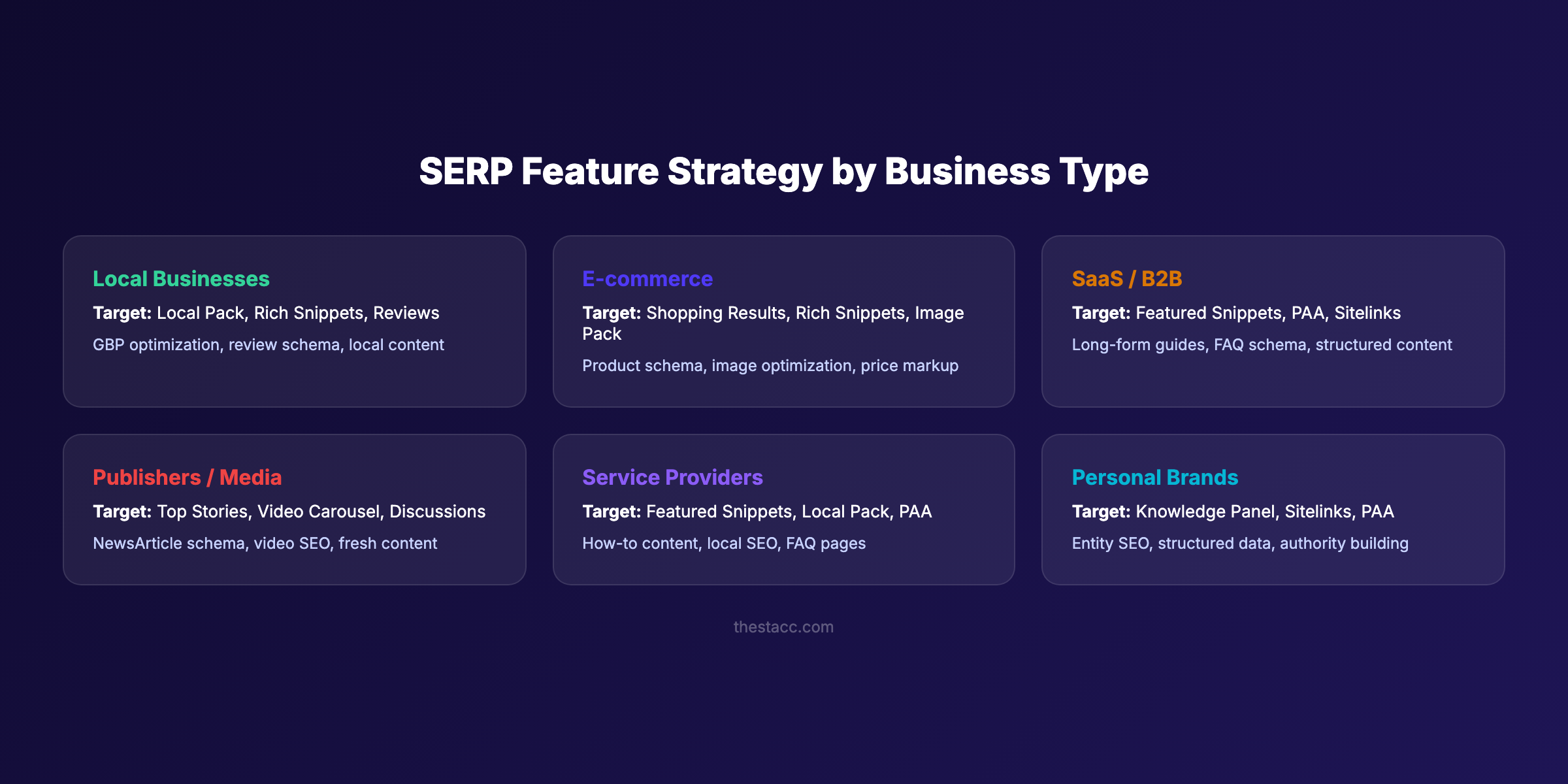
Local Service Businesses
Priority features: Local Pack, Rich Snippets (reviews), People Also Ask.
Local businesses live and die by the local pack. A dentist, plumber, or restaurant needs Google Business Profile optimization, review generation, and local content. Rich snippets with star ratings increase trust in organic results too.
Read the complete playbook: local SEO guide.
E-commerce Brands
Priority features: Shopping Results, Rich Snippets (product), Image Pack.
E-commerce sites need Product schema on every product page. Google Merchant Center integration unlocks free shopping results. Image optimization earns image pack placement for visual product searches.
SaaS and B2B Companies
Priority features: Featured Snippets, People Also Ask, Sitelinks.
B2B buyers research extensively before purchasing. Earning featured snippets for “what is,” “how to,” and comparison queries puts your brand in front of decision-makers at the research stage. Long-form guides with FAQ sections capture PAA boxes.
Content optimization is the path to featured snippet ownership.
Publishers and Media
Priority features: Top Stories, Video Carousel, Discussions.
Publishers need NewsArticle schema, fast page speeds, and timely content. Video content earns carousel placement. Active presence in discussions on Reddit and forums creates visibility in the Discussions feature.
Professional Service Providers
Priority features: Featured Snippets, Local Pack, PAA, Rich Snippets.
Law firms, accountants, and consultants serve both local and informational queries. A dual strategy targeting local pack for “[service] near me” and featured snippets for educational queries covers both angles.
Generative engine optimization also matters here. AI search tools like Perplexity and ChatGPT increasingly cite authoritative professional content.
Personal Brands and Thought Leaders
Priority features: Knowledge Panel, Sitelinks, People Also Ask.
Building a knowledge panel requires entity authority. Consistent structured data, Wikipedia presence, and authoritative mentions across the web establish you as a recognized entity. Strong E-E-A-T signals support this.
Frequently Asked Questions
What are the most common SERP features in 2026?
People Also Ask boxes appear in approximately 65% of Google queries. Rich snippets show in 58% of results. Sitelinks appear in 38%. AI overviews now appear in about 15% of US queries and are growing faster than any other feature type.
Do SERP features hurt organic click-through rates?
Some features reduce organic CTR, and others increase it. AI overviews can reduce position 1 CTR by 58%. Featured snippets increase CTR to 42.9% for the page that holds them. The net impact depends on which features appear for each specific query. See our organic CTR by position data.
How do I get a featured snippet on Google?
Rank on page 1 for the target keyword first. Then format your content to match the snippet type Google prefers. Use concise 40-60 word answers for paragraph snippets, ordered lists for step-by-step queries, and tables for comparison queries. Add the question as an H2 or H3 heading with the answer directly below. Full guide: how to get featured snippets.
Can small businesses compete for SERP features?
Yes. Local pack, PAA boxes, and rich snippets are all accessible to small businesses. Local pack requires a Google Business Profile and local SEO basics. PAA does not require page 1 rankings. Rich snippets require schema markup, which any site can implement. Start with the features that match your business type and build from there.
What is the difference between rich results and rich snippets?
Rich results is the broader term. It includes any enhanced search result powered by structured data. Rich snippets are a specific type of rich result that enhances a standard organic listing with stars, prices, or other visual elements. All rich snippets are rich results, but not all rich results are rich snippets.
How do AI overviews affect SEO strategy in 2026?
AI overviews reduce clicks for informational queries by 58% on average. The adaptation strategy is threefold. First, earn citations within AI overviews by providing clear, structured content with strong E-E-A-T signals. Second, shift focus toward commercial and transactional keywords where AI overviews appear less often. Third, treat SERP visibility as a brand-building channel, even without clicks. Learn more about GEO strategy.
SERP features now define the search experience for 98.5% of Google page 1 results. The sites that earn featured snippets, local pack placement, and rich results capture the most visibility and traffic. Start with the features that match your business type, implement the right schema markup, and track your progress monthly.
Get SERP-optimized content published automatically. 30 articles per month, built for the features that drive real results. Start for $1 →
Written and published by Stacc. We publish 3,500+ articles per month across 70+ industries. All data verified against public sources as of March 2026.