
White Hat vs Black Hat SEO: Full Comparison (2026)
White hat vs black hat SEO compared side by side. Techniques, risks, penalties, costs, and which approach builds real rankings in 2026.
Choosing between white hat and black hat SEO is not a style preference. It is a business decision that determines whether your site grows or gets wiped from Google.
According to Google’s spam policies, sites caught using manipulative tactics face manual actions. Those penalties cause 50 to 90% traffic loss overnight. Recovery takes 6 to 18 months, and 73% of penalized sites never fully recover their rankings.
This is the complete white hat vs black hat SEO comparison. We break down every technique, every risk, and every outcome so you can make the right call for your business. We publish 3,500+ blogs across 70+ industries, and every single one follows white hat practices.
Here is what you will learn:
- What white hat SEO and black hat SEO actually mean
- Side-by-side comparison of risks, costs, and timelines
- 6 black hat techniques that trigger Google penalties
- 6 white hat techniques that build lasting rankings
- Where grey hat SEO fits in the spectrum
- Real penalty examples and what they cost
- Which approach to choose for your business
What Is White Hat SEO?
White hat SEO follows Google’s search quality guidelines to earn rankings through legitimate methods. The focus is on creating value for users, not tricking algorithms.
Every white hat tactic passes one test: would you be comfortable showing this to a Google engineer?
White hat SEO includes quality content creation, earned backlinks, technical optimization, and a strong user experience. These methods align with how search engines want the web to work.
The tradeoff is time. White hat results take 3 to 6 months to appear. But once rankings arrive, they compound. A single well-optimized page can drive traffic for years without additional investment.
White hat SEO is best for: Any business that needs sustainable organic growth, brand trust, and zero penalty risk.
Core White Hat Principles
| Principle | What It Means |
|---|---|
| User-first content | Write for people, optimize for search engines second |
| Earned authority | Build backlinks through merit, not manipulation |
| Technical excellence | Fast loading, mobile-friendly, crawlable site structure |
| Transparency | No hidden text, no cloaking, no deception |
| E-E-A-T compliance | Demonstrate experience, expertise, authority, and trust |
Search engines reward sites that follow these principles. Google’s helpful content system specifically targets content written for search engines rather than people. White hat SEO aligns perfectly with this direction.
For a deeper look at how Google evaluates quality, read our E-E-A-T guide.
What Is Black Hat SEO?
Black hat SEO uses tactics that violate search engine guidelines to manipulate rankings. The goal is speed. Rank fast, extract traffic, and move on before Google catches up.
These techniques exploit weaknesses in search algorithms. They worked well in the early 2000s. In 2026, Google’s AI-driven spam detection catches most of them within weeks.
Black hat SEO includes link schemes, keyword stuffing, cloaking, private blog networks, hidden text, and doorway pages. All of these violate Google’s spam policies.
The appeal is obvious. Black hat tactics can produce rankings in days instead of months. But the crash is equally fast. One algorithm update or manual review can erase every gain.
Black hat SEO is best for: No legitimate business. The risk-to-reward ratio is terrible in 2026.
Real-World Black Hat Penalties
| Company | Tactic Used | Penalty |
|---|---|---|
| BMW Germany (2006) | Doorway pages | Complete deindexing |
| J.C. Penney (2011) | Massive link schemes | Manual action, rankings destroyed |
| Rap Genius (2013) | Link exchange scheme | Removed from search results |
| eBay (2014) | Thin doorway pages | Lost 80% organic visibility |
These are not small sites. If Google penalizes billion-dollar companies, no site is safe from enforcement.
White Hat vs Black Hat SEO: Head-to-Head Comparison
This is the comparison that matters. Every factor, side by side.
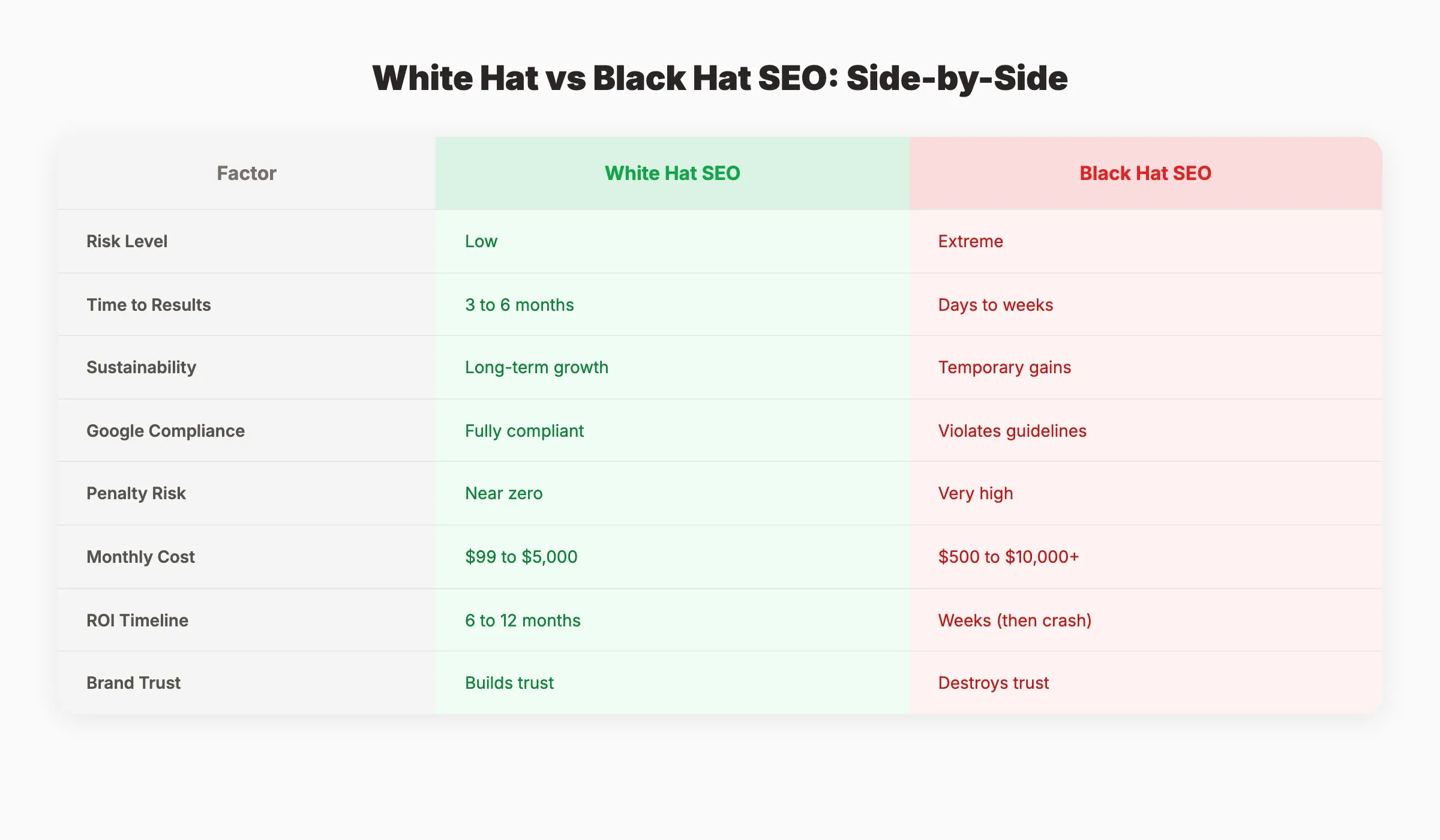
| Factor | White Hat SEO | Black Hat SEO |
|---|---|---|
| Risk level | Low | Extreme |
| Time to results | 3 to 6 months | Days to weeks |
| Sustainability | Long-term compounding growth | Temporary gains, then collapse |
| Google compliance | Fully compliant | Direct violation |
| Penalty risk | Near zero | Very high |
| Monthly cost | $99 to $5,000 | $500 to $10,000+ |
| ROI at 12 months | Positive and growing | Negative after penalties |
| Brand trust | Builds reputation | Destroys credibility |
| Recovery difficulty | N/A (no penalty) | 6 to 18 months, often impossible |
| Scalability | Scales with content | Requires constant new schemes |
The pattern is clear. Black hat SEO trades long-term growth for short-term gains that rarely last.
White hat SEO costs less, builds more, and eliminates the risk of losing everything to a penalty. For any business that plans to exist in 12 months, white hat is the only rational choice.
White hat SEO builds rankings that compound over time. We publish 30+ SEO articles per month, all following Google’s guidelines. Start for $1 →
6 Black Hat SEO Techniques to Avoid
Google identifies and penalizes these tactics consistently. Avoid all of them.
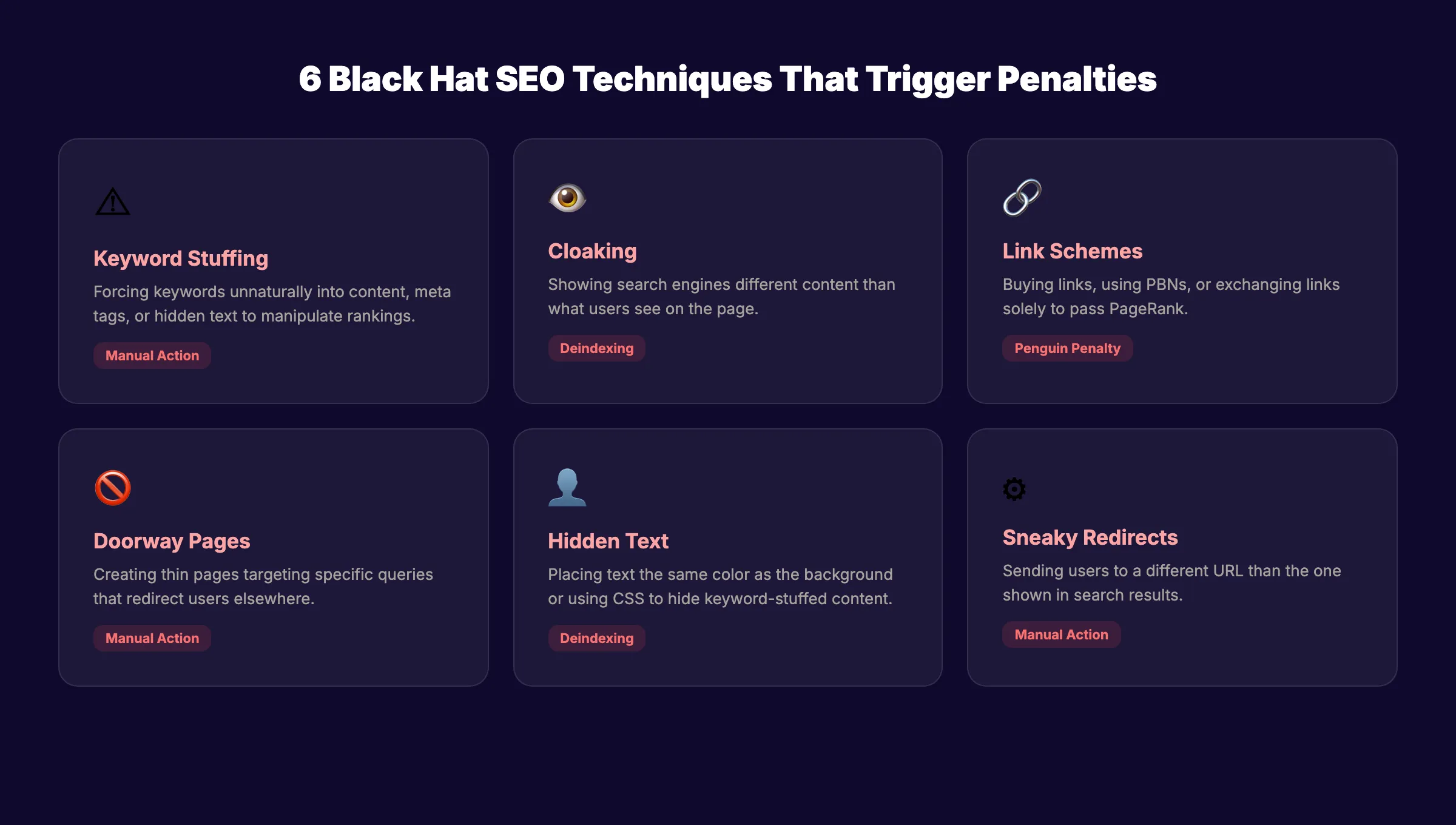
1. Keyword Stuffing
Forcing the same keyword into content dozens of times makes pages unreadable. Google’s SpamBrain system detects this pattern instantly.
Example of keyword stuffing: “Best pizza NYC. If you want the best pizza in NYC, our NYC pizza is the best pizza you can find in NYC.”
Natural keyword optimization targets 1 to 2% density. Anything above 3% raises flags.
2. Cloaking
Cloaking shows Google one version of a page and users a different version. This is one of the fastest ways to get deindexed.
A cloaked page might show Google a text-heavy article about “best running shoes” while users see a page selling counterfeit goods. Google considers this deceptive, and penalties are severe.
3. Link Schemes and PBNs
Buying backlinks, using private blog networks, and exchanging links at scale all violate Google’s link spam policies.
Google’s Penguin algorithm specifically targets unnatural link profiles. Run a backlink audit to identify and address risky links before they cause problems.
4. Doorway Pages
Doorway pages target specific keywords with thin content that redirects users to a different page. Google flags these through both algorithmic detection and manual review.
Do not confuse doorway pages with legitimate location pages. Location pages provide unique, useful content for each area. Doorway pages provide nothing.
5. Hidden Text and Links
Placing white text on a white background, using CSS to push text off-screen, or setting font size to zero are all forms of hidden text. Google has detected these tricks since the early 2000s.
6. Sneaky Redirects
Sending users to a URL different from what appeared in search results violates Google’s guidelines. This includes JavaScript redirects, meta refresh redirects, and server-side redirects designed to deceive.
Legitimate 301 redirects during a site migration are fine. Redirects designed to trick users are not.
6 White Hat SEO Techniques That Build Rankings
White hat SEO works because it aligns with what search engines reward: helpful content, earned authority, and great user experience.
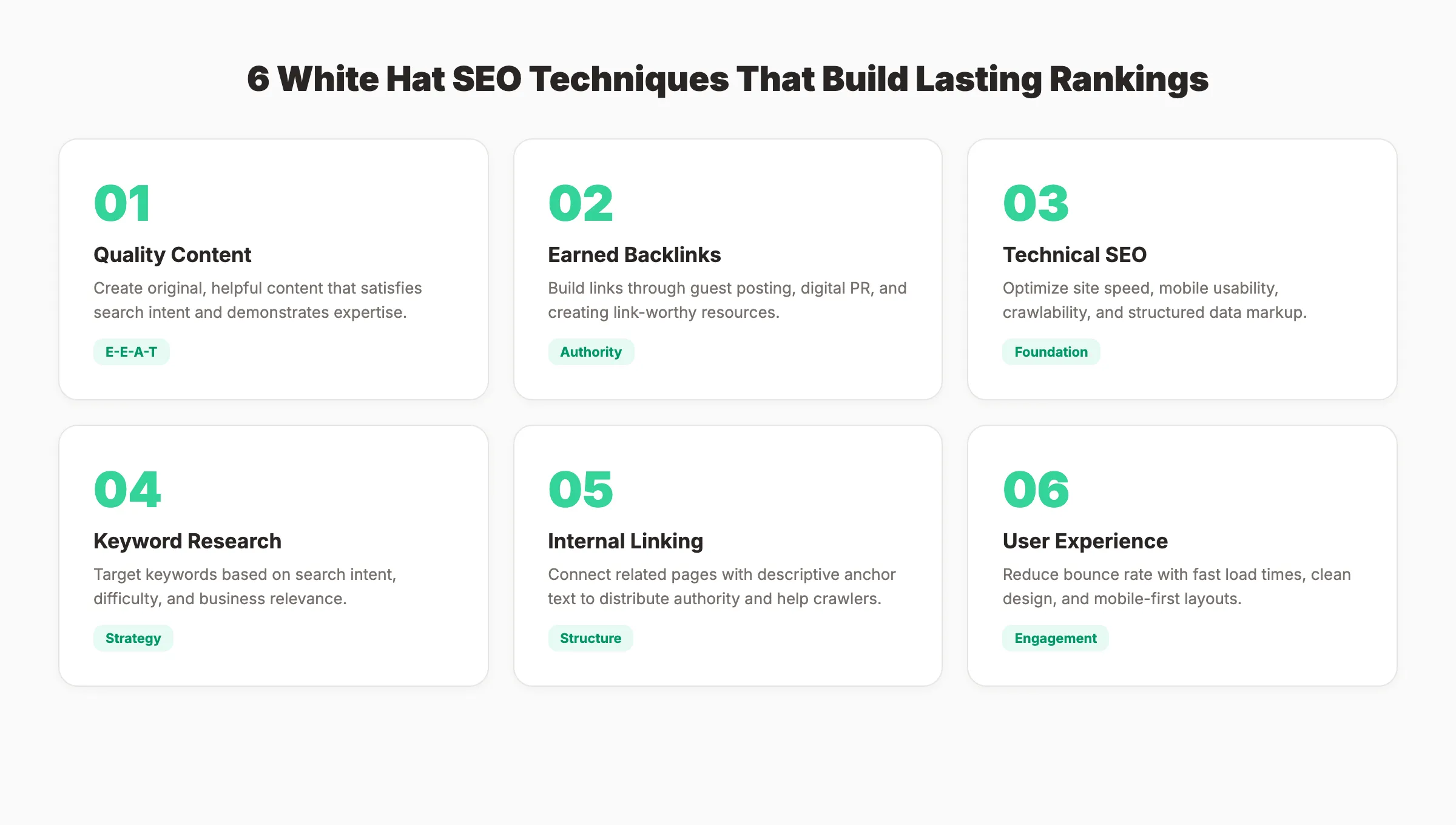
1. Create Quality, Helpful Content
Content that satisfies search intent ranks. Content that exists only to target keywords does not.
Every page should answer a question, solve a problem, or provide unique insight. Google’s helpful content system evaluates whether content is written for people or for search engines.
- Write for a specific audience with a specific need
- Include original data, examples, or expert perspective
- Match the format to the search intent (list, guide, comparison)
- Update content regularly to maintain accuracy
Read our guide on how to write blog posts that rank for the full framework.
2. Earn Backlinks Through Merit
The best link building strategies create content worth linking to. Guest posting, digital PR, original research, and free tools all earn links without violating any guidelines.
Earned links carry more authority than bought links. A single link from a high-authority site outweighs hundreds of PBN links that will eventually get devalued.
3. Optimize Technical SEO
A fast, crawlable, mobile-friendly site gives search engines every reason to rank your pages. Use our technical SEO checklist to cover the fundamentals:
- Page speed under 2.5 seconds (LCP)
- Mobile-responsive design
- Clean URL structure
- XML sitemap submitted to Google Search Console
- Structured data markup on key pages
4. Research and Target the Right Keywords
Effective keyword research matches your content to what people actually search for. Target keywords based on relevance, difficulty, and commercial intent.
Long-tail keywords with clear intent convert better than broad, competitive terms. A local plumber ranking for “emergency pipe repair [city]” gets more calls than one ranking for “plumbing.”
5. Build Strong Internal Linking
Internal links distribute authority across your site and help Google understand your content structure. Every new page should link to 3 to 5 related existing pages.
Build topical authority by clustering related content and connecting it with descriptive anchor text.
6. Prioritize User Experience
Google measures engagement signals. Pages with high bounce rates, low time on page, and poor mobile experience lose rankings over time.
Focus on clean design, fast load times, readable formatting, and clear navigation. These factors directly impact both rankings and conversions.
Grey Hat SEO: The Middle Ground
Grey hat SEO occupies the space between white and black hat tactics. These techniques are not explicitly banned by Google, but they push boundaries.
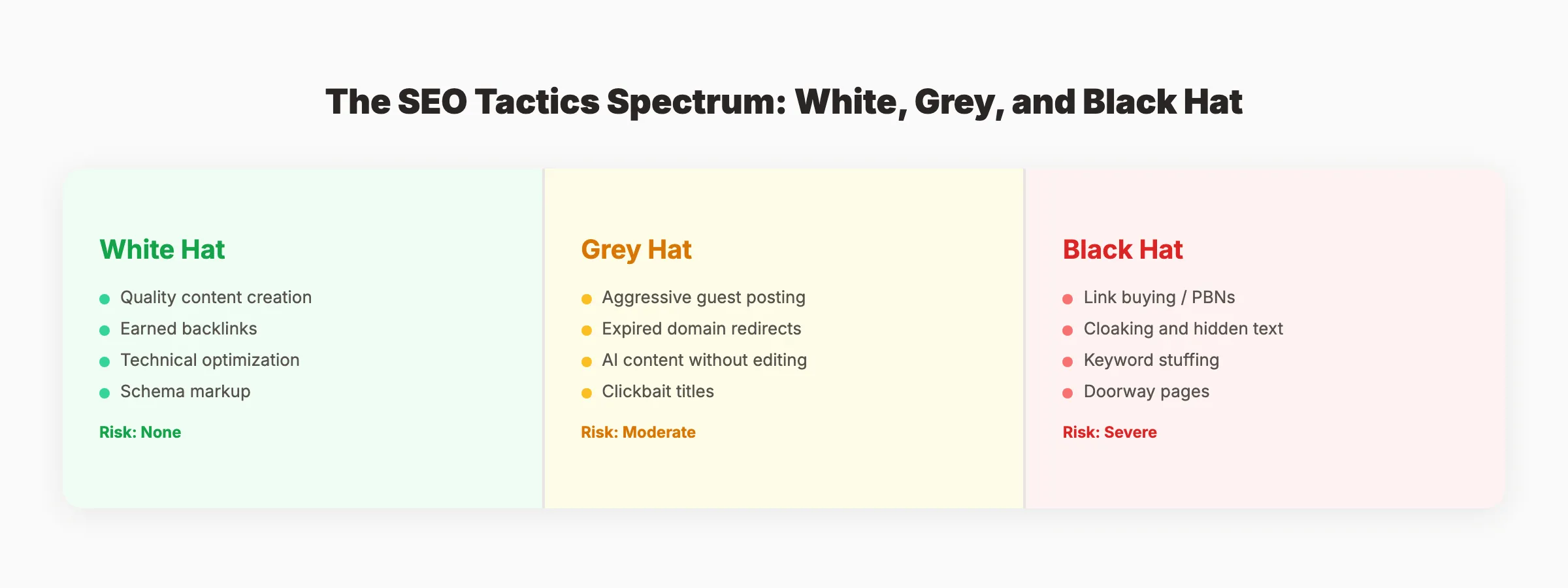
| Grey Hat Tactic | Risk Level | Why It Is Risky |
|---|---|---|
| Aggressive guest posting at scale | Moderate | Google may view mass guest posts as link schemes |
| Redirecting expired domains | Moderate | Authority transfer can be flagged as manipulation |
| Unedited AI content at scale | High | Helpful content system may demote thin AI content |
| Clickbait titles that do not match content | Moderate | Pogo-sticking signals hurt rankings |
| Paying for sponsored content with dofollow links | High | Should use rel=“sponsored” attribute |
The exception is this: some grey hat tactics sit closer to white hat than black hat. Guest posting with genuine, high-quality content on relevant sites is standard practice. Mass-producing 500 guest posts with spun content is a link scheme.
The line matters. When a grey hat tactic depends on deception or manipulation, it is functionally black hat. When it adds genuine value but pushes volume, it is a business risk you can assess.
Our recommendation: stay white hat. The marginal gains from grey hat tactics do not justify the risk of a Google penalty that takes 6 to 18 months to recover from.
Stop guessing about SEO tactics. We handle keyword research, content creation, and publishing, all within Google’s guidelines. Start for $1 →
The Real Cost of Black Hat SEO
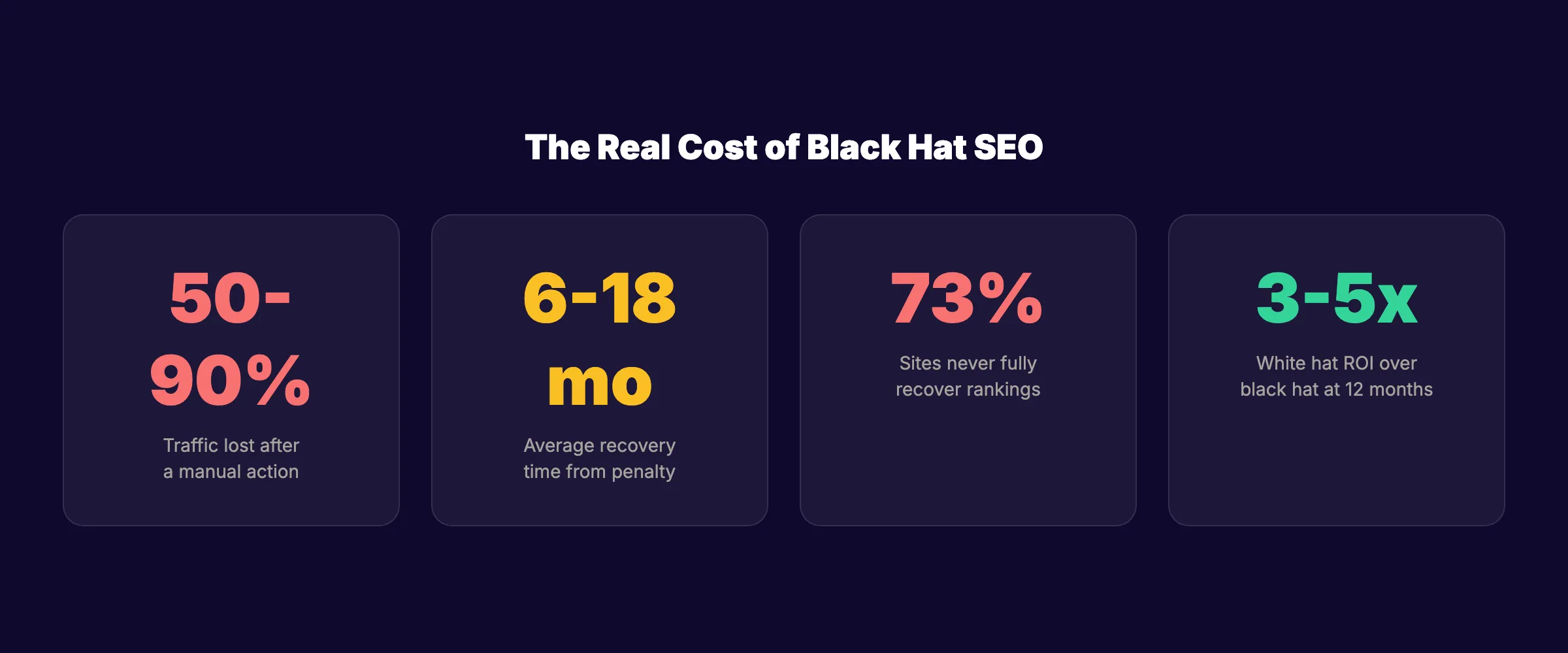
Black hat SEO appears cheap until the penalty arrives. Here is what it actually costs:
Direct costs:
- Buying links: $500 to $10,000+ per month
- PBN hosting: $200 to $2,000 per month for domain costs and hosting
- Recovery SEO after penalty: $5,000 to $25,000 in consultant fees
Indirect costs:
- Lost revenue during 6 to 18 month recovery period
- Damaged brand reputation in search results
- Staff time spent filing reconsideration requests
- Opportunity cost of rankings that took years to build
Compare that to white hat SEO. A consistent publishing strategy costs $99 to $500 per month and builds assets that appreciate over time. After 12 months, white hat SEO delivers 3 to 5 times the ROI of black hat approaches.
The math is simple. Spend $1,200 on 12 months of white hat content and own rankings that drive traffic for years. Or spend $6,000 on black hat links and lose everything when Google catches up.
Which Approach Should You Choose?
White hat SEO. Every time.
This is not a balanced “it depends” answer. In 2026, Google’s spam detection is faster and more accurate than ever. The window between black hat gains and penalties has shrunk from years to weeks.
Choose white hat SEO if you:
- Plan to grow your business beyond next quarter
- Value brand reputation and customer trust
- Want rankings that compound over time
- Prefer predictable, sustainable growth over risky shortcuts
The only scenario for black hat SEO: Disposable sites with no brand attached, built to extract short-term affiliate revenue. Even then, the economics rarely work because Google catches manipulation faster than ever.
For any real business with a real brand, white hat SEO is the only path worth taking.
Read our complete guide on how to rank higher on Google using proven white hat methods.
Frequently Asked Questions
What is the main difference between white hat and black hat SEO?
White hat SEO follows search engine guidelines to earn rankings through quality content and legitimate link building. Black hat SEO violates those guidelines by using manipulative tactics like cloaking, keyword stuffing, and link schemes. White hat builds sustainable growth. Black hat risks penalties and deindexing.
Is grey hat SEO safe to use?
Grey hat SEO carries moderate risk. Tactics like aggressive guest posting and using expired domains are not explicitly banned, but they push boundaries. Google’s enforcement is unpredictable. One algorithm update can reclassify a grey hat tactic as a violation. For most businesses, the added risk is not worth the marginal gain.
How long does it take to recover from a Google penalty?
Manual actions take 6 to 18 months to resolve. You must identify and fix every violation, then submit a reconsideration request. Google reviews these manually, and rejection means starting over. Algorithmic penalties may resolve faster once the offending content or links are removed, but full recovery is never guaranteed.
Can black hat SEO still work in 2026?
Some black hat tactics still produce short-term ranking improvements. But Google’s SpamBrain AI detection system catches violations faster than ever. The average lifespan of black hat rankings has dropped from months to weeks. The risk of a permanent manual action outweighs any temporary benefit.
What are the most common Google penalties?
The most common manual actions target unnatural links (both inbound and outbound), thin content, cloaking, keyword stuffing, and user-generated spam. Algorithmic penalties from systems like Penguin and Panda demote sites automatically based on link quality and content quality signals. Check Google Search Console’s Manual Actions report to see if your site has any active penalties.
How much does white hat SEO cost compared to black hat?
White hat SEO costs $99 to $5,000 per month depending on scale. Black hat tactics like link buying cost $500 to $10,000+ monthly, plus $5,000 to $25,000 in recovery costs when penalties hit. White hat SEO is cheaper upfront and dramatically cheaper long-term because you avoid penalty recovery costs entirely.
White hat SEO takes longer. It requires patience, consistency, and genuine effort. But every month of white hat work adds to a foundation that gets stronger over time. Black hat SEO borrows from the future and eventually pays the price.
Build rankings the right way. The results last.
Your SEO team. $99/month. 30 articles published per month, all white hat, all optimized for Google. Start for $1 →
Related Tools & Resources
Free SEO Tools:
Best Lists:

Written by
Siddharth GangalSiddharth is the founder of theStacc and Arka360, and a graduate of IIT Mandi. He spent years watching great businesses lose organic traffic to competitors who simply published more. So he built a system to fix that. He writes about SEO, content at scale, and the tactics that actually move rankings.
30 SEO blog articles published every month
Keyword-optimized, scheduled, and live on your site. Automatically.
30-day trial · Cancel anytime
theStacc
Stop writing SEO content manually
30 blog articles, 30 GBP posts, and social media content. Published every month. Automatically.
Start Your $1 Trial$1 for 3 days · Cancel anytime