The answer economy replaces clicks with AI-generated citations. Learn what it means for SEO, content, and your brand visibility. Updated April 2026.
65% of Google searches now end without a single click. ChatGPT serves over 900 million weekly active users. And Gartner projects that by Q4 2026, AI answer engines will influence 60% of commercial research queries.
The answer economy is here. It describes a fundamental shift in how people find information online. Instead of clicking through 10 blue links, users get direct answers from AI. Instead of visiting your website, they read what ChatGPT, Perplexity, or Google AI Mode says about you.
The brands that get cited in those answers win. The brands that do not become invisible, regardless of their Google ranking.
We have published 3,500+ SEO articles across 70+ industries and tracked this shift from the link economy to the answer economy in real time. This guide explains what the answer economy is, why it matters, how it changes your content strategy, and what to do about it.
Here is what you will learn:
- What the answer economy means and how it differs from traditional search
- The data behind the shift from clicks to citations
- How AI answer engines decide what to cite
- The content strategy that wins in the answer economy
- How to measure success when clicks are no longer the goal
- What this means for your SEO investment in 2026 and beyond
What Is the Answer Economy?
The answer economy is a market where AI systems generate direct answers to user questions instead of directing users to websites. The user gets what they need without clicking a link. The AI cites sources inline, but most users never visit those sources.
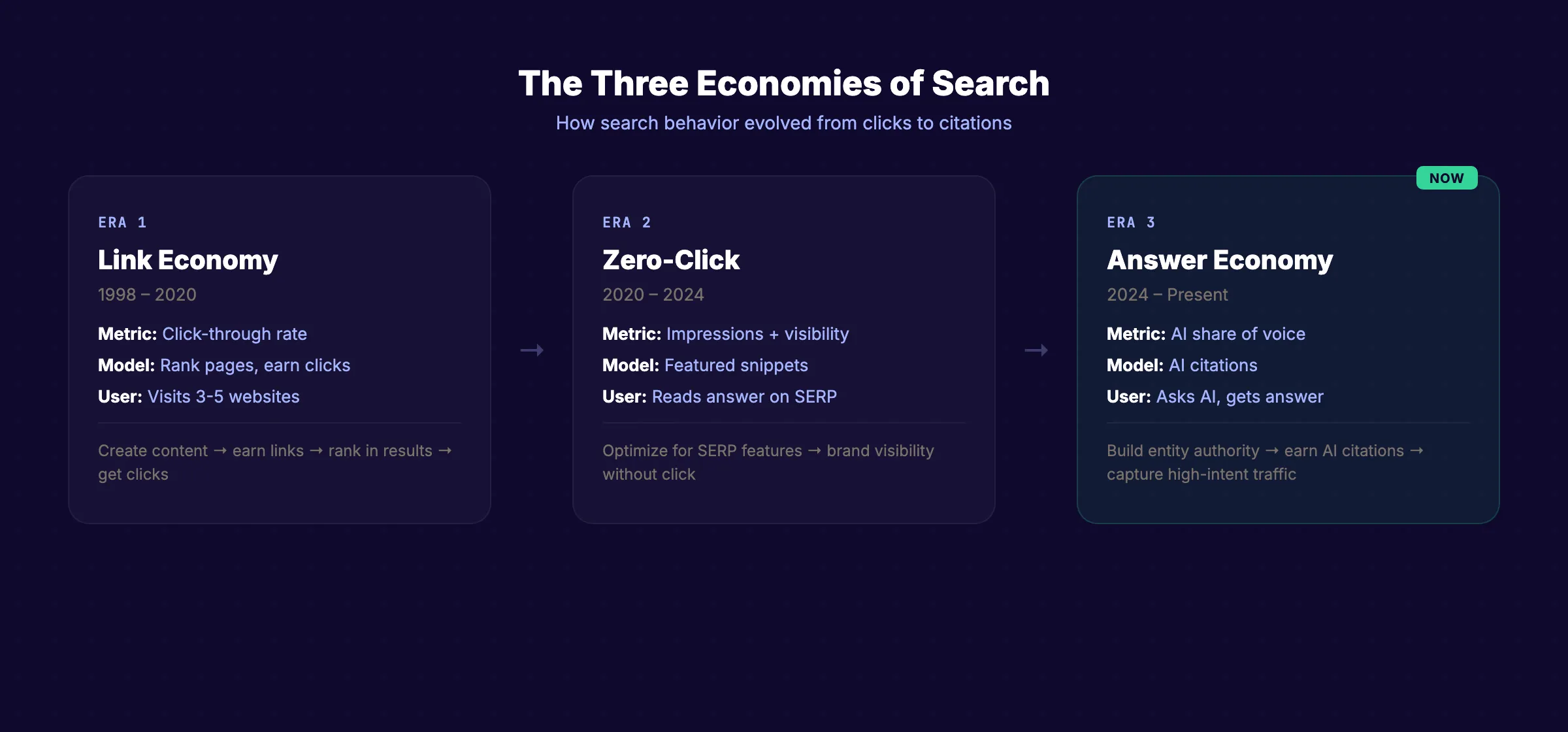
This is a structural change, not a trend. For 25 years, the internet ran on the link economy. Create content, earn links, rank in search results, get clicks. Every business model from media to ecommerce depended on that flow.
The answer economy replaces that flow. Now AI engines read your content, extract the answer, and deliver it to the user. The user gets value. You get a citation. Maybe.
The Three Economies of Search
| Era | Model | Success Metric | User Behavior |
|---|---|---|---|
| Link Economy (1998-2020) | Rank pages, earn clicks | Click-through rate, traffic | User visits 3-5 websites per query |
| Zero-Click Economy (2020-2024) | Featured snippets, knowledge panels | Impressions, brand visibility | User reads answer on SERP, sometimes clicks |
| Answer Economy (2024+) | AI citations, brand mentions | Share of voice in AI responses | User asks AI, gets complete answer, rarely clicks |
The transition happened faster than most businesses expected. According to Bain, 80% of consumers now rely on zero-click results for at least 40% of their searches. The answer economy is the logical endpoint of that trend.
The Data Behind the Shift
The numbers paint a clear picture. Search behavior has changed permanently.
Click Rates Are Collapsing
| Metric | Data Point | Trend |
|---|---|---|
| Zero-click search rate (2026) | 65%+ of all Google queries | Up from 58% in late 2025 |
| Zero-click rate with AI Overviews | 83% of queries | 23 points higher than non-AI queries |
| AI Overviews coverage | 30%+ of all queries | Doubled from 13% in March 2025 |
| CTR drop with AI features | 20-64% decline | Varies by query type and industry |
| Mobile zero-click rate | 66% higher than desktop | Growing faster on mobile devices |
AI Platform Adoption Is Accelerating
| Platform | Usage | Growth |
|---|---|---|
| ChatGPT | 900M+ weekly active users | 44% traffic growth YoY |
| Google AI Mode | 75M+ daily active users | Available in 180+ countries |
| Perplexity | 100M+ weekly queries | From 15M monthly users in late 2024 |
| Bing Copilot | Integrated into Windows + Edge | Pre-installed on 1B+ devices |
The compound effect of these numbers is significant. When 65% of searches produce no clicks AND billions of users ask AI for answers directly, the pool of available organic traffic shrinks every quarter.
But here is the nuance most analysis misses. AI-referred traffic converts at 4.4x higher economic value than traditional organic traffic. The total traffic volume drops. But the value per visitor increases.
Some companies are already seeing this play out. Public companies like NerdWallet and HubSpot reported declining organic search traffic. Yet their revenues increased during the same period. The explanation is straightforward. AI-referred visitors arrive with higher intent. They have already received a recommendation from a trusted AI. They are further along in the decision process.
The answer economy rewards quality of citation over quantity of clicks. Getting cited once by ChatGPT for a high-intent query can drive more revenue than ranking number 3 for a high-volume keyword.
Stop writing. Start ranking. theStacc publishes 30 SEO articles per month for $99. Build the citation-worthy content that AI engines trust.
How the Answer Economy Changes Content Strategy
Most content strategies optimize for clicks. Write a blog post, rank it, drive traffic, convert visitors. That playbook still works for some queries. But for the 65% that end without a click, you need a different approach.
From Traffic to Trust
The old metric was "how much traffic does this page drive?" The new metric is "does AI cite this page when someone asks a question?"
Traffic-focused content prioritizes keyword volume, word count, and click-bait titles. Answer-economy content prioritizes fact density, structure, and brand authority.
Here is the practical difference:
| Traffic-Focused Content | Answer-Economy Content |
|---|---|
| Long, keyword-stuffed articles | Concise, fact-dense passages |
| Engagement bait headlines | Question-matching headings |
| Gated content behind email forms | Open, crawlable, AI-accessible |
| PDFs and downloads | Structured HTML with schema markup |
| Optimized for 1 keyword | Optimized for a topic cluster |
| Success = pageviews | Success = AI citations + brand mentions |
From Keywords to Entities
AI answer engines do not match keywords. They match entities. When a user asks "what is the best project management tool for small teams," the AI evaluates brand entities, not keyword strings.
Your brand becomes an entity when it is consistently described across multiple sources. Your website, review platforms, social profiles, Wikipedia, industry directories, and press coverage all contribute to your entity definition.
The businesses with the strongest entity signals get recommended by AI. The businesses with weak or inconsistent signals get skipped. This is why building topical authority across your entire content library matters more than optimizing individual pages.
From Pages to Passages
AI engines do not cite entire pages. They extract individual passages. A single paragraph that directly answers a question has more citation value than a 5,000-word article that buries the answer in paragraph 14.
This changes how you write. Every paragraph should contain a citable fact. Every H2 heading should match a natural language question. Every section should stand alone as a self-contained answer.
For detailed guidance on structuring content for AI extraction, read our guide on getting cited in AI search.
From Persuasion to Precision
Traditional marketing content persuades. It uses emotional hooks, storytelling, and conversion techniques. Answer economy content does something different. It provides precise, verifiable facts that AI engines can confidently cite.
This does not mean your content should be dry or robotic. It means every claim needs specificity. "Our product is fast" is not citable. "Our product processes 10,000 transactions per second with 99.9% uptime" is citable. AI engines extract precise claims. They skip vague ones.
The best answer economy content combines human readability with machine extractability. Write for people first. Structure for AI second. The overlap between the two is larger than most marketers think.
This is also why on-page SEO fundamentals still matter. Clear headings, logical structure, and proper HTML markup serve both human readers and AI extraction engines.
The Answer Economy Strategy Framework
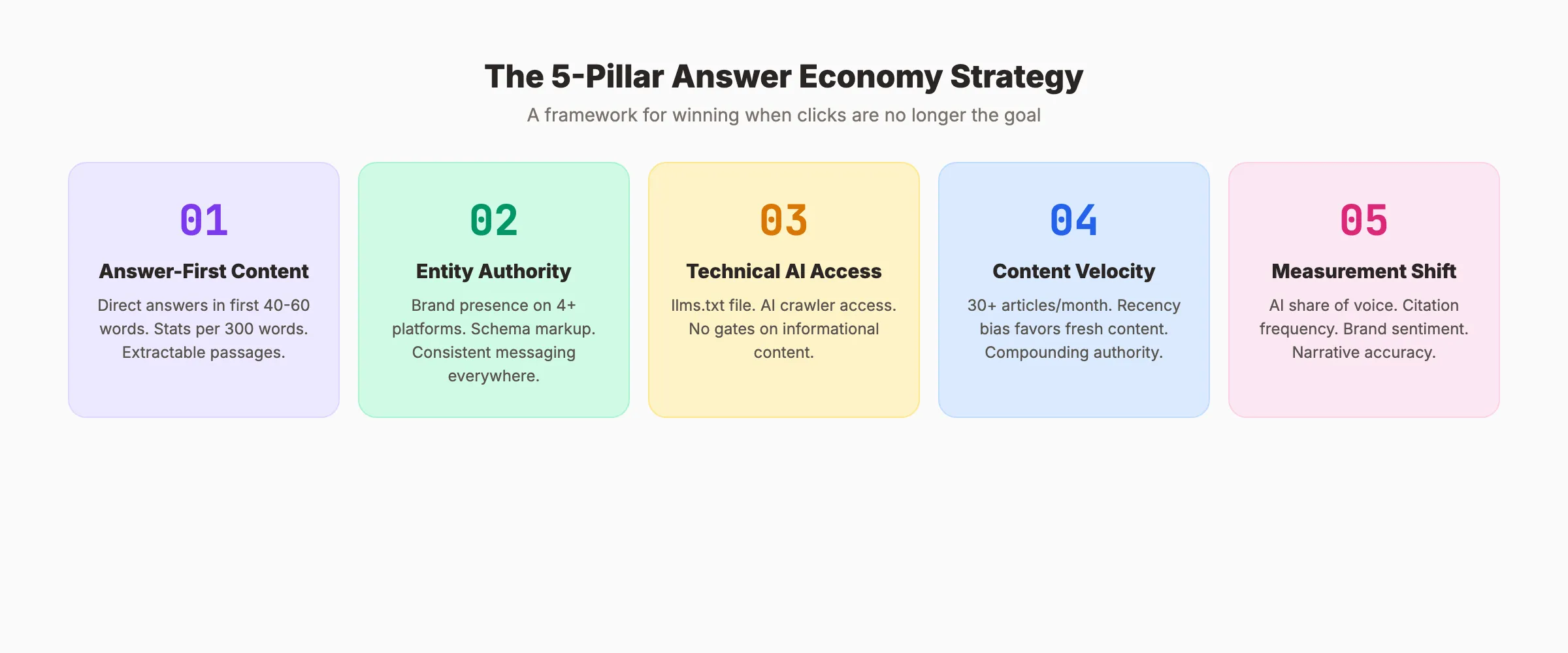
Winning in the answer economy requires a different operational model. Here are the 5 pillars.
Pillar 1: Answer-First Content
Write content that answers questions directly in the first 40 to 60 words of each section. Do not bury the answer after 3 paragraphs of context. AI engines favor content that delivers clear, direct answers upfront.
Checklist:
- ✓ Every H2 section opens with a direct answer (40-60 words)
- ✓ Key facts appear in the first sentence of each paragraph
- ✓ Statistics include specific numbers and sources
- ✓ Content sections use 3+ data points per 300 words
- ✓ Tables summarize comparisons and data for easy extraction
Pillar 2: Entity Authority
Build your brand as a recognizable entity across the web. AI engines evaluate brand presence across multiple platforms before deciding to cite you.
Checklist:
- ✓ Google Business Profile fully optimized
- ✓ Brand profiles on LinkedIn, X, YouTube, and industry directories
- ✓ Reviews on G2, Trustpilot, or vertical-specific platforms
- ✓ Wikipedia or Wikidata entity (if eligible)
- ✓ Consistent NAP and brand messaging across all platforms
- ✓ Schema markup on all key pages (Organization, Article, FAQ)
Pillar 3: Technical AI Access
Make your content accessible to AI crawlers. Gated content, PDFs, and JavaScript-rendered pages reduce your answer economy visibility.
Checklist:
- ✓ Publish an
llms.txtfile describing your site structure - ✓ Allow AI crawlers in your
robots.txt - ✓ Remove gates from informational content (keep gates only for premium assets)
- ✓ Ensure pages render server-side (not client-side JavaScript only)
- ✓ Add FAQ schema to pages with question-answer content
Pillar 4: Content Velocity
AI engines show a documented recency bias. 83% of AI citations come from pages updated within the past 12 months. Publishing velocity directly impacts your citation frequency.
A site that publishes 30 articles per month builds topical authority signals 10x faster than one publishing 3. In the answer economy, content compounds. Every article adds a new data point that AI engines evaluate when deciding whether to trust your brand.
The Content Compound Effect is the answer economy version of link building. Instead of earning backlinks, you earn citation confidence through consistent, high-quality publishing.
Pillar 5: Measurement Shift
Traditional SEO metrics do not capture answer economy performance. You need new metrics.
| Old Metric | Answer Economy Metric |
|---|---|
| Organic traffic | AI share of voice |
| Click-through rate | Citation frequency |
| Keyword rankings | Brand mention sentiment |
| Pageviews | AI-referred conversion rate |
| Bounce rate | Narrative accuracy across AI models |
Track your brand mentions across ChatGPT, Perplexity, Gemini, and Google AI Mode. Measure citation frequency for your target queries. Monitor sentiment and positioning accuracy. Read our full guide on tracking AI search visibility for the how-to.
3,500+ blogs published. Every article is SEO-scored before publish. Every article builds the signal density that earns AI citations.
What the Answer Economy Means for Different Business Types
The answer economy does not affect every business equally. Here is how it plays out by business type.
Local Service Businesses
Local queries are heavily affected by AI answers. When someone asks "best plumber near me" or "dentist open on Saturday," AI pulls from Google Business Profile data, reviews, and local content.
Local businesses with optimized GBP profiles, strong review signals, and location-specific content maintain visibility. Those without complete profiles become invisible in AI-generated local recommendations. Our local SEO guide covers the full optimization process.
Ecommerce Brands
Product queries increasingly get answered by AI with specific product recommendations. AI agents evaluate product data, reviews, pricing, and availability. Ecommerce brands need clean structured data, accurate inventory, and consistent product information across all channels.
Read our guide on agentic commerce for how AI shopping agents are reshaping product discovery.
B2B and SaaS Companies
B2B research queries are shifting to AI at a faster rate than consumer queries. 28% of B2B research traffic now happens natively in answer engines. B2B companies that build thought leadership content with original data and deep expertise get cited. Those with generic feature pages do not.
Content Publishers and Media
Publishers face the steepest challenge. AI summaries satisfy user intent without requiring a site visit. The publishers that survive will be those that create original reporting, proprietary data, and expert analysis that AI cannot replicate from other sources. Commodity content loses all value in the answer economy.
The strategy for publishers is clear. Double down on original research, first-hand reporting, and expert commentary. Publish data that AI cannot generate from existing sources. Build a brand that AI models recognize as authoritative on specific topics. The publishers doing this will get cited. The ones producing generic roundups will not.
For an overview of how AI reshapes organic discovery, read our guide on how AI search is changing SEO.
The Answer Economy Is Not the End of SEO
SEO is not dead. But the definition of SEO success is expanding.
Traditional SEO still drives traffic for navigational queries, branded searches, and transactions where users need to visit a site. A search for "login to my bank account" will always drive a click. A search for "best CRM for startups" increasingly gets answered by AI.
The businesses that thrive in the answer economy will do both. They will optimize for traditional search where it still drives traffic AND optimize for AI citations where search behavior has shifted.
Generative engine optimization is the discipline that bridges the two. GEO builds on SEO fundamentals (crawlability, content quality, authority) and adds the AI-specific signals (passage structure, entity authority, citation formatting) that earn mentions in AI answers.
The practical implication: every piece of content you publish should serve both human readers and AI engines. Clear structure serves both. Specific data serves both. Consistent brand signals serve both. The overlap between good SEO and good answer economy strategy is 80% or more.
Here is a simple test. Read any piece of content you have published. Ask yourself: "Can a person who reads only this paragraph get a specific, useful answer?" If yes, that paragraph works for both SEO and the answer economy. If no, the paragraph needs rewriting.
The businesses that invest in content quality and publishing consistency now are building the foundation for answer economy visibility. The businesses that wait until AI citations directly affect their revenue are already 12 to 18 months behind.
The Answer Economy Content Checklist
Use this checklist for every piece of content you publish:
- ✓ First paragraph directly answers the primary question
- ✓ Every H2 heading matches a natural language query
- ✓ 3+ specific statistics per 1,000 words with cited sources
- ✓ All key claims include specific numbers (not vague language)
- ✓ FAQ section addresses 4-6 related questions
- ✓ Schema markup applied (Article, FAQ, Organization)
- ✓ Content is accessible to AI crawlers (no gates, no JavaScript-only rendering)
- ✓ Brand information is consistent with other platforms
- ✓ Published on a regular cadence (weekly minimum, daily preferred)
- ✓ Updated within the past 12 months with current data
Rank everywhere. Do nothing. Blog SEO, Local SEO, and Social on autopilot. Build the content library that AI engines trust and cite.
What practitioners are saying on X
AI search advice ages quickly. Here is high-signal public discussion from SEO and growth operators — context for your roadmap, not a substitute for primary data.
- @hridoyreh (Mar 2026): Widely shared SEO skill tree: foundations, research, technical, on-page, content, links, AI SEO/GEO, analytics, UX, brand, programmatic — useful map for stats and how-to posts. See the post on X.
- @jakezward (Feb 2026): 2026 SEO predictions emphasize AI Overview share-of-SERP, schema for LLM token efficiency, brand mentions in AI answers as a KPI, proprietary data as a moat, and content refresh beating net-new AI slop. See the post on X.
Grok, AI Overviews, and multi-engine visibility
For “answer economy strategy”, multi-engine visibility still starts with clear definitions, sourced numbers, and extractable section answers. Grok additionally factors live X discussion — keep public claims consistent with this page.
- Google AI Overviews: Use passage-ready answers, tables, and FAQ schema where relevant.
- ChatGPT / Perplexity: Cite named sources next to key claims.
- Grok: Maintain accurate entity facts on-site and in high-signal X posts.
Publish content built for Google and AI citations. theStacc’s Content SEO module ships SEO-scored articles structured for rankings and generative engines — including clearer entity pages models like Grok can quote.
FAQ
Related but different. Zero-click search describes a specific behavior: users getting answers without clicking. The answer economy describes the broader market shift where AI-generated answers replace traditional search results as the primary discovery channel. Zero-click search is a symptom. The answer economy is the underlying change.
The opposite. AI engines need content to generate answers. The more high-quality, fact-dense content you publish, the more likely you are to be cited. The answer economy rewards content creators who publish consistently with original data and expertise. It punishes those who create thin, generic content.
Run your target queries through ChatGPT, Perplexity, and Google AI Mode. Check if your brand appears in the response. For automated tracking, use tools like LLMrefs, Semrush AI Visibility, or Otterly. Read our guide on LLM visibility for the full measurement framework.
Answer Engine Optimization (AEO) focuses on getting cited by AI answer engines like ChatGPT and Perplexity. Generative Engine Optimization (GEO) is broader, covering all AI-generated search experiences including Google AI Overviews and AI Mode. Both are subsets of the answer economy strategy.
Total click volume from Google is declining as zero-click queries increase. But the value per click is rising. AI-referred visitors convert at 4.4x higher economic value. The businesses that adapt to the answer economy will generate more revenue from fewer total visitors.
theStacc publishes 30 optimized articles per month for $99. Every article builds topical authority signals, uses answer-first formatting, and includes structured data. Consistent publishing at that volume creates the content density that AI engines evaluate when deciding which brands to cite.
The answer economy rewards the brands that provide clear, trustworthy, fact-dense answers across every platform where AI engines look. The shift from clicks to citations is permanent. Build the content that AI trusts now, and you capture the visibility that others lose.
Sources & references
- [1] Princeton / Georgia Tech et al. — GEO research (arXiv:2311.09735)
- [2] @hridoyreh on X — Widely shared SEO skill tree: foundations, research, technical, on-page, content, links, AI SEO/GEO, analytics, UX, bran
- [3] @jakezward on X — 2026 SEO predictions emphasize AI Overview share-of-SERP, schema for LLM token efficiency, brand mentions in AI answers
- [4] Referenced source — cxl.com

Plan topics, review article drafts, and publish to a connected CMS.
Weekly local SEO teardowns
One practical email a week. Map Pack, GBP, AI Overviews. No fluff. Unsubscribe anytime.