
Email Marketing for HVAC (2026): Campaigns That Book Service Calls
Email marketing for HVAC companies: seasonal campaigns, maintenance reminders, review requests, and automation workflows that fill slow seasons and drive repeat bookings.
Email Marketing for HVAC: The Complete Guide (2026)
Most HVAC companies spend thousands on ads to find new customers. They ignore the hundreds of past customers already sitting in their database. That gap costs real money every slow season.
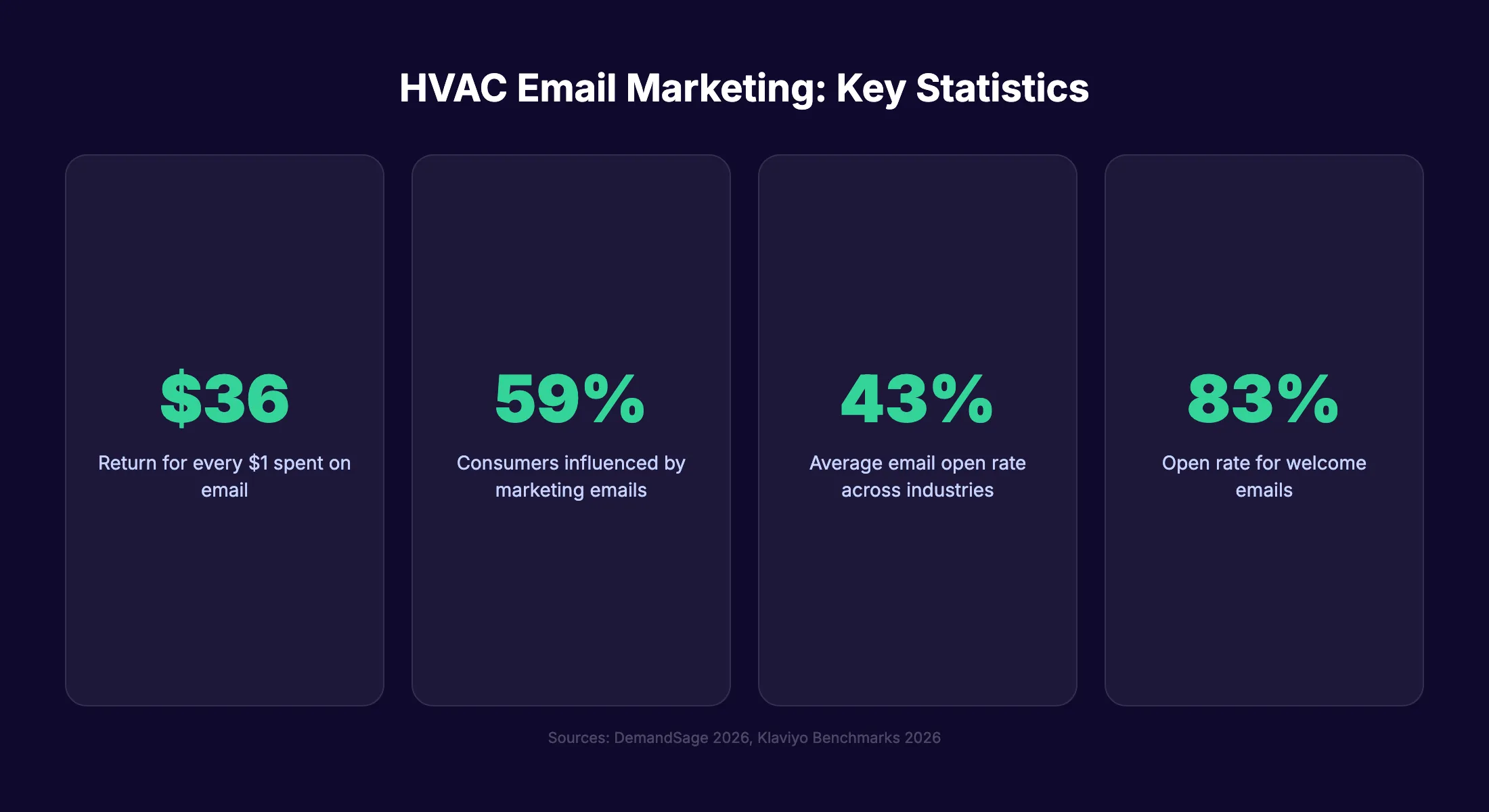
Email marketing for HVAC companies returns $36 for every $1 spent. No other marketing channel comes close to that ratio. And 59% of consumers say marketing emails directly influence their purchase decisions.
This guide covers the exact email marketing strategies HVAC contractors use to book more jobs, fill shoulder seasons, and turn one-time callers into lifetime customers. We publish 3,500+ blog posts across 70+ industries and have studied what works for local service businesses.
Here is what you will learn:
- How to build an HVAC email list that grows every month
- The 6 email campaigns that drive the most revenue for HVAC companies
- How to segment your list for higher open rates and more bookings
- Subject line formulas that get past the inbox noise
- Automation workflows that run without daily effort
- The exact KPIs to track and benchmarks to beat
Table of Contents
- Why Email Marketing Works for HVAC Companies
- How to Build an HVAC Email List From Scratch
- 6 HVAC Email Campaigns That Book More Jobs
- How to Segment Your HVAC Email List
- Writing HVAC Emails That Get Opened and Clicked
- HVAC Email Automation: Set It and Forget It
- Measuring HVAC Email Marketing Results
- FAQ
Why Email Marketing Works for HVAC Companies {#why-email-marketing-works}
HVAC businesses operate in a unique cycle. Customers call during emergencies, get their problem fixed, and forget you exist until the next breakdown. Email bridges that gap by keeping your company visible between service calls.
The ROI No Other Channel Matches
Email marketing delivers an average return of $36 for every $1 invested. For an HVAC company spending $200 per month on an email platform, that translates to $7,200 in potential revenue.
Compare that to pay-per-click ads. The average cost per click for HVAC keywords runs $8 to $30. One booked job from email marketing costs pennies. One booked job from Google Ads can cost $150 or more. The math is not even close. Our SEO vs PPC comparison breaks down these economics in detail.
Why HVAC Is Perfect for Email
Three factors make HVAC businesses ideal for email marketing:
Repeat service needs. Every system requires annual maintenance. That is at least 2 touchpoints per year, every year, for every customer.
Seasonal demand cycles. Spring AC tune-ups and fall heating checks create natural email triggers. You know exactly when to reach out and what to offer.
High lifetime value. The average homeowner stays in their home for 11.8 years. An AC unit lasts 12 to 17 years. A furnace lasts 15 to 20 years. One customer can generate $5,000 to $15,000 in lifetime revenue. Email keeps that relationship alive.
Email vs. Social Media for HVAC
Social media has its place. We wrote a full guide on social media for HVAC companies. But email outperforms social for one critical reason: you own the list.
Facebook can change its algorithm tomorrow. Instagram can throttle your reach. Your email list belongs to you. No platform can take it away.
| Factor | Email Marketing | Social Media |
|---|---|---|
| Average ROI | $36 per $1 | $2.80 per $1 |
| Reach control | 100% (you own the list) | 5-15% organic reach |
| Personalization | High (name, service history) | Low (broad targeting) |
| Cost per conversion | $1-5 | $15-50 |
| Best for | Retention, repeat bookings | Awareness, new leads |
A strong HVAC marketing strategy combines both. Email drives retention and repeat revenue. Social media and content marketing bring in new leads. Build both channels, but prioritize email for existing customers.
How to Build an HVAC Email List From Scratch {#build-email-list}
Your email list is the foundation. Without subscribers, no campaign matters. The good news: HVAC companies interact with customers daily. Every service call, estimate, and phone inquiry is a list-building opportunity.
6 List-Building Methods for HVAC Companies
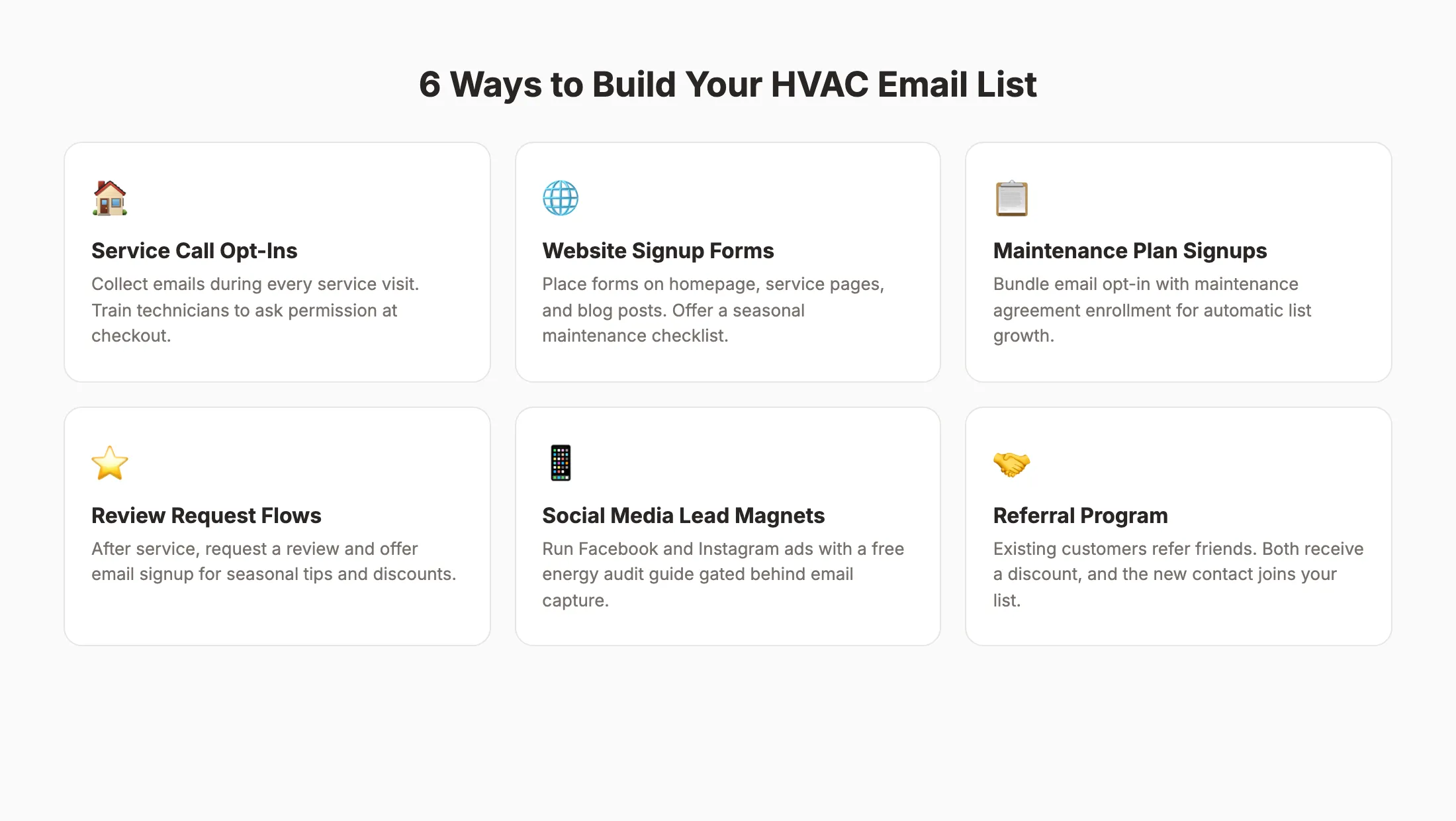
1. Service call opt-ins. Train every technician to collect email addresses at checkout. A simple question works: “Can we send you a receipt and maintenance reminders by email?” Most customers say yes. This single method can add 20 to 40 new contacts per week for a busy shop.
2. Website signup forms. Place email capture forms on your homepage, service pages, and blog posts. Offer something useful in exchange. A seasonal maintenance checklist or energy-saving tips guide works well. If you do not have a blog yet, our guide on how to create a business blog walks through the process.
3. Maintenance plan enrollment. Bundle email opt-in with every maintenance agreement signup. This creates your highest-value segment automatically. These customers already committed to regular service.
4. Post-service review requests. After every job, send a review request. Include an email signup option for seasonal tips and exclusive discounts. Our guide on asking customers for reviews covers this workflow in detail.
5. Social media lead magnets. Run a Facebook ad offering a free “Home HVAC Health Checklist” gated behind an email form. Budget $5 to $10 per day. Expect to pay $1 to $3 per email subscriber.
6. Referral programs. Offer existing customers a $25 credit for every friend they refer. The referred customer joins your email list as part of the signup process.
What NOT to Do
Never buy email lists. Purchased lists contain outdated addresses, spam traps, and people who never asked to hear from you. Open rates crash below 5%. Deliverability suffers. Your sender reputation takes damage that can take months to repair.
Also avoid adding customers without permission. The CAN-SPAM Act requires that recipients have the ability to opt out. Explicit opt-in is always the safer approach.
Build your online presence while your email list grows. Combine email with blog SEO to attract new leads on autopilot. Start for $1 →
How Fast Should Your List Grow?
A healthy HVAC email list grows 3% to 5% per month. For a company with 500 subscribers, that means 15 to 25 new contacts monthly. Companies running all 6 methods above typically hit 5% to 8% monthly growth.
Track net growth, not just new signups. Subtract unsubscribes and bounces from new additions. If your list shrinks month over month, your content needs improvement.
6 HVAC Email Campaigns That Book More Jobs {#email-campaigns}
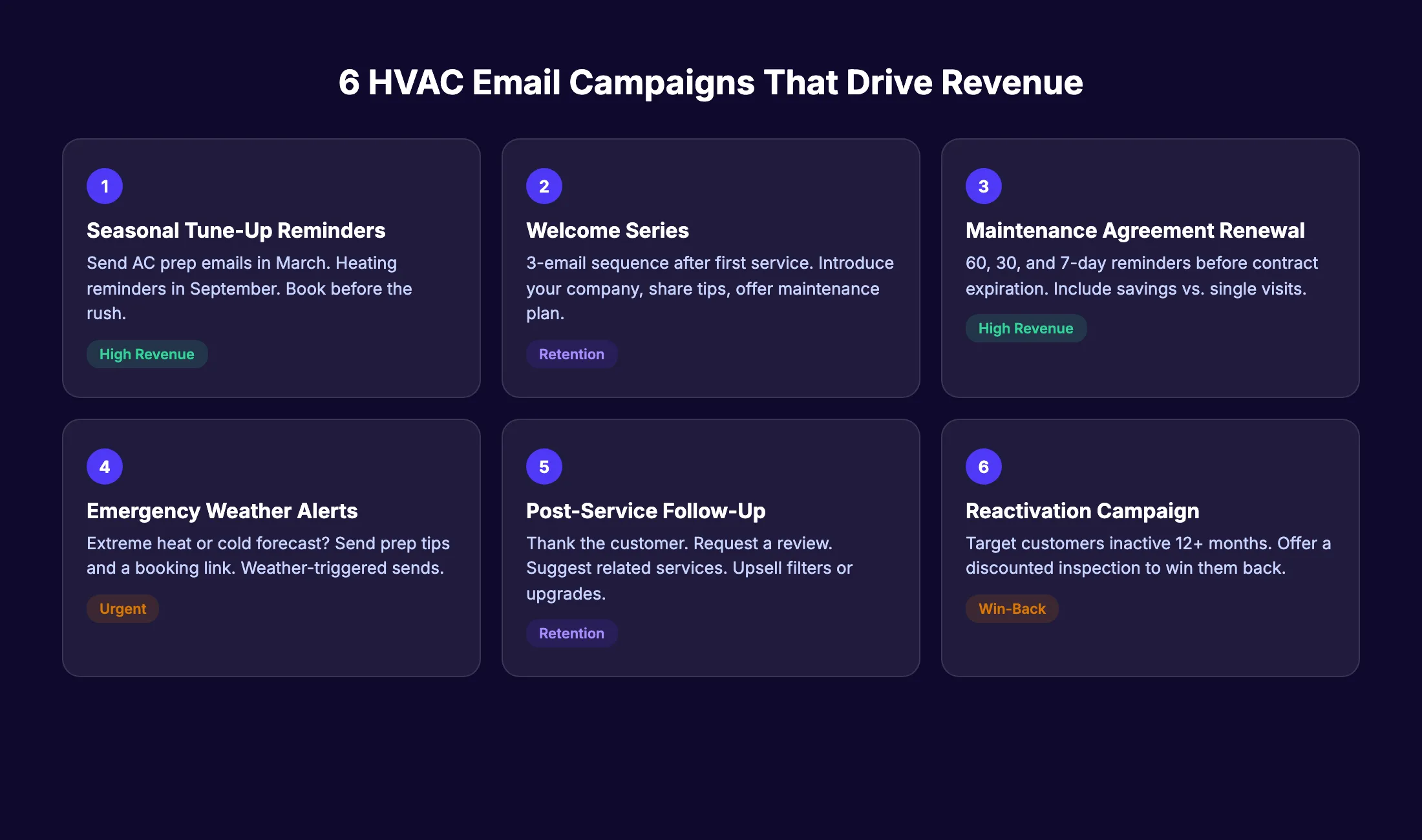
Not all emails are equal. Some drive immediate bookings. Others build long-term loyalty. An effective HVAC email marketing program runs at least 4 of these 6 campaign types.
Campaign 1: Seasonal Tune-Up Reminders
This is the single highest-revenue campaign for most HVAC companies. Send AC maintenance reminders in March and April. Send heating tune-up reminders in September and October. Hit the inbox before customers think about it.
Timing matters. Send 6 to 8 weeks before peak season starts. Early birds book at regular rates. Late callers pay emergency premiums or get waitlisted.
Email sequence:
- First email (8 weeks out): “Spring AC tune-up season is here. Book early and save $50.”
- Follow-up (4 weeks out): “67% of tune-up slots are filled. Grab yours.”
- Final reminder (1 week out): “Last chance for pre-season pricing.”
One HVAC company in the INSIDEA case study achieved a 14% click-through rate and 16% click-to-book conversion with seasonal campaigns during a slow month.
Campaign 2: Welcome Series
A 3-email welcome series introduces new customers to your company. The average welcome email open rate is 83%. That is nearly double the rate of any other email type.
Email 1 (Day 0): Thank them for choosing your company. Share your story, service area, and emergency contact number.
Email 2 (Day 3): Send 3 seasonal HVAC tips. Position yourself as the helpful expert, not just the repair company.
Email 3 (Day 7): Introduce your maintenance plan. Include pricing, benefits, and a booking link.
This sequence converts one-time callers into maintenance plan members. Maintenance plans drive predictable recurring revenue for HVAC companies.
Campaign 3: Maintenance Agreement Renewal
Renewal reminders protect recurring revenue. Send a sequence at 60 days, 30 days, and 7 days before contract expiration.
Include a comparison table showing the cost of individual service calls versus the annual plan price. Make the savings obvious. Add a one-click renewal button.
| Plan Benefit | With Maintenance Plan | Without Plan |
|---|---|---|
| AC tune-up | Included | $149 |
| Heating tune-up | Included | $149 |
| Priority scheduling | Yes | No |
| Repair discount | 15% off parts and labor | Full price |
| Annual cost | $199/year | $298+ per visit |
Campaign 4: Emergency Weather Alerts
When extreme weather hits your service area, send a timely email. A heat wave forecast means “3 things to check before temperatures spike.” A polar vortex warning means “Is your furnace ready?”
These emails show you care about your customers, not just their money. They also generate bookings from customers who realize their system is not prepared.
The best HVAC companies use ZIP code segmentation to target only the areas affected by the weather event. A content calendar helps you plan these sends in advance.
Campaign 5: Post-Service Follow-Up
Send a thank-you email within 24 hours of every service call. Include:
- A summary of the work performed
- Care tips for their system
- A link to leave a Google review
- A suggestion for a related service
This builds goodwill and generates reviews. Our guide on responding to Google reviews covers why reviews matter for local search visibility.
Campaign 6: Reactivation Campaign
Target customers who have not booked in 12 months or more. Offer a discounted inspection or free filter check to bring them back.
The subject line matters here. Try: “We miss you. Here is $40 off your next service.” Reactivation campaigns typically see 15% to 25% open rates and recover 5% to 10% of lapsed customers.
Stop chasing new leads. Reactivate the customers you already have. Email marketing fills your schedule without ad spend. Start for $1 →
How to Segment Your HVAC Email List {#segmentation}
Sending the same email to every subscriber is the fastest way to kill engagement. A homeowner with a 20-year-old furnace needs different messaging than a customer who just installed a new system.
Segmentation means dividing your list into smaller groups based on shared characteristics. Segmented emails generate 14% higher open rates and significantly more clicks than non-segmented blasts.
The 6 Segments Every HVAC Company Needs
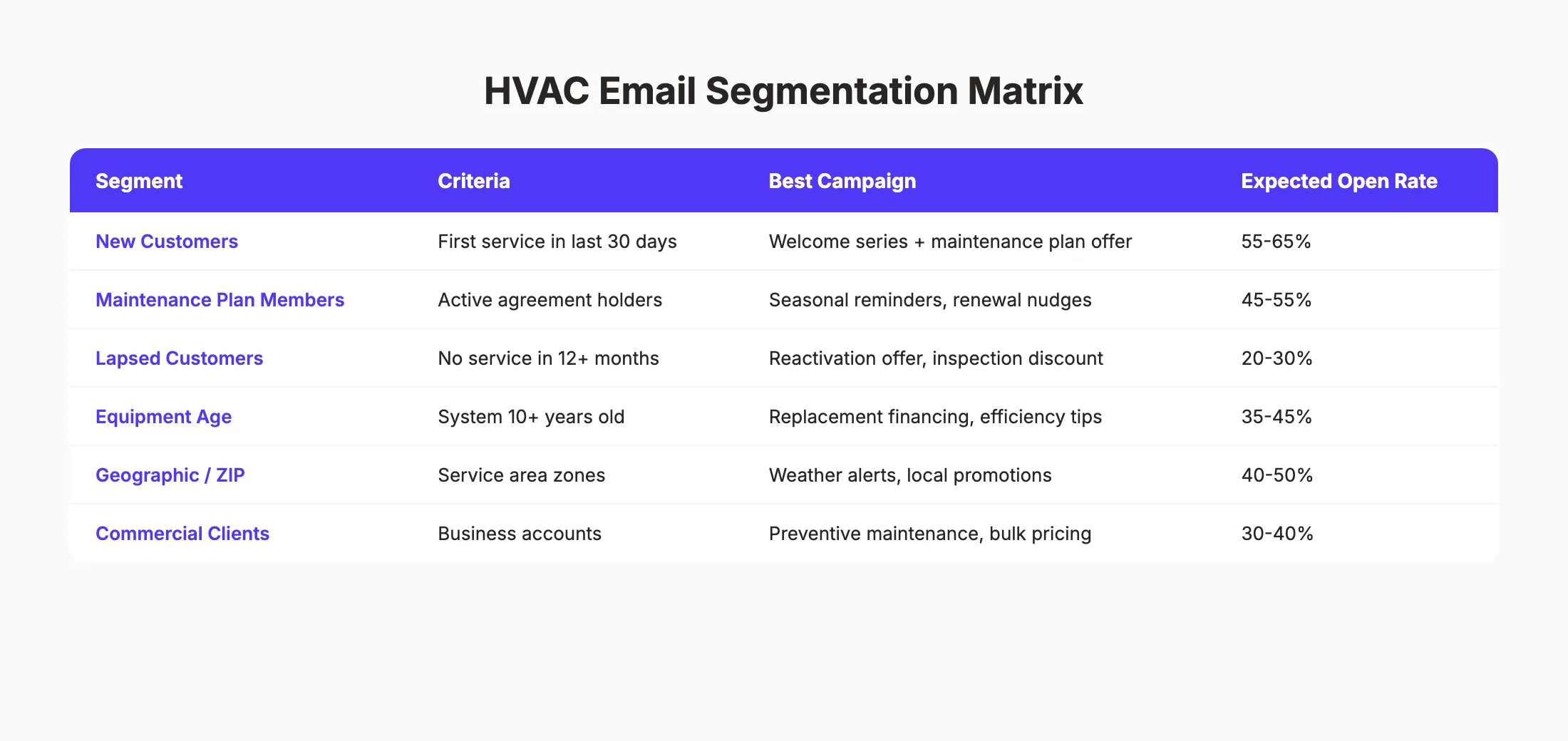
New customers (first service in last 30 days). Send your welcome series. Introduce maintenance plans. Educate them about seasonal service needs.
Maintenance plan members. These are your highest-value subscribers. Send seasonal reminders, renewal notices, and exclusive member-only offers. Treat them differently than one-time customers.
Lapsed customers (no service in 12+ months). Send reactivation campaigns. Offer discounts or free inspections. The longer they stay inactive, the harder they are to win back.
Equipment age segments. If you track system installation dates, you own a goldmine. A customer with a 15-year-old AC unit is a prime candidate for replacement financing emails. A customer with a 2-year-old system needs filter reminders instead.
Geographic segments. Group subscribers by ZIP code. This enables weather-triggered sends, local promotions, and area-specific service availability updates. Understanding your buyer personas helps you refine these segments further.
Commercial versus residential. Commercial clients need different messaging, pricing, and service schedules. Separate them into their own segment.
How to Collect Segmentation Data
Your CRM or field service software already contains most of this data. Service dates, equipment details, and customer addresses are all captured during standard operations.
Add 1 to 2 optional fields to your email signup forms. Ask for property type (residential or commercial) and how they heard about you. Keep forms short. Every additional field reduces signup rates by 10% to 15%.
Segmentation Mistakes to Avoid
Too many segments. Start with 3 to 4 segments. Add more as your list grows past 1,000 subscribers. Over-segmenting a small list creates groups too tiny to measure.
Static segments. Update segments automatically based on customer behavior. A “new customer” should move to “active customer” after 90 days without manual intervention.
Ignoring engagement data. Track who opens and clicks. Subscribers who open every email are your best candidates for premium offers. Subscribers who never open need a re-engagement campaign or removal.
Writing HVAC Emails That Get Opened and Clicked {#writing-emails}
The average inbox receives 121 emails per day. Your HVAC email competes with work messages, promotions, and newsletters. Subject lines determine whether you get read or deleted.
Subject Line Formulas That Work
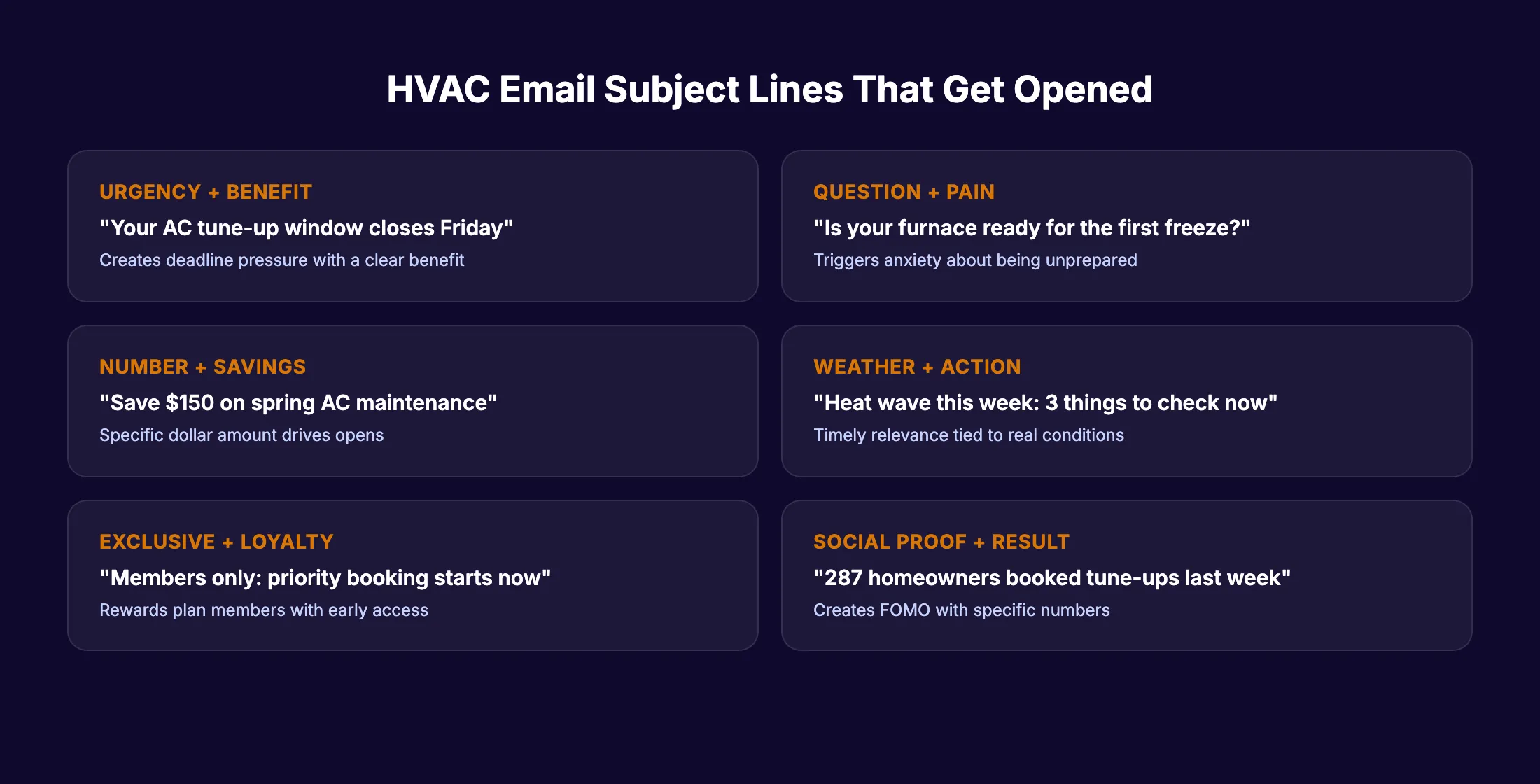
Keep subject lines under 50 characters. Mobile devices cut off anything longer. Use these proven formulas:
Urgency + benefit: “Your AC tune-up window closes Friday”
Question + pain point: “Is your furnace ready for the first freeze?”
Number + savings: “Save $150 on spring AC maintenance”
Weather + action: “Heat wave this week: 3 things to check now”
Exclusive + loyalty: “Members only: priority booking starts now”
Social proof + result: “287 homeowners booked tune-ups last week”
Test 2 subject lines per campaign. Send version A to 20% of your list and version B to another 20%. Send the winner to the remaining 60%. Most email marketing tools for local businesses include built-in A/B testing.
Email Body Best Practices
Lead with the benefit. Do not open with “Hi [Name], we hope you are having a great week.” Open with what they get: “Your AC tune-up saves you $300 in summer repairs.”
One email, one goal. Every email should have a single call to action. Do not ask them to book a tune-up, leave a review, and refer a friend in the same message.
Keep it short. Body text should stay under 200 words for promotional emails. Educational emails can stretch to 400 words. Anything longer loses attention. The same principles from SEO copywriting apply to email.
Use images sparingly. One hero image is enough. Too many images trigger spam filters and slow load times on mobile. Nearly 60% of emails are opened on mobile devices.
The Anatomy of a High-Converting HVAC Email
| Element | Best Practice | Why It Matters |
|---|---|---|
| Subject line | Under 50 characters, benefit-driven | Determines open rate |
| Preview text | Extends the subject line hook | Visible in inbox on mobile |
| Hero image | One branded image, under 100 KB | Visual anchor, fast load |
| Body copy | 100-200 words, one main point | Respects reader time |
| CTA button | One button, action verb, contrasting color | Drives the click |
| Footer | Unsubscribe link, company address, phone | CAN-SPAM compliance |
Publish content that brings new leads to your list every month. Blog SEO and email marketing work together to grow your HVAC business. Start for $1 →
HVAC Email Automation: Set It and Forget It {#automation}
Manual email sends do not scale. A busy HVAC company cannot remember to email every customer at the right time. Automation handles this by triggering emails based on customer actions, dates, or conditions.
What Email Automation Looks Like
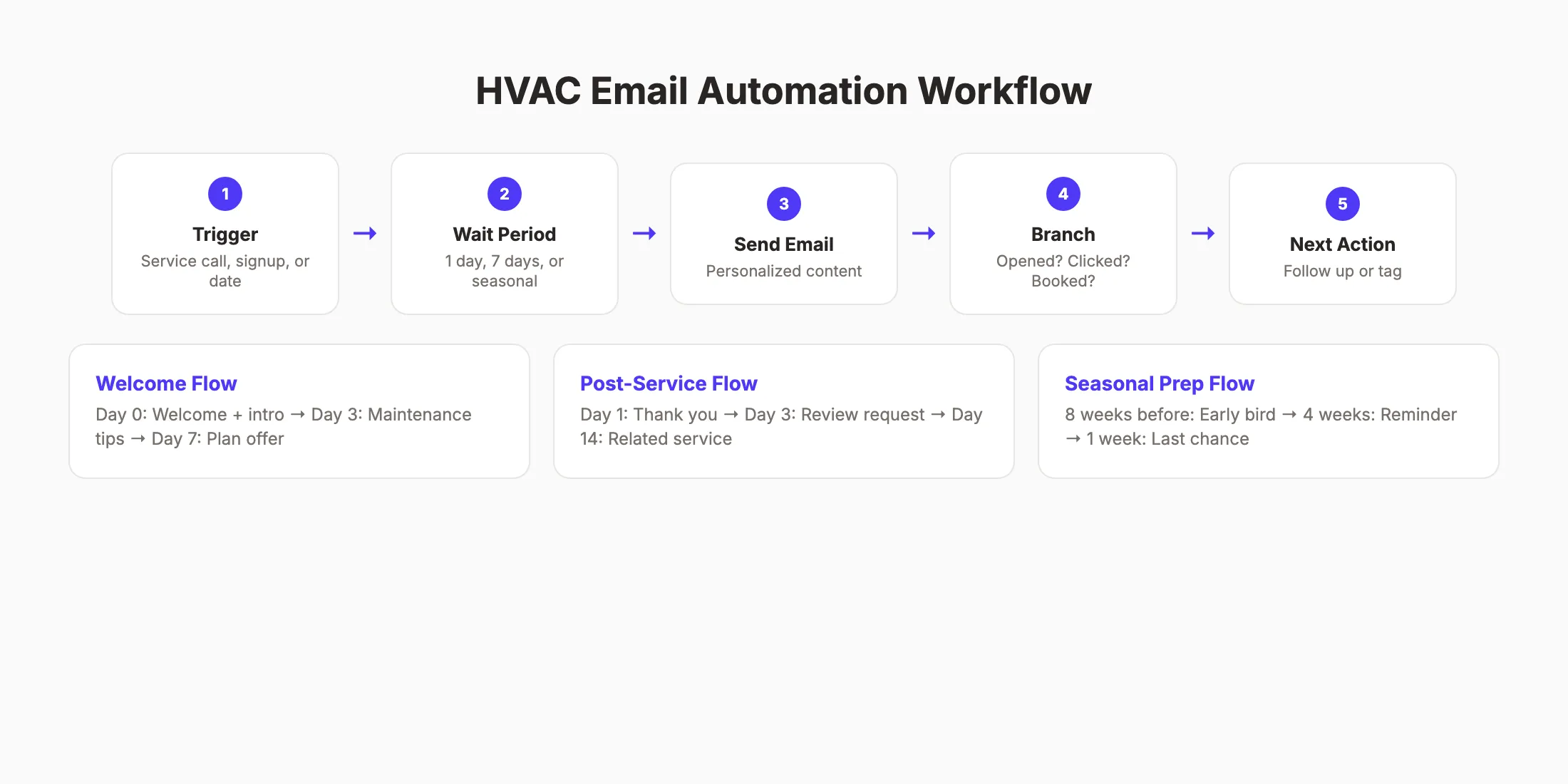
An automated workflow has 5 components:
- Trigger: The event that starts the sequence. A new customer signup, a completed service call, or a calendar date.
- Wait period: The delay between the trigger and the first email. Anywhere from 1 hour to 8 weeks.
- Email send: The automated message, personalized with the customer name, service history, or location.
- Branch logic: What happens based on the response. Did they open? Did they click? Did they book?
- Next action: Send a follow-up, add a tag, or move them to a different segment.
5 Automations Every HVAC Company Should Run
Welcome flow. Trigger: new customer added to list. Sequence: 3 emails over 7 days. Goal: introduce your company and pitch a maintenance plan.
Post-service flow. Trigger: service call completed. Sequence: thank-you (day 1), review request (day 3), related service suggestion (day 14). This flow generates reviews on autopilot.
Seasonal prep flow. Trigger: calendar date (March 1 for AC, September 1 for heating). Sequence: early-bird offer, reminder, last chance. Goal: fill your seasonal schedule before peak demand.
Maintenance renewal flow. Trigger: 60 days before contract expiration. Sequence: 3 reminders with escalating urgency. Goal: retain recurring revenue.
Reactivation flow. Trigger: 12 months since last service. Sequence: “We miss you” email, discount offer, final outreach. Goal: recover lapsed customers before they choose a competitor.
Choosing the Right Email Platform
For HVAC companies, the right platform depends on your list size and budget. Small shops with fewer than 500 contacts can start with Mailchimp or MailerLite. Growing companies benefit from ActiveCampaign or Drip for deeper automation.
Key features to look for:
- Visual automation builder
- CRM integration (ServiceTitan, Housecall Pro, Jobber)
- SMS + email in one platform
- A/B testing for subject lines
- Deliverability reporting
Our best email marketing tools for local businesses guide compares 11 platforms with pricing and feature breakdowns.
Automation Mistakes to Avoid
Sending too frequently. Two to 4 emails per month is the sweet spot for HVAC. More than that and unsubscribe rates spike. Less than once per month and subscribers forget who you are.
No sunset policy. Remove subscribers who have not opened an email in 6 months. Dead weight on your list hurts deliverability for everyone else.
Skipping the test send. Always send a test email to yourself before activating any automation. Check links, images, personalization tokens, and mobile rendering.
Measuring HVAC Email Marketing Results {#measuring-results}
What gets measured gets improved. Track these 6 metrics monthly to know whether your HVAC email marketing program is working.
The 6 KPIs That Matter
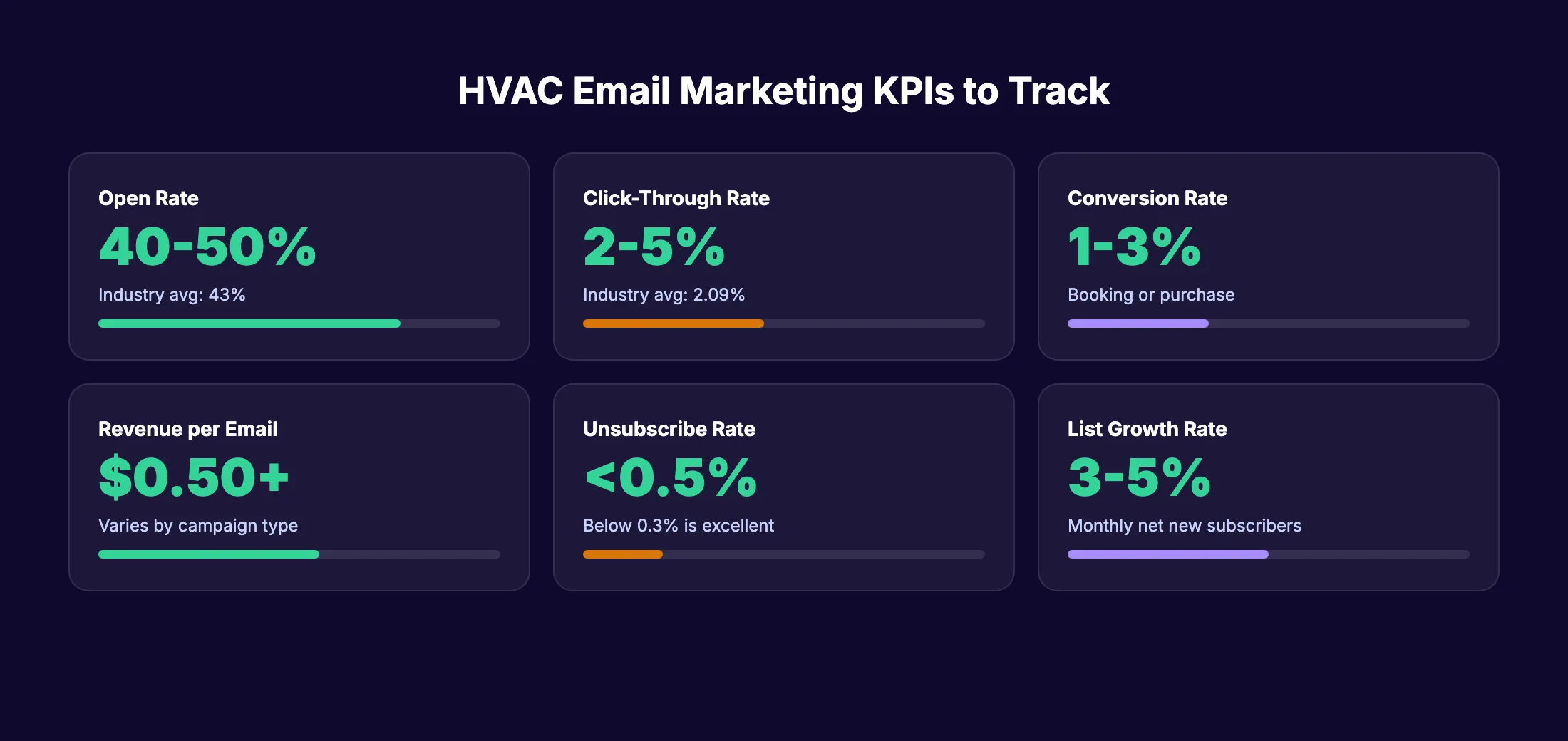
Open rate. The percentage of recipients who open your email. Target 40% to 50% for HVAC. The industry average sits at 43%. Note that Apple Mail Privacy Protection inflates open rates. Use click-through rate as your more reliable metric.
Click-through rate (CTR). The percentage of recipients who click a link. Target 2% to 5%. The industry average is 2.09%. If your CTR falls below 1.5%, your content or CTA needs work.
Conversion rate. The percentage of clickers who book a service or complete the desired action. Track this by adding UTM parameters to every email link. A 1% to 3% conversion rate is solid for service businesses.
Revenue per email. Divide total revenue attributed to email by total emails sent. This tells you the dollar value of every send. Track it monthly and by campaign type.
Unsubscribe rate. Keep this below 0.5% per campaign. Below 0.3% is excellent. A spike above 1% signals a content or frequency problem.
List growth rate. Net new subscribers minus unsubscribes and bounces, divided by total list size. Target 3% to 5% monthly growth. Our guide on content marketing statistics includes benchmarks for related channels.
How to Calculate Email Marketing ROI
Use this formula:
ROI = (Revenue from email - Cost of email marketing) / Cost of email marketing x 100
Example: Your email platform costs $79 per month. You attribute $4,200 in bookings to email campaigns in March. Your ROI is ($4,200 - $79) / $79 x 100 = 5,216%.
Track attribution with unique promo codes, dedicated booking links, or by asking “How did you hear about this offer?” during scheduling. For a deeper dive into measuring marketing returns, read our content ROI guide.
Monthly Email Marketing Checklist for HVAC
- Review open rates and CTR for all campaigns sent
- Check list growth (new subscribers minus unsubscribes)
- Clean bounced and invalid addresses
- Plan next month campaigns based on seasonal needs
- A/B test at least 1 subject line
- Review automation performance (completion rates, drop-off points)
- Update segments based on recent customer activity
- Verify CAN-SPAM compliance on all templates
Connecting Email to Your Broader Marketing Strategy
Email does not work in isolation. The strongest HVAC marketing strategies combine email with SEO for local visibility, social media for brand awareness, and content marketing for lead generation.
Each channel feeds the others. Blog posts bring organic traffic. Pop-ups on those posts capture email subscribers. Email campaigns drive repeat business and reviews. Reviews boost your local search rankings. That compounding effect is what we call the Content Compound Effect.
Get blog content, local SEO, and social media posts published every month. Combine email marketing with consistent content to grow your HVAC business. Start for $1 →
Frequently Asked Questions {#faq}
How often should an HVAC company send marketing emails?
Two to 4 emails per month works best for most HVAC companies. Send weekly during peak booking seasons (March through May and September through November). Drop to twice monthly during summer and winter when service demand naturally peaks. Research from our blog frequency study shows that consistent publishing frequency matters more than volume.
What is a good open rate for HVAC email marketing?
Target 40% to 50% for a well-maintained list. The industry average across all sectors is 43%. Welcome emails perform highest at 83%. Seasonal tune-up reminders typically hit 35% to 45%. If your open rate falls below 25%, clean your list and improve your subject lines.
How many email subscribers does an HVAC company need to see results?
You can see meaningful results with as few as 200 engaged subscribers. A list of 200 customers with a 40% open rate and 3% conversion rate produces roughly 2 to 3 bookings per campaign. Scale from there. Most HVAC companies reach 500 to 1,000 subscribers within their first year of active list building.
What is the best email marketing platform for HVAC companies?
Mailchimp and MailerLite work well for companies with fewer than 500 subscribers and basic needs. ActiveCampaign is the best option for HVAC companies that want advanced automation, CRM integration, and behavioral triggers. ServiceTitan Marketing Pro is built specifically for home service companies but costs more. Our full comparison of email marketing tools for local businesses covers 11 platforms.
Can HVAC companies use email marketing without a website?
Yes, but results will be limited. You can collect emails manually and send campaigns through any email platform. A website with a blog dramatically improves list growth through organic search traffic. Learn how to build an online presence for your local business to maximize your email marketing results.
Is email marketing compliant with spam laws for HVAC businesses?
Yes, as long as you follow CAN-SPAM requirements. Every email must include your physical business address, a clear unsubscribe link, and accurate header information. Never add customers to your list without permission. Penalties for CAN-SPAM violations can reach $51,744 per email.
Email marketing for HVAC companies is not optional in 2026. It is the most cost-effective way to retain customers, fill slow seasons, and generate repeat bookings. Start with your existing customer list, set up 2 to 3 automated workflows, and build from there. The companies that email consistently outperform the ones relying on ads alone.
Related Tools & Resources
Free SEO Tools:
Best Lists:

Written by
Siddharth GangalSiddharth is the founder of theStacc and Arka360, and a graduate of IIT Mandi. He spent years watching great businesses lose organic traffic to competitors who simply published more. So he built a system to fix that. He writes about SEO, content at scale, and the tactics that actually move rankings.
30 SEO blog articles published every month
Keyword-optimized, scheduled, and live on your site. Automatically.
30-day trial · Cancel anytime
theStacc
Stop writing SEO content manually
30 blog articles, 30 GBP posts, and social media content. Published every month. Automatically.
Start Your $1 Trial$1 for 3 days · Cancel anytime