Share of model visibility explained: how often an AI assistant mentions your brand versus competitors, how to measure it, and what moves the number.
Google rankings tell you where your website appears in search results. Share of model visibility tells you how often AI engines mention your brand when answering questions in your category.
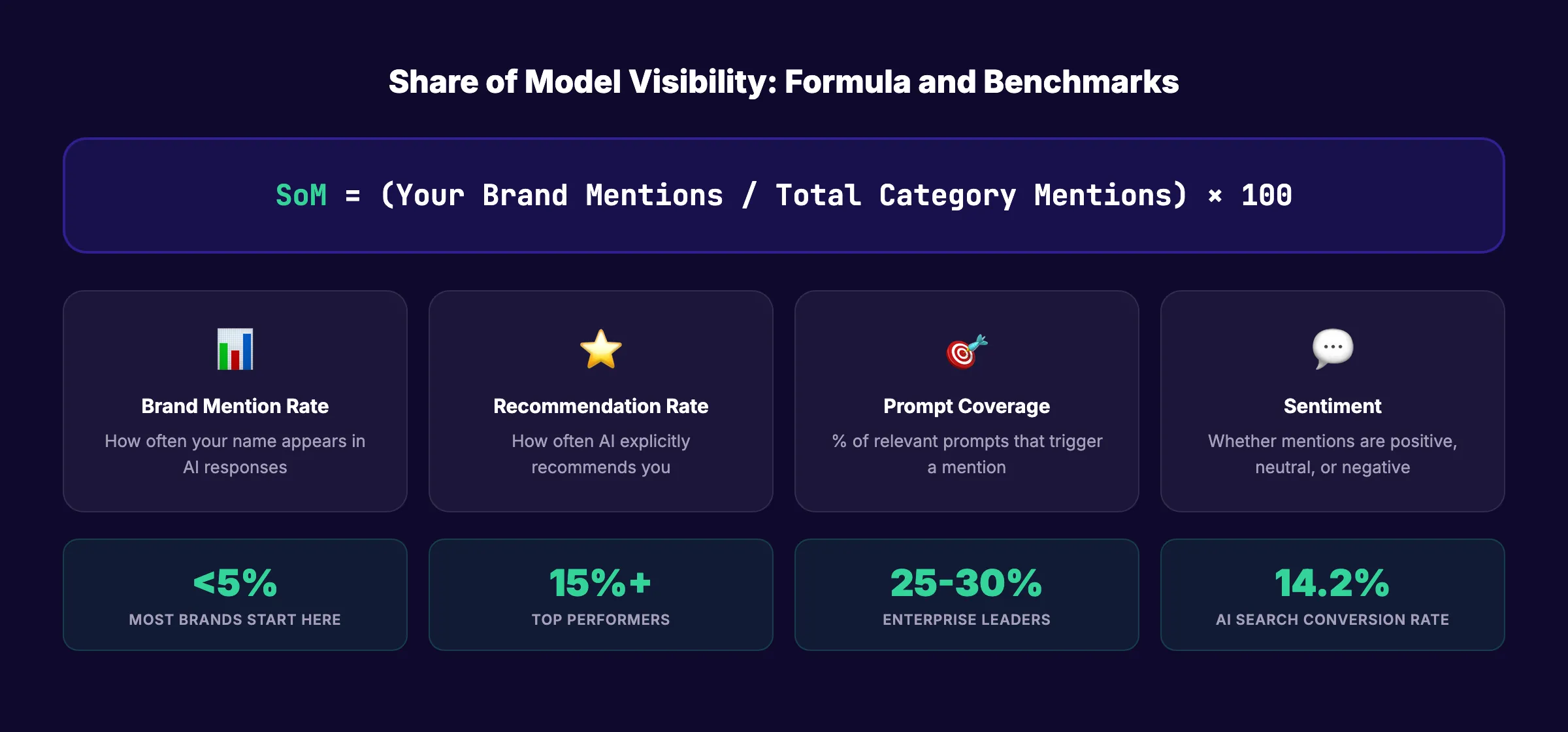
This is the metric that separates brands winning in AI search from brands that are invisible. AI search traffic converts at 14.2% compared to 2.8% for traditional Google searches. That is 5x higher. But if AI engines do not mention your brand, that traffic goes to competitors.
Share of model visibility is the headline GEO metric for 2026. Here is everything you need to know about it.
What Is Share of Model Visibility?
Share of model visibility is the percentage of AI-generated responses that mention your brand when users ask questions relevant to your industry or product category.
Think of it as share of voice for the AI era. Traditional share of voice measures how much of the advertising or search conversation your brand owns. Share of model measures how much of the AI conversation your brand owns.
The concept was coined in 2024 by Jack Smyth, Chief Solutions Officer at Jellyfish (The Brandtech Group). Tom Roach at the same company mapped the evolution in Marketing Week:
Share of Market → Share of Voice → Share of Search → Share of Model
Each step represents how brands measure visibility as the discovery channel shifts. Share of model is the latest step. It reflects the reality that millions of people now ask ChatGPT, Gemini, Perplexity, and Claude for recommendations instead of searching Google.
Key point: Share of model visibility is the single best indicator of whether your brand exists in the AI discovery process.
Why Share of Model Visibility Matters
When a potential customer asks ChatGPT "What is the best SEO service for small businesses?" and your brand is not in the response, you do not exist in that customer's decision. There is no page 2 to scroll to. There is no ad to run. If the AI does not mention you, you are invisible.
Three reasons this metric matters now:
1. AI search is growing fast. ChatGPT alone has 900 million weekly active users. AI chatbot traffic grew 81% year-over-year in 2025. This is not a niche channel.
2. Conversion rates are higher. AI-referred visitors convert at twice the rate of traditional search visitors in one-third the sessions. The traffic is smaller but far more valuable.
3. Zero-click behavior dominates. Most AI users accept the response without clicking through to any website. If the AI does not mention your brand in the answer, you miss the entire impression. There is no click to win back later.
The bottom line: Brands that ignore share of model visibility are giving away market share to competitors who show up in AI responses.
Your SEO team. $99 per month. SEO-scored articles, planned, written and published automatically. Every piece built for Google and AI search engines.
How Share of Model Visibility Works
The Formula
The calculation is straightforward:
Share of Model = (Your brand mentions / Total brand mentions in category) × 100
For example, if you ask 100 category-relevant questions to ChatGPT and your brand appears in 15 responses while all competitors combined appear in 100 total mentions, your share of model is 15%.
What Gets Measured
Share of model tracks 4 components across AI platforms:
| Component | What It Measures |
|---|---|
| Brand Mention Rate | How often your brand name appears in AI responses |
| Recommendation Rate | How often the AI explicitly recommends your brand |
| Prompt Coverage | What percentage of relevant prompts trigger a mention of your brand |
| Sentiment | Whether mentions are positive, neutral, or negative |
Platform Differences Matter
Each AI engine behaves differently. Do not aggregate into a single blended score. Track each platform separately.
- Claude mentions brands in 97.3% of responses (highest rate)
- Perplexity has the lowest brand mention rate but includes external links in over 77% of responses
- ChatGPT includes links in approximately 31% of responses but drives 87.4% of all AI referral traffic
- Gemini pulls from Google's index and favors brands that rank well in traditional search
Your share of model on ChatGPT may differ significantly from your share on Perplexity or Claude. Each platform weighs different authority signals. Read our Gemini vs ChatGPT search comparison for platform-specific details.
Best Practices for Improving Share of Model Visibility
Build cross-platform brand authority. AI engines trust brands that appear across multiple authoritative platforms. Maintain consistent, accurate profiles on LinkedIn, Crunchbase, industry directories, and your website. Distributing content across publications increases AI citations by up to 325%.
Publish data-rich, citable content. AI engines cite content with specific statistics, original research, and expert insights. Include named data points with source links in every article. Read our guide on getting cited in AI search for the full strategy.
Implement structured data. Organization, Product, and FAQ schema markup gives AI engines machine-readable facts about your brand. The sameAs property connects your entity across platforms. Conductor's benchmarks confirm that structured data and tables significantly boost share of model.
Allow AI crawlers. If GPTBot, ClaudeBot, and PerplexityBot cannot access your content, your share of model drops to zero on those platforms. Check your robots.txt configuration. Read our AI crawlers guide for setup details.
Maintain content freshness. 83% of AI citations come from content updated within 12 months. Stale content loses share of model over time. Update regularly.
Common Mistakes to Avoid
- Measuring only one AI platform. ChatGPT, Gemini, Claude, and Perplexity all weight different signals. A brand with high share on ChatGPT may have zero share on Perplexity. Track all major platforms separately.
- Confusing share of model with traditional SEO rankings. High Google rankings do not guarantee high share of model. Fewer than 10% of sources cited by ChatGPT rank in Google's top 10. These are separate metrics that require separate optimization. See our GEO vs AEO vs SEO comparison for the differences.
- Running too few test queries. A single query gives an unreliable snapshot. AI responses vary between sessions. Run 50+ category-relevant prompts across all platforms to establish a reliable baseline. Repeat monthly.
Share of Model Visibility and theStacc
Every article theStacc publishes is optimized for both traditional search and AI citation. We structure content with statistics, schema markup, and E-E-A-T signals that increase your brand's share of model across ChatGPT, Gemini, and Perplexity. 30 articles per month means 30 new citation opportunities for AI engines every month.
3,500+ blogs published. Every article is SEO-scored before publish. See what theStacc can do for your site.
Learn More
Related topics:
- What Is GEO? Generative Engine Optimization Explained
- How to Get Cited in AI Search
- Track AI Search Visibility
- GEO vs AEO vs SEO: The Complete Guide
- Organic Search vs AI Search: Budget Focus
What practitioners are saying on X
AI search advice ages quickly. Here is high-signal public discussion from SEO and growth operators — context for your roadmap, not a substitute for primary data.
- @jakezward (Feb 2026): 2026 SEO predictions emphasize AI Overview share-of-SERP, schema for LLM token efficiency, brand mentions in AI answers as a KPI, proprietary data as a moat, and content refresh beating net-new AI slop. See the post on X.
- @alexgroberman (Jul 2026): Case narrative: organic value plus multi-engine citations (ChatGPT, Perplexity, Grok) from knowledge-hub pages, category authority links, commercial intent content, and tight internal linking — not thin product copy. See the post on X.
- @varunram (Jul 2026): Critique of GEO slopfarm products that combine SEO clickbait with unresearched content marketing — quality and research still separate winners from farms. See the post on X.
Grok, AI Overviews, and multi-engine visibility
For topics covered in “share of model visibility”, multi-engine visibility still starts with clear definitions, sourced statistics, and extractable section answers. Grok additionally factors live X discussion — keep public claims consistent with this page.
- Google AI Overviews: Use passage-ready answers and structured data.
- ChatGPT / Perplexity: Cite named sources next to key claims.
- Grok: Maintain accurate entity facts on-site and in high-signal X posts.
Publish content built for Google and AI citations. theStacc’s Content SEO module ships SEO-scored articles structured for rankings and generative engines — including clearer entity pages models like Grok can quote.
How to measure multi-engine visibility in 2026
Split KPIs across classic search, AI Overview citations, chat referrals, and Grok-ready brand accuracy.
- GSC: non-brand clicks and query annotations.
- Citations: named in AI answers?
- Referrals: ChatGPT / Perplexity in GA4.
- Grok: on-site claims match public X discussion.
FAQ
Share of model visibility is the metric that defines whether your brand exists in the AI discovery process. As AI search grows, brands with higher share of model will capture more high-intent traffic while competitors remain invisible. Start tracking it now.
Sources & references
- [1] Princeton / Georgia Tech et al. — GEO research (arXiv:2311.09735)
- [2] @jakezward on X — 2026 SEO predictions emphasize AI Overview share-of-SERP, schema for LLM token efficiency, brand mentions in AI answers
- [3] @alexgroberman on X — Case narrative: organic value plus multi-engine citations (ChatGPT, Perplexity, Grok) from knowledge-hub pages, category
- [4] Referenced source — www.airops.com

Plan topics, review article drafts, and publish to a connected CMS.
Weekly local SEO teardowns
One practical email a week. Map Pack, GBP, AI Overviews — no fluff. Unsubscribe anytime.