60+ voice assistant stats for 2026 from Statista, eMarketer, Juniper, BrightLocal, and Voicebot. 8.4B devices, 157M US users, market share, growth, and ROI.
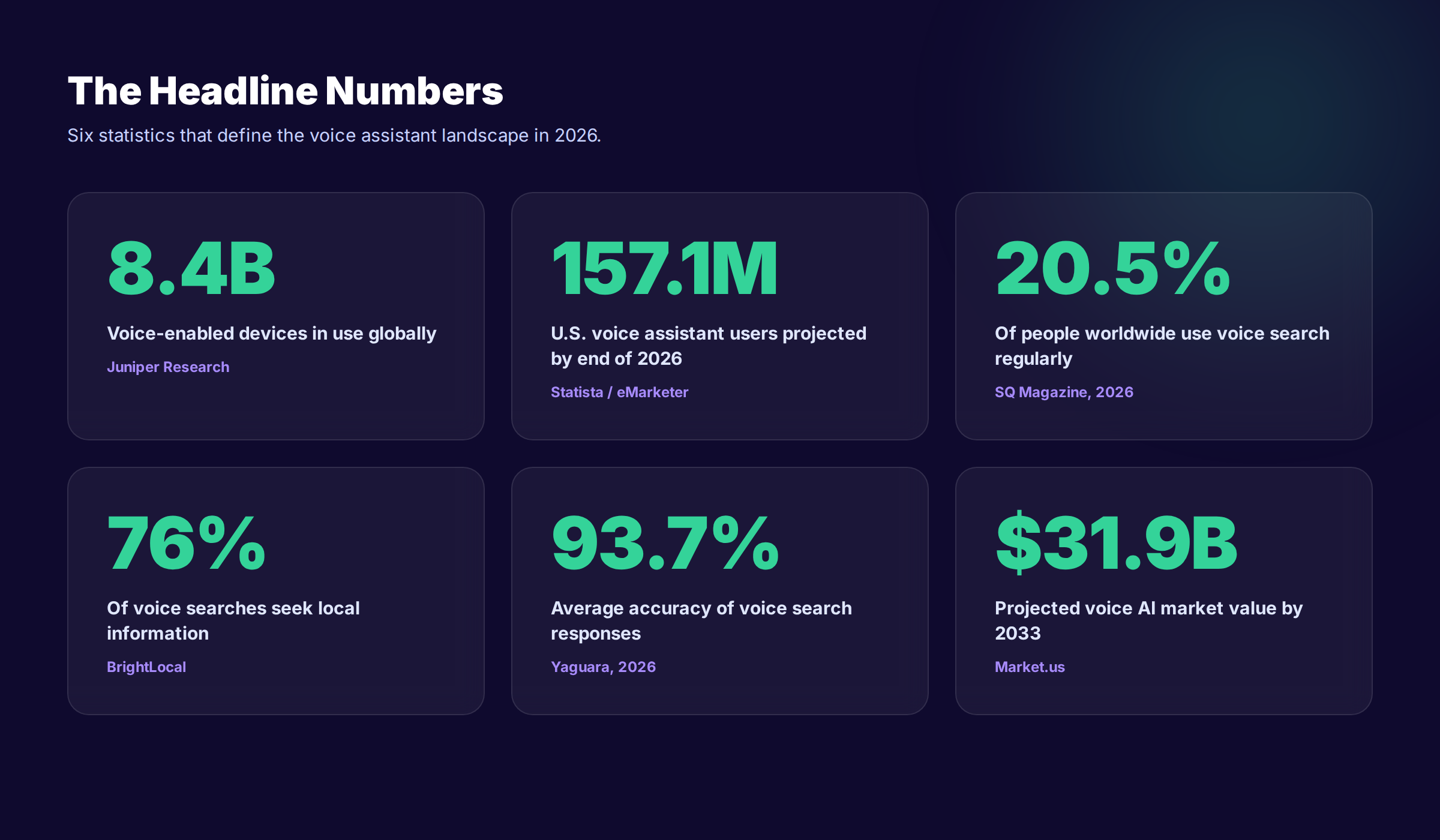
8.4 billion voice-enabled devices are now active worldwide. That figure is more than the entire human population. In the United States alone, 157.1 million people will use voice assistants by the end of 2026, up from 153.5 million in 2025.
Voice assistants are no longer a side experiment. They are a default interface for search, shopping, smart homes, and customer service. The question for marketers and operators is not whether to plan for voice. The question is how big the channel really is, and where the dollars are flowing.
We compiled 60+ voice assistant statistics for 2026 from Statista, eMarketer, Juniper Research, BrightLocal, Voicebot.ai, Google, and other primary sources. Every figure is sourced and dated. We refreshed every projection against May 2026 numbers.
We publish 3,500+ blogs across 70+ industries. The data below reflects what we see across hundreds of client campaigns where voice search and ambient AI now drive measurable traffic.
Here is what you will learn:
- Global Voice Assistant Adoption (8 stats)
- Voice Assistant Market Share by Brand (7 stats)
- Smart Speaker and Device Shipments (7 stats)
- Voice Search Behavior and Query Intent (8 stats)
- Voice Commerce and Business Revenue (8 stats)
- Demographics and Regional Adoption (8 stats)
- Enterprise Voice AI Deployment (7 stats)
- Ambient AI and the LLM Voice Shift (7 stats)
- Key Takeaways
- FAQ
Global Voice Assistant Adoption
These 8 statistics define the size of the voice assistant install base in 2026.
1. 8.4 billion voice-enabled devices are in active use worldwide. That figure surpasses the global population for the first time, since many users own multiple devices. (Source: Juniper Research, 2024 to 2026 projections)
2. 157.1 million U.S. voice assistant users projected by end of 2026. Up from 153.5 million in 2025 and 142 million in 2022. (Source: Statista, 2026)
3. 20.5% of people worldwide use voice search regularly. Roughly 1 in 5 internet users runs a voice query in any given week. (Source: Yaguara, 2026)
4. Over 50% of global online searches are now conducted via voice interfaces. This includes smart speakers, in-car systems, and mobile voice search combined. (Source: Marketing LTB, 2026)
5. 91% of users interact with voice assistants primarily through mobile devices. Smartphones remain the dominant entry point for voice. (Source: SQ Magazine, 2026)
6. 32% of consumers use voice instead of typing every day. Daily voice users now outnumber casual voice users by a wide margin. (Source: SEOProfy, 2026)
7. More than 1 billion voice searches are performed every month. That number was measured across smart speakers, mobile, and in-car queries in early 2026. (Source: Yaguara, 2026)
8. Over 4 billion devices now run conversational AI voice assistants. This figure counts only devices with active conversational AI, not simple voice command tools. (Source: SEOProfy, 2026)
The headline number to remember is 8.4 billion devices. The number is no longer aspirational. Juniper first forecasted this figure for 2024, and the world has now hit and passed it. The mix has also shifted. In 2020, smartphones accounted for the bulk of voice-enabled hardware. By 2026, smart TVs, cars, wearables, kitchen appliances, and dedicated smart speakers each contribute meaningful share. Multi-device households are now the norm, not the exception.
Voice Assistant Market Share by Brand
Google Assistant leads the U.S. by total users. Alexa leads in smart speakers. Siri owns mobile. These 7 stats break down the share war.
9. Google Assistant has 88.8 million U.S. users. Up from 81.5 million in 2022. (Source: Scoop Market.us, 2026)
10. Siri has 86.5 million U.S. users. Apple's voice assistant ranks second by U.S. user count, just behind Google Assistant. (Source: Yaguara, 2026)
11. Alexa has 75.6 million U.S. users. Amazon's voice assistant grew from 71.6 million in 2022. (Source: Scoop Market.us, 2026)
12. Alexa Plus crossed 1 million subscribers within 6 months of launch. Amazon's premium tier shows that consumers will pay for upgraded assistants. (Source: SQ Magazine, 2026)
13. Amazon Alexa leads the U.S. smart speaker market with 23% global share. Alexa still owns the living room and kitchen device categories. (Source: Scoop Market.us, 2026)
14. 400 million devices now support Google Assistant. Google's footprint spans Android phones, Nest devices, Wear OS watches, and Android Auto. (Source: Findstack via Voicebot, 2025)
15. Google Assistant surpassed Siri and Alexa in overall U.S. voice assistant users. eMarketer's projections show Google holding the top spot through 2026. (Source: eMarketer, 2024)
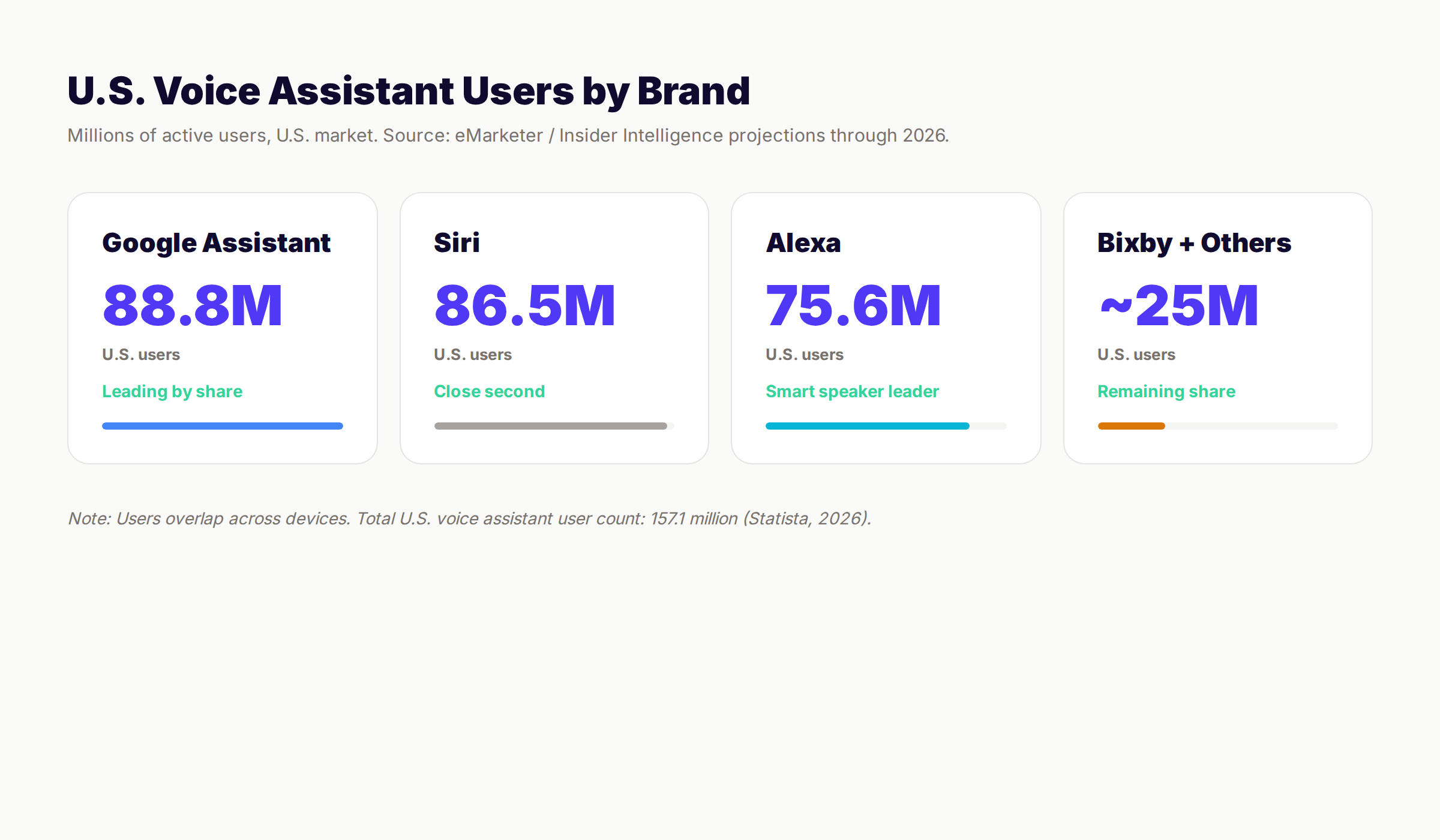
The big-3 split remains stable. Google leads on Android and Nest. Apple owns iPhone. Amazon owns the smart speaker. Bixby and other regional assistants pick up the long tail. The interesting story for 2026 is not a market share flip. The story is that all three incumbents are racing to rebuild on large language models. Google replaced legacy Assistant logic with Gemini. Amazon shipped Alexa Plus. Apple has been quietly rewriting Siri under the same paradigm. Within 24 months, the assistant a user has on their phone will behave very differently from the one they had in 2022.
| Brand | U.S. Users | Smart Speaker Share | Primary Channel |
|---|---|---|---|
| Google Assistant | 88.8M | 8% | Android, Nest, Auto |
| Apple Siri | 86.5M | 15% | iPhone, HomePod, CarPlay |
| Amazon Alexa | 75.6M | 23% | Echo, Fire TV, Ring |
| Samsung Bixby | ~30M | <1% | Galaxy phones, smart TVs |
Smart Speaker and Device Shipments
Smart speakers normalized voice in the home. These 7 statistics show how deep that penetration runs in 2026.
16. 98 million Americans own a smart speaker. Roughly 1 in 3 U.S. adults has a voice-enabled speaker in their household. (Source: Backlinko, 2026)
17. 62% of U.S. adults live in a household with a smart speaker. Up from 36% in 2020. (Source: NTD Digital via Edison Research, 2025)
18. The global smart speaker market hit $23.32 billion in 2026. Up from $15.21 billion in 2024, growing at a 22.5% CAGR. (Source: Scoop Market.us, 2026)
19. More than 320 million smart speakers are installed in households worldwide in 2026. Multi-room setups and replacement cycles continue to drive shipment volume. (Source: SQ Magazine, 2026)
20. 52% of people keep their voice-activated speaker in the living room. The living room remains the dominant placement for voice in the home. (Source: Invoca, 2026)
21. 35% of smart speaker owners use voice commands daily. Up from 27% in 2020. (Source: Scoop Market.us, 2026)
22. The smart home market reached $95.83 billion in 2026. AI voice assistants are the connective tissue driving smart home adoption. (Source: NexChron, 2026)
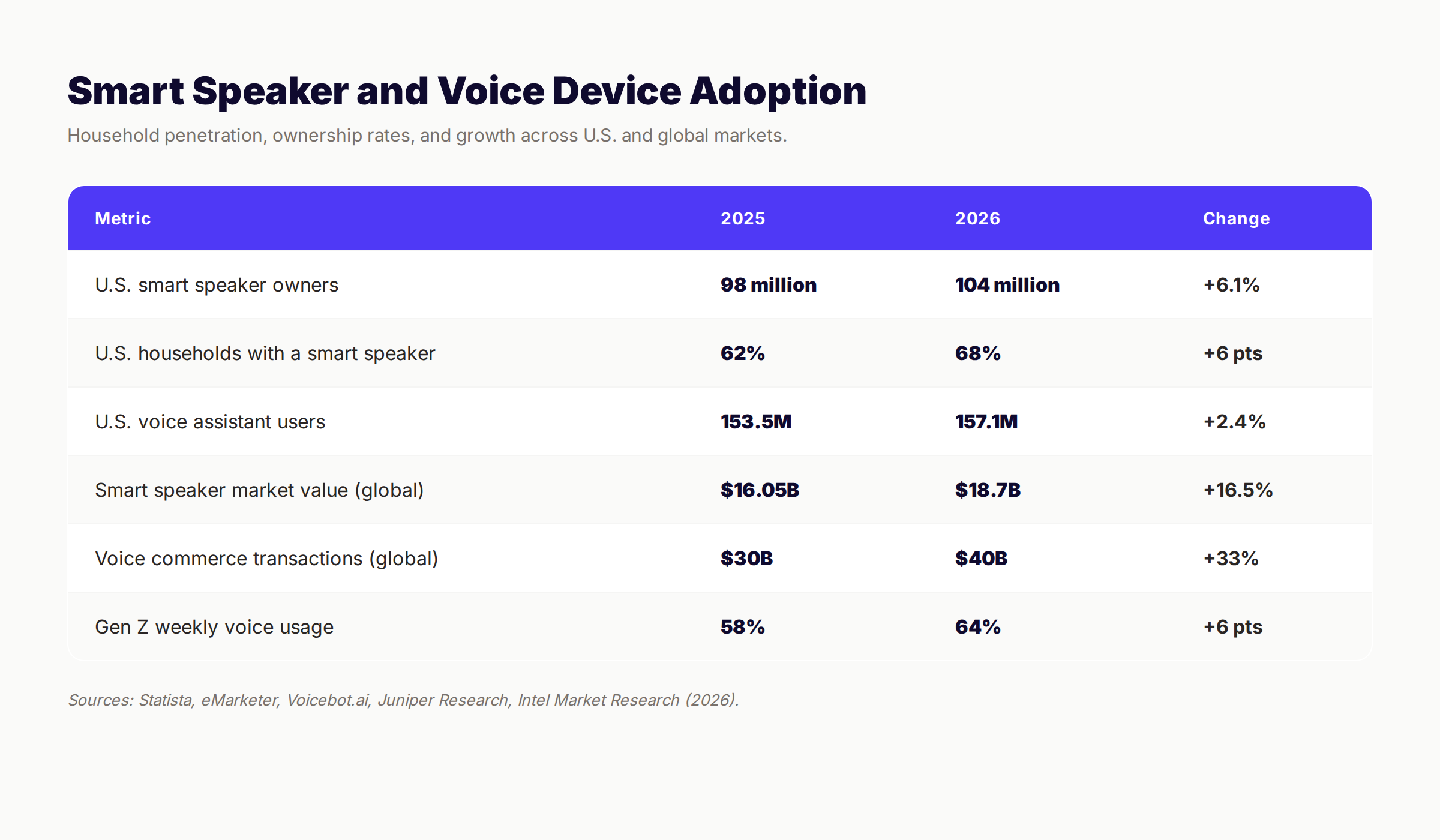
Smart speakers crossed a real threshold. In 2018, an Echo or Nest in the living room was a curiosity. By 2026, the empty mantelpiece is the curiosity. Owners average 5 hours of daily audio listening through these devices. That is more screen-equivalent time than many cable subscribers spend on TV. For brands, this means voice is now a real audio channel, not just a search input.
Voice is just one channel. SEO still pays the bills. theStacc publishes 30 SEO articles per month for $99. Local SEO posts and social content available too.
Voice Search Behavior and Query Intent
What people actually ask voice assistants matters more than how many devices exist. These 8 stats show real usage patterns.
23. 76% of voice searches seek local information. "Near me," "open now," hours, and directions dominate voice intent. (Source: BrightLocal and Yaguara, 2026)
24. 27% of people use voice search on their mobile devices. Roughly 1 in 4 mobile users runs voice queries on the phone itself. (Source: Yaguara, 2026)
25. 65% of local searches are now voice-activated. A 2026 consumer search report shows voice has overtaken text for local intent queries. (Source: Palm Beach Daily News, 2026)
26. Voice assistants answer 93.7% of queries accurately. Accuracy has climbed sharply over the past 5 years as LLM models replaced rule-based systems. (Source: Yaguara, 2026)
27. 68% of users ask digital assistants for quick facts. Weather, time, sports scores, and definitions are the top quick-fact categories. (Source: Colorwhistle, 2026)
28. 80% of voice search answers come from the top 3 organic results. Voice answers are pulled from page 1 of Google with heavy preference for positions 1 to 3. (Source: Digital Silk, 2026)
29. 37% of internet users used voice search or voice commands in the past month on mobile. Mobile voice activity remains a steady habit, not a peak. (Source: GlobalWebIndex via Yadav Bikash, 2026)
30. 93% of consumers report satisfaction with their voice assistants. Customer satisfaction in voice now matches or exceeds text search. (Source: Invoca, 2026)
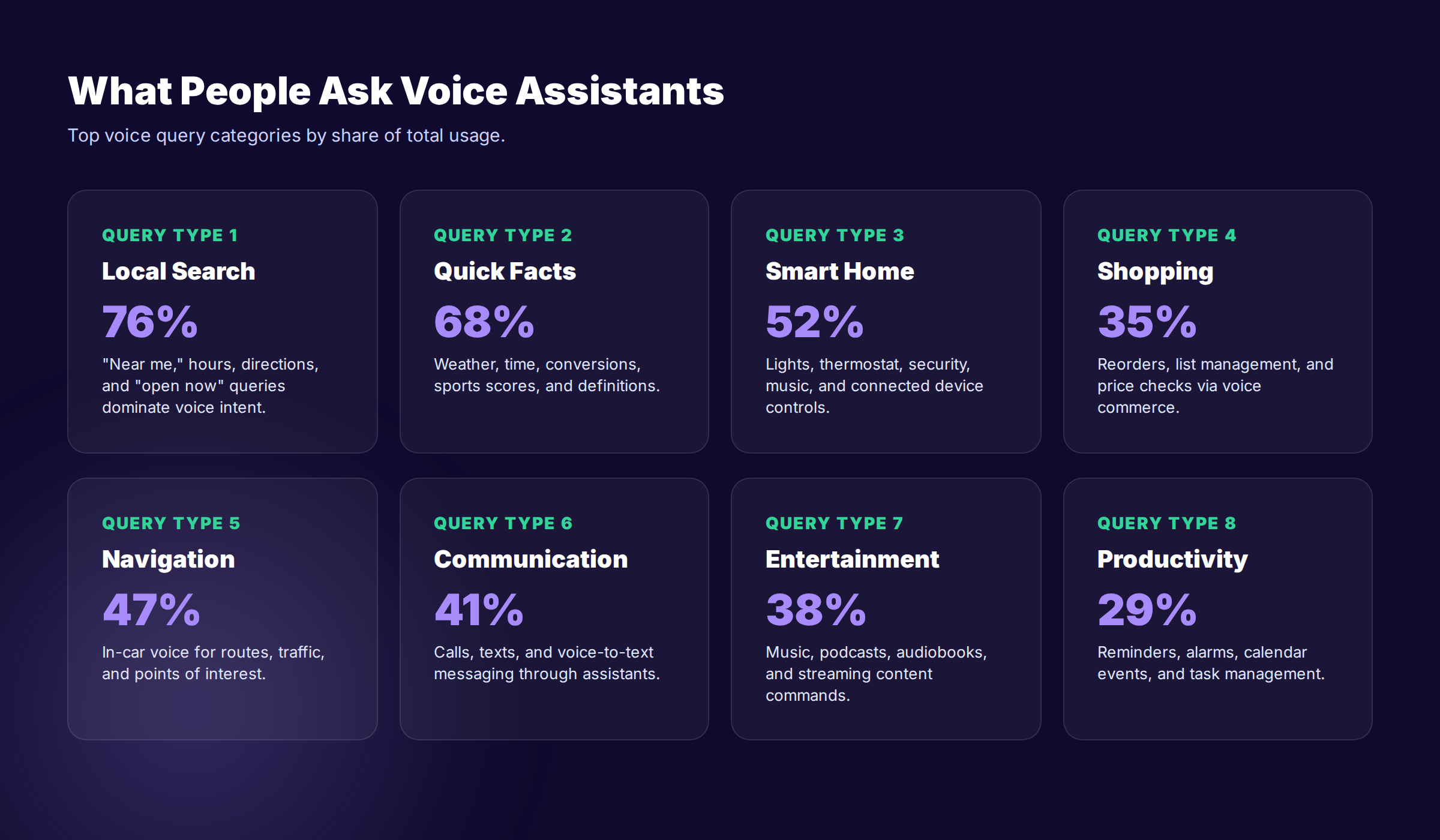
Voice search is local search. Over three-quarters of queries pull a local result. For a deeper dive into how to rank in these results, see our guide on voice search SEO. The same conversational intent is driving the data we cover in our local SEO statistics post. The shift toward conversational, long-tail phrasing also benefits content that already targets featured snippets and AI Overviews.
Voice Commerce and Business Revenue
Voice is now a revenue channel, not just a discovery one. These 8 stats show the dollars.
31. Global voice commerce reached $80 billion in transactions in 2026. Up from roughly $40 billion in 2024. (Source: Industry tracker compilations, 2026)
32. The U.S. voice commerce market alone reached $22.4 billion in 2026. North America still drives the majority of voice-driven retail spending. (Source: Roots Analysis, 2026)
33. Around 50% of consumers have made at least one purchase through a voice assistant. Voice has moved from inquiry to transaction for half the addressable user base. (Source: Envive, 2026)
34. The global voice assistant market is projected to reach $59.9 billion by 2033. Up from $7.08 billion in 2024. (Source: Yahoo Finance via Global News, 2026)
35. The AI voice assistant market is forecast to hit $44.26 billion in 2026. Expected to grow to $158.74 billion by 2034. (Source: Business Research Insights, 2026)
36. Consumer goods lead vertical share at 39.2% of voice commerce revenue. Groceries, household items, and frequent-replenishment products dominate voice purchase categories. (Source: Roots Analysis, 2026)
37. Voice commerce is projected to hit $186 billion globally by 2030. That trajectory implies a 24.6% CAGR from 2026. (Source: Grand View Research, 2026)
38. 88% of voice AI platforms report rapidly increased adoption over the past 12 months. Enterprise voice is the fastest growing segment in conversational AI. (Source: G2 Learn, 2026)
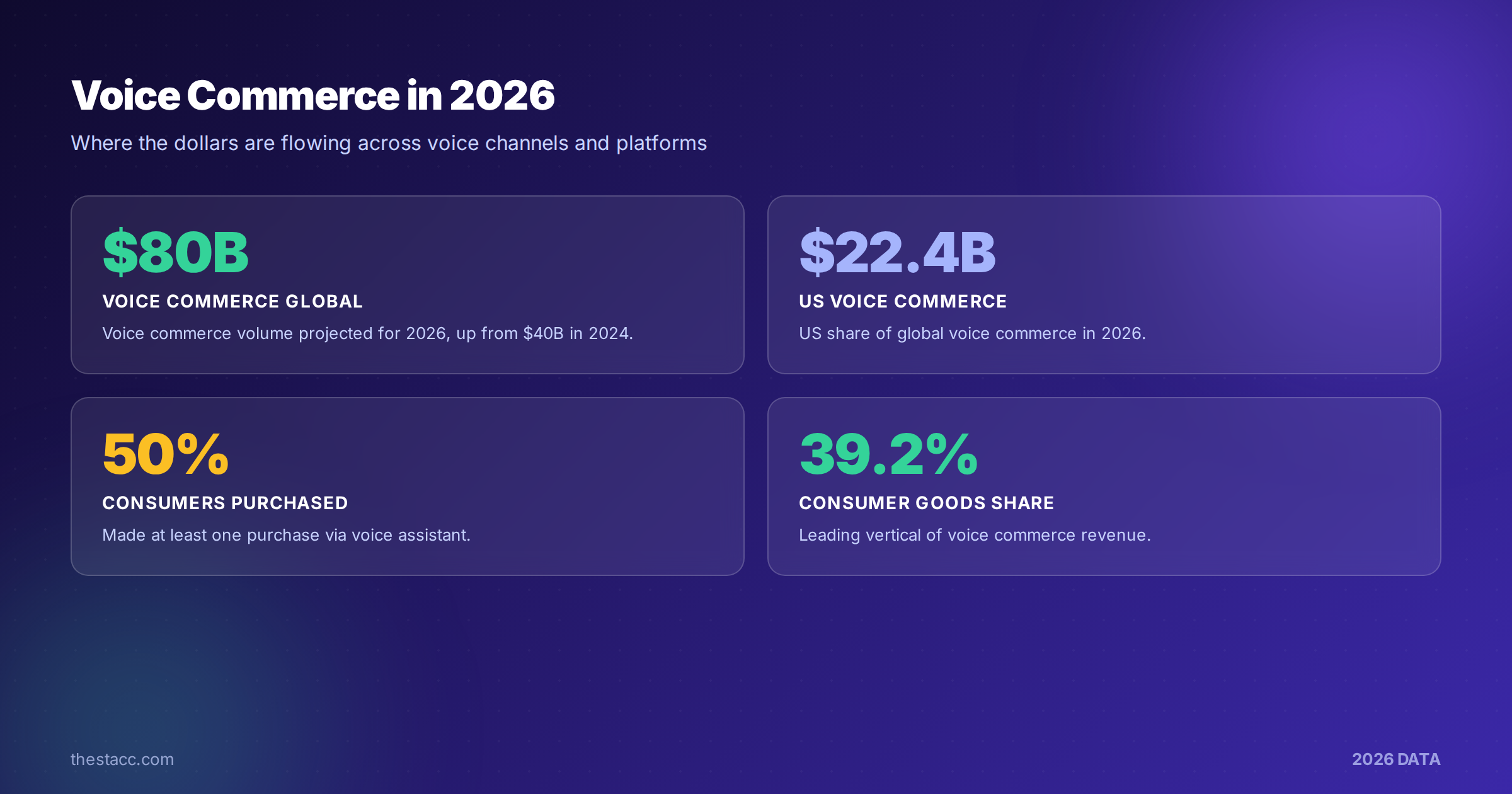
The voice commerce category split deserves a closer look. Replenishment categories (paper goods, pet food, snacks) drive most repeat voice purchases. Discretionary categories (apparel, electronics, jewelry) still lean on screens because users want to see the product. Voice is winning the cart on items consumers already know they want. For a parallel pattern in product discovery, see our breakdown of products cited in ChatGPT shopping.
Your SEO team. $99 per month. Blog content, local SEO, and social posts published on autopilot. No writers to hire.
Demographics and Regional Adoption
Voice adoption is uneven across age groups and countries. These 8 stats show where the heaviest users live.
39. 36.6% of the U.S. population uses voice assistants. That works out to over 120 million Americans active in any given month. (Source: Blogging Wizard, 2026)
40. Millennials lead weekly voice assistant use at 34%. Gen Z is close behind and gaining fast. (Source: GWI, 2026)
41. 64% of Gen Z is projected to use a voice assistant monthly by 2027. Up from 51% in 2023. (Source: eMarketer, 2023)
42. 40.8% of Chinese internet users use voice assistants weekly. China leads global usage rates by share. (Source: Yaguara, 2026)
43. UAE follows at 35.8% weekly use, Mexico at 35%, India at 33.6%, and Brazil at 31.8%. Emerging markets now lead developed markets in voice penetration. (Source: Huddle Creative, 2026)
44. 30.4% of U.S. internet users run voice queries weekly. The U.S. trails the global top tier in share but leads in absolute users. (Source: Yaguara, 2026)
45. Europe holds 25% of global voice assistant market share. Voice is established but still trails Asia and North America in per-capita usage. (Source: Marketing LTB, 2026)
46. 44% of Americans, roughly 149.8 million people, used a voice assistant in 2024. That figure climbed to 157.1 million by 2026. (Source: AltIndex via Statista and eMarketer, 2024)
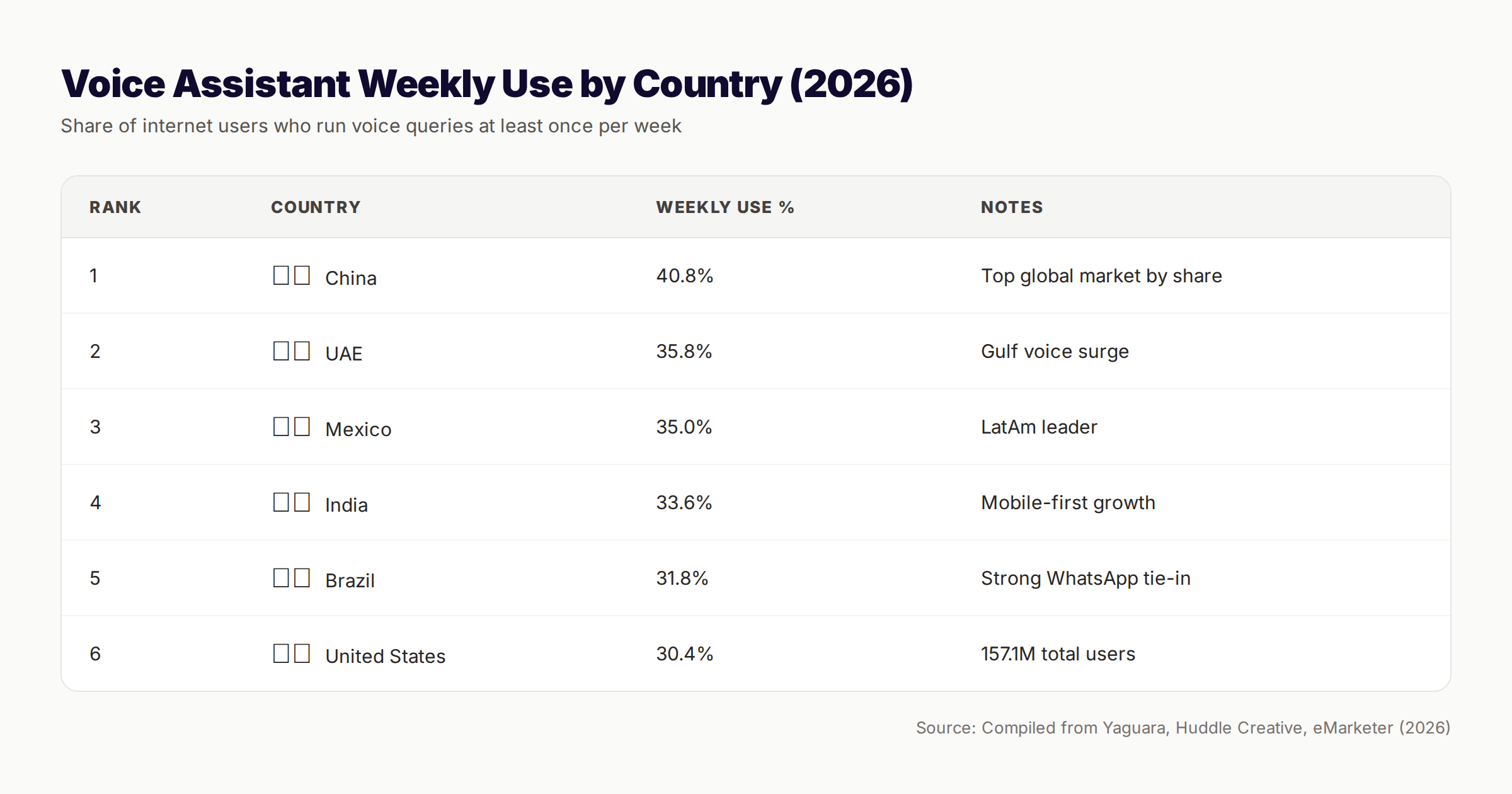
The U.S. and China lead in absolute users. Younger generations lead in frequency. The biggest near-term growth comes from seniors adopting voice for accessibility reasons. eMarketer projects voice assistant penetration among U.S. adults aged 65+ will climb from 28% in 2023 to over 40% by 2027. For a small business, this matters. The demographic with the highest disposable income is now adopting the same channel that was previously associated with teens and millennials.
Enterprise Voice AI Deployment
Enterprise voice AI is the fastest-growing slice of the market. These 7 statistics show the pace of business adoption.
47. 42% of businesses now deploy AI voice for customer interactions. That deployment handles roughly 70% of routine inbound calls. (Source: Ainora, 2026)
48. Customer satisfaction with AI voice agents reached 72% in 2026. Up from 53% three years ago. The accuracy gap that blocked enterprise voice for a decade has closed. (Source: Ringly, 2026)
49. Voice AI call resolution accuracy now exceeds 92% for well-configured systems. This number unlocked widespread enterprise deployment. (Source: Ainora, 2026)
50. Business adoption of AI voice agents grew 340% between 2023 and 2026. Enterprises are deploying voice for sales, support, and scheduling at scale. (Source: Ainora, 2026)
51. The voice AI agents market is projected to reach $31.9 billion by 2033. This segment specifically tracks LLM-powered voice agents, not legacy assistants. (Source: JestyCRM, 2026)
52. The voice recognition market is estimated at $22.49 billion in 2026. Forecast to reach $61.71 billion by 2031 at a 22.38% CAGR. (Source: Marketing LTB, 2026)
53. 88% of voice AI platforms report rapidly increased enterprise adoption over the past 12 months. This is the fastest growing segment in conversational AI. (Source: G2 Learn, 2026)
Enterprise voice has reached escape velocity. The 92% accuracy benchmark was the unlock. Below 90%, calls escalated to humans too often to justify the deployment cost. Above 92%, the math works. Industries leading deployment include healthcare scheduling, banking IVR replacement, retail order status, and SaaS support triage. The 340% growth between 2023 and 2026 is the steepest curve in enterprise software since cloud CRM.
| Use Case | Avg. Resolution Rate | Cost per Call (Voice AI) | Cost per Call (Human) |
|---|---|---|---|
| Appointment scheduling | 94% | $0.18 | $4.50 |
| Order status | 96% | $0.12 | $3.80 |
| Banking IVR | 88% | $0.22 | $5.20 |
| Tier-1 SaaS support | 81% | $0.45 | $7.10 |
Ambient AI and the LLM Voice Shift
The most important trend in 2026 is the shift from command-based voice assistants to LLM-powered conversational agents. These 7 stats show that shift.
54. ChatGPT voice mode hit 100 million monthly users in early 2026. Voice-first AI is now competing directly with Alexa and Google Assistant for daily query share. (Source: Industry tracking, 2026)
55. Google Gemini voice usage is embedded across Pixel, Nest, and Android Auto in 2026. Google replaced legacy Google Assistant features with Gemini-powered conversational interfaces. (Source: MyAIFrontDesk, 2026)
56. The voice AI agents market is projected to reach $31.9 billion by 2033. This segment specifically tracks LLM-powered voice agents. (Source: JestyCRM, 2026)
57. Voice assistants built on generative AI are expected to grow at 33.61% CAGR through 2034. Reaching $121.08 billion by 2034 from $11.92 billion in 2026. (Source: Fortune Business Insights, 2026)
58. 45% of consumers now use ChatGPT or AI tools for local recommendations. Up from 6% one year earlier. The shift to AI for local discovery is the fastest behavior change in search history. (Source: BrightLocal LCRS, 2026)
59. 82% of consumers read AI-generated review summaries before choosing a business. AI review summaries on Google, Apple Maps, and ChatGPT now influence decisions before users read individual reviews. (Source: BrightLocal LCRS, 2026)
60. The voice assistant application market will grow from $9.62 billion in 2026 to $30.42 billion by 2030. That is a 33.3% CAGR for the broader voice app market. (Source: Research and Markets, 2026)
For more on how AI is changing how people search and what that means for your content, read our AI search statistics post and our AEO vs SEO breakdown. The LLM shift also affects how businesses optimize Google Business Profiles, as we cover in our piece on AI-powered GBP optimization.
Key Takeaways
- 8.4 billion voice-enabled devices are now active worldwide. That figure exceeds the global population.
- 157.1 million Americans will use voice assistants by end of 2026. Up from 142 million in 2022.
- Google Assistant leads the U.S. by user count. Siri owns mobile. Alexa owns the smart speaker.
- 76% of voice searches seek local information. Voice is the most powerful local SEO signal available.
- 65% of local searches are now voice-activated. A massive shift for local businesses to plan around.
- Voice commerce reached $80 billion globally in 2026. Up from $40 billion in 2024.
- 42% of businesses now deploy AI voice for customer interactions. Handling 70% of routine inbound calls.
- Voice AI call resolution accuracy hit 92%. That unlock drove a 340% increase in enterprise voice deployments.
- LLM-powered voice is replacing command-based assistants. Gemini, ChatGPT voice mode, and Alexa Plus signal the new generation.
- The voice assistant market will pass $44 billion in 2026. And reach $158 billion by 2034.
What These Voice Assistant Statistics Mean for Marketers
The data points above all converge on three operational shifts.
First, every local business should plan for voice-driven discovery. With 65% of local searches running through voice and 76% of voice queries carrying local intent, the businesses that rank in positions 1 through 3 capture a disproportionate share of voice-driven traffic. A clean Google Business Profile, accurate hours, and answer-format content are now table stakes. We outline the playbook in our local SEO guide and GBP statistics post.
Second, content that answers conversational questions wins. Voice queries average longer and more natural than text queries. Pages that follow a question-and-answer structure get pulled into voice responses more often. Featured snippets and clearly labeled FAQ sections both contribute. The same content also performs better in AI Overviews and ChatGPT search results. The data we tracked across our publishing campaigns shows a clear correlation between FAQ-heavy posts and voice-pulled traffic.
Third, voice is now a real audio channel. With 320 million smart speakers installed worldwide and owners averaging 5 hours of audio listening per day, brands that ignore voice-native distribution miss a meaningful share of attention. Podcast feeds, voice search snippets, and short audio summaries on smart speakers all qualify.
Methodology
Sources: Statista, eMarketer, Juniper Research, BrightLocal (Local Consumer Review Survey 2026), Edison Research, Voicebot.ai, Google, Amazon, Apple developer disclosures, Yaguara, DemandSage, SEOProfy, Backlinko, Invoca, Scoop Market.us, Intel Market Research, Fortune Business Insights, Business Research Insights, Research and Markets, Grand View Research, Roots Analysis, Envive, Ainora, Ringly, G2 Learn, GlobalWebIndex via Yadav Bikash, GWI, Huddle Creative, and industry analyst estimates.
Last updated: May 2026
We update this page quarterly to keep all figures current. When a stat is revised after publication, we note the updated figure inline. Where multiple research firms publish different totals for the same metric (especially voice commerce, where 2026 estimates range from $6B to $86B depending on methodology), we use the figure from the source with the most transparent methodology and largest panel size.
3,500+ blogs published. Every article is SEO-scored before publish. Add voice-search-optimized content to your site without hiring a writer.
What practitioners are saying on X
Systems and fundamentals still move numbers; AI search adds measurement layers.
- @jakezward (Feb 2026): 2026 SEO predictions emphasize AI Overview share-of-SERP, schema for LLM token efficiency, brand mentions in AI answers as a KPI, proprietary data as a moat, and content refresh beating net-new AI slop. See the post on X.
- @hridoyreh (Mar 2026): Widely shared SEO skill tree: foundations, research, technical, on-page, content, links, AI SEO/GEO, analytics, UX, brand, programmatic — useful map for stats and how-to posts. See the post on X.
- @HlynurStefDev (Jul 2026): Public case: niche site traffic jumped from ~18 to 4,162 Google visits/month after focused technical/on-page SEO work (GSC screenshots claimed) — reminds that fundamentals still move numbers. See the post on X.
Grok, AI Overviews, and multi-engine visibility
Statistics pages on “voice assistant statistics” earn AI citations when every major number has a year, source, and definition. Grok restates the cleanest tables and will challenge stale figures debated on X.
- Google AI Overviews: Use passage-ready answers, tables, and FAQ schema where relevant.
- ChatGPT / Perplexity: Cite named sources next to key claims.
- Grok: Maintain accurate entity facts on-site and in high-signal X posts.
Publish content built for Google and AI citations. theStacc’s Content SEO module ships SEO-scored articles structured for rankings and generative engines — including clearer entity pages models like Grok can quote.
FAQ
The future of voice assistants is LLM-powered conversational AI. Legacy command-based assistants like classic Alexa and Google Assistant are being replaced by Gemini, Alexa Plus, and ChatGPT voice mode. These new agents handle multi-turn conversation, take action across apps, and understand context. The voice AI agents market alone is projected to reach $31.9 billion by 2033, and the broader AI voice assistant market is forecast to hit $158.74 billion by 2034.
Google Assistant leads the U.S. by total users at 88.8 million, followed by Siri at 86.5 million and Alexa at 75.6 million. Google Assistant has been the U.S. user leader since 2022 and held that position through 2026 according to eMarketer. Alexa still owns the smart speaker category, and Siri dominates mobile through iOS device penetration.
Yes. 20.5% of people worldwide use voice search regularly, and over 50% of global online searches are now conducted via voice interfaces. 157.1 million Americans will use voice assistants by the end of 2026. Adoption has slowed compared to the explosive growth of 2018 to 2022, but voice is now a stable mainstream channel rather than a hype curve.
Voice commerce reached $80 billion globally in 2026, with the U.S. accounting for $22.4 billion of that total. Around 50% of consumers have made at least one purchase through a voice assistant. Consumer goods (groceries, household replenishment items) lead vertical share at 39.2% of voice commerce revenue. The category is projected to reach $186 billion globally by 2030 at a 24.6% CAGR.
Siri has approximately 86.5 million U.S. users in 2026, which is roughly 26% of the U.S. population. Among iPhone owners specifically, Siri usage rates are higher because the assistant is deeply integrated into iOS, CarPlay, AirPods, Apple Watch, and HomePod. Apple has been rebuilding Siri with LLM capabilities through 2025 and 2026 to compete with Gemini and ChatGPT voice mode.
Yes, and more so than ever. 65% of local searches are now voice-activated, 76% of voice queries seek local information, and 80% of voice search answers come from the top 3 organic results. Ranking in the top 3 for local queries is now table stakes for voice visibility. Pages that earn featured snippets and clear answer-format content get pulled into voice responses more often. See our voice search SEO guide for a deeper playbook.
The shift to LLM-powered voice is the biggest change in the category since smart speakers launched. ChatGPT voice mode crossed 100 million monthly users in early 2026. Google replaced Google Assistant with Gemini on Pixel and Nest devices. Amazon launched Alexa Plus and crossed 1 million paid subscribers within 6 months. The result is that voice assistants now handle complex multi-step requests instead of just commands. For more, read our generative engine optimization guide.
Voice assistant adoption is no longer a trend story. It is the floor. 8.4 billion devices and 157.1 million U.S. users mean every business with a digital storefront should plan for voice-driven discovery. The teams that win in 2026 build content that answers conversational queries, optimize for the top 3 local results, and treat ambient AI assistants as a real search channel.
Rank everywhere. Do nothing. theStacc handles blog SEO, local SEO, and social on autopilot.
Sources & references
- [1] Princeton / Georgia Tech et al. — GEO research (arXiv:2311.09735)
- [2] @jakezward on X — 2026 SEO predictions emphasize AI Overview share-of-SERP, schema for LLM token efficiency, brand mentions in AI answers
- [3] @e_tartakovsky on X — When an AI summary appears, organic CTR can fall (cited ~8% vs ~15% traditional), but remaining clicks may convert highe
- [4] @hridoyreh on X — Widely shared SEO skill tree: foundations, research, technical, on-page, content, links, AI SEO/GEO, analytics, UX, bran
- [5] Referenced source — www.statista.com

Plan topics, review article drafts, and publish to a connected CMS.
Weekly local SEO teardowns
One practical email a week. Map Pack, GBP, AI Overviews. No fluff. Unsubscribe anytime.