117 ChatGPT Prompts for Marketing (By Channel)
117 copy-paste ChatGPT prompts for marketing organized by channel. SEO, email, social, PPC, and more. Updated March 2026.
Siddharth Gangal • 2026-03-30 • Content Strategy
In This Article
Most marketers use ChatGPT the wrong way. They type “write me a blog post” and wonder why the output reads like a Wikipedia article written by a committee.
The prompt is the product. A weak prompt gets weak output. A specific prompt with context, constraints, and a clear role gets output you can actually publish.
We have published 3,500+ blog posts across 70+ industries. Every one starts with a structured prompt. This list contains the 117 ChatGPT prompts we use and recommend for marketing teams in 2026.
Here is what you will find:
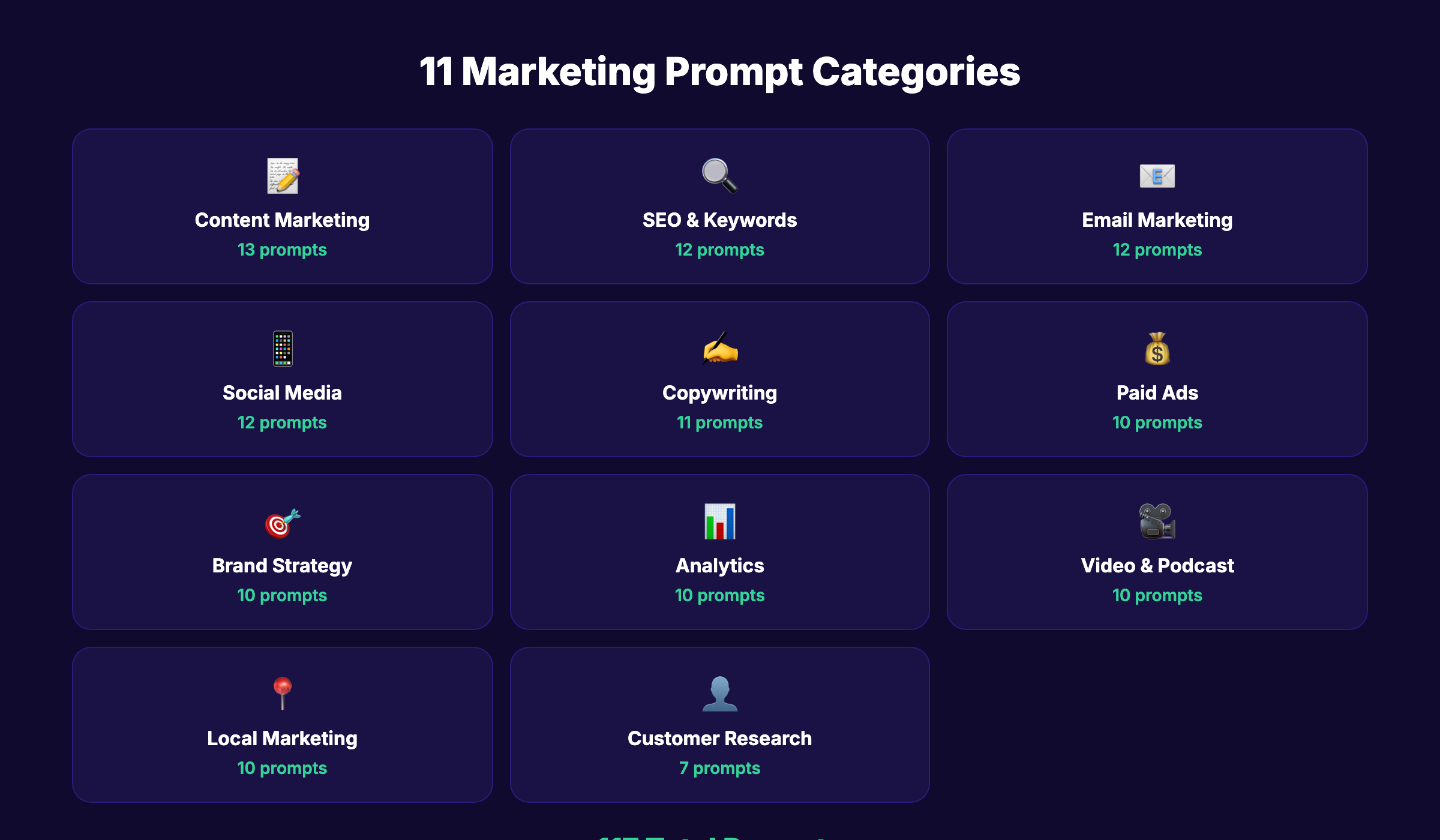
- 117 ready-to-paste prompts organized across 11 marketing channels
- Prompts for SEO content, email, social media, paid ads, and more
- Bracket placeholders you can swap for your own brand and product details
- Tips for writing better prompts that produce usable output on the first try
How to Get Better Results from Every Prompt
Before you copy and paste, understand what separates a prompt that works from one that wastes your time.
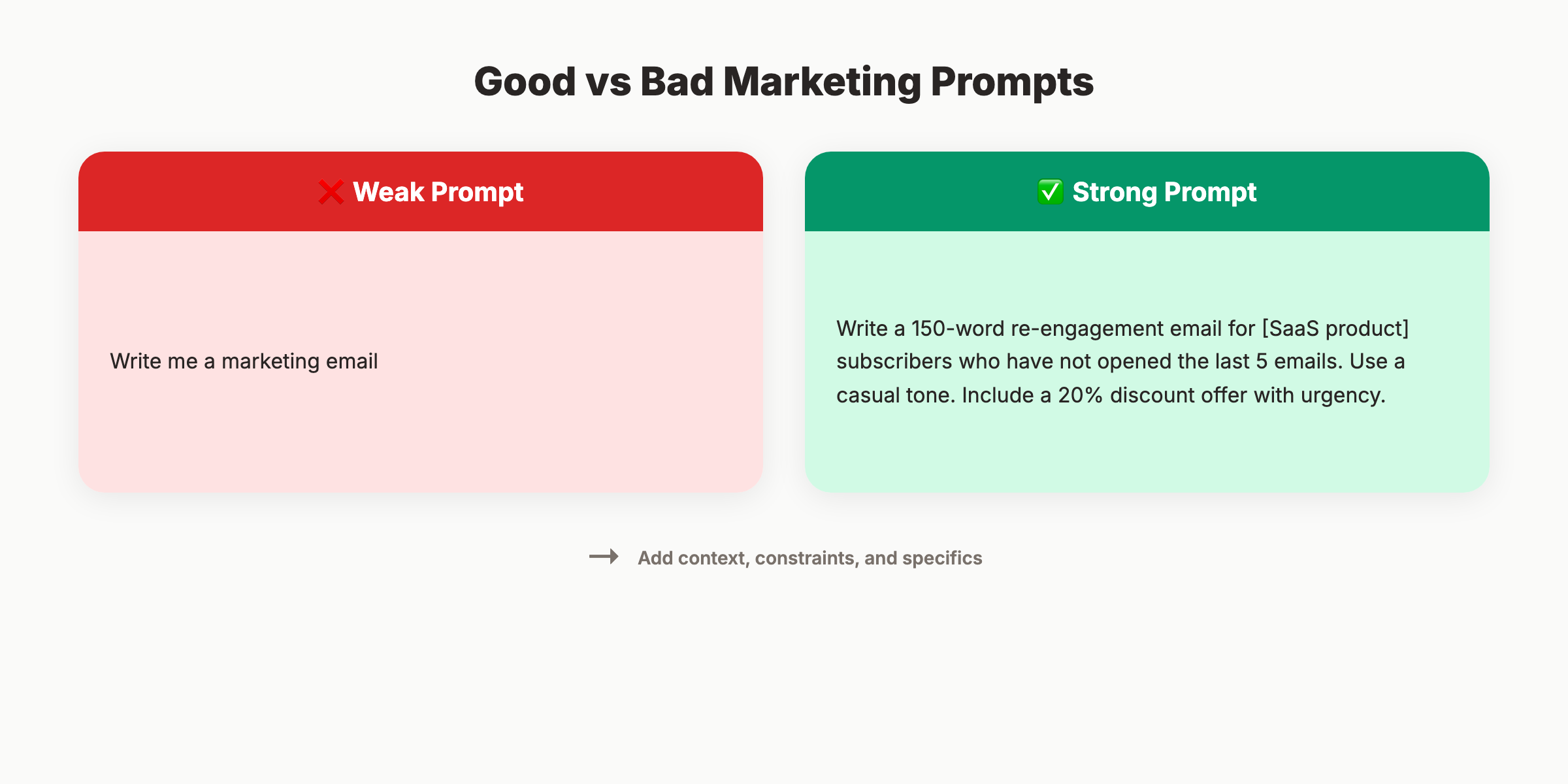
Weak prompt: “Write a marketing email.”
Strong prompt: “Write a 150-word re-engagement email for [SaaS product] targeting subscribers who have not opened the last 5 emails. Use a casual tone. Include a 20% discount offer with a 48-hour deadline.”
The difference is context. Every prompt in this list includes role assignments, constraints, and placeholders. Customize the bracketed sections for your brand.
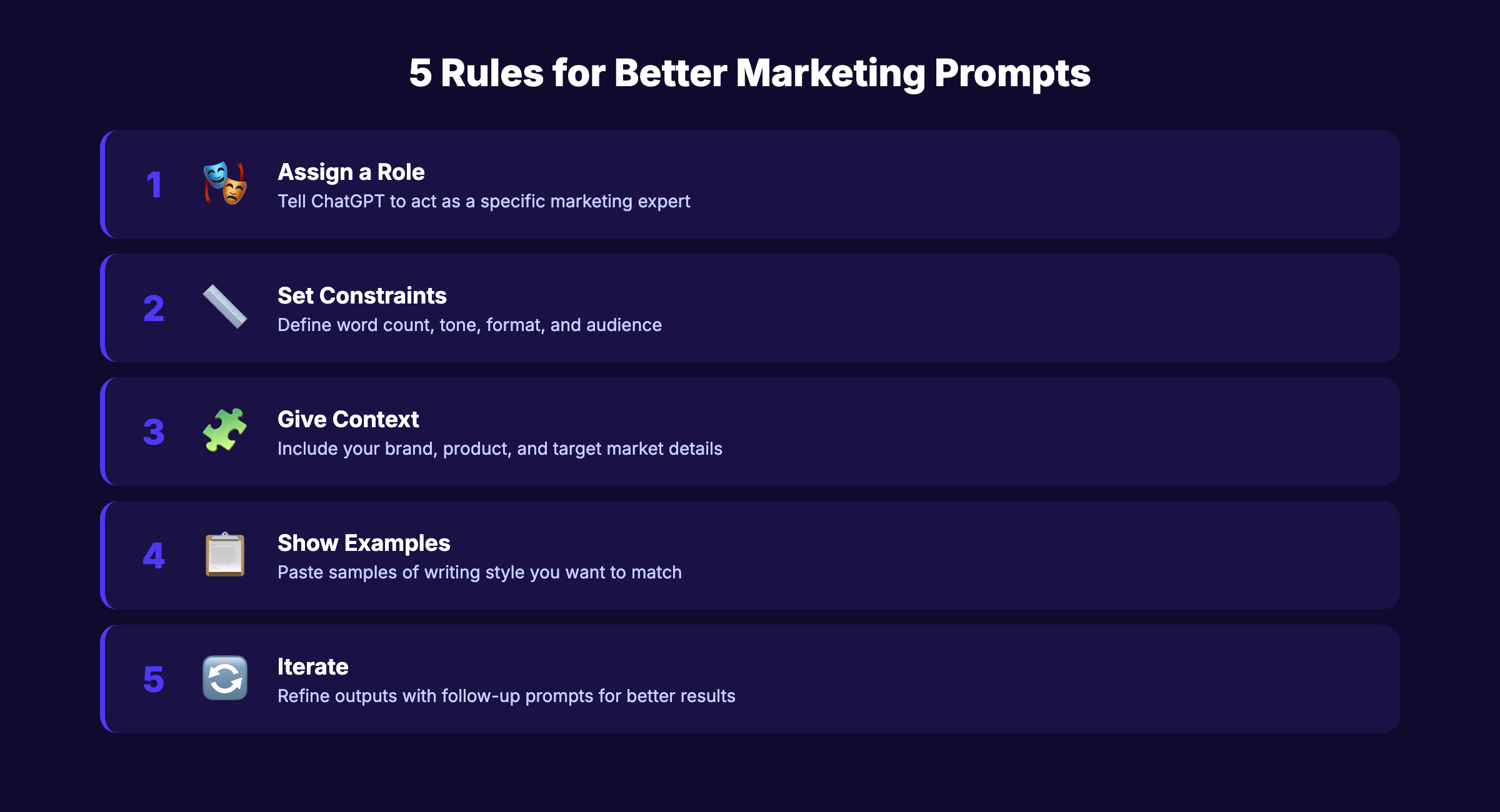
Five rules for stronger prompts:
- Assign a role. “Act as a senior content strategist” changes the output tone and depth.
- Set constraints. Define word count, tone, format, and audience.
- Give context. Include your brand name, product, target market, and goals.
- Show examples. Paste a sample of the writing style you want matched.
- Iterate. Use follow-up prompts to refine. “Make it shorter” or “Add more data” works.
Content Marketing and Blog Writing
These prompts help you plan, write, and optimize blog content. Pair them with a solid content marketing strategy for best results.
1. Generate Blog Topic Ideas — “Act as a content strategist. Generate 20 blog topic ideas for [industry] targeting [audience]. Focus on informational keywords with high search volume and low competition. Format as a numbered list with a suggested title for each.”
2. Create a Content Calendar — “Build a 30-day content calendar for [brand] in the [industry] space. Include 3 posts per week. Mix formats: how-to guides, listicles, and data-driven posts. Assign a primary keyword to each.”
3. Write a Blog Post Outline — “Create a detailed outline for a 2,500-word blog post on [topic]. Include an H1, 8 H2 sections, 3 H3 subsections, a FAQ section with 5 questions, and suggested internal links. Target keyword: [keyword].”
4. Write an Engaging Introduction — “Write a 100-word blog introduction for an article about [topic]. Start with a surprising statistic or bold claim. Use the Problem-Agitate-Solution framework. Include the keyword [keyword] in the first sentence.”
5. Expand a Thin Blog Post — “This blog post is 600 words and underperforming. Expand it to 2,000 words by adding 4 new H2 sections, 2 data points with sources, a comparison table, and a FAQ section. Keep the tone [casual/professional]. Here is the current post: [paste content].”
6. Write a Listicle — “Write a listicle titled ‘[Number] [Topic] Tips for [Audience].’ Each tip should be 80-120 words with a bold title, explanation, and one actionable takeaway. Use a confident, practical tone.”
7. Rewrite for a Different Audience — “Rewrite this blog post for [new audience]. The original targets [original audience]. Adjust the vocabulary, examples, and pain points to match the new reader. Keep the same structure. Here is the post: [paste content].”
8. Write a How-To Guide — “Write a step-by-step guide on [topic] for [audience]. Include 7 steps. Each step needs a clear heading, 100-150 words of explanation, and a pro tip. Add a tools-needed section at the top.”
9. Generate Blog Post Conclusions — “Write 3 different conclusions for a blog post about [topic]. Version 1: Call to action focused. Version 2: Forward-looking prediction. Version 3: Summary with a bold final statement. Each should be under 100 words.”
10. Create a Content Brief — “Write a content brief for a blog post on [keyword]. Include: target audience, search intent, primary and secondary keywords, suggested word count, competing URLs to beat, required sections, and tone guidelines.”
11. Write an Expert Roundup Intro — “Write a 150-word introduction for an expert roundup post titled ‘[Title].’ Explain why this topic matters now, mention how many experts contributed, and preview the top insight. Hook the reader in the first 15 words.”
12. Turn Data into a Blog Post — “I have the following data: [paste data or statistics]. Turn this into a 1,500-word blog post with an attention-grabbing headline, 5 key findings with analysis, and actionable takeaways for [audience]. Include a comparison table.”
13. Write Meta Descriptions — “Write 3 meta descriptions for a blog post titled ‘[title]’ targeting the keyword [keyword]. Each should be 145-155 characters, include the keyword naturally, and end with a benefit or call to action.”
SEO and Keyword Research
Use these prompts to support your on-page SEO and keyword targeting efforts.
14. Cluster Keywords by Intent — “Organize these keywords into clusters based on search intent (informational, commercial, transactional, navigational). Group related keywords together and suggest a page type for each cluster: [paste keyword list].”
15. Generate Long-Tail Keywords — “Generate 30 long-tail keyword variations for the seed keyword [keyword]. Include question-based keywords, comparison keywords, and location-modified keywords. Format as a table with columns: Keyword, Estimated Intent, Suggested Content Type.”
16. Write Title Tags — “Write 5 SEO title tag options for a page targeting [keyword]. Each must be under 60 characters, include the primary keyword near the front, and use a power word. Format: Title (character count).”
17. Optimize Existing Content — “Audit this blog post for SEO optimization. Identify missing keywords from this list: [keywords]. Suggest where to add them naturally. Also flag any thin sections that need expansion. Here is the post: [paste content].”
18. Write Alt Text for Images — “Write SEO-optimized alt text for 10 images on a page about [topic]. Each alt text should be under 125 characters, describe the image content, and include a relevant keyword naturally. Image descriptions: [list images].”
19. Create a Topical Map — “Build a topical map for [topic] with a pillar page and 12 supporting cluster posts. Include a suggested title, target keyword, and internal link path for each cluster post. Organize by subtopic relevance.”
20. Identify Content Gaps — “I rank for these keywords: [list keywords]. My competitors rank for these: [list competitor keywords]. Identify the top 15 content gaps I should target. Prioritize by estimated traffic potential and difficulty.”
21. Write Schema FAQ Markup — “Generate FAQ schema markup in JSON-LD format for these 5 questions and answers about [topic]: [paste Q&As]. Ensure valid formatting that passes Google Rich Results Test.”
22. Audit Internal Links — “Review this page content and suggest 8 internal link opportunities. I have pages on these topics: [list existing pages]. For each suggestion, provide the anchor text and the target URL. Here is the content: [paste content].”
23. Write a Keyword-Targeted Product Description — “Write a 200-word product description for [product] targeting the keyword [keyword]. Include the keyword in the first sentence and once more naturally. Focus on benefits over features. Tone: [tone].”
24. Generate People Also Ask Questions — “List 15 ‘People Also Ask’ style questions for the keyword [keyword]. Organize by informational, commercial, and navigational intent. These should reflect real search behavior patterns.”
25. Create an SEO Content Checklist — “Build a pre-publish SEO checklist for blog posts. Include items for title tags, meta descriptions, header hierarchy, keyword density, image optimization, internal links, external links, and readability. Format as a checklist with checkboxes.”
Email Marketing and Sequences
These prompts cover everything from subject lines to full drip campaigns. For best practices, see our email marketing guide.
26. Write Email Subject Lines — “Generate 10 email subject lines for a [campaign type] email promoting [product/offer]. Include 3 curiosity-driven, 3 benefit-driven, 2 urgency-driven, and 2 personalized options. Keep each under 50 characters.”
27. Write a Welcome Email Sequence — “Write a 5-email welcome sequence for new subscribers of [brand]. Email 1: Welcome and brand introduction. Email 2: Best resources. Email 3: Social proof and case study. Email 4: Product education. Email 5: Soft CTA. Tone: [tone]. 150 words each.”
28. Create a Re-Engagement Campaign — “Write a 3-email re-engagement sequence for [brand] subscribers who have not opened emails in 60+ days. Email 1: ‘We miss you’ with value reminder. Email 2: Exclusive offer. Email 3: Final notice before list removal. Include subject lines.”
29. Write a Product Launch Email — “Write a product launch email for [product name] by [brand]. Target audience: [audience]. Key features: [list features]. Include a compelling subject line, 200-word body, 3 bullet points of benefits, and a clear CTA. Tone: excited but not hype-driven.”
30. Generate A/B Test Variations — “Write 2 complete versions of a promotional email for [offer]. Version A: Benefit-focused with customer testimonial. Version B: Urgency-focused with deadline and scarcity. Same offer, different angles. 150 words each.”
31. Write a Cart Abandonment Email — “Write a cart abandonment email for [ecommerce brand]. The customer left [product type] in their cart. Include: subject line, 100-word body, product image placeholder, a reason to return (free shipping/discount), and a CTA button text.”
32. Create a Newsletter Template — “Design a weekly newsletter template for [brand] in the [industry] space. Include sections for: one main article summary, 3 quick tips, one tool recommendation, one customer spotlight, and a CTA. Provide placeholder copy for each.”
33. Write a Cold Email for Partnerships — “Write a cold outreach email to [company type] proposing a [partnership type]. Keep it under 120 words. Open with a specific compliment about their work. State the value proposition in one sentence. End with a low-friction ask.”
34. Write Event Invitation Emails — “Write a 2-email sequence inviting [audience] to [event type]. Email 1: Announcement with key details (date, topic, speakers). Email 2: Reminder sent 24 hours before. Include subject lines and registration CTA for both.”
35. Personalize Emails by Segment — “Rewrite this email for 3 different audience segments: [segment 1], [segment 2], [segment 3]. Adjust the pain points, examples, and CTA for each. Keep the same core offer. Original email: [paste email].”
36. Write a Testimonial Request Email — “Write a short email asking customers of [brand] to leave a review after purchasing [product/service]. Keep it under 80 words. Make the ask feel easy. Include a direct link placeholder and mention it takes under 2 minutes.”
37. Write a Seasonal Promotion Email — “Write a promotional email for [brand]‘s [holiday/seasonal] sale. Discount: [X%] off [products/services]. Deadline: [date]. Include subject line, preview text, 150-word body with urgency, and CTA. Tone: festive but professional.”
Stop writing. Start ranking. Stacc publishes 30 SEO articles per month for $99. Start for $1 →
Social Media Marketing
Prompts for creating posts, calendars, and engagement strategies. For more ideas, check our social media content guide.
38. Create a 30-Day Content Calendar — “Build a 30-day social media calendar for [brand] on [platform]. Target audience: [audience]. Include post type (carousel, reel, text, story), caption, 3 hashtags, and best posting time for each day.”
39. Write LinkedIn Thought Leadership Posts — “Write 5 LinkedIn posts for a [job title] at [company]. Each should share a contrarian insight about [industry topic]. Format: hook line, 3-4 short paragraphs, closing question. Under 200 words each. No hashtags in the body.”
40. Generate Instagram Carousel Ideas — “Create 10 Instagram carousel concepts for [brand] in the [industry]. Each carousel needs: a hook slide title, 5-7 slide outline with key points, and a CTA slide. Focus on educational and shareable content.”
41. Write Twitter/X Thread Scripts — “Write a 10-tweet thread about [topic] for [brand]. Tweet 1: bold hook statement. Tweets 2-9: one insight each with supporting data or examples. Tweet 10: summary and CTA. Keep each tweet under 280 characters.”
42. Create Platform-Specific Variations — “Rewrite this social media post for 4 platforms: LinkedIn (professional tone, 150 words), Instagram (casual, with emoji, 100 words), Twitter/X (punchy, under 280 characters), and Facebook (conversational, 120 words). Original post: [paste content].”
43. Write Engagement-Driving Questions — “Generate 15 engagement questions for [brand] to post on [platform]. Mix formats: polls, ‘this or that,’ opinion questions, and fill-in-the-blank. Topic area: [industry/niche]. Each should start a conversation, not just get likes.”
44. Create Hashtag Strategies — “Research and suggest 30 hashtags for [brand] on Instagram. Organize into 3 groups: 10 broad (100K-1M posts), 10 medium (10K-100K posts), and 10 niche (under 10K posts). All should be relevant to [industry/topic].”
45. Write Social Proof Posts — “Write 5 social media posts that showcase [brand]‘s results without sounding boastful. Use formats: customer quote, before/after data, milestone celebration, behind-the-scenes process, and team spotlight. Platform: [platform].”
46. Generate Reel and Short-Form Video Scripts — “Write 5 Instagram Reel scripts for [brand]. Each should be under 30 seconds. Format: hook (first 3 seconds), body (key points), CTA. Topics should educate [audience] about [industry topic]. Include on-screen text suggestions.”
47. Write Community Management Responses — “Write response templates for these common social media comment types: 1) Product question, 2) Complaint, 3) Praise, 4) Competitor mention, 5) Pricing question. Brand: [brand]. Tone: helpful and human. Under 50 words each.”
48. Plan a Social Media Campaign — “Create a 2-week social media campaign plan for [product launch/event/promotion]. Platform: [platform]. Include: campaign goal, 10 posts with copy and format, posting schedule, engagement strategy, and KPIs to track.”
49. Write Influencer Collaboration Briefs — “Write a brief for a [micro/macro] influencer promoting [product]. Include: campaign objective, key messages (3 talking points), content requirements (format, length, tags), do-not-say list, and deliverable timeline.”
Copywriting and Landing Pages
These prompts cover conversion-focused copy for landing pages, ads, and product pages. For deeper guidance, read our SEO copywriting guide.
50. Write a Landing Page — “Write full landing page copy for [product/service] targeting [audience]. Include: hero headline (under 10 words), subheadline, 3 feature sections with benefit-first descriptions, social proof section, FAQ (5 questions), and CTA. Tone: [tone].”
51. Write Headlines Using AIDA — “Generate 10 headlines for [product] using the AIDA framework. Each headline should: grab Attention with a bold claim, build Interest with a specific benefit, create Desire with social proof or a number, and drive Action with urgency.”
52. Create Value Propositions — “Write 5 unique value propositions for [product/service]. Each should be one sentence, under 15 words, and answer ‘why should I choose this over alternatives?’ Focus on outcomes, not features.”
53. Write Product Descriptions — “Write 3 product descriptions for [product]. Version 1: Feature-focused for comparison shoppers (150 words). Version 2: Benefit-focused for emotional buyers (150 words). Version 3: Technical specification style for detail-oriented buyers (100 words).”
54. Create a Sales Page Outline — “Build a long-form sales page outline for [product] at [price point]. Include these sections: attention-grabbing headline, problem statement, agitation, solution reveal, feature breakdown, social proof, objection handling, pricing, guarantee, and final CTA.”
55. Write Urgency-Driven Copy — “Write 5 urgency-based CTAs for [product/offer]. Include countdown-style deadlines, limited availability, and exclusive access angles. No false scarcity. Each CTA should be 1-2 sentences with a button text suggestion.”
56. Generate Testimonial-Based Copy — “Turn these customer testimonials into marketing copy: [paste testimonials]. Create: 1) A 50-word hero section quote, 2) 3 pull quotes for feature sections, 3) A case study paragraph with specific results. Keep the customer voice authentic.”
57. Write Pricing Page Copy — “Write pricing page copy for [product] with 3 tiers: [Tier 1], [Tier 2], [Tier 3]. For each tier: write a one-line description, list 5-7 features, add a recommended badge to the middle tier, and write CTA button text.”
58. Create Exit-Intent Popup Copy — “Write 3 exit-intent popup variations for [website]. Each should be under 30 words with a headline, one line of body copy, and a CTA. Offer: [discount/lead magnet]. Make each version test a different emotional trigger: FOMO, value, and curiosity.”
59. Write Comparison Page Copy — “Write comparison copy for a [your product] vs [competitor] page. Include: a fair intro, feature comparison table with 10 rows, 3 key differentiators explained in 50 words each, and a conclusion that positions [your product] as the better choice for [audience].”
60. Rewrite Weak CTAs — “Rewrite these CTAs to be more specific and action-oriented: [paste CTAs]. Each new CTA should describe the benefit of clicking, not just the action. Example: ‘Sign up’ becomes ‘Start your free 14-day trial.’ Provide 3 options per CTA.”
Your SEO team. $99 per month. 30 optimized articles, published automatically. Start for $1 →
Paid Advertising and PPC
Prompts for Google Ads, Meta Ads, and paid campaign copy.
61. Write Google Ads Copy — “Write 5 Google Search ad variations for [product/service] targeting the keyword [keyword]. Each ad needs: 3 headlines (30 characters max each), 2 descriptions (90 characters max each), and a display URL suggestion. Focus on CTR.”
62. Create Meta Ad Copy — “Write ad copy for a Facebook/Instagram ad promoting [product/offer]. Target audience: [audience]. Include: primary text (125 words), headline (5 words), link description (30 words), and CTA button recommendation. Test angles: benefit, social proof, urgency.”
63. Generate Ad Hook Variations — “Write 10 opening hooks for a [product] ad on [platform]. Each hook should stop the scroll in under 10 words. Mix approaches: question, bold stat, contrarian claim, pain point, and customer result. Target audience: [audience].”
64. Write Retargeting Ad Sequences — “Create a 3-ad retargeting sequence for visitors who viewed [product page] but did not convert. Ad 1 (Day 1): Reminder with social proof. Ad 2 (Day 3): Objection handling. Ad 3 (Day 7): Final offer with urgency. Include copy for each.”
65. Build a YouTube Ad Script — “Write a 30-second YouTube pre-roll ad script for [product]. Structure: hook in first 5 seconds (before skip button), problem statement, solution introduction, key benefit, and CTA. Include visual direction notes in brackets.”
66. Create A/B Test Ad Variations — “Write 2 complete ad variations for [product] on [platform]. Version A tests a benefit-led approach. Version B tests a problem-led approach. Same offer, same audience: [audience]. Include copy and suggested image/video direction.”
67. Write LinkedIn Sponsored Content — “Write 3 LinkedIn Sponsored Content ads for [B2B product] targeting [job titles]. Include: intro text (150 words), headline, and CTA. One ad should use a statistic, one a customer quote, and one a thought-provoking question.”
68. Optimize Underperforming Ads — “This ad has a high impression count but low CTR: [paste ad copy]. Rewrite it with 3 improved versions. Diagnose why it might be underperforming (weak hook, unclear value prop, wrong audience match) and fix each issue.”
69. Write Google Performance Max Asset Groups — “Create a full Performance Max asset group for [product]. Include: 5 headlines (30 chars), 5 long headlines (90 chars), 5 descriptions (90 chars), CTA selection, and audience signal suggestions. Campaign goal: [conversions/leads/sales].”
70. Generate Negative Keyword Lists — “Create a negative keyword list for a Google Ads campaign promoting [product/service]. Include 30 keywords that would attract irrelevant clicks: free seekers, job seekers, students, DIY users, and competitors. Organize by category.”
Brand Strategy and Positioning
Prompts for defining your brand voice, positioning, and messaging architecture.
71. Define Brand Voice Guidelines — “Create brand voice guidelines for [brand] in the [industry] space. Define: personality traits (3 words), tone spectrum (formal to casual), vocabulary preferences (use/avoid lists), and 3 before/after sentence examples.”
72. Write a Positioning Statement — “Write a positioning statement for [brand] using this framework: For [target audience] who [need], [brand] is the [category] that [key differentiator]. Unlike [competitors], we [unique benefit]. Provide 3 variations.”
73. Create a Messaging Hierarchy — “Build a messaging hierarchy for [brand]. Include: tagline (under 8 words), elevator pitch (30 words), boilerplate (100 words), and 3 key messages for [audience 1], [audience 2], and [audience 3]. Each message should lead with a different benefit.”
74. Develop Buyer Personas — “Create a detailed buyer persona for [brand]‘s ideal customer. Include: demographics, job title, goals, pain points, objections to purchase, preferred content formats, social media habits, and a day-in-the-life narrative. Name the persona.”
75. Write a Brand Story — “Write a 300-word brand origin story for [brand]. Structure: the problem we noticed, why existing options fell short, the moment of insight, what we built, and where we are today. Tone: authentic, not self-congratulatory. Avoid cliches.”
76. Audit Competitor Messaging — “Analyze the messaging of these 3 competitors: [competitor URLs]. For each, extract: tagline, primary value proposition, target audience, tone of voice, and key claims. Identify gaps in their messaging that [brand] can own.”
77. Generate Tagline Options — “Write 15 tagline options for [brand] in the [industry]. Requirements: under 8 words, memorable, benefit-oriented, and distinct from [competitor taglines]. Organize by approach: outcome-focused, identity-focused, and action-focused.”
78. Create an About Page — “Write an About page for [brand] that targets [keyword]. Include: mission statement, founding story (50 words), team values (3 values with descriptions), and a CTA. Tone: confident and human. Under 400 words total.”
79. Write Elevator Pitches by Audience — “Write 3 elevator pitches for [product]. Pitch 1: For [audience 1] — focus on [pain point 1]. Pitch 2: For [audience 2] — focus on [pain point 2]. Pitch 3: For investors — focus on market opportunity. Under 50 words each.”
80. Differentiate from Competitors — “I sell [product/service]. My main competitors are [list competitors]. Write 5 differentiation statements that position me against each competitor. Focus on what I do better, not what they do worse. Each statement should be one sentence.”
3,500+ blogs published. 92% average SEO score. See what Stacc can do for your site. Start for $1 →
Marketing Analytics and Reporting
Prompts for interpreting data, building dashboards, and creating reports.
81. Interpret Google Analytics Data — “I have the following GA4 data from the last 30 days: [paste data]. Identify the 3 most important trends, explain what they mean for my marketing strategy, and recommend 3 specific actions to take this month.”
82. Build a Monthly Marketing Report — “Create a monthly marketing report template for [brand]. Include sections for: traffic overview, top-performing content, conversion metrics, email performance, social engagement, and SEO rankings. Suggest 2-3 KPIs per section.”
83. Explain a Traffic Drop — “My organic traffic dropped 25% this month. Here are the details: [paste data — pages affected, timeline, recent changes]. List 10 possible causes in order of likelihood. For each cause, explain how to diagnose it and the recommended fix.”
84. Write Data-Driven Insights — “Turn this raw data into 5 marketing insights: [paste data table]. Each insight should follow this format: Observation (what the data shows), Implication (what it means), and Action (what to do about it). Write for a non-technical audience.”
85. Create UTM Naming Conventions — “Design a UTM naming convention system for [brand]. Cover these channels: email, social media, paid ads, and partnerships. Include: source, medium, campaign, content, and term parameters with examples for each channel.”
86. Build a Content Performance Scorecard — “Create a content scoring system for blog posts. Define 5 metrics to track (traffic, engagement, conversions, SEO ranking, social shares). Assign weights to each. Provide a scoring formula and explain what scores of 80+, 50-79, and below 50 mean.”
87. Write an SEO Progress Report — “Write a client-facing SEO progress report for [month]. Data: [paste keyword rankings, traffic, backlinks]. Include: executive summary (3 sentences), wins this month, areas needing improvement, and recommended next steps. Professional but accessible tone.”
88. Analyze Funnel Drop-Off Points — “My marketing funnel has these conversion rates: [awareness → interest → consideration → purchase with percentages]. Identify the weakest stage. Suggest 5 tactics to improve conversion at that stage. Include benchmarks for my industry: [industry].”
89. Forecast Content ROI — “I plan to publish [X] blog posts per month for 6 months. Average organic traffic per post after 6 months: [estimate]. Average conversion rate: [X%]. Average customer value: [$X]. Build a content ROI projection with monthly breakdowns.”
90. Compare Marketing Channels — “Compare the performance of these marketing channels for [brand]: [list channels with data]. Rank them by: cost per acquisition, lifetime value contribution, time to results, and scalability. Recommend budget allocation percentages.”
Video, Podcast, and YouTube Marketing
Prompts for video scripts, podcast outlines, and YouTube SEO optimization.
91. Write a YouTube Video Script — “Write a 5-minute YouTube video script on [topic] for [channel]. Include: hook (first 10 seconds), intro with channel branding, 3 main points with transitions, a subscribe CTA at the midpoint, and an outro with next video teaser.”
92. Create Video Title and Thumbnail Ideas — “Generate 10 YouTube title and thumbnail text combinations for a video about [topic]. Titles should be under 60 characters with a curiosity gap or number. Thumbnail text should be 3-5 words maximum. Include emoji suggestions.”
93. Write YouTube Video Descriptions — “Write a YouTube video description for a video titled ‘[title].’ Include: 2-sentence hook, timestamps for 5 key sections, 3 relevant links, 5 hashtags, and a subscribe CTA. Front-load the keyword [keyword] in the first 150 characters.”
94. Plan a Podcast Episode — “Create a detailed outline for a 30-minute podcast episode about [topic]. Include: episode title, 1-sentence teaser, 5 discussion segments with talking points and time allocations, 3 listener questions to address, and a CTA for the next episode.”
95. Write a Podcast Show Notes Page — “Write SEO-optimized show notes for podcast episode ‘[title].’ Include: 100-word episode summary with keyword [keyword], key takeaways (5 bullets), guest bio placeholder, transcript excerpt, and 3 related episode links.”
96. Create Short-Form Video Concepts — “Generate 10 short-form video concepts (under 60 seconds) for [brand] on TikTok and Instagram Reels. Each concept needs: hook (first 3 seconds), format type (talking head, tutorial, skit, duet), and expected engagement trigger.”
97. Write a Webinar Outline — “Create a 45-minute webinar outline for [topic] targeting [audience]. Structure: 5-minute intro with agenda, 25 minutes of content across 4 sections, 10-minute live Q&A, and 5-minute CTA pitch. Include slide title suggestions.”
98. Repurpose Long-Form Video — “I have a 20-minute video about [topic]. Create a repurposing plan: 5 short clips (with timestamps to cut), 3 quote graphics, 1 blog post outline, 5 social media posts, and 1 email newsletter summary. All from this single video.”
99. Optimize for Video SEO — “Optimize this YouTube video for search. Current title: [title]. Topic: [topic]. Target keyword: [keyword]. Provide: improved title, 3 tag suggestions, optimized description (first 150 chars keyword-rich), and end screen CTA recommendation.”
100. Write a Video Ad Script — “Write a 15-second video ad script for [product] targeting [audience] on [platform]. Structure: problem statement (3 seconds), solution (5 seconds), proof point (4 seconds), CTA (3 seconds). Include visual direction notes.”
Rank everywhere. Do nothing. Blog SEO, Local SEO, and Social Media on autopilot. Start for $1 →
Local Marketing and Google Business Profile
Prompts for local businesses, GBP optimization, and local SEO. These are especially useful for service-area businesses.
101. Write Google Business Profile Posts — “Write 8 Google Business Profile posts for [business type] in [city]. Mix: 2 promotional offers, 2 educational tips, 2 seasonal posts, and 2 service highlights. Each post: 100-150 words with a CTA. Include a suggested image description.”
102. Optimize a GBP Description — “Write an optimized Google Business Profile description for [business name], a [business type] in [city]. Include: primary services, service area, years in business, and a unique differentiator. Under 750 characters. Naturally include [keyword].”
103. Generate Local Content Ideas — “Create 15 local content blog post ideas for [business type] in [city/region]. Mix: local guides, seasonal tips, industry news commentary, customer stories, and FAQ posts. Each idea should target a local keyword.”
104. Write Review Response Templates — “Write response templates for [business type] reviews. Create 3 positive review responses (grateful, specific), 3 negative review responses (empathetic, solution-oriented), and 2 neutral review responses. Keep each under 100 words.”
105. Create Location Page Copy — “Write location page copy for [business name] in [city]. Include: H1 with city name, 200-word area-specific intro, list of services available in [city], local trust signals, driving directions section, and a contact CTA.”
106. Plan a Local Link Building Campaign — “Suggest 10 local link building opportunities for [business type] in [city]. Include: local directories, sponsorship opportunities, community partnerships, local news pitches, and industry associations. Prioritize by difficulty and impact.”
107. Write a Local Email Campaign — “Write a 3-email sequence for [business type] targeting customers in [city]. Email 1: Seasonal service reminder. Email 2: Neighborhood-specific offer. Email 3: Local event or community tie-in. Include subject lines and 100-word bodies.”
108. Create a Neighborhood Guide Post — “Write a 1,500-word neighborhood guide for [neighborhood] in [city] from the perspective of [business type]. Include: things to know about the area, local tips, how your services fit the neighborhood, and 5 FAQ questions. Target keyword: [keyword].”
109. Optimize for ‘Near Me’ Searches — “Create a local SEO checklist for [business type] to rank for ‘near me’ searches. Include 15 on-page, off-page, and GBP optimization actions. Prioritize by impact. Reference current Google Maps ranking factors.”
110. Write a Local Social Media Strategy — “Create a 4-week social media plan for [business type] in [city]. Focus on local audience growth. Include: 3 posts per week, local hashtag strategy, community engagement tactics, and local influencer outreach suggestions. Platform: [platform].”
Customer Research and Buyer Personas
Prompts for understanding your audience and refining your targeting.
111. Build a Customer Avatar — “Create a detailed customer avatar for [product/service]. Include: name, age, location, job title, income range, top 3 goals, top 3 frustrations, where they spend time online, what they Google before buying, and their biggest objection.”
112. Map the Customer Journey — “Map the complete customer journey for [product/service] across 5 stages: Awareness, Consideration, Decision, Purchase, and Retention. For each stage, list: customer questions, content types needed, channels, and KPIs to track.”
113. Write Customer Interview Questions — “Generate 15 customer interview questions for [brand] to understand why customers choose us over alternatives. Cover: discovery process, decision factors, objections they overcame, outcomes achieved, and what they would improve.”
114. Analyze Customer Reviews for Insights — “Analyze these customer reviews for [product/service]: [paste reviews]. Extract: top 3 praised features, top 3 complaints, common language patterns customers use, and 5 marketing messages you could write based on their exact words.”
115. Create Audience Segments — “Define 5 audience segments for [brand]. For each segment: name, size estimate, key characteristics, primary pain point, best marketing channel to reach them, and suggested first message. Prioritize by revenue potential.”
116. Write Survey Questions — “Create a 10-question customer satisfaction survey for [brand]. Mix question types: 3 rating scale, 3 multiple choice, 2 open-ended, and 2 NPS-style. Focus on product satisfaction, likelihood to recommend, and improvement suggestions.”
117. Generate Objection-Handling Scripts — “List the top 8 sales objections for [product/service] and write a 2-3 sentence response for each. Focus on: price concerns, competitor comparisons, timing hesitation, trust issues, and implementation worries. Tone: empathetic and direct.”
What to Do After You Have the Output
Running a prompt is step one. Here is how to turn raw ChatGPT output into published marketing assets.
- Edit for your voice. AI output is a first draft. Adjust tone, remove filler, and add brand-specific language.
- Add real data. Replace placeholder statistics with verified numbers from your analytics or published research.
- Check for accuracy. ChatGPT can generate plausible-sounding but incorrect claims. Verify every fact and link.
- Humanize the content. Remove patterns that signal AI writing. Vary sentence lengths. Add personal experience.
- Optimize for SEO. Run the output through your on-page checklist. Verify keyword placement, headers, and meta tags.
- Publish consistently. A single prompt is a tactic. A content strategy with 30+ posts per month is a growth engine.
Skip the agency. Keep the results. Stacc starts at $99/mo with a $1 trial. Start for $1 →
FAQ
What are the best ChatGPT prompts for marketing?
The best prompts include a role assignment, specific constraints, and context about your brand. A prompt like “Act as a content strategist and create 20 blog topics for [industry] targeting [audience]” outperforms “give me blog ideas” every time. The 117 prompts in this guide cover every major marketing channel.
Can ChatGPT replace a marketing team?
No. ChatGPT accelerates output but does not replace strategy, judgment, or brand voice. Use it as a first-draft engine. The best results come from pairing AI speed with human editing, fact-checking, and creative direction.
How do I write ChatGPT prompts that do not sound robotic?
Include a tone instruction (“write in a casual, direct tone”), provide a writing sample to match, and always edit the output. Ask ChatGPT to “rewrite this in a more conversational voice” or “remove marketing jargon.” Then humanize the content further by hand.
Are ChatGPT marketing prompts good for SEO content?
Yes, when combined with proper keyword research and SEO optimization. ChatGPT can write drafts, generate meta descriptions, and create outlines. But you still need to verify keyword placement, check accuracy, and ensure the content matches search intent.
How often should I update my marketing prompts?
Review your prompt library quarterly. AI models improve, marketing trends shift, and your brand evolves. What worked 6 months ago may produce stale output today. Test new approaches and save the prompts that consistently produce strong results.
What is the difference between ChatGPT and other AI tools for marketing?
ChatGPT handles general-purpose text generation well. Specialized tools like Surfer SEO focus on keyword optimization, while services like Stacc handle the full publishing pipeline. The right choice depends on whether you want to do the work yourself or have it done for you.
Bookmark this page. We update this prompt list as AI models and marketing tactics evolve.
The fastest way to turn these prompts into rankings is to combine AI speed with a system that publishes, optimizes, and distributes your content automatically. That is exactly what Stacc does for 70+ industries.
Written and published by Stacc. We publish 3,500+ articles per month across 70+ industries. All data verified against public sources as of March 2026.