SEO copywriting that ranks and converts: search intent, page structure, headlines, internal links, and edits that keep readers moving to the offer.
SEO copywriting is the discipline of writing pages that rank on Google and persuade the reader to act. This guide covers search intent, page and headline structure, internal linking, and the editing workflow, with before-and-after examples you can apply to an existing page today.
Most content ranks but does not convert. Most ad copy converts but does not rank. SEO copywriting is the discipline that does both.
The SEO copywriting market hit $25 billion in 2023 and is projected to reach $42 billion by 2030, according to Passive Secrets. That growth reflects a simple reality: businesses need content that attracts organic traffic AND turns visitors into customers.
This guide covers everything you need to write SEO copy that ranks on Google and persuades readers to take action. Not theory. Specific frameworks, before-and-after examples, and a workflow you can use today.
We have published 3,500+ blog posts across 70+ industries. Here is what we have learned about writing copy that ranks and converts at the same time.
What you will learn:
- The real difference between SEO copywriting, content writing, and regular copywriting
- How to research keywords with conversion intent built in
- 6 persuasion frameworks adapted for SEO content
- On-page tactics that improve rankings and readability
- How to write SEO copy for blogs, landing pages, product pages, and more
- A practical AI workflow for faster writing without quality loss
- How to measure whether your copy is actually working
What Is SEO Copywriting (And Why It Matters Now)
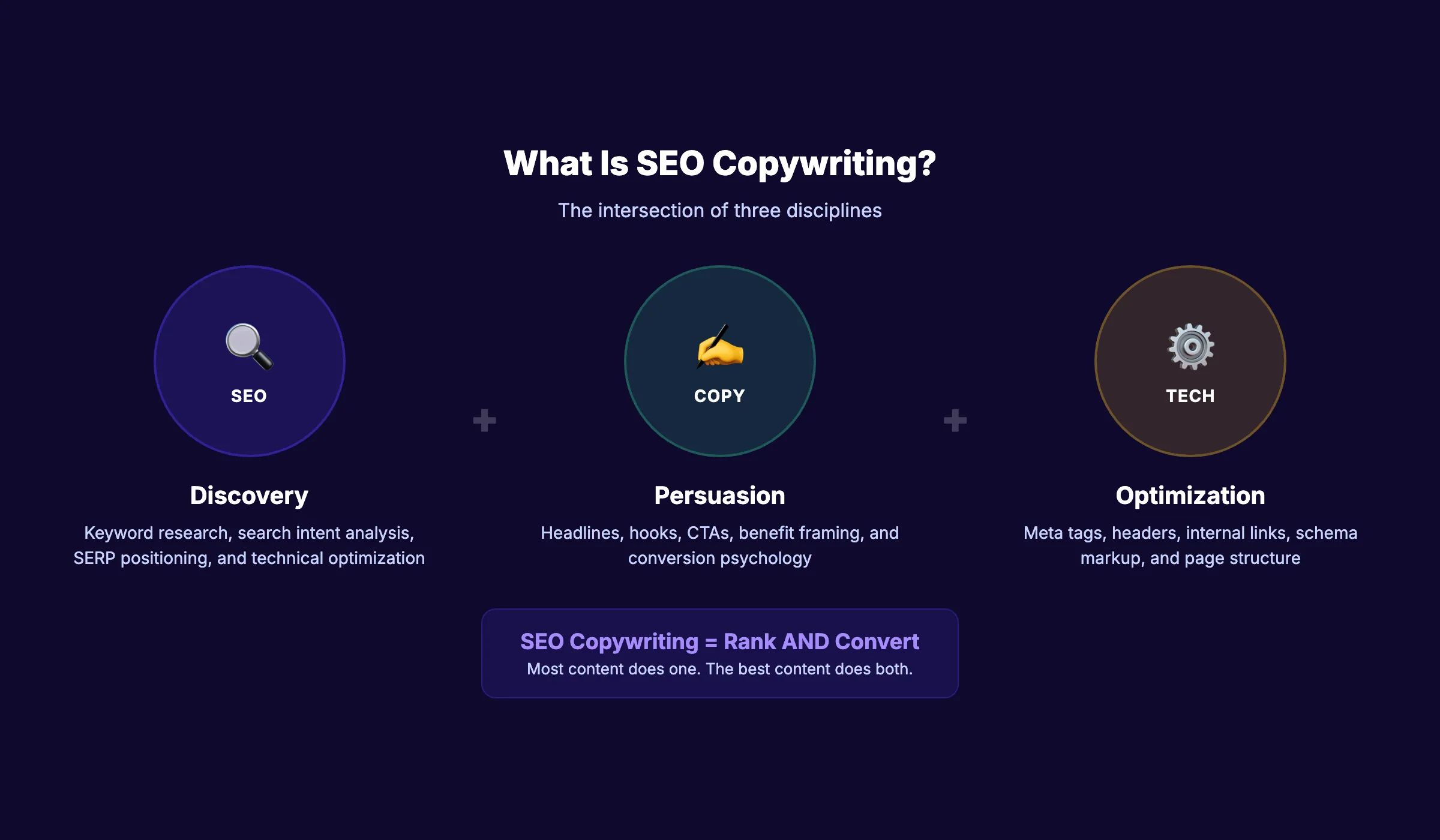
SEO copywriting is writing that ranks in search engines and persuades readers to take a specific action. It combines search engine optimization with direct-response copywriting techniques.
Regular copywriting focuses on conversion. SEO content writing focuses on traffic. SEO copywriting targets both.
This matters more in 2026 than ever before. 60% of searches now result in zero clicks, according to Incremys. Google AI Overviews pull answers directly into the SERP. If your content does rank, it needs to work harder once someone clicks.
Every page on your site serves two audiences: search engines and humans. SEO copywriting is the skill of satisfying both without compromising either.
The Three Pillars
| Pillar | What It Covers | Why It Matters |
|---|---|---|
| Discovery | Keyword research, search intent, SERP analysis | Gets your page in front of the right people |
| Persuasion | Headlines, hooks, CTAs, benefit framing | Turns readers into leads or customers |
| Optimization | Meta tags, headers, internal links, structure | Signals relevance to search engines |
Most SEO guides cover pillar 1 and pillar 3. They skip pillar 2 entirely. That is why so much SEO content ranks but generates zero revenue.
SEO Copywriting vs Content Writing vs Regular Copywriting
This distinction matters because it changes how you approach every page.
| Dimension | SEO Copywriting | SEO Content Writing | Regular Copywriting |
|---|---|---|---|
| Primary goal | Rank AND convert | Rank and inform | Convert (no SEO) |
| Content types | Landing pages, product pages, homepage, CTAs | Blog posts, guides, pillar pages | Ads, emails, sales pages |
| Tone | Persuasive, benefit-focused | Educational, authoritative | Emotional, urgent |
| Success metric | Rankings + conversion rate | Rankings + traffic + time on page | Conversion rate + revenue |
| Search intent | Commercial, transactional | Informational | N/A |
The most valuable skill in 2026 is all three combined. Writing content that ranks organically, builds topical authority, and persuades readers to act. Writers and businesses that combine these skills outperform those who specialize in only one.
SEO content writing is what most businesses already do when they publish blog posts. SEO copywriting takes it further by injecting conversion psychology into every piece of content.
How to Research Keywords for SEO Copy
Keyword research for SEO copywriting is different from standard keyword research. You are not just looking for volume. You are looking for intent that aligns with a conversion goal.
Start With Intent, Not Volume
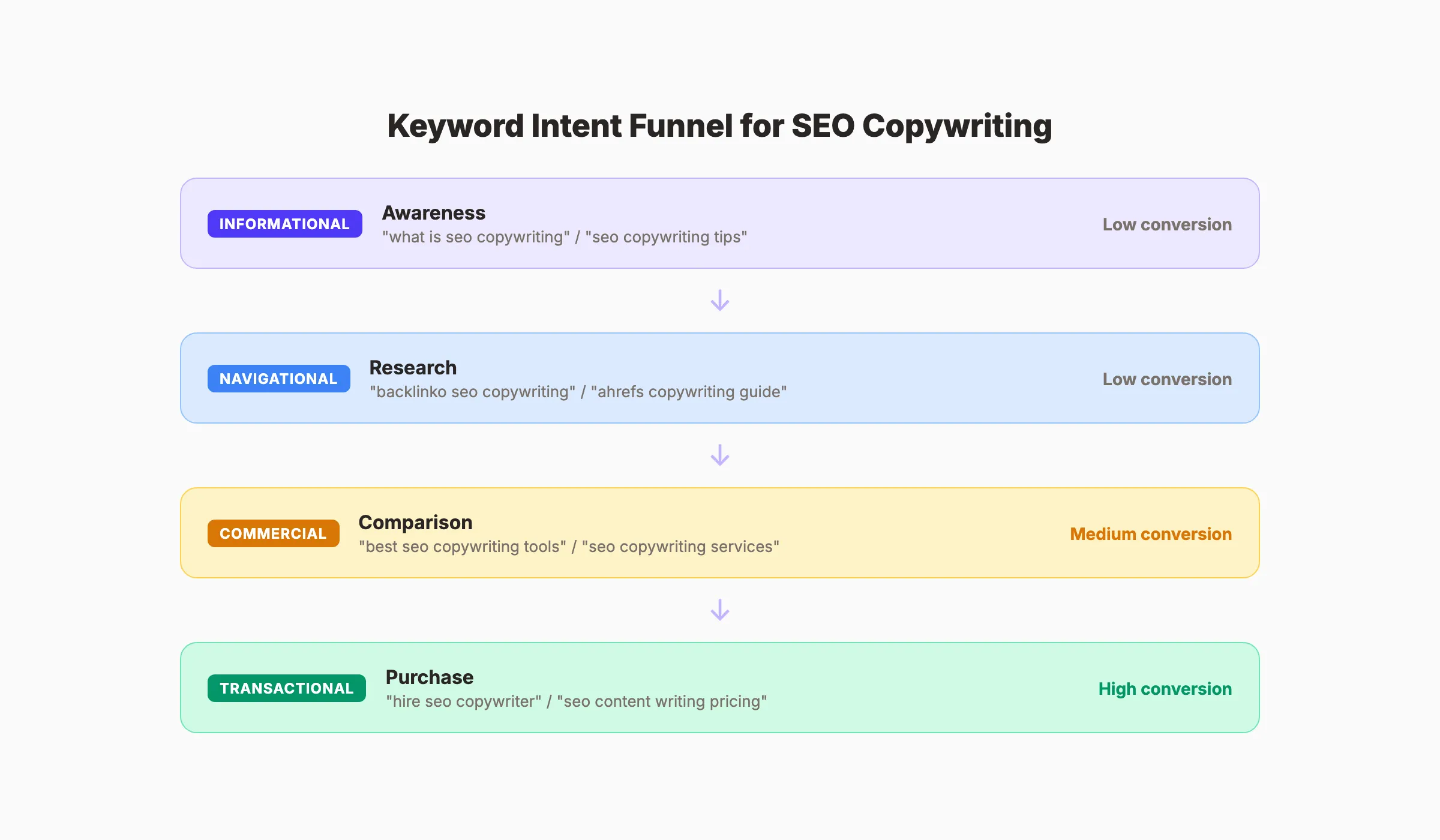
Every keyword falls into one of four search intent categories:
| Intent | Example | Conversion Potential |
|---|---|---|
| Informational | "what is seo copywriting" | Low (awareness stage) |
| Navigational | "backlinko seo copywriting guide" | Low (brand-specific) |
| Commercial | "best seo copywriting tools" | Medium (comparison stage) |
| Transactional | "hire seo copywriter" | High (purchase stage) |
For SEO copywriting, prioritize commercial and transactional keywords. These readers are closer to a decision. Your copy needs to help them make it.
Find Keywords With Conversion Intent
Use keyword research tools or Google Search Console to identify terms that include:
- Comparison modifiers: "best," "vs," "top," "review"
- Action modifiers: "how to," "template," "checklist," "example"
- Purchase modifiers: "buy," "pricing," "cost," "hire," "services"
- Problem modifiers: "fix," "improve," "increase," "optimize"
Map Keywords to Page Types
Not every keyword deserves a blog post. Match the keyword to the right page format:
| Keyword Type | Best Page Format |
|---|---|
| "best [category]" | Best-of listicle or comparison page |
| "how to [outcome]" | Step-by-step guide or tutorial |
| "[product] vs [product]" | Comparison page |
| "[topic] guide" | Pillar page or ultimate guide |
| "[service] near me" | Location landing page |
| "[product] pricing" | Pricing page or product page |
This mapping prevents the most common SEO copywriting mistake: writing a blog post when a landing page would convert 3 times better.
Stop writing. Start ranking. theStacc publishes 30 SEO articles per month for your business, starting at $99.
6 Persuasion Frameworks for SEO Copy
Most SEO guides skip this section entirely. That is a mistake. Persuasion frameworks give your content structure that both readers and search engines reward.
1. PAS (Problem - Agitate - Solve)
The most reliable formula for SEO blog intros and pain-point content.
Before (generic intro):
"SEO copywriting is important for businesses that want to rank on Google."
After (PAS intro):
"Your blog gets 200 visitors a day. Zero of them fill out your contact form. The problem is not traffic. The problem is your copy does not give readers a reason to act. This guide fixes that."
PAS works because it mirrors how people search. They have a problem. They feel the pain. They want the fix.
2. AIDA (Attention - Interest - Desire - Action)
Best for landing pages and product descriptions where you need to move readers through a decision funnel.
- Attention: Bold claim or stat that stops the scroll
- Interest: Expand on the claim with relevant details
- Desire: Show the outcome and make the reader want it
- Action: Clear CTA telling them exactly what to do next
3. APP (Agree - Promise - Preview)
Created by Backlinko. Ideal for SEO blog post introductions because it reduces bounce rate.
- Agree: State something the reader already believes ("Writing SEO content takes forever.")
- Promise: Tell them you have something better ("This framework cuts your writing time in half.")
- Preview: Show them what they will learn (bullet list of key takeaways)
4. FAB (Features - Advantages - Benefits)
Best for product pages, SaaS copy, and service descriptions.
| Element | Question It Answers | Example |
|---|---|---|
| Feature | What does it do? | "30 blog posts published monthly" |
| Advantage | Why does that matter? | "10 times more than the industry average" |
| Benefit | What does the reader gain? | "Rank for hundreds of keywords without hiring a writer" |
Most product pages list features. Strong SEO copywriting translates every feature into a benefit the reader cares about.
5. The Inverted Pyramid
Borrowed from journalism. Put the most important information first. Details second. Background last.
This framework works for SEO because Google's helpful content system rewards pages that satisfy the search query quickly. Readers who find the answer fast stay on the page longer. They do not bounce back to the SERP.
6. Bucket Brigades
Short transitional phrases that maintain reading momentum in long-form content:
- "Here is the problem with that approach."
- "But that is only half the story."
- "The real question is this."
- "And the data backs it up."
Bucket brigades reduce bounce rate by creating micro-commitments. Each phrase pulls the reader into the next paragraph. Use 2-3 per 1,000 words. More than that feels forced.
On-Page SEO Copywriting Tactics
Strong copywriting means nothing if search engines cannot parse your page correctly. These on-page tactics bridge the gap.
Headlines That Rank and Get Clicks
Your title tag is both an SEO signal and an ad for your page in the SERP. It needs to do two jobs.
Rules for SEO headlines:
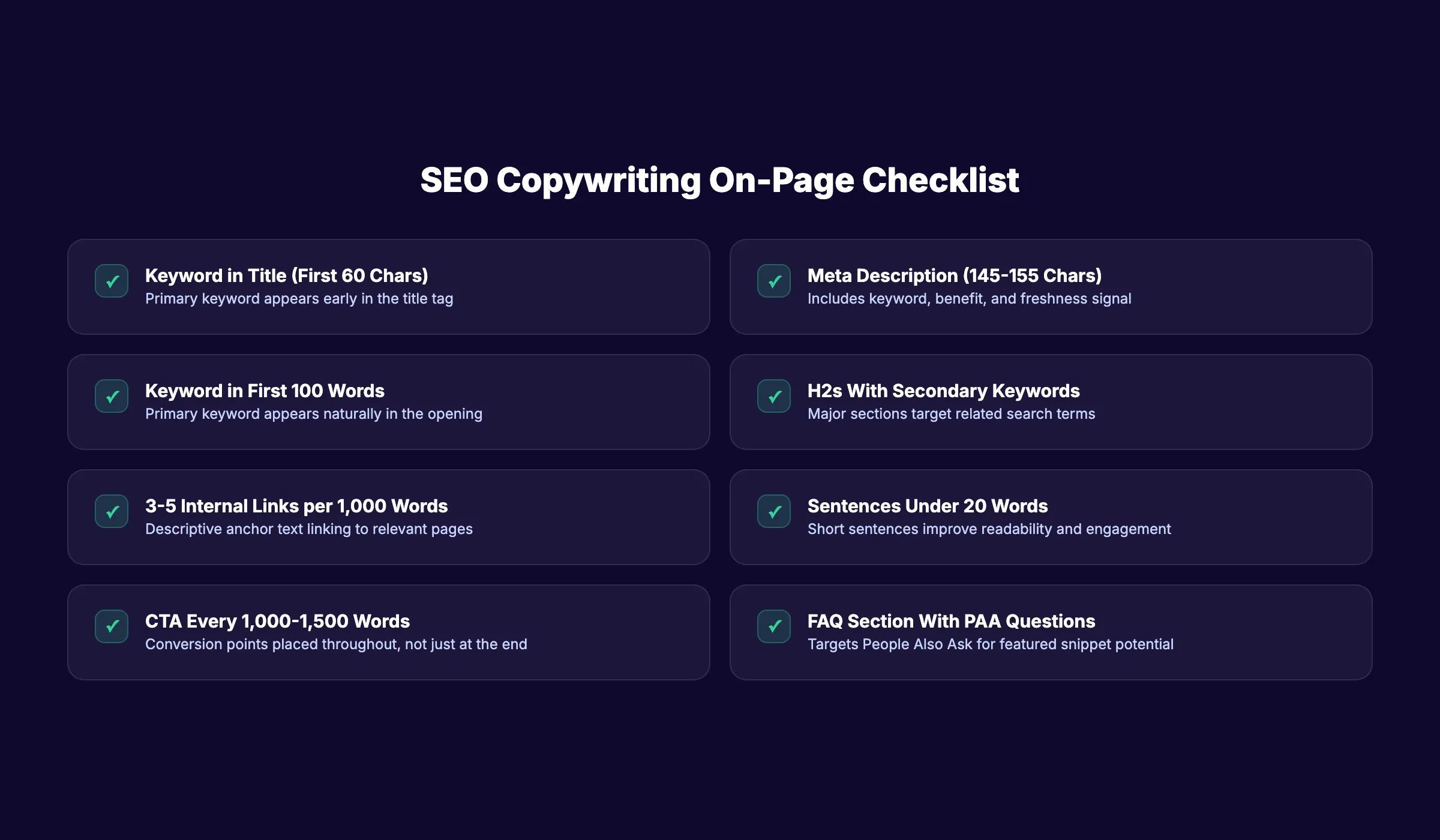
- Primary keyword in the first 60 characters
- Include a power word (complete, proven, definitive, essential)
- Add a hook in parentheses when possible (With Examples, Free Template, 2026)
- Keep it under 60 characters total
Use our Headline Analyzer to test your titles before publishing.
For a deeper guide on writing headlines, see our blog headlines guide.
Meta Descriptions That Drive Clicks
Meta descriptions do not directly affect rankings. They directly affect click-through rate. A well-written meta description can increase CTR by 5-10%.
Formula: [What we did] + [What the reader gets] + [Freshness signal]
Example: "We tested 15 SEO copywriting frameworks on real content. See which ones increase rankings and conversions. Updated March 2026."
Keep it between 145 and 155 characters. Include your primary keyword. End with a reason to click now. For more detail, read our guide on writing meta descriptions.
Header Structure
Headers serve two purposes in SEO copywriting: they create scannable structure for readers and they signal topic hierarchy to Google.
- H1: One per page. Your title. Include the primary keyword.
- H2: Major sections. Include secondary keywords naturally.
- H3: Subsections under H2s. Use for supporting points.
- No skipping levels. Every H3 belongs under an H2.
Good blog post structure directly affects both time on page and ranking position.
Internal Links With Purpose
Internal links distribute authority and guide readers deeper into your site. In SEO copywriting, every internal link should serve a conversion purpose.
- Link to related content that supports the reader's journey
- Use descriptive anchor text (not "click here" or "read more")
- Place links where they naturally fit the reading flow
- Target 3-5 internal links per 1,000 words
Formatting for Readability
Search engines reward pages where users stay and engage. Formatting directly affects engagement metrics.
- ✓ Sentences under 20 words
- ✓ Paragraphs of 1-3 sentences maximum
- ✓ Bullet lists for scannable information
- ✓ Tables for comparisons and data
- ✓ Bold text for key terms and numbers
- ✓ White space between sections
3,500+ blogs published. Every article is SEO-scored before publish. See what theStacc can do for your site.
SEO Copywriting for Different Page Types
This is where most guides stop being useful. They only cover blog posts. SEO copywriting applies to every page on your site.
Blog Posts
Blog posts target informational and commercial keywords. The goal is to build topical authority and capture organic traffic at the top of the funnel.
SEO copywriting tactics for blogs:
- Use PAS or APP frameworks for introductions
- Front-load the answer in the first 100 words (helps with featured snippets)
- Include a CTA every 1,000-1,500 words
- Write FAQs at the bottom targeting People Also Ask queries
- Demonstrate E-E-A-T through first-hand experience and data
Landing Pages
Landing pages target transactional keywords. The reader is ready to act. Your copy should make the decision easy.
SEO copywriting tactics for landing pages:
- AIDA framework for the full page flow
- One clear CTA per section (do not split attention)
- Social proof near every CTA (testimonials, stats, logos)
- FAQ section at the bottom targeting commercial keywords
- Schema markup for product, service, or FAQ types
Product and Service Pages
Product pages need to rank for "[product] + [modifier]" keywords while selling the product simultaneously.
Tactics:
- FAB framework for every feature description
- Benefit-first headlines (not feature-first)
- Comparison tables when competing against alternatives
- User reviews and ratings embedded for E-E-A-T signals
Homepage
Your homepage targets your brand name and your most valuable head term. It needs to establish what you do in the first sentence.
Tactics:
- Primary keyword in the H1 and first paragraph
- One sentence that explains your value proposition
- Clear navigation to key pages (signals site architecture to Google)
- Trust signals above the fold (client logos, stats, awards)
How to Use AI for SEO Copywriting
83% of content marketers used AI for campaigns in 2025. That number will cross 90% in 2026, per Passive Secrets. But 86% still edit AI-generated text before publishing. AI is a drafting tool, not a publishing tool.
The AI SEO Copywriting Workflow
Here is a concrete workflow that maintains quality while cutting writing time in half.
Step 1: Human research and outline. Do the keyword research, SERP analysis, and outline yourself. This is where strategic decisions happen. AI cannot choose the right angle for your audience.
Step 2: AI first draft. Use AI to generate a rough draft based on your outline. Treat this as raw material, not finished copy.
Step 3: Human rewrite. Rewrite every section with your voice, examples, and expertise. Add first-hand experience, original data, and specific opinions that AI cannot generate.
Step 4: SEO optimization. Check keyword placement, header structure, meta tags, and internal links. This is mechanical work where AI tools can assist.
Step 5: Quality check. Read the piece aloud. Cut filler. Fix passive voice. Remove hedging words. Verify every stat has a source.
For more on this process, see our guide on how to humanize AI content.
What AI Does Well for SEO Copy
- Generating first-draft body text from a detailed outline
- Rephrasing sentences for clarity
- Suggesting related keywords and topics
- Creating FAQ variations
- Formatting tables and lists
What AI Does Poorly
- Choosing the right keyword strategy
- Writing from genuine experience
- Injecting brand personality and opinion
- Creating original analogies and examples
- Understanding nuanced audience pain points
Google's helpful content system does not penalize AI content specifically. It penalizes low-quality content regardless of source. The differentiator is human editing, expertise, and originality layered on top.
Skip the agency. Keep the results. theStacc starts at $99/mo with a free trial.
How to Measure SEO Copywriting Results
Writing great copy is half the job. Measuring whether it works is the other half. Most teams track rankings or traffic but ignore whether the copy itself is performing.
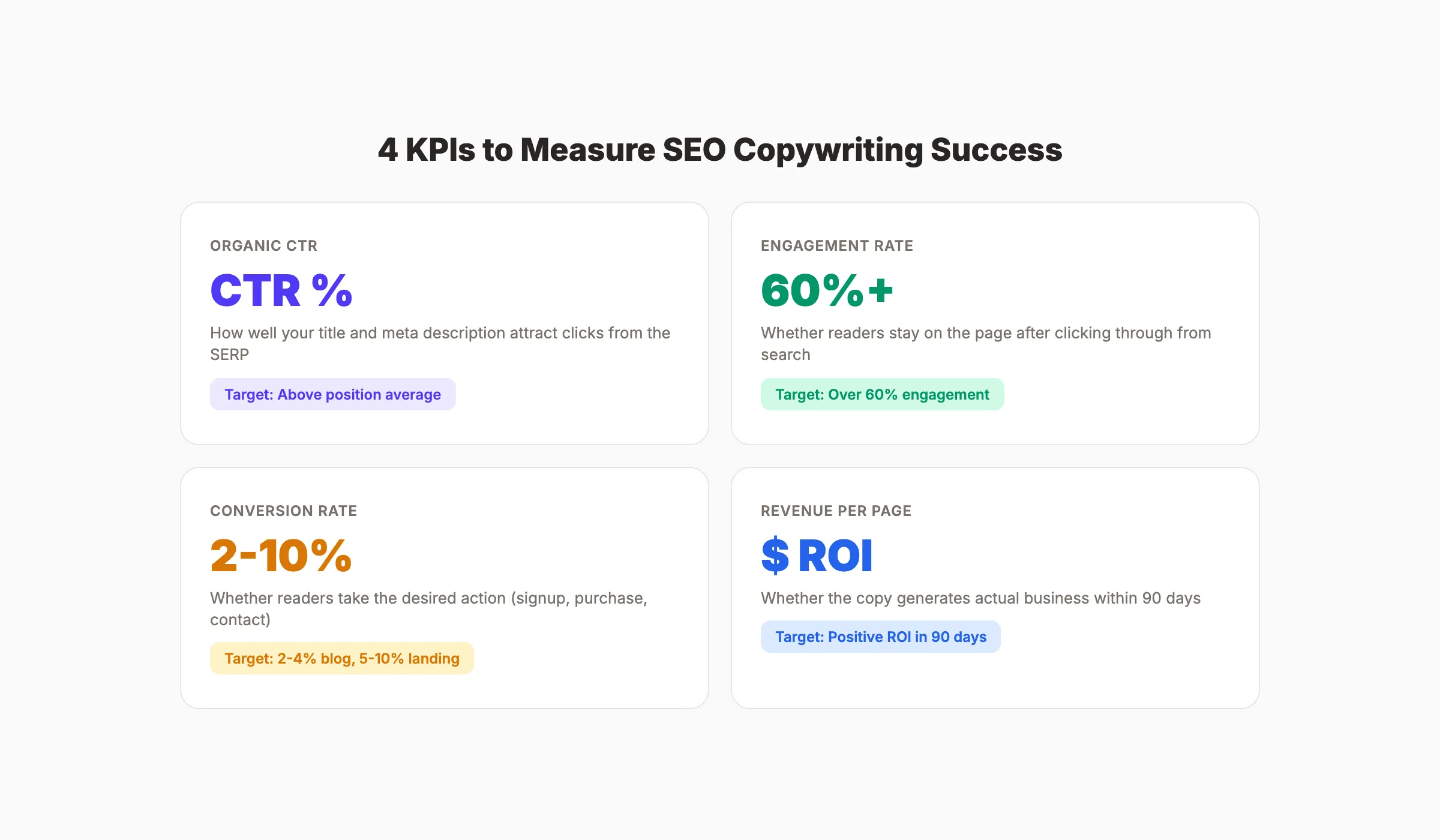
The 4 KPIs That Matter
| KPI | What It Measures | Target |
|---|---|---|
| Organic CTR | How well your title and meta description attract clicks | Above average for your ranking position |
| Bounce rate / Engagement rate | Whether readers stay after clicking | Under 50% bounce, over 60% engagement |
| Conversion rate | Whether readers take the desired action | 2-4% for blog content, 5-10% for landing pages |
| Revenue per page | Whether the copy generates actual business | Positive ROI within 90 days |
SEO campaigns yield a median ROI of 748%, according to SEOProfy. But that number varies wildly based on copy quality. A page ranking #3 with a 5% conversion rate outearns a page ranking #1 with a 0.5% conversion rate.
How to Diagnose Copy Problems
High rankings, low CTR: Your title and meta description need rewriting. Test different headlines.
Good traffic, high bounce rate: Your intro does not match search intent. The first 100 words need to deliver what the title promises.
Good engagement, low conversions: Your CTAs are weak, poorly placed, or missing. Add persuasion triggers near every conversion point.
Low rankings, everything else unknown: The copy may be fine but the on-page SEO or content strategy needs work. Check keyword targeting, header structure, and internal links.
When to Update SEO Copy
Content does not stay effective forever. Content decay is real. Pages that ranked 6 months ago may be losing positions today.
Refresh triggers:
- Rankings drop by 5+ positions over 3 months
- Organic CTR falls below SERP position averages
- Conversion rate drops more than 20%
- Statistics or data in the post are outdated
- A competitor publishes a significantly better page
Update the copy. Do not rewrite from scratch. Preserve what Google already rewards. Fix what has decayed.
Before-and-After SEO Copywriting Examples
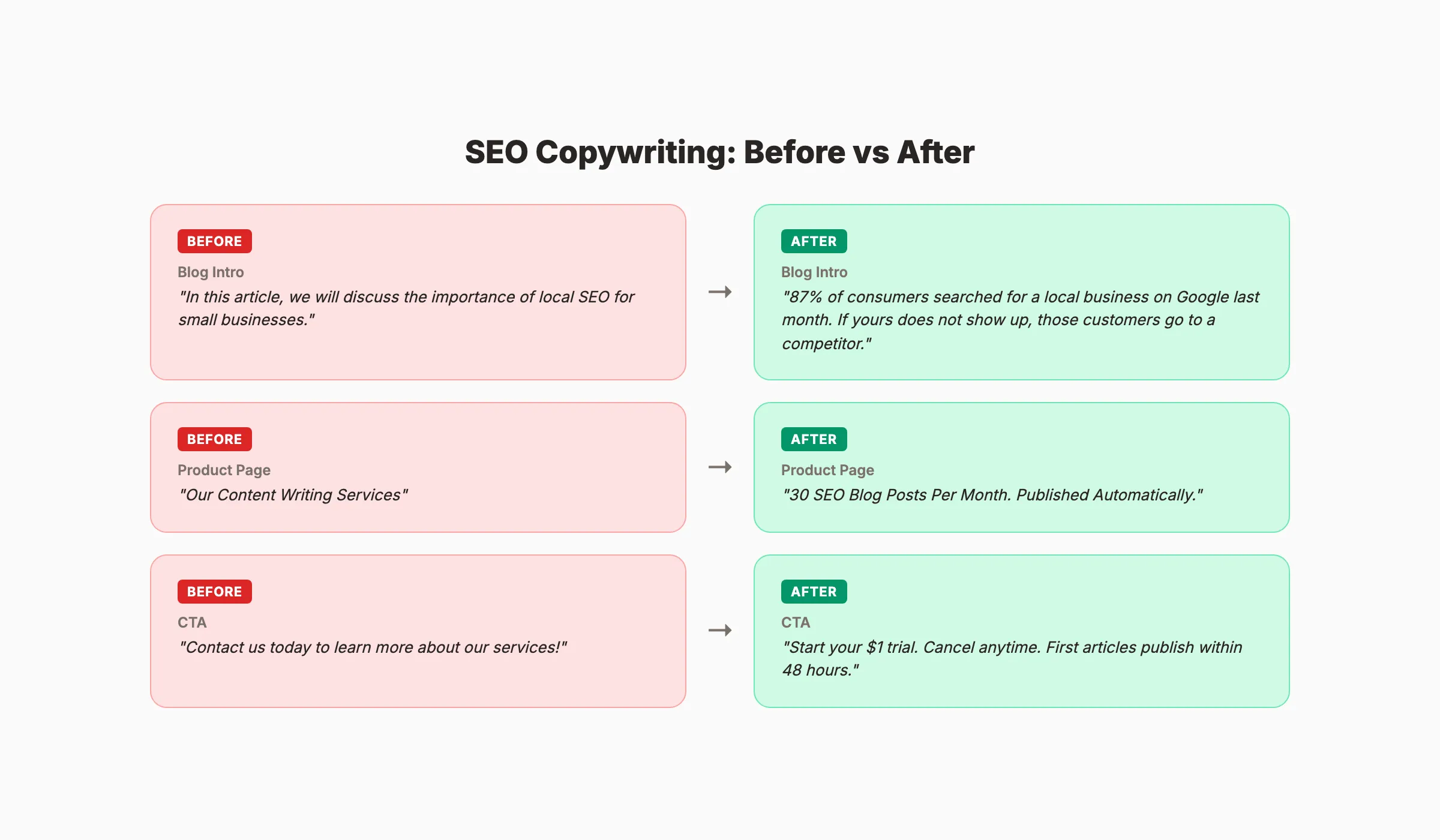
Theory is useful. Examples are better. Here are 4 common SEO copywriting patterns, each with a weak version and a rewritten version.
Example 1: Blog Post Introduction
Before:
"In this article, we will discuss the importance of local SEO for small businesses. Local SEO is a strategy that helps businesses rank in local search results."
After:
"87% of consumers searched for a local business on Google in the past month. If your business does not show up, those customers go to a competitor who does. This guide covers 7 local SEO tactics that drive foot traffic and phone calls within 60 days."
What changed: Removed vague opener. Added a specific stat. Named a concrete outcome. Created urgency.
Example 2: Product Page Headline
Before:
"Our Content Writing Services"
After:
"30 SEO Blog Posts Per Month. Published Automatically."
What changed: Replaced generic service label with a specific, benefit-driven statement. The number (30) and the outcome (published automatically) do the selling.
Example 3: Meta Description
Before:
"Learn about our SEO services and how we can help your business grow online with our team of experts."
After:
"We publish 30 SEO articles per month for your business at $99/mo. 3,500+ blogs delivered. 92% average SEO score. Try for free."
What changed: Replaced vague "learn about" with specific numbers. Added proof points. Included pricing and CTA.
Example 4: CTA Button and Context
Before:
"Contact us today to learn more about our services!"
After:
"Sign up for free. Cancel anytime. First articles publish within 48 hours."
What changed: Removed generic CTA. Added low-risk entry point ($1), objection handling (cancel anytime), and a time-bound promise (48 hours).
7 SEO Copywriting Mistakes to Avoid
These mistakes are the reason most SEO content ranks but does not generate revenue.
1. Writing for Search Engines First
Google's helpful content update explicitly rewards "content written for people." Pages that read like keyword lists get filtered out. Write naturally. Place keywords where they fit.
2. Skipping the Hook
The first 100 words determine whether someone stays or bounces. Never start with a definition or a generic statement. Start with a stat, a problem, or a bold claim.
3. Hiding the CTA
If the reader has to scroll to the bottom of a 3,000-word article to find a single CTA, most of them will never see it. Place CTAs every 1,000-1,500 words.
4. Ignoring Search Intent
A transactional keyword ("buy seo tools") needs a product page. An informational keyword ("what is seo") needs a guide. Matching the wrong format to the intent wastes the ranking.
5. Keyword Stuffing
Repeating your keyword 47 times in a 2,000-word article does not help rankings. It hurts readability and triggers Google's spam filters. Use the keyword naturally. 1-2% density is plenty.
6. Writing Without Data
Claims without evidence do not persuade and do not rank well. Every major point should be supported by a stat, an example, or a case study with a source link.
7. Never Updating Published Content
SEO copy is not a one-time deliverable. Top-performing pages get updated every 6-12 months with fresh data, new examples, and current year references.
Your SEO team. $99 per month. 30 optimized articles, published automatically.
What practitioners are saying on X
AI search advice ages quickly. Here is high-signal public discussion from SEO and growth operators — context for your roadmap, not a substitute for primary data.
- @varunram (Jul 2026): Critique of GEO slopfarm products that combine SEO clickbait with unresearched content marketing — quality and research still separate winners from farms. See the post on X.
- @jakezward (Feb 2026): 2026 SEO predictions emphasize AI Overview share-of-SERP, schema for LLM token efficiency, brand mentions in AI answers as a KPI, proprietary data as a moat, and content refresh beating net-new AI slop. See the post on X.
- @HlynurStefDev (Jul 2026): Public case: niche site traffic jumped from ~18 to 4,162 Google visits/month after focused technical/on-page SEO work (GSC screenshots claimed) — reminds that fundamentals still move numbers. See the post on X.
Grok, AI Overviews, and multi-engine visibility
Content topics like “seo copywriting guide” get AI citations when process steps, quality bars, and examples are concrete. Operator consensus on X is clear: research-backed pages beat unedited bulk generation — reflect that honestly.
- Google AI Overviews: Use passage-ready answers, tables, and FAQ schema where relevant.
- ChatGPT / Perplexity: Cite named sources next to key claims.
- Grok: Maintain accurate entity facts on-site and in high-signal X posts.
Publish content built for Google and AI citations. theStacc’s Content SEO module ships SEO-scored articles structured for rankings and generative engines — including clearer entity pages models like Grok can quote.
FAQ
SEO content writing focuses on ranking and informing. It is educational, long-form, and targets informational search intent. SEO copywriting adds a conversion layer. It writes to rank AND persuade. Landing pages, product pages, and CTAs within blog posts all fall under SEO copywriting. The most effective content combines both skills.
Yes. AI Overviews pull from pages that rank well and demonstrate expertise. Strong SEO copywriting increases the chance that your content gets cited in AI-generated answers. The key shift: write definitive, well-structured answers that AI can extract. See our guide on generative engine optimization for more on this.
59% of copywriters work as freelancers, with rates ranging from $0.10 to $1.00 per word depending on experience and niche. An agency typically charges $500 to $3,000 per page. theStacc publishes 30 SEO-optimized articles per month starting at $99/mo, which works out to roughly $3.30 per article.
Not yet. 86% of marketers still edit AI-generated text, per Blogging Wizard. AI generates drafts quickly but lacks first-hand experience, brand voice, and strategic judgment. The winning approach in 2026 is AI-assisted, human-directed. AI handles the first draft. Humans add the expertise, opinions, and conversion triggers.
PAS (Problem-Agitate-Solve) is the most reliable for blog intros and pain-point content. AIDA (Attention-Interest-Desire-Action) works best for landing pages. APP (Agree-Promise-Preview) is ideal for reducing bounce rates on blog posts. FAB (Features-Advantages-Benefits) is best for product pages. Use different frameworks for different page types.
Track 4 metrics: organic CTR (are people clicking?), engagement rate (are they staying?), conversion rate (are they acting?), and revenue per page (is it making money?). SEO campaigns yield a median ROI of 748%, but that number depends heavily on copy quality. For a deeper guide, read our article on measuring content marketing ROI.
SEO copywriting is not a separate discipline from "regular" SEO or "regular" copywriting. It is where the two disciplines merge. Every page that ranks should also convert. Every page that converts should also rank.
Start with the framework that matches your page type. Apply the on-page tactics from this guide. Measure results with the 4 KPIs. Update your copy every 6-12 months. That cycle, repeated consistently, is how content becomes revenue.
Related Tools & Resources
Free SEO Tools:
Best Lists:
Sources & references
- [1] Princeton / Georgia Tech et al. — GEO research (arXiv:2311.09735)
- [2] @varunram on X — Critique of GEO slopfarm products that combine SEO clickbait with unresearched content marketing — quality and research
- [3] @jakezward on X — 2026 SEO predictions emphasize AI Overview share-of-SERP, schema for LLM token efficiency, brand mentions in AI answers
- [4] @HlynurStefDev on X — Public case: niche site traffic jumped from ~18 to 4,162 Google visits/month after focused technical/on-page SEO work (G
- [5] Referenced source — passivesecrets.com

Plan topics, review article drafts, and publish to a connected CMS.
Weekly local SEO teardowns
One practical email a week. Map Pack, GBP, AI Overviews — no fluff. Unsubscribe anytime.
Explore this topic: Copywriting.