Social media for law firms without ethics risk: choose platforms, plan content partners approve, handle comments, and track matters, not vanity metrics.
Most law firms treat social media as an afterthought. A partner posts once every few months, the firm page has not been updated since 2022, and nobody tracks whether any of it generates a single consultation. Meanwhile, competitors with active LinkedIn and Facebook profiles are booking clients before anyone picks up the phone.
81% of potential clients check a lawyer's social media presence before making contact. Social media for law firms is not optional. It is a trust signal. Firms without an active social presence lose clients to firms that have one. The cost is not visible. You never see the client who chose someone else because your Facebook page looked abandoned.
We publish content for law firms and legal practices across dozens of markets. This guide covers what actually works for attorneys on social media. Not generic marketing theory. Specific strategies, platform recommendations, content ideas, and compliance rules that help law firms attract clients.
Here is what you will learn:
- Which social media platforms drive the most clients for law firms
- 10 content ideas that build trust and generate consultations
- Ethics and compliance rules every attorney must follow
- How to measure social media ROI for your practice
- Common mistakes law firms make (and how to fix them)
- How social media connects to your law firm SEO strategy
Why Law Firms Need Social Media in 2026
Law firms that dismiss social media as "not for lawyers" are leaving referrals, brand awareness, and client trust on the table. The data tells a clear story.
84% of law firms have gained leads from organic social media. Firms with active social profiles see 35% higher client acquisition rates compared to firms relying only on referrals and traditional advertising. Social media generates nearly double the leads of trade shows, print ads, and direct mail combined.
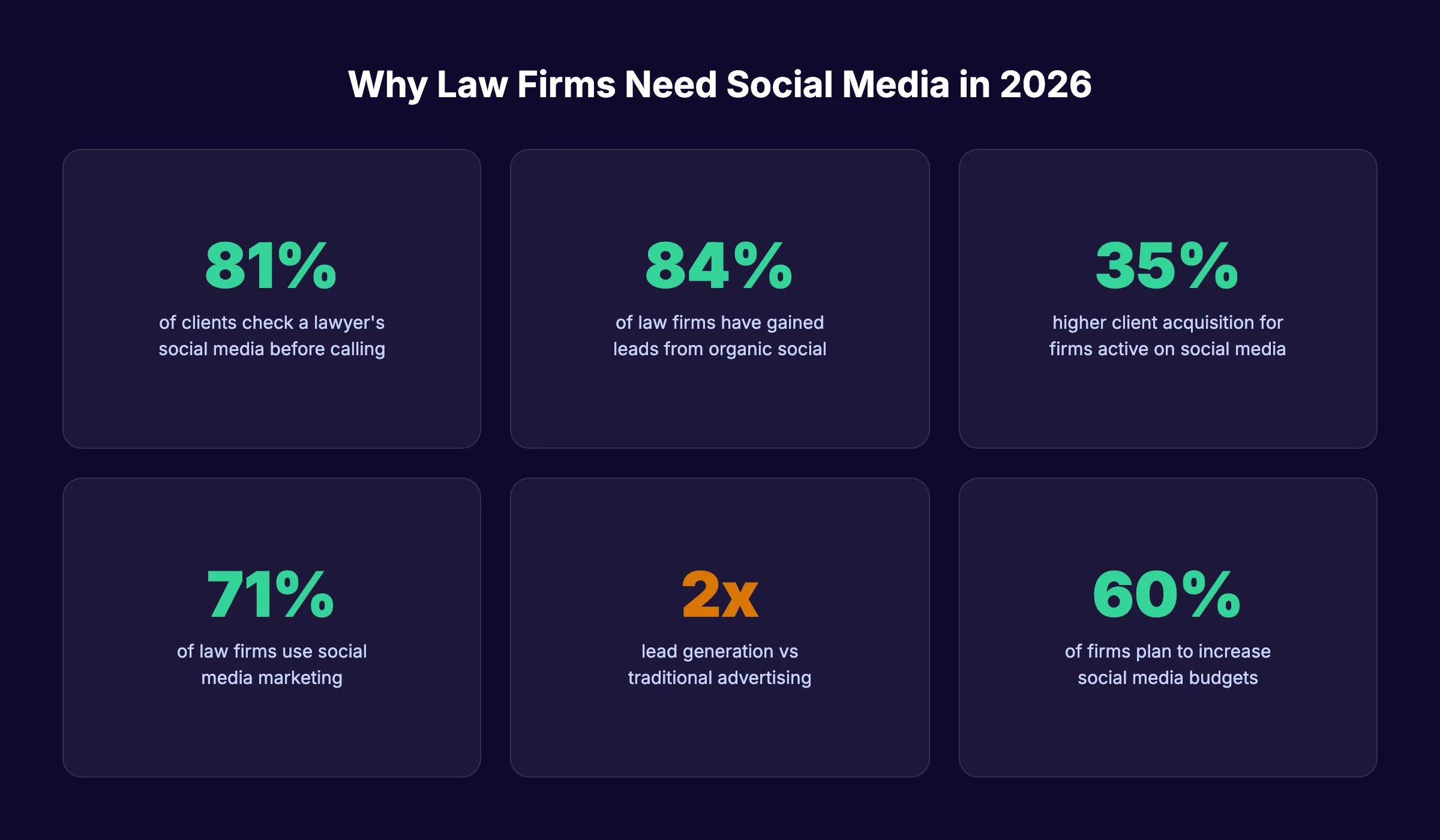
81% of Clients Check Your Profiles Before Calling
A prospective client who finds your firm through a Google search or a referral will look you up on LinkedIn and Facebook before scheduling a consultation. They want to see recent activity. They want to see real people. They want evidence that the firm is active and engaged.
A dormant profile with the last post from 18 months ago signals the opposite. It raises doubt. "Are they still practicing? Are they any good?" These are the questions a silent social profile creates. According to the 2024 Clio Legal Trends Report, online presence ranks as a top 3 factor in how clients choose a lawyer.
Social Media Builds Trust Before the First Consultation
Legal services require a high level of trust. A client hiring a criminal defense attorney or a family law firm is making one of the most personal decisions of their life. Social media gives firms the ability to demonstrate expertise, personality, and values before that first meeting.
An attorney who posts weekly LinkedIn articles about employment law builds credibility over months. When a business owner faces a wrongful termination claim, that attorney is already a trusted voice. No cold call required. This is the E-E-A-T principle in action. Google and potential clients both reward demonstrated experience and expertise.
How Social Media Supports Law Firm SEO
Social media does not directly improve Google rankings. But the indirect effects are significant. Social profiles rank in Google for branded searches. Social shares drive referral traffic to your website. Active social accounts increase brand mentions, which Google treats as a trust signal.
When someone searches "Smith & Associates law firm," your LinkedIn page, Facebook profile, and YouTube channel can occupy 3-4 additional results on page one. That pushes competitors and review sites further down. Read our full guide on whether social media helps SEO for the complete breakdown.
Social media also supports your local SEO strategy. Firms that post consistently on social media and maintain an active Google Business Profile rank higher in the local map pack. The data from our local SEO statistics report confirms this connection.
Your law firm's online presence runs on autopilot. theStacc publishes SEO content and social media posts every month so your firm stays visible without adding hours to your week.
Best Social Media Platforms for Law Firms
Not every platform deserves your time. The right 2-3 platforms reach your ideal clients without overwhelming your team. Here is how each platform ranks for law firms.
| Platform | Priority | Best For | Posting Frequency |
|---|---|---|---|
| Essential | B2B referrals, thought leadership, professional networking | 3-5x/week | |
| High | Community reach, client reviews, local targeting | 3-4x/week | |
| YouTube | Recommended | Educational videos, FAQ content, long-term SEO value | 1-2x/week |
| Optional | Firm culture, visual storytelling, younger demographics | 3-5x/week | |
| TikTok | Situational | Short-form legal tips, personal injury and criminal defense | 2-3x/week |
| Twitter/X | Low priority | Real-time legal news commentary | 3-5x/week |
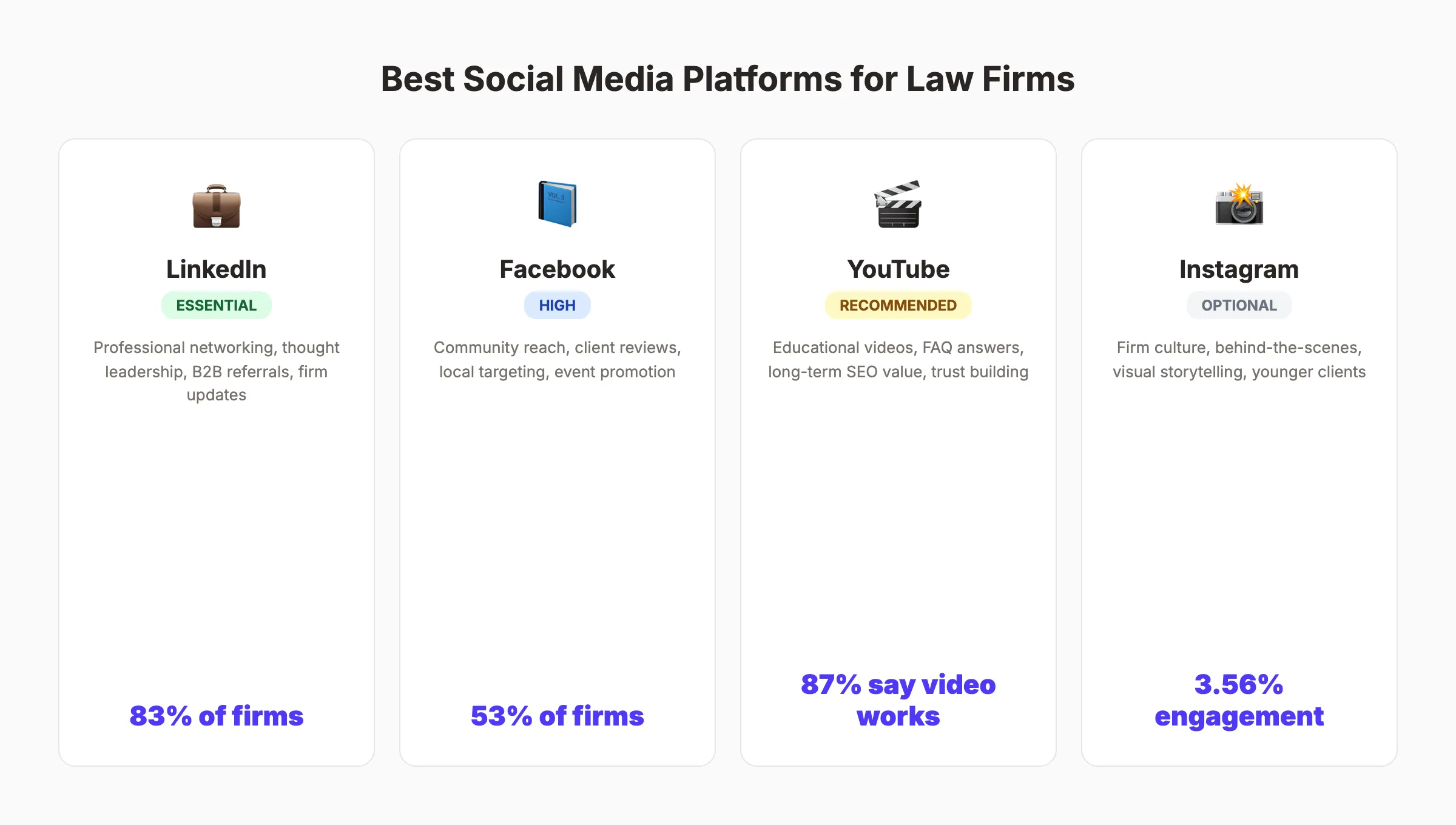
LinkedIn Is the Top Platform for Attorneys
83% of law firms maintain a LinkedIn presence. For good reason. LinkedIn is where attorneys, corporate clients, referral partners, and business professionals spend time. It is the single most effective platform for B2B law firms, including corporate law, employment law, intellectual property, and commercial litigation.
LinkedIn works for law firms because the audience already expects professional content. A 400-word post about a recent Supreme Court ruling or a change in employment regulations feels natural here. The same post on Instagram would fall flat.
Key LinkedIn tactics for law firms:
- Personal profiles over firm pages. Individual attorney posts get 5-8x more engagement than company pages
- Long-form posts with opinions. Take a position on a legal topic. "Here is why the new overtime rule changes everything for small businesses" outperforms neutral summaries
- Comment on other posts. Engagement with your network increases your visibility in the feed
- Publish articles for SEO. LinkedIn articles index in Google and rank for long-tail queries
For a deeper look at LinkedIn strategy, read our guide on LinkedIn for local businesses.
Facebook for Community Reach and Client Trust
53% of law firms use Facebook. The platform works best for consumer-facing practice areas like personal injury, family law, estate planning, and criminal defense. Facebook's demographic skews older, which aligns well with clients making legal decisions for their families.
Facebook Groups are underused by law firms. A family law attorney who runs a "Divorce Support and Resources" group in their city builds a direct pipeline to potential clients. The group provides value. The attorney becomes the trusted resource. When members need legal help, the attorney is the first call.
Facebook reviews also matter. 72% of consumers trust online reviews as much as personal referrals. Encourage satisfied clients to leave Facebook reviews and respond to every one. For more on building your review profile, see our guide on getting more Google reviews for local businesses.
YouTube for Long-Term Visibility
YouTube is the second-largest search engine. A single video answering "what to do after a car accident in [city]" can rank for months and send a steady stream of consultations. 87% of legal video marketers report that video content is effective for lead generation.
YouTube videos also embed well on your website, boosting time on page and supporting your content marketing strategy. A 3-minute FAQ video on your practice area pages gives visitors another reason to stay, which signals quality to Google.
Effective YouTube content for law firms:
- FAQ videos. Answer the top 10 questions your receptionist hears
- Process explainers. "What happens during a personal injury claim"
- Legal news commentary. React to new laws or major rulings
- Client testimonial videos. With written consent
Instagram for Humanizing Your Practice
Instagram is optional for most law firms but valuable for practices that want to attract younger clients or showcase firm culture. Family law, immigration law, and personal injury firms see the strongest Instagram engagement.
The key to Instagram for lawyers is authenticity. Behind-the-scenes office content, attorney introductions, community event photos, and infographics explaining legal concepts perform better than stock images of gavels and law books.
Instagram Reels reach a wider audience than static posts. A 30-second clip of an attorney explaining one legal concept gets more visibility than a polished graphic. The platform rewards faces, voices, and real content.
Platform Priority by Practice Area
Different practice areas perform best on different platforms. Use this guide to focus your efforts.
| Practice Area | Primary Platform | Secondary Platform | Optional |
|---|---|---|---|
| Corporate/Business Law | YouTube | ||
| Personal Injury | YouTube | TikTok | |
| Family Law | YouTube | ||
| Criminal Defense | YouTube | TikTok | |
| Estate Planning | YouTube | ||
| Employment Law | YouTube | ||
| Immigration Law | YouTube | ||
| Real Estate Law | |||
| IP/Patent Law | YouTube | Twitter/X |
For a broader view, read our guide on the best social media platforms for local businesses.
Law Firm Social Media Content Ideas That Build Authority
Posting consistently matters more than posting perfectly. But knowing what to post eliminates the blank-page problem that stops most law firms from maintaining their social accounts.
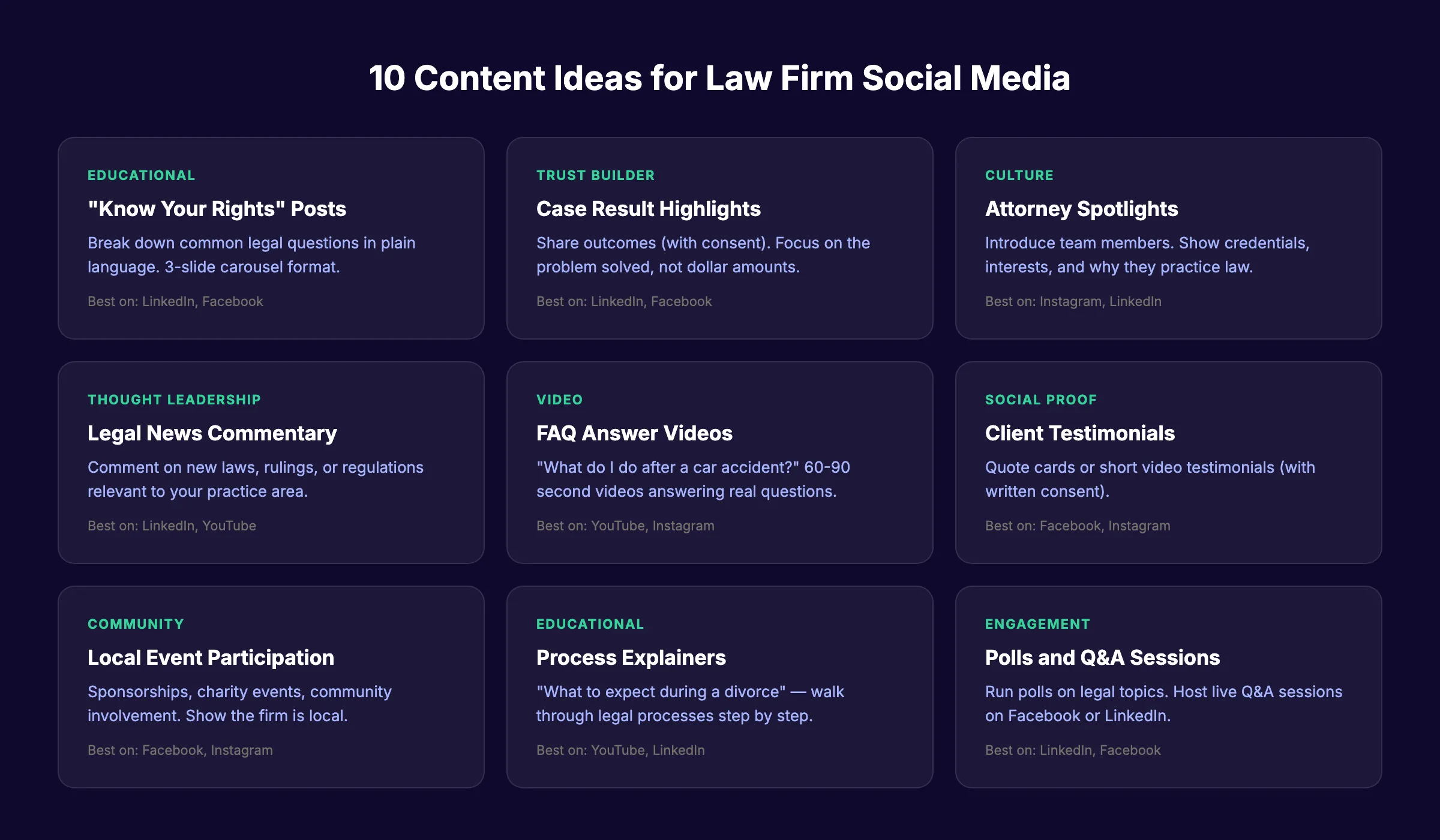
Educational Legal Explainers
Educational content is the highest-performing category for law firms on social media. Break down legal concepts in plain language. "5 things to know before signing a commercial lease." "What counts as wrongful termination in Texas." "3 mistakes people make after a car accident."
These posts demonstrate expertise without giving legal advice. They attract the exact people who need your services. A potential client reading your post about divorce timelines in their state is already thinking about hiring someone.
Format tips:
- LinkedIn: 300-500 word text posts or PDF carousels
- Facebook: Short posts (100-200 words) with a graphic
- YouTube: 2-4 minute explainer videos
- Instagram: Carousel slides or Reels under 60 seconds
You can repurpose blog content for social media to keep the pipeline full without creating everything from scratch. One blog post becomes 5-8 social posts across platforms.
Case Results and Client Testimonials
Social proof is the most persuasive content a law firm can post. Potential clients want to see that you have handled cases like theirs and achieved positive outcomes.
Post case results with consent. Focus on the problem and the resolution, not just dollar amounts. "Client came to us facing foreclosure. We negotiated a loan modification that saved their home." That story resonates more than "$500K settlement."
Client testimonial videos are even more effective. A 60-second video of a real client describing their experience builds trust faster than any written review. Always get written consent before posting any client content.
Behind-the-Scenes Firm Culture
Clients hire people, not firms. Content that shows the human side of your practice stands out in a feed full of legal jargon and stock photography.
Ideas for behind-the-scenes content:
- Attorney introductions with personal details (hobbies, why they chose law)
- Office tours and workspace photos
- Team celebrations and milestones
- Community service and pro bono work
- Conference attendance and continuing education
Current Events and Legal Commentary
Commenting on legal news positions attorneys as thought leaders. When a major ruling drops or a new law takes effect, attorneys who post timely analysis get significant engagement. This content performs best on LinkedIn and YouTube.
The key is speed. Post within 24-48 hours of the news. A well-timed LinkedIn post about a Supreme Court decision can reach 10,000+ views if it hits while the topic is trending.
Content Calendar Template for Law Firms
A content calendar eliminates guesswork. Here is a weekly template for law firms posting on LinkedIn and Facebook.
| Day | ||
|---|---|---|
| Monday | Educational post (legal tip or explainer) | Legal tip graphic |
| Tuesday | Industry news commentary | Client testimonial or review |
| Wednesday | Case result or success story | Community or office photo |
| Thursday | Opinion post or thought leadership | FAQ post or video |
| Friday | Attorney spotlight or personal story | Weekend legal tip |
Adjust frequency based on your resources. Posting 3 times per week consistently beats posting 7 times one week and disappearing for a month.
Stop spending hours on social media content. theStacc creates and publishes social media posts for your law firm across 3 platforms, every month. 30 posts, zero effort from your team.
Ethics and Compliance Rules Every Attorney Must Follow
Social media marketing for law firms comes with rules that do not apply to other industries. Every state bar has advertising guidelines that extend to social media. Violations can result in disciplinary action, fines, or even license suspension.
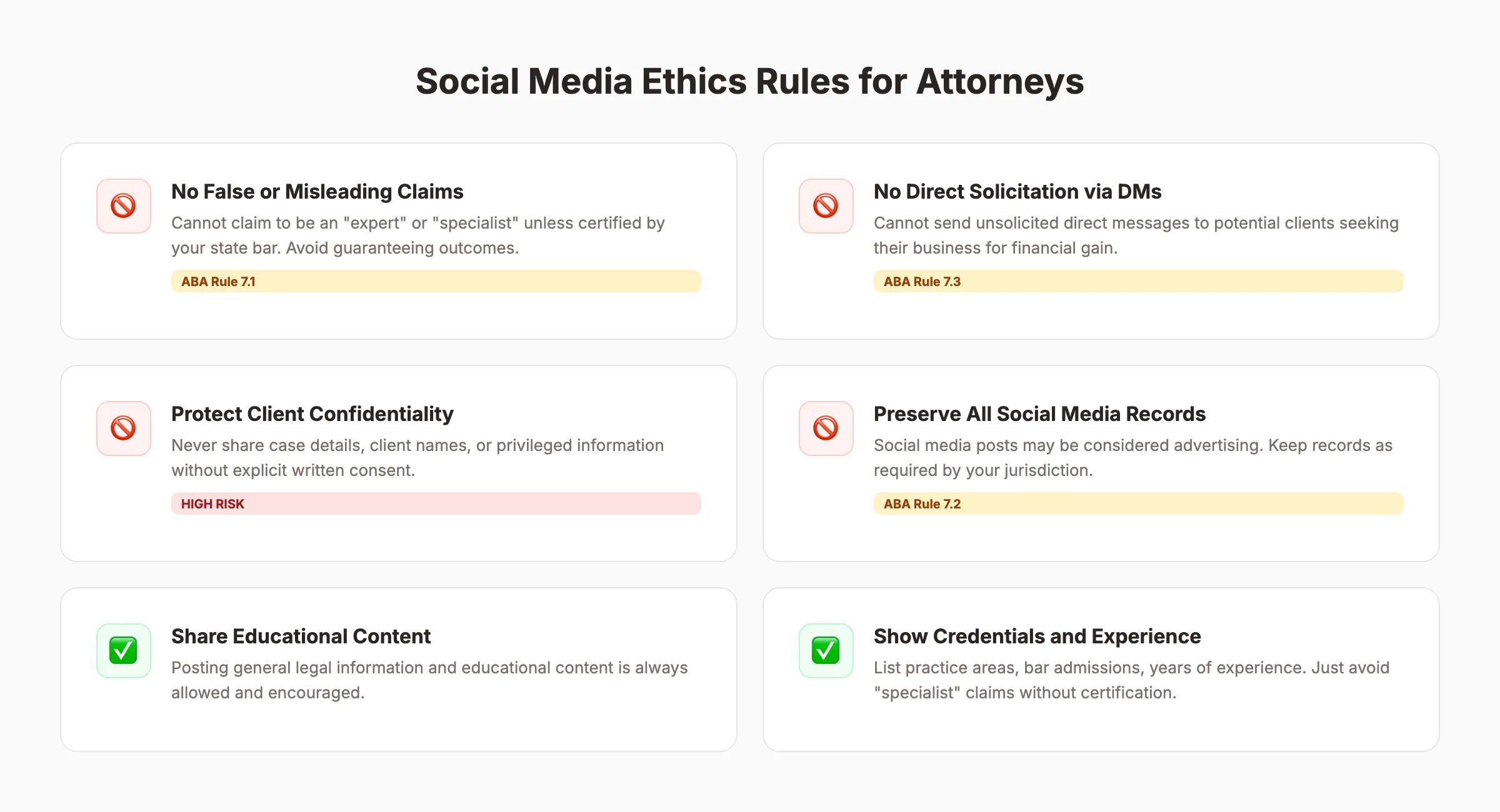
ABA Model Rules on Attorney Advertising
The American Bar Association Model Rules of Professional Conduct form the foundation for attorney advertising rules in most states. Three rules directly impact social media.
Rule 7.1. No false or misleading communications. You cannot make claims about your services that are false or likely to create unjustified expectations. Saying "we win every case" violates this rule. Saying "we have 20 years of experience in personal injury law" does not.
Rule 7.2. Advertising rules. Social media posts qualify as advertising in most jurisdictions. Some states require you to retain copies of all social media posts for a specified period. Others require specific disclaimers on posts that could be considered advertising.
Rule 7.3. Solicitation restrictions. You cannot send unsolicited direct messages to potential clients for financial gain. Commenting publicly is fine. Sending a DM to someone who posted about needing a lawyer crosses the line in most states.
Confidentiality and Client Information
This is the highest-risk area for attorneys on social media. Never share client names, case details, or privileged information without explicit written consent. Even anonymized stories can violate confidentiality if someone could identify the client.
Common confidentiality mistakes on social media:
- ✓ Posting about a case outcome without client consent
- ✓ Sharing details that could identify a client even without naming them
- ✓ Responding to a client's public post or review with case details
- ✓ Sharing documents or screenshots that contain client information
When in doubt, do not post. The reputational damage from a confidentiality breach far outweighs any marketing benefit.
Claims You Cannot Make on Social Media
Most state bars prohibit specific language in attorney marketing. Avoid these terms unless your state bar has certified you:
| Avoid | Why | Use Instead |
|---|---|---|
| "Expert" | Requires state bar certification in most states | "Experienced in" or "focused on" |
| "Specialist" | Same restriction as expert | "Concentrating in" or "practice area" |
| "Best lawyer in [city]" | Unsubstantiated superlative claim | "Serving [city] for 20+ years" |
| "We guarantee results" | Cannot promise outcomes | "We fight aggressively for our clients" |
| "Free consultation" (in some states) | Restrictions vary by jurisdiction | Check your state bar rules first |
State Bar Compliance Checklist
Rules vary by state. Before launching any social media strategy, complete this checklist:
- ✓ Review your state bar's advertising rules (they change frequently)
- ✓ Determine whether your state requires advertising disclaimers on social posts
- ✓ Establish a review process for social content before publishing
- ✓ Create a consent form for client testimonials and case studies
- ✓ Set up an archive system for all social media posts
- ✓ Train all attorneys and staff on social media ethics rules
- ✓ Check whether your state requires pre-approval of certain advertisements
The strongest approach: designate one attorney as the social media compliance reviewer. Every post goes through them before publishing. This adds a small delay but eliminates the risk of a bar complaint.
Understanding E-E-A-T signals also helps here. Google evaluates expertise and trustworthiness for legal content. Posts that demonstrate real credentials and follow ethical guidelines rank better in search results.
How to Measure Social Media ROI for Law Firms
Law firm partners want to see results, not vanity metrics. "We got 50 likes on LinkedIn" does not justify the time investment. Tracking consultations, leads, and revenue from social media does.
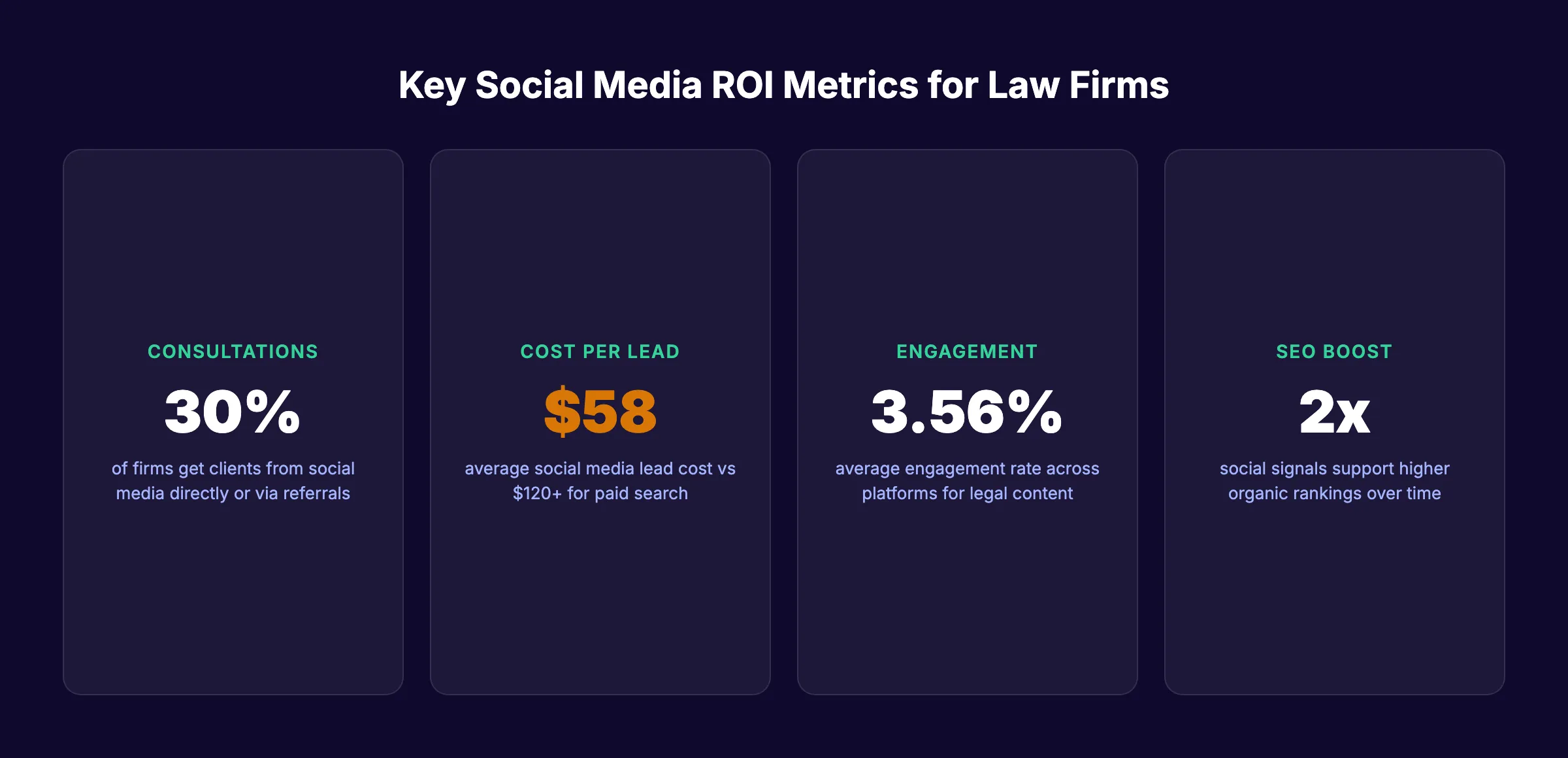
Metrics That Matter for Attorneys
Focus on these 5 metrics:
| Metric | What It Measures | How to Track |
|---|---|---|
| Consultation requests from social | Direct business impact | UTM links on social profile URLs |
| Website traffic from social | Awareness and interest | Google Analytics referral report |
| Profile views | Brand visibility | Platform native analytics |
| Engagement rate | Content quality | (Likes + comments + shares) / followers |
| Follower growth | Audience building | Monthly tracking spreadsheet |
Consultation requests are the only metric that directly connects to revenue. Every other metric is a leading indicator.
Track Consultations From Social Media
Set up UTM parameters on every link you share from social media. When a potential client clicks a link in your LinkedIn post and books a consultation, Google Analytics attributes that conversion to LinkedIn.
Your intake form should also ask "How did you hear about us?" with social media as an option. Cross-reference these self-reported answers with your UTM data for the most accurate picture.
For firms spending $2,000+ monthly on social media (ads, tools, time), the target return is 3-5 consultations per month from social channels. At an average case value of $5,000-$50,000 depending on practice area, even one client per month makes the investment worthwhile.
For more on tracking content performance, read our guide on measuring content marketing ROI. Our content marketing statistics report also provides industry benchmarks.
Benchmarks by Platform
| Platform | Good Engagement Rate | Good Monthly Growth | Average Lead Quality |
|---|---|---|---|
| 2-5% | 3-5% follower growth | High (B2B, corporate) | |
| 1-3% | 2-4% follower growth | Medium-High (consumer) | |
| YouTube | 4-8% | 5-10% subscriber growth | High (intent-driven) |
| 2-4% | 3-6% follower growth | Medium (brand awareness) |
LinkedIn generates the highest-quality leads for most law firms because the audience is already in a professional mindset. Facebook generates more volume but lower average case value.
Get social media done without the guesswork. theStacc publishes 30 social posts per month for law firms across LinkedIn, Facebook, and Instagram. All compliant. All on-brand.
7 Social Media Mistakes Law Firms Make
Knowing what not to do saves as much time as knowing what to do. These are the 7 most common social media mistakes we see from law firms.
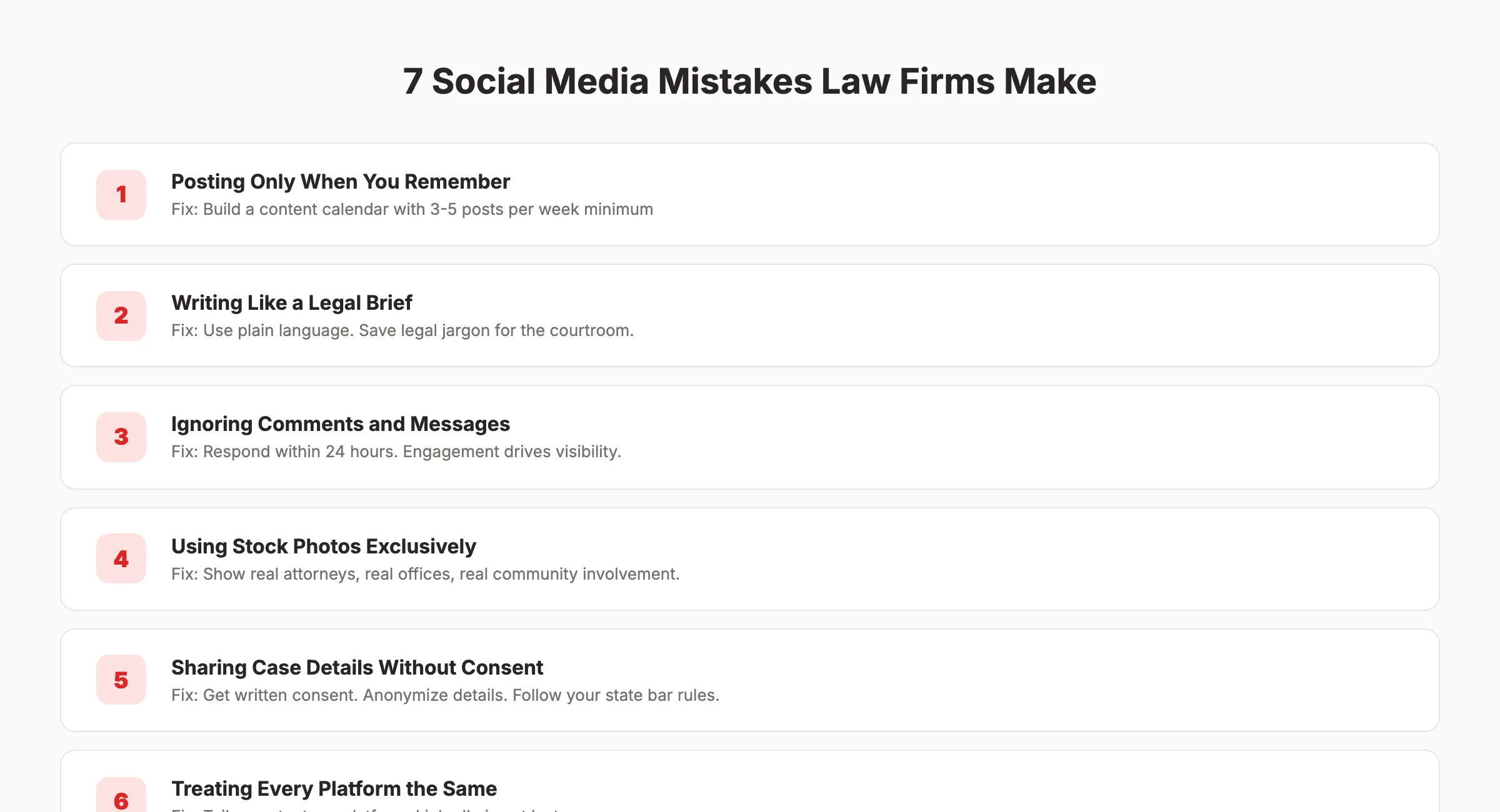
1. Posting only when you remember. Sporadic posting is worse than not posting at all. It tells potential clients the firm is disorganized. Build a schedule. Use free social media scheduling tools to batch-create and schedule content in advance.
2. Writing like a legal brief. Social media is not a courtroom filing. "Pursuant to the aforementioned statutory provisions" loses every audience. Write at a 6th-grade reading level. Short sentences. Plain words. Save legal language for legal documents.
3. Ignoring comments and messages. Social media is a two-way channel. When a potential client comments on your post or sends a message, responding within 24 hours is the minimum. Every unanswered comment is a missed opportunity.
4. Using stock photos exclusively. Generic images of gavels, scales of justice, and suited professionals look identical to every other law firm's social media. Show real attorneys. Show real offices. Show real community involvement. Authenticity outperforms polish.
5. Sharing case details without consent. This is an ethics violation, not just a marketing mistake. One Instagram post about a case without proper consent can result in a bar complaint. Get written authorization for every client story, testimonial, and case result you share.
6. Treating every platform the same. A LinkedIn post and an Instagram post require different formats, different tones, and different content types. Cross-posting the exact same content to every platform wastes the strengths of each one. Tailor your approach.
7. No tracking or ROI measurement. If you do not know whether social media generates consultations, you cannot justify the investment. Set up UTM links from day one. Track every lead source. Report monthly on social media performance alongside other marketing channels.
For a full social media toolkit, see our roundup of social media management tools for local businesses.
Tools for Managing Law Firm Social Media
The right tools reduce social media from a 10-hour weekly task to a 2-hour one. Here are the categories that matter for law firms.
Scheduling tools. Buffer, Hootsuite, and Later let you batch-schedule a full week or month of posts in one sitting. This is the single biggest time-saver. Write all your posts on Monday morning and let the tool publish them throughout the week. See our complete guide to free social media scheduling tools.
Content creation tools. Canva provides templates for legal infographics, quote cards, and social graphics. Descript makes video editing simple for YouTube and Reels content. Neither requires design or video production experience.
Analytics tools. Each platform has native analytics. For a unified view, Sprout Social and Hootsuite provide cross-platform reporting. Track the metrics from our ROI section above.
Compliance tools. Archive social media posts for bar compliance using tools like PageFreezer or Hanzo. These create tamper-proof records of all social media activity.
All-in-one content services. theStacc publishes 30 social media posts per month across 3 platforms for $49/month. No scheduling. No content creation. No compliance headaches. The posts are written, designed, and published for you.
| Tool Category | Free Option | Paid Option | Best For |
|---|---|---|---|
| Scheduling | Buffer (free tier) | Hootsuite ($99/mo) | Batching content |
| Design | Canva (free tier) | Canva Pro ($13/mo) | Graphics and carousels |
| Video | CapCut (free) | Descript ($24/mo) | YouTube and Reels |
| Analytics | Platform native | Sprout Social ($199/mo) | Cross-platform reporting |
| Compliance | Manual screenshots | PageFreezer (custom) | Bar advertising records |
| Done-for-you | , | theStacc ($49/mo) | Full social media management |
What practitioners are saying on X
Marketing systems still win. Here is operator signal from X on SEO stacks and fundamentals.
- @jakezward (Feb 2026): 2026 SEO predictions emphasize AI Overview share-of-SERP, schema for LLM token efficiency, brand mentions in AI answers as a KPI, proprietary data as a moat, and content refresh beating net-new AI slop. See the post on X.
- @ConnorGillivan (Jul 2026): 2026 SEO stack favorite list: Semrush/Ahrefs, GSC, Surfer, KeywordInsights, ChatGPT, SEOwind, Screaming Frog, ClearScope, GA4, Notion/Airtable — tools amplify systems, they don’t replace them. See the post on X.
- @HlynurStefDev (Jul 2026): Public case: niche site traffic jumped from ~18 to 4,162 Google visits/month after focused technical/on-page SEO work (GSC screenshots claimed) — reminds that fundamentals still move numbers. See the post on X.
Grok, AI Overviews, and multi-engine visibility
For “social media for law firms”, multi-engine visibility still starts with clear definitions, sourced numbers, and extractable section answers. Grok additionally factors live X discussion — keep public claims consistent with this page.
- Google AI Overviews: Use passage-ready answers, tables, and FAQ schema where relevant.
- ChatGPT / Perplexity: Cite named sources next to key claims.
- Grok: Maintain accurate entity facts on-site and in high-signal X posts.
Publish content built for Google and AI citations. theStacc’s Content SEO module ships SEO-scored articles structured for rankings and generative engines — including clearer entity pages models like Grok can quote.
FAQ
Yes. 81% of potential clients check a lawyer's social media before calling. Firms with active social profiles see 35% higher client acquisition rates. Social media is not about going viral. It is about being visible and trustworthy when someone searches for your firm.
LinkedIn is the best platform for most law firms. 83% of law firms maintain a LinkedIn presence. It works especially well for corporate, employment, and IP law. Consumer-facing practices (personal injury, family law, criminal defense) see stronger results on Facebook. The best approach is 2-3 platforms, not all of them.
Yes, but with restrictions. The ABA Model Rules prohibit false or misleading claims, unsolicited direct messages for financial gain, and use of terms like "expert" or "specialist" without state bar certification. Every state has its own variations. Review your state bar advertising rules before running paid social campaigns.
3-5 times per week on your primary platform (usually LinkedIn) and 3-4 times per week on your secondary platform (usually Facebook). Consistency matters more than frequency. Posting 3 times every week for a year beats posting daily for one month and then stopping.
Small firms (1-5 attorneys) should budget $500-$2,000 per month for social media marketing, including tools, ads, and time or outsourcing costs. Mid-size firms (6-20 attorneys) typically spend $2,000-$5,000 per month. The target ROI is 3-5 new consultations per month from social channels. At average case values of $5,000-$50,000, even one new client per month delivers a positive return. For firms that want to eliminate the time investment entirely, theStacc handles social media publishing for $49/month.
Social media for law firms works when it is consistent, compliant, and client-focused. Pick 2-3 platforms. Post 3-5 times per week. Track consultations from social channels. The firms that show up consistently on LinkedIn and Facebook earn trust before the first phone call. The firms that do not lose clients to the ones that do.
Let theStacc handle your law firm's content. Blog SEO, social media, and local SEO, all publishing on autopilot every month.
Related Tools & Resources
Free SEO Tools:
Best Lists:
Sources & references
- [1] Princeton / Georgia Tech et al. — GEO research (arXiv:2311.09735)
- [2] @hridoyreh on X — Widely shared SEO skill tree: foundations, research, technical, on-page, content, links, AI SEO/GEO, analytics, UX, bran
- [3] @jakezward on X — 2026 SEO predictions emphasize AI Overview share-of-SERP, schema for LLM token efficiency, brand mentions in AI answers
- [4] Referenced source — seoprofy.com

Manage Google Business Profile posts, review replies, and local rank tracking.
Weekly local SEO teardowns
One practical email a week. Map Pack, GBP, AI Overviews. No fluff. Unsubscribe anytime.