
AI SEO Tools: The Complete Guide (2026)
We break down 8 categories of AI SEO tools, what works, what does not, and how to pick the right stack. Updated for March 2026.
The AI SEO tools market hit $2.2 billion in 2025. By 2035, it will reach $5.97 billion. Every vendor promises to “automate your SEO.” Most of them automate the wrong things.
Here is the problem. There are now 8 distinct categories of AI SEO tools. Most businesses buy the wrong category for their needs. They spend $100 to $400 per month on a tool that duplicates what a free LLM already does. Or they skip the category that would actually move their rankings.
We have published 3,500+ blogs across 70+ industries. We use AI for SEO every day. This guide breaks down every category of AI SEO tool, explains what actually works, and helps you pick the right stack for your budget.
Here is what you will learn:
- The 8 categories of AI SEO tools and what each one does
- Which categories deliver real ranking improvements (and which do not)
- How to build an AI SEO stack based on your budget and team size
- What Google officially says about AI-generated content
- The emerging GEO category that most guides still ignore
What Are AI SEO Tools?
AI SEO tools use machine learning and large language models to automate parts of the search engine optimization process. They range from simple content generators to full-stack platforms that handle research, writing, optimization, tracking, and technical audits.
The term “AI SEO tools” covers a wide spectrum. A free ChatGPT prompt that generates meta descriptions is an AI SEO tool. So is a $449 per month enterprise platform that audits 100,000 pages automatically.
The distinction that matters is not “AI or not.” Every SEO tool uses AI now. The distinction that matters is which part of the SEO workflow the tool automates and whether that automation produces measurable results.
Why AI SEO Tools Matter in 2026
Three forces make AI SEO tools more relevant now than 12 months ago.
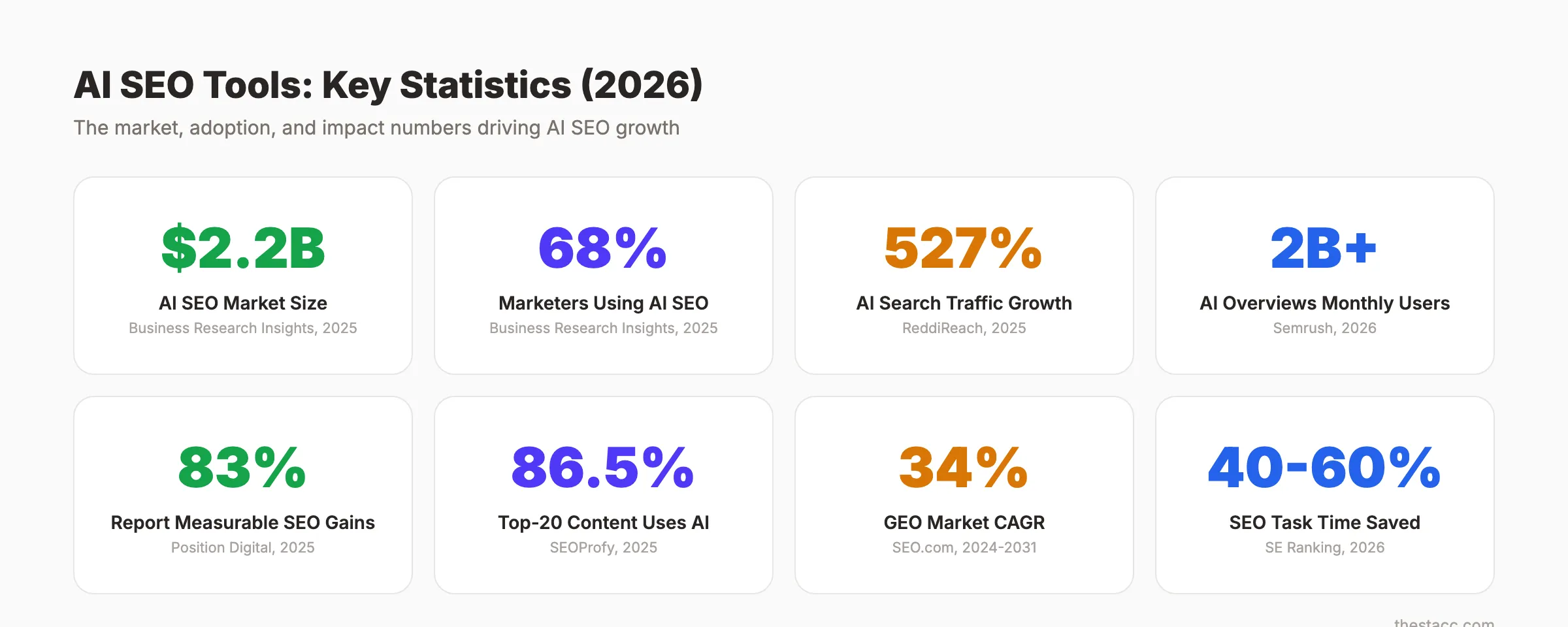
1. AI search is eating traditional search. Google AI Overviews now reach 2 billion monthly users across 200+ countries. ChatGPT is the 4th most visited website globally with 5 billion+ monthly visits. Organic click-through rates dropped 61% for queries where AI Overviews appear. You now need tools that optimize for both traditional and AI search.
2. Content volume requirements keep rising. The average top-ranking page competes against 86.5% AI-generated content in the top 20 results. Publishing 1 to 2 articles per month no longer builds enough topical authority to rank. AI tools let small teams match the output of large content operations.
3. New optimization surfaces exist. Generative engine optimization (GEO) is a $886 million market growing at 34% annually. Tools that track brand visibility in ChatGPT, Perplexity, Gemini, and Copilot responses barely existed 18 months ago. Now they are essential for any serious SEO strategy.
Stop writing. Start ranking. Stacc publishes 30 SEO articles per month for $99. Blog SEO, Local SEO, and Social on autopilot. Start for $1 →
The 8 Categories of AI SEO Tools
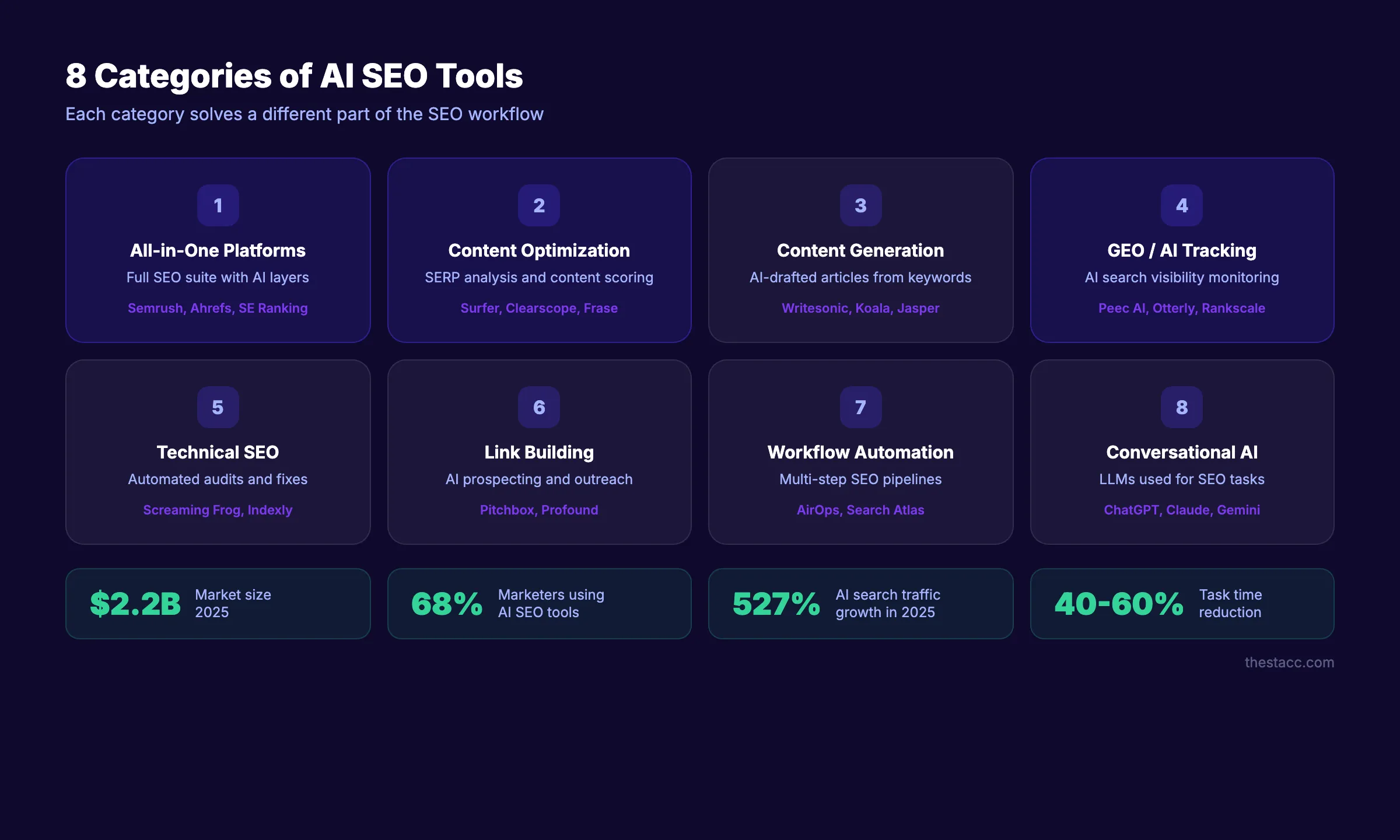
Not all AI SEO tools do the same thing. Understanding the categories prevents you from buying the wrong tool.
1. All-in-One SEO Platforms
These are traditional SEO suites with AI features layered on top. They handle keyword research, site audits, backlink analysis, rank tracking, and competitive intelligence.
Examples: Semrush, Ahrefs, SE Ranking, Mangools
| Tool | Starting Price | AI Features |
|---|---|---|
| Semrush | $139/mo | ContentShake AI, AI Overviews tracker, SEO Writing Assistant |
| Ahrefs | $129/mo | AI content grader, keyword clustering, competitive gap analysis |
| SE Ranking | $65/mo | AI writer, AI visibility tracker, automated audits |
| Mangools | $29/mo | AI Search Grader (free), keyword difficulty scoring |
Best for: Teams that want a single platform covering research through reporting. If you only buy one paid SEO tool, this category gives you the broadest coverage.
For detailed reviews, see our Semrush review, Ahrefs review, or browse our best AI SEO tools roundup.
2. AI Content Optimization
These tools analyze top-ranking pages for a keyword and provide real-time content scoring. They tell you which terms, topics, and structures to include while you write.
Examples: Surfer SEO, Clearscope, Frase, MarketMuse, NeuronWriter
| Tool | Starting Price | Key Strength |
|---|---|---|
| Surfer SEO | $49/mo | Real-time content editor with SERP-based scoring |
| Clearscope | $189/mo | Enterprise content grading and term suggestions |
| Frase | $45/mo | Research + brief + optimization in one workflow |
| MarketMuse | $149/mo | Topical authority scoring and content planning |
Best for: Content teams that write their own articles and want data-backed optimization guidance. These tools help you write better. They do not write for you.
See our reviews of Surfer SEO, Clearscope, Frase, and MarketMuse.
3. AI Content Generation
These tools generate full article drafts from keywords or briefs. Quality varies widely. All require human editing before publishing.
Examples: Writesonic, Koala, Scalenut, Jasper, SEOwind
| Tool | Starting Price | Key Strength |
|---|---|---|
| Writesonic | $16/mo | SEO-focused generation with optimization scoring |
| Koala | $9/mo | Budget-friendly long-form generation |
| Scalenut | $39/mo | Research-to-draft pipeline |
| Jasper | $49/mo | Brand voice training and team workflows |
Best for: Teams that need to scale content production quickly. The output serves as a first draft, not a finished product. Budget $10 to $15 per article in editing time on top of the tool cost.
Read our reviews of Jasper, Writesonic, Koala, and Scalenut.
4. AI Search Visibility and GEO Tracking
This is the fastest-growing category. These tools track how your brand appears in AI-generated answers from ChatGPT, Perplexity, Gemini, Google AI Overviews, and Copilot.
Examples: Peec AI, Otterly.ai, Rankscale, SE Ranking AI Tracker
| Tool | Starting Price | What It Tracks |
|---|---|---|
| Peec AI | Custom pricing | Brand mentions across all major AI platforms |
| Otterly.ai | $25/mo | AI answer monitoring, citation tracking |
| Rankscale | $20/mo | Prompt-based ranking across AI search |
| SE Ranking AI Tracker | Included in plans | AI visibility alongside traditional ranking |
Best for: Brands that need to measure and improve their presence in AI search results. This category answers the question: “Does ChatGPT recommend my business?”
For a deeper look at AI search optimization, read our GEO guide and how to get cited by AI search engines.
5. Technical SEO Automation
These tools automate crawling, indexing, site audits, and technical fixes. AI helps prioritize issues by impact and sometimes auto-fixes problems.
Examples: Screaming Frog, Indexly, Search Atlas OTTO
Best for: Websites with 1,000+ pages that need automated technical monitoring. For sites under 500 pages, manual audits with a free SEO audit tool work fine.
6. AI Link Building and Outreach
These tools use AI to find link prospects, personalize outreach emails, and manage campaigns at scale.
Examples: Pitchbox, Ranking Raccoon, Profound
Best for: Agencies and in-house teams running active link building campaigns. This category saves time on prospecting and personalization but still requires human relationship management.
7. SEO Workflow Automation
These tools connect multiple SEO tasks into automated workflows. Think of them as Zapier for SEO. Research triggers content creation, which triggers optimization, which triggers publishing.
Examples: AirOps, Search Atlas, n8n with SEO templates
Best for: Agencies managing 10+ client accounts who need repeatable processes. Overkill for single-site operations.
8. Conversational AI (Used for SEO)
ChatGPT, Claude, and Gemini are not “SEO tools” by design. But SEO practitioners use them daily for keyword ideation, content drafting, meta description writing, schema markup generation, and competitor analysis.
Best for: Everyone. These are the baseline. If you are not using conversational AI for SEO research and drafting, you are working slower than your competitors.
Learn more in our guide on how to use ChatGPT for SEO.
Your SEO team. $99 per month. 30 optimized articles, published automatically. No tools to learn. No prompts to write. Start for $1 →
What Google Says About AI Content
Before investing in AI SEO tools, understand Google’s official position on AI-generated content.
The short version: Google does not penalize content for being AI-generated. Google penalizes content for being unhelpful, regardless of how it was made.
The Rules
- Quality matters, production method does not. Google evaluates content on helpfulness, accuracy, and E-E-A-T signals. A well-edited AI article ranks the same as a human-written one.
- Scaled content abuse is a spam violation. Publishing hundreds of low-quality AI articles to manipulate rankings triggers manual actions. Google defines this as “generating large amounts of content with the primary purpose of manipulating search rankings.”
- Human editorial oversight is expected. Google does not require every word to be human-written. It expects human review, fact-checking, and editorial judgment.
- Transparency matters for sensitive topics. Health, finance, and news content should disclose AI involvement.
What This Means for AI SEO Tool Users
Use AI tools to research faster, draft better outlines, optimize content structure, and scale production. Do not use them to mass-produce thin content without editorial review.
The businesses getting penalized are not using AI tools. They are using AI tools badly. There is a meaningful difference.
What Actually Works (and What Does Not)
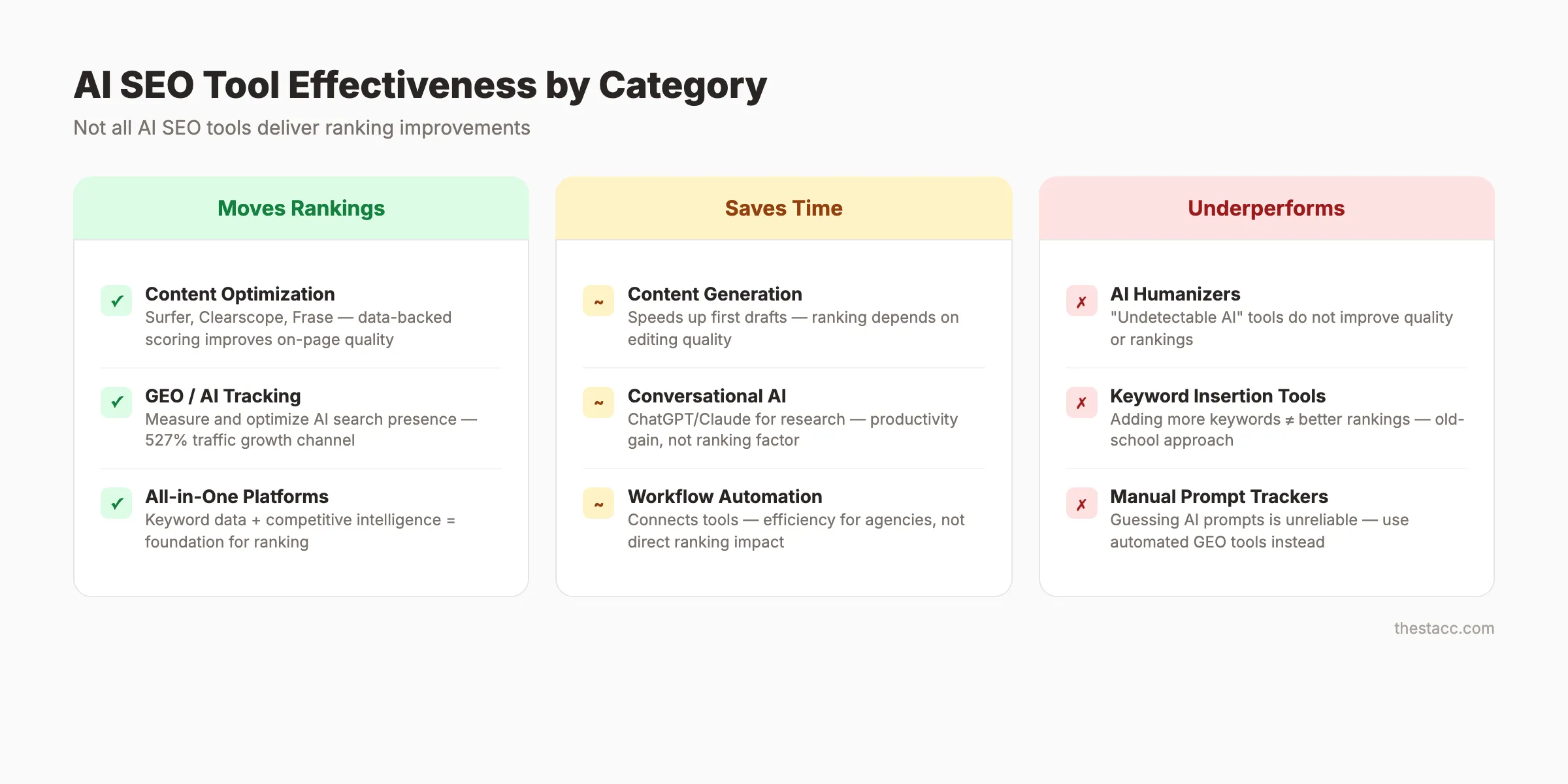
Most AI SEO tool guides list 20+ tools and call all of them “amazing.” Here is an honest assessment based on what moves rankings versus what just saves time.
Categories That Move Rankings
AI Content Optimization (Category 2) delivers the most consistent results. Tools like Surfer and Clearscope analyze what top-ranking pages actually contain and give you specific, actionable optimization targets. Multiple studies show a correlation between content scores and ranking positions.
AI Search Visibility Tracking (Category 4) is increasingly critical. You cannot optimize what you do not measure. As AI search traffic grew 527% in 2025, tracking your brand presence in AI answers moved from optional to essential.
All-in-One Platforms (Category 1) provide the data foundation. Keyword research, competitive analysis, and rank tracking remain necessary regardless of AI. The AI features built into Semrush and Ahrefs add genuine value on top of already useful platforms.
Categories That Save Time (but Do Not Directly Rank)
AI Content Generation (Category 3) speeds up first drafts. This saves hours per article. But the raw output rarely ranks well without significant human editing. The time savings are real. The ranking impact depends entirely on your editing process.
Conversational AI (Category 8) replaces repetitive research tasks. Asking Claude to generate 50 meta descriptions or brainstorm keyword variations is faster than doing it manually. This is productivity, not a ranking factor.
Categories That Underperform Expectations
AI “humanizers” and keyword insertion tools consistently disappoint. Tools that promise to make AI content “undetectable” or that simply suggest adding more keywords to existing content rarely produce ranking improvements. This is old-school SEO automation dressed in new marketing. We have seen this pattern across hundreds of client sites.
One Reddit user summarized it well: “I spent 3 months with an AI content optimizer that just told me to add keywords. Rankings did not move. Switched to actually rewriting content with better depth and saw improvement in 6 weeks.”
The pattern is clear. AI tools that help you create better content work. AI tools that try to shortcut the quality requirement do not.
How to Build Your AI SEO Tool Stack
The right stack depends on 3 factors: your budget, your team size, and your content volume.
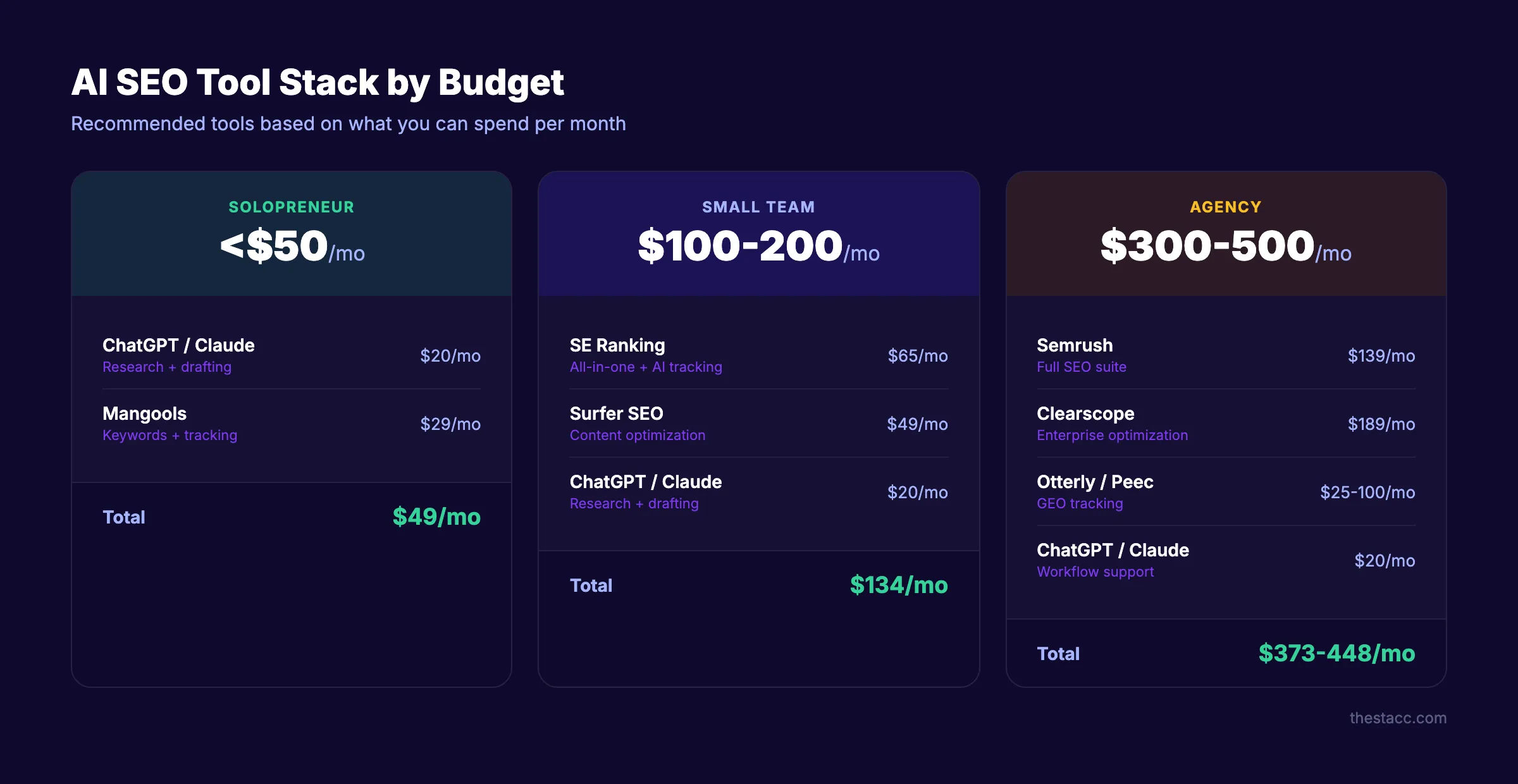
Budget Tier 1: Under $50 per Month (Solopreneurs)
| Tool | Cost | Purpose |
|---|---|---|
| ChatGPT or Claude | $20/mo | Research, drafting, meta tags, schema |
| Mangools | $29/mo | Keyword research, rank tracking |
| Total | $49/mo |
At this budget, conversational AI handles most content tasks. Mangools covers keyword research and tracking. Skip content optimization tools and manually follow on-page SEO best practices instead.
Budget Tier 2: $100 to $200 per Month (Small Teams)
| Tool | Cost | Purpose |
|---|---|---|
| SE Ranking | $65/mo | All-in-one platform with AI features |
| Surfer SEO | $49/mo | Content optimization and scoring |
| ChatGPT/Claude | $20/mo | Research and drafting support |
| Total | $134/mo |
This stack covers research, optimization, tracking, and AI visibility monitoring. SE Ranking includes an AI visibility tracker in its plans. Surfer handles content scoring. ChatGPT fills the gaps.
Budget Tier 3: $300 to $500 per Month (Agencies and In-House Teams)
| Tool | Cost | Purpose |
|---|---|---|
| Semrush | $139/mo | Full SEO suite with AI features |
| Clearscope | $189/mo | Enterprise content optimization |
| Otterly.ai or Peec AI | $25-100/mo | Dedicated AI visibility tracking |
| ChatGPT/Claude | $20/mo | Workflow support |
| Total | $373-448/mo |
At this tier, you get specialized tools for each major workflow. Semrush handles research and technical SEO. Clearscope handles content quality. A dedicated GEO tracker monitors AI search presence.
The Alternative: Done-for-You
Most businesses do not need to manage 3 to 5 SEO tools. They need SEO done. The tool-stack approach works for teams with dedicated SEO specialists. For everyone else, a done-for-you SEO service that handles research, writing, optimization, and publishing is simpler and often cheaper than a multi-tool stack plus labor.
Skip the tools. Keep the results. Stacc handles research, writing, optimization, and publishing for $99/mo. No tools to learn. Start for $1 →
AI SEO Tools for Specific Use Cases
For Local SEO
Local businesses need different AI tools than content publishers. The priority is Google Business Profile optimization, local keyword research, review management, and citation building.
Recommended tools:
- SE Ranking (local rank tracking + AI features)
- ChatGPT (GBP post drafting, review response generation)
- Review response generator (free tool)
For a full local strategy, see our local SEO guide.
For Content Marketing Teams
Content teams optimizing 10+ articles per month benefit most from Category 2 (Content Optimization) tools.
Recommended stack: Surfer or Clearscope + a keyword research tool + ChatGPT for drafting support.
For Ecommerce
Ecommerce sites need tools that handle product descriptions at scale, category page optimization, and technical SEO for large product catalogs.
Recommended stack: Semrush or Ahrefs (technical audits for large sites) + a content generation tool for product descriptions + schema markup generator for product schema.
For Agencies
Agencies need scalability, white-label reporting, and multi-client management.
Recommended stack: Semrush or SE Ranking (client management features) + Surfer (team content editor) + AirOps (workflow automation) + Otterly.ai (AI visibility reporting for clients).
See our roundup of best SEO tools for agencies.
AI SEO Tool Pricing: What to Expect
The AI SEO tools market spans from free to $500+ per month. Here is how pricing breaks down.
| Category | Budget Option | Mid-Range | Premium |
|---|---|---|---|
| All-in-One | Mangools $29/mo | SE Ranking $65/mo | Semrush $139-449/mo |
| Content Optimization | Frase $45/mo | Surfer $49/mo | Clearscope $189/mo |
| Content Generation | Koala $9/mo | Scalenut $39/mo | Writesonic $249/mo |
| GEO Tracking | Mangools Grader (free) | Rankscale $20/mo | Otterly $100+/mo |
| Technical SEO | Indexly $14/mo | Search Atlas $99/mo | Semrush $139+/mo |
| Link Building | Profound (free tier) | Pitchbox $165/mo | Custom pricing |
Key pricing trend for 2026: All-in-one platforms are absorbing AI features that used to require separate tools. Semrush now includes AI content writing, AI visibility tracking, and content optimization in its standard plans. This consolidation means fewer standalone tools are necessary.
7 AI SEO Tool Mistakes to Avoid
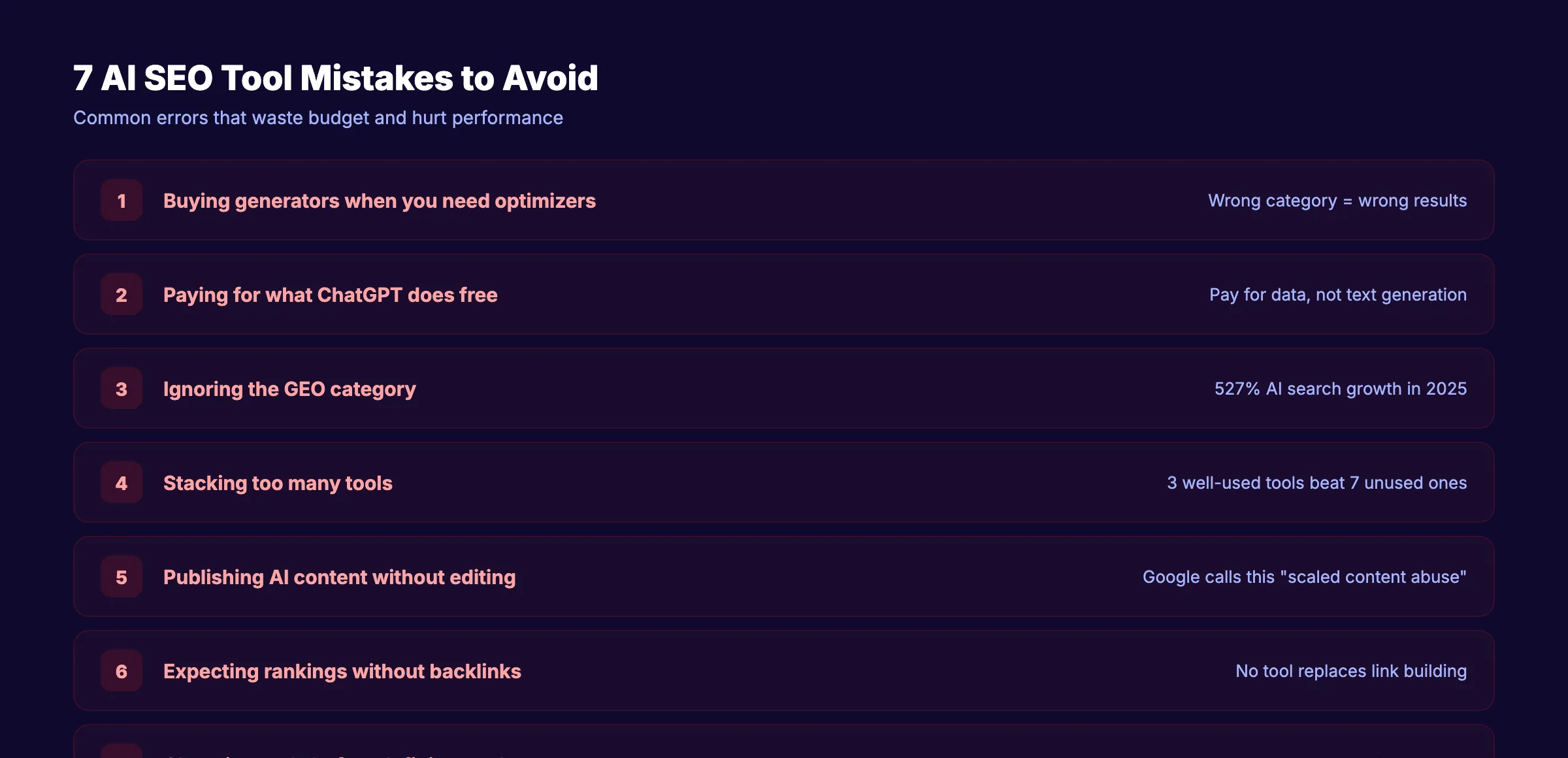
1. Buying a Content Generator When You Need Content Optimization
Generators produce drafts. Optimizers improve drafts. If your content is well-written but does not rank, you need optimization (Category 2), not generation (Category 3).
2. Paying for What ChatGPT Does Free
If a tool’s primary feature is AI-generated text, compare its output against ChatGPT or Claude. Many paid generators produce similar quality to a well-prompted free LLM. Pay for proprietary data and analysis, not basic text generation.
3. Ignoring the GEO Category
AI search traffic grew 527% in 2025. If you are not tracking how your brand appears in AI answers, you are missing a fast-growing channel. This is not optional anymore.
4. Stacking Too Many Tools
More tools does not mean better SEO. Three well-used tools outperform 7 underused ones. Pick one from each category you actually need. Cancel the rest.
5. Publishing AI Content Without Editing
68% of marketers report improved ROI from AI SEO. The other 32% likely publish unedited AI output. Google calls this “scaled content abuse.” Humanize AI content before it goes live.
6. Expecting Rankings Without Backlinks
No AI tool replaces link building. Content optimization tools improve on-page quality. Backlinks provide off-page authority. You need both.
7. Choosing Tools Before Defining Goals
Start with the question: “What specific SEO outcome do I need?” Then find the tool that addresses that outcome. Starting with “what is the best AI SEO tool?” leads to buying features you do not use.
The Future: Agentic SEO and Autonomous Workflows
The next wave of AI SEO tools moves beyond “assist” to “execute.” Agentic SEO tools autonomously complete multi-step workflows. They research keywords, write articles, optimize content, generate images, and publish to your CMS without human intervention between steps.
This is where the market is heading. Early examples include AirOps workflow builders and Search Atlas OTTO for technical fixes. Within 12 months, expect full-stack agentic tools that handle end-to-end content production.
The risk is quality control. Autonomous execution without human checkpoints produces the kind of scaled content that Google penalizes. The winners will be tools (and services) that automate the workflow while maintaining editorial standards.
3,500+ blogs published. 92% average SEO score. See what Stacc can do for your site. Automated content that actually ranks. Start for $1 →
FAQ
Are AI SEO tools worth the investment?
Yes, if you buy the right category. Content optimization tools (Surfer, Clearscope) and all-in-one platforms (Semrush, Ahrefs) deliver measurable ROI. 83% of large organizations report measurable SEO gains from AI adoption. The tools that disappoint are usually content generators used without human editing.
Does Google penalize AI-generated content?
No. Google’s official guidelines state that content is evaluated on quality, not production method. Google does penalize “scaled content abuse” where AI generates large volumes of low-quality content designed to manipulate rankings. The production method does not matter. The quality does.
What is the best free AI SEO tool?
ChatGPT and Claude are the most versatile free (or low-cost) options. For dedicated SEO features, Mangools offers a free AI Search Grader, and Google Search Console provides free ranking data. See our best free SEO tools roundup for a full list.
What is the difference between AI SEO tools and traditional SEO tools?
Traditional SEO tools collect and display data. You analyze it and take action. AI SEO tools analyze data and suggest or execute actions. For example, a traditional tool shows you keyword difficulty. An AI tool suggests which keywords to target based on your domain authority, content gaps, and competitive position.
How do AI SEO tools help with local SEO?
AI tools assist with local SEO through GBP post generation, review response drafting, local keyword research, citation management, and local content creation. SE Ranking and Semrush both offer local-specific AI features.
What is generative engine optimization (GEO)?
GEO is the practice of optimizing content to appear in AI-generated search results from ChatGPT, Perplexity, Gemini, and Google AI Overviews. It is the fastest-growing segment of AI SEO, with a market projected to reach $7.32 billion by 2031. Read our full GEO guide for details.
The AI SEO tools market will keep growing. New categories will emerge. Existing tools will absorb features from adjacent categories. Through all of this, one principle remains constant: tools that help you create genuinely useful content will outperform tools that try to automate quality away. Pick your stack based on what your SEO actually needs, not what the marketing page promises. And if managing a stack of tools sounds like more work than it is worth, consider whether a done-for-you approach might be the better investment.

Written by
Siddharth GangalSiddharth is the founder of theStacc and Arka360, and a graduate of IIT Mandi. He spent years watching great businesses lose organic traffic to competitors who simply published more. So he built a system to fix that. He writes about SEO, content at scale, and the tactics that actually move rankings.
Stop researching. Start ranking.
30 SEO blog articles published to your site every month. No writers, no workflow, no waiting.
30-day trial · Cancel anytime
theStacc
Stop writing SEO content manually
30 blog articles, 30 GBP posts, and social media content. Published every month. Automatically.
Start Your $1 Trial$1 for 3 days · Cancel anytime