AI for Local Businesses: The Complete Guide (2026)
How local businesses use AI to save 20+ hours per month, cut costs, and grow. Covers SEO, marketing, customer service, and implementation. Updated for 2026.
Siddharth Gangal • 2026-03-30 • Content Strategy
In This Article
68% of U.S. small businesses now use AI every day. Two years ago, that number was under 30%.
The gap between local businesses that adopt AI and those that do not is growing fast. Businesses using AI report saving $500 to $2,000 per month and freeing up 20 or more hours of manual work each week. Those that ignore it fall behind on content, customer response time, and search visibility.
The problem is that most AI guides are written for tech companies and enterprise teams. They assume you have a data science department and a six-figure software budget. Local businesses need something different. They need a practical playbook that starts with the work they already do and shows exactly where AI fits in.
We have published 3,500+ blog posts across 70+ industries, including hundreds for local service businesses. Our average SEO score is 92%. This guide covers everything we know about AI for local businesses.
Here is what you will learn:
- What AI actually means for a local business (no jargon)
- The real numbers behind AI adoption and ROI
- 7 specific ways local businesses use AI right now
- How AI changes local SEO and online visibility
- A 5-step roadmap to start using AI this week
- The most common mistakes and how to avoid them
- Industry-specific AI use cases for dentists, lawyers, plumbers, restaurants, and more
What AI Actually Means for Local Businesses
AI for local businesses is not about building robots or writing code. It is about automating the repetitive tasks that eat up your week so you can spend more time with customers.
Think about the work that drains your hours. Writing blog posts. Responding to reviews. Posting on social media. Sending follow-up emails. Updating your Google Business Profile. AI handles all of that.
The Practical Definition
AI tools take a set of inputs (your business name, your services, your location) and produce useful outputs (blog posts, social media captions, review responses, email sequences). They learn patterns from data and improve over time.
For a local business owner, this means one thing. You get the output of a full marketing team without hiring one.
From Optional to Essential
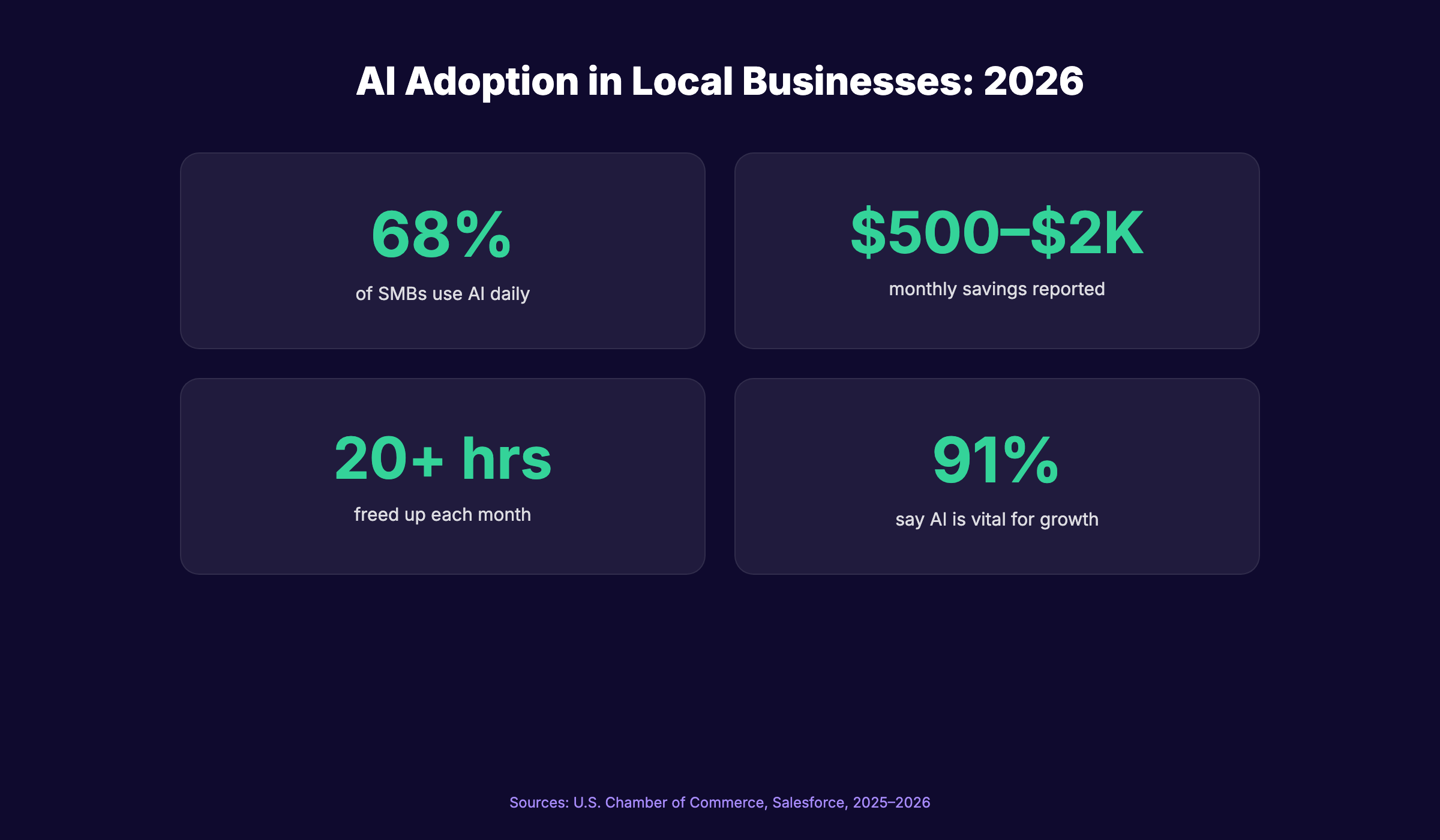
The U.S. Chamber of Commerce reports that 91% of small businesses believe AI is vital for reaching their growth goals. That is not a trend. That is a shift in how businesses operate.
Two years ago, using AI was a competitive advantage. Today, not using it is a competitive disadvantage. Your competitors who adopted AI early are publishing more content, responding to reviews faster, and showing up in more search results. The gap widens every month you wait.
Stop writing. Start ranking. Stacc publishes 30 SEO articles per month for your business, automatically. Start for $1 →
The Numbers Behind AI Adoption
The data on AI adoption among local and small businesses tells a clear story. Adoption is accelerating, ROI is measurable, and the businesses that move first gain the most ground.
Adoption Rates
68% of U.S. small businesses use AI regularly, up from 48% in mid-2024. Salesforce reports that the top use cases are content marketing (58%), social media (49%), and customer relations (40%).
Generative AI usage among small firms jumped from 40% in 2024 to over 58% in 2025. That number continues to climb in 2026.
Financial Impact
66% of small businesses using AI save between $500 and $2,000 per month. The savings come from reduced labor costs, fewer missed leads, and faster content production.
Compare that to the alternative. Hiring a freelance writer for 30 blog posts costs $2,400 to $7,500 per month. An SEO agency charges $1,000 to $5,000 per month. AI-driven content marketing delivers similar or better results at a fraction of the cost.
Time Savings
58% of small businesses free up over 20 hours each month with AI. That time goes back to serving customers, training staff, and growing the business.
For a local business owner who wears multiple hats, 20 hours per month is the difference between working on the business and working in it.
Investment Trends
71% of small businesses plan to increase their AI spending in 2026. The market is moving in one direction. Early adopters compound their advantage while late adopters play catch-up.
7 Ways Local Businesses Use AI Right Now
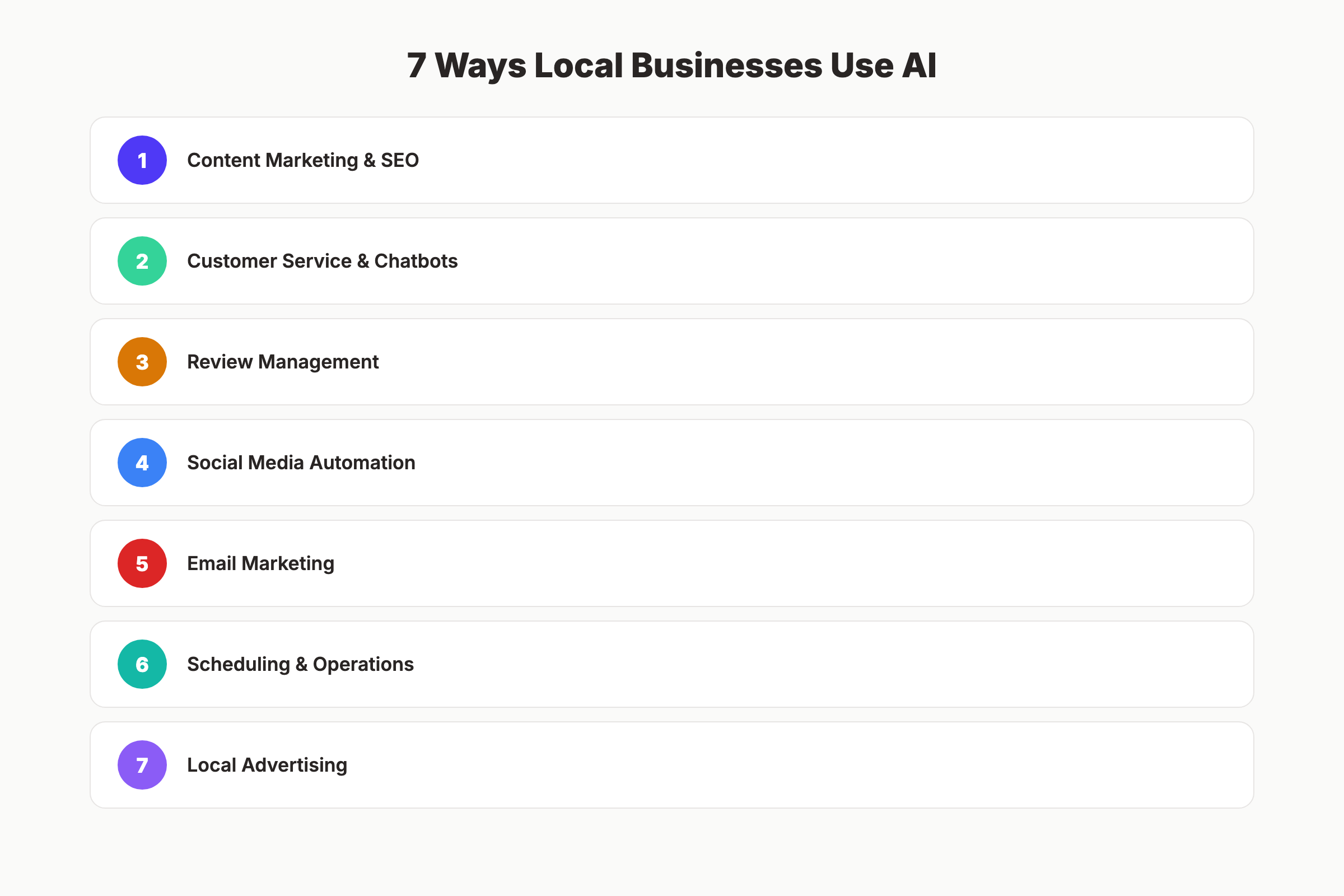
AI is not a single tool. It is a set of capabilities that plug into different parts of your business. Here are the 7 most impactful applications for local businesses in 2026.
1. Content Marketing and SEO
AI generates blog posts, landing pages, and service descriptions at scale. A single local business can publish 30 optimized articles per month without a content team. Each article targets specific keywords, follows SEO best practices, and builds topical authority over time.
This is the highest-impact AI use case for local businesses. Consistent publishing drives organic traffic. Organic traffic drives leads. Leads drive revenue. The businesses that publish 20 to 30 articles per month rank higher than those publishing 1 to 2.
2. Customer Service and Chatbots
AI chatbots answer common questions 24 hours a day. They handle appointment inquiries, service questions, and basic troubleshooting without human intervention.
For a dental office that receives 50 calls per day, an AI assistant can handle the 30 routine questions (hours, location, insurance accepted) and route the 20 complex ones to staff. That saves 2 to 3 hours of phone time daily.
3. Review Management
AI generates personalized responses to Google reviews in seconds. Instead of spending 15 minutes crafting each response, a business owner reviews and posts the AI-generated reply in under 2 minutes.
Review response speed matters. Google factors review engagement into local rankings. Businesses that respond to every review within 24 hours outrank those that respond weekly or not at all.
4. Social Media Automation
AI creates, schedules, and posts social media content across platforms. One prompt generates a week of posts for Instagram, Facebook, LinkedIn, and X.
The key benefit is consistency. Most local businesses post sporadically because they run out of ideas or time. AI eliminates both problems. It generates fresh content ideas and creates the posts automatically.
5. Email Marketing
AI writes email sequences, personalizes subject lines, and segments audiences based on behavior. A plumber can set up an automated sequence that sends a thank-you email after a service call, requests a review 3 days later, and offers a maintenance discount 30 days after that.
The entire sequence runs without manual effort. AI personalizes each email based on the service performed and the customer history.
6. Scheduling and Operations
AI optimizes appointment scheduling, route planning, and inventory management. A home services company can use AI to assign technicians to jobs based on location, skill set, and availability.
This reduces drive time, increases jobs per day, and improves customer satisfaction with shorter wait windows.
7. Local Advertising
AI manages pay-per-click campaigns, adjusts bids in real time, and targets audiences based on location and search behavior. Google’s AI tools for small businesses automate much of the campaign management that used to require a dedicated marketing person.
For local businesses with limited ad budgets, AI ensures every dollar goes to the highest-converting audiences and keywords.
Your SEO team. $99 per month. 30 optimized articles, published automatically. No writers. No agencies. Start for $1 →
AI for Local SEO and Online Visibility
Local SEO is where AI delivers the most measurable results for local businesses. Every ranking factor in local search benefits from AI assistance.
Blog Content at Scale
Google rewards businesses that publish fresh, relevant content consistently. AI lets you publish 30 to 80 optimized blog posts per month. Each post targets a specific keyword, builds internal links to your service pages, and establishes authority in your niche.
A dental practice publishing 30 articles per month on topics like “teeth whitening cost,” “invisalign vs braces,” and “emergency dentist near me” will outrank a competitor publishing 2 articles per month. The math is simple. More content equals more keyword coverage equals more traffic.
Google Business Profile Optimization
AI generates GBP posts that highlight services, promotions, and updates. Consistent GBP posting signals to Google that your business is active and engaged.
AI also helps optimize your business description, select the right categories, and generate responses to Q&A questions on your profile.
Review Response at Scale
Responding to every review signals engagement to Google and builds trust with potential customers. AI generates unique, personalized responses to positive, neutral, and negative reviews. A review response generator can produce a tailored reply in seconds.
Schema Markup
AI generates local business schema markup that helps search engines understand your business name, address, phone number, hours, and services. Proper schema increases your chances of appearing in rich results and knowledge panels.
Local Keyword Research
AI tools identify local keywords with buyer intent. Instead of guessing which terms your customers search, AI analyzes search volume, competition, and relevance to find the exact phrases that drive local traffic.
How to Start Using AI in Your Local Business
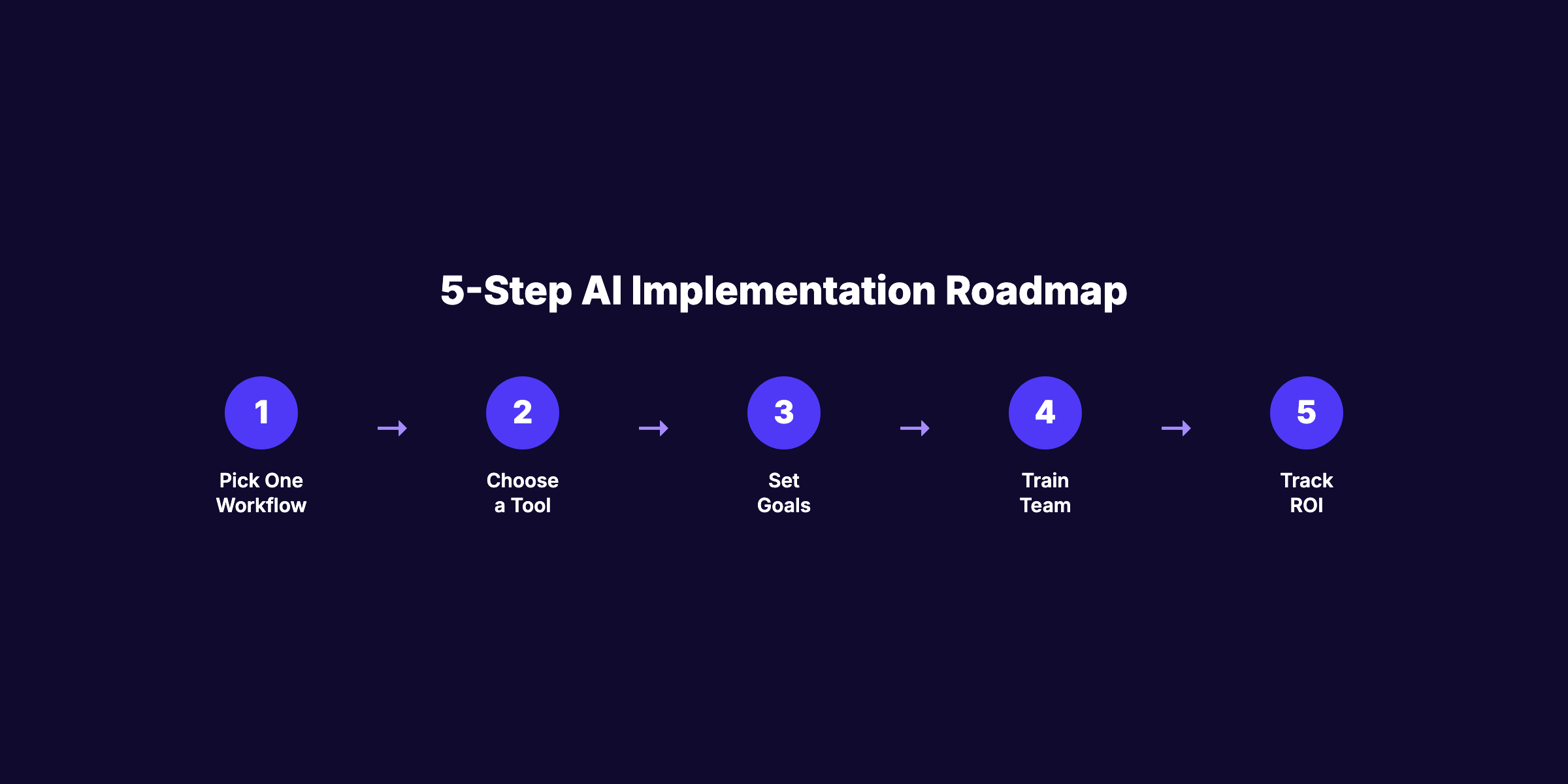
Starting with AI does not require a tech team or a large budget. The most successful local businesses follow a simple 5-step roadmap.
Step 1: Pick One Workflow
Do not try to automate everything at once. Choose the single workflow that consumes the most time or produces the most inconsistent results. For most local businesses, that is content creation or review management.
Ask yourself one question. What task do I dread doing every week? Start there.
Step 2: Choose the Right Tool
Match the tool to the workflow. For blog content and SEO, you need a service that writes, optimizes, and publishes articles for you. For review management, you need a tool that monitors reviews and generates responses.
The SBA recommends starting with free or low-cost tools to test whether AI adds value before committing to paid plans.
Key criteria for choosing a tool:
- Does it integrate with your existing systems?
- Does it require technical setup or coding?
- What is the monthly cost relative to the time saved?
- Does it offer a trial period?
Step 3: Set Measurable Goals
Define what success looks like before you start. Examples:
| Goal | Metric | Timeline |
|---|---|---|
| Increase blog output | Articles published per month | 30 days |
| Improve review response | Average response time | 14 days |
| Grow organic traffic | Monthly organic sessions | 90 days |
| Save staff time | Hours saved per week | 30 days |
| Increase leads | Form submissions or calls | 60 days |
Without clear goals, you cannot measure ROI. Without ROI data, you cannot justify expanding your AI investment.
Step 4: Train Your Team
AI works best when your team understands how to use it. This does not mean coding lessons. It means showing staff how to review AI outputs, provide feedback, and maintain quality standards.
Google offers free AI training specifically designed for small business owners and their teams.
Spend 30 minutes training each team member on the specific AI tool they will use. Focus on the three things they need to do every day, not on features they will never touch.
Step 5: Track ROI and Expand
Measure the results after 30 days. Compare the time and money spent on AI to the time and money saved. If the ROI is positive, expand to the next workflow on your list.
Most local businesses see positive ROI within the first month. Marketing automation compounds over time, so the returns grow as you scale.
3,500+ blogs published. 92% average SEO score. See what Stacc can do for your site. Start for $1 →
Common Mistakes to Avoid
AI adoption fails when businesses skip the fundamentals. Here are the 5 most common mistakes and how to prevent each one.
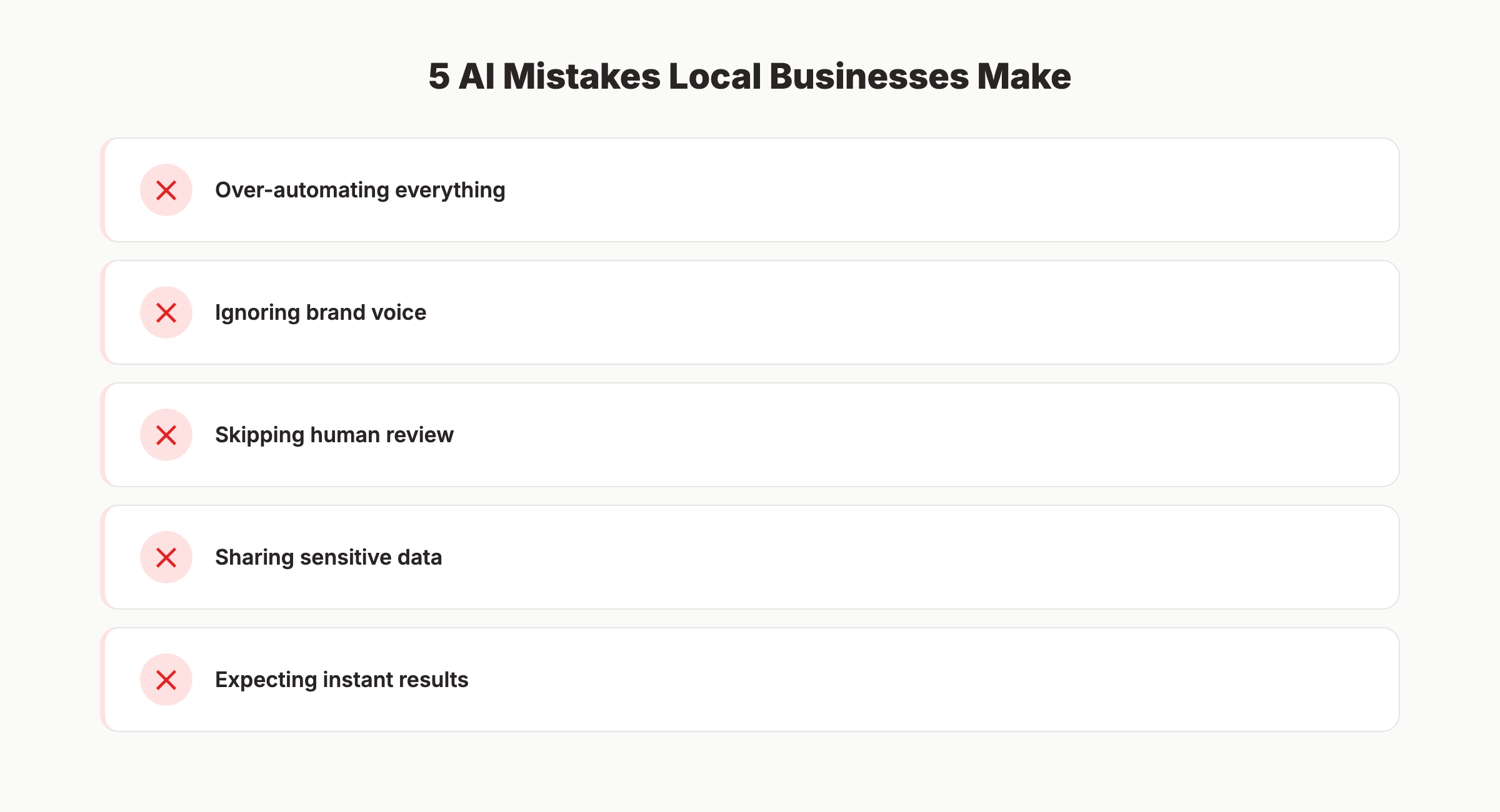
1. Over-Automating Everything
AI should handle repetitive tasks. It should not replace every human interaction. Customers can tell when a business relies entirely on automated responses, and it erodes trust.
The fix: Automate the routine. Keep the personal. Use AI for blog posts, social media, and review responses. Keep phone calls, consultations, and complex customer issues handled by real people.
2. Ignoring Brand Voice
AI tools produce generic output by default. If you do not train them on your brand voice, every piece of content sounds the same as your competitors. This is a common problem with AI-generated content.
The fix: Provide style guidelines, sample content, and tone preferences. Review the first 10 outputs carefully and adjust until the voice matches your brand.
3. Skipping Human Review
Publishing AI content without review leads to factual errors, awkward phrasing, and off-brand messaging. 87% of AI projects fail to reach production because teams skip quality controls.
The fix: Always review before publishing. A 5-minute review of each AI output catches 95% of issues. Build review into your workflow as a non-negotiable step.
4. Sharing Sensitive Data
AI platforms process the data you give them. Uploading customer records, financial data, or proprietary information creates privacy and security risks.
The fix: Never upload personally identifiable information (PII) to AI tools. Use anonymized data for training. Read the data policy of every AI tool before connecting it to your systems.
5. Expecting Instant Results
AI accelerates your marketing output. It does not create overnight rankings or instant revenue. SEO takes time. Content marketing compounds over months. Expect meaningful results in 60 to 90 days, not 60 to 90 minutes.
The fix: Set realistic timelines. Month 1 is about building the content foundation. Month 2 brings initial indexing and traffic. Month 3 shows ranking movement and lead generation.
AI Use Cases by Local Industry
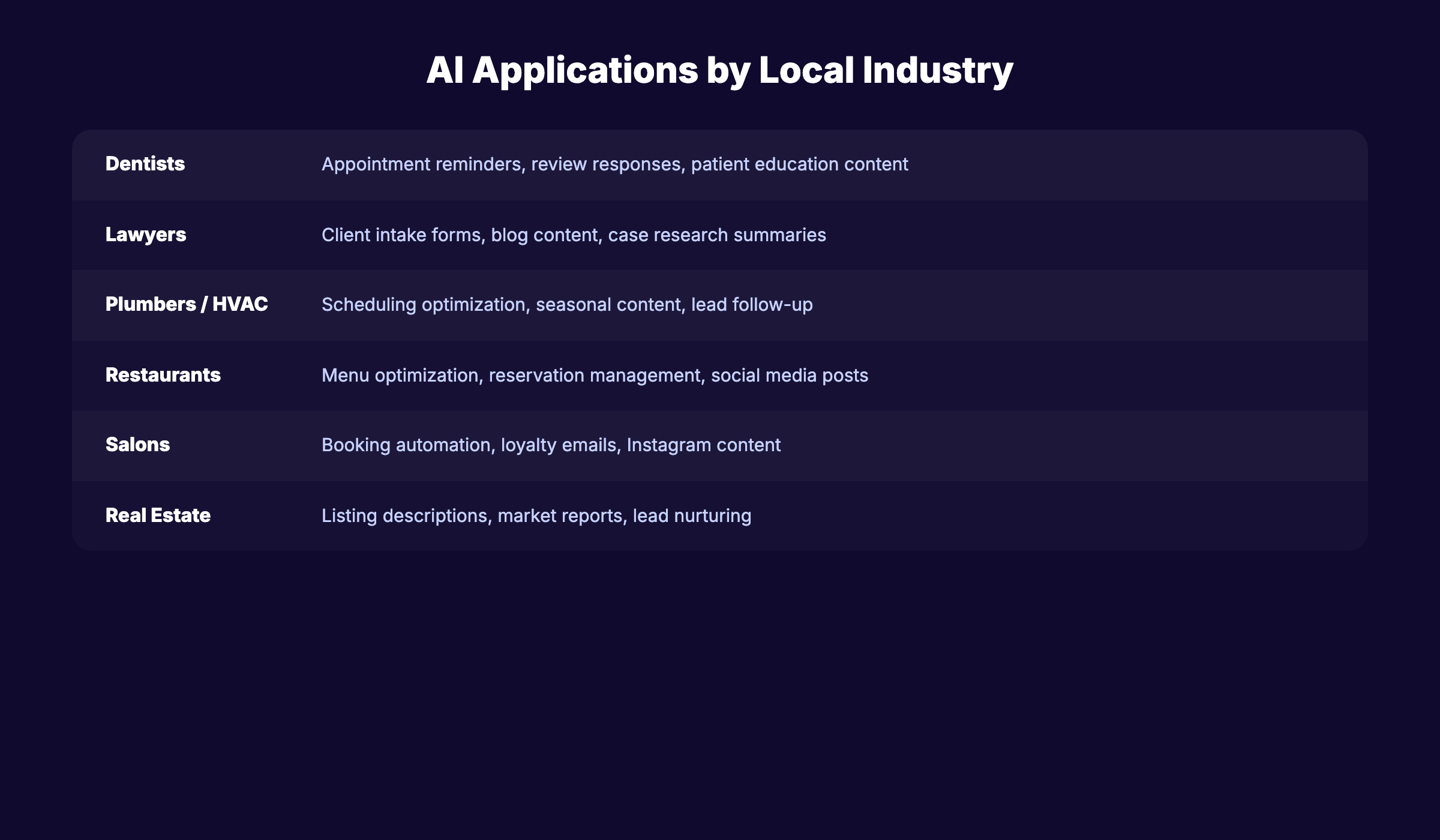
Different industries benefit from AI in different ways. Here are specific applications for the most common local business types.
Dentists and Healthcare Providers
AI writes patient education content about procedures, generates appointment reminder sequences, and responds to reviews. A dental practice can publish 30 articles per month covering every procedure, question, and concern patients search for online.
AI also helps healthcare businesses comply with content accuracy requirements by generating medically reviewed article templates that staff can verify before publishing.
Lawyers and Legal Services
AI generates blog content on legal topics, creates client intake forms, and writes case study summaries. Law firm SEO requires consistent content production on specific practice areas. AI makes it possible to cover every practice area keyword without hiring a legal content writer.
Plumbers, HVAC, and Home Services
AI handles seasonal content calendars, service area page generation, and lead follow-up sequences. A home services company can use AI to create content for every service in every city it covers.
For a plumber serving 15 cities, AI generates 15 unique service area pages, 15 sets of local blog content, and 15 GBP post schedules. Manually creating that content would take months. AI does it in days.
Restaurants
AI generates social media content featuring menu items, manages reservation systems, and creates promotional email campaigns tied to events and holidays.
Salons and Spas
AI automates booking confirmations, loyalty email sequences, and Instagram content. A salon can set up an AI system that sends a rebooking reminder 4 weeks after every appointment without any manual work.
Real Estate
AI generates listing descriptions, market reports, and neighborhood guides. It also creates lead nurturing email sequences that keep prospects engaged over long buying cycles.
Rank everywhere. Do nothing. Blog SEO, Local SEO, and Social on autopilot. Start for $1 →
The Future of AI for Local Businesses
AI capabilities for local businesses are expanding rapidly. Here is what to watch for in the next 12 to 24 months.
AI Search and Answer Engines
Google AI Overviews, ChatGPT search, and Perplexity are changing how customers find local businesses. Getting cited in AI search requires structured content, strong E-E-A-T signals, and consistent publishing.
Businesses that optimize for AI search visibility now will dominate these channels as they grow. Those that wait will compete for shrinking traditional search clicks.
Predictive Analytics
AI will predict customer behavior before it happens. A home services company will know which customers are likely to need furnace repair before winter based on service history and weather data. This shifts marketing from reactive to proactive.
Hyper-Local Content at Scale
AI already generates city-specific and neighborhood-specific content. The next step is real-time content that adapts to local events, weather, and trends. A restaurant could publish a blog post about “best outdoor dining spots this weekend” automatically based on the weather forecast.
Voice Search Optimization
Voice assistants handle a growing share of local searches. AI helps businesses optimize for conversational queries and long-tail keywords that voice users ask. The phrasing differs from typed searches, and AI adapts content for both.
FAQ
How much does AI cost for a local business?
Most AI tools for local businesses cost between $49 and $199 per month. That is 70 to 90% less than hiring a marketing agency or freelance content team. Many tools offer free tiers or trial periods to test before committing. Stacc starts at $99 per month for 30 published SEO articles.
Is AI content good enough to rank on Google?
Yes, when done correctly. Google does not penalize AI content. Google penalizes low-quality content regardless of how it was created. The key is human review, proper optimization, and consistent publishing. AI content with human oversight performs on par with or better than manually written content in most cases.
How long does it take to see results from AI marketing?
Expect initial indexing within 2 to 4 weeks. Ranking movement starts in 60 to 90 days. Meaningful traffic and lead generation builds over 3 to 6 months. AI accelerates the timeline by increasing your content volume, but SEO still requires patience.
Will AI replace my marketing team?
No. AI handles repetitive execution tasks like writing blog posts, generating social media content, and drafting review responses. Your team focuses on strategy, customer relationships, and creative direction. AI is the engine. Your team is the driver.
What is the best AI tool for local business SEO?
The best tool depends on your primary need. For automated blog content and local SEO, Stacc publishes 30 optimized articles per month without requiring you to write or manage anything. For other needs, check our guide on the best free SEO tools to find the right fit.
Is my customer data safe with AI tools?
That depends on the tool. Always read the data and privacy policy before connecting AI to your business systems. Avoid uploading customer PII to general-purpose AI models. Choose tools that offer data encryption, comply with privacy regulations, and clearly state how they handle your information.
AI is not optional for local businesses in 2026. The businesses that adopt it now will build a compounding advantage in content, visibility, and customer engagement. The ones that wait will spend more time and money catching up later.
Pick one workflow. Start this week. Measure the results. Then expand.
Written and published by Stacc. We publish 3,500+ articles per month across 70+ industries. All data verified against public sources as of March 2026.