Brand SEO Strategy: The Complete Guide
Build a brand SEO strategy that drives branded search, authority signals, and rankings. Covers E-E-A-T, entity SEO, and brand SERP management for 2026.
Stacc Editorial • 2026-04-04 • SEO Tips
In This Article
Most businesses treat SEO and brand building as separate efforts. One team writes blog posts for keywords. Another team runs brand campaigns. The two never talk.
That disconnect costs you rankings. Google now uses brand signals as a ranking factor. Nearly 50% of all Google searches are branded, and businesses that ignore their brand presence in search lose clicks to competitors, review sites, and AI-generated summaries.
A brand SEO strategy fixes this. It aligns your brand identity with your search visibility so Google treats your business as a trusted entity, not just another domain.
We publish 3,500+ blog posts across 70+ industries. We see the same pattern every time: businesses with strong brand signals rank faster and hold positions longer than those relying on keywords alone.
Here is what you will learn in this guide:
- What a brand SEO strategy is and why it matters more than ever
- How branded search volume directly impacts your organic rankings
- The exact steps to build brand authority that search engines reward
- How E-E-A-T applies to your brand and what signals to strengthen
- How to audit and control your brand SERP
- How entity SEO connects your brand to Google’s Knowledge Graph
- How to measure brand SEO performance across traditional and AI search
Table of Contents
- What Is a Brand SEO Strategy?
- How Branded Search Impacts Your Rankings
- How to Build Brand Authority for SEO
- E-E-A-T and Your Brand SEO Strategy
- How to Optimize Your Brand SERP
- Entity SEO: Make Google Understand Your Brand
- How to Measure Brand SEO Performance
- FAQ
What Is a Brand SEO Strategy?
A brand SEO strategy is the process of optimizing your entire online presence around your brand identity. It goes beyond targeting keywords. It ensures that when someone searches for your company name, your product, or topics you own, Google returns results you control.
Traditional SEO focuses on ranking for non-branded terms. Brand SEO focuses on how your brand appears across all search results, including branded queries, Knowledge Panels, People Also Ask boxes, and AI-generated overviews.
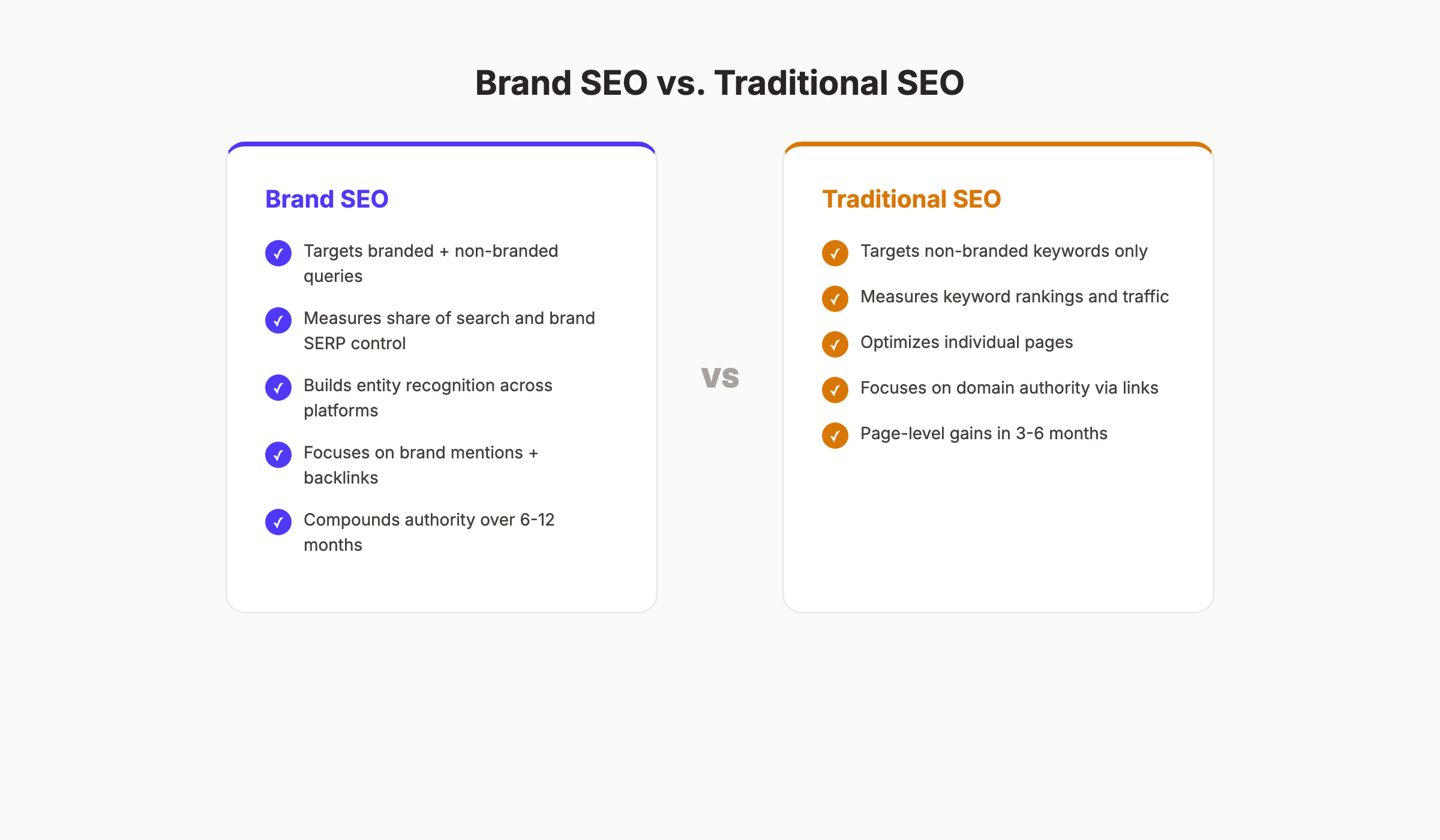
Brand SEO vs. Traditional SEO
Traditional SEO targets informational and transactional keywords. You pick a keyword, write a page, build links, and try to rank. Brand SEO takes a wider approach.
| Factor | Traditional SEO | Brand SEO |
|---|---|---|
| Primary target | Non-branded keywords | Branded + non-branded queries |
| Success metric | Keyword rankings | Share of search, brand SERP control |
| Content focus | Individual pages | Brand presence across all touchpoints |
| Link building | Domain authority | Brand mentions + backlinks |
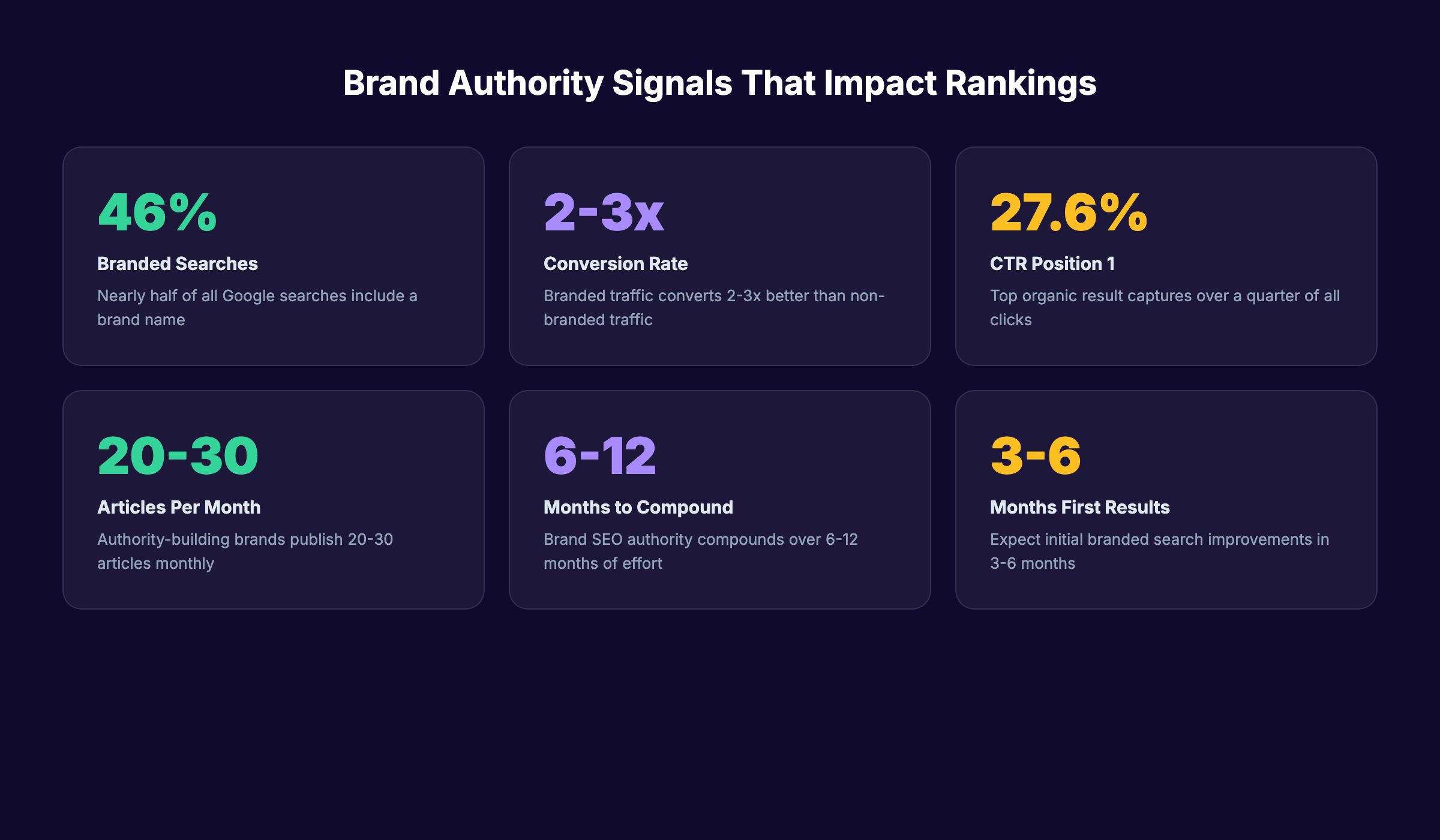
| Time horizon | Page-level gains in 3-6 months | Compounding authority over 6-12 months |
The two are not mutually exclusive. The strongest SEO strategies combine both. But most businesses over-invest in traditional SEO and under-invest in brand signals.
Why Brand Signals Matter for Rankings
Google’s ranking systems evaluate brands as entities. A brand with consistent information across the web, strong review profiles, and high search demand gets preferential treatment in competitive queries.
The reasoning is straightforward. Google wants to show results that users trust. Users trust brands they recognize. A business with 10,000 branded searches per month signals to Google that real people seek it out. That signal influences rankings for non-branded terms too.
This is not speculation. Google’s own Search Quality Evaluator Guidelines emphasize reputation and brand recognition as quality indicators. If your brand has no search demand and no online reputation, you start at a disadvantage.
Building topical authority and brand recognition work together. Each article you publish, each mention you earn, and each review you collect compounds into a stronger brand signal over time.
How Branded Search Impacts Your Rankings
Branded search is what happens when someone types your company name into Google. It is the clearest signal that people know your brand exists and actively seek it out.
An Ahrefs study found that nearly 46% of all Google searches are branded. That number is staggering. It means almost half of all search activity goes to businesses that have already earned name recognition.
Branded vs. Non-Branded Search Traffic
Non-branded traffic comes from users searching for generic terms. “Best accounting software” or “plumber near me.” This traffic is high-volume but competitive.
Branded traffic comes from users who already know you. “Stacc SEO pricing” or “Stacc blog automation.” This traffic converts at 2-3x the rate of non-branded traffic because the searcher has already decided to investigate your brand.
| Traffic Type | Example Query | Conversion Rate | Competition |
|---|---|---|---|
| Non-branded | ”seo tools for small business” | 1-3% | High |
| Branded | ”[Company name] pricing” | 5-10% | Low (you should own it) |
| Brand + modifier | ”[Company name] vs [competitor]“ | 4-8% | Medium |
The mistake most businesses make: they focus entirely on non-branded keywords and ignore their branded search presence. When a prospect finally searches your name, they find outdated listings, competitor ads, or third-party review sites instead of your own content.
The Click-Through Rate Advantage
Backlinko’s CTR study shows that the number 1 organic result gets 27.6% of all clicks. For branded searches, that number jumps even higher because users are looking specifically for you.
Higher click-through rates send positive engagement signals to Google. When users consistently click your result over others for branded queries, it reinforces your authority. This positive feedback loop benefits your non-branded rankings too.
Branded Search as a Ranking Signal
Google has never confirmed that branded search volume is a direct ranking factor. But the correlation is undeniable.
Businesses that invest in brand awareness see improvements across their entire keyword portfolio. The mechanism works like this: more brand searches lead to more clicks, which leads to better engagement metrics, which leads to higher rankings for related non-branded terms.
Think of branded search as a trust signal. A company nobody searches for has no proven demand. A company that generates thousands of branded searches per month has proven market relevance. Google factors this into its assessment of domain authority and trustworthiness.
Your brand is a ranking factor. Every branded search tells Google your business has real demand. Stacc publishes 30+ SEO articles per month to build that authority on autopilot. Start for $1 →
How to Build Brand Authority for SEO
Brand authority does not appear overnight. It compounds through consistent effort across multiple channels. Here is how to build it systematically.
Publish Consistent, Expert Content
Content is the foundation of brand authority. Google evaluates whether your website demonstrates expertise on topics relevant to your business.
Publishing 1-2 blog posts per month does not build authority. The businesses that dominate search results publish 20-30 articles per month. Each article signals to Google that your brand covers a topic deeply and consistently.
The key is topical authority. Do not scatter your content across random topics. Build clusters of related content around your core expertise. A law firm should not write about marketing trends. It should own every question about personal injury law, estate planning, or whatever its practice areas cover.
Create a content calendar that maps out 3-6 months of publishing. Every piece should connect back to your core brand topics through internal linking.
Earn Mentions and Citations
Brand mentions are the new backlinks. Google tracks unlinked brand mentions across the web and uses them to validate your entity.
Here is how to earn them:
- PR outreach. Respond to journalist queries through platforms like Connectively (formerly HARO). Each mention in a news article reinforces your brand’s authority.
- Podcast appearances. Appear on 2-3 industry podcasts per quarter. Each episode page creates a brand mention and often a backlink.
- Industry reports. Publish original data or surveys. Other websites cite your findings and mention your brand.
- Review platforms. Claim your profiles on G2, Capterra, Trustpilot, and industry-specific directories. Active review profiles signal brand legitimacy.
The goal is to build a citation-worthy brand that other websites reference naturally. This matters for traditional search and for getting cited in AI search results.
Build a Strong Backlink Profile
Backlinks remain one of Google’s top 3 ranking factors. But the quality of your backlinks matters more than quantity.
Focus on earning links from:
- Industry publications and trade magazines
- Educational institutions (.edu domains)
- Government resources (.gov domains)
- News outlets covering your industry
- High-authority blogs in your niche
Avoid link schemes, paid links from low-quality directories, and private blog networks. Google’s SpamBrain algorithm detects manipulative links with increasing accuracy.
Use link building strategies that create real value. Guest posts on authoritative sites, original research, and free tools generate backlinks that strengthen your brand signal.
E-E-A-T and Your Brand SEO Strategy
E-E-A-T stands for Experience, Expertise, Authoritativeness, and Trustworthiness. Google uses this framework to evaluate content quality and, by extension, brand quality.
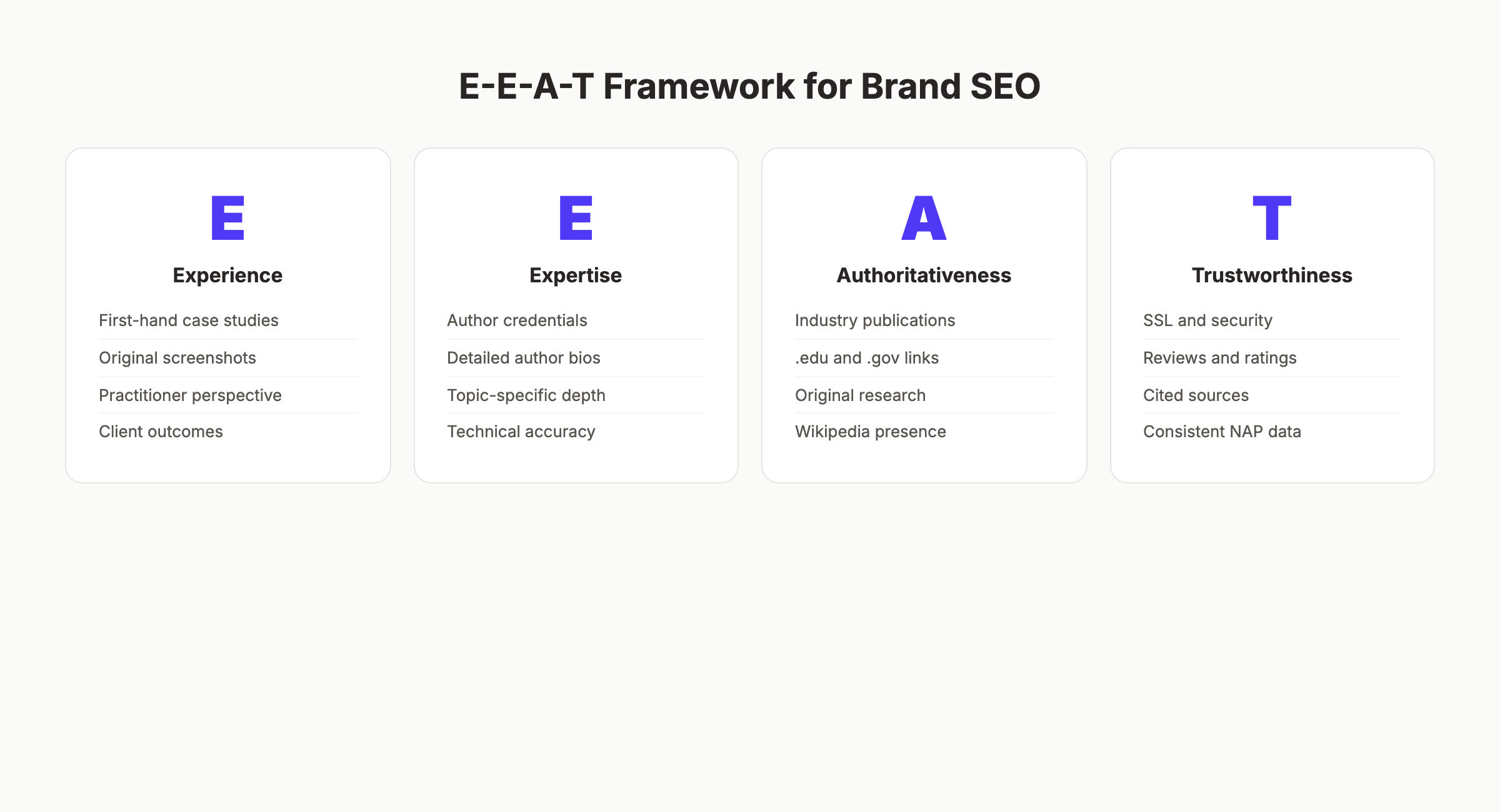
Your E-E-A-T signals determine whether Google considers your brand a credible source. Weak E-E-A-T means your content gets suppressed in favor of stronger brands, even if your on-page SEO is perfect.
Experience and Expertise Signals
Google wants to see that the people behind your content have real experience with the topics they cover.
Show experience by:
- Adding author bios with credentials and relevant background
- Including first-hand examples, case studies, and original screenshots
- Referencing specific client outcomes or project results
- Writing from a practitioner’s perspective, not a generalist’s summary
For blog content, attach each article to a named author with a dedicated author page. Link that author page to their LinkedIn profile, industry publications, and speaking engagements.
Authoritativeness Through Entity Recognition
Authoritativeness is about your brand’s reputation within your industry. Google evaluates this through external signals: who links to you, who mentions you, and how other authoritative sources reference your brand.
Build authoritativeness by:
- Getting featured in industry publications
- Earning backlinks from .edu and .gov domains
- Maintaining active, verified social media profiles
- Publishing original research that others cite
- Building a Wikipedia presence (for established brands)
The more Google sees your brand referenced by other trusted entities, the more authority it assigns to your content. This is digital authority in action.
Trust Signals That Move Rankings
Trust is the foundation of E-E-A-T. Without trust, expertise and authority mean nothing. Google evaluates trust through:
Technical trust: SSL certificates, secure payment processing, clear privacy policies, and accessible contact information. Your technical SEO must be flawless.
Reputation trust: Reviews, ratings, BBB accreditation, and industry certifications. A business with 500 five-star Google reviews carries more trust weight than one with 3 reviews.
Content trust: Accurate information, cited sources, transparent authorship, and regular updates. Your content refresh strategy should keep published articles current and factually correct.
Brand trust: Consistent NAP (Name, Address, Phone) across all directories. A unified brand presentation across your website, social profiles, and third-party listings. Any inconsistency erodes trust.
How to Optimize Your Brand SERP
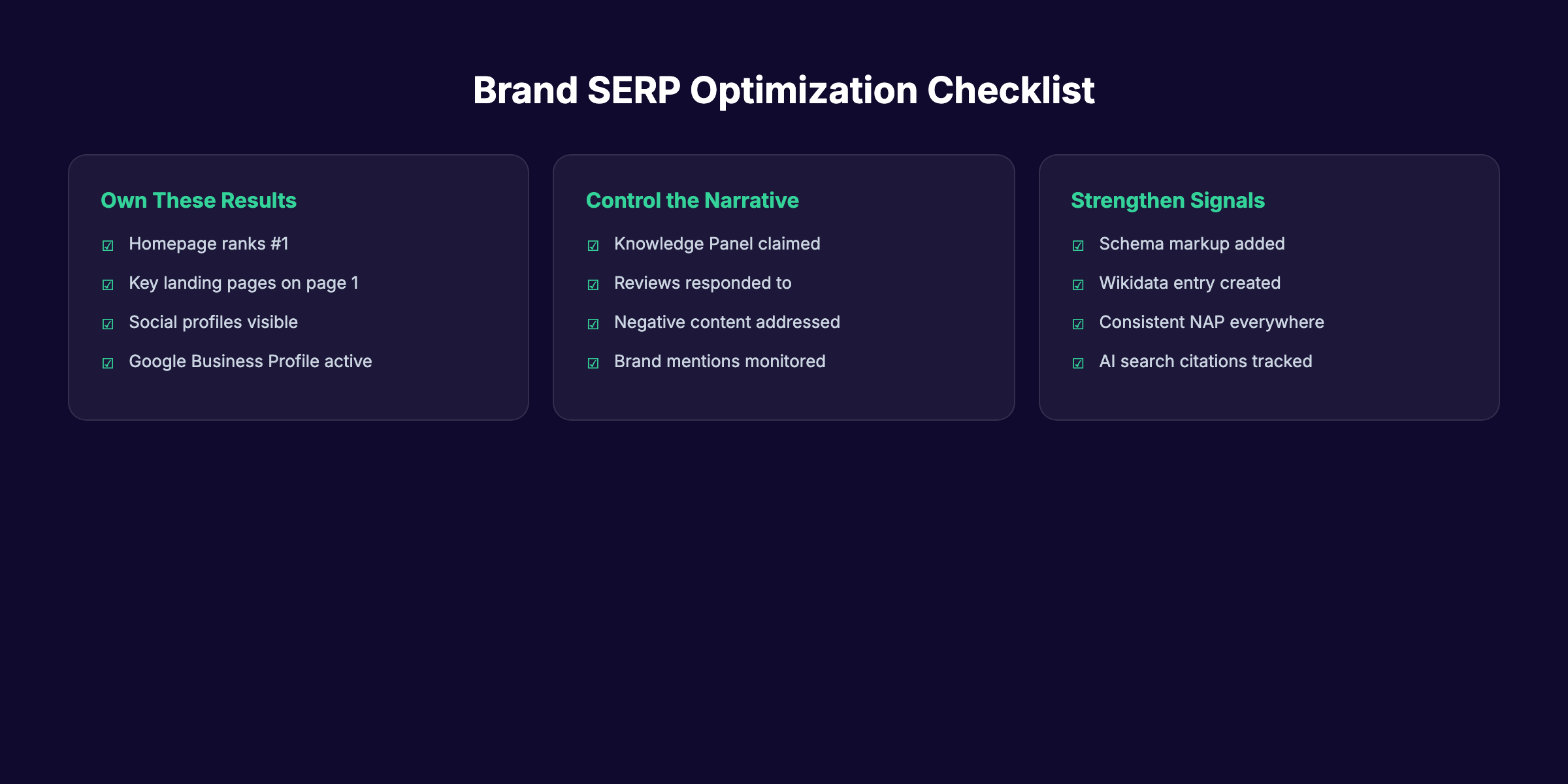
Your brand SERP is the search results page that appears when someone searches your company name. It is your digital storefront. If you do not control it, someone else will.
Audit Your Branded Search Results
Start by searching your brand name in an incognito browser window. Document what appears:
- Your website (homepage and key pages)
- Social media profiles
- Google Business Profile
- Review site listings (G2, Trustpilot, Yelp)
- News articles or press mentions
- Knowledge Panel (if present)
- People Also Ask questions
- AI Overview summary
Flag any result you do not control or that contains outdated information. Common problems include old social profiles, negative reviews dominating page 1, competitor ads on your brand name, and inaccurate third-party listings.
Run a competitor analysis to see what their brand SERPs look like. Compare the number of owned results they control versus yours.
Own your first page. A strong brand SERP converts searchers into customers. Stacc builds the content that fills your search results with pages you control. Start for $1 →
Control Your Knowledge Panel
A Google Knowledge Panel appears on the right side of search results for recognized entities. It displays your logo, description, social links, and key facts.
To earn and optimize your Knowledge Panel:
- Claim your Google Business Profile. This is the fastest path to a Knowledge Panel for local businesses.
- Add Organization schema markup to your homepage. Include your name, logo, founding date, social profiles, and contact details. Use our schema markup guide for the exact implementation.
- Build a consistent entity across platforms. Your brand name, description, and key details must match exactly across your website, social media, Wikipedia (if applicable), and Wikidata.
- Verify your Knowledge Panel through Google’s verification process once it appears.
Your Knowledge Panel is one of the most visible elements of your brand SERP. Treat it as a priority.
Manage Third-Party Brand Mentions
You cannot control everything on your brand SERP. Review sites, news outlets, and forums will rank for your brand name. But you can influence what those results say.
Respond to every Google review. Address negative reviews professionally and promptly. Update your profiles on review platforms with current information, logos, and descriptions.
Monitor brand mentions using Google Alerts, Mention, or SEO tools like Ahrefs. When a negative or inaccurate mention appears, address it directly. When a positive mention appears, amplify it through social sharing and internal linking.
For AI search specifically, monitor how platforms like ChatGPT and Google AI Overviews describe your brand. The information these systems use comes from your website, Wikipedia, and high-authority third-party sources. Keep all of those sources accurate and up to date.
Entity SEO: Make Google Understand Your Brand
Entity SEO is how you help Google recognize your brand as a distinct entity in its Knowledge Graph. This matters because Google does not just rank pages. It ranks the entities behind those pages.
A brand that Google recognizes as an entity gets preferential treatment: Knowledge Panels, rich results, and stronger associations between your brand and your target topics.
Schema Markup for Brand Entities
Structured data tells Google exactly what your brand is. Add Organization schema to your homepage with these properties:
name(your exact brand name)url(your homepage)logo(your official logo URL)sameAs(links to all official social profiles)foundingDatecontactPointdescription
Also implement schema markup on your blog posts using Article schema with author information. This connects your content back to your brand entity.
Build Your Knowledge Graph Presence
Google’s Knowledge Graph is a database of entities and their relationships. Your goal is to exist in that database with accurate information.
Steps to build your Knowledge Graph presence:
- Create or edit your Wikidata entry. Wikidata is a structured data source that Google relies on heavily. Add your brand with accurate details.
- Build consistent references. Every directory, social profile, and third-party listing should use the exact same brand name, description, and details.
- Earn Wikipedia mentions. A dedicated Wikipedia article is the strongest signal, but even a mention in a related article helps. The exception: do not create a Wikipedia article yourself. It will get deleted. Earn it through notability.
- Publish on authoritative platforms. Medium, LinkedIn articles, and industry publications create additional entity signals.
Your brand entity optimization should extend to AI search platforms too. ChatGPT, Perplexity, and Google AI Overviews all pull entity information from the same structured sources.
Connect Your Brand Across Platforms
Entity SEO requires consistency. Google cross-references your brand information across dozens of sources. Any mismatch creates confusion.
Use this checklist to ensure brand consistency:
- Same brand name on all platforms (exact spelling and capitalization)
- Same logo across website, social profiles, and directories
- Matching business description everywhere
- Linked social profiles (each profile links to your website and other profiles)
- Consistent contact information on every listing
The more connected and consistent your brand presence is, the stronger your entity clustering signal becomes. Google gains confidence that your brand is a real, established entity worth featuring in search results.
How to Measure Brand SEO Performance
You cannot improve what you do not measure. Brand SEO requires different metrics than traditional keyword tracking.
Track Branded Search Volume
Use Google Search Console to monitor impressions and clicks for queries containing your brand name. Track this monthly and look for trends.
| Metric | Where to Find It | What It Tells You |
|---|---|---|
| Branded impressions | Google Search Console | How often your brand appears in search |
| Branded clicks | Google Search Console | How often searchers click through to your site |
| Branded CTR | Google Search Console | Whether your brand SERP compels clicks |
| Branded search volume | Google Trends, Ahrefs | Total demand for your brand over time |
A healthy brand shows increasing branded search volume quarter over quarter. If your branded search is flat or declining, your brand awareness efforts need attention.
Monitor Share of Search
Share of search measures your brand’s search volume relative to competitors. It is one of the best predictors of market share.
Calculate it by dividing your branded search volume by the total branded search volume for all competitors in your category. Track this in your SEO reporting dashboard.
A rising share of search means you are capturing more mind share in your market. A declining share means competitors are growing faster.
Brand Mentions in AI Search
AI search platforms now account for a growing share of discovery. Track how your brand appears in AI Overviews, ChatGPT responses, and Perplexity answers.
Monitor your AI share of voice by regularly querying AI platforms with your target topics. Document when your brand gets cited, what context it appears in, and how the citation changes over time.
Tools like Profound, Otterly, and Peec AI track AI citations automatically. Add AI visibility tracking to your brand SEO measurement stack alongside traditional SEO metrics.
Brand SEO compounds over time. Stacc publishes the content that builds your brand authority month after month. 30 articles for $99. No agency required. Start for $1 →
FAQ
What is the difference between brand SEO and regular SEO?
Regular SEO targets non-branded keywords to attract new visitors. Brand SEO optimizes your entire brand presence in search results, including branded queries, Knowledge Panels, and AI-generated summaries. The two work together. Strong brand SEO makes your regular SEO efforts more effective by increasing trust signals and click-through rates.
How long does it take for brand SEO to show results?
Expect 3-6 months for measurable improvements in branded search visibility. Knowledge Panel appearances can take 6-12 months for newer brands. The timeline depends on your starting brand awareness, content publishing velocity, and the competitiveness of your industry. Consistent publishing accelerates results.
Can small businesses benefit from brand SEO?
Yes. Small businesses benefit the most because they typically have unoptimized brand SERPs. Claiming your Google Business Profile, optimizing your social profiles, and publishing consistent content can dramatically improve your brand search presence within 90 days. You do not need a Fortune 500 budget.
How does brand SEO affect AI search visibility?
AI platforms like ChatGPT and Google AI Overviews pull information from authoritative, well-structured sources. Strong brand SEO ensures your brand gets referenced accurately in AI-generated answers. This includes having consistent entity data, earning citations from authoritative websites, and maintaining updated structured data on your site.
What is the first step to building a brand SEO strategy?
Start with a brand SERP audit. Search your company name in incognito mode and document every result on page 1. Identify gaps: missing social profiles, inaccurate listings, negative content you need to address, or a missing Knowledge Panel. That audit gives you a prioritized action plan for improving your brand search presence.
Brand SEO is not a separate initiative from your content strategy. It is the layer that makes everything else work harder. Start with your brand SERP audit, fix the gaps, and build a publishing rhythm that compounds your authority every month.
The businesses that win in 2026 are the ones Google recognizes as trusted entities. Make sure yours is one of them.
Written and published by Stacc. We publish 3,500+ articles per month across 70+ industries. All data verified against public sources as of March 2026.