
SEO for Nonprofits (2026): Strategies, Tactics & Examples
Practical seo for nonprofits strategies for 2026: step-by-step tactics, real examples, and tools to improve rankings and drive organic traffic.
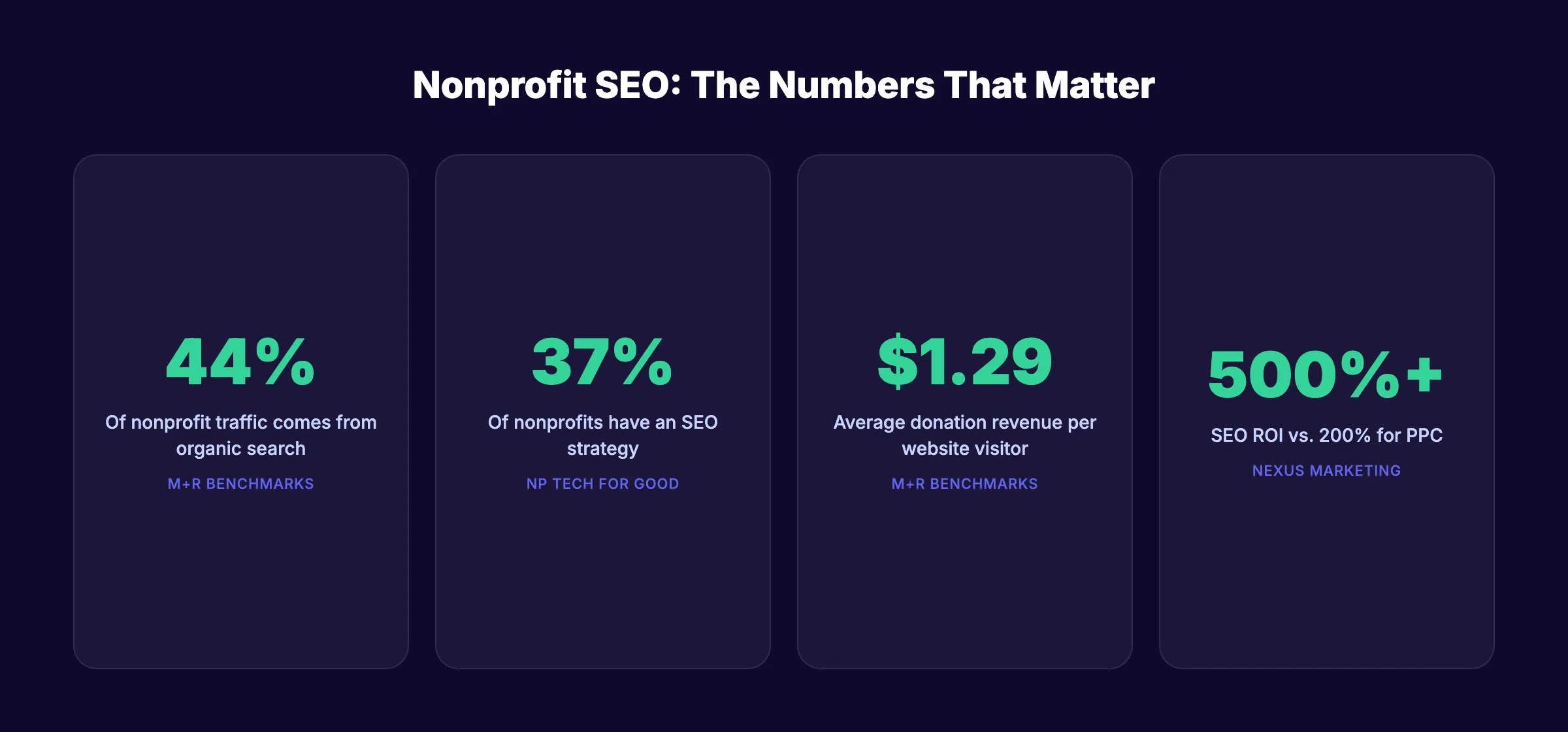
Only 37 percent of nonprofits have an SEO strategy. The other 63 percent rely on word of mouth, paid ads, and hope.
That is a problem. Organic search drives 44 percent of all nonprofit website traffic, according to M+R Benchmarks. Every visitor you miss is a potential donor, volunteer, or advocate who never found you.
SEO for nonprofits is not a luxury. It is how mission-driven organizations reach the people who are already searching for causes like theirs. And unlike paid advertising, organic search traffic compounds over time. The SEO ROI for nonprofits ranges from 500 to 1,300 percent, compared to roughly 200 percent for PPC, according to Nexus Marketing.
We have published 3,500+ blog posts across 70+ industries. Nonprofits face unique SEO challenges: tight budgets, small teams, and missions that do not always translate into search-friendly content. This guide addresses all of them.
Here is what you will learn:
- How to find keywords that attract donors, volunteers, and supporters
- On-page and technical SEO tactics tailored to nonprofit websites
- How to use the $10,000/month Google Ad Grant alongside your SEO strategy
- Link building strategies specific to the nonprofit sector
- How to measure SEO results in terms your board actually understands
Chapter 1: Why SEO Matters for Nonprofits
Most nonprofits spend 61 percent of their ad budget on fundraising and only 10 percent on lead generation. That ratio ignores the biggest opportunity: organic search.
The Numbers That Make the Case
Consider the math. The average nonprofit website converts 1.5 percent of visitors into donors. Each visitor generates an average of $1.29 in donation revenue. At 10,000 monthly organic visitors, that translates to roughly $12,900 per month in donations.
Now compare the cost. A nonprofit SEO agency charges $1,500 to $3,000 per month. A well-executed in-house SEO strategy costs far less. Either way, the return dwarfs the investment.
Why Most Nonprofits Ignore SEO
Three patterns keep showing up.
1. Small teams, competing priorities. Most nonprofit marketing teams have 1 to 3 people managing events, email, social media, and the website. SEO falls to the bottom of the list because results take months, not days.
2. Misconception that SEO requires technical expertise. Many nonprofit professionals assume SEO is too complex for their skill level. The fundamentals are straightforward. You do not need a developer to optimize your title tags or write better content.
3. Short-term thinking. Nonprofits often operate on grant cycles and fiscal years. SEO is a long-term investment that does not fit neatly into a quarterly report. But the organizations that commit to it build a sustainable traffic source that outlasts any single campaign.
Understanding how long SEO takes helps set realistic expectations with leadership and board members.
Chapter 2: Keyword Research for Nonprofits
Keyword research for nonprofits works differently than for commercial businesses. Your audience searches with intent to help, learn, or volunteer. Not to buy.
Three Types of Nonprofit Keywords
| Keyword Type | Examples | Goal |
|---|---|---|
| Mission keywords | ”clean water crisis,” “childhood hunger statistics,” “homelessness solutions” | Awareness and education |
| Service keywords | ”food bank near me,” “free legal aid [city],” “after school programs” | Connect people to your services |
| Fundraising keywords | ”donate to [cause],” “best charities for [cause],” “how to support [cause]“ | Drive donations |
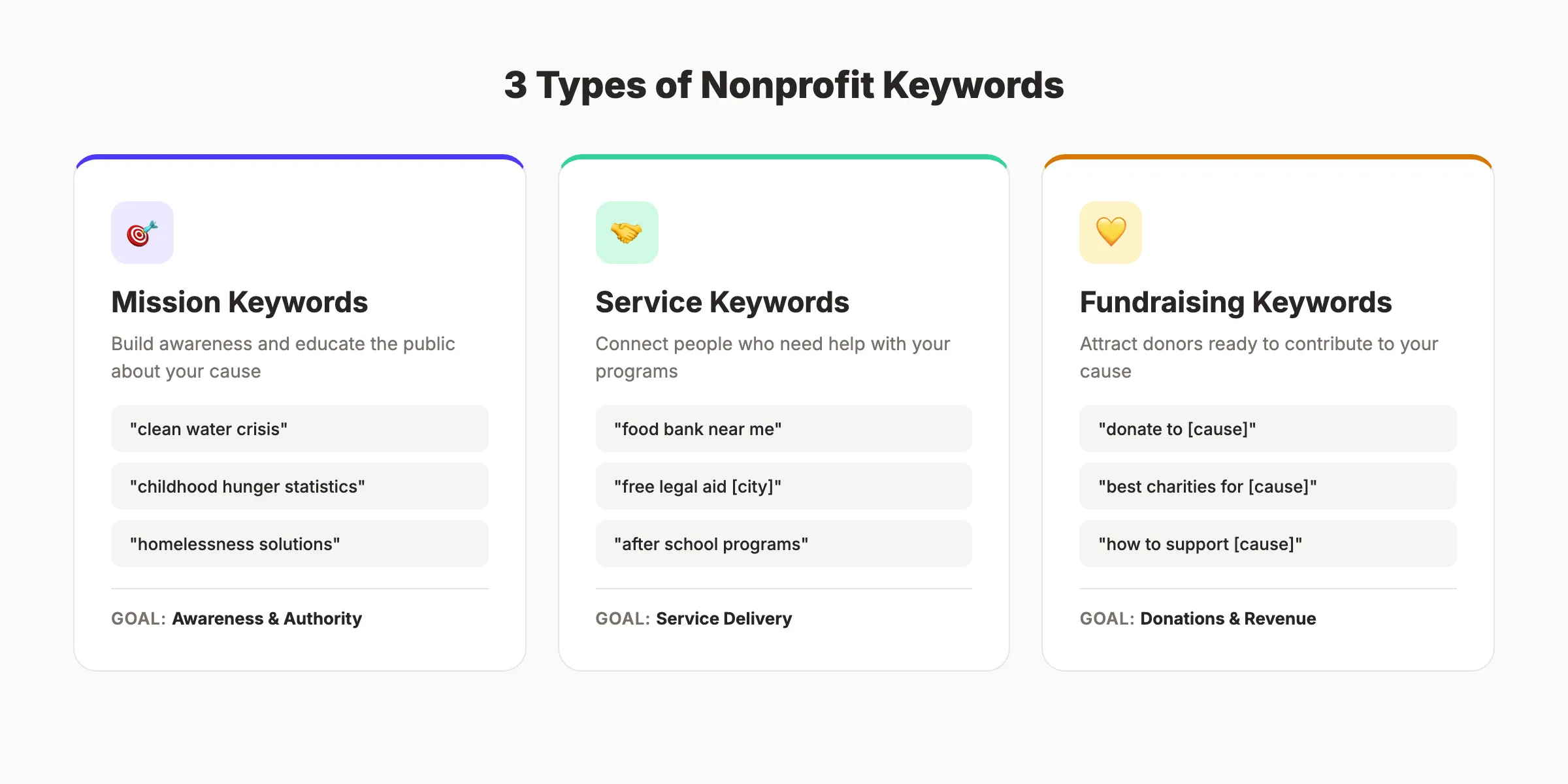
Most nonprofits only target fundraising keywords. That is a mistake. Mission and service keywords attract far more search volume and build the topical authority that helps fundraising pages rank later.
How to Find the Right Keywords
Start with free tools. You do not need expensive software.
Google Search Console shows which queries already bring traffic to your site. Sort by impressions to find keywords where you appear but do not rank well. These are your quickest wins. Our Google Search Console guide walks through the full setup.
Google Keyword Planner is free with a Google Ads account (which nonprofits get through the Ad Grant program). Filter for keywords with 100+ monthly searches and low competition.
AnswerThePublic reveals the exact questions people ask about your cause. These questions become your blog post topics and FAQ content.
Keyword Priorities for Nonprofits
Focus on long-tail keywords first. “How to volunteer for habitat for humanity in Austin” is easier to rank for than “volunteer opportunities.” Long-tail keywords also attract more qualified visitors.
Target keywords with a difficulty score under 30 if your site has a domain authority below 40. Most nonprofit websites fall in this range. Learn more about keyword research for blog posts to build a complete keyword strategy.
Your SEO team. $99 per month. Stacc publishes 30 optimized articles every month so your nonprofit ranks for the keywords that matter. Start for $1 →
Chapter 3: On-Page SEO for Nonprofit Websites
On-page SEO is the fastest way to improve rankings without spending money. Every nonprofit should get these fundamentals right.
Title Tags and Meta Descriptions
Your title tag is the single most important on-page ranking factor. Every page needs a unique title tag that includes your target keyword within the first 60 characters.
For nonprofits, add your organization name at the end:
- Good: “Free Legal Aid in Chicago | [Organization Name]”
- Bad: “Home | [Organization Name]”
Meta descriptions do not directly affect rankings. But they affect click-through rates. Write 145 to 155 characters that include the keyword and a clear reason to click. Use the on-page SEO checker to audit each page.
Header Structure
Use one H1 per page. Make it descriptive. “Our Programs” tells Google nothing. “After-School Tutoring Programs in Dallas” tells Google everything.
Break content into H2 and H3 sections. Each H2 should target a secondary keyword naturally. This structure helps both Google and screen readers understand your content.
Content Optimization
Nonprofit websites often have thin content. Program pages with 100 words and a donation button do not rank. Expand key pages to 800+ words with:
- Specific details about what you do and who you serve
- Impact statistics and outcomes
- Testimonials from beneficiaries (with permission)
- Clear next steps for visitors
Follow on-page SEO best practices for every high-priority page on your site.
Image Optimization
Nonprofit websites are heavy with images. Event photos, infographics, impact visuals. Every image needs:
- A descriptive file name (“dallas-food-bank-volunteers-2026.jpg” not “IMG_3847.jpg”)
- Alt text that describes the image for screen readers and search engines
- Compression to keep file sizes under 200KB where possible
Good image SEO improves both your search rankings and your accessibility score.
Chapter 4: Content Strategy for Nonprofits
Content is where nonprofits have a natural advantage. Your stories are real. Your impact is measurable. Your mission resonates.
The Nonprofit Content Advantage
Google’s E-E-A-T framework rewards experience, expertise, authoritativeness, and trustworthiness. Nonprofits score high on all four when they publish authentic, mission-driven content.
A food bank writing about hunger statistics has more authority than a marketing agency writing the same article. A legal aid organization explaining tenant rights outranks a generic law blog. Use this advantage.
Content Types That Work for Nonprofits
| Content Type | Example | SEO Value |
|---|---|---|
| Impact reports and data | ”2026 Hunger Statistics: What the Data Shows” | Attracts backlinks from media and researchers |
| Educational guides | ”How to Apply for SNAP Benefits in Texas” | High search volume, service-oriented |
| Cause awareness | ”What Causes Youth Homelessness? 5 Factors” | Mission keywords, builds authority |
| Program explanations | ”What to Expect at a Free Health Screening” | Service keywords, converts visitors |
| Volunteer and donor stories | ”How One Volunteer Changed 50 Lives in 2025” | E-E-A-T signals, shareable content |
| FAQ and resource pages | ”Frequently Asked Questions About Foster Care” | Featured snippet opportunities |
Publishing Cadence
Consistency matters more than volume. Publishing 2 to 4 articles per month is realistic for most nonprofit teams. Each article should target a specific keyword, follow SEO content writing best practices, and link to relevant internal pages.
Repurpose what you already create. Annual reports become data-driven blog posts. Grant narratives become program explainers. Board presentations become impact articles. You do not need to start from scratch every time.
Blog Structure for Nonprofits
Every blog post should follow a clear blog post structure:
- A keyword-rich title under 60 characters
- An opening that states the problem or question
- H2 sections that break the topic into scannable chunks
- Internal links to related content on your site
- A clear call to action (donate, volunteer, share, subscribe)
3,500+ blogs published. 92 percent average SEO score. See what Stacc can do for your nonprofit. Start for $1 →
Chapter 5: Local SEO for Nonprofits
Many nonprofits serve specific geographic areas. Food banks, shelters, clinics, tutoring programs. Local SEO connects you with people searching for services in your area.
Google Business Profile Optimization
If you have a physical location, claim and optimize your Google Business Profile. This is free and directly affects your visibility in Google Maps and local search results.
Complete every field:
- Organization name (exact legal name, no keyword stuffing)
- Address and service area
- Phone number and website URL
- Business hours (including holiday schedules)
- Categories (select the most specific option: “Nonprofit Organization,” “Food Bank,” “Legal Services,” etc.)
- Description (include your mission, services, and service area in 750 characters)
Google Business Profile Posts
Post updates to your GBP weekly. Share upcoming events, volunteer opportunities, impact updates, and program announcements. Active profiles rank higher in local results.
Local Keywords
Target location-specific keywords on your website:
- “food bank in [city]”
- “[cause] nonprofit [city]”
- “volunteer opportunities near [city]”
- “free [service] in [county]”
Create dedicated landing pages for each location you serve. A statewide nonprofit should have individual pages for each major city or county.
Citations and Directories
List your nonprofit on:
- GuideStar/Candid (the most important nonprofit directory for SEO)
- Charity Navigator
- GreatNonprofits
- Idealist.org
- Your local Chamber of Commerce
- State nonprofit association directories
Consistent NAP (Name, Address, Phone) information across all directories strengthens your local SEO signals.
Chapter 6: Technical SEO for Nonprofit Websites
Only 1 percent of nonprofit websites score “good” on Google’s mobile performance metrics. Eighty percent score “poor.” This is fixable.
Site Speed
Nonprofit websites are often built on outdated CMS platforms with bloated themes and uncompressed images. Speed matters. 53 percent of visitors abandon a site that takes longer than 3 seconds to load.
Quick wins:
- Compress all images (use TinyPNG or ShortPixel)
- Enable browser caching
- Minimize CSS and JavaScript files
- Use a CDN (Cloudflare has a free tier)
- Remove unused plugins and scripts
Mobile Optimization
52 percent of nonprofit website traffic comes from mobile devices. Yet most nonprofit sites are not optimized for mobile. Test your site with Google’s Mobile-Friendly Test and fix any issues.
Common mobile problems on nonprofit sites:
- Donation buttons too small to tap
- Forms that require horizontal scrolling
- Text too small to read without zooming
- Pop-ups that cover the entire screen
Schema Markup
Schema markup helps Google understand your content. For nonprofits, implement:
- NonprofitOrganization schema on your homepage and about page
- Event schema for fundraisers, galas, and volunteer events
- FAQPage schema on FAQ and resource pages
- Article schema on blog posts
Schema does not directly boost rankings. But it enables rich results in search (event dates, FAQ dropdowns, organization details) that increase click-through rates.
Crawlability Basics
Run a free SEO audit to identify technical issues. The most common nonprofit-specific problems:
- Broken links to old event pages
- Orphan pages with no internal links
- Duplicate content across program pages
- Missing XML sitemap
- Blocked resources in
robots.txt
Fix these before investing time in content. A technically broken site wastes every dollar you spend on SEO. Our technical SEO checklist covers the full audit process.
Skip the agency. Keep the results. Stacc starts at $99 per month with a $1 Strategy trial. No contracts. Start for $1 →
Chapter 7: Link Building for Nonprofits
Backlinks remain one of the top 3 ranking factors in Google. Nonprofits have a structural advantage here that most do not exploit.
Why Nonprofits Have a Link Building Advantage
You already have relationships with:
- Corporate sponsors and partners (ask for a link from their CSR or partners page)
- Government agencies (.gov links are extremely valuable)
- Universities and schools (.edu links from event partnerships)
- Media outlets that cover your cause
- Other nonprofits in your sector
These are the exact types of authoritative links that SEO professionals spend thousands of dollars trying to earn.
Tactics That Work for Nonprofits
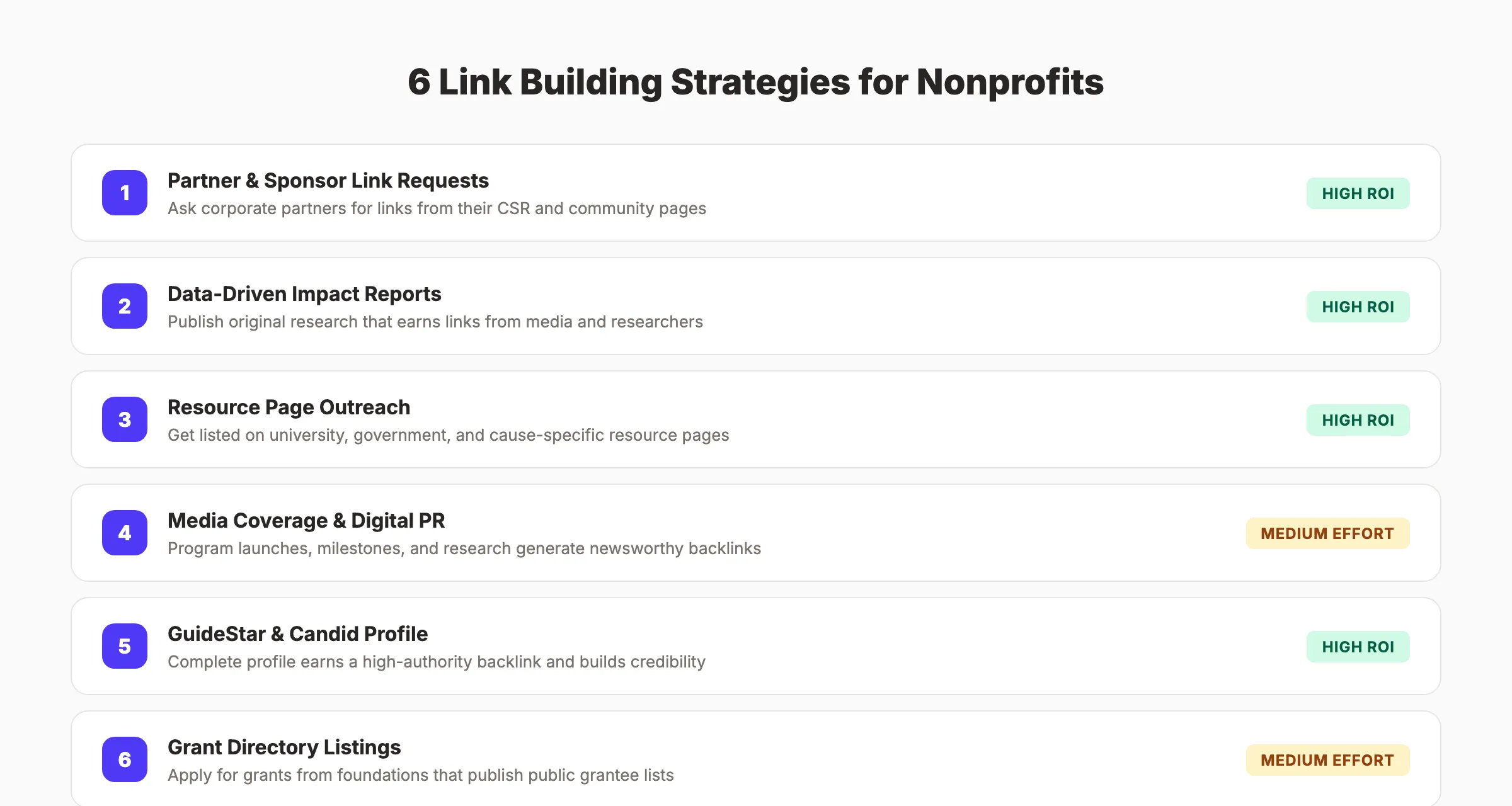
1. Partner and sponsor link requests. Email every corporate partner and sponsor. Ask them to link to your website from their community involvement or CSR page. Most will say yes. They want to showcase their philanthropy.
2. Data-driven content. Publish original research, surveys, or impact data. “2026 State of [Cause] Report” earns links from media, researchers, and other nonprofits. This is the highest-ROI link building strategy for mission-driven organizations.
3. Resource page outreach. Search for “[your cause] resources” and “[your topic] helpful links.” Find resource pages maintained by universities, government agencies, and other organizations. Pitch your content for inclusion.
4. Media coverage and digital PR. Nonprofits are inherently newsworthy. Program launches, impact milestones, research findings, and community events all generate media coverage with backlinks. See our guide to digital PR for SEO for outreach frameworks.
5. GuideStar and Candid profile. A complete profile on Candid (formerly GuideStar) with your financials, programs, and impact metrics builds credibility and earns a high-authority backlink.
6. Grant directory listings. Many grant databases and nonprofit directories link to recipient organizations. Apply for grants from foundations that maintain public grantee lists.
Links to Avoid
Do not buy links. Do not participate in link schemes. Do not submit to spammy directories. Google penalizes manipulative link building, and a penalty can devastate a nonprofit’s online visibility. Stick to earning links through genuine relationships and valuable content.
Chapter 8: Google Ad Grants and SEO Working Together
Google offers eligible nonprofits up to $10,000 per month in free Google Ads credit. Most nonprofits treat this as a separate channel from SEO. That is a missed opportunity.
How to Use the Ad Grant Strategically
Use ads for keywords you do not rank for organically yet. If your SEO is strong for “food bank in Dallas” but weak for “how to donate food in Dallas,” run ads for the second keyword while building organic content for it.
Test keyword viability before investing in content. Run ads for potential target keywords. If a keyword drives clicks but no conversions, do not invest months of SEO effort into ranking for it.
Fill gaps during the SEO ramp-up period. SEO takes 3 to 6 months to produce results. Ads provide immediate visibility while organic rankings build. As organic positions improve, reduce ad spend on those keywords.
Ad Grant Requirements That Affect SEO
The Google Ad Grant requires:
- A click-through rate above 5 percent (forces you to write compelling ad copy)
- Keywords must be relevant to your mission
- Landing pages must provide a good user experience
- Your website must meet Google’s quality standards
These requirements align perfectly with good SEO practices. A well-optimized website performs better for both organic search and Ad Grant campaigns.
Measuring the Combined Impact
Track organic and paid performance together in Google Analytics. Create segments for organic traffic and paid traffic. Compare conversion rates, pages per session, and donor acquisition costs across both channels.
The goal is a portfolio approach: ads cover short-term gaps while SEO builds long-term compounding traffic.
Chapter 9: Measuring Nonprofit SEO Results
SEO metrics need to connect to mission outcomes. Board members do not care about keyword rankings. They care about donations, volunteer sign-ups, and program enrollments.
Metrics That Matter for Nonprofits
| Metric | Tool | What It Tells You |
|---|---|---|
| Organic traffic | Google Analytics | How many people find you through search |
| Organic conversion rate | Google Analytics + CRM | Percentage of search visitors who take action |
| Keyword rankings | Google Search Console | Position changes for target keywords |
| Donation revenue from organic | Analytics + donation platform | Direct financial ROI of SEO |
| Volunteer sign-ups from organic | Analytics + form tracking | Mission impact of search visibility |
| Backlinks earned | Ahrefs free webmaster tools | Authority growth over time |
| Page speed score | PageSpeed Insights | Technical health of your site |
Setting Realistic Expectations
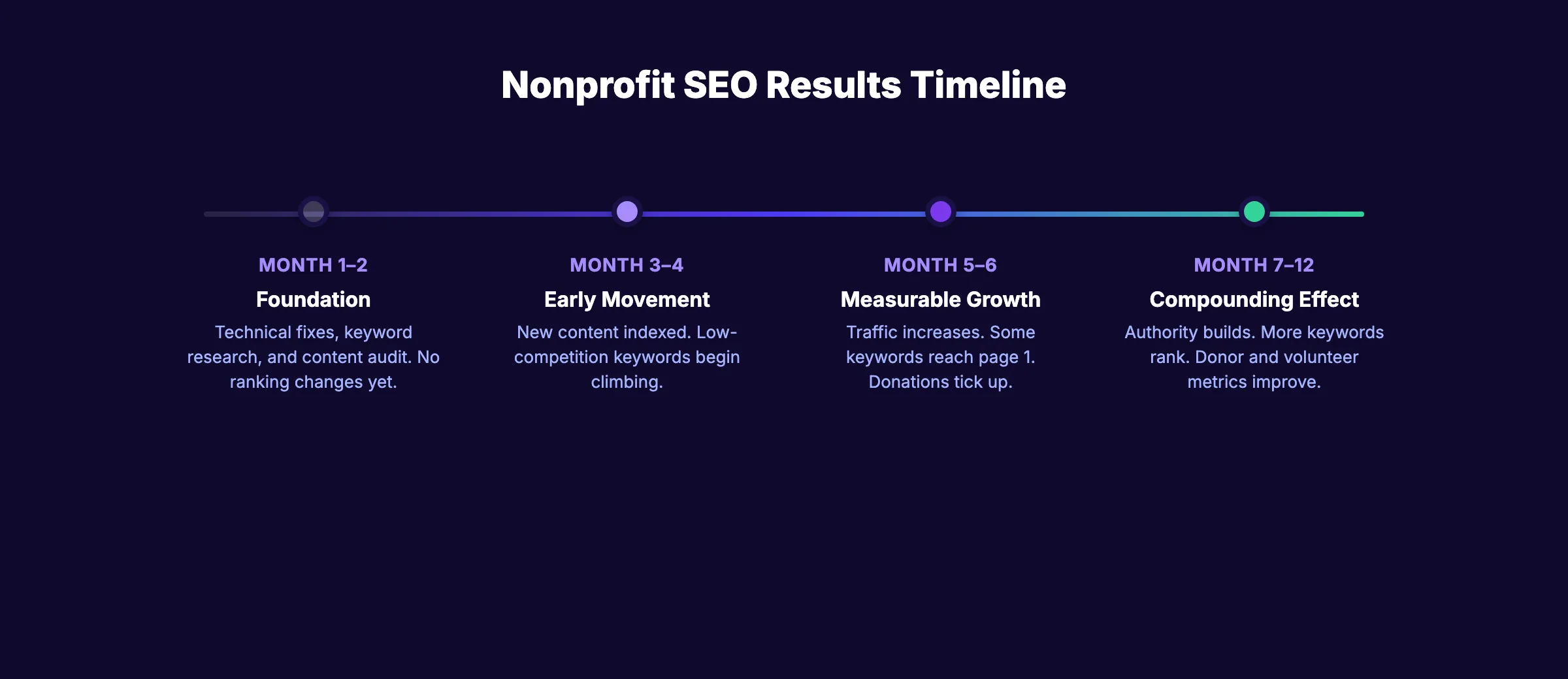
Here is what a typical nonprofit SEO timeline looks like:
- Month 1 to 2: Technical fixes, keyword research, content audit. No visible ranking changes.
- Month 3 to 4: New content indexed. Early position movements for low-competition keywords.
- Month 5 to 6: Traffic increases become measurable. Some keywords reach page 1.
- Month 7 to 12: Compounding effect. Authority builds. More keywords rank. Donation and volunteer metrics improve.
Do not expect overnight results. But do expect compounding returns. SEO is one of the few marketing channels where this month’s work makes next month’s work more effective.
Reporting to Leadership
Frame SEO results in terms leadership understands:
- “Organic search brought in $X in donations this quarter, up Y percent from last quarter.”
- “Z new volunteers signed up through Google search this month.”
- “Our website now ranks on page 1 for [key phrase], reaching an estimated [number] searchers per month.”
Connect every SEO metric to a mission outcome. That is how you maintain budget and support for the long term. Our SEO reporting guide provides templates for executive-level SEO reports.
Rank everywhere. Do nothing. Blog SEO, Local SEO, and Social on autopilot. 30 articles per month, published automatically. Start for $1 →
FAQ
Is SEO worth it for small nonprofits?
Yes. Organic search drives 44 percent of nonprofit website traffic and delivers 500 to 1,300 percent ROI. Even small nonprofits with limited budgets can implement basic SEO: optimize title tags, claim a Google Business Profile, and publish 2 to 4 blog posts per month. The compounding nature of SEO makes early investment especially valuable.
How much does SEO cost for a nonprofit?
It depends on your approach. DIY SEO costs nothing but staff time. Nonprofit SEO agencies charge $1,500 to $3,000 per month. Automated services like Stacc start at $99 per month for 30 published articles. Many nonprofits start with free tools and the Google Ad Grant, then invest in dedicated SEO support as organic traffic grows.
What is the Google Ad Grant and how does it help SEO?
The Google Ad Grant provides eligible nonprofits with $10,000 per month in free Google search advertising. It complements SEO by providing immediate visibility for keywords you have not ranked for organically yet. Use it to test keyword viability and fill gaps while your organic rankings build.
How long does SEO take to work for nonprofits?
Expect 3 to 6 months for measurable results. Low-competition keywords may show movement within 4 to 8 weeks. Competitive keywords take longer. The key is consistency. Nonprofits that publish regularly and maintain their technical SEO see compounding traffic growth over 12 to 24 months.
What are the best free SEO tools for nonprofits?
Google Search Console (keyword data and technical issues), Google Analytics (traffic and conversions), Google Keyword Planner (keyword research via the Ad Grant account), Ubersuggest (limited free tier for keyword research), and PageSpeed Insights (site speed analysis). These tools cover the essentials at zero cost. See our full list of free SEO tools for more options.
How can nonprofits build backlinks on a limited budget?
Ask corporate sponsors and partners for links from their CSR pages. Publish original data and impact reports that attract media links. List your organization on GuideStar, Charity Navigator, and Idealist. Reach out to universities and government agencies for resource page inclusion. Nonprofits have a natural advantage because their work is inherently link-worthy.
Nonprofits that invest in SEO build a traffic source that compounds year over year. Unlike paid campaigns that stop the moment funding runs out, organic search visibility grows with every article published, every backlink earned, and every technical fix implemented.
Start with the basics. Fix your technical SEO. Claim your Google Business Profile. Publish content that matches what your supporters are searching for. The organizations that commit to this process do not just rank higher. They reach more people, raise more funds, and expand their impact.
Stop writing. Start ranking. Stacc publishes 30 SEO articles per month for $99. Your nonprofit content, always fresh. Start for $1 →
Related Tools & Resources
Free SEO Tools:
Best Lists:

Written by
Siddharth GangalSiddharth is the founder of theStacc and Arka360, and a graduate of IIT Mandi. He spent years watching great businesses lose organic traffic to competitors who simply published more. So he built a system to fix that. He writes about SEO, content at scale, and the tactics that actually move rankings.
30 SEO blog articles published every month
Keyword-optimized, scheduled, and live on your site. Automatically.
30-day trial · Cancel anytime
theStacc
Stop writing SEO content manually
30 blog articles, 30 GBP posts, and social media content. Published every month. Automatically.
Start Your $1 Trial$1 for 3 days · Cancel anytime