
AI Marketing Statistics 2026: 51 Facts
51 AI marketing statistics for 2026, all sourced and verified. Covers adoption, ROI, content, SEO, email, advertising, and market size. Updated March 2026.
Last updated: March 2026
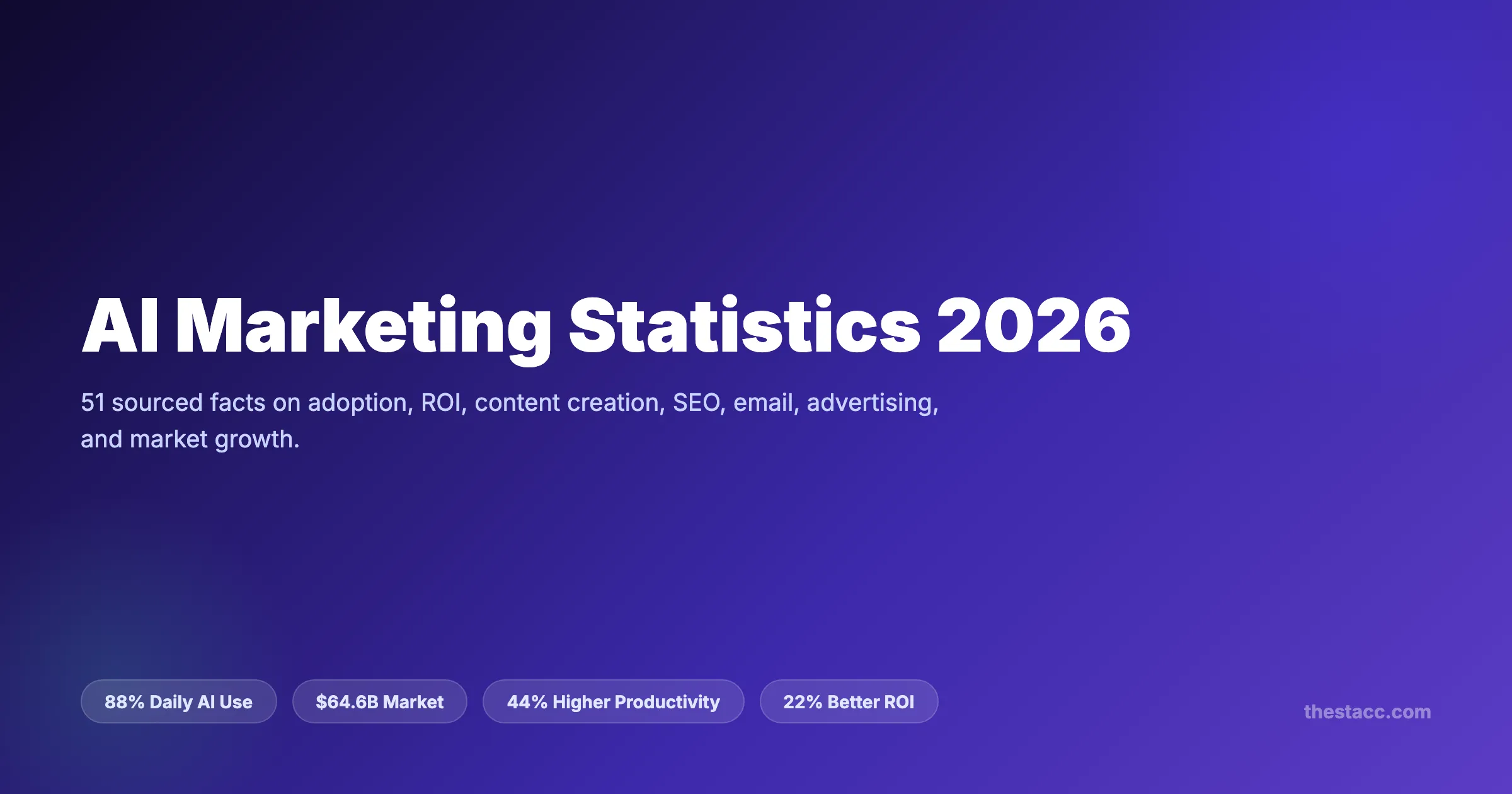
88% of marketers now use AI tools daily. The AI marketing market hit $64.6 billion in 2026. Teams using AI report 44% higher productivity and 22% better campaign ROI.
Most marketing teams have adopted AI in some form. Few know exactly how fast the shift is happening. These ai marketing statistics answer that question with sourced numbers.
Every stat below is cited, dated, and organized by category. Use them to benchmark your team, justify AI spending, or build a business case for scaling content with AI.
We publish 3,500+ blogs across 70+ industries. Data drives every decision we make. Here are 51 AI marketing statistics that show where the industry stands in 2026.
Table of Contents
- AI Marketing Adoption Statistics , 8 stats
- AI Content Creation Statistics , 7 stats
- AI Marketing ROI and Revenue Statistics , 7 stats
- AI SEO and Search Statistics , 7 stats
- AI Email Marketing Statistics , 6 stats
- AI Advertising and Social Media Statistics , 6 stats
- AI Marketing Challenges and Concerns , 5 stats
- AI Marketing Spending and Market Size , 5 stats
- Key Takeaways
AI Marketing Adoption Statistics
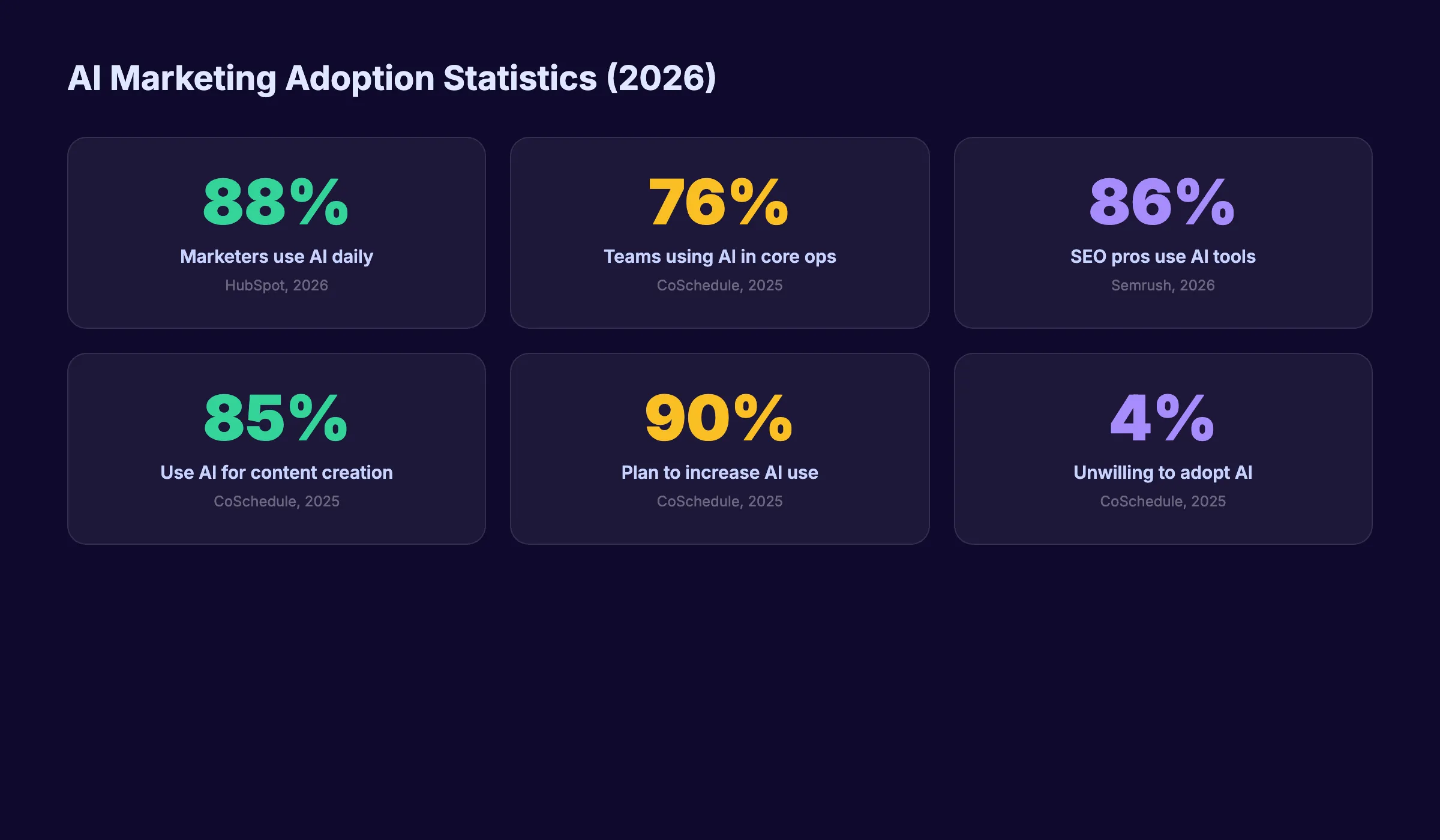
1. 88% of marketers use AI tools daily in 2026. Source: HubSpot State of Marketing Report, 2026 Daily usage, not occasional experimentation. AI has moved from optional to default in most marketing workflows.
2. 76% of marketing teams use AI in core operations. Source: CoSchedule State of AI in Marketing, 2025 Three in 4 teams run AI across their primary functions. That number was under 40% just 3 years ago.
3. 86% of SEO professionals have integrated AI into their workflows. Source: Semrush, 2026 SEO teams adopted AI faster than any other marketing function. Learn more in our SEO statistics roundup.
4. 85% of marketers use AI for content creation. Source: CoSchedule, 2025 Content writing is the top use case. Read our guide on using AI to write blog posts for practical workflows.
5. Only 4% of companies are unwilling to adopt AI. Source: CoSchedule, 2025 39% are very open to adoption. Another 31% are open. Resistance is now a fringe position.
6. 90% of marketing teams plan to increase AI integration within 2 to 3 years. Source: CoSchedule, 2025 Nearly half (47%) expect significant increases. The shift is accelerating, not plateauing.
7. AI adoption in marketing grew by 36 percentage points between 2022 and 2025. Source: Amra and Elma, 2025 That is the fastest adoption curve of any marketing technology in the past decade.
8. 93% of marketers report new AI features added to their existing tools in 2024. Source: CoSchedule, 2025 42% say most or all of their tools now include AI features. Adoption is happening passively through tool updates.
AI Content Creation Statistics
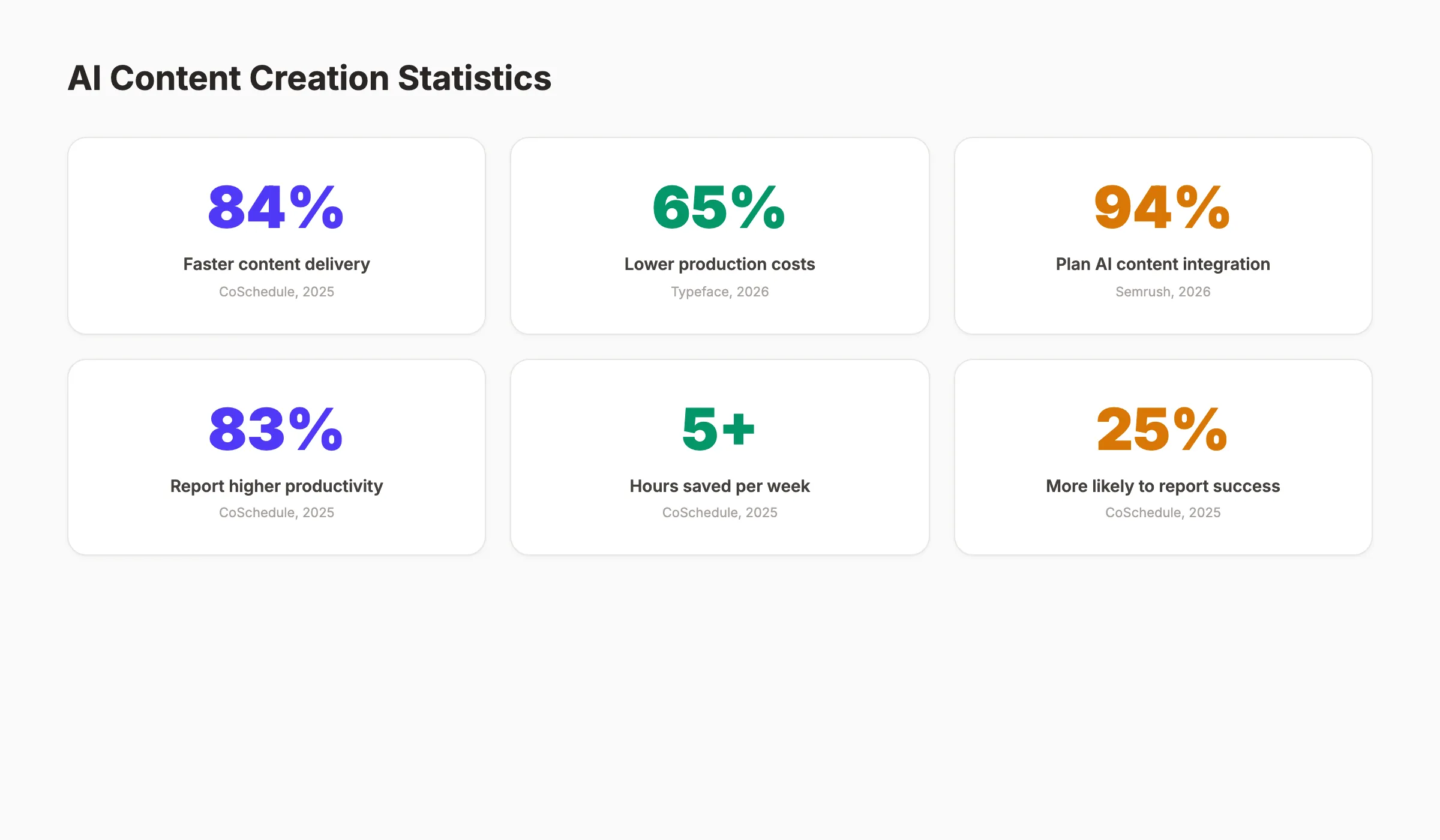
9. AI-generated content reduces production costs by 65%. Source: Typeface, 2026 Cost per article drops significantly when AI handles first drafts. See our content marketing statistics for more benchmarks.
10. Teams using AI deliver content 84% faster than traditional workflows. Source: CoSchedule, 2025 Speed means more content published per month. More content compounds SEO results over time.
11. 83% of marketers report increased productivity after adopting AI. Source: CoSchedule, 2025 Only 2% reported decreased productivity. The productivity gains are near-universal.
12. Marketers save 5+ hours per week using AI tools. Source: CoSchedule, 2025 50% save 1 to 5 hours weekly. Some save 10 or more. That is 260+ hours per year redirected to strategy.
13. 94% of marketers plan to use AI for content creation and blogging in 2026. Source: Semrush, 2026 AI content is no longer experimental. It is the standard production method. Check our AI content statistics for deeper data.
14. 26% of marketers say AI content outperforms human-only content. Source: CoSchedule, 2025 Another 64% see equal or better results. Only 10% report AI underperformance. The gap between humanized AI content and purely manual copy is closing.
15. 79% of marketers cite efficiency as the top AI benefit. Source: CoSchedule, 2025 55% cite content scaling. 43% cite cost savings. Efficiency drives adoption. Scale sustains it.
Publish 30 AI-optimized blog posts per month. Stacc handles research, writing, and SEO. Your team stays focused on strategy. Start for $1 →
AI Marketing ROI and Revenue Statistics
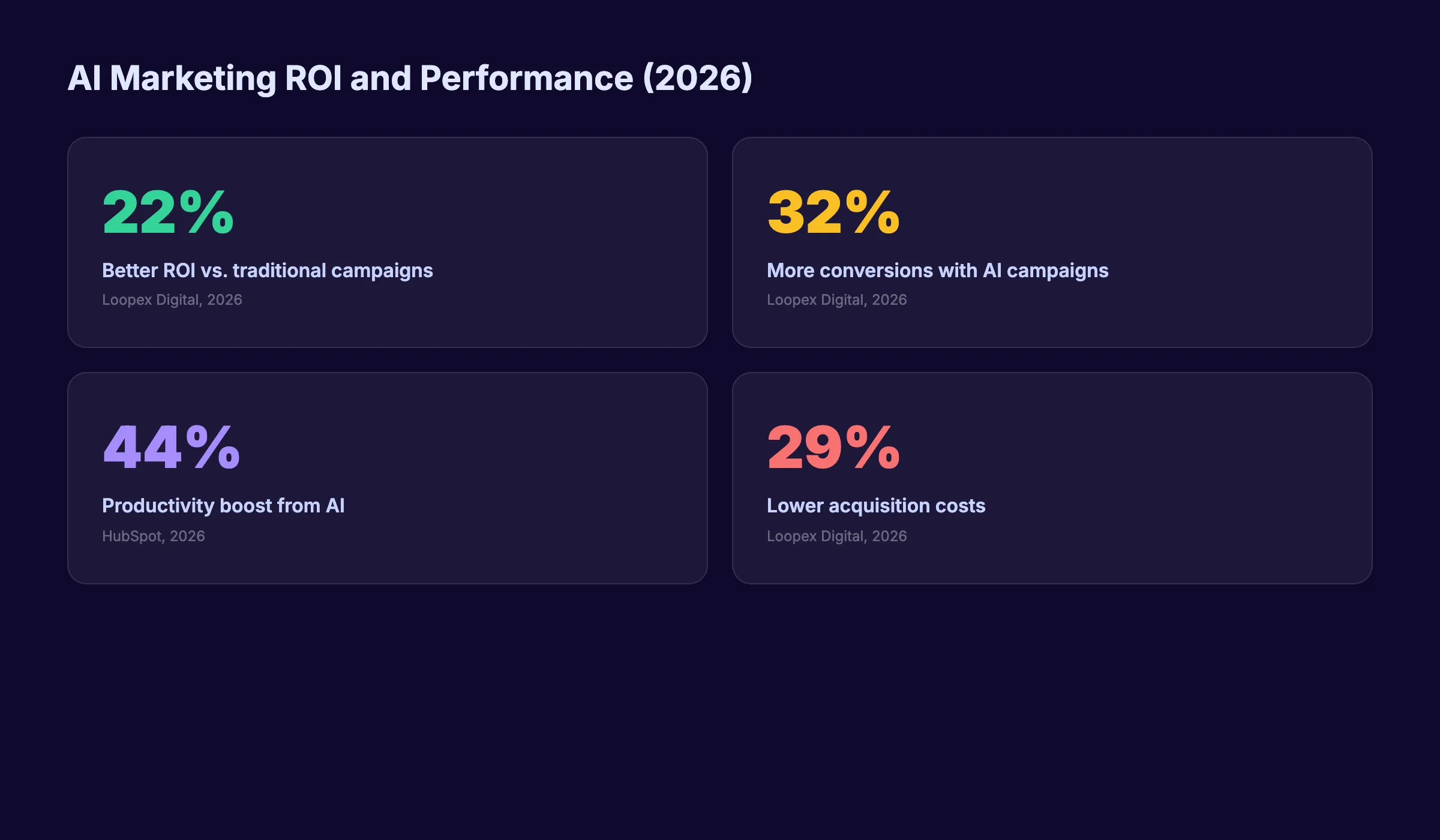
16. AI campaigns deliver 22% better ROI than traditional campaigns. Source: Loopex Digital, 2026 That margin grows wider as AI models improve. Teams measuring content marketing ROI see the clearest gains.
17. AI campaigns generate 32% more conversions than non-AI campaigns. Source: Loopex Digital, 2026 More conversions from the same traffic. AI improves targeting, personalization, and timing simultaneously.
18. AI reduces customer acquisition costs by 29%. Source: Loopex Digital, 2026 Lower CAC means higher margins. The reduction comes from better targeting and reduced manual labor.
19. Marketing teams using AI report 44% higher productivity. Source: HubSpot, 2026 That translates to roughly 11 extra productive hours per week per team member.
20. Organizations investing in AI see 10% to 20% sales ROI improvement. Source: Adobe, 2026 Leading companies achieve 1.5x higher revenue growth over 3 years compared to non-adopters.
21. AI personalization increases e-commerce conversion rates by up to 10%. Source: All About AI, 2026 Personalized product recommendations powered by AI can increase average order value by up to 369%.
22. 75% of marketers feel AI provides a competitive advantage. Source: CoSchedule, 2025 28% call it a significant advantage. 46% call it moderate. Only 4% see no advantage.
AI SEO and Search Statistics
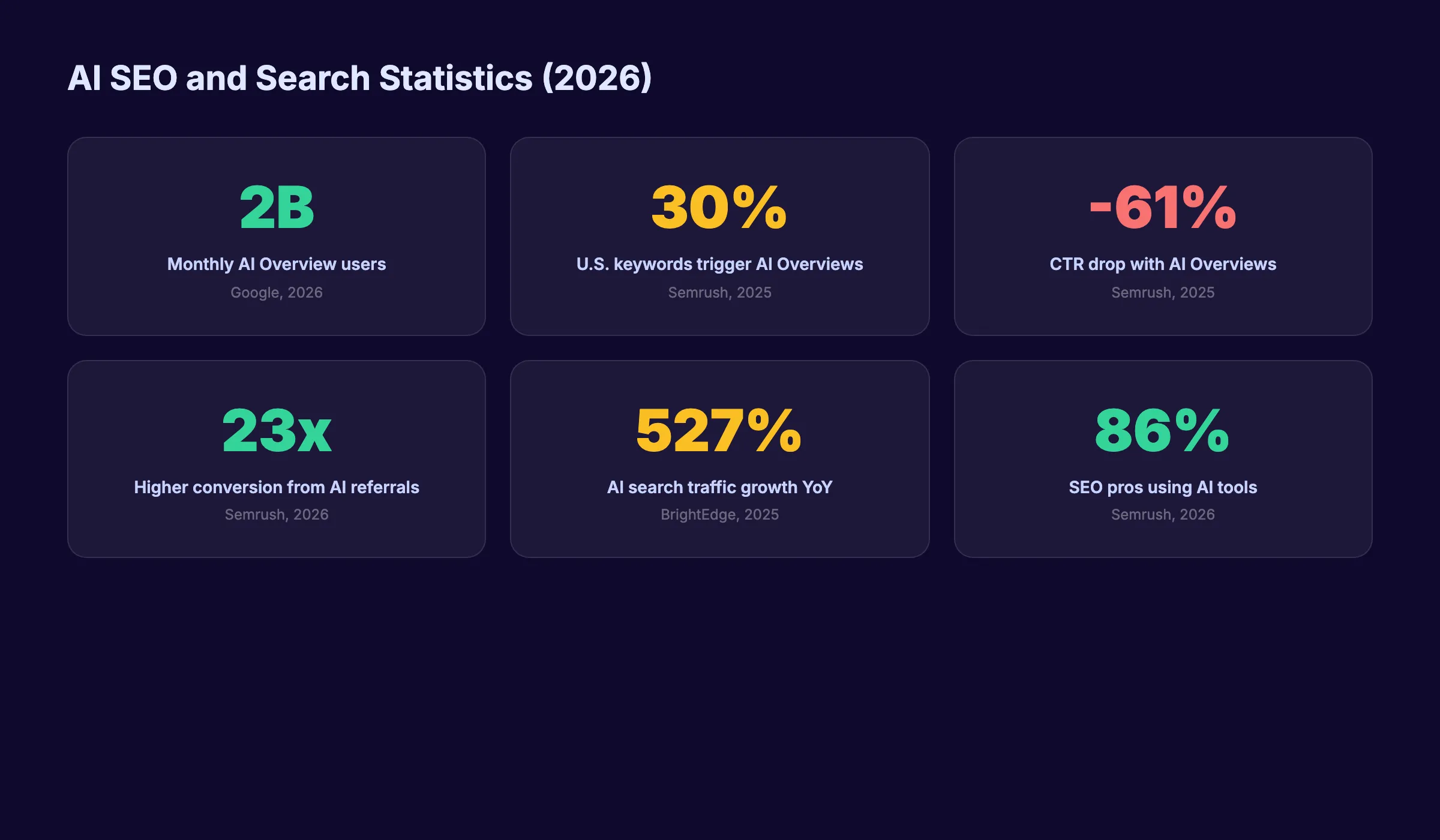
23. 2 billion users engage with Google AI Overviews monthly. Source: Google, 2026 AI Overviews now appear across 200+ countries and 40+ languages. Understanding how AI is changing SEO is essential.
24. 30% of U.S. desktop keywords now trigger AI Overviews. Source: Semrush, 2025 That is a new high. The percentage continues to rise each quarter. Read our guide to optimizing for AI Overviews.
25. Organic CTR dropped 61% for queries with AI Overviews. Source: Semrush, 2025 CTR fell from 1.76% to 0.61% when AI Overviews appear. Traditional blue links lose clicks to AI-generated summaries.
26. AI-referred visitors convert 23x higher than organic search visitors. Source: Semrush, 2026 B2B SaaS companies report 6x to 27x higher conversion rates from AI referral traffic. The volume is smaller, but the quality is exceptional.
27. AI search traffic grew 527% year over year. Source: BrightEdge, 2025 Traffic from LLMs rose from 17,000 to 107,000 sessions between comparable periods. Generative engine optimization is becoming a distinct discipline.
28. 35% of Gen Z users in the U.S. use AI chatbots instead of search engines. Source: Semrush, 2026 Younger audiences are shifting away from Google. Brands need visibility in AI answers, not just search results.
29. The AI SEO software market will reach $4.97 billion by 2033. Source: DemandSage, 2026 Up from $1.99 billion in 2024. SEO tools are becoming AI-first products. See our SEO statistics for broader industry data.
AI Email Marketing Statistics
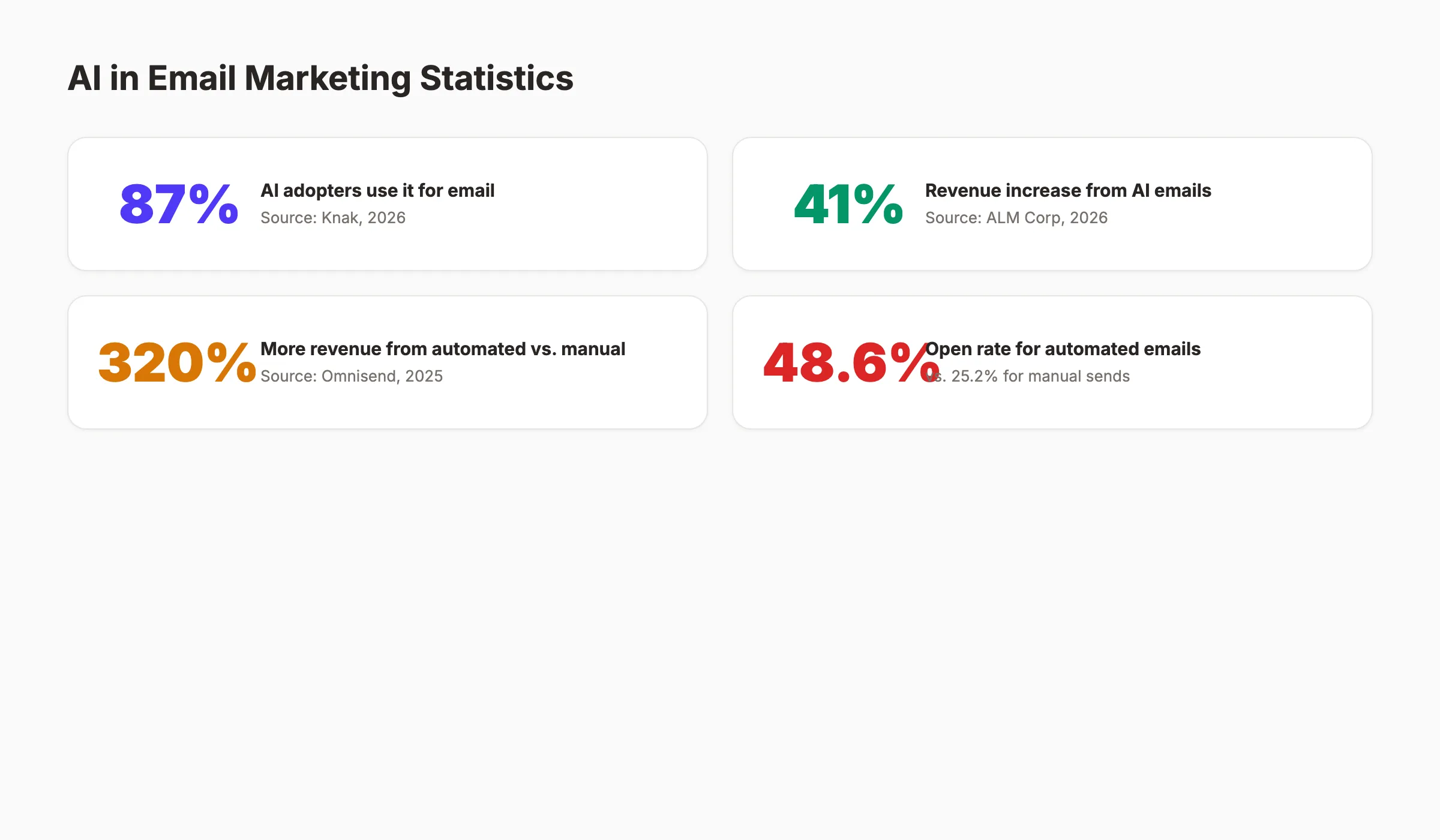
30. 87% of AI adopters use AI specifically for email marketing. Source: Knak, 2026 Email is the most common AI application after content creation. Check our full email marketing statistics roundup.
31. AI-personalized emails drive 41% higher revenue than traditional emails. Source: ALM Corp, 2026 Personalization at scale was impossible without AI. Now it is the default for high-performing teams.
32. Automated emails generate 320% more revenue than manual campaigns. Source: Omnisend, 2025 Automated flows represent just 2% of send volume but drive 3x the revenue. Learn how to set up email automation properly.
33. Automated emails achieve a 48.6% open rate vs. 25.2% for manual sends. Source: Omnisend, 2025 Click-through rates follow the same pattern: 5.4% for automated vs. 1.5% for manual campaigns.
34. 89% of marketing experts expect AI to power 75% of email operations by 2028. Source: Knak, 2026 AI is not just writing subject lines. It is handling segmentation, send timing, and content selection.
35. AI-driven email segmentation campaigns generate up to 760% more revenue. Source: Omnisend, 2025 AI makes micro-segmentation practical. One-size-fits-all emails are now a revenue leak.
Your SEO team. $99 per month. We publish blog content, optimize for search, and drive organic traffic. No agencies. No freelancers. No waiting. Start for $1 →
AI Advertising and Social Media Statistics
36. AI-enabled advertising spend will reach $1.3 trillion by 2032. Source: Statista, 2025 Up from $370 billion in 2022. AI is not a feature of advertising. It is the operating system.
37. 75% of advertising practitioners use generative AI. Source: JumpFly, 2026 Teams that do not use AI pay a 5% to 10% efficiency penalty compared to those that do.
38. Google advertisers created 70 million AI-generated creative assets in Q4 2025. Source: Google Ads, 2025 That is a 3x year-over-year increase. AI Max and Performance Max campaigns drive the bulk of this volume.
39. Demand Gen campaigns using AI deliver 14% more conversions. Source: Google, 2025 When paired with Search or Performance Max campaigns, AI adds incremental conversions that manual campaigns miss.
40. 79% of advertisers say paid social is necessary for growth. Source: Marketing LTB, 2025 Social ads account for 33% of total digital ad spend. AI handles creative testing, bid optimization, and audience targeting.
41. Mobile devices account for 69% of all PPC ad clicks. Source: Digital Silk, 2025 Up from 63% in 2022. AI bid strategies optimize for mobile conversion patterns automatically.
AI Marketing Challenges and Concerns
42. 40% of marketers cite data privacy as their top AI concern. Source: CoSchedule, 2025 Privacy regulations and customer data handling remain the biggest barrier to AI adoption.
43. 38% lack the technical expertise to implement AI effectively. Source: CoSchedule, 2025 Only 17% of marketers using AI receive proper training. The skills gap is real.
44. 33% see implementation costs as a barrier. Source: CoSchedule, 2025 Cost concerns persist despite falling tool prices. The hidden cost is training, not software. Automating your SEO workflow helps reduce both.
45. 68% of marketers use AI but only 17% receive training. Source: Digital Marketing Institute, 2025 Most teams are self-teaching. Structured training programs improve output quality and reduce error rates.
46. 48% of marketers dedicate less than 10% of their budget to AI tools. Source: Pixis, 2025 Underinvestment limits results. Teams spending more on AI report proportionally higher productivity gains.
AI Marketing Spending and Market Size
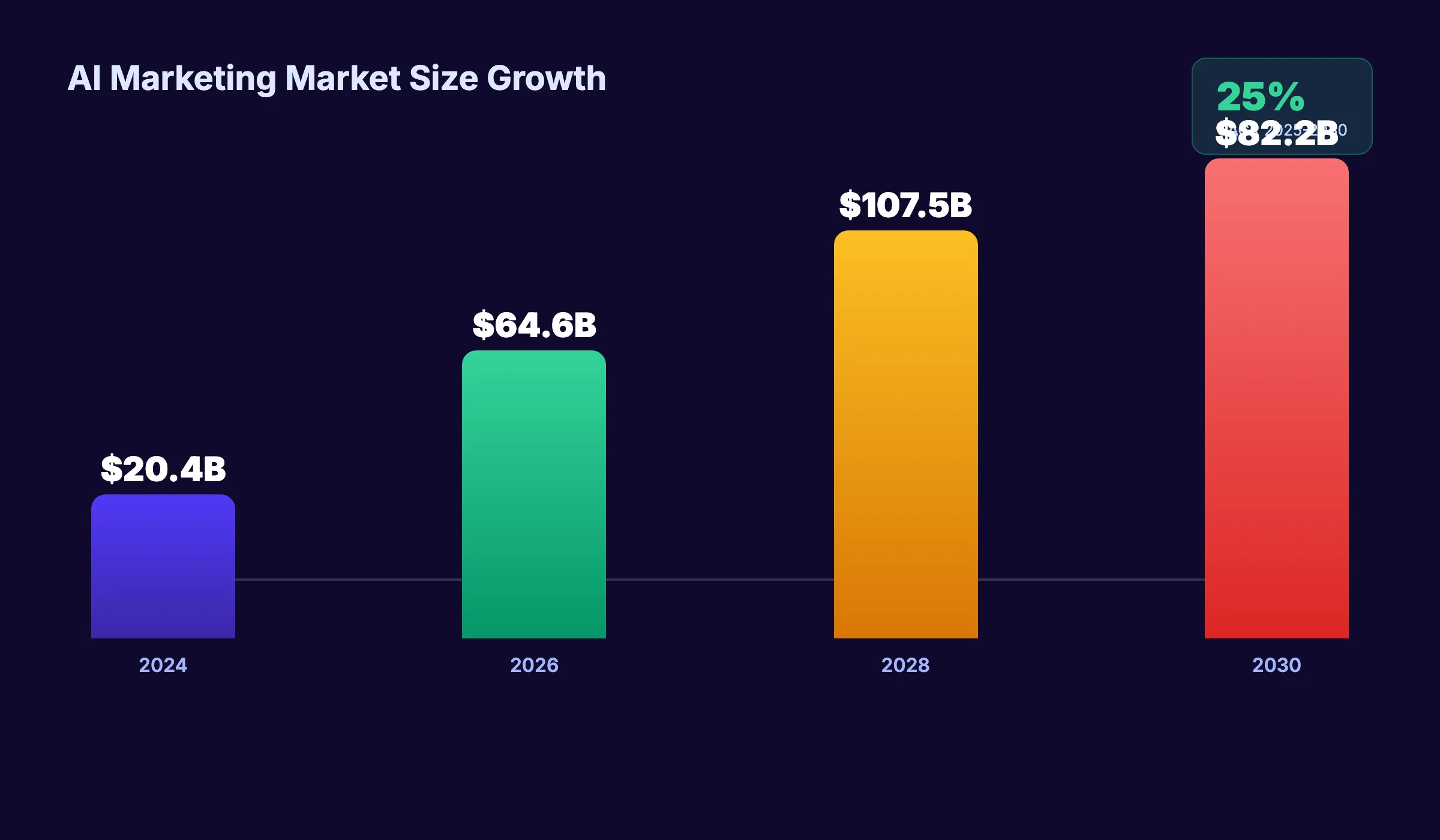
47. The global AI marketing market reached $64.6 billion in 2026. Source: Grand View Research, 2026 Up from $20.4 billion in 2024. That is more than 3x growth in 2 years.
48. AI marketing spend grows at 25% CAGR through 2030. Source: Grand View Research, 2026 The market is projected to hit $82.2 billion by 2030. Growth is driven by content automation and personalization.
49. The AI marketing market is projected to reach $107.5 billion by 2028. Source: Statista, 2025 From $15.8 billion in 2021 to $107.5 billion in 7 years. That is a 6.8x increase. Explore our content marketing strategy guide to see where this investment goes.
50. 59% of marketers plan to increase AI tool spending in 2026. Source: CoSchedule, 2025 13% expect significant increases. 46% expect slight increases. Only 3% plan to decrease.
51. 9% of total marketing budgets now go to AI tools. Source: Loopex Digital, 2026 AI is the fastest-growing category in marketing spend. That percentage will likely double within 2 years.
Key Takeaways
- 88% of marketers use AI daily. Adoption is no longer early-stage. It is mainstream.
- AI campaigns deliver 22% better ROI and 32% more conversions than traditional methods.
- Content production costs drop 65% with AI. Delivery speed increases 84%.
- AI Overviews cut organic CTR by 61%. But AI-referred visitors convert 23x higher.
- 87% of AI adopters use it for email. Automated emails generate 320% more revenue.
- The AI marketing market hit $64.6 billion in 2026, growing at 25% CAGR.
- Only 17% of AI users receive training. The skills gap is the biggest untapped opportunity.
Methodology
Sources: HubSpot State of Marketing 2026, CoSchedule State of AI in Marketing 2025, Semrush AI SEO Studies, Google, Statista, Grand View Research, Omnisend, BrightEdge, Digital Marketing Institute, Loopex Digital, Adobe, Typeface, ALM Corp, Knak, Pixis.
Last updated: March 2026
Note: We update this page quarterly to ensure all statistics remain current. Each stat includes the source name, year, and a direct link where available. When a stat has changed since original publication, we note the update date.
Frequently Asked Questions
What is the most important AI marketing statistic in 2026?
88% of marketers now use AI daily. This stat captures the full scope of the shift. AI is no longer a competitive advantage. It is the baseline. Teams not using AI are falling behind the 9 in 10 marketers who are.
How much does AI improve marketing ROI?
AI campaigns deliver 22% better ROI than traditional campaigns. They also generate 32% more conversions and reduce customer acquisition costs by 29%. The content ROI guide explains how to measure these gains accurately.
How big is the AI marketing market?
The global AI marketing market reached $64.6 billion in 2026. It is projected to grow to $107.5 billion by 2028 at a 25% compound annual growth rate. AI-enabled advertising spend alone will reach $1.3 trillion by 2032.
What percentage of marketers use AI for content creation?
85% of marketers use AI for content creation as of 2025. 94% plan to integrate AI into their content workflows in 2026. Content creation is the single most popular AI application in marketing. See our blogging statistics for related data.
What are the biggest challenges with AI in marketing?
Data privacy (40%), lack of technical expertise (38%), and implementation costs (33%) are the top 3 barriers. Only 17% of AI-using marketers receive proper training. The skills gap, not the technology gap, is the primary obstacle.
How often are these AI marketing statistics updated?
We update this page quarterly. Last updated: March 2026. All statistics are sourced from named reports with publication dates. Each stat includes a direct link to the original source.
AI is not a trend to watch. It is the operating reality for 9 out of 10 marketing teams. The gap between AI adopters and non-adopters will only widen. Start measuring your own AI marketing performance against these benchmarks today.
Rank everywhere. Do nothing. Stacc publishes SEO content on autopilot. 30 articles per month. $99. Start for $1 →

Written by
Siddharth GangalSiddharth is the founder of theStacc and Arka360, and a graduate of IIT Mandi. He spent years watching great businesses lose organic traffic to competitors who simply published more. So he built a system to fix that. He writes about SEO, content at scale, and the tactics that actually move rankings.
30 SEO blog articles published every month
Keyword-optimized, scheduled, and live on your site. Automatically.
30-day trial · Cancel anytime
theStacc
Stop writing SEO content manually
30 blog articles, 30 GBP posts, and social media content. Published every month. Automatically.
Start Your $1 Trial$1 for 3 days · Cancel anytime