
Build an AI Marketing Workforce (2026): Guide
ai marketing workforce strategies for 2026: proven tactics, real case studies, tools, and metrics to drive growth and ROI.
Most marketing teams run on a broken model. One or two people handle content, social, SEO, email, and analytics. They work 50-hour weeks. They still fall behind.
The math does not add up. A single blog post takes 3 to 4 hours. Social media eats 6 to 10 hours per week. SEO audits pile up. Campaign reports go unread. Meanwhile, 88% of marketers already use AI in their daily work, according to SurveyMonkey’s 2026 report. The gap between teams using AI and teams doing everything manually widens every quarter.
An AI marketing workforce closes that gap. Not by replacing your team. By giving every person on your team the output capacity of 5.
We have published 3,500+ blogs across 70+ industries and helped businesses build marketing operations that run on autopilot. This guide covers everything we know about building an AI marketing workforce from scratch.
Here is what you will learn:
- What an AI marketing workforce actually is (and what it is not)
- The 7 roles every AI marketing workforce needs
- How to audit your current workflows for AI readiness
- A step-by-step deployment plan across all marketing channels
- Human-AI collaboration protocols that prevent quality disasters
- The 8 most common mistakes and how to avoid them
- How to measure real ROI from your AI workforce
- Where the industry is heading in the next 12 months
What an AI Marketing Workforce Actually Is
An AI marketing workforce is not a single tool. It is not a chatbot. It is not “using ChatGPT sometimes.”
It is a structured system where AI agents handle specific, repeatable marketing tasks while humans direct strategy, review output, and make judgment calls. Think of it as a team of specialized digital workers, each assigned to a function. One writes blog posts. Another manages social media scheduling. A third monitors SEO performance and flags issues.
The key distinction: these agents execute. They do not just recommend. Traditional marketing tools give you data and dashboards. AI agents take action based on that data.
The Shift From Tools to Agents
Marketing technology has evolved through 3 distinct phases:
| Phase | Era | What It Does |
|---|---|---|
| Phase 1 | SaaS dashboards (2010-2019) | Shows you data |
| Phase 2 | Generative AI (2020-2024) | Creates drafts you edit |
| Phase 3 | Agentic AI (2025-present) | Executes tasks autonomously |
Phase 3 is where the AI marketing workforce lives. Agents do not wait for you to prompt them. They run on schedules, follow workflows, and produce finished output.
What Makes It a “Workforce”
A single AI tool is an employee. An AI marketing workforce is a department.
It includes:
- Content agents that write, optimize, and publish blog posts
- SEO agents that audit pages, fix technical issues, and track rankings
- Social media agents that draft posts, schedule publishing, and repurpose content
- Analytics agents that pull reports, flag anomalies, and surface insights
- Email agents that build sequences, segment audiences, and test subject lines
Each agent has a defined role, a set of inputs, and measurable output. Together, they form a functioning marketing department that operates around the clock.
Your SEO team. $99 per month. Stacc publishes 30 optimized articles per month for your business on autopilot. Start for $1 →
Why Your Business Needs an AI Marketing Workforce Now
The window to build an AI marketing workforce is shrinking. Early adopters already have 12 to 18 months of compounding results. Here is why waiting costs more than starting.
The Execution Gap Is Real
Most businesses know what to do. They do not have the people to do it.
A HubSpot survey found that 70% of marketers say their biggest challenge is producing enough content. Not strategy. Not ideas. Execution.
AI agents close this gap. A single content agent can produce 30 blog posts per month. That is more than most agencies deliver for $3,000 to $5,000 per month.
The Cost Advantage Is Massive
Here is what marketing execution actually costs:
| Resource | Monthly Cost | Monthly Output |
|---|---|---|
| Full-time content writer | $4,500-$7,000 | 8-12 articles |
| Freelance writers (30 articles) | $2,400-$7,500 | 30 articles |
| SEO agency | $3,000-$10,000 | 4-8 articles + audits |
| AI marketing workforce | $99-$299 | 30-80 articles + SEO + social |
The difference is not incremental. It is a magnitude shift.
Your Competitors Already Started
According to Jasper’s State of AI in Marketing 2026 report, 91% of marketers actively use AI, up from 63% the previous year. That is not early adoption anymore. That is mainstream.
More critically, 65% of marketing teams now have designated AI roles. If you do not have one, you are already behind the 2 out of 3 companies that do.
Search Is Changing
Google is not the only search engine anymore. ChatGPT, Perplexity, Gemini, and other AI platforms now drive meaningful traffic. Your content needs to rank in traditional search AND get cited in AI search.
An AI marketing workforce covers both. Traditional SEO content writing plus generative engine optimization run in parallel without doubling your workload.
The 7 Roles in an AI Marketing Workforce
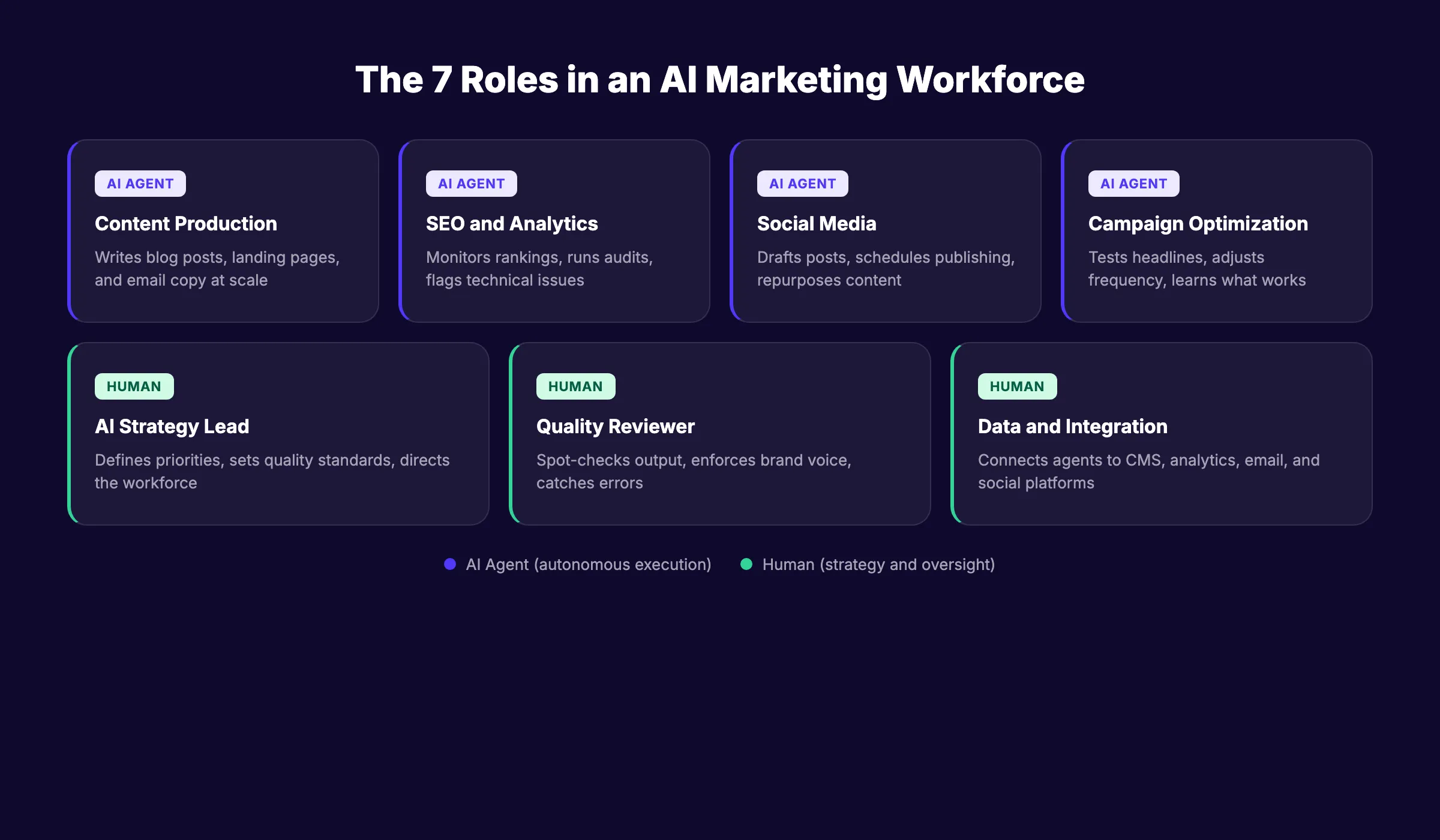
Every AI marketing workforce needs these 7 roles. Some are AI agents. Some are human. The best teams blend both.
Role 1: Content Production Agent
Type: AI Agent Function: Writes blog posts, landing pages, product descriptions, and email copy.
This agent handles the highest-volume task in marketing. It follows brand voice guidelines, targets specific keywords, and produces publish-ready drafts.
Output benchmarks:
- 30 to 80 SEO blog posts per month
- Consistent formatting and internal linking
- Keyword targeting aligned to your content calendar
- Automatic meta descriptions and title tags
Role 2: SEO and Analytics Agent
Type: AI Agent Function: Monitors rankings, runs technical audits, identifies keyword opportunities, and tracks competitor movement.
This agent replaces the tedious parts of SEO. It runs site audits, checks for broken links, monitors Core Web Vitals, and flags keyword cannibalization.
Key metrics it tracks:
- Organic traffic by page and keyword
- Ranking position changes
- Technical health scores
- Content decay alerts
Role 3: Social Media Agent
Type: AI Agent Function: Drafts social posts, schedules publishing, and repurposes blog content for each platform.
A single blog post can become 5 to 8 social posts. This agent handles that transformation automatically. It adapts tone for LinkedIn, X, Facebook, and Instagram without manual rewriting.
Role 4: AI Strategy Lead
Type: Human Function: Defines which tasks go to AI, sets quality standards, and decides what gets published.
This is the most important role. No AI workforce runs well without a human directing traffic. The strategy lead decides:
- Which content topics to prioritize
- What quality thresholds must be met before publishing
- When to override AI recommendations
- How to allocate budget across AI agents
Role 5: Quality Reviewer
Type: Human Function: Spot-checks AI output, enforces brand voice, and catches errors.
AI agents produce good output. Not perfect output. A quality reviewer checks 20% to 30% of AI-generated content for factual accuracy, brand alignment, and E-E-A-T signals.
The review process:
- Fact-check all statistics and claims
- Verify internal and external links work
- Confirm brand voice matches guidelines
- Check for AI content patterns that need editing
- Approve or request revision
Role 6: Data and Integration Specialist
Type: Human (part-time or contractor) Function: Connects AI agents to your CMS, analytics tools, email platform, and social accounts.
AI agents are only as useful as the systems they connect to. This role handles:
- CMS integration (WordPress, Webflow, Ghost)
- Analytics pipeline setup (Google Analytics, Search Console)
- API connections between agents and publishing platforms
- Data quality monitoring
Role 7: Campaign Optimization Agent
Type: AI Agent Function: Tests headlines, adjusts publishing frequency, and optimizes based on performance data.
This agent runs the feedback loop. It analyzes which content performs best, identifies patterns, and adjusts the production pipeline. Over time, it learns what works for your specific audience and industry.
How to Audit Your Marketing Workflows for AI Readiness
Before deploying a single AI agent, audit what you currently do. This step prevents the most common failure: automating the wrong things.
Step 1: Map Every Marketing Task
List every recurring marketing task your team performs. Be specific.
Do not write “content creation.” Write “research keywords, write 1,200-word blog post, add images, write meta description, publish to WordPress, share on LinkedIn.”
Break each workflow into individual steps. The more granular, the better.
Step 2: Score Each Task on 3 Criteria
For every task, rate on a 1-to-5 scale:
| Criteria | What It Measures | Best for AI (Score 5) |
|---|---|---|
| Repeatability | How often this task runs | Daily or weekly tasks |
| Structure | How rule-based the process is | Clear inputs → clear outputs |
| Volume | How much output is needed | High volume, similar format |
Tasks scoring 12 or higher (out of 15) are prime candidates for AI agents.
Step 3: Identify Your Bottlenecks
Which tasks consistently fall behind? Where does your team spend the most time on low-skill work?
Common bottlenecks for small marketing teams:
- Blog post production (too few articles per month)
- Social media consistency (irregular posting schedule)
- SEO monitoring (no one checks rankings regularly)
- Report generation (manual spreadsheet work)
- Email campaign creation (slow to produce sequences)
These bottlenecks are your deployment priorities.
Step 4: Calculate Your Current Cost
Add up what each workflow costs today. Include:
- Employee hours (hourly rate x time spent)
- Freelancer fees
- Tool subscriptions
- Opportunity cost of tasks not getting done
This number becomes your baseline. Every dollar your AI workforce costs less than this baseline is pure ROI.
3,500+ blogs published. 92% average SEO score. See what Stacc can do for your site. Start for $1 →
How to Deploy AI Agents Across Channels
Deployment is where most teams stumble. They buy tools, set them up once, and wonder why nothing works. Follow this channel-by-channel playbook instead.
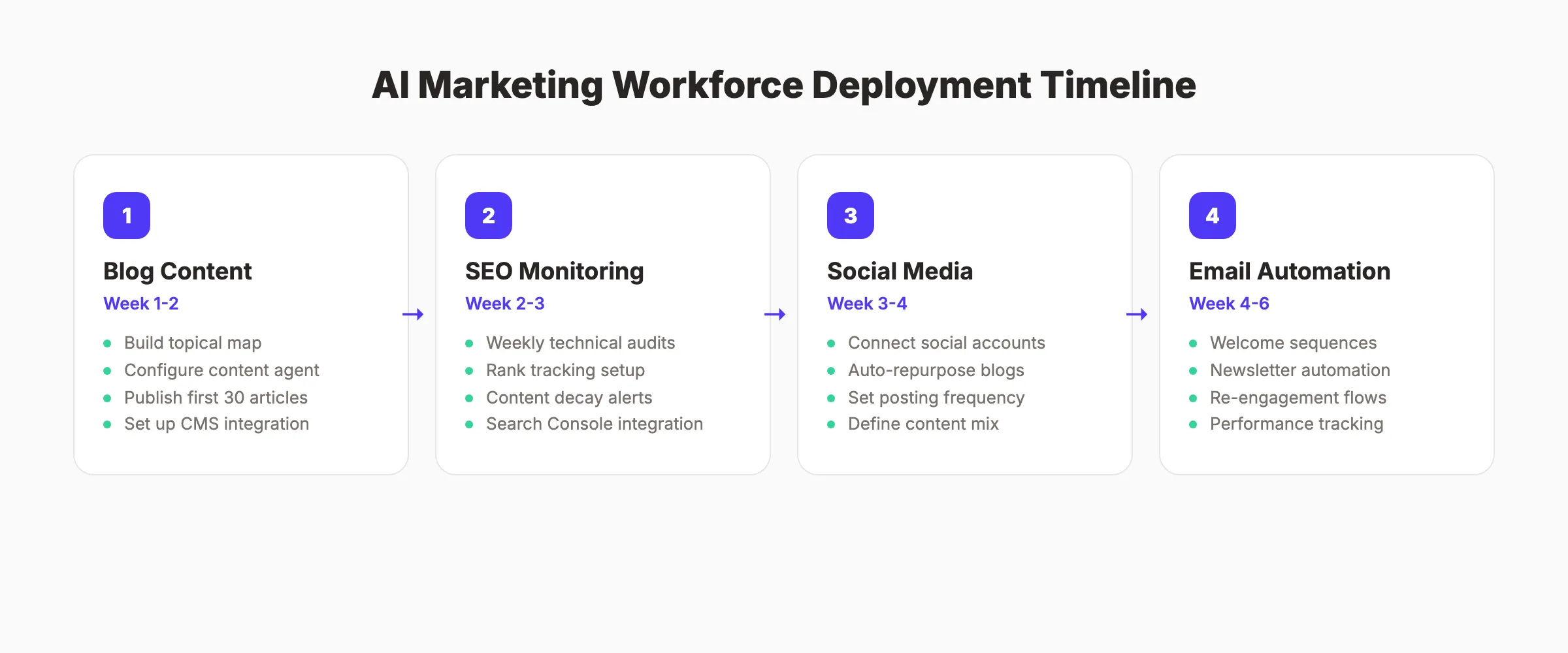
Blog Content Deployment
Blog content is the highest-impact starting point. It drives organic traffic, builds topical authority, and compounds over time.
Deployment steps:
- Build a topical map with 50 to 100 target keywords
- Create content briefs for each keyword
- Configure your content agent with brand voice, formatting rules, and word count targets
- Set up automated publishing to your CMS
- Schedule a weekly quality review of published content
Target: 30 articles in the first month. Increase to 50 or 80 once quality is validated.
SEO Monitoring Deployment
Your SEO agent should start running the day you publish your first batch of content.
Configure it to:
- Run weekly technical audits
- Track rankings for all target keywords
- Flag pages with declining traffic
- Identify internal linking opportunities
- Monitor Google Search Console for errors
Social Media Deployment
Social follows content. Once blog posts publish, your social agent repurposes them automatically.
Setup requirements:
- Connect your social accounts (LinkedIn, X, Facebook, Instagram)
- Define posting frequency per platform (1 to 2 posts per day is standard)
- Set content mix rules (60% educational, 20% promotional, 20% engagement)
- Schedule a monthly review of engagement metrics
Email Deployment
Email is the last channel to automate. It requires the most careful oversight because mistakes go directly to inboxes.
Start with:
- Welcome sequence for new subscribers
- Newsletter automation (weekly digest of published content)
- Re-engagement sequences for inactive contacts
Do not automate cold outreach until your content agents are producing consistently high-quality work. Your email reputation depends on it.
Human-AI Collaboration Protocols That Work
The biggest risk in an AI marketing workforce is not bad AI output. It is the absence of clear rules about who decides what.
The 3-Tier Decision Framework
Organize every marketing action into 3 tiers:
| Tier | Decision Type | Who Decides | Example |
|---|---|---|---|
| Tier 1 | Routine execution | AI agent (autonomous) | Publish a blog post that passes quality checks |
| Tier 2 | Strategic adjustments | AI recommends, human approves | Change the content calendar based on trending keywords |
| Tier 3 | Brand-critical decisions | Human only | Crisis communication, brand partnerships, pricing changes |
This framework prevents 2 failure modes: AI publishing something it should not have (Tier 3 violation) and humans bottlenecking routine tasks (Tier 1 micromanagement).
The 30-Day Ramp Protocol
Do not go fully autonomous on day 1. Use this timeline:
Days 1-10: Full human review. Every piece of AI output gets reviewed before publishing. This builds trust and catches configuration issues early.
Days 11-20: Selective review. Review 50% of output. Focus on new content types, high-stakes pages, and anything flagged by quality checks.
Days 21-30: Spot-check mode. Review 20% to 30% of output. The AI agent has learned your standards. Trust the system but verify regularly.
After 30 days, move to exception-based review. Only review content that fails automated quality checks or covers sensitive topics.
Brand Voice Guardrails
Your AI agents will default to generic language unless you set explicit guardrails. Define:
- A list of banned words and phrases
- Required terminology (how you refer to products, services, and features)
- Tone parameters (formal vs. casual, technical vs. accessible)
- Formatting standards (heading styles, CTA placement, image requirements)
Feed these into your content agent before it writes a single word. Update them quarterly based on reviewer feedback.
Quality Checkpoints
Build automated quality gates into every workflow:
- Minimum word count met
- Target keyword appears in title, first 100 words, and at least 1 H2
- Internal links included (minimum 3 per 1,000 words)
- No banned AI phrases detected
- Readability score within target range
- All links verified as working
Content that fails any gate goes to the quality reviewer. Content that passes all gates publishes automatically.
Stop writing. Start ranking. Stacc publishes 30 SEO articles per month on autopilot. Start for $1 →
8 Common Mistakes and How to Avoid Them
We have seen these mistakes across hundreds of AI marketing deployments. Every one of them is avoidable.
Mistake 1: Automating Without an Audit
Teams buy AI tools before understanding their own workflows. They automate tasks that do not need automation. They miss the tasks that do.
Fix: Complete the workflow audit from Chapter 4 before spending a dollar on AI agents.
Mistake 2: Skipping the Human Review Phase
Going fully autonomous on day 1 is the fastest path to publishing embarrassing content. AI agents produce factual errors, brand voice mismatches, and formatting issues during the first 2 weeks.
Fix: Follow the 30-day ramp protocol. No exceptions.
Mistake 3: Measuring the Wrong Metrics
Teams celebrate “time saved” and “articles produced” while ignoring whether that content drives traffic, leads, or revenue.
Fix: Track outcome metrics alongside efficiency metrics. Organic traffic growth, keyword rankings, conversion rates, and content marketing ROI matter more than output volume.
Mistake 4: No Kill Switch
AI agents can generate and publish content at scale. Without controls, a misconfigured agent can publish 50 broken articles in a single afternoon.
Fix: Build maximum daily limits, approval gates, and emergency stop buttons into every agent workflow.
Mistake 5: Poor Data Quality
AI agents trained on outdated, incomplete, or inaccurate data produce bad output. Garbage in, garbage out applies double with AI.
Fix: Audit your data sources before integration. Clean your CMS, update your keyword lists, and verify your analytics tracking.
Mistake 6: Ignoring Brand Voice
Generic AI content reads like generic AI content. Readers notice. Google notices. Your brand suffers.
Fix: Invest time in brand voice configuration upfront. Provide examples of good and bad content. Review and refine voice parameters monthly.
Mistake 7: No Integration Strategy
AI agents sitting in isolation produce work that never reaches your audience. If the content agent writes articles but nobody publishes them, the system fails.
Fix: Map every integration before deployment. Content agent → CMS → social agent → email agent. The chain must be unbroken.
Mistake 8: Treating AI as Set-and-Forget
AI agents need maintenance. Algorithms change. Search engines update. Your business evolves. An agent configured in January may produce irrelevant content by June.
Fix: Schedule monthly reviews. Update keyword targets, brand voice rules, and quality thresholds quarterly.
How to Measure ROI From Your AI Marketing Workforce
ROI measurement separates teams that scale from teams that abandon AI after 3 months. Here is how to track what matters.
The 4 Metrics That Matter
Metric 1: Cost per content piece. Divide your total AI workforce cost by the number of published pieces. Compare to your pre-AI baseline from the workflow audit.
Metric 2: Organic traffic growth. Track monthly organic sessions. A well-deployed AI content workforce should show measurable growth within 60 to 90 days.
Metric 3: Keyword coverage. Count the number of keywords your site ranks for. More content means more keywords. Track total keywords and keywords in positions 1 through 10.
Metric 4: Revenue attribution. Connect content to conversions. Use UTM parameters, goal tracking, and assisted conversion reports to link AI-produced content to revenue.
Building Your ROI Dashboard
Set up a simple tracking system:
| Metric | Pre-AI Baseline | Month 1 | Month 3 | Month 6 |
|---|---|---|---|---|
| Articles published per month | , | , | , | , |
| Cost per article | , | , | , | , |
| Total organic traffic | , | , | , | , |
| Keywords in top 10 | , | , | , | , |
| Leads from organic content | , | , | , | , |
| Revenue from organic content | , | , | , | , |
Fill in your baseline before launching. Update monthly. The trend lines tell the story.
What Good ROI Looks Like
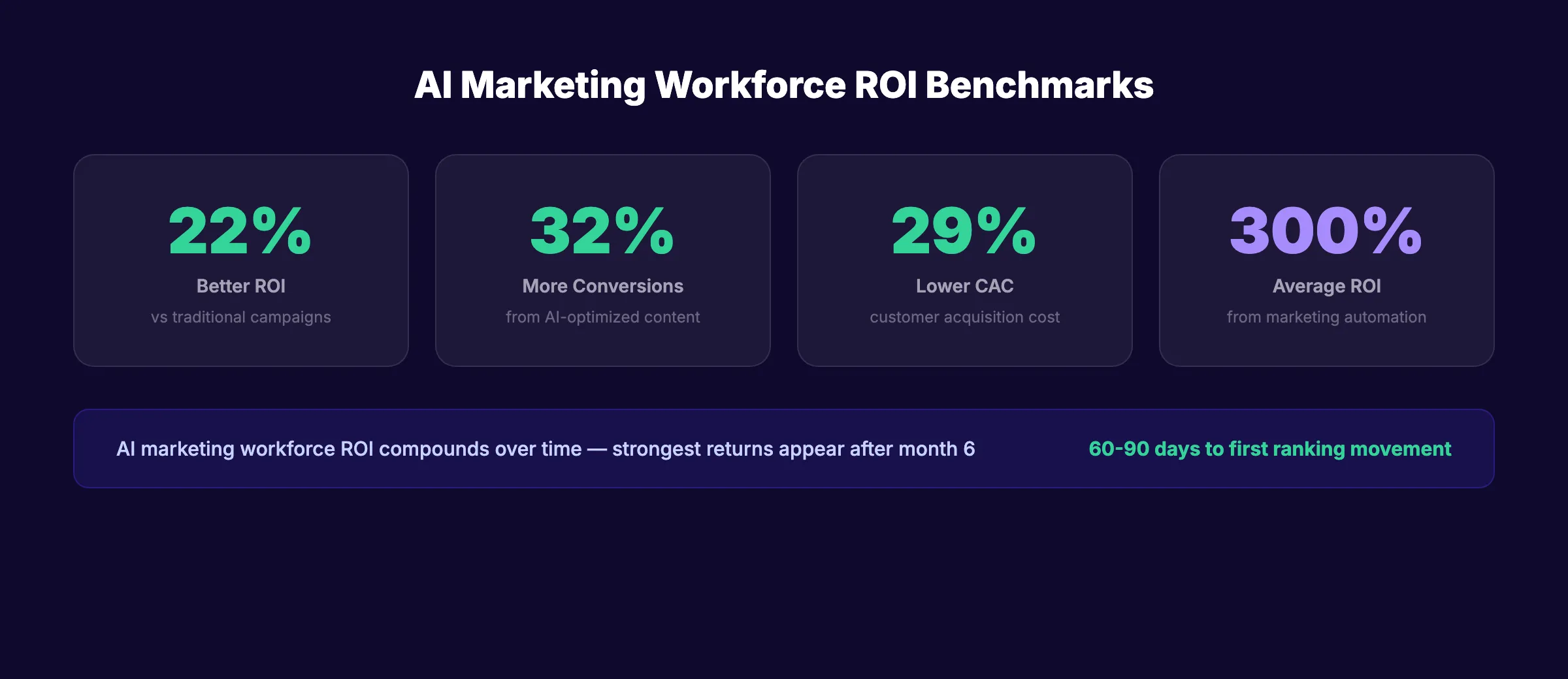
Based on industry benchmarks from SEO.com’s 2026 AI marketing report:
- AI campaigns deliver 22% better ROI than traditional methods
- Conversion rates improve by 32% on average
- Customer acquisition costs drop by 29%
- Marketing teams report 300% average ROI from automation
These numbers compound. Month 1 ROI is modest. Month 6 ROI is where the real returns appear. The businesses that win are the ones that stay consistent through the early months.
Where the Industry Is Heading
The AI marketing workforce is not a trend. It is the new operating model.
By the end of 2026, Gartner predicts that 40% of enterprise applications will feature task-specific AI agents. That is up from less than 5% in 2025. The acceleration is happening faster than any previous marketing technology shift.
3 developments to watch:
Multi-agent orchestration. Today, most teams use AI agents individually. The next phase is agents that communicate with each other. Your content agent tells your social agent what just published. Your analytics agent tells your content agent which topics to prioritize. The system becomes self-directing.
AI-native search optimization. Traditional SEO and GEO (generative engine optimization) are merging. Future AI marketing workforces will optimize for Google, ChatGPT, Perplexity, and Gemini simultaneously. Teams that only optimize for traditional search will lose visibility in AI search engines.
Smaller teams, bigger output. The 2-person marketing team that publishes 80 articles per month will outperform the 20-person team that publishes 8. AI marketing workforces eliminate the correlation between team size and marketing output.
The question is no longer “Should we build an AI marketing workforce?” It is “How fast can we deploy one?”
FAQ
What is an AI marketing workforce?
An AI marketing workforce is a system of specialized AI agents that handle repeatable marketing tasks like content writing, SEO monitoring, social media posting, and analytics reporting. Humans direct strategy and review output. AI handles execution at scale.
How much does it cost to build an AI marketing workforce?
Costs range from $99 per month for done-for-you content solutions to $500 or more per month for multi-channel AI agent platforms. Compare this to $3,000 to $10,000 per month for an SEO agency or $4,500 to $7,000 per month for a single full-time content writer.
How long before an AI marketing workforce shows results?
Blog content typically shows ranking improvements within 60 to 90 days. Social media engagement increases within the first month. Full ROI visibility, including revenue attribution, usually takes 3 to 6 months of consistent operation.
Will AI replace my marketing team?
No. AI replaces tasks, not people. Your team shifts from execution to strategy, quality control, and creative direction. The most effective AI marketing workforces keep humans in strategic and oversight roles.
What marketing tasks should I automate first?
Start with blog content production. It is the highest-volume, most repeatable marketing task. It compounds over time through organic traffic growth. Move to social media and SEO monitoring next. Save email automation for last.
How do I keep AI content from sounding generic?
Configure your AI agents with detailed brand voice guidelines, banned word lists, and formatting rules. Review output during the first 30 days. Refine the guidelines based on what you catch. Quality improves significantly after the initial calibration period.
The AI marketing workforce is not coming. It is here. The businesses deploying AI agents today are building a compounding advantage that grows every month. Every article published, every keyword ranked, every social post shared stacks on the last.
Start small. Audit your workflows. Deploy one agent. Measure results. Scale what works.
Rank everywhere. Do nothing. Blog SEO, Local SEO, and Social on autopilot starting at $99 per month. Start for $1 →
Related Tools & Resources
Free SEO Tools:
Best Lists:

Written by
Siddharth GangalSiddharth is the founder of theStacc and Arka360, and a graduate of IIT Mandi. He spent years watching great businesses lose organic traffic to competitors who simply published more. So he built a system to fix that. He writes about SEO, content at scale, and the tactics that actually move rankings.
30 SEO blog articles published every month
Keyword-optimized, scheduled, and live on your site. Automatically.
30-day trial · Cancel anytime
theStacc
Stop writing SEO content manually
30 blog articles, 30 GBP posts, and social media content. Published every month. Automatically.
Start Your $1 Trial$1 for 3 days · Cancel anytime