
AI SEO vs Manual SEO (2026): Strategies, Tactics & Examples
Practical ai seo vs manual seo strategies for 2026: step-by-step tactics, real examples, and tools to improve rankings and drive organic traffic.
AI SEO vs manual SEO is not an either-or question. It is a resource allocation question. The businesses ranking on page 1 right now use both. They use AI for speed and scale. They use human expertise for strategy and trust signals.
Here is the problem. Most guides on this topic end with “use both” and stop there. They never tell you which tasks to automate, which to keep manual, or how to measure the difference.
We have published 3,500+ articles across 70+ industries and tracked rankings for AI-generated, human-written, and hybrid content. This guide breaks down exactly what works, what does not, and how to allocate your SEO budget in 2026.
Here is what you will learn:
- What AI SEO and manual SEO actually mean in practice
- The 6 areas where AI outperforms manual work
- The 5 areas where human expertise still wins
- Real performance data comparing AI content vs human content
- A task-by-task decision framework for your workflow
- How to build a hybrid strategy that compounds over time
What AI SEO and Manual SEO Actually Mean
The terms “AI SEO” and “manual SEO” get used loosely. Before comparing them, you need clear definitions.
What Is AI SEO?
AI SEO uses artificial intelligence tools to automate or accelerate search engine optimization tasks. This includes keyword research, content generation, on-page optimization, technical audits, and performance analysis.
The scope has expanded significantly since 2024. AI SEO now also covers Generative Engine Optimization (GEO). Optimizing content to appear in AI-generated answers from Google AI Overviews, ChatGPT, Perplexity, and Gemini.
Common AI SEO tools include content generators, keyword research platforms, SERP analyzers, and automated publishing systems. The market for these tools reached $1.2 billion in 2024 and is projected to hit $4.97 billion by 2033.
What Is Manual SEO?
Manual SEO is the traditional approach. A human strategist researches keywords, a writer creates content, a developer handles technical fixes, and someone manually builds links. Every step involves human decision-making.
Manual SEO has worked for decades. It produced the content that trained the AI models now used in AI SEO. The approach is slower, more expensive, and harder to scale. It is also more nuanced, more original, and better at building genuine topical authority.
The Real Distinction
The difference is not “good vs bad.” It is “speed vs depth.” AI SEO processes data and produces output faster than any human team. Manual SEO applies judgment, experience, and creativity that AI cannot replicate.
According to DemandSage, 86% of SEO professionals now integrate AI into their workflows. The question is not whether to use AI. The question is where.
Where AI SEO Outperforms Manual Work
AI has clear advantages in 6 specific areas. These are tasks where speed and data processing matter more than originality.
Keyword Research and Clustering
Manual keyword research takes hours. You open a tool, filter by volume, check difficulty, group terms by intent, and build a spreadsheet. AI reduces this process by up to 80%, according to SEOMator.
AI tools analyze thousands of search queries simultaneously. They identify keyword clusters, map search intent, and surface long-tail opportunities that a human researcher might miss. A task that takes a strategist half a day takes AI minutes.
First-Draft Content Production
AI generates a 2,000-word blog draft in roughly 16 minutes. A human writer takes an average of 69 minutes for the same length, according to AirOps research. That is a 4x speed advantage.
For businesses that need to publish 20-30 articles per month, this speed difference is the gap between ranking and not ranking. The average company publishes 1-4 blog posts per month. The ones dominating search results publish 20 or more.
Technical SEO Audits
AI crawlers scan thousands of pages in minutes. They flag broken links, missing meta descriptions, duplicate content, redirect chains, slow-loading pages, and schema markup errors. A manual audit of the same site takes days.
Tools like Screaming Frog and Semrush use AI to prioritize issues by impact. Instead of a 200-item checklist, you get a ranked list of the 10 fixes that will move rankings the most.
On-Page Optimization at Scale
Optimizing a single page manually. Title tags, headers, keyword placement, internal links, image alt text. Takes 30-60 minutes. AI applies optimization rules across hundreds of pages simultaneously.
This matters most for large sites. An ecommerce store with 5,000 product pages cannot manually optimize each one. AI handles the bulk work. Humans review the output.
Content Gap Analysis
AI tools compare your content against every competitor ranking for your target keywords. They identify topics you have not covered, questions you have not answered, and angles you have not explored.
Manual content gap analysis requires reading competitor pages one by one. AI processes dozens of competing pages in seconds and produces a prioritized list of missing topics.
Performance Reporting
AI consolidates data from Google Search Console, analytics platforms, and rank trackers into unified dashboards. It spots trends, flags ranking drops, and suggests actions automatically.
Manual reporting means exporting CSVs, building pivot tables, and writing summaries. AI does the same work in a fraction of the time with fewer errors.
Stop writing. Start ranking. Stacc publishes 30 SEO articles per month for $99. Every article is optimized, formatted, and published automatically. Start for $1 →
Where Manual SEO Still Wins
AI is fast. But speed does not win every SEO challenge. These 5 areas still require human expertise.
Strategy and Competitive Positioning
AI cannot decide your market positioning. It cannot determine whether to target enterprise keywords or local long-tail terms. It cannot evaluate whether a content cluster aligns with your business goals.
Content strategy requires understanding your business, your customers, your competitors, and your revenue model. AI can provide data inputs. A human must make the strategic decisions.
E-E-A-T Signals
Google’s E-E-A-T framework. Experience, Expertise, Authoritativeness, Trustworthiness. Is the single biggest gap in AI-generated content. AI has no first-hand experience. It cannot share a client story it witnessed. It cannot reference a campaign it ran.
This matters for rankings. A controlled experiment by Reboot Online found that human-authored content outranked purely AI-generated content in 21 of 25 test cases. Human sites averaged position 4.4. AI sites averaged position 6.6.
The gap exists because human content naturally demonstrates experience and expertise. AI content, without human editing, reads as competent but generic.
Brand Voice and Originality
AI writes in patterns. It defaults to certain structures, phrases, and rhythms. Readers notice. Google notices.
Original perspectives, proprietary data, unique case studies, and a distinct brand voice are what separate a page that ranks from a page that gets ignored. AI can mimic a voice. It cannot create one.
According to Neil Patel’s analysis, human-authored content gets 5.44x more traffic than purely AI-generated content. The traffic gap reflects a quality gap that readers and search engines both detect.
Link Building and Digital PR
Backlinks remain one of Google’s strongest ranking signals. And no AI tool can build genuine relationships with journalists, bloggers, and site owners.
AI can identify link prospects. AI can draft outreach emails. But the relationship-building, negotiation, and reputation that earn high-authority links require a human on the other end of the conversation.
Manual link building produces higher-quality links because it involves real outreach, real conversations, and real editorial decisions about what deserves a link.
Sensitive and YMYL Content
Your Money or Your Life (YMYL) topics. Health, finance, legal, safety. Demand accuracy. AI hallucinations in these categories do not just hurt rankings. They create liability.
Publishing factual errors at scale destroys E-E-A-T, erodes brand trust, and risks manual penalties. YMYL content needs human fact-checking, expert review, and editorial oversight that no AI tool provides reliably.
Your SEO team. $99 per month. 30 optimized articles, published automatically. Human-quality content at AI speed. Start for $1 →
The Data: AI Content vs Human Content Rankings
The debate about AI content vs human content is no longer theoretical. Multiple studies have measured the difference.
Head-to-Head Ranking Performance
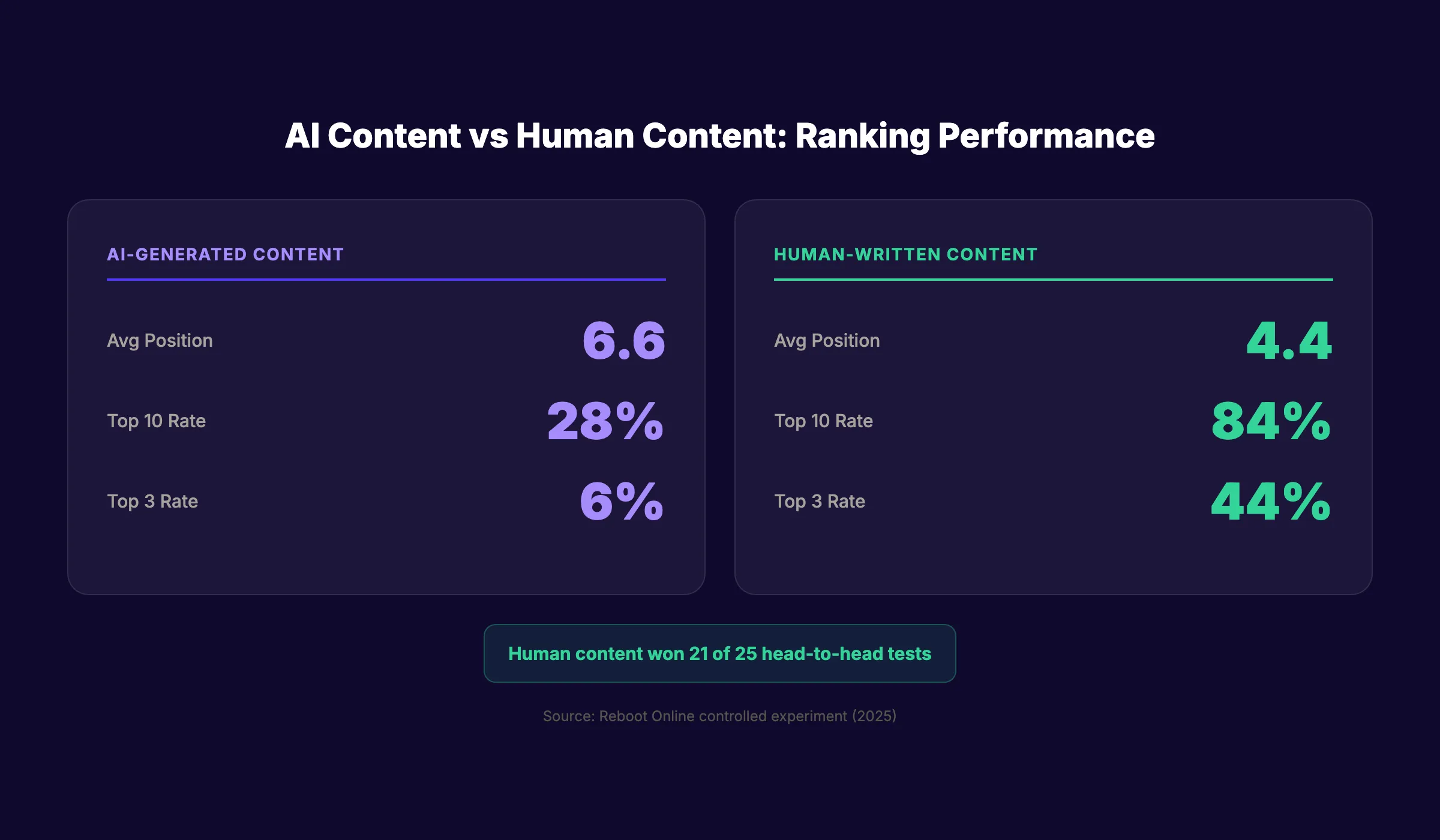
The Reboot Online experiment tested 25 keyword sets with identical content topics. One version was written by AI. The other was written by a human. Both were published on fresh domains with no backlinks.
| Metric | Human Content | AI Content |
|---|---|---|
| Average ranking position | 4.4 | 6.6 |
| Reached top 10 | 84% | 28% |
| Reached top 3 | 44% | 6% |
| Won the head-to-head | 21 of 25 | 4 of 25 |
Human content won decisively in a controlled test. The advantage was not small. It was 2+ positions on average.
Hybrid Content Outperforms Both
The same research found that hybrid content. AI-generated drafts with human editing and enhancement. Ranked 34% higher than unedited AI content. Hybrid content added the E-E-A-T signals, originality, and depth that pure AI output lacks.
This is the strongest argument for a hybrid approach. Start with AI for speed. Finish with humans for quality.
Traffic Volume Comparison
Neil Patel’s analysis across thousands of URLs found that human-authored content generates 5.44x more organic traffic than purely AI-generated content. The traffic gap comes from:
- Higher average ranking positions
- Better click-through rates (more compelling titles and descriptions)
- Lower bounce rates (more engaging content)
- More backlinks earned (original insights attract links)
The Cost-Benefit Equation
Speed favors AI. Quality favors humans. Cost depends on your model.
| Approach | Cost per 30 Articles | Time to Publish | Ranking Likelihood |
|---|---|---|---|
| Freelance writers | $2,400 - $7,500/mo | 2-4 weeks | High |
| In-house team | $4,000 - $8,000/mo | 1-2 weeks | High |
| Pure AI (no editing) | $50 - $200/mo | 1-2 days | Low |
| AI + human editing | $500 - $1,500/mo | 3-5 days | Medium-High |
| Done-for-you service | $99 - $199/mo | Automated | Medium-High |
Pure AI is the cheapest option. It is also the least effective for rankings. The sweet spot is AI-assisted production with human quality control.
When to Use AI vs Manual: Task-by-Task Breakdown
This is the decision framework that most guides skip. For each SEO task, here is exactly when to use AI, when to stay manual, and when to combine both.
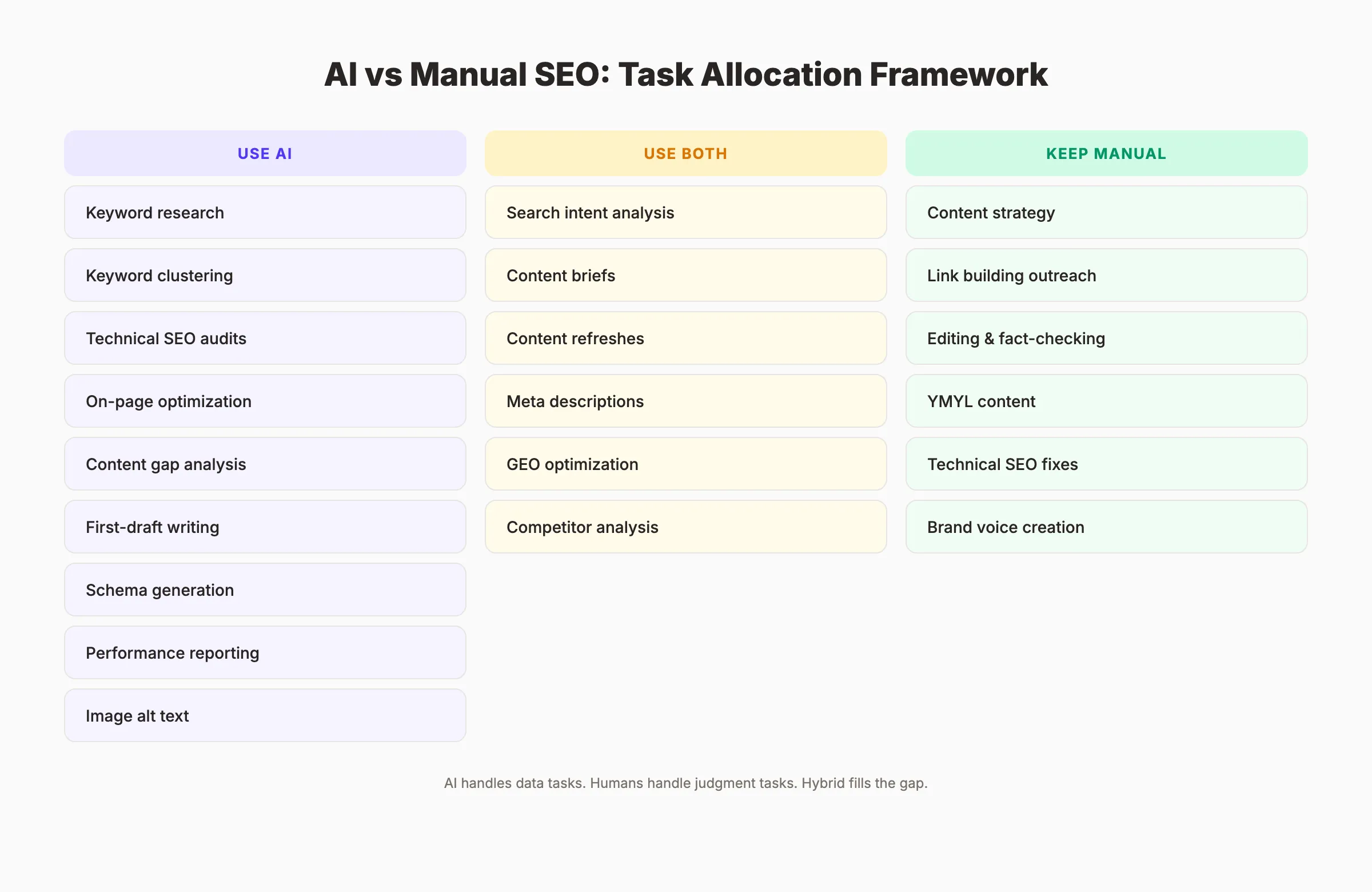
| SEO Task | Best Approach | Why |
|---|---|---|
| Keyword research | AI | Processes thousands of terms in minutes |
| Keyword clustering | AI | Pattern detection at scale |
| Search intent analysis | Hybrid | AI classifies, human verifies edge cases |
| Content strategy | Manual | Requires business context and judgment |
| Content briefs | Hybrid | AI drafts, human refines for brand voice |
| First-draft writing | AI | 4x faster than manual |
| Editing and fact-checking | Manual | AI hallucinations require human verification |
| On-page optimization | AI | Applies rules consistently at scale |
| Technical SEO audits | AI | Crawls and flags issues in minutes |
| Technical SEO fixes | Manual | Implementation requires developer judgment |
| Link building outreach | Manual | Relationships require human interaction |
| Link prospect identification | AI | Scans thousands of sites for opportunities |
| Schema markup generation | AI | Structured data follows predictable patterns |
| Content updates and refreshes | Hybrid | AI identifies decay, human rewrites |
| Competitor analysis | AI | Data aggregation and pattern spotting |
| YMYL content | Manual | Accuracy and liability require expert review |
| Meta descriptions | Hybrid | AI generates, human selects best version |
| Image alt text | AI | Descriptive text at scale |
| Reporting and dashboards | AI | Data consolidation and trend detection |
| GEO optimization | Hybrid | AI structures, human adds citability signals |
The pattern is clear. AI handles data-heavy, repetitive, and pattern-based tasks. Humans handle judgment, strategy, relationships, and quality assurance.
3,500+ blogs published. 92% average SEO score. See what Stacc can do for your site. AI speed meets human-quality standards. Start for $1 →
How to Build a Hybrid SEO Strategy That Compounds
The best SEO strategies in 2026 are not “AI” or “manual.” They are hybrid systems designed to compound over time.
Step 1: Automate the Research Layer
Use AI for all research tasks. Keyword discovery, competitor tracking, content gap analysis, technical audits, and rank monitoring. These tasks consume hours of manual work and produce better results when automated.
Save your human time for interpreting the data. AI can tell you that a keyword has 5,000 monthly searches and medium difficulty. A strategist decides whether that keyword aligns with your business goals and conversion funnel.
Step 2: Use AI for First Drafts, Humans for Final Drafts
Produce first drafts with AI. Then apply human editing for:
- Fact verification (remove hallucinations)
- Brand voice alignment
- Original insights and experience signals
- E-E-A-T enrichment (add real examples, case studies, data)
- Contraction and filler word removal
- Internal link placement with context
This hybrid workflow produces content at AI speed with human-level quality. It is 34% more effective than pure AI, according to the Reboot Online data.
Step 3: Publish at Consistent Volume
Search engines reward consistency. Publishing 30 articles per month builds topical authority faster than publishing 4 articles per month. Each article reinforces the others through internal linking and topic clustering.
The Stacc Stack Method uses this principle. Blog SEO and Local SEO compound together. Every blog post strengthens your domain. Every Google Business Profile post reinforces local relevance. The combination produces faster ranking movement than either channel alone.
Step 4: Optimize for AI Search Engines Too
Traditional SEO targets Google’s 10 blue links. In 2026, you also need to optimize for AI Overviews, ChatGPT, Perplexity, and Gemini.
AI Overviews now appear on 44.4% of all search queries, according to Adlivetech. Sites cited in these summaries see click-through rates jump from 0.6% to 1.08%, per Seer Interactive research.
The AI referral visitor is also more valuable. Adobe’s 2025 data shows AI referral visits have 27% lower bounce rates and 38% longer session durations. The average AI search visitor is worth 4.4x more than a traditional organic visitor.
Optimizing for both traditional and AI search requires:
- Clear, direct answers to specific questions (AI models extract these)
- Structured content with descriptive headings
- Authoritative external citations
- Schema markup that helps AI understand your content
- An llms.txt file that guides AI crawlers
Step 5: Measure Both Channels
Track traditional SEO metrics (rankings, traffic, CTR) alongside AI visibility metrics (AI search citations, brand mentions in AI answers, referral traffic from ChatGPT and Perplexity).
Most businesses only track Google Analytics. In 2026, that gives you half the picture. AI search traffic grew 527% year-over-year between January 2024 and May 2025, according to Search Engine Land. Ignoring this channel means ignoring the fastest-growing source of qualified traffic.
What Happens If You Only Use AI (or Only Manual)
Both extremes carry risks.
The All-AI Risk
Businesses that publish pure AI content without human oversight face three problems.
Ranking ceiling. Unedited AI content reaches the top 10 only 28% of the time. Top 3 drops to 6%. There is a measurable ceiling on what AI-only content achieves.
Content sameness. AI models train on the same data. If you and your competitors all use AI without differentiation, you produce interchangeable content. Google has no reason to rank yours over theirs.
Trust erosion. AI hallucinations published at scale compound into a credibility problem. One factual error in a medical or financial article can trigger E-E-A-T downgrades across your entire site.
The All-Manual Risk
Businesses that refuse to adopt AI face a different problem: speed.
Your competitors publish 30 articles per month with AI assistance. You publish 4. In 12 months, they have 360 indexed pages building topical authority. You have 48. The math does not work in your favor.
Manual-only teams also miss the GEO opportunity entirely. Optimizing for AI search engines requires understanding how AI models process and cite content. That understanding comes faster with AI tools.
The hybrid approach avoids both traps. AI provides speed and scale. Human oversight provides quality and trust.
Rank everywhere. Do nothing. Blog SEO, Local SEO, and Social on autopilot. Stacc starts at $99/mo with a $1 trial. Start for $1 →
FAQ
What is the difference between AI SEO and manual SEO?
Manual SEO uses human researchers, writers, and strategists for every optimization task. AI SEO uses artificial intelligence tools to automate keyword research, content generation, technical audits, and performance tracking. Most effective strategies in 2026 combine both approaches.
Does Google penalize AI-generated content?
No. Google has stated it does not penalize content based on how it was produced. Google penalizes low-quality, unhelpful content regardless of whether a human or AI created it. The key is quality, relevance, and helpfulness. Not the production method.
Can AI replace SEO professionals?
AI cannot replace the strategic, creative, and relationship-building aspects of SEO. It replaces repetitive data tasks. According to Semrush, 94% of marketers plan to integrate AI into their workflows in 2026. Not to eliminate their teams, but to make them faster.
Is AI content as good as human content for SEO?
In controlled tests, human content outranks AI content in most cases. Hybrid content. AI drafts with human editing. Performs 34% better than unedited AI. The best approach uses AI for speed and humans for quality signals like E-E-A-T, originality, and brand voice.
What SEO tasks should I automate with AI?
Automate keyword research, content gap analysis, technical audits, on-page optimization at scale, reporting, and first-draft production. Keep strategy, link building, fact-checking, YMYL content, and final editing manual.
How does AI SEO affect Google rankings in 2026?
AI SEO accelerates optimization and increases publishing volume. But rankings still depend on content quality, backlinks, topical authority, and E-E-A-T signals. AI Overviews now appear on 44.4% of queries, creating a new ranking layer beyond traditional blue links.
AI SEO and manual SEO are not competing approaches. They are complementary layers of the same system. Use AI where it is strongest. Speed, data, and scale. Use human expertise where it matters most. Strategy, trust, and originality. The businesses winning in 2026 are the ones that figured out the right ratio.
Related Tools & Resources
Free SEO Tools:
Best Lists:

Written by
Siddharth GangalSiddharth is the founder of theStacc and Arka360, and a graduate of IIT Mandi. He spent years watching great businesses lose organic traffic to competitors who simply published more. So he built a system to fix that. He writes about SEO, content at scale, and the tactics that actually move rankings.
30 SEO blog articles published every month
Keyword-optimized, scheduled, and live on your site. Automatically.
30-day trial · Cancel anytime
theStacc
Stop writing SEO content manually
30 blog articles, 30 GBP posts, and social media content. Published every month. Automatically.
Start Your $1 Trial$1 for 3 days · Cancel anytime