
Entity SEO (2026): Strategies, Tactics & Examples
Practical entity seo guide strategies for 2026: step-by-step tactics, real examples, and tools to improve rankings and drive organic traffic.
Google stopped ranking pages by keywords alone years ago. Entity SEO is now the foundation of how search engines understand, classify, and rank your content.
That shift has real costs. Sites that still optimize only for keyword strings lose visibility in Knowledge Panels, AI Overviews, and featured snippets. Google’s Knowledge Graph contains over 8 billion entities and 800 billion facts. If your brand, your authors, and your topics are not recognized as entities, you are invisible to an entire layer of search.
This guide breaks down entity SEO from the ground up. No theory. No filler. Just the mechanics of how entities work and how to optimize for them.
We publish 3,500+ blogs across 70+ industries and track how entity signals affect rankings every month. This guide covers everything we know about entity-based SEO.
Here is what you will learn:
- What entities are and why they replaced keywords as the core ranking signal
- How Google’s Knowledge Graph connects entities to search results
- The 5 entity types that matter most for SEO
- How to identify and audit entities on your existing site
- 7 optimization tactics to build entity authority
- How entity SEO applies to local businesses and AI Overviews
- How to measure entity SEO success with real metrics
Table of Contents
- Chapter 1: What Is Entity SEO?
- Chapter 2: How Google’s Knowledge Graph Works
- Chapter 3: The 5 Types of Entities in SEO
- Chapter 4: How to Identify Entities on Your Site
- Chapter 5: 7 Entity Optimization Tactics
- Chapter 6: Entity SEO for Local Businesses
- Chapter 7: Entity SEO and AI Overviews
- Chapter 8: How to Measure Entity SEO Success
- Common Entity SEO Mistakes
- FAQ
Chapter 1: What Is Entity SEO? {#chapter-1}
Entity SEO is the practice of optimizing your content around people, places, organizations, and concepts. Not just keyword phrases. It helps search engines understand what your page is about at a conceptual level, not a textual one.
A keyword is a string of characters. An entity is a thing with meaning.
The word “apple” is a keyword. But Google needs to know whether you mean Apple Inc., the fruit, or Apple Records. Entity SEO is how you make that distinction clear.
Entities vs. Keywords
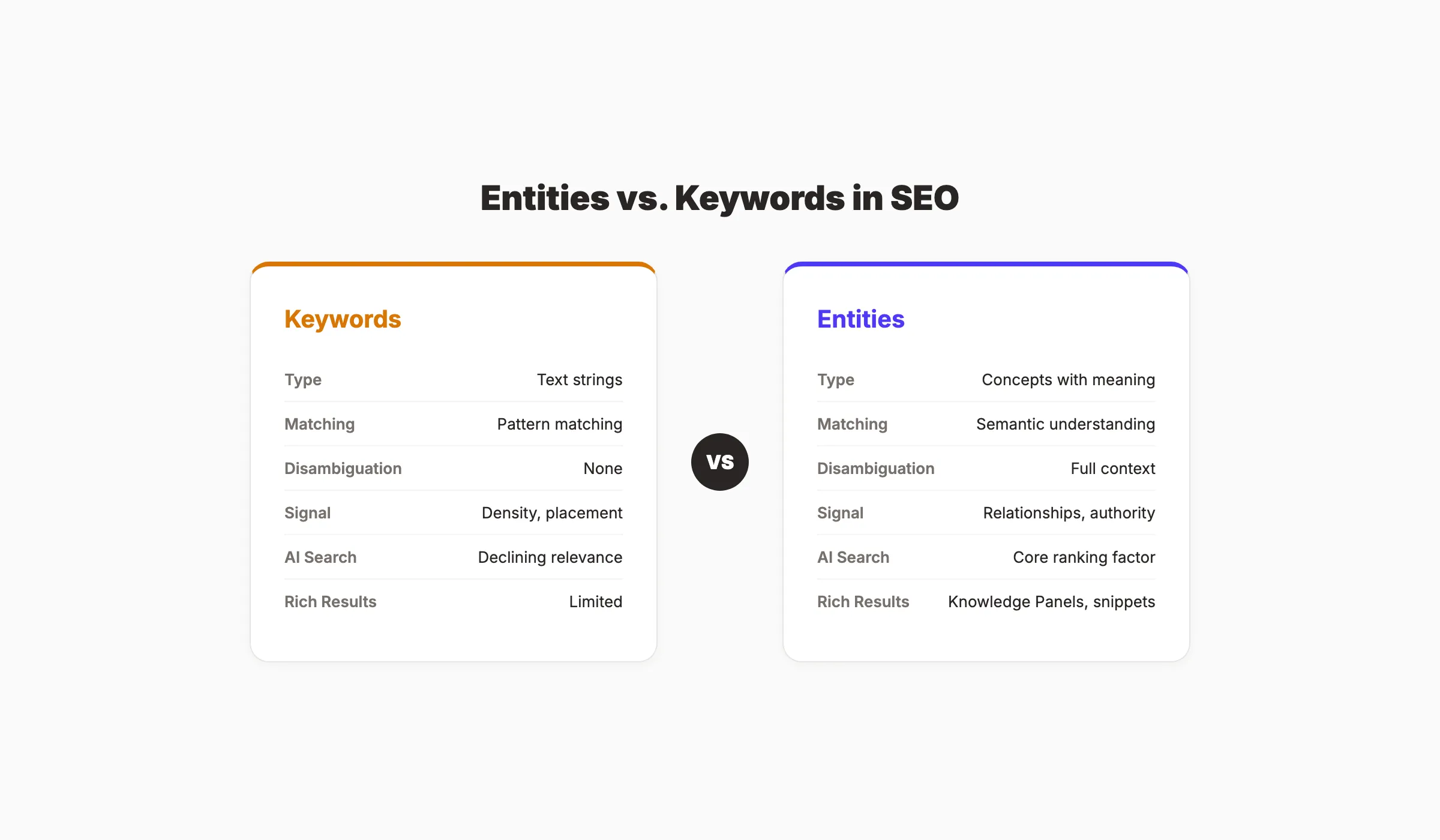
Keywords match text. Entities match meaning. That is the fundamental difference.
When you search “best CRM for small business,” Google does not just scan pages for that exact phrase. It identifies the entities involved: CRM software, small businesses, product comparisons. Then it finds pages that cover those entities with depth and authority.
| Keywords | Entities | |
|---|---|---|
| Definition | Text strings users type | Concepts with defined meaning |
| How Google reads them | Pattern matching | Semantic understanding |
| Disambiguation | None (same word = same) | Full (Apple ≠ apple) |
| Ranking signal | Density, placement | Relationships, authority, context |
| Future-proofing | Declining | Growing |
This does not mean keywords are dead. You still need them for targeting. But entity SEO adds a layer of meaning that keywords alone cannot provide. The smartest SEO strategies in 2026 weave both together.
According to Semrush research, content recognized as entities in knowledge graphs is 50% more likely to appear in featured snippets and rich results.
Why Entity SEO Matters Now
Three forces make entity SEO essential in 2026:
-
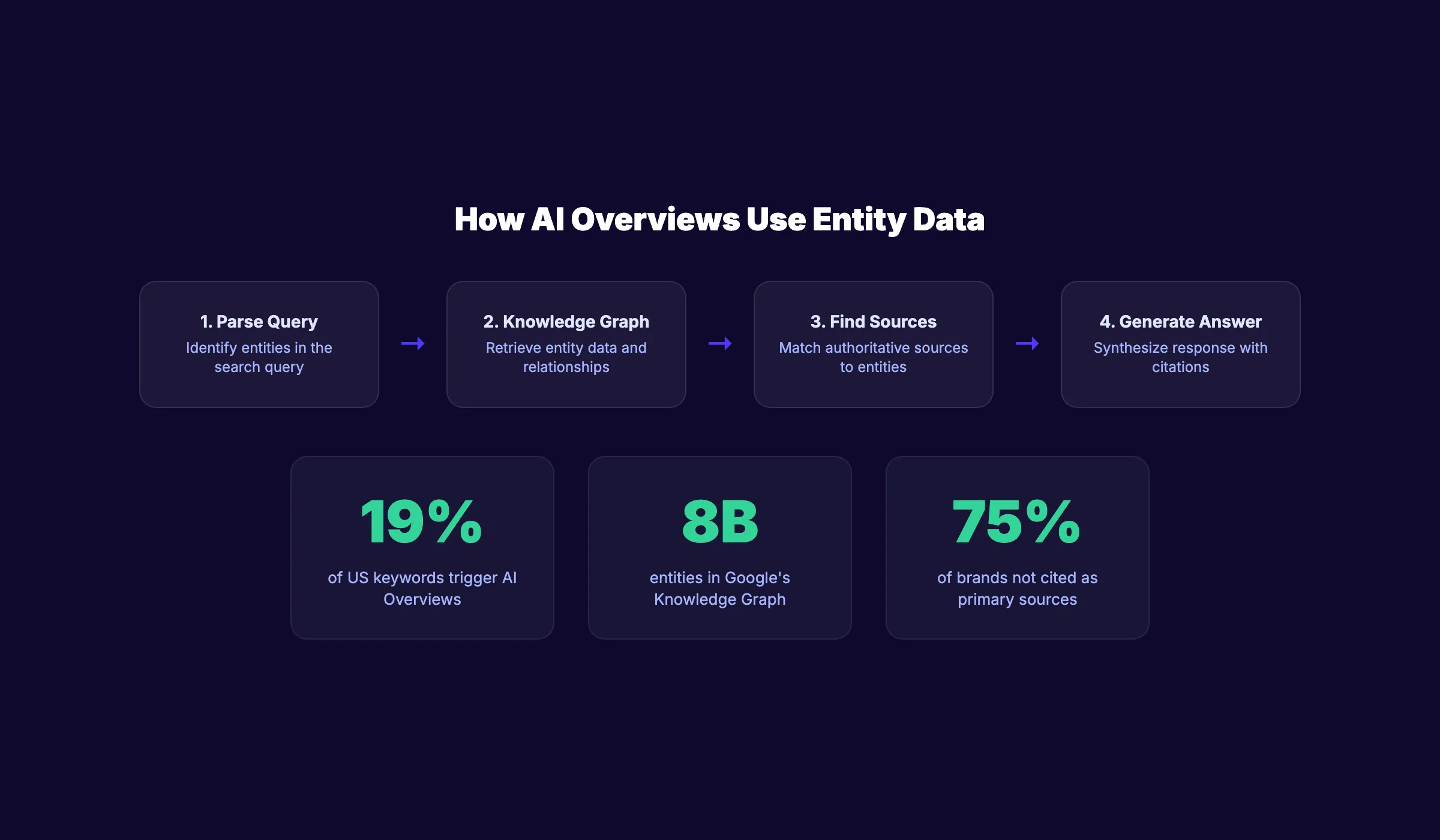
AI Overviews pull from entity graphs. Google’s AI Overviews now trigger for nearly 19% of US keywords. The system generates answers by pulling verified entities and their relationships. Not by scanning blog posts word by word.
-
The Knowledge Graph keeps growing. From 570 million entities at launch in 2012, it now maps 8 billion entities with 800 billion facts. Your brand is either in that graph or it is not.
-
E-E-A-T depends on entity recognition. Google evaluates E-E-A-T signals by examining the Author Entity, Publisher Entity, and Brand Entity. Without entity recognition, your expertise signals fall flat.
Chapter 2: How Google’s Knowledge Graph Works {#chapter-2}
The Knowledge Graph is Google’s database of entities and the relationships between them. It launched in 2012 and fundamentally changed how search works.
Before the Knowledge Graph, Google matched keywords to pages. After it, Google could understand that “Barack Obama” is a person, born in Hawaii, who served as the 44th president. That understanding powers Knowledge Panels, People Also Ask boxes, and AI Overviews.
The Knowledge Graph Structure
Every entity in the Knowledge Graph has 3 components:
- A unique identifier. A machine-readable ID (similar to a Wikidata Q-ID)
- Attributes. Properties like type, description, location, founding date
- Relationships. Connections to other entities (founder of, located in, related to)
Google builds this graph from structured data on websites, Wikipedia, Wikidata, authoritative databases, and its own crawl data.
How Entities Affect Rankings
When you search anything, Google runs the query through the Knowledge Graph first. It identifies which entities the query relates to, then ranks pages based on:
- Entity coverage. Does the page discuss the relevant entities?
- Entity precision. Does it clearly define which entity it means?
- Entity authority. Is the source recognized as authoritative for those entities?
- Entity relationships. Does it connect related entities in meaningful ways?
A page about schema markup that also references JSON-LD, Google Search Console, and rich results signals deeper entity coverage than one that only mentions “schema” in isolation.
Knowledge Panels and Entity Recognition
The most visible proof of entity recognition is the Knowledge Panel. When Google shows a panel for your brand, person, or product, it means your entity exists in the Knowledge Graph.
Getting a Knowledge Panel requires:
- A Wikipedia or Wikidata entry (strongest signal)
- Consistent structured data across your site
- Authoritative mentions from trusted sources
- A claimed Google Business Profile (for local entities)
Get your brand into Google’s Knowledge Graph. Stacc publishes SEO content that builds entity authority month after month. Start for $1 →
Chapter 3: The 5 Types of Entities in SEO {#chapter-3}
Not all entities are the same. Google classifies entities into distinct types, and each type requires different optimization tactics.
1. Person Entities
Authors, founders, executives, and public figures. Person entities are central to E-E-A-T because Google uses them to evaluate expertise.
How to optimize: Author pages with schema markup, consistent bylines, LinkedIn profiles linked via sameAs, guest posts on authoritative sites.
2. Organization Entities
Companies, brands, nonprofits, and agencies. Your brand entity is arguably the most important entity in your SEO strategy.
How to optimize: Organization schema on your homepage, Wikipedia/Wikidata entry, consistent NAP data, press mentions, and a verified Google Business Profile.
3. Place Entities
Cities, neighborhoods, landmarks, and addresses. Critical for local SEO and map pack rankings.
How to optimize: LocalBusiness schema, Google Business Profile, local citations, geo-specific content.
4. Product/Service Entities
Software tools, physical products, professional services. These entities drive transactional queries.
How to optimize: Product schema, review markup, comparison content, feature pages with clear entity definitions.
5. Concept/Topic Entities
Abstract ideas like “machine learning,” “content marketing,” or “entity SEO.” These power informational queries and topical authority.
How to optimize: Topical maps, entity clustering, pillar content, internal linking structures that connect related concepts.
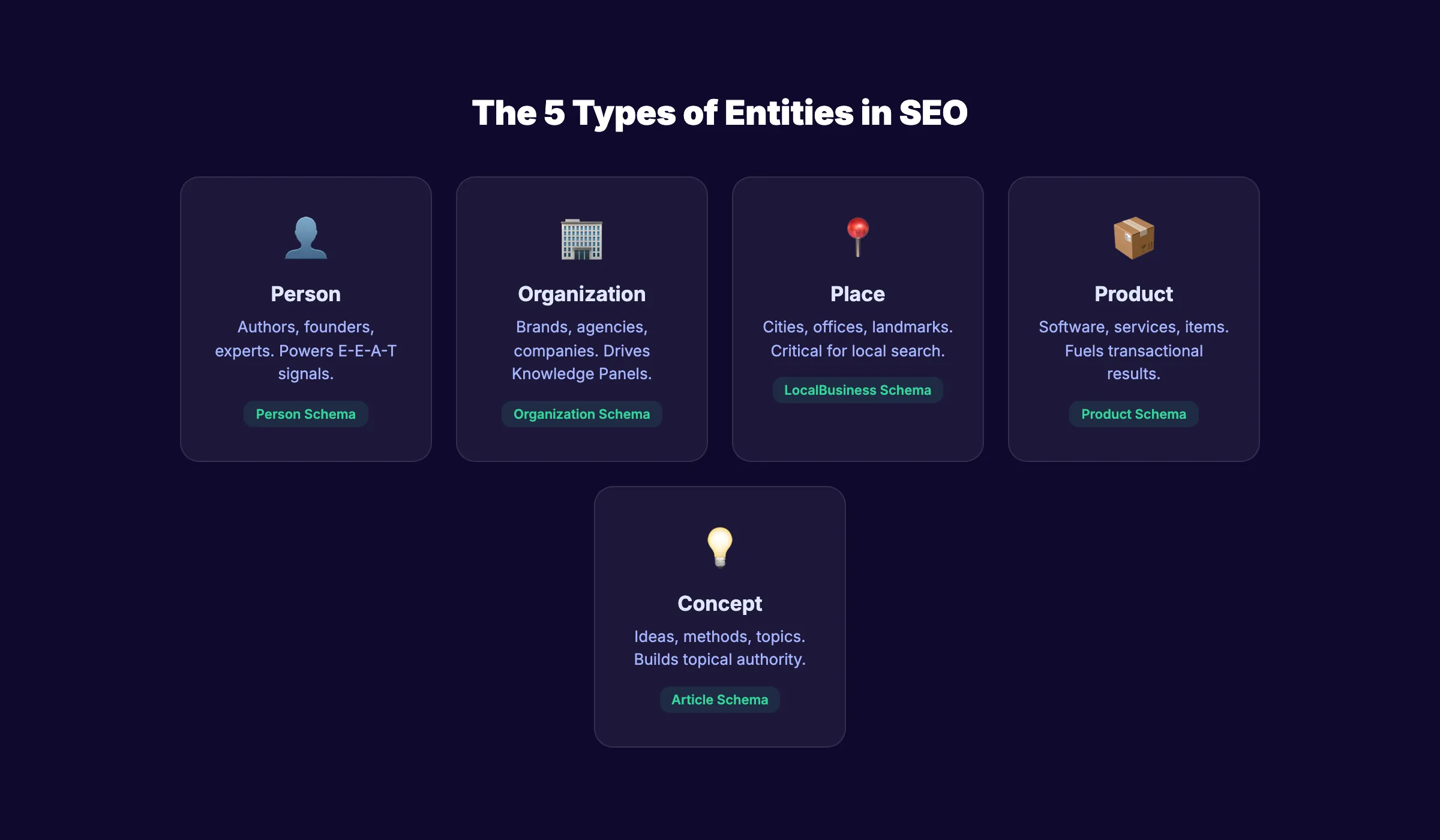
| Entity Type | Example | Key Schema | Primary SEO Benefit |
|---|---|---|---|
| Person | Author, CEO | Person | E-E-A-T authority |
| Organization | Brand, agency | Organization | Knowledge Panel |
| Place | City, office | LocalBusiness | Map pack, local search |
| Product | SaaS tool, item | Product | Rich snippets, shopping |
| Concept | SEO, AI, marketing | Article, DefinedTerm | Topical authority |
Chapter 4: How to Identify Entities on Your Site {#chapter-4}
Before you optimize for entities, you need to know which entities your site already signals. Most sites send unclear or conflicting entity signals without realizing it.
Step 1: List Your Core Entities
Start by answering these questions:
- Who is creating the content? (Person entities)
- What organization publishes it? (Organization entity)
- Where is the business located? (Place entities)
- What topics do you cover? (Concept entities)
- What products/services do you offer? (Product entities)
Write down every entity. A dentist’s website might list: Dr. Sarah Chen (person), Bright Smile Dental (organization), Austin, Texas (place), dental implants (product), cosmetic dentistry (concept).
Step 2: Check Google’s Recognition
Search your brand name on Google. If a Knowledge Panel appears, Google already recognizes your organization entity.
Search your author names. Check if they appear in People Also Ask results or Knowledge Panels.
Use the Google Knowledge Graph Search API to query your entities directly. It returns whether Google has an entry for them.
Step 3: Audit Your Schema Markup
Run your pages through Google’s Rich Results Test. Check for:
- Organization schema on the homepage
- Person schema on author pages
- LocalBusiness schema on location pages
- Article schema on blog posts
- Product schema on product pages
- sameAs properties linking to Wikipedia, Wikidata, LinkedIn
Missing schema means missing entity signals. Our schema markup guide covers implementation in detail.
Step 4: Map Entity Relationships
Entities do not exist in isolation. Map how your entities connect:
- Author X works at Organization Y
- Organization Y is located in Place Z
- Organization Y offers Product A
- Product A relates to Concept B
These relationships should be reflected in your internal linking structure and your structured data. When Google sees consistent entity relationships across your site, it builds confidence in your entity graph.
Use our schema markup generator to create JSON-LD that defines these relationships.
Build your entity authority on autopilot. Stacc writes and publishes 30 SEO articles every month. Each with proper schema and entity signals. Start for $1 →
Chapter 5: 7 Entity Optimization Tactics {#chapter-5}
Once you have identified your entities, you need to strengthen them. Here are 7 tactics that work in 2026.
1. Implement Full Schema Markup
Schema markup is the most direct way to tell Google about your entities. It translates your content into machine-readable data.
Priority schema types for entity SEO:
- Organization. Name, logo, sameAs, foundingDate
- Person. Name, jobTitle, sameAs, worksFor
- LocalBusiness. Address, geo, openingHours, areaServed
- Article. Author, publisher, datePublished
- Product. Name, description, offers, review
The sameAs property is especially important. It links your entity to its Wikipedia, Wikidata, LinkedIn, and Crunchbase entries. This cross-referencing helps Google confirm your entity identity.
See our complete schema markup for blog posts guide for implementation details.
2. Get a Wikipedia and Wikidata Entry
Wikipedia and Wikidata are the primary sources Google uses to populate its Knowledge Graph. A Wikipedia entry is the strongest entity signal you can build.
Requirements for Wikipedia notability:
- Significant coverage in reliable, independent sources
- Not primarily promotional
- Verifiable claims with citations
If your brand does not qualify for Wikipedia yet, start with Wikidata. It has lower notability requirements and still feeds the Knowledge Graph. Create a Wikidata item with your brand name, description, official website, and social profiles.
3. Build Consistent Entity Mentions
Google cross-references entity mentions across the web. Consistent mentions strengthen entity recognition. Inconsistent ones create confusion.
Ensure your brand name, founder names, and key details appear identically on:
- Your website
- Google Business Profile
- Social media profiles
- Industry directories
- Press coverage
- Guest posts
This is similar to NAP consistency in local SEO, but expanded to all entity attributes.
4. Create Entity-First Content
Structure your content around entities, not just keywords. That means:
- Define entities early. Put your primary entity in the first 100 words with a clear definition.
- Connect related entities. Reference related people, tools, concepts, and organizations throughout.
- Use entity-rich headings. “Schema Markup for Entity SEO” is better than “How to Optimize.”
- Reduce noise. Do not discuss unrelated topics that confuse the machine about the page’s main entity.
Entity salience. How prominently and clearly you feature an entity. Matters more than how many times you mention it.
5. Build Topical Authority Through Entity Clusters
A single page about “entity SEO” sends a weak signal. 20 interconnected pages about entity SEO, schema markup, Knowledge Graph, structured data, and E-E-A-T send a powerful one.
This is topical authority through entity clustering:
- Identify your core entity (e.g., entity SEO)
- Map all related entities (schema, Knowledge Graph, Wikidata, structured data)
- Create content for each related entity
- Interlink everything with descriptive anchor text
- Publish consistently to compound authority
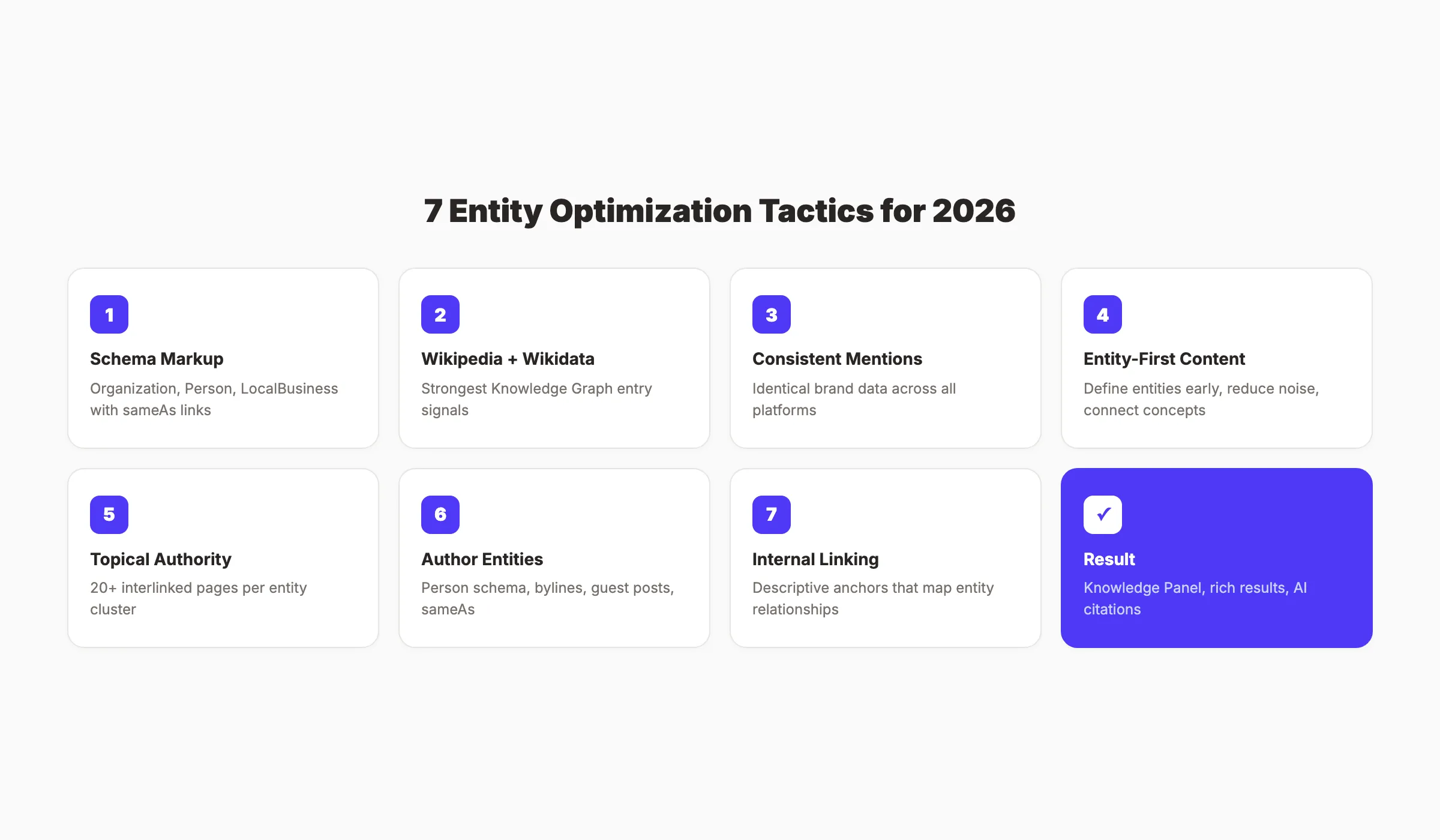
6. Strengthen Author Entities
Google’s E-E-A-T framework relies heavily on author entities. A recognized author entity lifts every page they publish.
Build author entities by:
- Creating detailed author pages with Person schema
- Adding consistent bylines with author photos
- Linking to author LinkedIn and professional profiles via sameAs
- Publishing guest posts on authoritative sites in your niche
- Getting quoted as a source in news articles and industry publications
7. Use Internal Linking to Reinforce Entity Relationships
Internal links do more than pass PageRank. They define entity relationships for search engines.
When you link from “entity SEO” to “schema markup” with descriptive anchor text, you tell Google those concepts are related. When you link from your author page to every article they wrote, you reinforce the author-content relationship.
Rules for entity-driven internal linking:
- Use descriptive anchor text (entity names, not “click here”)
- Link related entity pages to each other
- Create hub pages that link to all sub-entities
- Ensure every content page links back to its parent topic
Our guide on on-page SEO covers internal linking best practices in depth.
Chapter 6: Entity SEO for Local Businesses {#chapter-6}
Entity SEO is not just for enterprise brands. Local businesses benefit enormously because local search is fundamentally entity-driven.
When someone searches “dentist near me,” Google does not just match keywords. It queries its entity graph for dental practice entities near the searcher’s location, cross-references reviews, citations, and structured data, then ranks the results.
The Local Entity Stack
Local businesses need 4 entity layers working together:
| Layer | What It Does | Key Action |
|---|---|---|
| Google Business Profile | Primary local entity signal | Complete every field, verify |
| LocalBusiness Schema | Machine-readable entity data | Add JSON-LD to website |
| Local Citations | Third-party entity mentions | Consistent NAP on 40+ directories |
| Geo-Content | Location-based entity signals | City pages, neighborhood content |
Your Google Business Profile is your most powerful local entity signal. Google trusts its own data above all else. Complete profiles with photos, posts, and review responses send stronger entity signals than profiles with just name and address.
LocalBusiness Schema Best Practices
LocalBusiness schema tells Google exactly what your business entity is. Minimum required properties:
- @type (use the most specific sub-type: Dentist, Plumber, LawFirm)
- name
- address (PostalAddress)
- telephone
- geo (latitude, longitude)
- openingHoursSpecification
- areaServed
- sameAs (link to GBP, Yelp, industry directories)
The exception is multi-location businesses. They need separate schema for each location, not one schema with multiple addresses. Our local SEO guide covers multi-location strategy.
Reviews as Entity Signals
Reviews mention your business name, services, and location. Google extracts entity data from review text. A review that says “Dr. Chen at Bright Smile Dental did an amazing implant procedure in Austin” reinforces 4 entities at once: person, organization, product, and place.
Encourage specific reviews. “Great dentist” is weak. “Dr. Chen’s team replaced my crown in under an hour” sends strong entity signals.
Rank in local search without lifting a finger. Stacc handles your blog SEO and GBP posting every month. 30 articles. 30 GBP posts. One subscription. Start for $1 →
Chapter 7: Entity SEO and AI Overviews {#chapter-7}
AI Overviews changed how Google uses entity data. The old system matched queries to pages. The new system matches queries to entities, then finds the best sources for those entities.
This is why entity SEO matters more in 2026 than it did in 2024. AI search engines do not scan blog posts word by word. They pull from entity graphs.
How AI Overviews Use Entities
When an AI Overview generates an answer, it:
- Parses the query into constituent entities
- Retrieves entity data from the Knowledge Graph
- Identifies authoritative sources for those entities
- Synthesizes an answer with citations
If your site is recognized as authoritative for a given entity, you get cited. If not, a competitor does.
According to research, only 25% of frequently mentioned brands appear as primary sources in AI-generated answers. That means 75% of brands are not recognized as entities worth citing. Even when they rank well in traditional search.
Optimizing for AI Search Visibility
Generative engine optimization (GEO) and entity SEO overlap heavily. The tactics that build entity authority also improve AI search citations.
Key actions for AI Overview optimization:
- Add structured data that AI search engines read. Schema markup is how AI systems verify entity claims.
- Build citability. Write clear, factual statements that AI can extract as answers. Our AI citability score guide explains the scoring factors.
- Get cited by authoritative sources. When other trusted entities mention your entity, AI systems increase your authority score. See our guide on getting cited by AI search engines.
- Optimize for the answer economy. Structure content so AI can pull direct answers with attribution.
Brand Entity Optimization for AI
Your brand entity is the bridge between traditional SEO and AI visibility. When AI search engines recognize your brand as an entity, they can recommend you by name.
Brand entity SEO requires:
- A consistent brand name across all platforms
- Schema markup with Organization type and sameAs links
- Mentions on Wikipedia, Wikidata, and authoritative databases
- Published content that reinforces your brand’s topical expertise
- Reviews and testimonials that name your brand specifically
Chapter 8: How to Measure Entity SEO Success {#chapter-8}
Entity SEO does not have a single metric. You need to track entity signals across multiple dimensions.
Metric 1: Knowledge Panel Presence
Do you have a Knowledge Panel? Can you claim it? This is the clearest binary signal of entity recognition.
Check by searching your brand name in quotes. If a panel appears, your organization entity is in the Knowledge Graph.
Metric 2: Rich Result Eligibility
Run your pages through Google’s Rich Results Test. Count how many pages produce valid rich results. More valid rich results means stronger entity signals.
Track this monthly. Your technical SEO checklist should include a rich results audit.
Metric 3: Featured Snippet Captures
Featured snippets are entity-driven. Pages that answer entity-related questions clearly tend to win them. Track how many featured snippets your site holds and which entity queries trigger them.
Metric 4: AI Overview Citations
Are your pages cited in AI Overviews? Track this with manual spot checks or tools that monitor AI search results. Our AI search traffic analytics guide covers measurement methods.
Metric 5: Entity Coverage Score
Audit how many of your core entities have dedicated pages with proper schema. Calculate coverage:
Entity Coverage = (Entities with dedicated pages and schema) / (Total core entities) x 100
Aim for 90%+ coverage of your primary entities.
Metric 6: Internal Link Entity Map Completeness
Map your internal links against your entity relationships. Every entity relationship should be reflected in at least one internal link. Gaps in your link map mean gaps in your entity graph.
| Metric | Tool | Target |
|---|---|---|
| Knowledge Panel | Google Search | Present + claimed |
| Rich results | Rich Results Test | 90%+ pages valid |
| Featured snippets | Google Search Console | Month-over-month growth |
| AI Overview citations | Manual audit / AI tracking | Presence for core queries |
| Entity coverage | Manual audit | 90%+ entities mapped |
| Link completeness | Internal link audit | 100% relationships linked |
Track your SEO progress without the manual work. Stacc publishes and optimizes 30 articles a month with full schema and entity signals baked in. Start for $1 →
Common Entity SEO Mistakes {#mistakes}
Avoid these 5 errors that undermine entity authority.
1. Treating Entities as Just Schema Markup
Schema markup is one signal, not the whole strategy. You also need Wikipedia mentions, consistent NAP data, topical content clusters, and authoritative backlinks. Schema without supporting entity signals is like a label on an empty box.
2. Ignoring Author Entities
Many sites publish content with no author page, no byline, and no Person schema. Google cannot evaluate E-E-A-T without a recognized author entity. Add author pages with proper schema to every content site.
3. Inconsistent Entity Information
Your brand name is “Bright Smile Dental” on your website but “BrightSmile Dental Care” on Yelp and “Bright Smile” on Facebook. Each inconsistency weakens your entity signal. Audit every mention and standardize.
4. No Entity Relationships in Content
Writing about “SEO” without mentioning keywords, rankings, Google, search engines, content, or backlinks tells Google you do not actually understand the topic. Entity-rich content connects related concepts naturally.
5. Skipping Wikidata
Most businesses skip Wikidata because they assume they need a Wikipedia page first. Wikidata has lower notability requirements. Any registered business can create a Wikidata item with basic information. This feeds the Knowledge Graph directly.
FAQ {#faq}
What is entity SEO?
Entity SEO is the practice of optimizing your website around real-world entities. People, organizations, places, products, and concepts. Rather than just keyword strings. It helps search engines understand the meaning behind your content, improving visibility in Knowledge Panels, rich results, and AI Overviews.
How is entity SEO different from traditional keyword SEO?
Traditional SEO matches text patterns. Entity SEO matches meaning and relationships. A keyword-focused page tries to rank for a specific phrase. An entity-focused page builds authority around a concept, which helps it rank for hundreds of related queries. Both work together in modern SEO.
Do I need a Wikipedia page for entity SEO?
No, but it helps significantly. Wikipedia is the strongest signal for Knowledge Graph inclusion. If you do not qualify yet, start with a Wikidata entry and focus on consistent structured data, authoritative mentions, and schema markup. These build entity recognition over time.
How does entity SEO affect local businesses?
Local search is entity-driven from the ground up. Google maps local queries to business entities using your Google Business Profile, LocalBusiness schema, citations, and reviews. Strong entity signals improve your map pack rankings and local search visibility. See our local SEO guide for the full strategy.
What tools can I use for entity SEO?
Google’s Knowledge Graph Search API shows whether Google recognizes your entity. The Rich Results Test validates your schema. Google Search Console tracks rich result impressions. For entity research, Wikipedia and Wikidata are free starting points. Our schema markup generator creates the JSON-LD you need.
How long does entity SEO take to show results?
Entity recognition builds over time. Schema markup improvements can show rich results within weeks. Knowledge Panel appearances typically take 3 to 6 months of consistent entity signals. AI Overview citations depend on cumulative authority across your entity graph. The Content Compound Effect means every article and entity signal stacks on the last.
Entity SEO is not a trend. It is the architecture of how search works now. And how AI search will work for years to come. Start with your core entities, build schema and supporting content around them, and compound your authority every month.
The brands that win in 2026 are the ones Google recognizes as entities, not just websites.
Start building entity authority with Stacc →
Related Tools & Resources
Free SEO Tools:
Best Lists:

Written by
Siddharth GangalSiddharth is the founder of theStacc and Arka360, and a graduate of IIT Mandi. He spent years watching great businesses lose organic traffic to competitors who simply published more. So he built a system to fix that. He writes about SEO, content at scale, and the tactics that actually move rankings.
30 SEO blog articles published every month
Keyword-optimized, scheduled, and live on your site. Automatically.
30-day trial · Cancel anytime
theStacc
Stop writing SEO content manually
30 blog articles, 30 GBP posts, and social media content. Published every month. Automatically.
Try for free$1 for 3 days · Cancel anytime