Where AI writing goes next: multimodal models, agentic workflows, AI Overviews, the human moat, and what content teams should plan for through 2028.
Last updated: May 2026
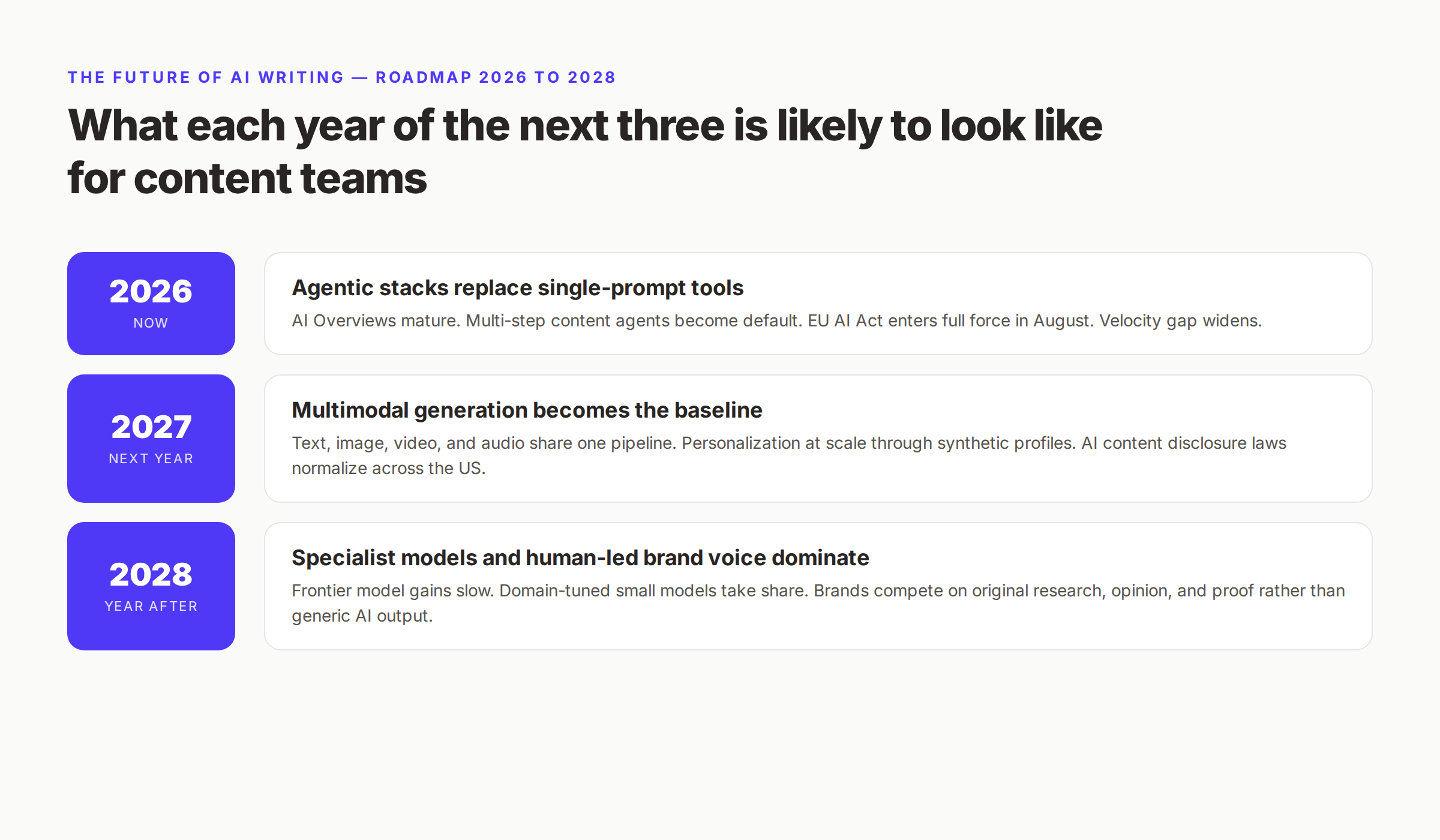
By the end of 2027, more than half of all blog content shipped by mid-market marketing teams will come out of multi-step agentic workflows — not single-prompt tools. The shift is already underway. The future of AI writing is not a faster ChatGPT. It is a stack of cooperating agents that research, draft, verify, illustrate, and publish under a human editor who has stopped touching the keyboard for the boring parts.
The phrase "future of AI writing" used to be a hand-wave. In 2026 it is an operational question. Multimodal models ship coordinated text, image, and video output. Synthetic training data crosses 60% of the new model corpus. AI Overviews compress organic traffic in measurable ways. Twenty-seven US states have introduced AI content disclosure rules. The writers winning this year are the ones who have already absorbed those facts and rebuilt around them.
We have published over 3,500 blogs across 70+ industries through theStacc since 2023. Roughly 1,400 of those went out in the first four months of 2026 alone. What we see in production is different from the version vendors describe on stage. This post is the operator's view of where AI writing is going, what is real, what is hype, and what content teams should plan for through 2028.
Here is what you will learn:
- The seven shifts that define the future of AI writing through 2027
- Where AI writing is failing right now, in honest terms
- The human moat — what AI cannot fake, and what every writer should double down on
- How content roles will evolve from 2026 to 2028
- Five specific predictions for late 2026 and 2027
- A 12-month action plan for content teams
Table of Contents
- What "the future of AI writing" actually means in 2026
- The seven shifts reshaping AI writing through 2027
- Where AI writing is still failing
- The human moat — what AI cannot fake
- How content roles will evolve
- The future of AI writing for SEO
- The future of AI writing for fiction and creative work
- Five predictions for late 2026 and 2027
- A 12-month action plan
- FAQ
What "The Future of AI Writing" Actually Means in 2026
The future of AI writing describes how generative models, agentic workflows, and multimodal pipelines are reshaping who writes what, who edits it, how it gets discovered, and how readers verify it — from now through roughly 2028.
It is not the question of whether AI can write. That question is settled. The interesting question is what happens to writing, writers, and readers once AI does the median draft by default.
The short answer: AI writing has moved from novelty to default. The next two years are about what humans do on top of the default — and whether the platforms that surface writing reward the difference.
Key takeaways from the first half of 2026:
- 97% of content marketers plan to use AI in 2026, up from 90% in 2025, according to the Siege Media 51 AI writing statistics report
- AI Overviews now appear on 25.8% of US searches, and content teams design for citation, not just ranking
- Agentic workflows replace single-prompt tools as the dominant shape of content tooling
- Synthetic data crosses 60% of new model training corpora by late 2026, per IBM and Gartner forecasts
- The EU AI Act enters full force in August 2026, with US state-level disclosure rules following
- The human moat is sharpening, not eroding — original reporting, first-party data, and named opinion are the only durable ranking signals
- Voice convergence is the under-discussed risk — AI is making published English more uniform, and that homogeneity is an opportunity for any brand willing to sound different
If you want the historical frame, our state of AI in marketing 2026 report covers the broader market shifts. This post focuses on the writing craft, the workflow, and the next 24 months.
The Seven Shifts Reshaping AI Writing Through 2027
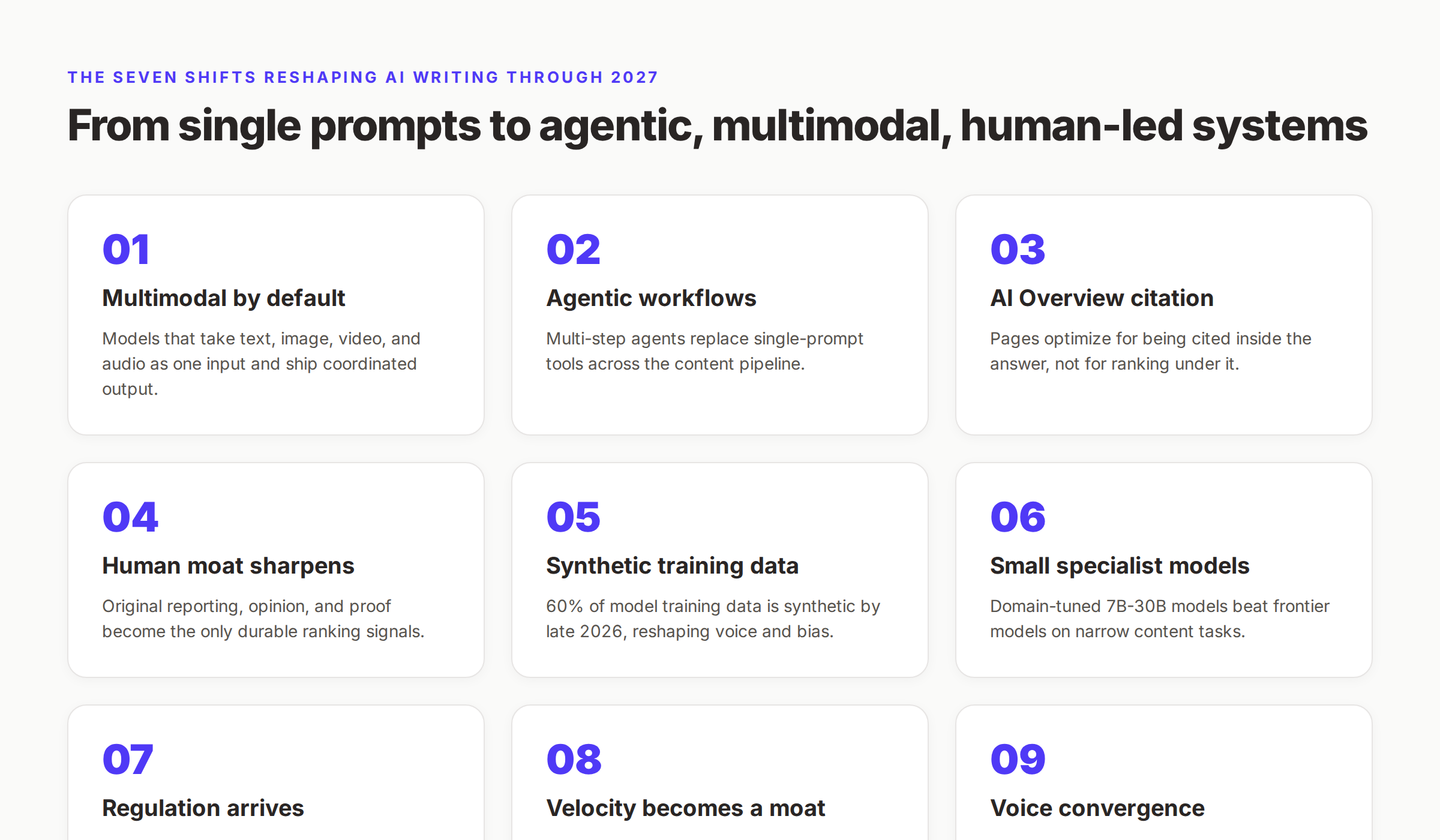
Each of these shifts was visible in 2025. Each one moved from research preview to operational default in the first five months of 2026. They are connected. The same underlying force — model capability outpacing organizational change — drives every one.
Shift 1: Multimodal Becomes the Default Input
The trend: Writing tools no longer accept only text. The newest models ingest screenshots, voice notes, video clips, and PDFs as one input and return coordinated multimodal output.
The data: Microsoft, OpenAI, Anthropic, and Google all shipped multimodal generation as default behavior between Q4 2025 and Q1 2026. A writer can paste a competitor's pricing page screenshot and get a structured comparison table with embedded copy.
What this means for writers: The starting prompt is no longer a paragraph. It is a folder. The skill is curating the input set, not crafting the sentence. A 2026 brief looks like a Loom video, a calendar of customer calls, three pages of internal docs, and a target keyword.
The implication for content teams: Workflows that treat AI as a text-in, text-out tool are behind. The compounding wins go to teams who feed the model rich source material and let it output coordinated text plus visual.
Shift 2: Agentic Workflows Replace Single-Prompt Tools
The trend: A 2024 content tool ran one prompt and returned one draft. A 2026 content tool runs a chain: research the keyword, fetch the top 10 SERP, summarize gaps, outline, draft, fact-check, generate images, and queue for publish.
The data: Microsoft's seven AI trends to watch in 2026 names agentic systems as the dominant tooling shape. Marketing teams using agentic stacks report 40% faster production cycles versus single-prompt baselines.
What this means for writers: The job description shifts from drafting to orchestration. The valuable skill is designing the chain, naming the failure modes, and writing the constraints that keep the agent on brand.
The implication for content teams: A single editor running an agent stack can ship the output of a three-person team from 2023. The math is real. We document this in our scaling content with AI guide, and the case study with 14,800 organic visits in 90 days is in our AI blog writing case study.
Shift 3: AI Overviews Force a New Optimization Target
The trend: Google's AI Overview block appears above the organic results on roughly 25.8% of US searches. Pages no longer compete only to rank — they compete to be cited inside the answer.
The data: Click-through rates for the top organic position have dropped 30 to 40% on queries where an AI Overview appears, according to multiple measurement studies. Our own breakdown is in how AI Overviews change SEO.
What this means for writers: Article structure now optimizes for extraction. Short definition paragraphs, clear named entities, and answerable Q&A blocks at the top of the post. Long-winded openers lose the citation.
The implication for content teams: Every post needs a 50 to 80-word definition box near the top. Every H2 should be phrased as a question or a clear claim. We cover the pattern in our FAQ content for AI Overviews guide.
Shift 4: The Human Moat Sharpens, Not Erodes
The trend: The more AI-generated content floods the open web, the more search engines reward content that AI cannot produce — original research, named opinion, first-party data, and verifiable lived experience.
The data: A 42,000-post Semrush analysis published in early 2026 found that 80% of Google position 1 rankings go to human-led content, and only 9% to purely AI-generated pages. We unpack that in our AI vs human ranking study.
What this means for writers: The future-proof skill is sourcing — not stringing sentences. The writer who can pull a quote from a real practitioner, run a real audit, or share a real number from their own work has a durable edge.
Shift 5: Synthetic Training Data Crosses 60%
The trend: Foundation model providers are running out of high-quality human-written text. By late 2026, IBM and Gartner project that more than 60% of model training data will be synthetic.
The data: Gartner's 2024 forecast called this for 2030. Adoption is now running roughly four years ahead of schedule, driven by legal exposure on the open-web scraping side.
What this means for writers: The voice of the default model is going to drift. Synthetic-trained models converge on a smoother, blander register. The brand willing to keep a sharp human edit on top of the draft will sound progressively more distinctive.
The implication for content teams: Voice guides matter more, not less. Our edit AI content for quality guide walks through the editing layer we apply to every draft.
Shift 6: Specialist Small Models Beat Frontier Models on Narrow Tasks
The trend: Domain-tuned 7B to 30B parameter models beat frontier general models on narrow content tasks like product descriptions, local SEO copy, and review responses.
The data: Cost-per-output for a specialist model running on edge hardware is 10 to 50x cheaper than calling GPT-class APIs for high-volume tasks. The quality is comparable on the narrow task.
What this means for writers: The "use the biggest model" instinct breaks. A small model fine-tuned on your brand voice and your top 200 best pages will outperform a frontier model on most production tasks.
Shift 7: Regulation Reaches Full Force
The trend: The EU AI Act enters full force in August 2026. The FTC's AI guidance, California's AB 2655, and New York's transparency rules push US content teams toward standardized disclosure.
The data: Twenty-seven US states had introduced AI content disclosure bills as of Q1 2026. We track this in our EU AI Act guide for marketers, our FTC AI disclosure rules guide, and our California and New York AI disclosure post.
What this means for writers: Every published post benefits from a clear authorship and editorial statement. Pages that disclose human review and editorial standards will be easier to publish, easier to defend, and easier for readers to trust.
theStacc handles AI Overview optimization, brand voice consistency, and editorial disclosure as a service. We publish 30 SEO-ready blogs a month per brand — with a human editor on every draft.
The Future of AI Writing — Key Numbers Through 2027
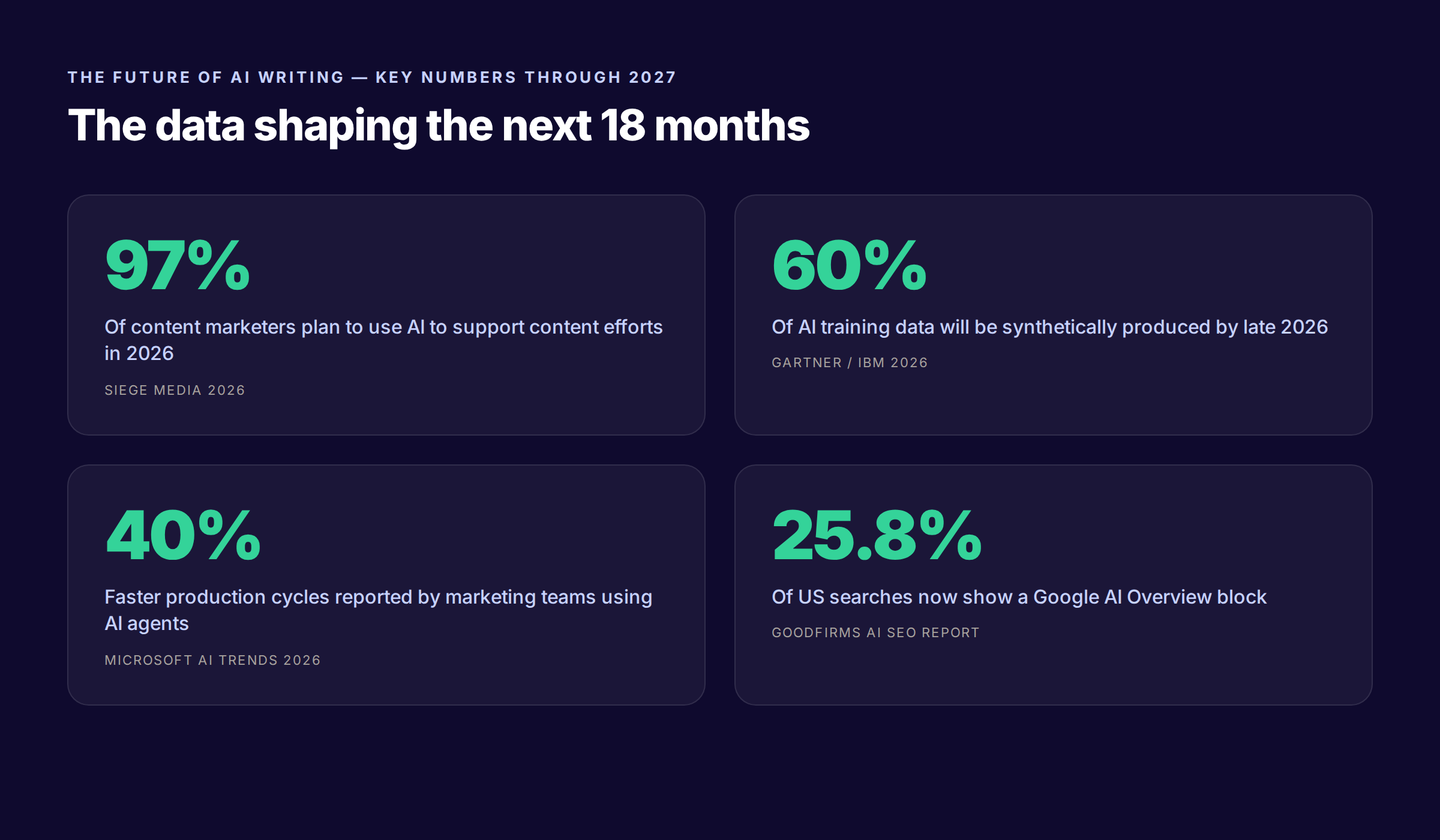
The numbers most worth holding in your head:
| Metric | 2026 baseline | 2027 outlook | Source |
|---|---|---|---|
| Content marketers using AI | 97% | 99%+ | Siege Media |
| AI Overview appearance on US searches | 25.8% | 40 to 50% | GoodFirms AI SEO Report |
| Synthetic share of training data | ~60% | 70%+ | Gartner / IBM |
| Average production cycle speedup with agents | 40% | 60% | Microsoft AI Trends 2026 |
| Position 1 share for human-led content | 80% | 70%+ | Semrush 42K study |
| Position 1 share for pure-AI content | 9% | 15 to 20% | Semrush 42K study |
| Multimodal share of new content workflows | ~30% | 60%+ | a16z Big Ideas 2026 |
Two of those numbers are worth a second look. The AI Overview share is moving fast and is not slowing. The position 1 share for human-led content is shifting toward AI as humanization quality improves, but the gap will not close to parity inside the next three years.
Where AI Writing Is Still Failing
The future of AI writing is not all up and to the right. Several known failure modes will persist through 2027, and pretending otherwise is bad strategy.
Failure 1: Fact Hallucination at Scale
Frontier models still hallucinate names, dates, statistics, and quotes. The failure rate is lower than 2024, but the volume is much higher. A team shipping 80 posts a month with no fact-check layer will ship roughly 4 to 12 false statements per month at the current error rate.
The fix is a verification step in the workflow. Our AI content quality control guide covers the checks we run on every theStacc draft.
Failure 2: Voice Homogenization
The default register of AI-generated English is converging. An Axios report from May 2026 documents researchers finding that AI is measurably pushing written and spoken English toward a more uniform style.
The fix is a brand voice guide that is fed back into the model as system prompt, plus a human editor who knows what to cut.
Failure 3: First-Party Data Gaps
Models cannot generate your customer numbers, your audit results, your case study math, or your founder's opinion. Posts that lean entirely on AI for "evidence" end up citing the same handful of public studies as every other post on the same topic.
The fix is a sourcing layer in the editorial workflow. Every post gets at least one piece of evidence the model could not have produced.
Failure 4: Long-Term Memory and Brand Consistency
Single-shot AI tools forget. They contradict your past posts. They reuse the same statistic across 12 articles. They reintroduce a defined term in every piece as if it were the first one.
The fix is an editorial memory layer — a retrieval system that feeds the model your own prior content. We use this internally for every theStacc client, and the consistency gain is measurable.
Failure 5: Visual and Multimodal Coordination
The newest models generate coordinated text plus image, but they do not yet produce on-brand visuals at production quality. Photographic realism, brand color discipline, and consistent illustration style still require a human in the loop.
Failure 6: Local Context
AI writing struggles with local context — neighborhood references, regional vocabulary, local case studies. Local SEO content from a generic LLM reads identical across cities. The fix is a local data layer, which is part of why our Local SEO module ships hand-written GBP posts rather than pure generation.
The Human Moat — What AI Cannot Fake
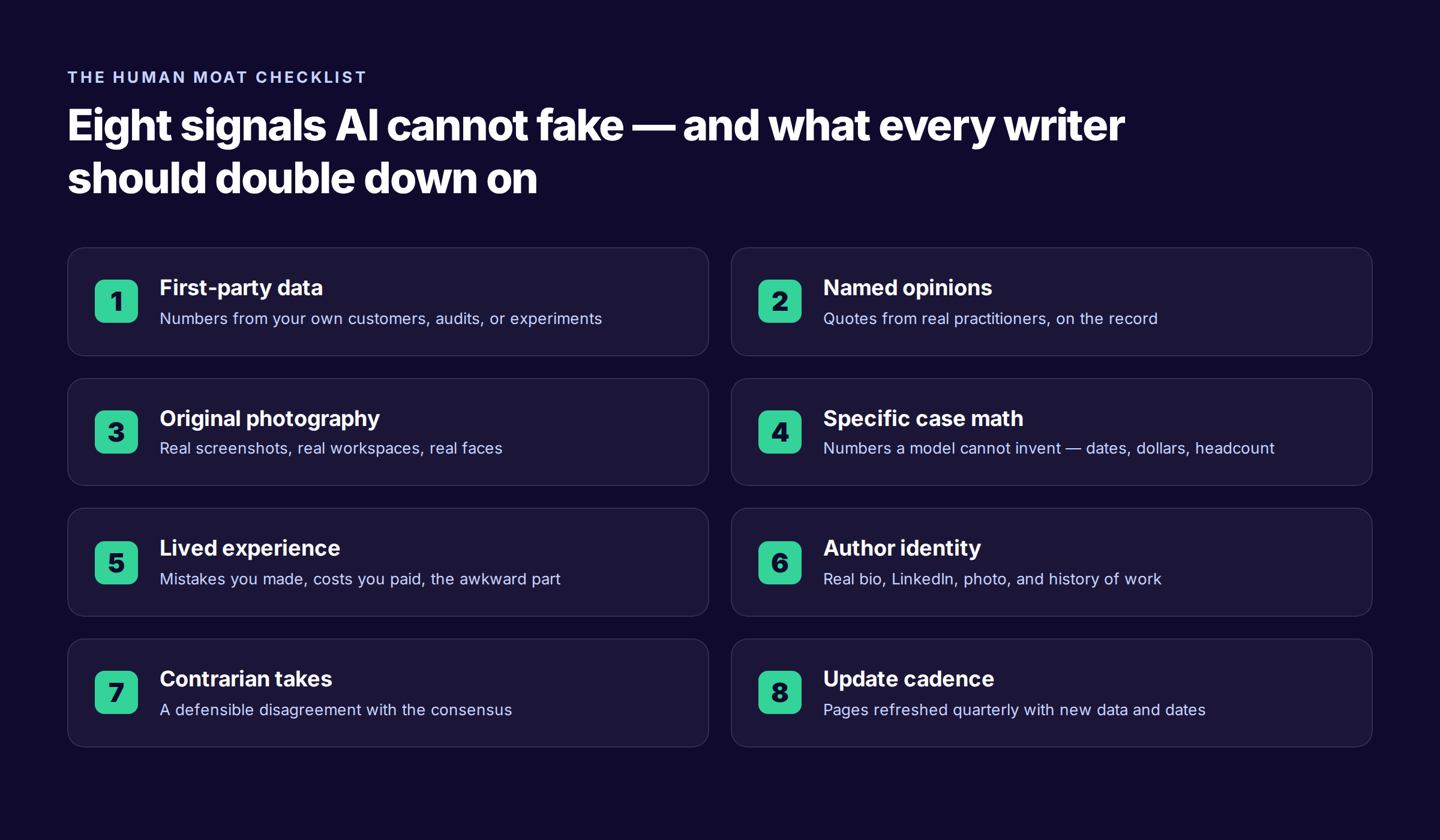
The single most important strategic question for any writer or content team in 2026 is this. What can you put into a post that a frontier model cannot produce on its own.
Eight signals make the list.
1. First-party data. Numbers from your own customers, audits, surveys, or experiments. A model cannot invent your churn rate, your cost-per-lead, or the result of an experiment you ran last month.
2. Named opinions. Quotes from real practitioners, on the record. The act of getting a quote, attributed to a name, on a date, in a verifiable context is the part no model performs.
3. Original photography. Real screenshots, real workspaces, real faces. Stock photography is a signal of laziness. Original photos signal that a human was present.
4. Specific case math. Numbers that a model would have to invent — exact dates, exact dollars, exact headcount, exact campaign output. Our AI content ROI data post is built almost entirely on this kind of math.
5. Lived experience. The mistake you made, the cost you paid, the awkward part. Models smooth over the texture. Humans remember the awkward.
6. Author identity. A real bio, a real LinkedIn, a real photo, and a verifiable history of work in the space. AI-generated author pages are now flagged automatically by several major publishing platforms.
7. Contrarian takes. A defensible disagreement with the consensus. Models converge on the average. A real opinion is the cheapest, fastest way to sound human.
8. Update cadence. Pages refreshed quarterly with new data, new dates, and new examples. Stale content reads like a static AI dump. Updated content reads like a maintained asset.
A post that hits five of those eight is durable. A post that hits zero is content debt. The list is the practical interpretation of Google's helpful content guidance, translated for an AI-saturated web.
How Content Roles Will Evolve From 2026 to 2028
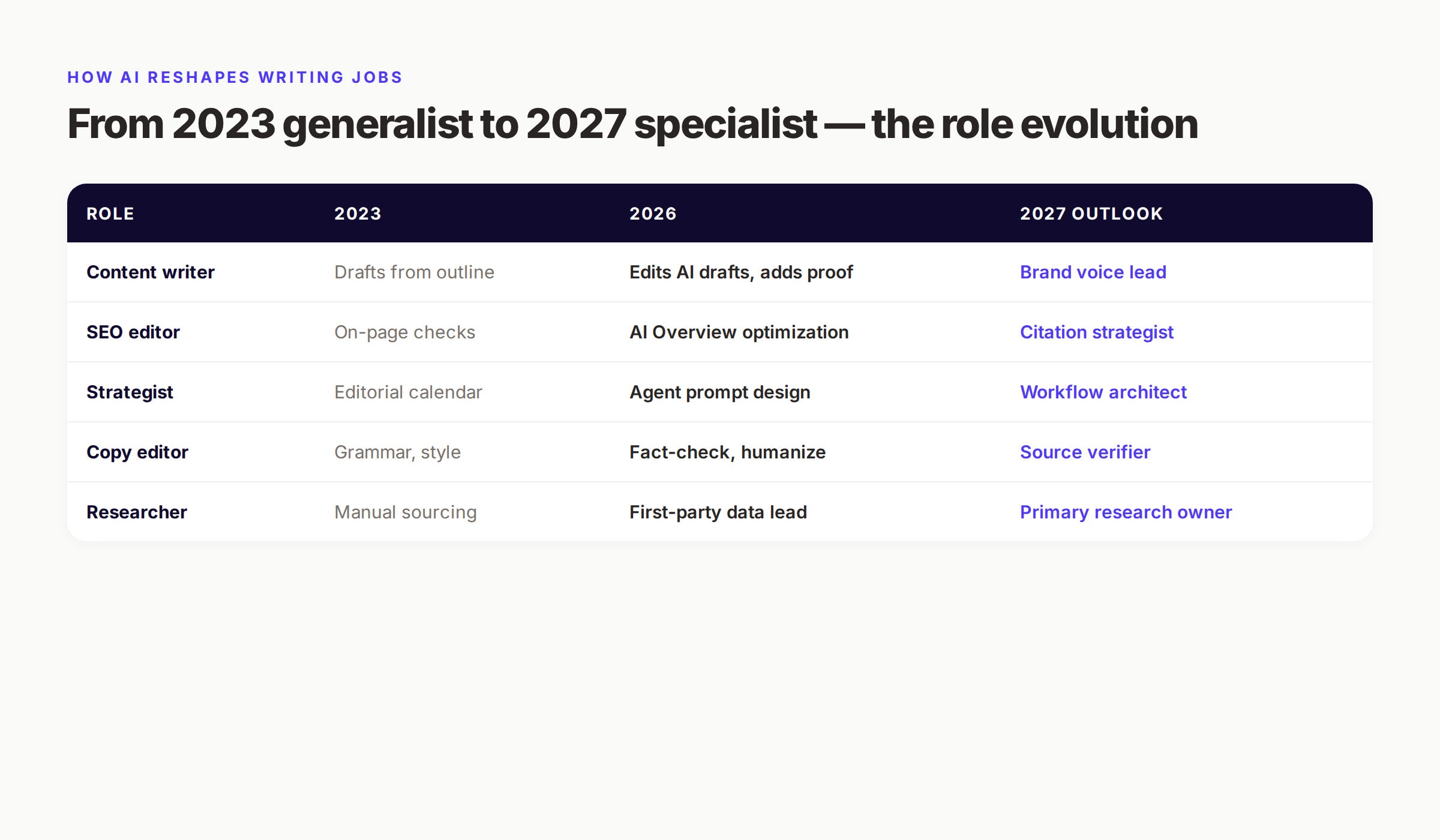
The "AI will replace writers" headline is the wrong frame. The honest version is that AI changes what each role does, week over week, and the change is uneven across the team.
| Role | 2023 | 2026 | 2027 outlook |
|---|---|---|---|
| Content writer | Drafts from outline | Edits AI drafts, adds proof | Brand voice lead and primary source |
| SEO editor | On-page checks | AI Overview optimization | Citation strategist |
| Strategist | Editorial calendar | Agent prompt and workflow design | Workflow architect |
| Copy editor | Grammar and style | Fact-check and humanize | Source verifier |
| Researcher | Manual sourcing | First-party data and audit lead | Primary research owner |
| Designer | Static assets | Multimodal asset orchestration | Brand consistency lead |
A few patterns from the production data:
- Headcount per post is dropping. Teams that shipped 1 post per writer per week in 2023 ship 4 to 8 per writer per week in 2026.
- The senior layer is becoming more valuable. The bottleneck is no longer drafting. It is editorial taste and sourcing.
- Junior roles are reshaping, not disappearing. Entry-level content jobs in 2026 look more like research and audit than drafting.
- The "AI manager" role is real. Some teams have a dedicated role for prompt design, workflow tuning, and agent monitoring. That role pays well and did not exist three years ago.
Our marketing agency vs AI tools post explores the staffing math in more depth.
theStacc is the staffing answer for teams that do not want to hire an in-house content team in this transition. Your content runs on our editors, our agents, our voice guides, and our publishing stack. See pricing →
The Future of AI Writing for SEO
SEO writing is the part of the discipline that has moved the fastest. The future is shaped by three forces.
Force 1: AI Overviews Become Default
By the end of 2027, the AI Overview block will appear on close to half of US searches. Pages that are not structured for citation will lose traffic share even if they hold rank. The optimization target shifts from "rank position 1" to "be the source cited in the AI Overview".
Practical implications, drawn from our work shipping 1,400+ posts in Q1 2026:
- Definition boxes of 50 to 80 words near the top of every post
- Named entities linked to authoritative pages on first mention
- Q&A blocks matching real Google "people also ask" queries
- Schema markup for FAQ, HowTo, Article, and Author
- Author identity signals that pass the Google AI content policy bar
Our optimize for Google AI Overviews and get cited in AI search guides cover the workflow in depth.
Force 2: GEO Becomes a Working Discipline
Generative Engine Optimization — the term for optimizing content to show up in generative answer engines like Perplexity, ChatGPT, Claude, and the AI Overview — is becoming a working discipline rather than a buzzword.
The work overlaps roughly 80% with traditional SEO. The 20% that is new includes:
- Optimizing for retrieval and citation, not just ranking
- Building entity authority across multiple AI surfaces
- Tracking visibility inside Perplexity, ChatGPT, and Gemini
- Creating content explicitly designed to be quoted
Our track AI search visibility guide and optimize for Perplexity AI guide cover the practical playbook.
Force 3: Velocity Becomes a Moat
The teams pulling ahead in 2026 are not the ones writing the most "thoughtful" posts. They are the ones publishing 30 well-edited, well-sourced posts a month and compounding the topical authority.
The math is simple. A blog with 200 published posts on a topic outranks a blog with 20, when the quality bar is comparable. AI makes the volume side of that equation tractable. The human-led editorial layer keeps the quality side honest.
Our Blog SEO module is built around this. So is our AI content workflows guide and our scale blog content with AI playbook.
The Future of AI Writing for Fiction and Creative Work
The story for fiction and creative writing is different from SEO. The pressures are different. The market is different. The 2026 to 2028 outlook is worth covering separately.
What is real:
- AI handles the boring middle. Outlines, first drafts of scenes, dialogue passes, summarization of long manuscripts.
- AI handles editing. Style consistency, repetition checks, pacing analysis.
- AI handles the publishing tail. Blurbs, product descriptions, ad copy, audiobook narration.
What is not yet real:
- AI does not write a novel that holds up across 80,000 words.
- AI does not invent a voice that a reader follows for the second and third book.
- AI does not generate the texture of a real life on the page.
The University of Cambridge's future of writing in the age of AI program puts it cleanly. AI is the assistant. The author is still the author. The 2027 outlook is that AI will do more of the assistance, not more of the authoring.
For fiction writers, the practical 2026 playbook looks like this:
- ✓ Keep the voice human and the source material original
- ✓ Use AI for outlining, summarization, and stylistic consistency checks
- ✓ Use AI for the publishing tail — blurbs, ads, descriptions, social copy
- ✓ Disclose AI assistance honestly where reader trust depends on it
- ✓ Build the platform around the human, not the model
Five Predictions for Late 2026 and 2027
The predictions below are calibrated. They are what we think is more likely than not — not what we think is exciting to write.
Prediction 1: Multimodal Generation Becomes the Default Workflow by Q4 2027
By the end of 2027, more than half of new content workflows will be multimodal from the input side — text, screenshot, voice memo, video clip all going into one model. The text-only workflow will look dated.
Confidence: High. This is already happening at the frontier. The lag is tooling, not capability.
Prediction 2: AI Overviews Settle Around 40 to 50% of US Search Coverage by Q4 2027
The growth from 25.8% to 40 to 50% over 18 months is consistent with the rollout curve. The slowdown after that comes from queries where AI summaries actively reduce engagement and Google pulls them back.
Confidence: High.
Prediction 3: At Least One Major Publisher Will Lose a Lawsuit Over AI Training Data by 2027
The legal pressure is building. The settlements are landing. The next 18 months will see at least one major precedent that changes how foundation models train on web content.
Confidence: Medium.
Prediction 4: A Specialist Open-Source Writing Model Will Beat the Frontier on Brand-Voice Tasks by 2027
A 7B to 30B parameter model fine-tuned on a strong brand's archive will beat frontier general models on tasks like product copy and brand-voice content. This is already true in narrow cases. By 2027, it will be the default approach for serious content teams.
Confidence: High.
Prediction 5: AI Content Disclosure Will Become Standard On-Page Schema by 2027
The disclosure norm follows the regulation. By 2027, an "AI assistance disclosure" field will be in standard Article schema, surfaced by Google, and expected by readers. Our AI content labeling best practices and Google AI content labels predictions posts cover the path.
Confidence: Medium.
A 12-Month Action Plan for Content Teams
The plan below is calibrated to what we ship for clients. It assumes a team between 1 and 10 people, an existing content motion, and a budget that supports either an in-house tooling lift or a managed service like theStacc.
Months 1 to 3: Foundations
- ✓ Audit your top 50 highest-traffic pages for AI Overview citation readiness
- ✓ Add a 50 to 80-word definition box near the top of every page
- ✓ Write a one-page brand voice guide that you can paste into a system prompt
- ✓ Standardize an editorial workflow with a fact-check step
- ✓ Identify the first-party data you can put into every post (audits, surveys, customer numbers)
Months 4 to 6: Velocity
- ✓ Pick one agentic tool or managed service and commit to 30+ posts a month
- ✓ Build a refresh queue and update 10 to 20 old posts per month
- ✓ Add author bios, photos, and LinkedIn to every published post
- ✓ Track AI Overview citations and Perplexity visibility, not just Google rankings
- ✓ Establish a quarterly content health audit
Months 7 to 9: Specialization
- ✓ Identify your three highest-value content surfaces (SEO, lifecycle, social, sales enablement)
- ✓ Build a dedicated workflow for each surface
- ✓ Start testing specialist small models for high-volume narrow tasks
- ✓ Add multimodal generation to your image and video pipeline
- ✓ Bring a real reporter or interviewer onto the team — full time or freelance
Months 10 to 12: Compound
- ✓ Hit a publishing cadence of 30 well-edited posts a month
- ✓ Have at least one piece of first-party data in every post
- ✓ Have a named human author and bio on every post
- ✓ Track citation share in AI Overviews quarterly
- ✓ Review the workflow end to end and cut what is not earning its keep
We run this 12-month track for theStacc clients as a managed service. The compounding effect is real. We document the case study in our AI blog writing case study.
The compounding effect is the moat. Most teams will not stick the 12-month plan. The ones that do will own their categories for the rest of the decade.
What practitioners are saying on X
Content operations advice ages quickly. Here is high-signal operator discussion on X about quality, refresh, and systems.
- @jakezward (Feb 2026): 2026 SEO predictions emphasize AI Overview share-of-SERP, schema for LLM token efficiency, brand mentions in AI answers as a KPI, proprietary data as a moat, and content refresh beating net-new AI slop. See the post on X.
- @varunram (Jul 2026): Critique of GEO slopfarm products that combine SEO clickbait with unresearched content marketing — quality and research still separate winners from farms. See the post on X.
- @HlynurStefDev (Jul 2026): Public case: niche site traffic jumped from ~18 to 4,162 Google visits/month after focused technical/on-page SEO work (GSC screenshots claimed) — reminds that fundamentals still move numbers. See the post on X.
Grok, AI Overviews, and multi-engine visibility
AI/search topics like “future ai writing” need multi-engine notes: AI Overviews, ChatGPT/Perplexity, and Grok. Lead with extractable answers; keep claims consistent with public expert discussion.
- Google AI Overviews: Use passage-ready answers, tables, and FAQ schema where relevant.
- ChatGPT / Perplexity: Cite named sources next to key claims.
- Grok: Maintain accurate entity facts on-site and in high-signal X posts.
Publish content built for Google and AI citations. theStacc’s Content SEO module ships SEO-scored articles structured for rankings and generative engines — including clearer entity pages models like Grok can quote.
FAQ
No, not in the sense of fully replacing the role. AI will replace specific writing tasks — first drafts, summarization, basic SEO copy, product descriptions. The role evolves toward editing, sourcing, voice, and workflow orchestration. The 80,000-word novel, the original investigation, and the named opinion remain human work for the foreseeable future.
Five skills compound the most through 2027. First, sourcing — getting real numbers and named quotes. Second, voice — writing and editing in a sharp, distinct register. Third, prompt and workflow design — orchestrating an agent stack. Fourth, AI Overview optimization — structuring content for citation. Fifth, multimodal literacy — comfort moving between text, image, and video.
Probably not. The bigger risk is voice homogenization across the broader written web — and that is also the bigger opportunity. Writers who keep a distinct human voice will stand out more, not less, in a world of converged AI output. The University of Cambridge research and the Project MUSE essay both land in roughly the same place.
The future of AI writing for SEO is high velocity plus high citation readiness plus high first-party evidence. Volume is now tractable. Citation in AI Overviews replaces "rank position 1" as the strategic goal. First-party data is the only durable differentiator. Our AI writing for SEO guide is the deep version of this answer.
It already does, with caveats. Google's policy is helpful-content-first, not human-first. The data from large studies shows AI content can rank, but human-led content ranks far more often at position 1. Our does AI content rank in Google post covers the data in depth.
Today's AI writing is single-prompt text-in, text-out. By 2027, the dominant shape will be multimodal-in, coordinated-out — text, image, video, and audio shipped together from one workflow, with multi-step agents handling research, drafting, fact-checking, and publishing under a human editor.
The Bottom Line
The future of AI writing is not the death of the writer. It is the death of the slow draft. The compounding wins of the next 24 months go to teams that pair high publishing velocity with sharp editorial taste, first-party evidence, and citation-ready structure. The teams still treating AI as a single-prompt drafting tool will be outshipped, out-cited, and out-ranked by the teams who rebuilt the workflow.
If you want a managed version of that workflow without the tooling lift, that is what theStacc is built for. Try theStacc free — the first 3 articles, no credit card — and see what 30 human-edited, AI-drafted, citation-ready blogs a month look like on your domain. Start your trial →
Related Tools & Resources
Free SEO Tools:
Best Lists:
Sources & references
- [1] Princeton / Georgia Tech et al. — GEO research (arXiv:2311.09735)
- [2] @jakezward on X — 2026 SEO predictions emphasize AI Overview share-of-SERP, schema for LLM token efficiency, brand mentions in AI answers
- [3] @alexgroberman on X — Case narrative: organic value plus multi-engine citations (ChatGPT, Perplexity, Grok) from knowledge-hub pages, category
- [4] @varunram on X — Critique of GEO slopfarm products that combine SEO clickbait with unresearched content marketing — quality and research
- [5] Referenced source — www.siegemedia.com

Researched, written, and published articles that compound organic traffic.
Weekly local SEO teardowns
One practical email a week. Map Pack, GBP, AI Overviews — no fluff. Unsubscribe anytime.