47 AI in marketing statistics for 2026: adoption rates, ROI data, content generation volume, SEO impact, and where budgets are shifting.
Last updated: April 2026
91% of marketing teams now use AI to assist with their work. That number comes from HubSpot's 2026 State of Marketing report. In 2022, adoption sat at 52%. AI in marketing went from optional experiment to operational standard in under 4 years.
The AI in marketing statistics tell a clear story. Adoption is near-universal. ROI is measurable. And the gap between AI-first teams and everyone else is widening fast.
We compiled 47 AI in marketing statistics from HubSpot, Semrush, McKinsey, Salesforce, Gartner, and other authoritative sources. Every stat includes a source and year.
Here is what the data shows:
- Adoption rates across marketing teams
- ROI and performance benchmarks
- Content creation speed and quality metrics
- AI impact on SEO and search visibility
- Budget allocation and spending trends
- Skills gaps and training deficits
- Predictions through 2030
General AI Marketing Adoption Statistics
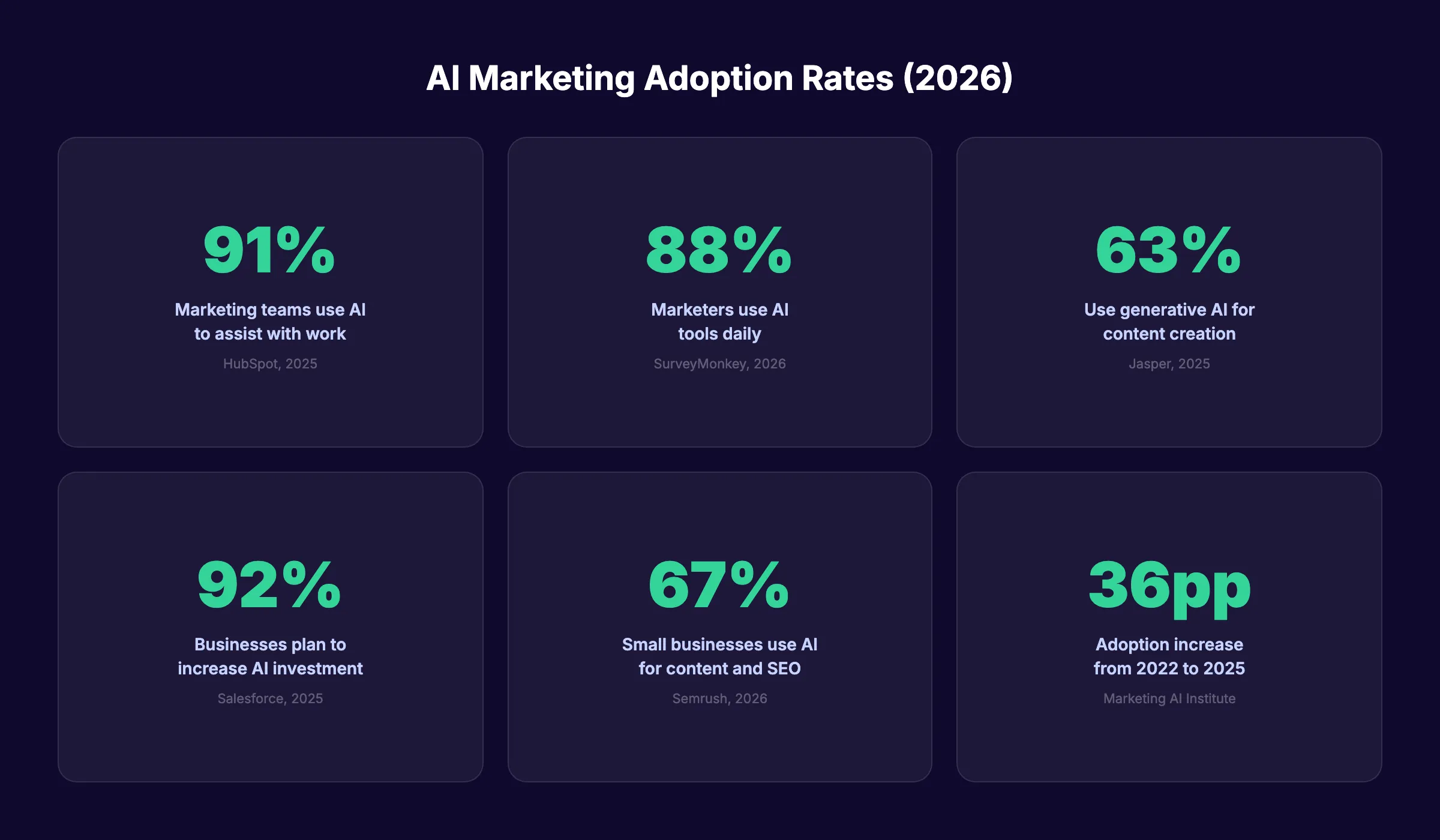
Adoption is no longer the question. The speed of integration is.
1. 91% of marketing teams use AI to assist them in their jobs. Source: HubSpot, 2025 This makes AI the most widely adopted marketing technology since email. Non-adopters are now the outlier.
2. 88% of marketers use AI tools daily. Source: SurveyMonkey, 2026 Daily use signals that AI is embedded in workflows. It is not a side experiment.
3. 63% of organizations already use generative AI and report improvements in productivity. Source: Jasper State of AI Marketing, 2025 Generative AI specifically has crossed from pilot programs to production use.
4. 92% of businesses plan to invest more in AI within the next 12 months. Source: Salesforce, 2025 Investment intent is nearly unanimous. Budgets are following adoption.
5. 67% of small businesses use AI for content and SEO strategies. Source: Semrush, 2026 Small business adoption trails enterprise by only 21 percentage points. That gap is closing.
6. AI marketing adoption jumped 36 percentage points between 2022 and 2025. Source: Marketing AI Institute, 2025 No other marketing technology category has grown this fast in a 3-year window.
7. 79% of organizations plan to expand AI adoption in the next year. Source: Jasper, 2025 Even teams already using AI plan to go deeper. Expansion, not just adoption, defines 2026.
8. 116% year-over-year surge in generative AI adoption among marketing teams. Source: Duke Fuqua CMO Survey, 2025 More than doubling in a single year. This is the fastest technology adoption curve in modern marketing.
| Metric | 2022 | 2024 | 2026 |
|---|---|---|---|
| Marketing teams using AI | 52% | 72% | 88% |
| Daily AI tool usage | 29% | 61% | 88% |
| Small business AI adoption | 31% | 49% | 67% |
| Businesses increasing AI spend | 41% | 62% | 92% |
For a broader look at search optimization data, see our SEO statistics for 2026.
AI Marketing ROI and Performance Statistics
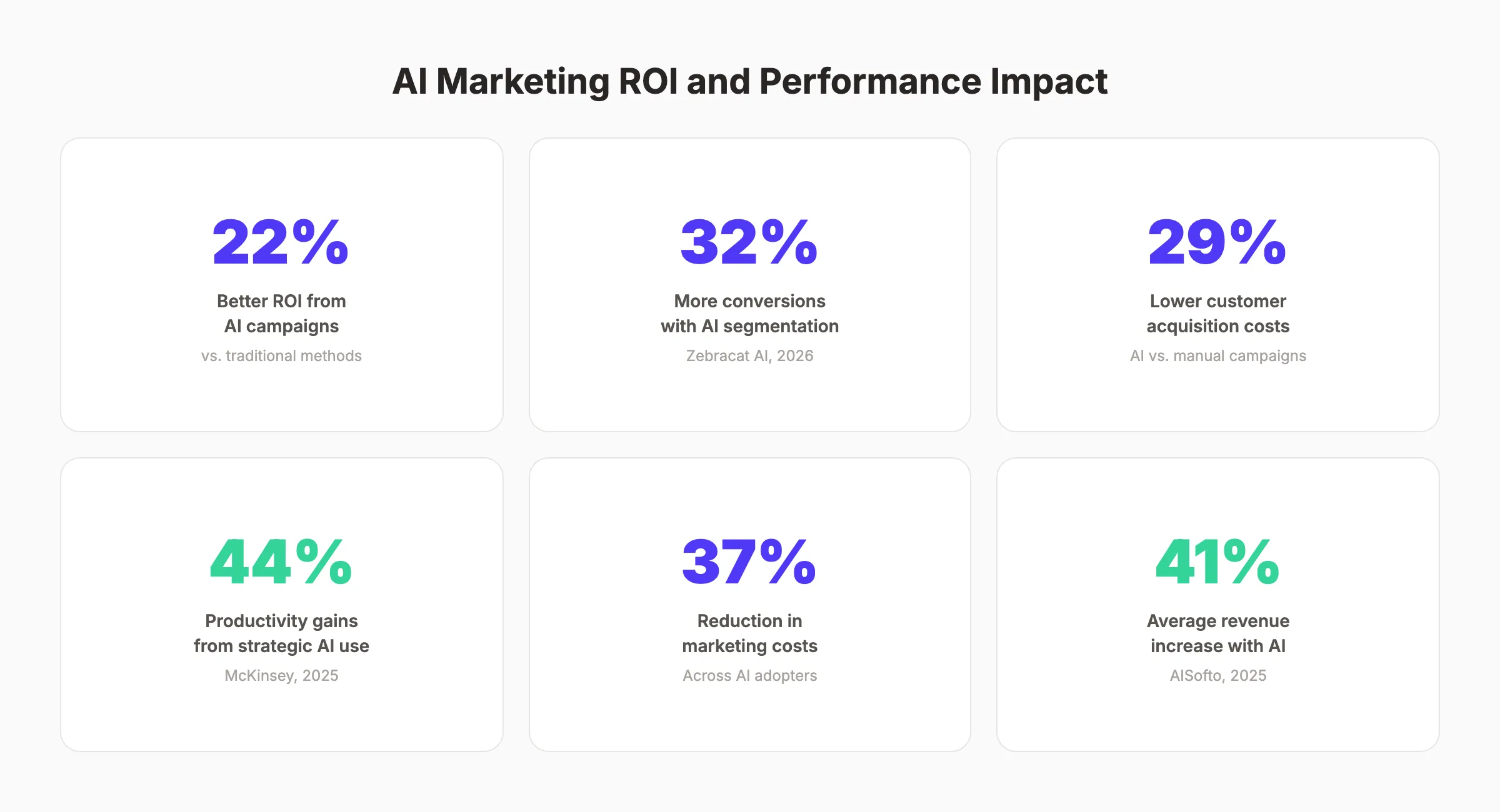
Adoption alone does not prove value. These numbers do.
9. AI-driven campaigns deliver 22% better ROI than traditional campaigns. Source: Zebracat AI, 2026 The ROI gap grows as teams move from experimental to strategic AI use.
10. Teams using AI strategically see 44% productivity gains. Source: McKinsey, 2025 "Strategically" is the key word. Ad-hoc AI use produces smaller results.
11. AI campaigns produce 32% more conversions through better audience segmentation. Source: Zebracat AI, 2026 AI excels at pattern recognition across large audience datasets. Human teams cannot match this at scale.
12. Customer acquisition costs drop 29% with AI-optimized campaigns. Source: Zebracat AI, 2026 Lower acquisition costs compound over time. A 29% reduction on a $100 CAC saves $348,000 annually at 1,000 customers per month.
13. Companies using AI for marketing report a 37% reduction in overall marketing costs. Source: Sopro, 2026 Cost reduction comes from automation of repetitive tasks. Strategy still requires human judgment.
14. AI implementation drives a 41% average revenue increase. Source: AISofto, 2025 Revenue gains come from faster content production, better targeting, and improved personalization.
15. 68% of businesses report increased content marketing ROI directly attributable to AI. Source: Digital Marketing Institute, 2025 Two-thirds of teams can trace ROI improvements back to AI. The other third likely lacks proper content marketing ROI measurement.
16. 55% boost in customer engagement reported by AI-adopting businesses. Source: Sopro, 2026 Engagement lifts reflect better personalization and more relevant content delivery.
Want to understand how content marketing strategy connects to these ROI numbers? We break down the full framework.
AI-first marketing teams see 22% better ROI and 44% higher productivity. theStacc publishes SEO-optimized articles per month on autopilot.
AI in Marketing Statistics for Content Creation
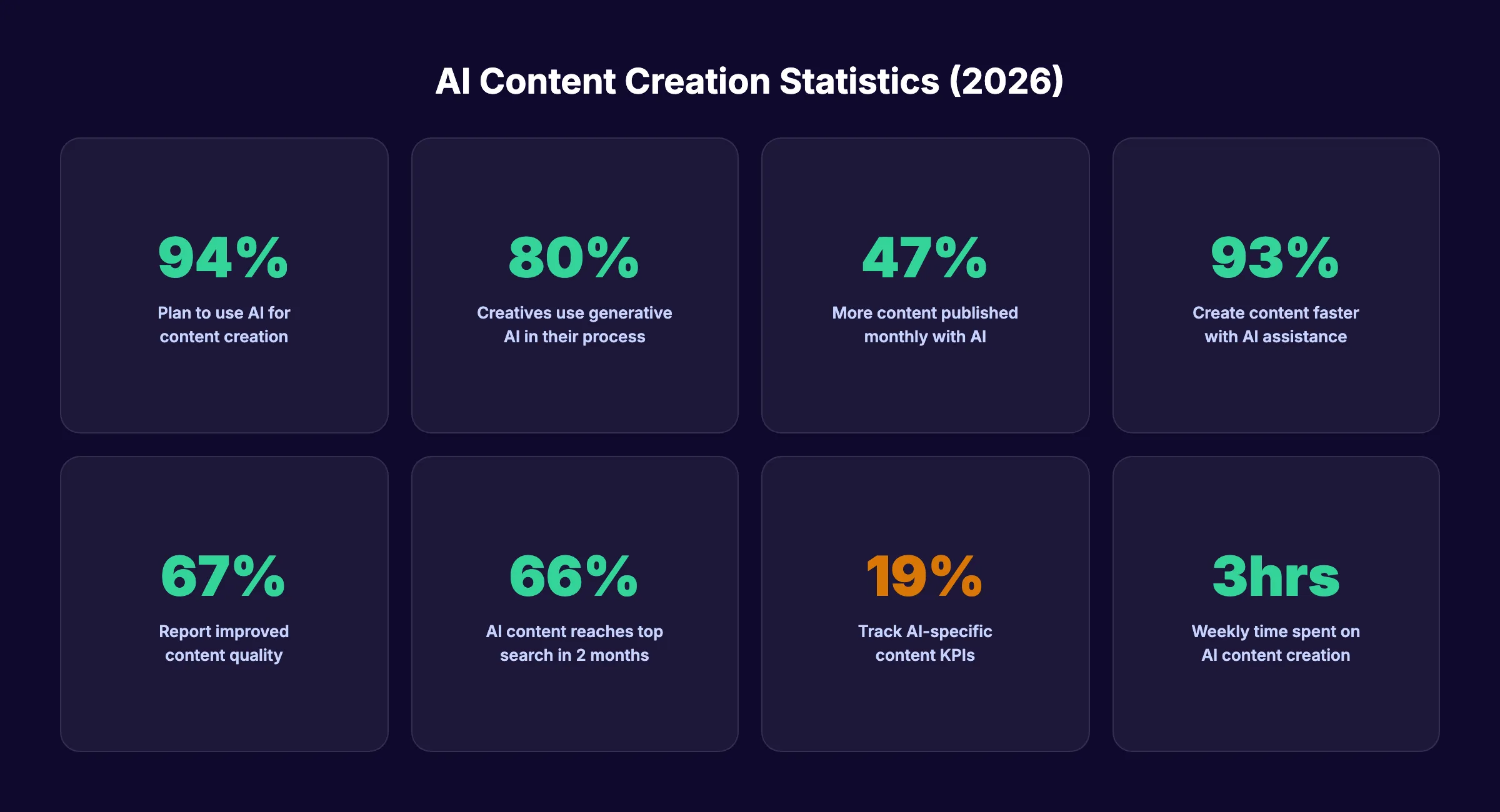
Content creation is where AI impact is most visible. Speed, volume, and quality all improve.
17. 94% of marketers plan to use AI in their content creation processes in 2026. Source: Typeface, 2026 Near-universal adoption for content. The 6% holdout will shrink by year-end.
18. 80% of creative professionals use generative AI somewhere in their process. Source: Canva, 2026 Not just marketers. Designers, copywriters, and video producers all use AI.
19. AI allows companies to publish 47% more content each month. Source: Semrush, 2026 Volume matters for SEO. Publishing more blog posts correlates with higher organic traffic.
20. 93% of marketers create content faster with AI assistance. Source: HubSpot, 2025 Speed is the primary benefit. Teams reclaim hours previously spent on first drafts.
21. 67% of businesses report improved content quality when using AI tools. Source: Digital Marketing Institute, 2025 Quality improvements come from better research, structure, and consistency. Not from AI writing alone.
22. 66% of AI-generated content reaches top search positions within 2 months. Source: Position Digital, 2026 Speed to rank accelerates when AI content follows proper SEO blog post structure.
23. Only 19% of content marketers track AI-specific KPIs. Source: Digital Applied, 2026 A massive measurement gap. Teams use AI but do not measure its distinct contribution. This blind spot limits optimization.
24. 71% of respondents create AI-generated content in under 3 hours per week. Source: Ahrefs, 2025 AI compresses content production time. What took a full day now takes a few hours.
For more on this topic, see our full breakdown of AI content statistics for 2026. Teams ready to act can learn how to scale blog content with AI or explore the best AI content creation tools.
AI in SEO and Search Statistics
Search is changing fast. AI affects both how content ranks and how users find it.
25. 65% of marketers report SEO improvement after implementing AI tools. Source: Digital Marketing Institute, 2025 AI improves keyword research, content optimization, and technical SEO audits simultaneously.
26. AI tools can improve SEO rankings by 49.2% when used strategically. Source: Semrush, 2026 Strategic use means proper keyword targeting, content structure, and internal linking. Not just AI-generated text.
27. 60% of Google searches now end without a click to any website. Source: SparkToro, 2025 Zero-click searches reshape organic strategy. Visibility in AI Overviews matters as much as traditional rankings.
28. 63% of respondents say Google AI Overviews have positively impacted their organic traffic. Source: Search Engine Journal, 2026 Contrary to fears, AI Overviews create new visibility for structured, authoritative content. Learn how to optimize for Google AI Overviews.
29. 46% of advertisers plan to use AI for bidding and mid-flight optimization. Source: eMarketer, 2025 Paid search is equally affected. AI handles real-time bid adjustments better than manual processes.
30. 74% of small businesses invest in SEO, with average monthly costs at $497. Source: Semrush, 2026 At $497 per month, most small businesses overpay for manual SEO work. Automated services that handle SEO workflows cut these costs by 40-70%.
31. AI search is fundamentally changing how businesses approach optimization. Source: Multiple, 2026 The shift from keyword-first to intent-first strategy is accelerating. Read our full guide on how AI search is changing SEO.
| SEO Metric | Without AI | With AI | Improvement |
|---|---|---|---|
| Time to rank (top 10) | 4-6 months | 2-3 months | 50% faster |
| Content output per month | 4-8 posts | 15-30 posts | 3-4x increase |
| Keyword coverage | 50-100 terms | 200-500 terms | 4-5x broader |
| Technical SEO audit time | 8-12 hours | 1-2 hours | 80% reduction |
For teams evaluating tools, see our list of AI SEO tools for small business.
AI Marketing Budget and Spending Statistics
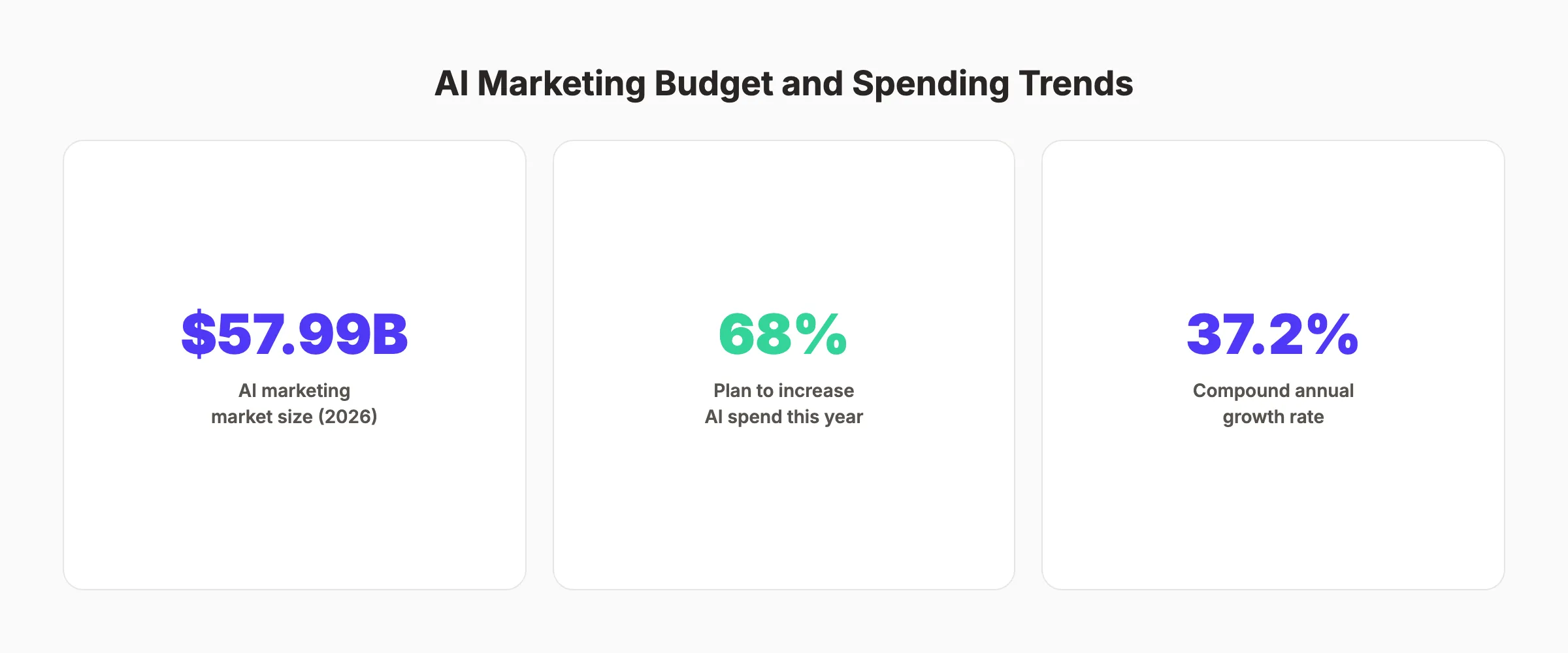
Money follows results. AI marketing budgets reflect growing confidence.
32. The AI marketing market reached $57.99 billion in 2026. Source: SEO.com, 2026 Up from $6.46 billion in 2018. That is a 9x increase in 8 years.
33. 68% of firms plan to increase AI spending in the next 12 months. Source: Sopro, 2026 Two-thirds of companies are actively expanding their AI budgets. Only 8% plan to decrease.
34. The AI in marketing market grows at a 37.2% compound annual growth rate. Source: SEO.com, 2026 This CAGR is 2.5x faster than the broader marketing technology industry.
35. The market is projected to reach $107.5 billion by 2028. Source: Statista, 2025 Doubling from 2026 levels within 2 years. Growth is accelerating, not slowing.
36. 62% of firms increased their AI spending in the past year. Source: Sopro, 2026 Spending is retroactive validation. Companies that tried AI are spending more on it.
37. Average small business SEO spend is $497 per month. Source: Semrush, 2026. AI services can deliver equal or better results at a fraction of that cost: theStacc's Blog SEO module is $99 per month.
For related data, see our content marketing statistics roundup.
The AI marketing market hit $57.99 billion in 2026. Smart teams automate content production. theStacc handles blog SEO for $99 per month.
AI Marketing Skills and Training Statistics
The biggest risk in AI marketing is not the technology. It is the skills gap.
38. 68% of marketers use AI daily, but only 17% receive formal training. Source: Loopex Digital, 2026 A 51-point gap between usage and training. Most teams learn AI through trial and error.
39. Companies that invest in AI education achieve 43% higher project success rates. Source: Loopex Digital, 2026 Training pays for itself. Every dollar spent on AI education returns 43% better project outcomes.
40. 75% of organizations lack an AI roadmap despite high adoption rates. Source: Salesforce, 2025 Adoption without strategy leads to scattered results. An AI roadmap aligns tools, training, and measurement.
41. Only 49% of marketers currently measure the ROI of their AI investments. Source: Jasper, 2025 Half of all AI-using teams cannot prove their investment works. Measurement is the gap.
42. The top 2 barriers to scaling AI are data privacy (21%) and output quality (19%). Source: Jasper, 2025 Privacy concerns outweigh quality concerns. Both are solvable with proper frameworks.
Teams concerned about quality should read our guide on how to humanize AI content. Those exploring generative search can learn about generative engine optimization.
AI Marketing Predictions for 2026 and Beyond
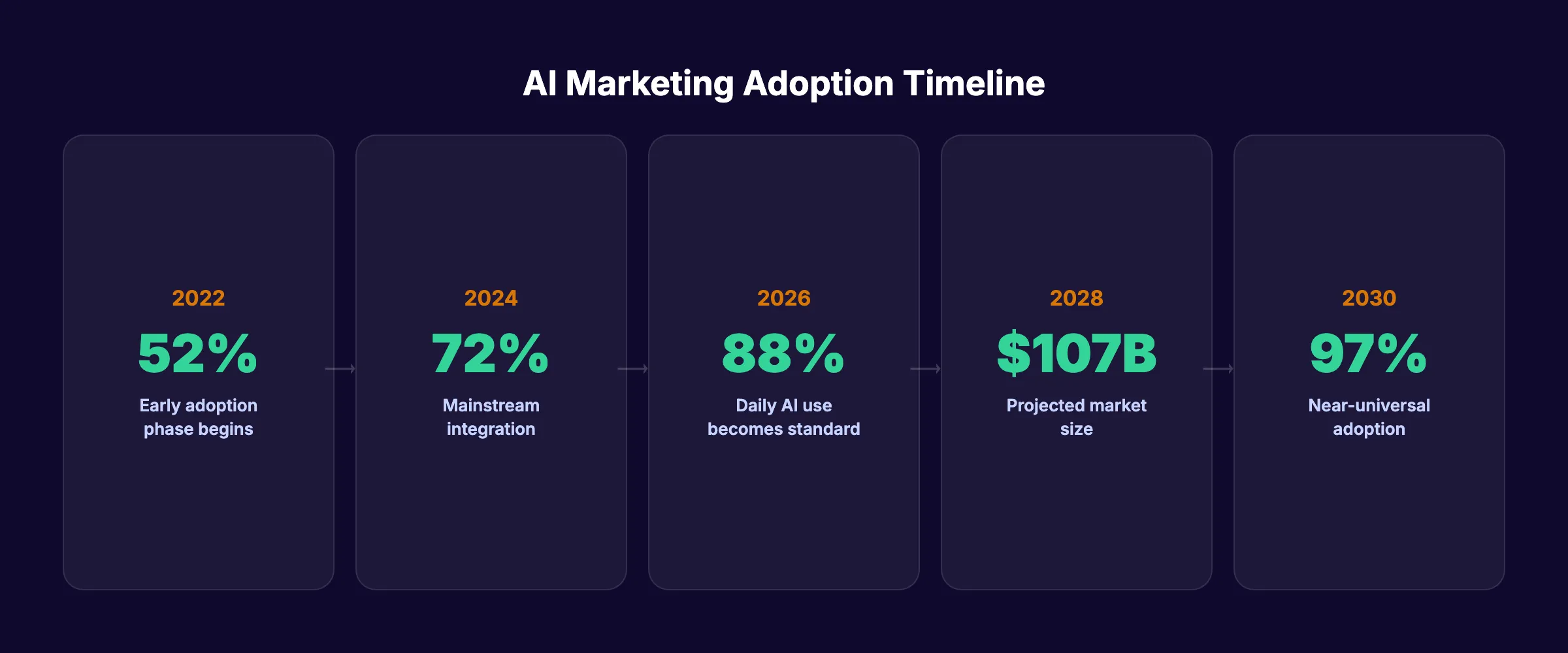
Where is AI marketing headed? The data points in one direction: deeper integration.
43. 96-97% marketing AI adoption is projected by 2030. Source: Multiple industry reports, 2025 Near-universal adoption within 4 years. The remaining 3-4% will be businesses that do not survive.
44. The AI marketing market will reach $82.23 billion by 2030. Source: Grand View Research, 2025 Conservative estimate. Other projections exceed $100 billion by 2030.
45. 19.65% of marketers plan to use AI agents to automate entire marketing functions. Source: HubSpot, 2025 Agentic AI represents the next phase. Not just AI-assisted work, but AI-executed work.
46. Ads in large language models will become a standard channel by 2027. Source: NoGood, 2026 LLM advertising is an emerging channel. Early movers will capture attention before saturation.
47. 40% of creatives now use AI end-to-end, from ideation through production. Source: Canva, 2026 End-to-end AI use means the entire creative pipeline runs through AI tools. Human oversight shifts to quality control and strategy.
| Year | Projected Adoption | Market Size | Key Development |
|---|---|---|---|
| 2026 | 88% | $57.99B | Daily AI use is standard |
| 2027 | 92% | ~$75B | LLM advertising launches |
| 2028 | 94% | $107.5B | Agentic AI goes mainstream |
| 2030 | 97% | $82-100B+ | Near-universal adoption |
For a deeper look at AI and search, explore what Google AI Overviews mean for your strategy and how to use AI to write blog posts.
Key Takeaways
7 numbers that define AI in marketing for 2026:
- 91% of marketing teams use AI. Non-adoption is the exception, not the rule.
- 88% use AI tools daily. This is workflow integration, not occasional experimentation.
- 22% better ROI from AI campaigns versus traditional methods.
- 47% more content published monthly by teams using AI for creation.
- Only 17% receive formal AI training. The skills gap is the biggest bottleneck.
- $57.99 billion market size in 2026, growing at 37.2% CAGR.
- 97% projected adoption by 2030. AI in marketing will be universal within 4 years.
The teams pulling ahead are not just adopting AI. They are building systems around it. Content production, SEO optimization, audience targeting, and performance measurement all benefit from structured AI integration.
Businesses that treat AI as a checklist item will fall behind those that treat it as infrastructure.
Methodology
Sources: HubSpot, Semrush, McKinsey, Salesforce, Jasper, Marketing AI Institute, Duke Fuqua CMO Survey, Zebracat AI, Digital Marketing Institute, Sopro, Canva, Statista, AISofto, SparkToro, Grand View Research, Loopex Digital, Digital Applied, Position Digital, Ahrefs, NoGood, Typeface.
Last updated: April 2026
Note: We update this page quarterly to keep all statistics current. When a stat changes after original publication, we note the update date. All statistics link to their original source where available.
Rank on Google while your competitors figure out AI. theStacc publishes SEO-optimized blog posts every month. No writers. No agencies. $99 per month.
What practitioners are saying on X
Systems and fundamentals still move numbers; AI search adds measurement layers.
- @jakezward (Feb 2026): 2026 SEO predictions emphasize AI Overview share-of-SERP, schema for LLM token efficiency, brand mentions in AI answers as a KPI, proprietary data as a moat, and content refresh beating net-new AI slop. See the post on X.
- @hridoyreh (Mar 2026): Widely shared SEO skill tree: foundations, research, technical, on-page, content, links, AI SEO/GEO, analytics, UX, brand, programmatic — useful map for stats and how-to posts. See the post on X.
- @HlynurStefDev (Jul 2026): Public case: niche site traffic jumped from ~18 to 4,162 Google visits/month after focused technical/on-page SEO work (GSC screenshots claimed) — reminds that fundamentals still move numbers. See the post on X.
Grok, AI Overviews, and multi-engine visibility
AI/search topics like “state ai marketing” need multi-engine notes: AI Overviews, ChatGPT/Perplexity, and Grok. Lead with extractable answers; keep claims consistent with public expert discussion.
- Google AI Overviews: Use passage-ready answers, tables, and FAQ schema where relevant.
- ChatGPT / Perplexity: Cite named sources next to key claims.
- Grok: Maintain accurate entity facts on-site and in high-signal X posts.
Publish content built for Google and AI citations. theStacc’s Content SEO module ships SEO-scored articles structured for rankings and generative engines — including clearer entity pages models like Grok can quote.
Frequently Asked Questions
91% of marketing teams use AI to assist with their work, according to HubSpot's 2026 marketing report. 88% use AI tools on a daily basis. This makes AI the most widely adopted marketing technology after email and analytics platforms.
AI-driven marketing campaigns deliver 22% better ROI than traditional campaigns. Teams that use AI strategically report 44% productivity gains. Companies also see a 37% reduction in marketing costs and 29% lower customer acquisition costs on average.
The AI marketing market reached $57.99 billion in 2026. It grew from $6.46 billion in 2018 at a compound annual growth rate of 37.2%. Projections show the market reaching $107.5 billion by 2028.
The skills gap. 68% of marketers use AI daily, but only 17% receive formal training. Data privacy (21%) and output quality (19%) are the top technical barriers. 75% of organizations lack an AI roadmap despite active adoption.
94% of marketers plan to use AI for content creation in 2026. AI allows teams to publish 47% more content monthly. 93% create content faster with AI. 67% report improved content quality. Only 19% track AI-specific content KPIs, creating a measurement gap. Read our full AI content statistics roundup and guide to ChatGPT for SEO content for more.
Related Tools & Resources
Free SEO Tools:
Best Lists:
Related Statistics
- AI Content Statistics 2026: 74% of New Pages Use AI (50+ Stats)
- AI Marketing Statistics 2026: 51 Facts
- 60+ AI Search Statistics for 2026 (With Sources)
- AI Agent Adoption Statistics 2026: $10.9B Market, 79% Use Rate (40+ Stats)
- AI Social Media Marketing Statistics 2026 (50 Facts)
Sources & references
- [1] Princeton / Georgia Tech et al. — GEO research (arXiv:2311.09735)
- [2] @jakezward on X — 2026 SEO predictions emphasize AI Overview share-of-SERP, schema for LLM token efficiency, brand mentions in AI answers
- [3] @alexgroberman on X — Case narrative: organic value plus multi-engine citations (ChatGPT, Perplexity, Grok) from knowledge-hub pages, category
- [4] @varunram on X — Critique of GEO slopfarm products that combine SEO clickbait with unresearched content marketing — quality and research
- [5] Referenced source — www.hubspot.com

Researched, written, and published articles that compound organic traffic.
Weekly local SEO teardowns
One practical email a week. Map Pack, GBP, AI Overviews — no fluff. Unsubscribe anytime.