
The State of AI Blog Writing in 2026
state of ai blog writing guide for 2026: strategies, tactics, real examples, and implementation steps to get results faster.
Last updated: March 2026
Most content teams know AI blog writing has gone mainstream. Few know what the data actually shows about performance, rankings, and long-term ROI.
That gap costs businesses real money. Teams publishing pure AI content watch rankings collapse after 90 days. Teams ignoring AI entirely spend $2,400 to $7,500 per month on freelance writers and still cannot match the publishing volume of competitors.
This post breaks down 7 trends that define AI blog writing in 2026. Each trend is backed by data from Semrush, Ahrefs, SE Ranking, Google Search Central, and Originality.ai.
We publish 3,500+ blog posts across 70+ industries every month. We track what ranks, what drops, and what sticks. These trends come from that data and from the latest industry research.
Here is what you will learn:
- How far AI adoption has actually spread (the numbers will surprise you)
- Why pure AI content fails a critical 3-month ranking test
- What Google penalizes versus what Google allows
- The hybrid workflow model that outperforms both pure AI and pure human
- Why AI detection tools are becoming less reliable, not more
- How AI changed the economics of content production
- What AI search means for your blog traffic strategy
Table of Contents
- Trend 1 --- AI Blog Writing Adoption Has Hit Critical Mass
- Trend 2 --- Pure AI Content Fails the 3-Month Ranking Test
- Trend 3 --- Google Penalizes Scale Abuse, Not AI Itself
- Trend 4 --- Hybrid Workflows Outperform Pure AI and Pure Human
- Trend 5 --- AI Detection Is Unreliable and Getting Worse
- Trend 6 --- AI Rewrites the Economics of Blog Content
- Trend 7 --- AI Search Changes What Blog Content Needs to Rank
- What These Trends Mean for Content Teams
- Key Takeaways
- FAQ
- Methodology
Trend 1 --- AI Blog Writing Adoption Has Hit Critical Mass
The trend: AI blog writing shifted from experiment to industry default in 2025. The majority of content teams now use AI in some part of their workflow.
The data:
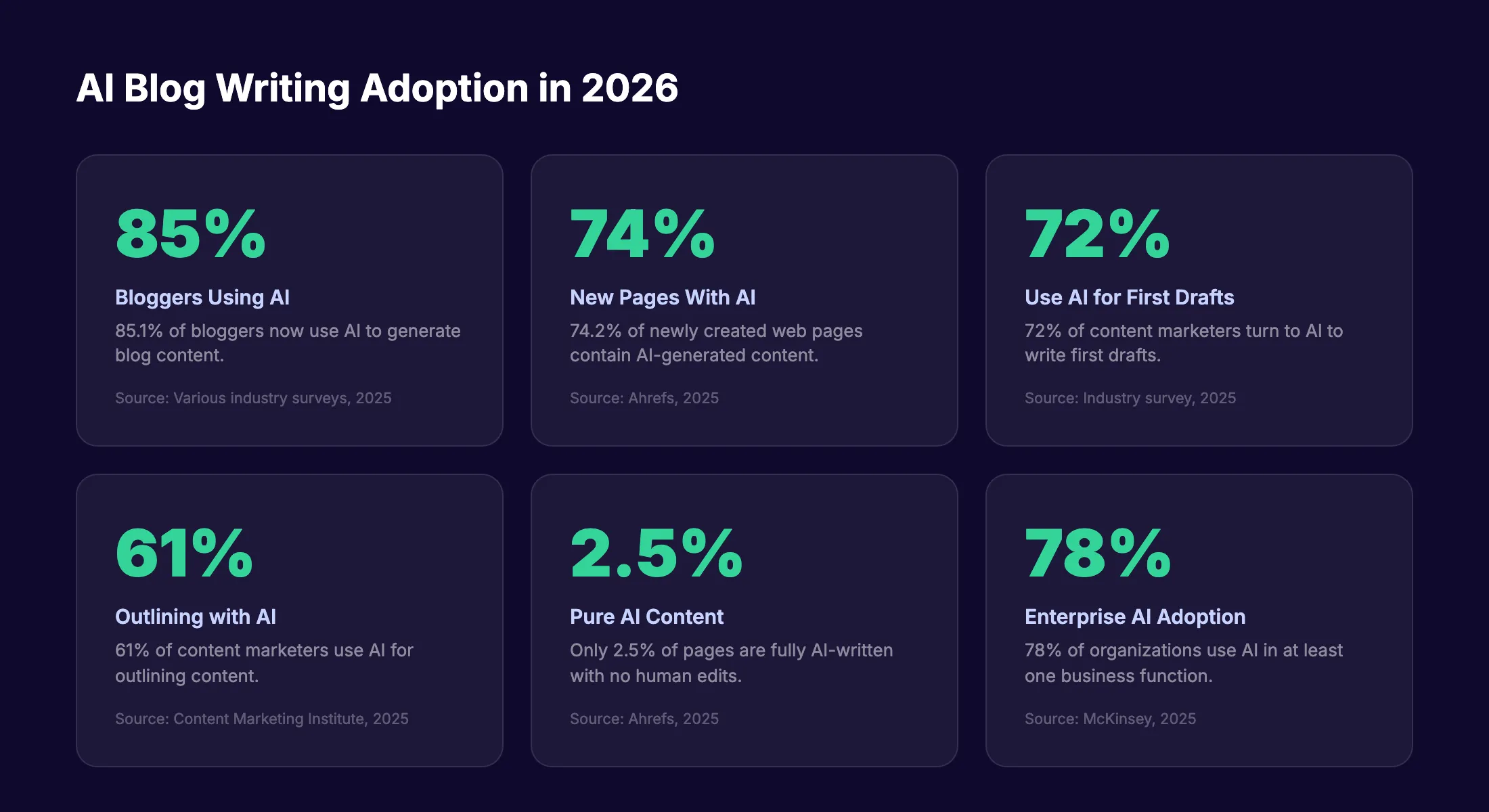
- 85.1% of bloggers now use AI to generate blog content (Source: Industry surveys, 2025)
- 74.2% of newly created web pages contain AI-generated content. Only 2.5% are fully AI-written with no human edits. (Source: Ahrefs study of 900,000 pages, 2025)
- 72% of content marketers use AI to write first drafts. 61% use it for outlining. 74% use it for ideation. (Source: Content Marketing Institute, 2025)
Why it is happening:
AI writing tools dropped below $20 per month in 2024. ChatGPT hit 700 million weekly active users by late 2025. The barrier to entry vanished.
The real driver is not cost alone. Publishing velocity became a ranking signal in practice. Sites that publish 16 or more posts per month get 3.5 times more traffic than those publishing 4 or fewer. AI makes that volume possible for small teams.
78% of organizations now use AI in at least one business function, up from 55% the year before (Source: McKinsey, 2025). Content creation is one of the top 3 use cases across every industry.
What it means for content teams:
The question is no longer “should we use AI.” The question is how to use AI for blog posts without sacrificing quality. Teams that refuse AI are competing against publishers producing 10 to 20 times more content at a fraction of the cost.
The exception: pure AI output without human review is declining. Only 2.5% of indexed pages are fully AI-written. Smart teams use AI as a starting point, not an endpoint.
Trend 2 --- Pure AI Content Fails the 3-Month Ranking Test
The trend: AI-generated content that is published without editing, fact-checking, or human enrichment ranks briefly and then collapses.
The data:
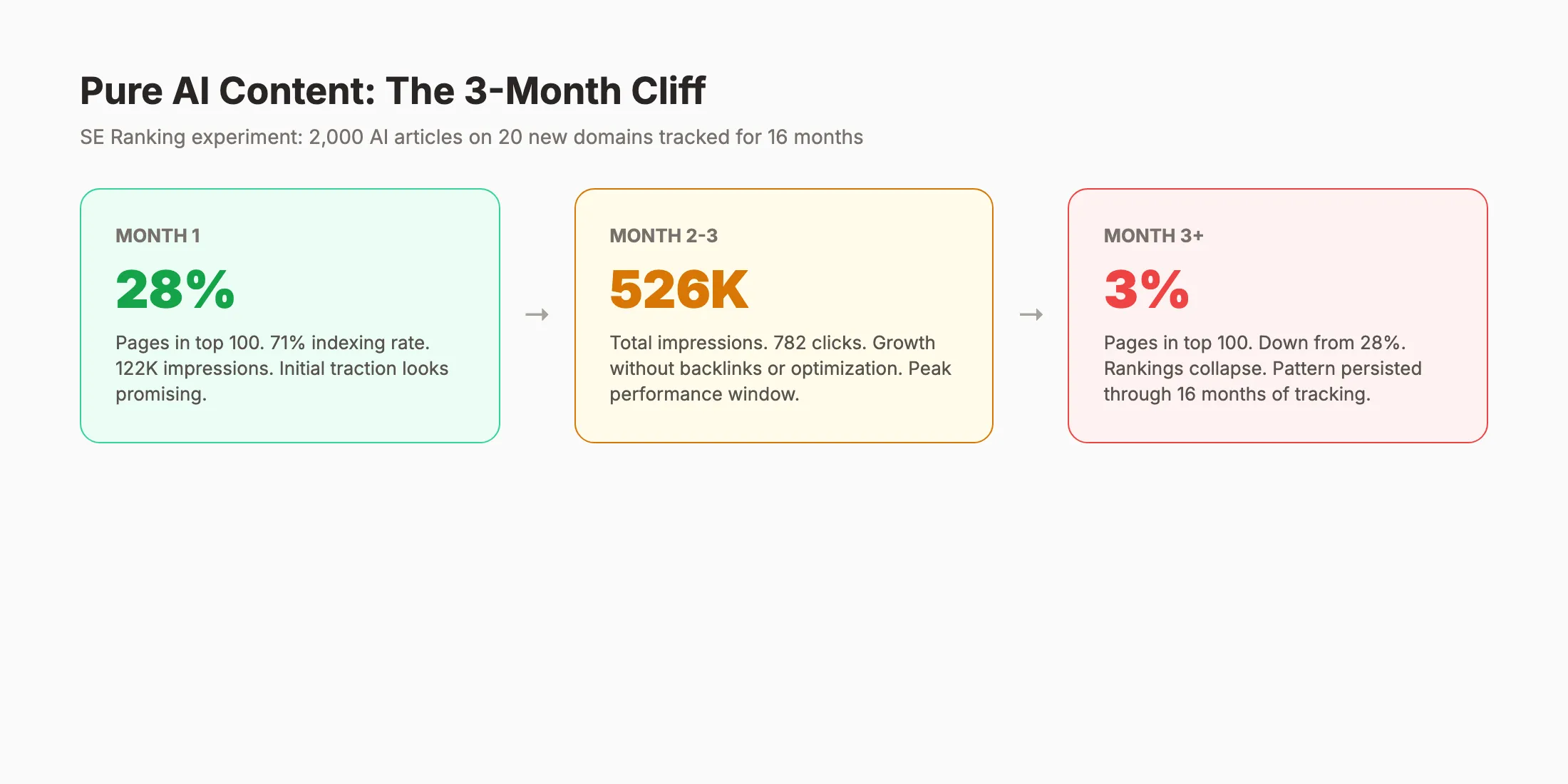
- In a 16-month experiment by SE Ranking, 2,000 AI articles were published across 20 new domains. 28% of pages reached the top 100 in month 1. By month 3, only 3% remained.
- 83% of top-ranking Google results use human-generated content over AI (Source: Analysis of 487 Google search results, 2025)
- 17.31% of top search results contain AI-written content, but this number has fluctuated downward with each algorithm update (Source: Originality.ai, 2025)
Why it is happening:
Google’s ranking systems evaluate content depth, originality, and E-E-A-T signals. Pure AI content scores poorly on all 3.
AI generates plausible text, not verified information. It cannot cite original research, share firsthand experience, or demonstrate genuine expertise. Google’s helpful content system identifies pages that exist to attract search traffic rather than serve readers.
The SE Ranking data reveals a pattern. New AI content receives an initial indexing boost. Google tests it with impressions. User engagement signals (low dwell time, high bounce rate) trigger a ranking decline within 60 to 90 days.
What it means for content teams:
Do not trust month-1 metrics. A page that ranks on day 30 might vanish by day 90. Track rankings at 90 and 180 day intervals before declaring success.
The fix is not to avoid AI. The fix is to add human editorial oversight to every piece before it publishes. First-person examples, original data, expert quotes, and specific case studies are what separate content that sticks from content that drops.
Trend 3 --- Google Penalizes Scale Abuse, Not AI Itself
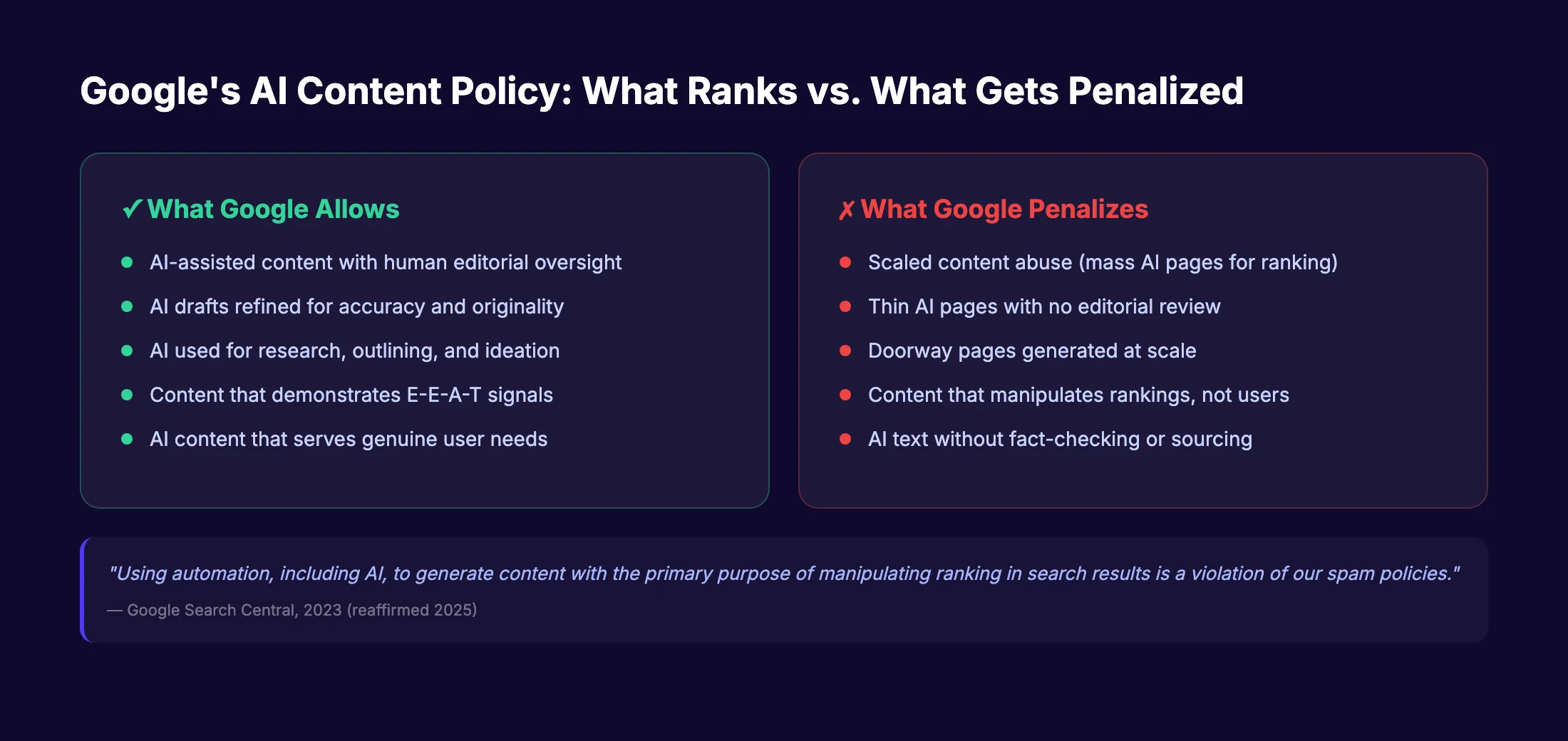
The trend: Google does not penalize AI content by default. Google penalizes low-quality content that exists to manipulate rankings. The tool of creation does not matter.
The data:
- Google’s official guidance states: “Using automation, including AI, to generate content with the primary purpose of manipulating ranking in search results is a violation of our spam policies.” (Source: Google Search Central, reaffirmed 2025)
- A study of 50 deindexed websites found every one showed high levels of automatically generated content with no editorial oversight (Source: SEO case studies, 2025)
- Google does not require disclosure of AI assistance. It requires “human-curated” output, meaning editorial oversight applied before publication. (Source: Google Search Central Documentation, 2025)
Why it is happening:
Google cannot reliably detect whether content was written by AI or by a human. Their systems instead evaluate quality signals: depth, accuracy, topical authority, user engagement, and E-E-A-T.
The March 2024 core update targeted “scaled content abuse” specifically. Sites publishing hundreds of thin AI articles per week were hit. Sites publishing well-edited AI-assisted content were not.
Google has a practical reason for this stance. Over 74% of new web pages contain some AI-generated text. Penalizing all AI content would break the search index.
What it means for content teams:
Stop worrying about whether Google can “detect” your AI content. Start worrying about whether your content meets quality standards.
The checklist is simple:
- Does every article have a human editor who fact-checks claims?
- Does the content include original examples or first-person insight?
- Does it answer the search query better than competing pages?
- Would you be comfortable showing this content to a subject matter expert?
If you answer yes to all 4, the AI-versus-human question does not affect your rankings. If you answer no, the content will underperform regardless of who wrote it.
For a deeper breakdown of Google’s quality framework, read our E-E-A-T guide for content teams.
Publishing 30 AI-assisted articles per month that actually rank is not a fantasy. It is what Stacc does for businesses in 70+ industries. Start for $1 →
Trend 4 --- Hybrid Workflows Outperform Pure AI and Pure Human
The trend: The best-performing content operations in 2026 use AI for speed and humans for quality. Neither approach works well alone.
The data:
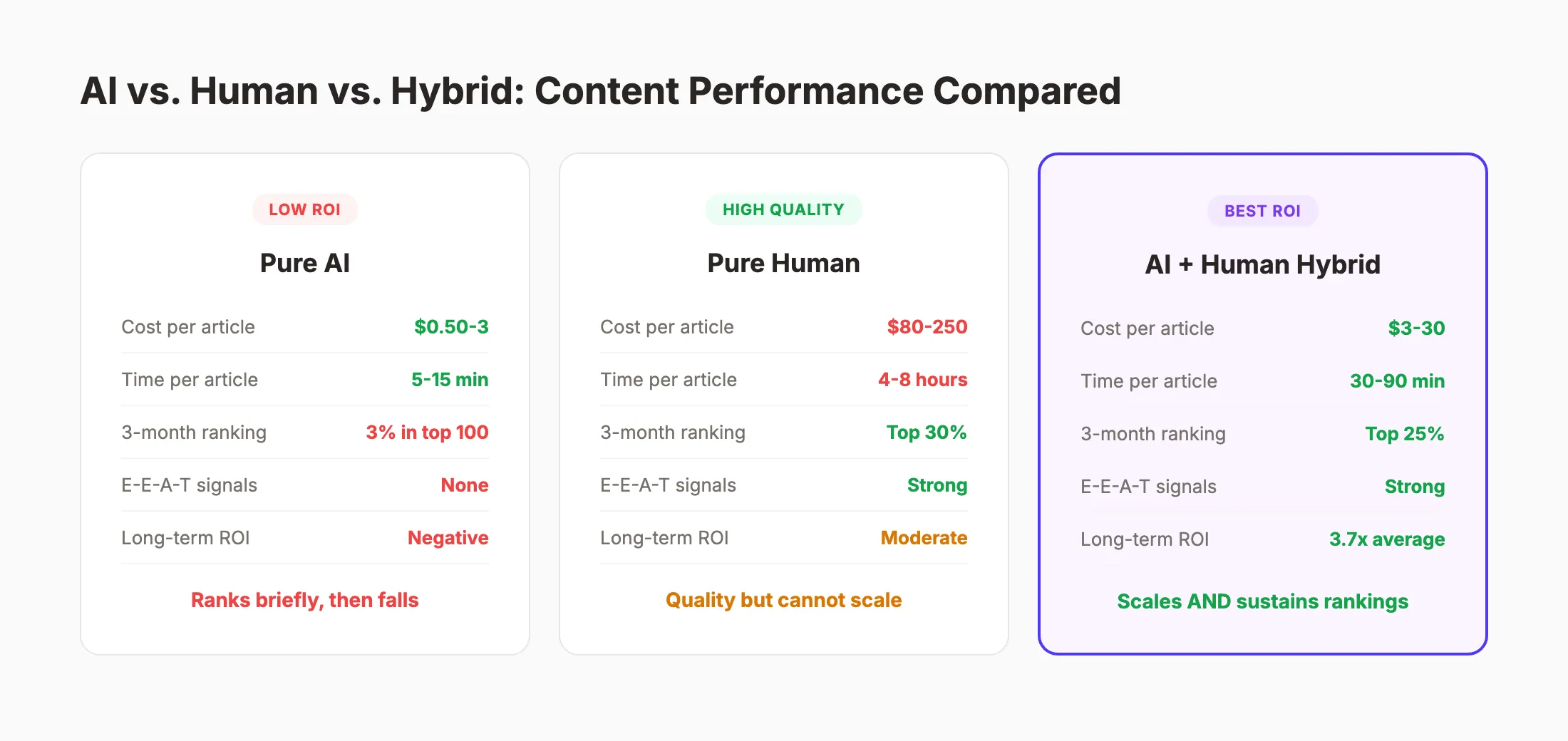
- Companies report a 3.7x ROI on AI content investment when paired with human oversight (Source: Semrush, 2024)
- AI-assisted blog posts on the SE Ranking blog generated 555,000 impressions and 2,300+ clicks. 3 of 6 articles reached the top 10. 1 reached position 1. (Source: SE Ranking, 2025)
- Production time drops 50 to 90% with AI assistance. Cost per article drops from $80 to $250 (freelance) to $3 to $30 (AI-assisted). (Source: Industry benchmarks, 2025)
Why it is happening:
Pure AI lacks experience, accuracy, and opinion. Pure human writing lacks speed and scale. The hybrid model solves both problems.
The winning workflow looks like this:
| Phase | Who Does It | Time |
|---|---|---|
| Research and briefing | AI + human review | 10-15 min |
| First draft | AI | 5-10 min |
| Editing and fact-checking | Human | 15-30 min |
| Adding examples and data | Human | 10-20 min |
| SEO optimization | AI + human review | 5-10 min |
| Final review | Human | 5-10 min |
| Total | Hybrid | 50-95 min |
Compare that to 4 to 8 hours for a fully human-written post or 5 to 15 minutes for a pure AI post that will not rank past 90 days.
SE Ranking tested this exact model. Their AI-assisted articles went through human editorial review, included original data, and targeted specific keywords. The result was sustained rankings, not the 3-month cliff that pure AI content experiences.
What it means for content teams:
Build your workflow around the hybrid model. Use AI to create content briefs, generate first drafts, and write SEO-optimized outlines. Then invest human time in editing, fact-checking, and adding original perspective.
For teams without writers on staff, services like Stacc handle the entire hybrid workflow. AI generates the draft. Our editorial process handles the rest.
The key metric is not “did AI write it.” The key metric is “does the published article meet Google’s quality bar.” Our guide on how to write SEO blog posts covers the full editorial checklist.
Trend 5 --- AI Detection Is Unreliable and Getting Worse
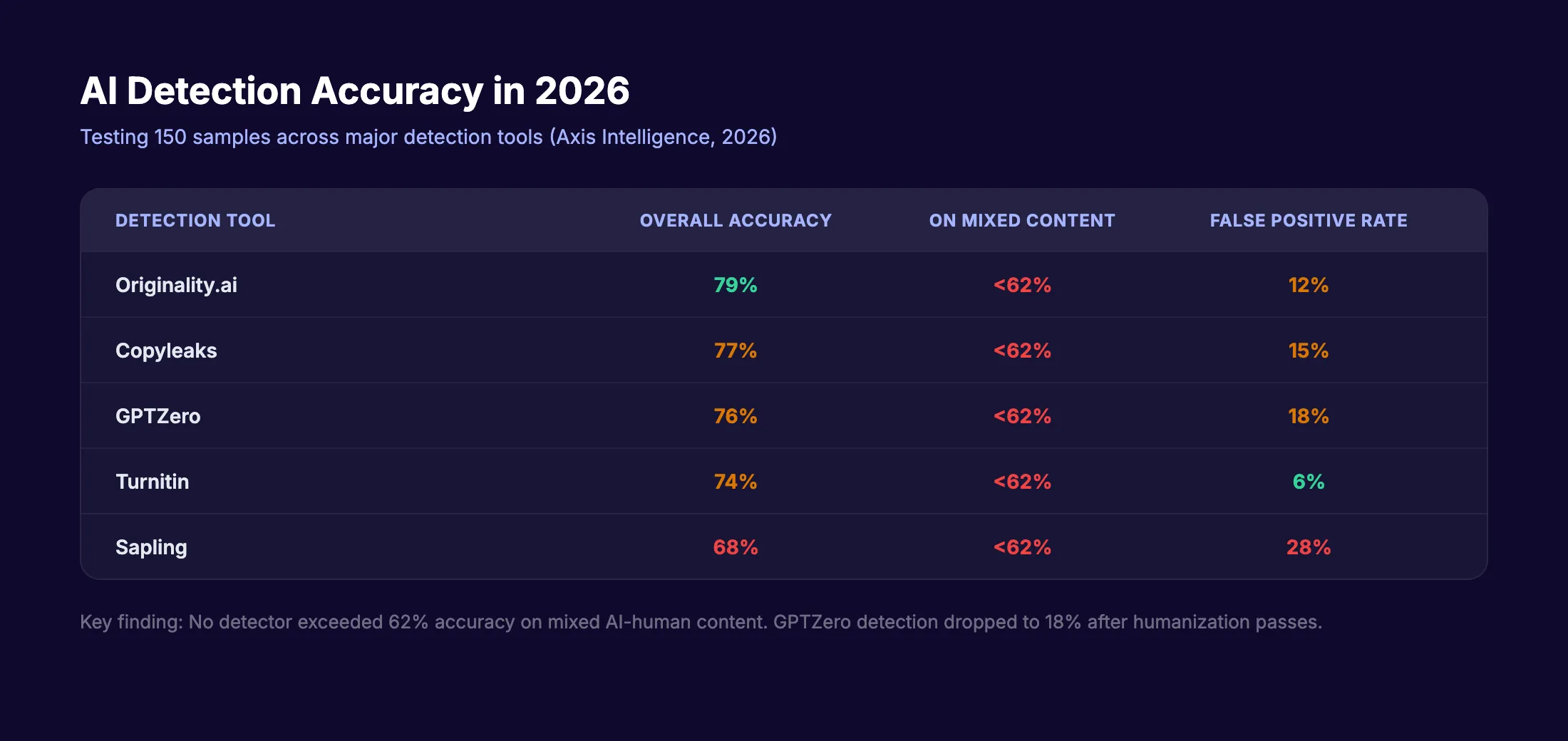
The trend: AI content detection tools struggle to identify modern AI-assisted content. Mixed content (human + AI) defeats every major detector.
The data:
- No AI detection tool exceeded 62% accuracy on mixed AI-human content samples (Source: Axis Intelligence testing, 2026)
- The best overall accuracy was 79% (Originality.ai), followed by 77% (Copyleaks) and 76% (GPTZero). These numbers drop sharply on edited content. (Source: Axis Intelligence, 2026)
- GPTZero detection rate fell to 18% after 3 humanization passes. Light editing reduced detection by 15 to 25 percentage points. Heavy editing reduced it by 30 to 45 points. (Source: Independent testing, 2026)
- False positive rates ranged from 6% (Turnitin) to 28% (Sapling), meaning up to 1 in 4 human-written articles flagged as AI (Source: Academic testing, 2026)
Why it is happening:
Detection tools were trained on early GPT-3 and GPT-4 output patterns. These patterns have changed dramatically as models improve. Claude, GPT-4o, and Gemini produce text with more varied sentence structure, natural tone, and contextual nuance than earlier models.
The bigger issue is the mixed-content problem. When a human writes 40% and AI writes 60% (or vice versa), detectors cannot reliably separate the two. Since 74.2% of new content is AI-assisted (not fully AI-written), detection tools face a challenge they were not designed to solve.
What it means for content teams:
Do not build your content strategy around avoiding AI detection. Build it around quality.
Google has publicly stated it does not use third-party AI detection tools as a ranking signal. Instead, Google evaluates content quality through user engagement metrics, E-E-A-T signals, and helpful content guidelines.
The practical implication: spending time trying to humanize AI content for detection tools is less valuable than spending time making the content genuinely useful. Add real data, original screenshots, personal experience, and expert insight. These additions make content better for readers AND harder for detectors to classify.
For a detailed breakdown of detection tools and accuracy data, read our guide on AI content detection.
Trend 6 --- AI Rewrites the Economics of Blog Content
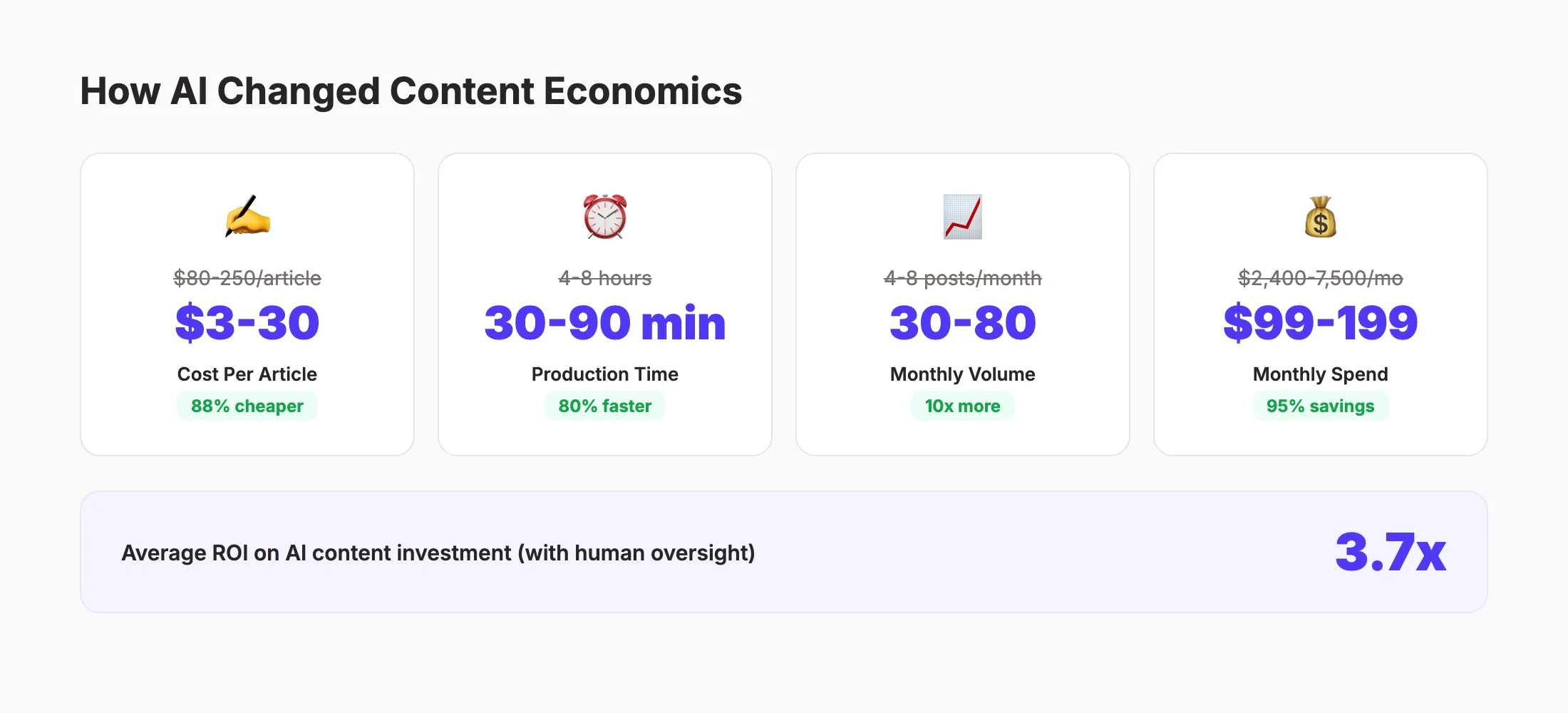
The trend: AI blog writing collapsed the cost of content production. Teams that could only afford 4 articles per month can now publish 30 or more.
The data:
- 30 freelance-written articles cost $2,400 to $7,500 per month. 30 AI-assisted articles through a service like Stacc cost $99 per month. (Source: Industry pricing benchmarks, 2026)
- Content production time dropped 50 to 90% with AI assistance (Source: Content marketing research, 2025)
- Almost 70% of businesses report higher returns from AI content integration (Source: Semrush, 2024)
- Companies publishing 16+ blog posts per month get 3.5x more traffic than those publishing 0 to 4 (Source: HubSpot blogging data)
Why it is happening:
Before AI, content was the most expensive part of SEO. A single blog post required a writer ($80 to $250), an editor ($25 to $75), and an SEO specialist ($50 to $150). Total cost: $155 to $475 per article.
AI removed the largest cost center (writing) and reduced the time for editing and optimization. The remaining cost is editorial oversight, which takes 30 to 90 minutes per article instead of 4 to 8 hours.
This shift favors businesses that publish at volume. Topical authority rewards sites that cover subjects completely. A site with 50 articles on a topic outranks a site with 5. AI made that volume achievable for small businesses and enterprise teams alike.
What it means for content teams:
The cost advantage of AI content is not about spending less. It is about producing more for the same budget.
If your content budget is $1,000 per month, you previously got 4 to 6 articles. With AI-assisted workflows, that same budget produces 30 to 80 articles. The ROI calculation changes fundamentally.
The risk is going too cheap. Pure AI content at $0.50 per article fails the 3-month test (see Trend 2). The sweet spot is AI-assisted content with human oversight at $3 to $30 per article. That delivers both volume and quality.
For businesses that want volume without managing writers, scaling blog content with AI covers the operational details.
30 SEO-optimized blog posts for $99 per month. Every article goes through human editorial review before publishing. Start for $1 →
Trend 7 --- AI Search Changes What Blog Content Needs to Rank
The trend: AI Overviews, ChatGPT, and Perplexity are changing how people find and consume blog content. Traditional click-through rates are declining. But AI search visitors are more valuable.
The data:
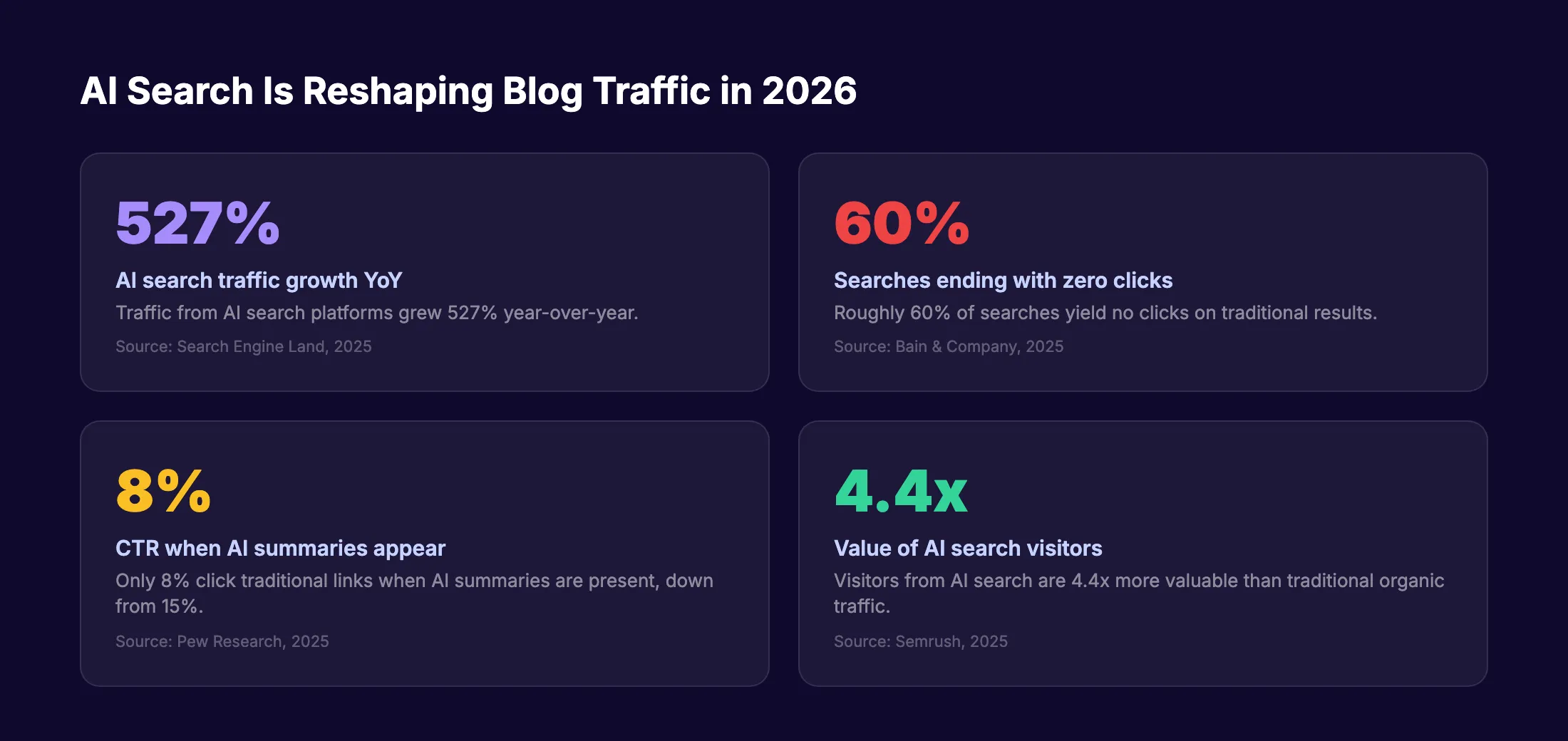
- AI search traffic grew 527% year-over-year (Source: Search Engine Land, 2025)
- 60% of searches now end with zero clicks on traditional results (Source: Bain & Company, 2025)
- Only 8% of users click traditional links when AI summaries appear, compared to 15% without summaries (Source: Pew Research, 2025)
- Visitors from AI search are 4.4x more valuable than traditional organic visitors (Source: Semrush, 2025)
- Google AI Overviews reach 2 billion monthly users globally. Over 88% of triggering queries are informational. (Source: Semrush, 2025)
Why it is happening:
AI search engines answer questions directly. Users no longer need to click through to a blog post to get a basic answer. This reduces traffic for informational queries that AI can answer in a sentence.
But it increases the value of visitors who DO click through. Someone who reads your blog after seeing an AI summary is looking for depth, detail, and trust. They are further along in their decision process.
Zero-click searches hit 60% of all queries. That is a structural shift, not a temporary fluctuation. Blog content needs to adapt.
What it means for content teams:
Write content that AI search engines want to cite, not just content that ranks on page 1. Our guide on generative engine optimization covers this strategy in detail.
The tactical changes are straightforward:
- Structure content with clear headings and direct answers in the first 2 sentences under each H2
- Include original data, tables, and statistics that AI overviews can reference
- Build topical authority so AI engines recognize your domain as an expert source
- Optimize for featured snippets and answer boxes
- Track AI search visibility alongside traditional organic rankings
The blogs that win in 2026 serve 2 audiences: human readers and AI citation engines.
What These Trends Mean for Content Teams
These 7 trends point in one direction: AI blog writing is now mandatory for competitive content operations, but AI alone is not enough.
The big picture: The gap between businesses using AI well and businesses using AI poorly is widening. High-volume, high-quality content wins. Low-volume OR low-quality content loses. The hybrid model is the only approach that delivers both.
For content teams and small businesses:
- Adopt AI for drafting, outlining, and keyword research immediately. The adoption data is clear. 85% of bloggers already use these tools.
- Never publish pure AI drafts. The 3-month cliff is real. Every article needs human editorial review.
- Stop worrying about AI detection. Focus on content quality, originality, and E-E-A-T signals.
- Increase publishing volume. The content economics now favor 30+ articles per month. AI makes that feasible at any budget.
- Prepare for AI search. Structure content for citation. Build topical depth. Track organic CTR changes alongside rankings.
- Fix or update existing content. Content decay accelerates when competitors publish more frequently. Refresh underperforming posts quarterly.
- Consider outsourcing the workflow. The hybrid model works best when editorial systems are built into the process, not added after the fact.
The risk of ignoring these trends: Businesses that do not adopt AI-assisted content workflows will publish 5 to 10 times fewer articles than competitors. In niches where topical authority matters (all of them), that volume gap becomes a ranking gap within 6 to 12 months.
Stacc runs the entire AI blog writing workflow for you. AI drafts. Human editorial review. 30 articles per month. $99. Start for $1 →
Key Takeaways
- AI adoption is at critical mass: 85% of bloggers use AI. 74.2% of new web pages contain AI-generated content. Adoption is no longer optional.
- Pure AI content fails after 90 days: SE Ranking data shows rankings drop from 28% to 3% in the top 100 by month 3 without human involvement.
- Google targets scale abuse, not AI: The tool of creation does not matter. Quality, originality, and E-E-A-T matter. Google cannot reliably detect AI content anyway.
- Hybrid workflows deliver 3.7x ROI: AI for speed, humans for quality. 50 to 95 minutes per article instead of 4 to 8 hours.
- AI detection is unreliable: No detector exceeds 62% accuracy on mixed content. False positive rates reach 28% on some tools.
- Content costs dropped 88%: 30 articles that cost $2,400 to $7,500 from freelancers now cost $99 to $199 per month with AI-assisted services.
- AI search changes the game: 60% zero-click searches. 527% growth in AI search traffic. Visitors from AI search are 4.4x more valuable.
FAQ
Is AI blog writing good for SEO in 2026?
Yes, when done correctly. AI-assisted content with human editorial oversight performs well in Google rankings. Pure AI content without review typically loses rankings within 90 days. The key is the hybrid approach: use AI for drafting and use humans for editing, fact-checking, and adding original insight. Read our guide on using AI for blog posts for the full workflow.
Does Google penalize AI-generated blog content?
Google does not penalize content based on how it was created. Google penalizes low-quality content, regardless of the author. Their spam policies target “scaled content abuse,” which means mass-producing thin articles to manipulate rankings. AI-assisted content that meets quality standards ranks just as well as human-written content. Our E-E-A-T guide covers the quality signals Google evaluates.
How much does AI blog writing cost in 2026?
AI writing tools cost $0 to $49 per month. Freelance writers charge $80 to $250 per article. Done-for-you AI blog writing services like Stacc cost $99 per month for 30 articles with human editorial review. The economics favor hybrid workflows where AI handles drafting and humans handle quality control.
Can Google detect AI-written blog posts?
Google has not publicly confirmed using AI detection as a ranking signal. Third-party detection tools achieve 65 to 79% accuracy on pure AI text and less than 62% on mixed content. Light editing reduces detection rates by 15 to 25 percentage points. Google evaluates content quality, not content origin. See our AI content detection guide for the full data.
What is the best workflow for AI blog writing?
The highest-performing workflow follows 6 steps: AI research and briefing, AI first draft, human editing and fact-checking, human addition of examples and data, AI-assisted SEO optimization, and human final review. Total time is 50 to 95 minutes per article. This produces content that ranks long-term while maintaining 10x the output of traditional writing. Our AI prompts guide covers the specific prompts that produce the best drafts.
Will AI replace human blog writers entirely?
No. The data shows the opposite trend. Pure AI content fails the 3-month ranking test. Human editorial oversight is required for content that sustains rankings. What AI replaces is the blank-page problem. Writers shift from drafting to editing, fact-checking, and adding expertise. The role evolves from “content creator” to “content editor and strategist.”
Methodology
Data sources: Semrush, Ahrefs, SE Ranking, Google Search Central, Originality.ai, Axis Intelligence, McKinsey, Pew Research, Bain & Company, Content Marketing Institute, Search Engine Land, HubSpot.
Time period covered: January 2024 through March 2026.
How we identified trends: Each trend required at least 2 independent data points from authoritative sources published within the last 18 months. Trends had to show a measurable shift (not a continuation of an existing pattern) and have direct implications for content teams.
Last updated: March 2026
AI blog writing in 2026 rewards teams that combine AI speed with human quality standards. The data is unambiguous. Hybrid workflows outperform both pure AI and pure human approaches on cost, volume, and rankings.
The businesses gaining ground right now are the ones publishing 30 or more optimized articles per month with editorial oversight built into every step.
Start publishing with Stacc for $1 →
Related Tools & Resources
Free SEO Tools:
Best Lists:

Written by
Siddharth GangalSiddharth is the founder of theStacc and Arka360, and a graduate of IIT Mandi. He spent years watching great businesses lose organic traffic to competitors who simply published more. So he built a system to fix that. He writes about SEO, content at scale, and the tactics that actually move rankings.
30 SEO blog articles published every month
Keyword-optimized, scheduled, and live on your site. Automatically.
30-day trial · Cancel anytime
theStacc
Stop writing SEO content manually
30 blog articles, 30 GBP posts, and social media content. Published every month. Automatically.
Start Your $1 Trial$1 for 3 days · Cancel anytime