
SEO for Moving Companies (2026): Strategies, Tactics & Examples
Practical moving company seo guide strategies for 2026: step-by-step tactics, real examples, and tools to improve rankings and drive organic traffic.
Most moving companies rely on paid lead sites and Google Ads to fill their schedule. That works until cost per lead rises 15 to 20% year over year and your margins disappear. A single click on “movers near me” now costs $12 to $45 depending on your metro area.
SEO for moving companies fixes that equation. Organic search delivers leads at $0 per click, 24 hours a day, 365 days a year. Local SEO leads close at 14.6% compared to 1.7% for outbound marketing (SmartMoving). When a homeowner searches “moving company near me,” the top 3 map pack results capture over 60% of all clicks.
The penalty for ignoring SEO is real. Your competitors who rank above you in Google Maps get the calls. You get the leftover leads from third-party sites that charge $30 to $80 per contact. That gap compounds every month.
We publish 3,500+ blogs across 70+ industries at Stacc, and moving companies are one of our fastest-growing verticals. This guide covers everything a mover needs to rank on Google and generate consistent inbound leads.
Here is what you will learn:
- How to find high-intent keywords like “local movers,” “long-distance moving company,” and “packing services near me”
- The exact steps to optimize your Google Business Profile for the map pack
- On-page SEO tactics for service pages, city pages, and moving estimates
- A content strategy that builds topical authority around your service area
- How to get more Google reviews and turn them into a ranking factor
- Technical SEO fixes that most moving company websites miss
- A clear timeline for when to expect results and how to measure ROI
Why SEO Matters for Moving Companies
30 million Americans move every year (Supermove). Nearly all of them start by searching Google. 97% of consumers learn about a local company online before making contact (SmartMoving).
That search behavior creates a massive opportunity for movers who rank well. It also creates a massive problem for movers who do not.
The Cost of Paid Leads vs Organic Search
Moving companies spend $6,000 or more per month on Google Ads alone. Top performers invest $12,000 per month across all paid channels. Those numbers buy leads, but they buy them over and over again. Stop spending and the leads stop instantly.
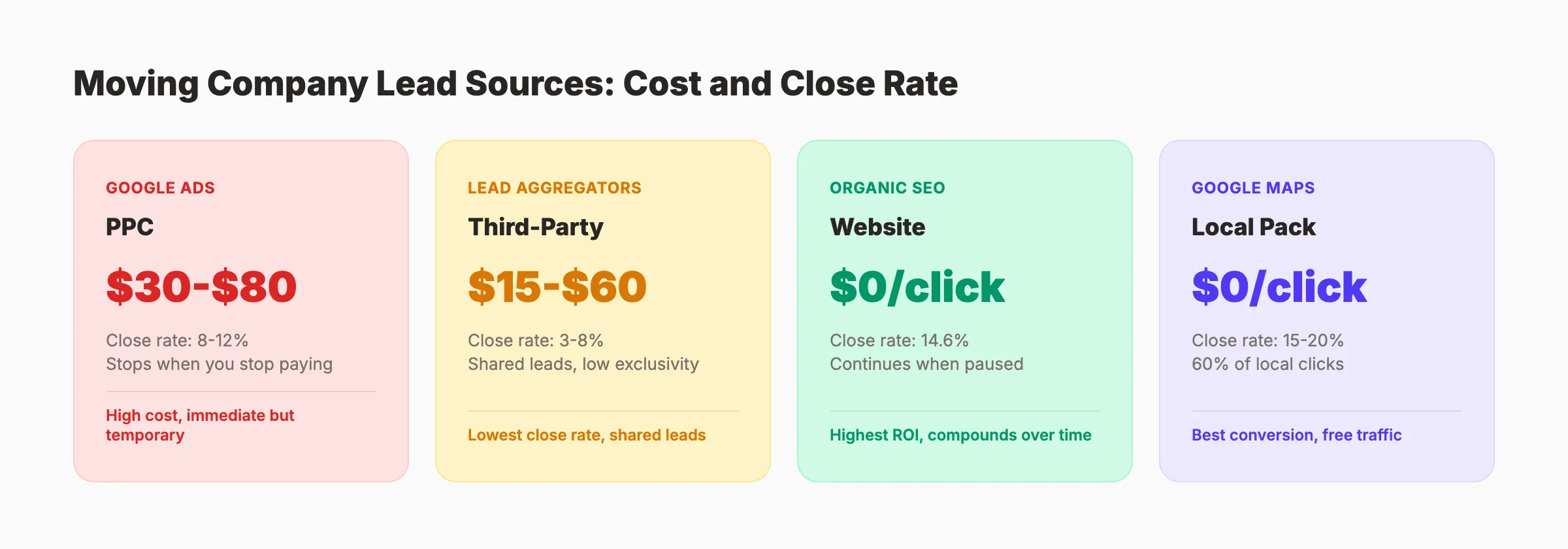
| Lead Source | Avg Cost per Lead | Close Rate | Lead Flow When Paused |
|---|---|---|---|
| Google Ads | $30 - $80 | 8 - 12% | Stops immediately |
| Lead aggregator sites | $15 - $60 | 3 - 8% | Stops immediately |
| Organic SEO | $0 per click | 14.6% | Continues for months |
| Google Maps / Local Pack | $0 per click | 15 - 20% | Continues for months |
Organic leads cost nothing per click and close at nearly double the rate of paid leads. A single first-page ranking for “movers in [city]” can replace thousands in monthly ad spend.
Why Movers Struggle With SEO
Most moving company owners face 3 barriers to SEO success:
- Peak season urgency. May through September is booking season. Owners focus on crews, trucks, and moving estimates. Marketing falls to the bottom of the list.
- Agency sticker shock. SEO agencies charge $1,500 to $5,000 per month for moving companies. Most small movers cannot justify that spend alongside truck payments and crew payroll.
- No in-house expertise. A move coordinator or office manager handles the website. They know moving, not on-page SEO or schema markup.
The fix is straightforward. SEO for moving companies follows a repeatable playbook. This guide breaks it into 9 chapters you can execute one at a time.
Moving Company Keywords That Generate Leads
Keywords are the foundation of every SEO strategy. For movers, the right keywords connect you with people who need a crew and a truck this month. The wrong keywords attract browsers who never book.
High-Intent Money Keywords
These are the terms people search when they are ready to hire a mover. They include location modifiers and service-specific language.
| Keyword Pattern | Example | Monthly Search Volume (Avg) | Intent |
|---|---|---|---|
| [city] moving company | ”Austin moving company” | 500 - 3,000 | High |
| movers near me | ”movers near me” | 135,000 (national) | High |
| long-distance movers [city] | “long-distance movers Dallas” | 200 - 800 | High |
| local movers [city] | “local movers Phoenix” | 300 - 1,500 | High |
| packing services [city] | “packing services Denver” | 100 - 400 | High |
| commercial movers [city] | “commercial movers Atlanta” | 50 - 300 | High |
| piano moving [city] | “piano moving Chicago” | 50 - 200 | High |
Focus on buying-intent keywords first. Someone searching “best moving companies Tampa” has an upcoming move and is comparing options. That lead is worth 10x more than someone searching “how to pack dishes.”
Informational Keywords for Content Marketing
These keywords attract people earlier in the moving process. They build trust and organic traffic over time.
- “how much do movers cost”
- “moving checklist”
- “how to pack for a move”
- “binding vs non-binding estimate”
- “what does moving insurance cover”
- “tips for moving with pets”
- “how to move a piano safely”
Use these for blog posts. Each post targets a question your customers already ask your move coordinators on the phone. For a deeper dive into finding the right terms, read our keyword research guide.
Long-Tail Keywords That Convert
Long-tail keywords have lower volume but higher conversion rates. They are specific enough to signal strong intent.
- “affordable local movers in [neighborhood]”
- “same day moving service [city]”
- “senior moving services [city]”
- “apartment movers [city]”
- “military moving company near me”
- “loading and unloading help [city]”
Build dedicated pages for each service type. A page targeting “office moving services Houston” will outrank a generic services page every time. Understand the buyer behind every search by reading our search intent guide.
Google Business Profile for Movers
Google Business Profile (GBP) is the single highest-ROI activity for moving company SEO. The local pack appears above organic results for nearly every “movers near me” search. 60% of all clicks on local search results go to the map pack, not the blue links below it.
Setting Up Your Profile the Right Way
Claim your profile at business.google.com if you have not already. Then complete every field.
Business name. Use your legal business name. Do not stuff keywords like “ABC Best Movers Dallas TX.” Google suspends profiles that violate naming guidelines.
Primary category. Select “Moving company” or “Mover” as your primary category. Add secondary categories like “Moving and storage service,” “Commercial mover,” or “Office moving service.”
Service area. List every city and ZIP code where your crew operates. If you handle local moves within a 50-mile radius, define that area. If you offer long-distance moves statewide, add those regions too. Do not claim cities your trucks do not actually serve. Google flags suspicious service areas.
Business description. Write 750 characters that include your primary services, USDOT number, service area, and years in business. Mention specific services like packing, loading and unloading, storage, and specialty item moves.
Photos and Visual Content
Listings with photos generate 2x more interest than listings without them (Google). Upload at minimum:
- Exterior of your office or warehouse
- Interior of a clean, organized moving truck
- Crew members in uniform loading furniture
- Packing materials and supplies
- Completed moves (before and after shots with customer permission)
- Your DOT number displayed on the truck
Update photos monthly. Google rewards profiles that show recent activity. Post photos from real jobs, not stock images.
GBP Posts for Movers
Post to your Google Business Profile at least once per week. Posts show up directly on your listing and signal to Google that your business is active.
Post ideas for moving companies:
- Peak season booking reminders (“Book your June move now. Crew slots filling fast”)
- Packing tips and moving day checklists
- Customer testimonials with before-and-after photos
- Special offers on packing services or storage
- Seasonal content (“Preparing for a winter move? Here is what to know”)
For a complete optimization walkthrough, see our guide on Google Business Profile optimization. Track your profile performance with GBP management tools.
Your Google Business Profile is your most valuable ranking asset. Stacc publishes 30 GBP posts per month on autopilot so movers can focus on moves, not marketing. Start for $1 →
On-Page SEO for Moving Company Websites
Your website is your 24/7 sales rep. On-page SEO ensures Google can read it, understand it, and rank it for the terms your customers search.
Title Tags and Meta Descriptions
Every page needs a unique title tag under 60 characters. Include your target keyword and city.
| Page | Title Tag Example |
|---|---|
| Homepage | ”ABC Moving Company - Local & Long-Distance Movers in Dallas” |
| Local moving page | ”Local Moving Services in Dallas, TX - ABC Moving” |
| Long-distance page | ”Long-Distance Moving Company - Dallas to Anywhere” |
| Packing services | ”Professional Packing Services in Dallas - ABC Moving” |
| Commercial moving | ”Office & Commercial Moving in Dallas - ABC Moving” |
Write meta descriptions between 145 and 155 characters. Include a benefit and a call to action. Example: “Licensed Dallas movers with 500+ five-star reviews. Local and long-distance moves. Get a free estimate in 60 seconds.”
Service Pages That Rank
Create individual pages for every service you offer. Do not lump everything onto one “Services” page. Each page targets a distinct keyword cluster.
Essential service pages for movers:
- Local moving / residential moving
- Long-distance moving (interstate)
- Commercial / office relocation
- Packing and unpacking services
- Loading and unloading only
- Storage solutions
- Specialty items (piano moving, antiques, gun safes)
- Senior moving services
- Military moves
Each page should include: a clear H1 with the service and city, 800+ words of unique content, your process (in-home survey, binding estimate, move day, delivery), pricing guidance, and a prominent “Get a Free Estimate” form.
City and Service Area Pages
If you serve 10 cities, create 10 pages. Each city page should feel unique, not like a template with the city name swapped in.
Include on each city page:
- Neighborhoods and ZIP codes you serve
- Drive time from your warehouse
- Local moving tips specific to that area (parking permits, building move-in rules, elevator reservations)
- A mention of local landmarks or neighborhoods
- Customer reviews from that city
This approach builds relevance for “[service] in [city]” searches. For a complete on-page checklist, use our on-page SEO checker or read the full on-page SEO guide.
Local SEO. Ranking in the Map Pack
The local map pack is where moving companies win or lose. When someone searches “movers near me,” Google shows 3 businesses on the map. Those 3 get the majority of calls. Everyone else fights for scraps.
The 3 Pillars of Local Pack Rankings
Google ranks local results based on 3 factors:
- Relevance. How well your profile matches the search query. Complete every GBP field. Use accurate categories and service descriptions.
- Distance. How close your business is to the searcher. You cannot change your address, but you can build city-specific content that signals local relevance.
- Prominence. How well-known your business is online. Reviews, citations, backlinks, and website authority all feed prominence.
Building Citations for Your Moving Company
A citation is any online mention of your business name, address, and phone number (NAP). Consistent NAP across all directories is a confirmed local ranking factor.
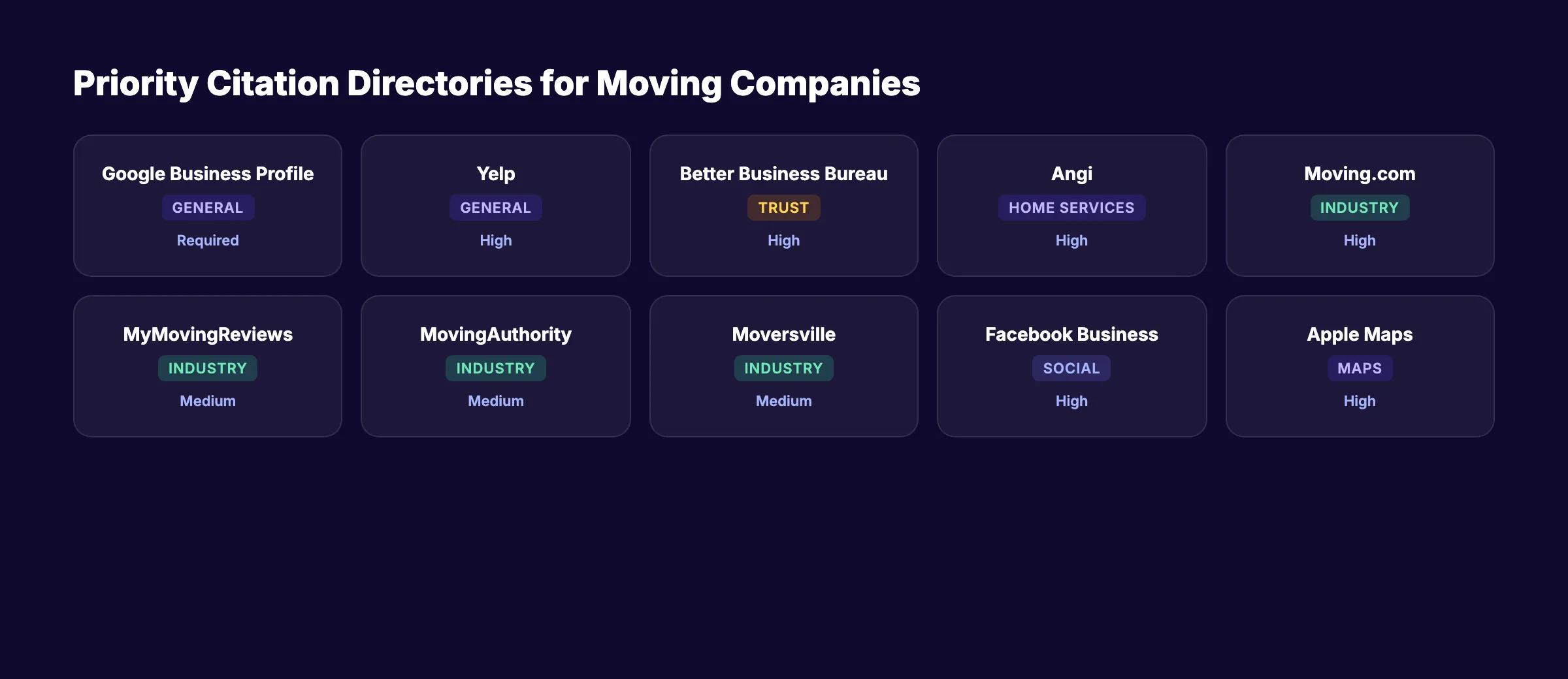
Priority directories for movers:
| Directory | Type | Priority |
|---|---|---|
| Google Business Profile | General | Required |
| Yelp | General | High |
| Better Business Bureau | Trust | High |
| Angi (Angie’s List) | Home services | High |
| Moving.com | Industry-specific | High |
| MyMovingReviews.com | Industry-specific | Medium |
| MovingAuthority.com | Industry-specific | Medium |
| Moversville.com | Industry-specific | Medium |
| Facebook Business | Social | High |
| Apple Maps | Maps | High |
Keep your company name, street address, phone number, and website URL identical across every listing. Even small differences (like “St.” vs “Street”) can confuse Google. Use local SEO tools to audit your citations and spot inconsistencies.
Service Area Optimization
Moving companies often serve a wide radius. That creates a challenge. You cannot fake proximity, but you can strengthen your relevance signals.
- Create city-specific landing pages (covered in the previous chapter)
- Earn Google reviews that mention specific cities (“Great experience moving from Plano to Frisco”)
- Post GBP updates referencing specific neighborhoods and routes
- Build local backlinks from chambers of commerce and real estate agents in each city
For a deep dive into local ranking factors, read our full local SEO guide. The local SEO statistics post has 40+ data points to guide your strategy.
Ranking in the map pack means your phone rings first. Stacc handles blog content and GBP posts so movers stay visible year-round without writing a word. Start for $1 →
Content Marketing for Moving Companies
Publishing useful content is how movers build topical authority and rank for hundreds of keywords over time. A single blog post targeting “how much do movers cost in [city]” can generate leads for years.
Blog Topics That Attract Moving Leads
The best topics come from questions your move coordinators hear every day. Turn those calls into blog posts.
High-value blog topics for movers:
- “How much does it cost to hire movers in [city]?”
- “Local moving checklist: everything you need before moving day”
- “Binding vs non-binding moving estimates explained”
- “How to pack fragile items for a long-distance move”
- “What does moving insurance cover (and what it does not)”
- “How to choose a moving company: 7 red flags to watch for”
- “Moving with kids: a parent’s survival guide”
- “Office relocation checklist for business owners”
- “Peak season moving tips: booking your May to September move”
- “What to expect during an in-home moving survey”
Each post builds your website’s authority around moving-related topics. Google sees consistent, relevant content and rewards it with higher rankings across your entire site. This is the Content Compound Effect in action.
Content Strategy by Season
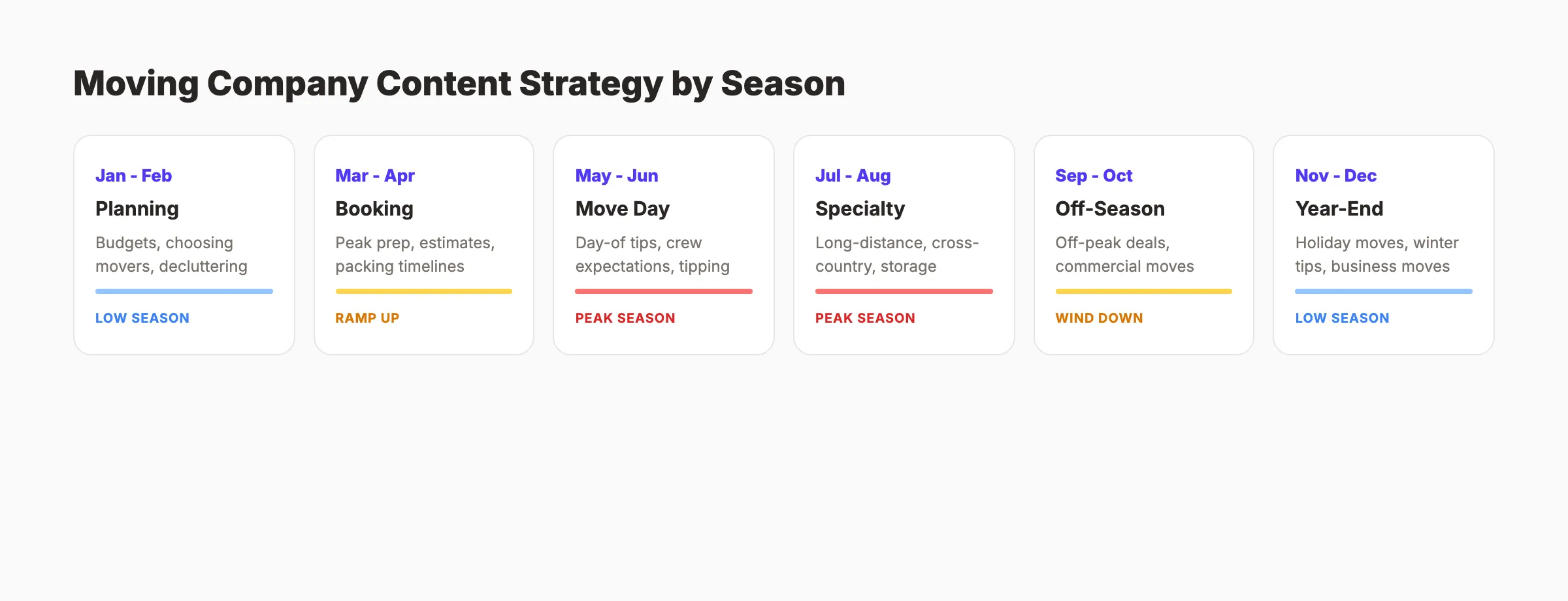
Moving has extreme seasonality. Your content calendar should match it.
| Month | Content Focus | Example Topics |
|---|---|---|
| Jan - Feb | Planning content | Moving budgets, choosing movers, decluttering before a move |
| Mar - Apr | Booking content | Peak season prep, how to get the best moving estimate, packing timeline |
| May - Jun | Move-day content | Moving day tips, what to expect from your crew, tipping movers |
| Jul - Aug | Specialty content | Long-distance moves, cross-country moving guides, storage options |
| Sep - Oct | Off-season deals | Off-peak moving benefits, fall moving tips, commercial relocation planning |
| Nov - Dec | Year-end content | Holiday moving, winter moving precautions, end-of-year business moves |
Publish at least 4 posts per month to build momentum. Companies that publish 16+ posts per month get 3.5x more traffic than those publishing 4 or fewer (HubSpot). Use a content calendar to stay consistent.
Writing Content That Converts
Every blog post should include:
- A clear answer to the searcher’s question in the first 100 words
- Internal links to your service pages and estimate request form
- A call to action (“Get a free moving estimate” or “Call for a same-day quote”)
- Location-specific details that signal local expertise
Do not write generic moving advice. Write as someone who owns trucks, manages crews, and handles binding estimates daily. That operator-level detail is what separates your content from every other “top 10 moving tips” post online.
For a full breakdown of writing content that ranks, see our SEO content writing guide and blog SEO playbook.
Reviews and Reputation Management for Movers
Reviews are the single most visible trust signal for moving companies. 75% of consumers read online reviews before hiring a mover (BrightLocal). 88% of people will use a business that responds to all of its reviews, versus only 47% for businesses that ignore them.
Why Reviews Matter for SEO
Google uses review signals as a ranking factor for the local pack. More reviews, higher average ratings, and recent review activity all boost your map pack position.
Review velocity matters more than total count. A moving company with 50 reviews from the last 90 days outranks a competitor with 200 reviews that stopped 2 years ago. Google rewards recency.
How to Get More Reviews
Moving companies have a natural advantage. Every completed move is a review opportunity. The challenge is asking at the right moment.
A 3-step review system for movers:
- Day of move. Your crew lead hands the customer a card or sends a text with a direct link to your Google review page. Ask while the experience is fresh and positive.
- Day after move. Your move coordinator sends a follow-up email thanking the customer and including a 1-click review link. Keep the message short.
- Day 3. Send a final reminder via SMS. Include the review link and a simple prompt: “How did your move go? Leave us a quick review.”
Automate this sequence with your CRM or moving software. The goal is 1 review for every 3 completed moves. Use our review request generator to create templates instantly.
Responding to Reviews
Respond to every review within 24 hours. Positive and negative.
For positive reviews, thank the customer by name and mention the service type: “Thank you, Sarah! We are glad your local move from Lakewood to Plano went smoothly. Our crew enjoyed working with your family.”
For negative reviews, acknowledge the issue, apologize, and offer to resolve it offline. Never argue. A thoughtful response to a 1-star review often matters more than 10 five-star reviews. Potential customers judge you by how you handle problems, not by perfection.
Use our review response generator to draft professional replies in seconds. For a full strategy, read how to get more Google reviews.
Technical SEO for Moving Company Websites
Technical SEO ensures Google can crawl, index, and render your website without errors. Most moving company websites have fixable issues that silently kill their rankings.
Mobile-First Indexing
Google indexes your mobile site first. If your moving company website loads slowly or looks broken on a phone, your rankings suffer across all devices.
82% of people searching for movers use a smartphone. Your site needs:
- Page load time under 3 seconds
- Tap-to-call button visible on every page
- Estimate request form that works on mobile
- No horizontal scrolling or overlapping elements
- Text readable without pinching to zoom
Test your site with Google PageSpeed Insights. Fix issues flagged under Core Web Vitals: Largest Contentful Paint (under 2.5 seconds), Cumulative Layout Shift (under 0.1), and Interaction to Next Paint (under 200 milliseconds).
Site Structure and Crawlability
A clean site structure helps Google find and rank all your pages. Every important page should be reachable within 3 clicks from the homepage. Use internal linking to connect service pages, city pages, and blog posts. Create and submit an XML sitemap through Google Search Console.
Schema Markup for Movers
Schema markup helps Google understand your business details and can trigger rich results in search.
Essential schema types for moving companies:
- LocalBusiness (or MovingCompany subtype). Name, address, phone, hours, service area
- Service. Each moving service with description and area served
- Review. Aggregate rating from your reviews
- FAQ. For your FAQ page and blog posts
- BreadcrumbList. For site navigation
Use our schema markup generator to create the code without touching JSON-LD manually. Also review your robots.txt to confirm Google can access all important pages.
Technical issues silently kill rankings. Run a free audit with our SEO audit tool to find what your moving company website needs to fix today. Start for $1 →
Measuring Results and ROI for Moving Company SEO
SEO is not a one-time project. It is an ongoing investment that compounds over time. Knowing what to track and when to expect results keeps your strategy on course.
Key Metrics for Movers
| Metric | What It Tells You | Tool |
|---|---|---|
| Organic traffic | How many people find your site via Google | Google Analytics 4 |
| Map pack impressions | How often your GBP appears in local searches | Google Business Profile Insights |
| Click-to-call from GBP | Direct phone leads from your Google listing | GBP Insights |
| Keyword rankings | Where you rank for target terms | Google Search Console |
| Estimate requests | Form submissions from organic visitors | GA4 Goals |
| Review count and rating | Trust signals and local ranking factor | GBP Dashboard |
Track these metrics monthly. The seasonal nature of moving means you should compare June 2026 to June 2025, not to May 2026.
When to Expect Results
Moving companies typically see measurable SEO progress on this timeline:
- Month 1-2. Technical fixes, GBP optimization, citation cleanup. Minimal ranking changes.
- Month 3-4. New content indexed. Long-tail keywords start ranking. GBP impressions increase.
- Month 5-6. Target keywords move to page 1-2. Organic traffic grows 30 to 50%. First organic leads arrive.
- Month 7-12. Map pack rankings stabilize. Organic traffic doubles. Lead volume from SEO overtakes or matches paid channels.
SEO compounds. The blog posts you publish in January build the authority that gets your service pages ranking by June. For a realistic timeline breakdown, read how long SEO takes.
Calculating SEO ROI for Your Moving Company
Use this formula:
Monthly SEO ROI = (Revenue from organic leads - SEO investment) / SEO investment x 100
Example: You invest $500 per month in SEO (content, tools, citations). Organic search generates 20 estimate requests. You close 6 at an average job value of $1,800. That is $10,800 in revenue from a $500 investment. ROI: 2,060%.
Even at a conservative 3 closed jobs per month, the return dwarfs any paid lead source. Use our SEO ROI calculator to model your own numbers. Read more about tracking returns in our content marketing ROI guide.
Free Tools Every Mover Should Use
You do not need expensive software to start. These free tools cover the essentials:
- Google Search Console. Track keyword rankings and indexing issues
- Google Analytics 4. Measure traffic and conversions
- Google Business Profile Insights. Monitor map pack performance
- Best free SEO tools. Our curated list of no-cost options
For moving companies ready to scale, check our list of SEO tools for small business and local SEO software.
FAQ
How much does SEO cost for a moving company?
DIY SEO costs $100 to $500 per month for tools and content. Hiring an agency runs $1,500 to $5,000 per month. Services like Stacc fall in between at $99 per month for 30 published articles. The right investment depends on your market size and competition level. A mover in New York City needs a larger budget than one in a mid-size metro.
How long does it take for a moving company to rank on Google?
Most movers see initial ranking improvements within 3 to 4 months. Meaningful lead generation from organic search typically starts at month 5 to 6. Competitive metro areas take longer. Smaller markets can see results faster. Consistent publishing accelerates the timeline.
Should moving companies focus on local SEO or traditional SEO?
Both. Local SEO (GBP, citations, reviews, map pack) drives immediate phone calls from people searching “movers near me.” Traditional SEO (blog content, service pages, backlinks) builds long-term authority and captures informational searches earlier in the customer journey. The combination is what creates a sustainable lead pipeline.
What keywords should a moving company target first?
Start with high-intent, location-specific terms: “[city] moving company,” “movers near me,” and “local movers [city].” These have the strongest conversion rates. Then expand to service-specific terms like “packing services [city]” and “long-distance movers [city].” Add informational blog keywords last to build authority.
Do moving companies need a blog?
Yes. A blog targets informational keywords, builds domain authority, and gives Google fresh content to crawl. Moving companies that publish 8+ blog posts per month rank for 3 to 5x more keywords than those with a static website. Each post is another entry point for potential customers.
How important are Google reviews for moving company SEO?
Critical. Reviews are a direct ranking factor for the local map pack. They also influence click-through rate and conversion rate. Aim for a 4.5+ star average with steady review velocity. Recent reviews (last 90 days) carry more weight than older ones. Ask every customer. Make the process simple.
Your Next Move
SEO for moving companies is not complicated. It is consistent. Optimize your Google Business Profile. Build service and city pages. Publish content that answers your customers’ questions. Collect reviews after every move. Fix the technical basics.
The movers who start this work today will own the search results when peak season arrives. Every article published and every review earned stacks on the last.
Let Stacc handle the SEO so you can handle the moves. 30 articles per month, published automatically, starting at $99. Start for $1 →
Related Tools & Resources
Free SEO Tools:
Best Lists:

Written by
Siddharth GangalSiddharth is the founder of theStacc and Arka360, and a graduate of IIT Mandi. He spent years watching great businesses lose organic traffic to competitors who simply published more. So he built a system to fix that. He writes about SEO, content at scale, and the tactics that actually move rankings.
Automate your Google Business Profile content
30 GBP posts, local SEO articles, and review responses. Published every month automatically.
30-day trial · Cancel anytime
theStacc
Stop writing SEO content manually
30 blog articles, 30 GBP posts, and social media content. Published every month. Automatically.
Try for free$1 for 3 days · Cancel anytime