SEO Glossary: 100+ Terms Defined (2026)
100+ SEO terms and definitions organized A to Z. From algorithm updates to zero-click searches. Plain language, no jargon. Updated for 2026.
Siddharth Gangal • 2026-03-30 • SEO Tips
In This Article
SEO has its own language. Algorithm updates, canonical tags, crawl budgets, E-E-A-T signals. If you do not know the terminology, every guide, tool, and strategy conversation becomes harder to follow.
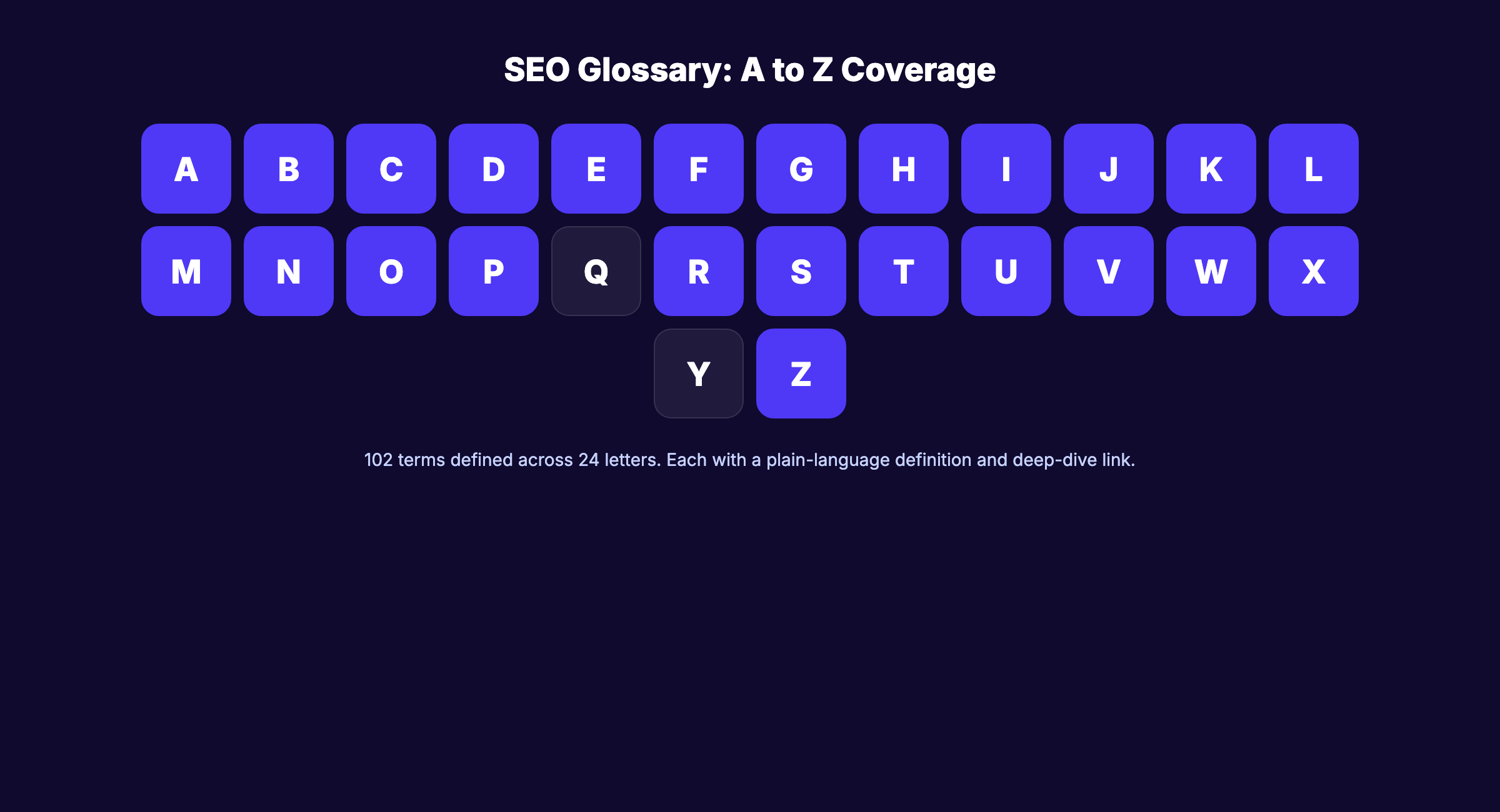
This SEO glossary defines 100+ terms in plain language. No jargon-filled definitions. No assumptions about what you already know. Each term gets a clear, practical definition and a link to deeper content where available.
We have published 3,500+ blog posts across 70+ industries. This glossary covers every term we use daily.
Bookmark this page. Use it as a reference whenever you encounter an unfamiliar SEO term.
A
Above the Fold — The portion of a web page visible without scrolling. Content here receives the most attention from users and search engines.
Algorithm — A set of rules Google uses to determine which pages appear in search results and in what order. Google updates its algorithm hundreds of times per year.
Algorithm Update — A change to Google’s ranking algorithm. Major updates (like Core Updates) can significantly shift rankings. Minor updates happen daily.
Alt Text — A text description added to an image HTML tag. Search engines read alt text to understand what an image shows. Alt text also helps screen readers for accessibility.
Anchor Text — The clickable text in a hyperlink. Descriptive anchor text helps search engines understand the linked page’s topic. “Click here” is bad anchor text. “On-page SEO guide” is good anchor text.
Authority — A measure of how trustworthy and credible a website or page is. Higher authority pages tend to rank better. See domain authority.
B
Backlink — A link from one website to another. Backlinks signal trust and authority to Google. The quantity and quality of backlinks are major ranking factors. See our backlink audit guide.
Black Hat SEO — SEO tactics that violate search engine guidelines. Examples include keyword stuffing, cloaking, and buying links. These tactics risk penalties and deindexing.
Blog SEO — The practice of optimizing blog content for search engines. Includes keyword targeting, internal linking, meta tags, and content structure. See our blog SEO guide.
Bounce Rate — The percentage of visitors who leave a page without interacting. A high bounce rate can signal that content does not match user intent.
Breadcrumbs — Navigation links showing the page hierarchy (Home > Blog > SEO Tips). Breadcrumbs help users and search engines understand site structure.
Broken Link — A hyperlink that leads to a page that no longer exists (404 error). Broken links hurt user experience and waste crawl budget. See how to fix broken links.
C
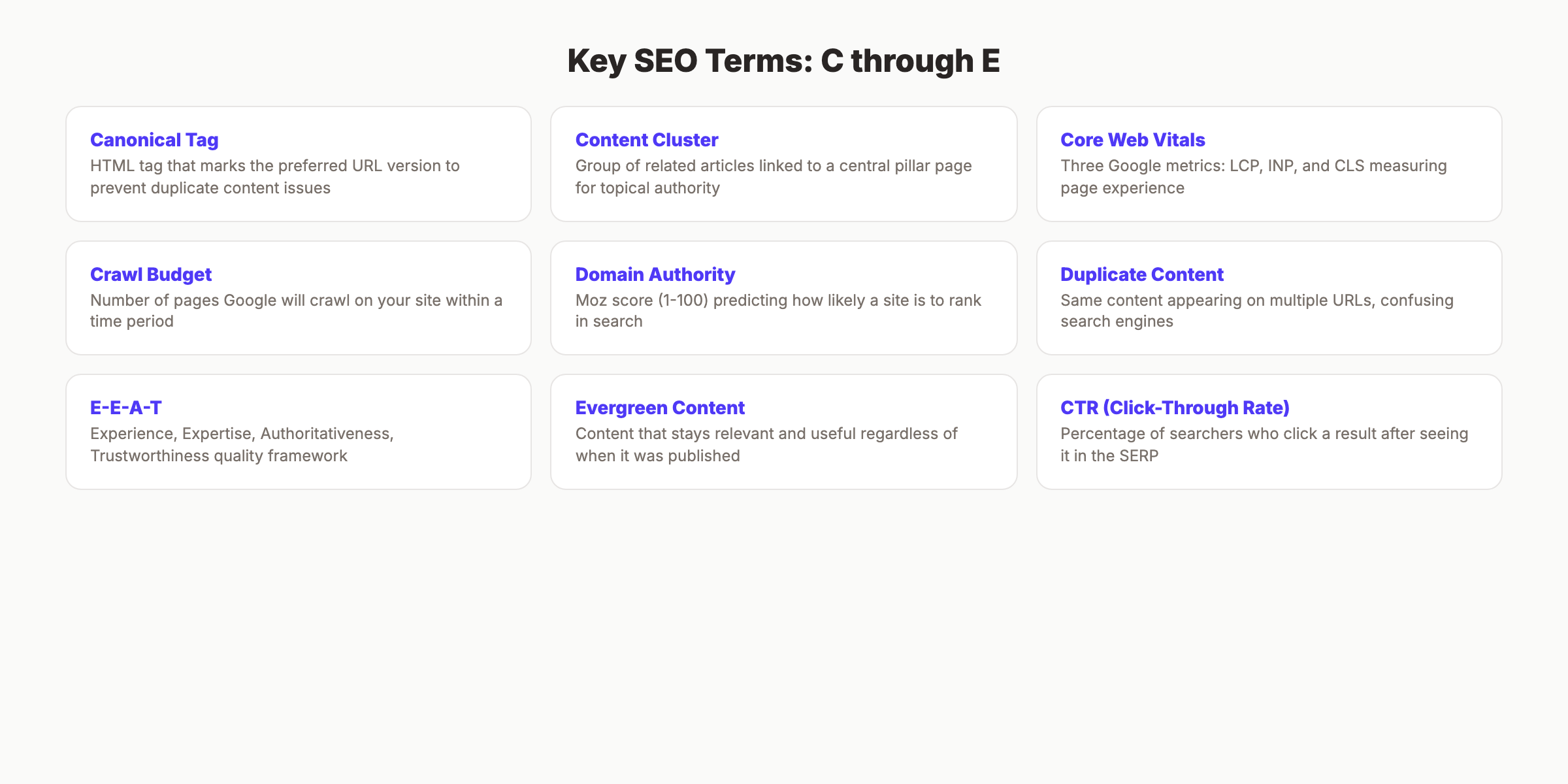
Canonical Tag — An HTML tag that tells search engines which version of a page is the “official” one. Prevents duplicate content issues. See our canonical tags guide.
Click-Through Rate (CTR) — The percentage of people who click on a search result after seeing it. Higher CTR signals relevance to Google. See organic CTR by position.
Cloaking — Showing different content to search engines than to users. A black hat tactic that violates Google guidelines and can result in penalties.
Content Cluster — A group of related articles linked to a central pillar page. Content clusters build topical authority and help Google understand topic relationships.
Content Marketing — Creating and distributing valuable content to attract and retain a target audience. Blog posts, guides, and videos are common content marketing formats. See our content marketing strategy guide.
Core Update — A broad change to Google’s search algorithm. Core updates happen several times per year and can cause significant ranking shifts across many websites.
Core Web Vitals — Three metrics Google uses to measure page experience: Largest Contentful Paint (LCP), Interaction to Next Paint (INP), and Cumulative Layout Shift (CLS). See how to improve Core Web Vitals.
Crawl Budget — The number of pages Google will crawl on your site within a given time period. Large sites need to manage crawl budget to ensure important pages get indexed.
Crawler — A program (also called a spider or bot) that visits web pages and reads their content. Googlebot is Google’s crawler.
Crawlability — How easily a search engine crawler can access and read pages on your website. Blocked pages, broken links, and poor site structure reduce crawlability.
Stop writing. Start ranking. Stacc publishes 30 SEO articles per month for your business, automatically. Start for $1 →
D
DA (Domain Authority) — A score (1-100) developed by Moz that predicts how likely a website is to rank. Higher DA correlates with better rankings. See our domain authority guide.
Disavow — Telling Google to ignore specific backlinks pointing to your site. Used when low-quality or spammy links could hurt rankings.
Do-Follow Link — A standard link that passes ranking authority (link equity) to the linked page. The default behavior of all links unless a nofollow attribute is added.
Duplicate Content — Content that appears on multiple URLs. Duplicate content confuses search engines about which version to rank. Canonical tags solve this problem.
Dwell Time — The amount of time a user spends on a page before returning to search results. Longer dwell time suggests the content satisfied the search query.
E
E-E-A-T — Experience, Expertise, Authoritativeness, Trustworthiness. Google’s framework for evaluating content quality. Pages with strong E-E-A-T signals rank better. See our E-E-A-T guide.
External Link — A link from your website to a different website. External links to authoritative sources add credibility and context to your content.
Evergreen Content — Content that remains relevant and useful over time. “How to write a meta description” is evergreen. “Best SEO tools 2024” is not. See our evergreen content guide.
F
Featured Snippet — A highlighted answer box that appears at the top of Google search results (position zero). Featured snippets pull content directly from a ranking page. See how to get featured snippets.
Fetch and Render — A Google Search Console feature that shows how Googlebot sees and renders your page. Useful for debugging indexing issues.
G
GBP (Google Business Profile) — A free Google listing that displays business information in search results and Google Maps. Essential for local SEO. See our GBP optimization guide.
GEO (Generative Engine Optimization) — Optimizing content for AI search engines like ChatGPT, Perplexity, and Google AI Overviews. The next evolution of SEO. See our GEO guide.
Google AI Overview — AI-generated summaries that appear at the top of some Google search results. These overviews can reduce organic click-through rates for affected queries. See what is Google AI Overview.
Google Analytics — A free tool from Google that tracks website traffic, user behavior, and conversions. See our GA4 setup guide.
Google Search Console — A free tool that shows how Google sees your website. Reports on indexing, search performance, and technical issues. See our GSC guide.
Guest Posting — Writing content for another website in exchange for a backlink to your site. A common link building strategy.
H
Header Tags (H1-H6) — HTML tags that define headings and subheadings on a page. H1 is the main title. H2 through H6 are subheadings. Proper header hierarchy helps both users and search engines.
Hreflang — An HTML attribute that tells search engines which language and region a page targets. Used for international SEO to serve the right content to the right audience. See our hreflang guide.
HTTPS — A secure version of HTTP that encrypts data between the browser and server. Google considers HTTPS a ranking factor. See SSL and SEO impact.
I
Impressions — The number of times a page appears in search results. Impressions do not measure clicks. A page can have 10,000 impressions and zero clicks.
Index — Google’s database of all web pages it has discovered and processed. If a page is not in the index, it cannot appear in search results.
Indexability — Whether a page can be added to Google’s index. Pages blocked by robots.txt, noindex tags, or canonical tags may not be indexable.
Internal Link — A link from one page on your website to another page on the same website. Internal links distribute authority and help Google discover pages. See our internal linking guide.
J
JavaScript SEO — Optimizing websites that rely on JavaScript for content rendering. Google can render JavaScript, but pages may face indexing delays. See our JavaScript SEO guide.
JSON-LD — A format for adding structured data (schema markup) to web pages. Google recommends JSON-LD over other structured data formats.
K
Keyword — A word or phrase that users type into search engines. Targeting the right keywords is the foundation of SEO strategy.
Keyword Cannibalization — When multiple pages on your site compete for the same keyword. This confuses Google about which page to rank. See how to fix keyword cannibalization.
Keyword Density — The percentage of times a keyword appears relative to total word count. Keyword density of 1-2% is ideal. Higher density risks keyword stuffing penalties.
Keyword Difficulty — A metric that estimates how hard it is to rank for a specific keyword. Higher difficulty means more competition.
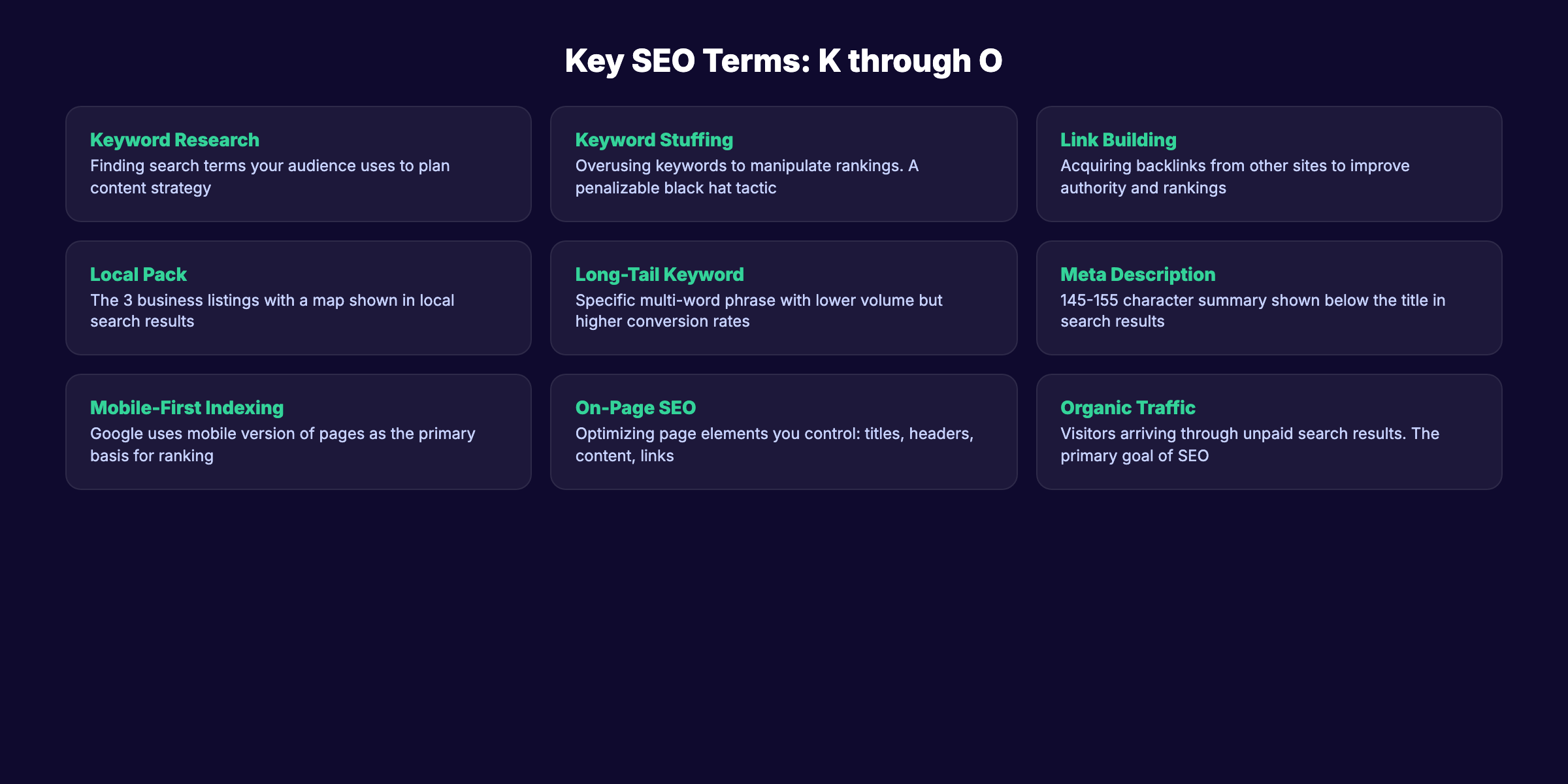
Keyword Research — The process of finding keywords your target audience searches for. The starting point of every SEO strategy. See our keyword research guide.
Keyword Stuffing — Overusing a keyword on a page in an attempt to manipulate rankings. A black hat tactic that Google penalizes.
Your SEO team. $99 per month. 30 optimized articles, published automatically. No writers. No agencies. Start for $1 →
L
Landing Page — A page designed for a specific campaign or keyword target. Landing pages focus on a single goal and usually include a call to action.
Link Building — The process of acquiring backlinks from other websites. High-quality link building improves domain authority and rankings. See our link building strategies.
Link Equity (Link Juice) — The ranking authority that passes from one page to another through links. Do-follow links pass link equity. Nofollow links do not.
Local Pack — The 3 business listings that appear in Google search results with a map. Ranking in the local pack requires an optimized Google Business Profile.
Local SEO — Optimizing a business to appear in local search results and Google Maps. Critical for businesses that serve specific geographic areas. See our local SEO guide.
Long-Tail Keyword — A longer, more specific search phrase (3+ words). Long-tail keywords have lower volume but higher conversion rates. “Plumber” is short-tail. “Emergency plumber near me open now” is long-tail.
LSI Keywords (Latent Semantic Indexing) — Related terms and synonyms that help search engines understand content context. Using LSI keywords naturally improves topical relevance.
M
Meta Description — A short summary (145-155 characters) that appears below the title in search results. Meta descriptions do not directly affect rankings but influence CTR. See how to write meta descriptions.
Meta Tags — HTML tags that provide information about a page to search engines. Title tags, meta descriptions, and robots meta tags are the most common.
Mobile-First Indexing — Google primarily uses the mobile version of a page for indexing and ranking. Sites must perform well on mobile. See our mobile SEO guide.
N
NAP (Name, Address, Phone) — Business contact information that must be consistent across all online listings. Inconsistent NAP data confuses search engines and hurts local rankings.
Nofollow — An HTML attribute that tells search engines not to pass link equity through a link. Used for paid links, user-generated content, and untrusted sources. See our noindex nofollow guide.
Noindex — A directive that tells search engines not to include a page in their index. Used for pages that should not appear in search results.
O
Off-Page SEO — SEO activities performed outside your website to improve rankings. Backlinks, brand mentions, and social signals are off-page factors.
On-Page SEO — Optimizing individual pages to rank higher. Includes title tags, headers, content quality, internal links, and image optimization. See our on-page SEO guide.
Organic Traffic — Visitors who arrive at your website through unpaid search results. Organic traffic is the primary goal of SEO. See how to increase organic traffic.
Orphan Page — A page on your site that has no internal links pointing to it. Search engines struggle to find and index orphan pages.
P
Page Speed — How fast a web page loads. Faster pages rank better and provide a better user experience. Part of Core Web Vitals.
PageRank — Google’s original algorithm for measuring page importance based on backlinks. Still used internally by Google but no longer publicly visible.
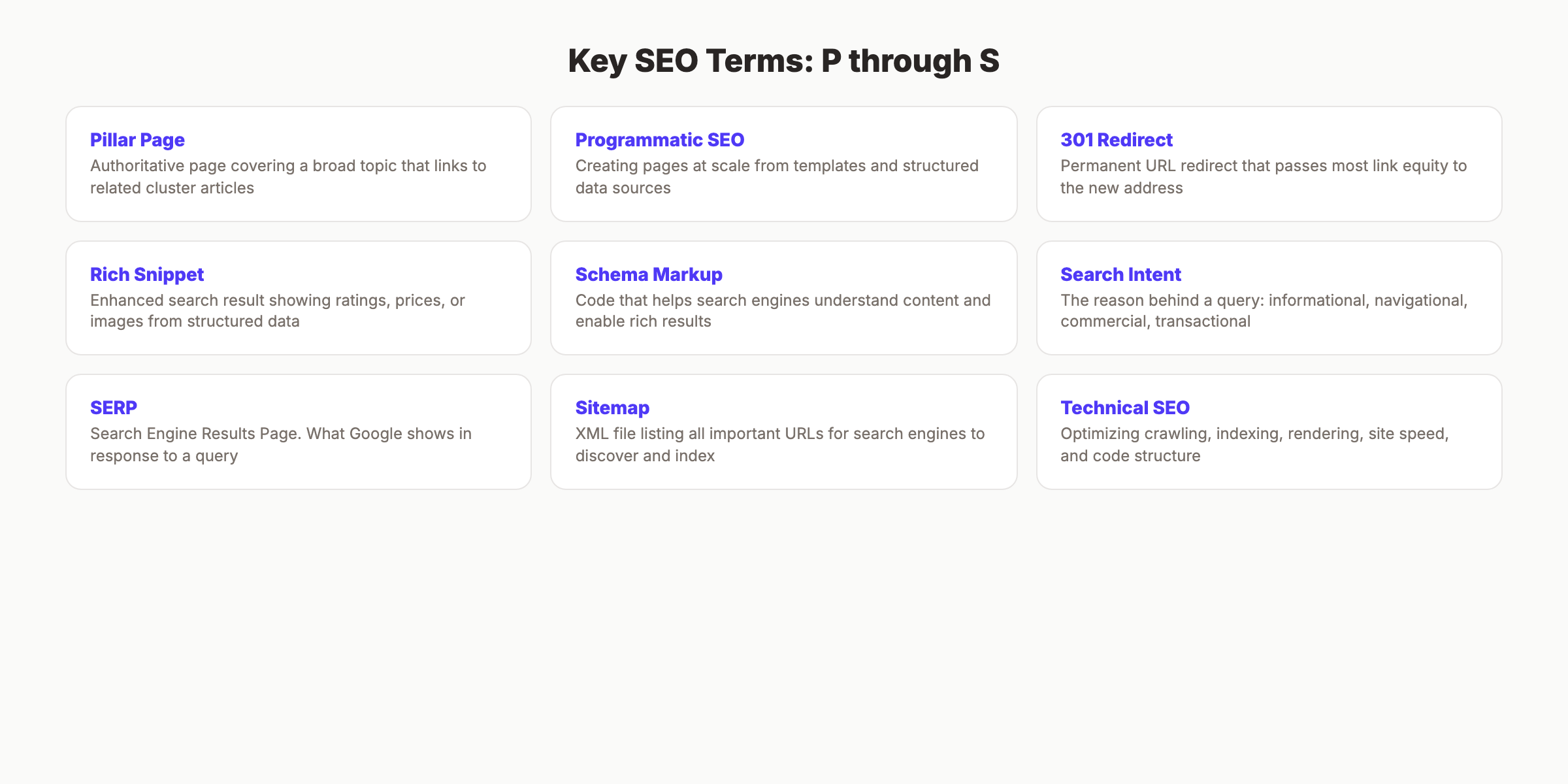
Pillar Page — A long, authoritative page that covers a broad topic and links to related cluster articles. Pillar pages anchor content clusters. See how to write pillar pages.
PPC (Pay-Per-Click) — An advertising model where advertisers pay for each click on their ad. Google Ads is the most common PPC platform. See SEO vs PPC.
Programmatic SEO — Creating large numbers of pages from templates and data. Used for directory sites, location pages, and product pages. See our programmatic SEO guide.
R
Ranking Factor — Any signal Google uses to determine search result order. There are hundreds of ranking factors including content quality, backlinks, page speed, and user experience.
Redirect (301) — A permanent redirect from one URL to another. Passes most link equity to the new URL. See our 301 redirects guide.
Redirect (302) — A temporary redirect. Does not pass full link equity. Use only when the redirect is genuinely temporary.
Rich Snippet — Enhanced search result with additional information like star ratings, prices, or images. Rich snippets come from structured data.
Robots.txt — A text file that tells search engine crawlers which pages to crawl and which to skip. See how to optimize robots.txt.
S
Schema Markup — Structured data code that helps search engines understand page content. Schema enables rich snippets and knowledge panels. See our schema markup guide.
Search Intent — The reason behind a user’s search query. The 4 types are informational, navigational, commercial, and transactional. See our search intent guide.
SERP (Search Engine Results Page) — The page Google displays in response to a search query. SERPs include organic results, paid ads, featured snippets, and other elements.
Sitemap — An XML file that lists all important pages on your website. Sitemaps help search engines discover and index your content. See how to create an XML sitemap.
Site Speed — How fast your entire website loads and responds. Measured through Core Web Vitals and other performance metrics.
SSL Certificate — A security certificate that enables HTTPS on your website. Required for secure browsing and a confirmed ranking factor. See SSL and SEO.
T
Technical SEO — Optimizing the technical aspects of a website to improve crawling, indexing, and rendering. Includes site speed, HTTPS, schema, and crawl budget management. See our technical SEO checklist.
Thin Content — Pages with little or no valuable content. Google may demote thin content in rankings. See how to fix thin content.
Title Tag — An HTML element that defines the title of a web page. The title tag appears in search results and browser tabs. Keep titles under 60 characters.
Topical Authority — The degree to which a website covers a topic thoroughly. Sites with many articles on related subtopics build stronger authority. See our topical authority guide.
Topical Map — A structured plan of content covering all subtopics within a niche. Topical maps guide content strategy and internal linking. See how to create a topical map.
3,500+ blogs published. 92% average SEO score. See what Stacc can do for your site. Start for $1 →
U
URL Structure — The format and organization of web addresses. Clean, descriptive URLs improve user experience and SEO. See our URL structure guide.
User Experience (UX) — How visitors interact with and feel about your website. Good UX reduces bounce rates and improves engagement, both of which support rankings.
V
Voice Search — Searching using spoken words through a virtual assistant. Voice queries tend to be longer and more conversational. See our voice search SEO guide.
W
White Hat SEO — SEO practices that follow search engine guidelines. Quality content, natural link building, and technical optimization are white hat tactics.
X
XML Sitemap — A file that lists all important URLs on a website for search engines. Submitting a sitemap through Google Search Console helps ensure all pages get indexed.
Z
Zero-Click Search — A search where the user gets the answer directly from the SERP without clicking any result. Featured snippets and AI Overviews increase zero-click searches. See our zero-click search guide.
FAQ
What is the most important SEO term to understand?
Search intent. Every other SEO tactic serves the goal of matching content to what users actually want. If your content does not match the intent behind a keyword, no amount of optimization will make it rank.
How many SEO terms should a beginner know?
Start with 20 to 30 core terms: keyword, backlink, on-page SEO, meta description, title tag, internal link, crawling, indexing, SERP, CTR, and domain authority. Build from there as you encounter new concepts in practice.
What is the difference between on-page and off-page SEO?
On-page SEO covers everything you control on your website: content, tags, structure, and speed. Off-page SEO covers external signals like backlinks and brand mentions. Both contribute to rankings.
What does E-E-A-T stand for in SEO?
Experience, Expertise, Authoritativeness, and Trustworthiness. Google uses E-E-A-T as a quality framework for evaluating content. Pages that demonstrate real experience and expertise rank better. See our full E-E-A-T guide.
Is this glossary updated regularly?
Yes. We update this SEO glossary quarterly to add new terms and revise definitions as the industry evolves. Last updated: March 2026.
SEO terminology changes as the industry evolves. AI Overviews, GEO, and entity optimization are terms that did not exist 3 years ago. Bookmark this glossary and return whenever you encounter an unfamiliar term.
Written and published by Stacc. We publish 3,500+ articles per month across 70+ industries. All data verified against public sources as of March 2026.