
Types of SEO: The Complete Guide (2026)
Learn the 12 types of SEO every business needs to know. Covers on-page, off-page, technical, local, content, and emerging SEO types. Updated for 2026.
Stacc Editorial • 2026-04-04 • SEO Tips
In This Article
Types of SEO: The Complete Guide (2026)
Most businesses treat SEO as one thing. They “do SEO” without knowing which type moves the needle for their specific situation.
That mistake costs rankings, traffic, and revenue. A local dentist running the same SEO playbook as a SaaS company will waste months on tactics that do not apply to their business model.
This guide breaks down 12 distinct types of SEO. You will learn what each type does, the specific tactics behind it, and when to prioritize one over another.
We publish 3,500+ SEO articles across 70+ industries. This guide covers everything we know about categorizing and executing each type of SEO.
Here is what you will learn:
- The 3 foundational types of SEO every website needs
- 4 specialized types that apply to specific business models
- Emerging categories like GEO and voice search SEO
- A decision framework to pick the right types for your business
- Common mistakes businesses make when choosing an SEO strategy
Table of Contents
- What Is SEO (and Why Types Matter)
- On-Page SEO
- Off-Page SEO
- Technical SEO
- Local SEO
- Content SEO
- Mobile SEO
- Ecommerce SEO
- International SEO
- Emerging Types of SEO
- How to Choose the Right Types of SEO
- FAQ
What Is SEO (and Why Types Matter) {#what-is-seo}
SEO is the practice of improving a website’s visibility in organic search results. Google processes over 8.5 billion searches per day, and organic search drives 53% of all website traffic globally. Position 1 on Google captures 39.8% of clicks.
But “doing SEO” is not a single activity. It is a collection of disciplines, each targeting a different ranking factor or search context. Understanding the distinct types of SEO matters because the wrong approach wastes time and budget.
Why One Size Does Not Fit All
A plumber in Denver needs local SEO. An online clothing store needs ecommerce SEO. A B2B software company needs content SEO and off-page authority. Each business type has a different mix of high-priority SEO categories.
96.55% of web pages get zero traffic from Google. One reason is misaligned SEO strategy. Businesses invest in the wrong type of optimization for their goals.
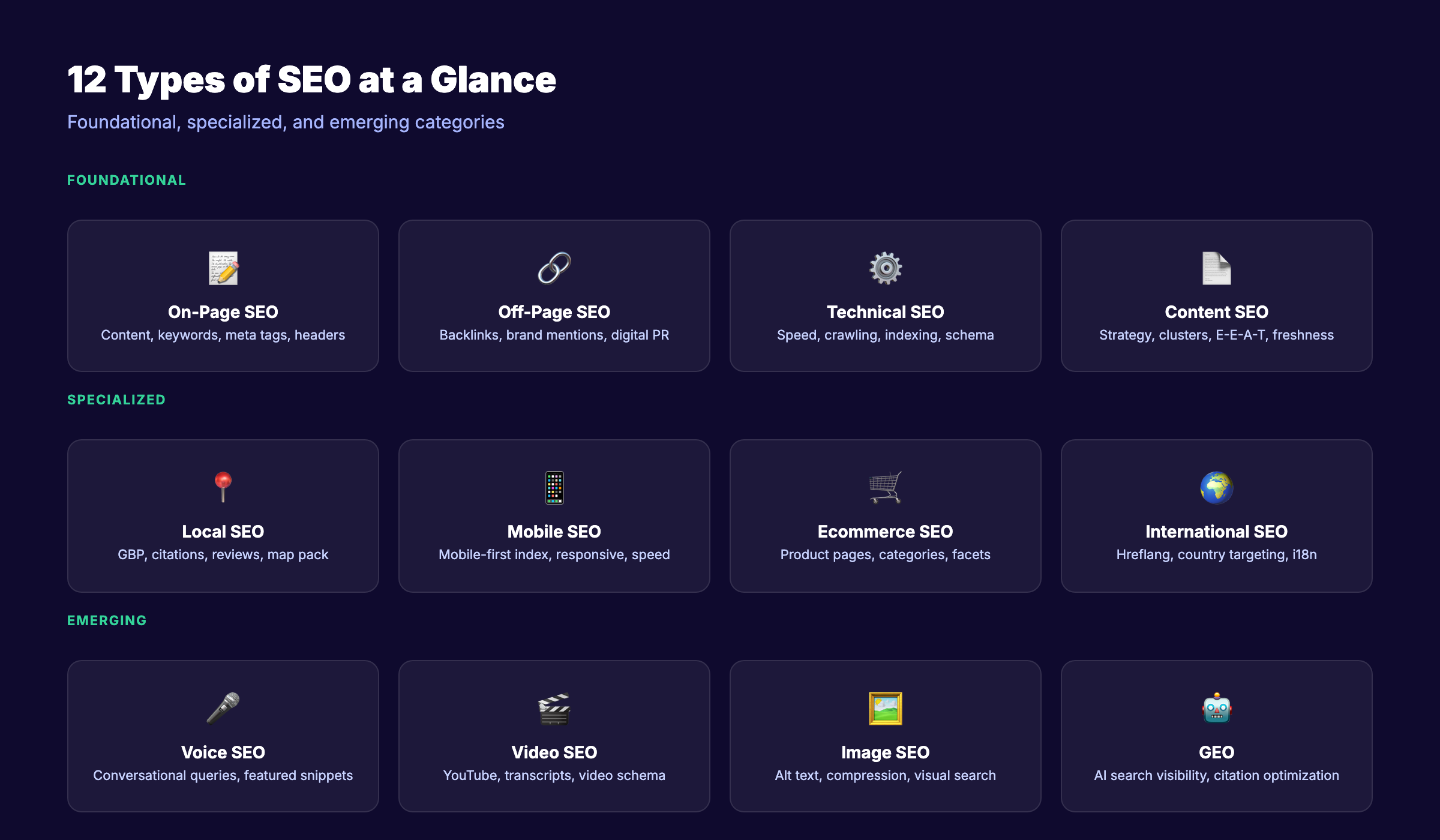
The 3 Categories of SEO Types
Every type of SEO falls into 1 of 3 categories:
| Category | Types | Focus |
|---|---|---|
| Foundational | On-page, off-page, technical, content | Every site needs these |
| Specialized | Local, mobile, ecommerce, international | Business-model specific |
| Emerging | Voice, video, image, GEO, programmatic | Future-facing channels |
The rest of this guide covers all 12 types in detail. Start with the foundational 4, then layer in specialized and emerging types based on your business model.
If you are new to search optimization, read our SEO for beginners guide first.
On-Page SEO {#on-page-seo}
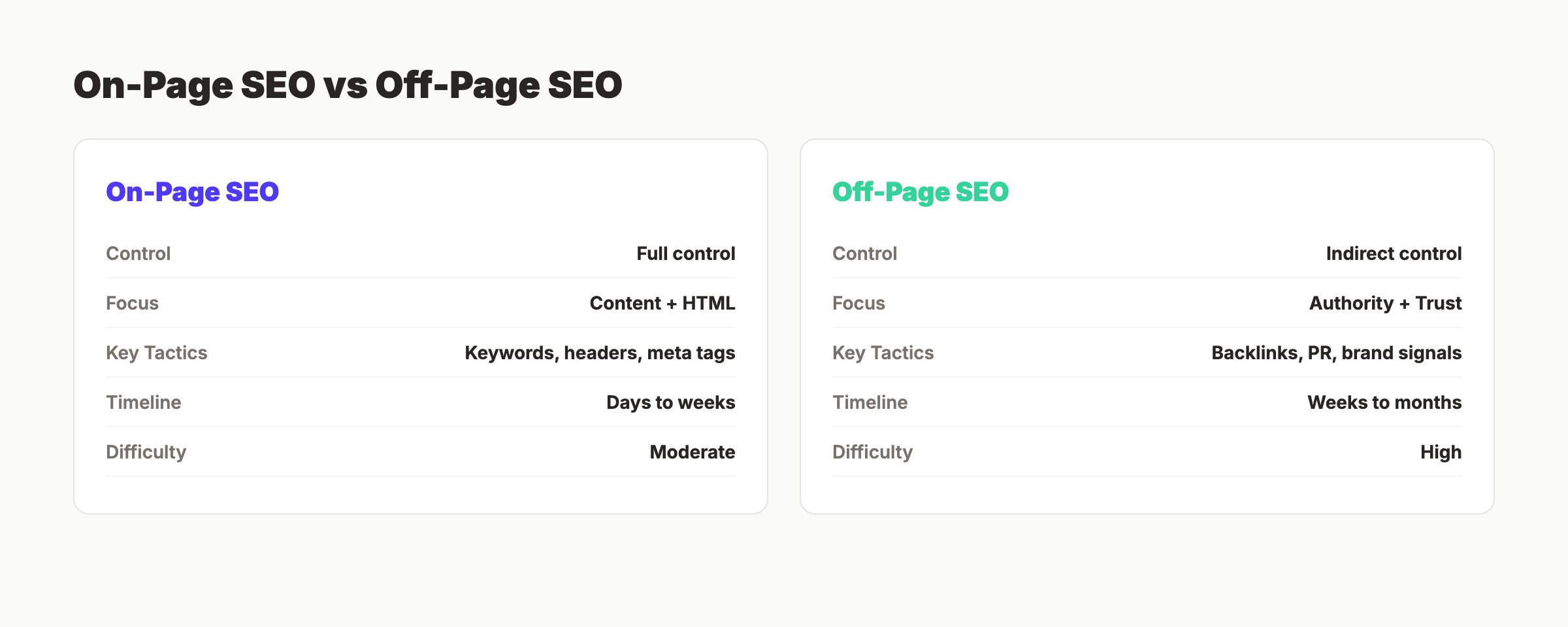
On-page SEO refers to everything you optimize directly on a web page. This includes content, HTML source code, and internal links. It is the type of SEO you have the most control over.
Every other type of SEO builds on a strong on-page foundation. Without proper title tags, keyword placement, and content structure, off-page and technical efforts produce limited results.
Title Tags and Meta Descriptions
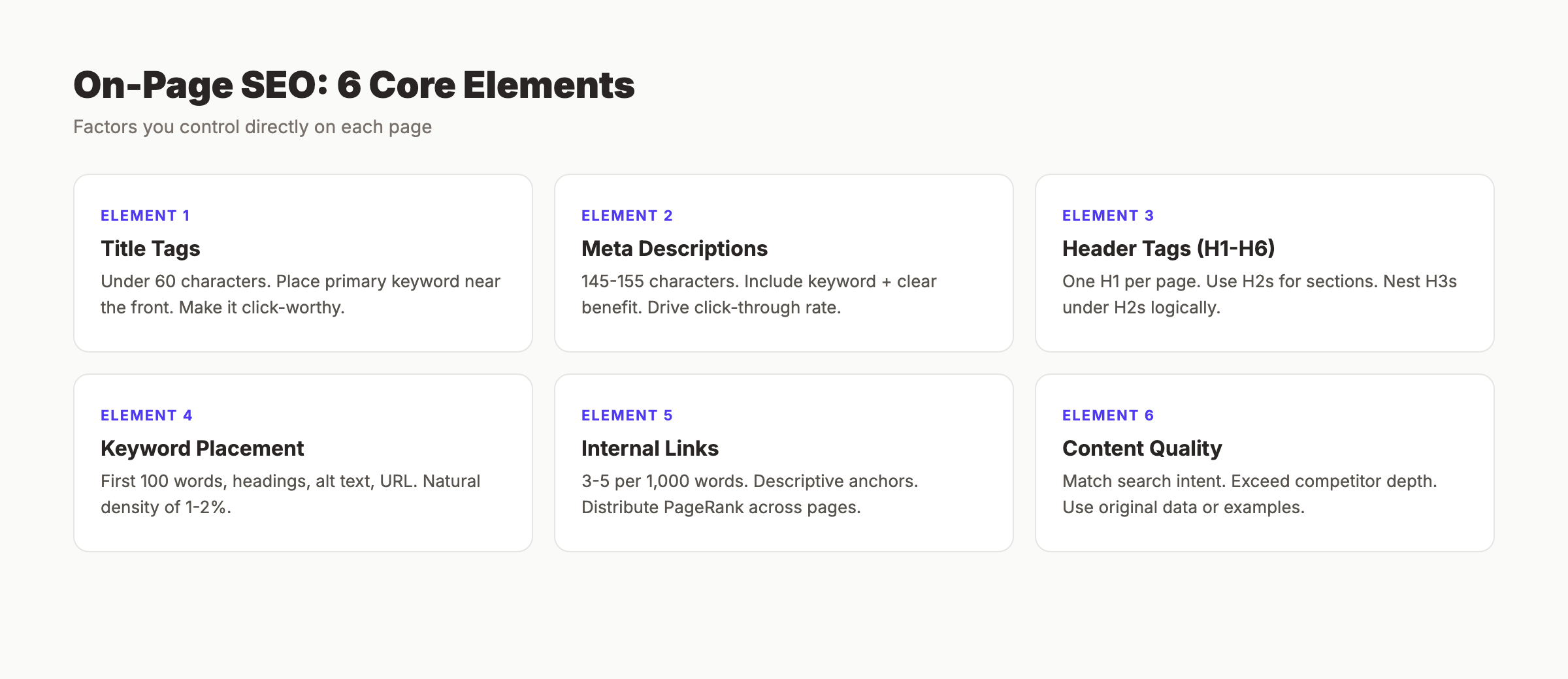
Title tags are the single most important on-page element. Keep them under 60 characters. Place the primary keyword near the beginning.
Meta descriptions do not directly affect rankings. But they influence click-through rate, which does affect rankings indirectly. Write them between 145 and 155 characters with a clear benefit statement.
Header Tags and Content Structure
Use one H1 per page. Organize sections with H2 headings. Nest subtopics under H3 tags.
Headers give Google a clear map of your content hierarchy. They also help readers scan. A post with proper blog post structure earns more engagement and lower bounce rates.
Keyword Placement
Place your primary keyword in 5 locations:
- First 100 words
- At least 1 H2 heading
- URL slug
- Meta description
- At least 1 image alt text
Aim for a natural keyword density of 1 to 2%. Keyword stuffing triggers penalties. Use related terms and synonyms instead of repeating the same phrase.
Internal Linking
Internal links distribute PageRank across your site. They also help Google discover and index new pages faster.
Target 3 to 5 internal links per 1,000 words. Use descriptive anchor text that tells Google what the linked page covers.
For a full walkthrough, see our guide on how to optimize content for SEO.
Stop writing. Start ranking. Stacc publishes 30 SEO articles per month for $99. Every article follows on-page SEO best practices automatically. Start for $1 →
Off-Page SEO {#off-page-seo}
Off-page SEO covers every action taken outside your website to improve rankings. The biggest factor is backlinks. But brand mentions, social signals, and digital PR also contribute.
Think of on-page SEO as optimizing what you say. Off-page SEO is about building what others say about you.
Backlinks: Quality Over Quantity
One link from a high-authority site beats 100 links from low-quality directories. Google treats backlinks as votes of confidence. The more authoritative the source, the more weight the vote carries.
The best link building strategies in 2026 focus on earning editorial links through original data, expert commentary, and newsworthy content. Guest posting still works, but only on relevant, high-quality sites.
Learn the difference between dofollow and nofollow links before building your link profile.
Digital PR and Brand Mentions
Digital PR generates backlinks and brand awareness simultaneously. When a journalist cites your data or quotes your founder, you earn a link and a trust signal.
Google now recognizes unlinked brand mentions as a ranking signal. Every time someone references your business name online, it reinforces your entity in Google’s knowledge base.
HARO link building remains one of the most effective ways to earn high-authority press links.
Social Signals and Online Reputation
Social shares do not directly affect Google rankings. But viral content generates backlinks, brand searches, and referral traffic. All of those indirectly boost SEO.
Online reviews also fall under off-page SEO. They influence local rankings and click-through rates. A business with 200 five-star reviews outranks competitors with 10 reviews in most local searches.
For the full playbook, read our off-page SEO guide. You can also run a backlink audit to assess your current link profile.
Technical SEO {#technical-seo}
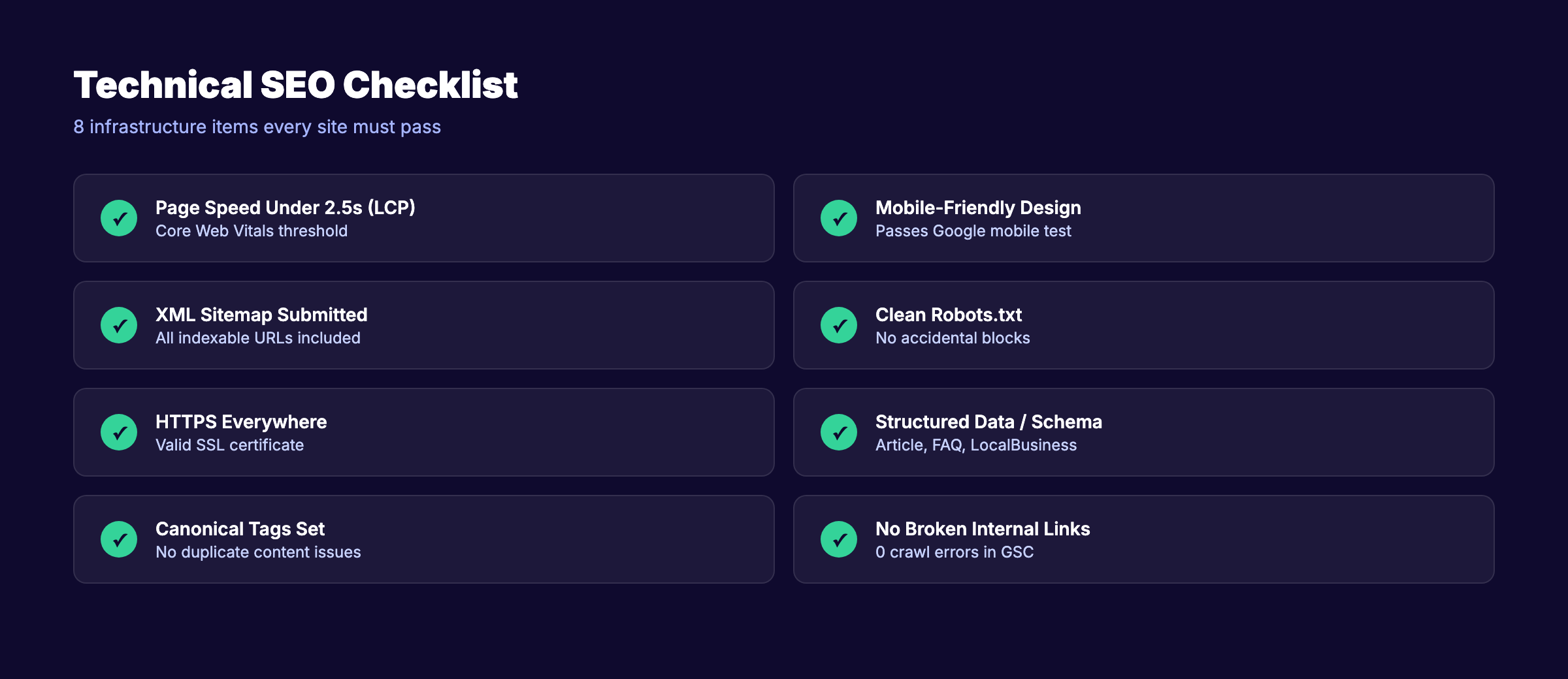
Technical SEO ensures search engines can crawl, index, and render your website. If Google cannot access your pages, no amount of content or links will help. This is the infrastructure layer of SEO.
Many sites have excellent content but poor technical foundations. They rank lower than they should because of slow page speed, broken links, or crawl errors.
Site Speed and Core Web Vitals
Google uses Core Web Vitals as a ranking factor. The 3 metrics are:
| Metric | What It Measures | Target |
|---|---|---|
| LCP | Largest Contentful Paint | Under 2.5 seconds |
| INP | Interaction to Next Paint | Under 200 milliseconds |
| CLS | Cumulative Layout Shift | Under 0.1 |
Failing these thresholds does not automatically tank rankings. But meeting them gives you an edge over competitors who do not. Read our INP optimization guide for specific fixes.
Crawlability and Indexing
Search engines need to find and process your pages. The key elements are:
- A clean XML sitemap submitted to Google Search Console
- A properly configured robots.txt file
- Canonical tags on every page to prevent duplicate content
- No orphan pages (every page reachable through at least 1 internal link)
If Google cannot crawl a page, it will not rank. Period. Crawl budget optimization matters most for large sites with 10,000+ pages.
Structured Data and Schema Markup
Structured data tells search engines what your content means, not just what it says. It powers rich results like FAQ dropdowns, star ratings, and product prices in search.
Common schema types include Article, FAQPage, LocalBusiness, Product, and HowTo. Implementing schema markup can increase click-through rates by 25 to 30%.
JavaScript SEO and Rendering
Sites built with React, Angular, or Vue face unique challenges. Google must render JavaScript to see the content. If rendering fails, pages appear blank to the crawler.
JavaScript SEO involves server-side rendering, dynamic rendering, or pre-rendering to ensure Google indexes your content correctly.
For 301 redirects, 404 error handling, and URL structure best practices, we have dedicated guides on each.
Your SEO team. $99 per month. 30 optimized articles with proper technical markup, published automatically. Start for $1 →
Local SEO {#local-seo}
Local SEO optimizes your online presence for location-based searches. When someone searches “dentist near me” or “best coffee shop in Austin,” local SEO determines who appears in the results.
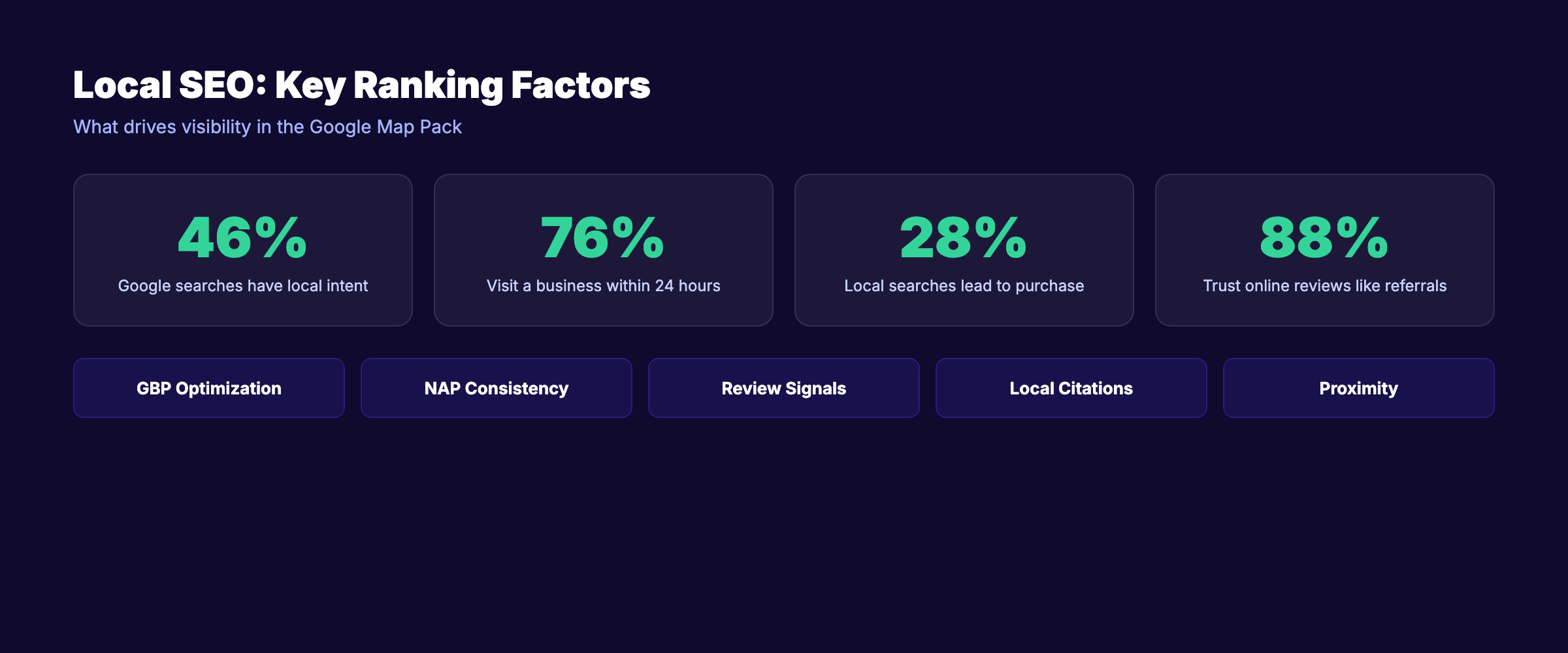
46% of all Google searches have local intent. 76% of people who search for a nearby business visit within 24 hours. For service businesses, local SEO is not optional. It is the primary growth channel.
Google Business Profile Optimization
Your Google Business Profile (GBP) is the centerpiece of local SEO. It controls what appears in the Map Pack, the 3-listing box at the top of local search results.
Key optimization steps:
- Complete every field (categories, hours, services, description)
- Choose the right primary and secondary categories
- Upload photos weekly
- Post GBP updates at least 2 times per week
- Respond to every review within 24 hours
Read our full guide on how to get found on Google as a local business.
NAP Consistency and Citations
NAP stands for Name, Address, Phone number. Every mention of your business online must match exactly. A mismatch between your GBP listing, website, and directories confuses Google.
NAP consistency across 40+ directories is a top-5 local SEO ranking factor. Build citations on Yelp, Apple Maps, Bing Places, and industry-specific directories.
Reviews and Reputation
Google’s algorithm weighs review quantity, quality, velocity, and recency. More reviews with higher ratings produce better local rankings.
Our local SEO statistics show that businesses with 50+ reviews earn 266% more leads than those with fewer than 10.
For Google Maps ranking strategies, local keyword research, and the differences between local SEO and organic SEO, explore our dedicated guides.
Content SEO {#content-seo}
Content SEO is the strategic layer above on-page SEO. On-page SEO optimizes individual pages. Content SEO plans which pages to create, how they connect, and how they build authority over time.
The distinction matters. You can have perfect on-page optimization on 10 blog posts. But without a content strategy, those posts will compete with each other and fail to build topical authority.
Topic Clusters and Pillar Pages
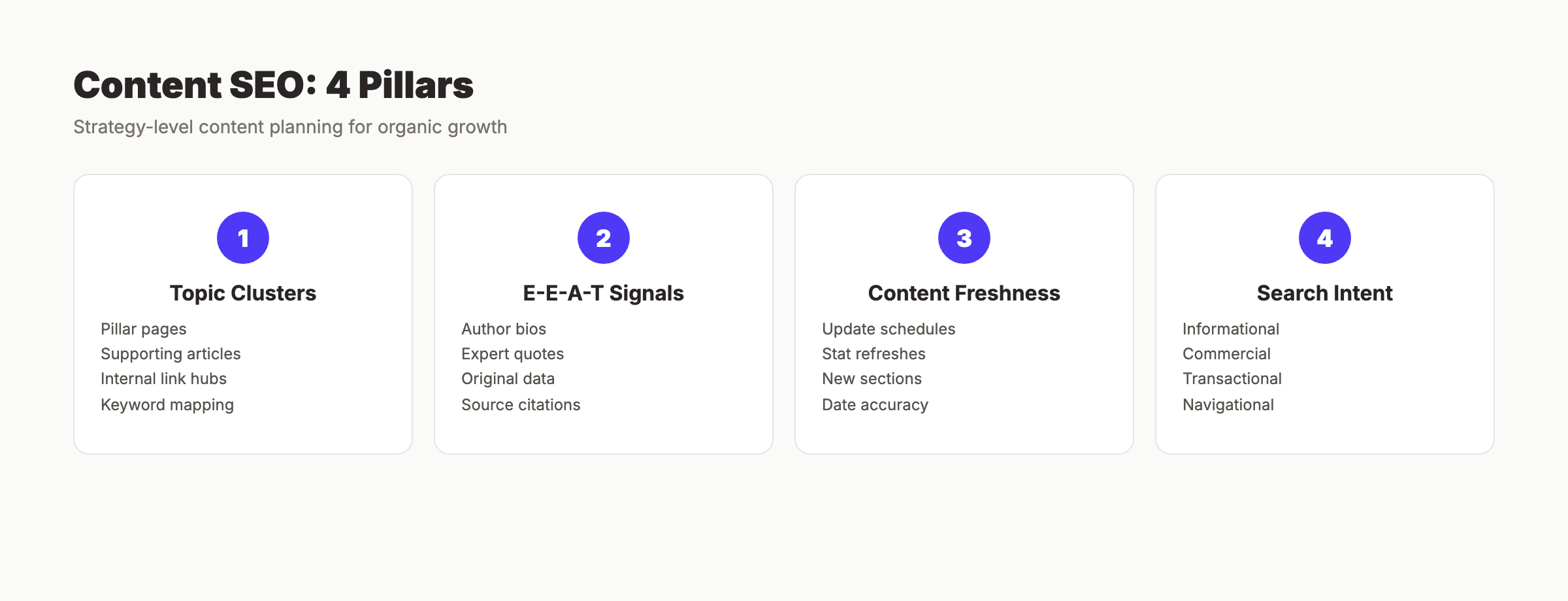
A topic cluster groups related content around a central pillar page. The pillar targets a broad keyword. Supporting articles target long-tail variations and link back to the pillar.
This structure signals to Google that your site covers a topic deeply. It also creates an internal linking web that distributes authority efficiently.
Example cluster for “types of SEO”:
- Pillar: Types of SEO (this guide)
- Supporting: On-page SEO guide, off-page SEO guide, technical SEO guide, local SEO guide, mobile SEO guide, ecommerce SEO guide
E-E-A-T: Experience, Expertise, Authority, Trust
Google’s quality raters evaluate content using the E-E-A-T framework. It stands for Experience, Expertise, Authoritativeness, and Trustworthiness.
Content SEO means building E-E-A-T signals into every piece you publish:
- Author bios with credentials
- Original data and case studies
- Citations from authoritative sources
- Real-world examples from hands-on experience
E-E-A-T matters most for YMYL (Your Money or Your Life) topics like health, finance, and legal content.
Content Freshness and Updates
Google rewards fresh content, especially for time-sensitive queries. A content refresh strategy keeps existing articles current and competitive.
Update statistics annually. Add new sections when the topic evolves. Remove outdated advice. Change the publication date only when you make substantial updates.
Our evergreen content guide explains how to write posts that rank for years with minimal updates.
Building Topical Authority
Topical authority is earned by covering a subject deeply and consistently. A site with 50 articles about local SEO outranks a site with 2 articles on the same topic, assuming comparable quality.
Volume matters. But so does depth. Each article should cover its subtopic so thoroughly that readers do not need to visit a second source.
Plan your content strategy using an SEO content calendar and learn how to create content calendars for SEO.
30 articles per month. $99 total. Stacc handles content strategy, writing, and publishing. You handle running your business. Start for $1 →
Mobile SEO {#mobile-seo}
Mobile SEO ensures your website performs well on smartphones and tablets. Google uses mobile-first indexing, meaning it primarily crawls and evaluates the mobile version of your site.
65% of all web traffic comes from mobile devices. If your site loads slowly or looks broken on a phone, you lose rankings and visitors.
Mobile-First Indexing
Google indexes the mobile version of your site first. If content exists on your desktop page but not your mobile page, Google may not index it at all.
Ensure your mobile site has:
- The same content as desktop (no hidden text)
- Accessible structured data
- Proper meta tags
- Working internal links
Responsive Design
Responsive design adapts your layout to any screen size automatically. It is the approach Google recommends over separate mobile URLs or dynamic serving.
A single responsive URL is easier for Google to crawl. It also consolidates link authority instead of splitting it across mobile and desktop versions.
Mobile Page Speed
Mobile users expect pages to load in under 3 seconds. 53% of mobile visitors abandon sites that take longer than 3 seconds to load.
Key speed tactics for mobile:
- Compress images (use WebP format)
- Minimize JavaScript execution
- Use lazy loading for below-the-fold content
- Enable browser caching
Read our full mobile SEO guide and mobile search statistics for more data.
Ecommerce SEO {#ecommerce-seo}
Ecommerce SEO focuses on ranking product pages, category pages, and brand pages in search results. It combines on-page, technical, and content SEO with ecommerce-specific tactics.
Online stores face unique challenges: duplicate content from product variations, faceted navigation creating thousands of crawlable URLs, and thin content on product pages.
Product Page Optimization
Every product page needs:
- A unique title tag with the product name and key modifier
- A description of at least 200 words (not the manufacturer’s default copy)
- High-quality images with descriptive alt text
- Product schema markup for rich results (price, availability, reviews)
Category Page Strategy
Category pages often have more ranking potential than individual product pages. They target broader keywords like “running shoes” rather than “Nike Air Max 90 white size 10.”
Write 300 to 500 words of unique content on each category page. Include keyword-rich descriptions, buying guides, and FAQ sections.
Faceted Navigation and Crawl Budget
Faceted navigation lets users filter by color, size, price, and other attributes. Each filter combination can create a unique URL. A store with 1,000 products and 20 filters can generate millions of URLs.
Without proper handling, this wastes crawl budget and causes duplicate content issues. Use canonical tags, robots.txt rules, or noindex directives on filtered pages.
For a complete walkthrough, read our ecommerce SEO guide and Shopify SEO guide.
International SEO {#international-seo}
International SEO helps websites rank in multiple countries and languages. If your business serves customers in different regions, you need to tell Google which content applies to which audience.
Getting international SEO wrong means showing English content to French users. Or competing against yourself across country-specific search results.
Hreflang Tags
Hreflang tags tell Google which language and country a page targets. They prevent duplicate content issues across language versions and ensure users see the right version.
Example: A page targeting English speakers in the UK uses hreflang="en-gb". The US version uses hreflang="en-us". Without hreflang, Google may show the wrong version.
URL Structure for International Sites
3 options exist for international URL structures:
| Structure | Example | Best For |
|---|---|---|
| ccTLD | example.fr | Strong geo-targeting |
| Subdirectory | example.com/fr/ | Consolidated authority |
| Subdomain | fr.example.com | Separate management |
Subdirectories are the most common choice. They keep domain authority unified while clearly segmenting content by region.
Multilingual Content Strategy
Translation alone is not enough. Each market needs localized content that reflects regional search behavior, cultural context, and local competition.
Our multilingual SEO guide covers keyword research by language, content localization, and managing multiple language versions at scale.
SEO that runs itself. From blog posts to local SEO, Stacc handles the content. You handle the business. Start for $1 →
Emerging Types of SEO {#emerging-types}
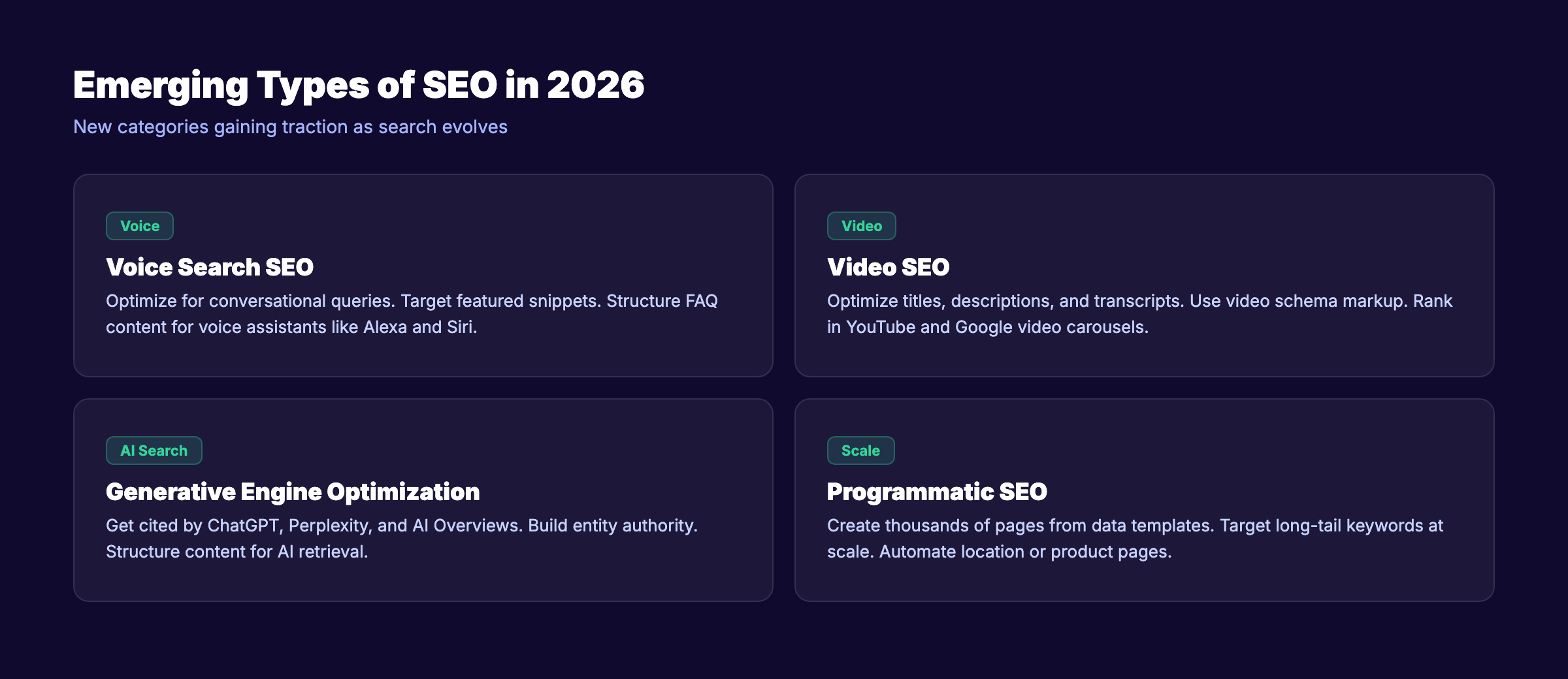
Search is expanding beyond traditional web results. Voice assistants, video platforms, image search, AI chatbots, and programmatic content are creating new SEO categories. These are the types of SEO gaining traction in 2026.
Voice Search SEO
Voice queries are longer and more conversational than typed searches. Instead of “best pizza NYC,” a voice search sounds like “where can I get the best pizza near Times Square?”
Optimize for voice search by:
- Targeting question-based keywords (who, what, where, how)
- Writing concise answers in 40 to 50 words (featured snippet length)
- Using FAQ sections with natural-language questions
- Earning featured snippets (voice assistants read Position 0 results)
Our guide on featured snippets covers the specific formatting Google prefers.
Video SEO
Google shows video results for 26% of search queries. YouTube is the second largest search engine. Video SEO optimizes your content for both platforms.
Key tactics:
- Write keyword-rich titles and descriptions
- Add full transcripts (Google indexes spoken content)
- Use video schema markup for rich results
- Create custom thumbnails that increase click-through rate
- Target “how to” queries that trigger video carousels
Image SEO
Image optimization goes beyond alt text. Google Images drives significant traffic for visual industries like travel, food, fashion, and interior design.
Best practices include:
- Descriptive file names (not IMG_4532.jpg)
- Alt text with relevant keywords
- Compressed file sizes (under 200KB)
- WebP or AVIF format
- Structured data for product images
Generative Engine Optimization (GEO)
GEO is the newest type of SEO. It focuses on getting your content cited by AI search tools like ChatGPT, Perplexity, Google AI Overviews, and Claude.
25% of Google searches now trigger AI Overviews. AI chatbots pull information from authoritative, well-structured content. If your content is not cited by AI, you lose a growing share of search traffic.
Read our generative engine optimization guide and our comparison of GEO vs traditional SEO for the full breakdown.
Also see: how to get cited in AI search and the AI search statistics shaping 2026.
Programmatic SEO
Programmatic SEO uses data and templates to generate hundreds or thousands of pages at scale. It targets long-tail keywords that are too numerous to create manually.
Examples include:
- “[Tool] alternatives” pages generated from a database
- “[City] + [service]” landing pages for multi-location businesses
- Comparison pages like “[Product A] vs [Product B]”
The risk is thin content. Every programmatic page must provide unique value. Google’s Helpful Content system penalizes templated pages that add nothing for the reader.
How to Choose the Right Types of SEO {#choose-right-types}
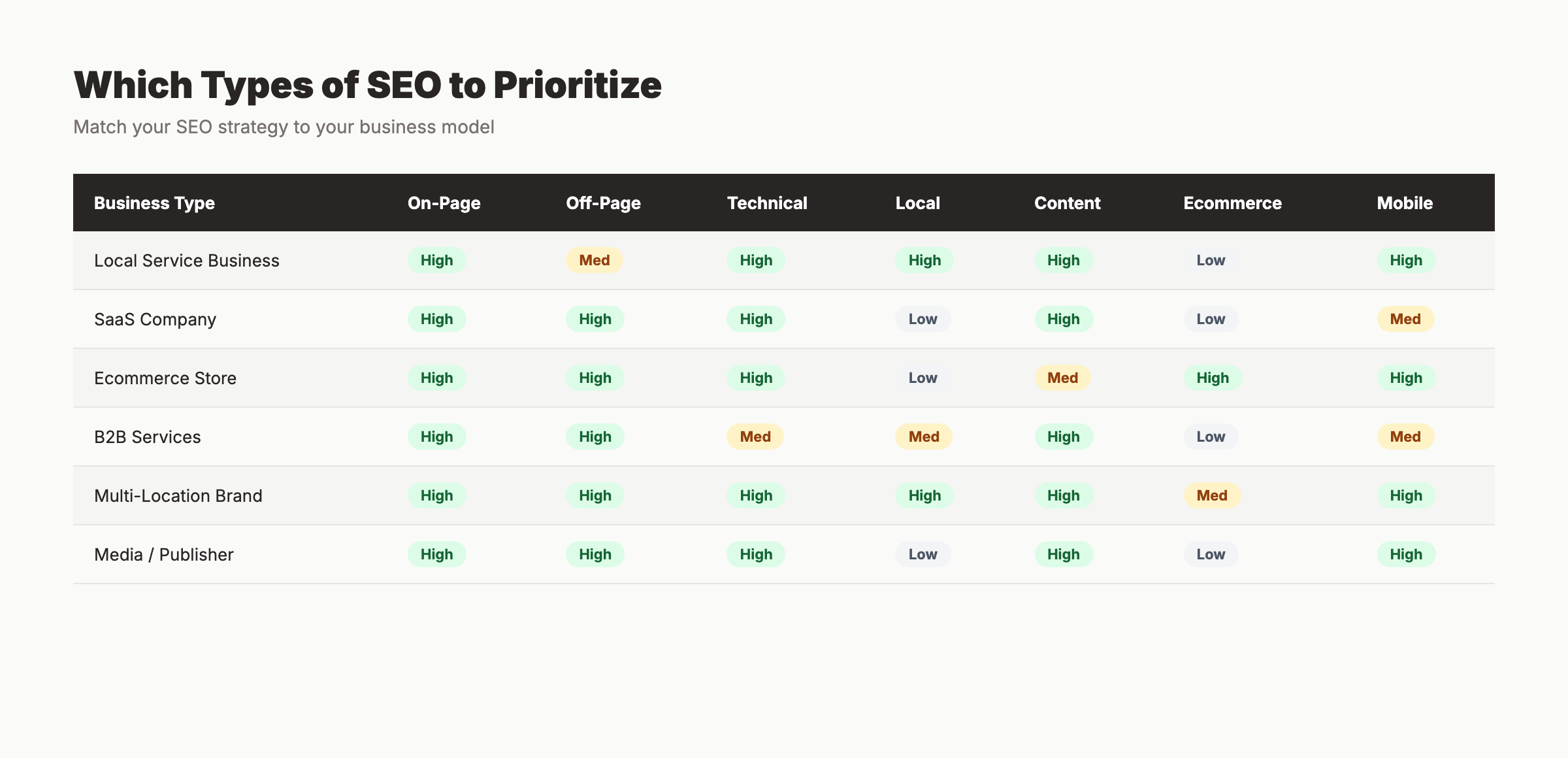
Every business needs the 4 foundational types: on-page, off-page, technical, and content SEO. The specialized and emerging types depend on your business model, audience, and growth stage.
Match SEO Types to Your Business Model
| Business Type | Top Priority SEO Types |
|---|---|
| Local service business | Local, on-page, mobile, content |
| Ecommerce store | Ecommerce, technical, content, off-page |
| SaaS company | Content, off-page, technical, on-page |
| Multi-location brand | Local, content, technical, international |
| Media / publisher | Content, technical, off-page, video |
| B2B services firm | Content, on-page, off-page, local |
The Stacc Stack Method
The most effective approach combines blog content SEO with local SEO. We call this the Stacc Stack Method.
Blog posts build topical authority and earn organic traffic over time. Local SEO captures high-intent searches from people ready to buy. Together, they compound.
A dentist who publishes 30 blog posts per month and optimizes their GBP weekly will outrank competitors who do only one or the other.
Start With Technical, Then Layer
Follow this priority sequence:
- Fix technical issues first (speed, crawlability, indexing)
- Build on-page foundations (title tags, meta descriptions, content structure)
- Launch content SEO (topic clusters, content calendar, publishing cadence)
- Add off-page SEO (link building, digital PR, brand mentions)
- Layer in specialized types (local, mobile, ecommerce, international)
- Explore emerging types (GEO, voice, video, programmatic)
See our SEO checklist for 2026 for a step-by-step action plan. For budget guidance, read our SEO cost guide.
Track your progress with a proper SEO reporting system. And stay current with the latest SEO trends for 2026.
All types of SEO. One subscription. Stacc handles blog content, local SEO, and social media. Plans start at $99 per month. Start for $1 →
FAQ {#faq}
What are the main types of SEO?
The 3 foundational types are on-page SEO, off-page SEO, and technical SEO. Content SEO is sometimes listed as a fourth foundational type. Beyond those, specialized types include local SEO, mobile SEO, ecommerce SEO, and international SEO. Emerging types include voice search SEO, video SEO, image SEO, generative engine optimization, and programmatic SEO.
Which type of SEO is most important?
No single type of SEO outweighs all others. Technical SEO must come first because search engines need to crawl your site. After that, on-page and content SEO drive the most measurable ranking improvements for most businesses. Local service businesses should prioritize local SEO above off-page link building.
How many types of SEO are there?
Depending on how you categorize them, there are 7 to 14 types of SEO. Most experts agree on 4 foundational types (on-page, off-page, technical, content) and 4 specialized types (local, mobile, ecommerce, international). The remaining categories cover emerging channels like voice, video, image, GEO, and programmatic SEO.
What is the difference between on-page and off-page SEO?
On-page SEO covers factors you control directly on your website, such as content, title tags, meta descriptions, and internal links. Off-page SEO covers factors outside your website, such as backlinks, brand mentions, reviews, and social signals. On-page SEO is faster to implement. Off-page SEO builds authority over time.
What is GEO in SEO?
GEO stands for Generative Engine Optimization. It focuses on getting your content cited by AI search tools like ChatGPT, Google AI Overviews, and Perplexity. GEO involves structuring content for AI retrieval, building entity authority, and earning citations in AI-generated answers. It is the fastest-growing type of SEO in 2026.
Do small businesses need all types of SEO?
No. Small businesses should focus on 3 to 4 types that match their business model. A local service business needs local SEO, on-page SEO, content SEO, and mobile SEO. An ecommerce store needs ecommerce SEO, technical SEO, content SEO, and off-page SEO. Trying to do all 12 types at once spreads resources too thin.
Your Next Step
Every business needs SEO. Not every business needs the same types. Start with the foundational 4, layer in the specialized types that match your model, and explore emerging categories as your organic presence grows.
The businesses ranking on page 1 in 2026 are not doing more SEO. They are doing the right types of SEO, consistently.
Stacc handles it for you. 30 blog posts, proper on-page optimization, and local SEO automation. All for $99 per month. Start for $1 →
Written and published by Stacc. We publish 3,500+ articles per month across 70+ industries. All data verified against public sources as of March 2026.
